
Direct Answer
Spring design is the process of converting a required force, torque, travel, stored energy, package envelope, environment, and service life into a spring type, material, geometry, rate, stress level, and production specification that works throughout the entire operating range.
For a round-wire helical compression spring, the core design variables are wire diameter, mean coil diameter, active coils, free length, end configuration, and material. A valid design must satisfy force-at-height requirements without excessive corrected shear stress, fatigue damage, coil bind, buckling, relaxation, interference, or manufacturing variation. Extension, torsion, flat, wave, disc, and constant-force springs use different stress and geometry models, so compression-spring equations should not be applied to them blindly.
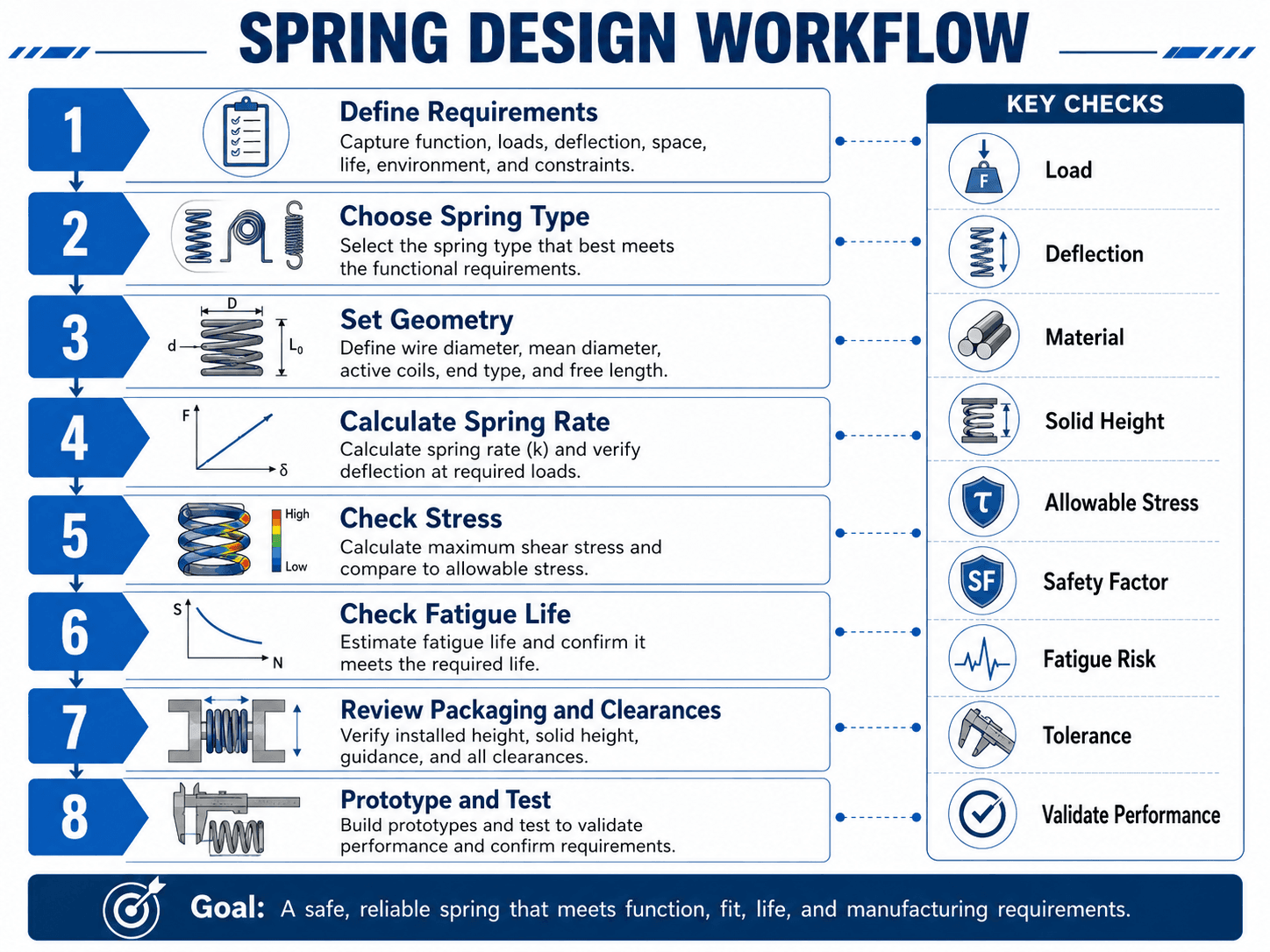
Spring Design Workflow: From Mechanism Requirement to Production Spring
A spring should be designed from the mechanism outward. Start with what the assembly needs at specific positions, not with a guessed wire diameter or catalog spring rate.
Required force or torque at defined positions, working travel, overtravel, available package space, cycle life, temperature, corrosion exposure, and mounting conditions.
Spring type, material, wire/strip size, mean diameter, active coils, free length, end geometry, preload/initial tension, and guidance or mounting details.
Rate, load at height, maximum and cyclic stress, fatigue, solid-height margin, buckling, surge/dynamics, relaxation, tolerances, assembly interference, and inspection.
-
Define the two or more operating points.
State required load or torque at actual installed and working positions. Include maximum travel and abnormal but credible overtravel.
-
Select spring type and package.
Choose compression, extension, torsion, disc, wave, flat, constant-force, or another form based on load direction, motion, space, life, and serviceability.
-
Solve geometry and rate.
Choose manufacturable geometry that produces the required load-deflection behavior while respecting OD, ID, free length, active coils, ends, and material.
-
Close strength, life, and production checks.
Verify corrected stress, fatigue, solid height, buckling, dynamic behavior, temperature, corrosion, tolerances, inspection, and prototype performance.
When the assembly function is force-based, specify the spring in terms of load at defined heights or positions in addition to geometry. That connects supplier inspection directly to what the mechanism needs and avoids relying on free length or theoretical rate alone.
Industry reference: Spring Manufacturers Institute — Handbook of Spring Design is an industry spring-design reference covering multiple spring forms, calculations, and specification practices. SMI also publishes dedicated testing and tolerancing guidance for manufactured springs.
Choose the Spring Type From the Motion and Load Path
Compression, extension, and torsion springs are common, but they solve different mechanical problems. Select the spring form from the required motion, load direction, package, fatigue demand, and mounting—not from familiarity.
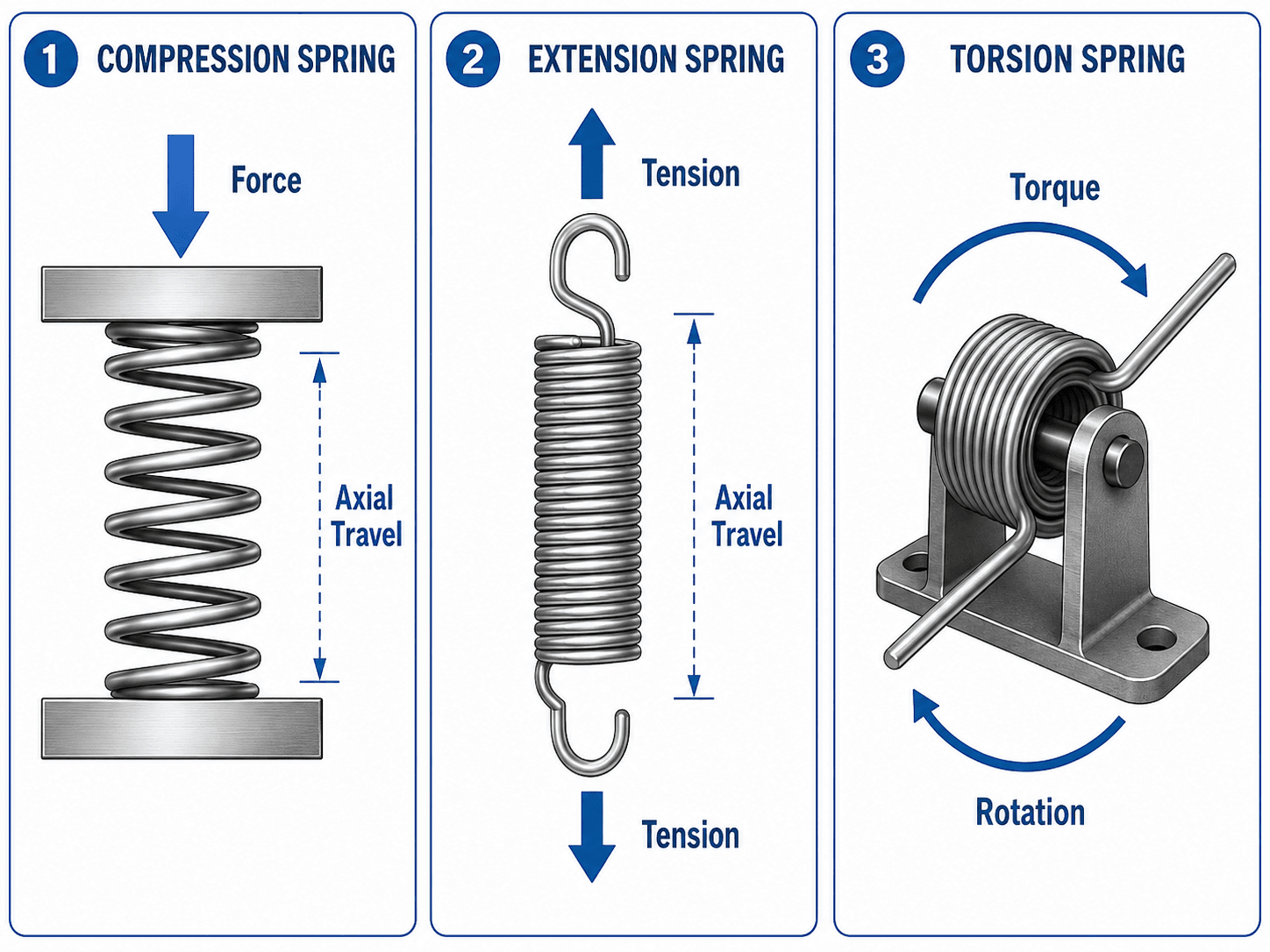
| Spring Type | Best Fit | Primary Design Variables | Critical Checks | Common Failure / Limitation |
|---|---|---|---|---|
| Compression spring | Axial push force, return motion, preload, shock absorption. | Wire diameter, mean diameter, active coils, free length, ends. | Rate, corrected shear stress, solid height, buckling, fatigue. | Coil bind, set, buckling, fatigue, seat rubbing. |
| Extension spring | Axial pull force and return tension. | Body geometry, active coils, initial tension, hook/loop geometry. | Rate, body stress, end stress, attachment, overtravel. | Hook/loop fatigue can control before coil-body stress. |
| Torsion spring | Rotary return torque around a pin/shaft. | Wire diameter, body diameter, coils, leg length/orientation, preload angle. | Torque-angle behavior, body/leg stress, mandrel clearance, fatigue. | Wrong winding direction, leg interference, body-diameter change. |
| Disc / Belleville spring | High axial load in short travel and compact axial space. | Disc geometry, thickness, cone height, stack arrangement. | Load-deflection nonlinearity, stress, stacking, seating. | Do not use helical compression equations. |
| Wave spring | Axial force where reduced solid height/axial package is important. | Wave count, turns, strip section, diameter, free height. | Load at height, stress, nesting/contact, manufacturing tolerance. | Geometry is manufacturer/process-specific. |
| Constant-force / power spring | Long stroke, retraction, near-constant output force or stored rotational energy. | Strip geometry, coil/mandrel size, working turns/travel. | Fatigue, strip stress, spool geometry, mounting. | Requires type-specific methods and supplier data. |
Swipe horizontally to view all table columns.
Compression vs. extension
If the mechanism can be arranged so the spring is compressed rather than pulled, a compression spring often avoids the highly stressed hooks or loops found on many extension springs. Extension springs remain appropriate when the geometry fundamentally requires a tensile return force.
Torsion-spring winding direction is functional
A torsion spring should be oriented so the working torque loads the spring in its intended winding direction. Mandrel clearance, body-diameter change, leg sweep, and nearby-component interference must be checked through the full angular travel.
SMI’s Other Types of Springs reference addresses specialized spring forms including flat, volute, constant-force, spiral, retaining-ring, and washer-style spring elements. Use type-specific guidance rather than applying compression-coil formulas outside their scope.
Compression Spring Geometry and Core Design Equations
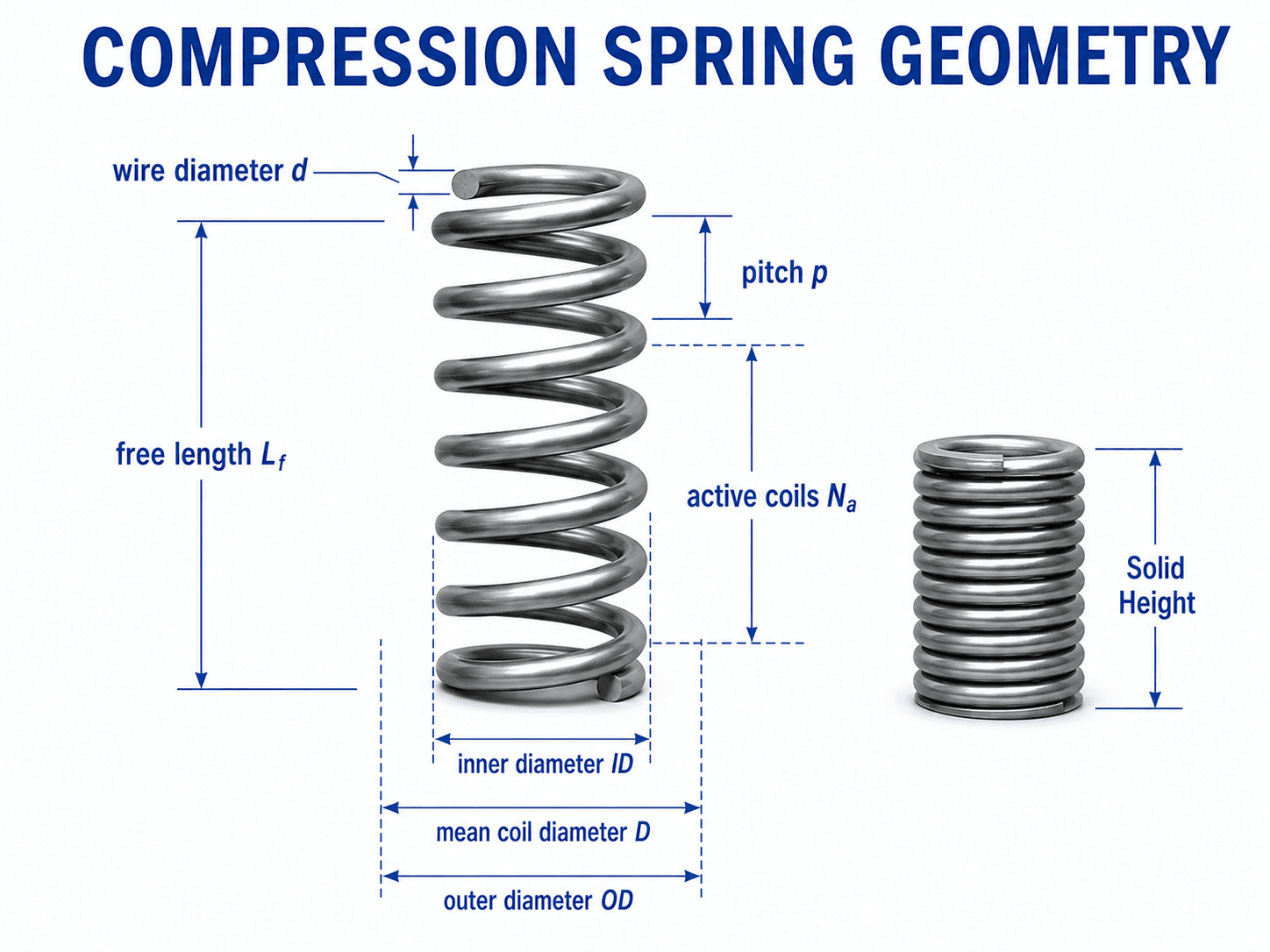
The equations in this section apply to a conventional round-wire helical compression spring in its approximately linear working region. Real production springs also require end-condition, tolerance, fatigue, stability, and supplier-specific checks.
1. Determine required rate from the mechanism
Use two actual mechanism positions rather than an arbitrary zero-load point whenever possible. This immediately captures the load range the assembly must produce.
2. Relate rate to spring geometry
- kSpring rate, e.g. N/mm or lbf/in.
- GShear modulus of the selected spring material at the applicable condition.
- dWire diameter.
- DMean coil diameter, measured to the wire centerline.
- NaNumber of active coils contributing to deflection.
The equation reveals the major sensitivities: wire diameter enters to the fourth power, mean diameter to the third power, and active coils linearly. A small wire-size change can therefore move the rate substantially.
3. Check spring index
Spring index is a geometry/manufacturability indicator. Very tight coils increase curvature and manufacturing difficulty; very open coils can create package, handling, and stability concerns. Do not treat one recommended index range as an absolute design limit—confirm feasibility with the spring supplier, especially for unusual materials, wire sizes, or end details.
4. Correct helical wire stress for curvature
The Wahl factor increases the nominal torsional stress to account for wire curvature and direct-shear effects. Historical NASA spring-testing literature describes the Wahl correction factor as correcting computed spring stress for wire curvature and shear loading, consistent with its standard mechanical-spring use.
5. Calculate deflection at load
This is the rate equation rearranged for deflection and should agree with x = F/k in the same linear model.
6. Estimate solid height carefully
This is a first-pass geometric estimate for total coil count Nt. Actual solid height depends on end style, coil geometry, manufacturing variation, and how coils nest or contact. The production value should come from the finalized spring definition or supplier drawing.
7. Check stored energy when it matters to the mechanism
Stored energy is important in latches, actuators, launch/return mechanisms, impact systems, and service safety. It also helps identify whether a spring can release enough energy to damage nearby components during assembly or disassembly.
For the basic linear force-deflection model and sign conventions, see Hooke’s Law. For quick rate calculations from known force and deflection, use the Spring Constant Calculator.
Formula context: NASA spring testing literature documents use of the Wahl correction for helical compression spring stress. Final spring design should use current spring-industry guidance and verified material/supplier data for the specific wire, ends, manufacturing process, and application.
Stress, Fatigue, Solid Height, Buckling, and Dynamic Checks
A spring with the correct rate is not finished. The maximum position, minimum position, cycle range, package constraint, and environmental condition determine whether the spring survives.
Maximum stress and permanent set
Evaluate corrected working stress at the maximum credible load, including tolerances and overtravel. Compare the result with an allowable appropriate to the selected material, wire size, heat treatment, finish, preset/scragging condition, temperature, and application. Do not use a universal fraction of tensile strength across every spring material and fatigue condition.
Fatigue: use mean and alternating stress
When a spring cycles between two loads, calculate the corresponding corrected stresses and separate them into mean and alternating components:
Use these with validated spring-fatigue data or a recognized spring-industry design method for the exact material, surface condition, processing, and required life. Shot peening, residual stress, presetting, corrosion, wire quality, and end geometry can materially change fatigue performance.
Do not use coil bind as the mechanism stop
The maximum operating height should remain above actual solid height with deliberate margin for dimensional tolerance, load/rate variation, wear, thermal change, and abnormal overtravel. Repeatedly driving a compression spring hard into solid can generate very high local stress and permanent set even when the normal operating point looks acceptable.
Long compression springs can buckle
Buckling depends on free length, mean diameter, end support, guidance, loading alignment, and spring geometry. A long slender spring may require a guide rod, guide tube, larger diameter, shorter free length, or another architecture. Avoid publishing one universal free-length-to-diameter cutoff because end conditions and spring geometry change stability.
High-speed cyclic systems need surge and resonance checks
Valve springs, reciprocating mechanisms, high-speed actuators, and rapidly cycled springs can experience dynamic wave effects and resonance. A static rate/stress calculation cannot prove dynamic stability. Evaluate natural frequency/surge using the appropriate spring model, expected excitation frequency, mass, damping, and supplier test data.
Temperature and time can reduce spring load
Stress relaxation can reduce force while a spring is held at deflection, especially at elevated temperature or high stress. If retained load is critical over long dwell periods, choose material and stress level using temperature/time-dependent spring data and include load-loss acceptance criteria in validation.
The coil-body equations above do not prove extension hooks or torsion legs. Ends often see different bending and local stress states and can become the fatigue-critical region even when the spring body has acceptable stress.
For broader fatigue, mean/alternating stress, stress concentration, and FEA interpretation, use the Turn2Engineering Stress Analysis guide.
Spring Materials, Environment, Manufacturability, and Tolerances
Material and manufacturing process determine more than strength. They control corrosion resistance, relaxation, fatigue, available wire sizes, coiling feasibility, heat treatment, surface condition, cost, and repeatability.
| Material Family | Common Selection Reason | Watch For | Verify Before Release |
|---|---|---|---|
| Music wire / high-carbon spring wire | High strength, broad use, cost-effective general mechanical springs. | Corrosion and elevated-temperature limits. | Wire specification, diameter-dependent properties, finish/coating, environment. |
| Stainless spring wire | Corrosion resistance and clean/wet service. | Strength, relaxation, galling/contact conditions, and temperature depend on alloy/temper. | Exact alloy, spring temper, surface condition, passivation/coating if applicable. |
| Chrome-silicon / alloy spring steel | High stress, shock, fatigue, and elevated-temperature applications depending on grade/process. | Cost, processing, availability, heat treatment, finish. | Exact material specification and spring supplier process. |
| Copper alloys | Electrical conductivity, corrosion resistance, nonmagnetic requirements. | Lower strength/stiffness than many steel spring grades and higher material cost. | Exact alloy/temper, conductivity requirement, fatigue/corrosion condition. |
| Nickel-base / specialty alloys | High-temperature or highly corrosive environments. | Cost, availability, specialized processing, different relaxation behavior. | Temperature-dependent properties, supplier capability, qualification requirements. |
Swipe horizontally to view all table columns.
Tolerance the functional outputs first
Every geometric spring dimension varies in production. Rather than applying unnecessarily tight limits everywhere, identify which characteristics actually control the mechanism: load at height, torque at angle, free length, OD/ID, solid height, squareness, hook orientation, torsion-leg angle, or another interface.
Load-at-height testing directly checks function
If a compression spring must create a particular force at an installed height and another force at a working height, those load points are often stronger acceptance criteria than theoretical rate alone. The drawing can still control geometry needed for fit and manufacturing.
Design around standard wire and supplier capability
A tiny theoretical change in wire diameter can have a large effect on rate because d appears to the fourth power. But spring wire is manufactured in available sizes and tolerances. Use real supplier material sizes early and iterate geometry around manufacturable stock rather than finishing the analytical design with an impractical custom diameter.
The mechanism’s tolerance stack changes installed spring load
Variation in spring seats, spacers, housings, stops, retainers, and free length changes installed deflection and therefore load. Use Tolerance Stack Up Analysis when the mechanism’s height variation is large enough to affect force, coil-bind margin, or preload.
For process selection, supplier capability, inspection, and manufacturability checks, use Design for Manufacturing.
Testing/tolerancing reference: Spring Manufacturers Institute — Testing and Tolerancing is dedicated to spring testing procedures and tolerance guidance in U.S. customary and metric units.
Worked Compression Spring Design Example
Preliminary plunger-return spring
A plunger mechanism requires 20 N at the installed position and 50 N after an additional 15 mm of compression. The available spring outside diameter must remain below 25 mm. For an instructional preliminary design, assume round wire with shear modulus G = 79,000 N/mm², select d = 2.00 mm and mean diameter D = 20.0 mm, and then calculate the active coils and stress. Material strength and fatigue limits are intentionally not assumed; they must be verified from the final material/supplier data.
Calculate required spring rate
The two required operating points define the mechanism stiffness.
Solve for the required active coils
Use the selected wire and mean diameter to determine the active coil count needed for the target rate.
Check spring index and maximum corrected stress
Geometry must be practical and the maximum-load stress must be quantified before choosing material/allowable.
Check installed deflection and package geometry
The rate determines how far the spring is compressed at each required load and therefore how much free-length/solid-height margin is needed.
The specified load change is 30 N over 15 mm, exactly 2.00 N/mm.
Nominal OD is 22 mm; actual drawing tolerance and guide/housing clearance must still be included.
Select an actual material/wire size and end style with the spring supplier, then recalculate rate/stress and verify fatigue, solid-height margin, and load at height.
How to Specify, Inspect, and Validate a Production Spring
A production spring drawing should control the characteristics that determine function and assembly, while leaving noncritical manufacturing details flexible enough for a qualified spring supplier to produce consistently.
| Specification Item | What to State | Why It Matters | Typical Verification |
|---|---|---|---|
| Spring form | Compression/extension/torsion/etc.; hand of wind where functional. | Defines the correct spring architecture and installation direction. | Visual/dimensional inspection. |
| Material | Exact material specification, temper/condition where applicable, finish/coating. | Controls strength, fatigue, corrosion, relaxation, and procurement. | Certification + supplier process control. |
| Functional load points | Required force at one or more defined heights, or torque at defined angles. | Directly verifies mechanism behavior. | Load tester at specified position. |
| Package geometry | OD/ID, free length, body length, leg/hook geometry as required. | Prevents interference and controls assembly. | Dimensional inspection/gauging. |
| Ends | Open/closed/ground, hook/loop form, torsion leg angle and orientation. | Controls seating, force direction, local stress, and installation. | Visual/profile/fixture inspection. |
| Solid-height / max travel constraint | Required minimum clearance or maximum compressed geometry where critical. | Protects against coil bind and overtravel. | Dimensional or functional compression test. |
| Fatigue / cycle requirement | Required cycles, load/height endpoints, temperature/environment. | Defines the actual life test rather than vague “high cycle” language. | Qualification or sample cycle testing. |
| Load retention | Allowed load loss after dwell, temperature exposure, or cycling where relevant. | Captures relaxation/set that geometry alone cannot show. | Pre/post conditioning load test. |
Swipe horizontally to view all table columns.
Do not over-constrain geometry and function simultaneously
If load at height is the true functional requirement, excessively tight simultaneous tolerances on wire diameter, coil diameter, active coils, free length, and rate can leave the supplier very little process freedom while adding no product value. Coordinate tolerances so they protect assembly and function without contradictory requirements.
Prototype at the real mechanism endpoints
Prototype testing should reproduce installed height, maximum travel, loading rate where relevant, guidance/seat conditions, temperature, and cycle duty. A bench force test alone may miss buckling, rubbing, resonance, end rotation, interference, and relaxation that occur in the actual product.
SMI’s Testing and Tolerancing publication specifically addresses spring testing procedures and tolerance guidelines, making testing/tolerance closure part of spring design rather than an afterthought.
Senior Engineer Spring Design Review Checklist
Use this final review before approving a custom spring or selecting a catalog part for production. A “no” answer should become a specific design, supplier, or test action.
- The spring function is explicit: Return, preload, contact, energy storage, vibration isolation, shock absorption, torque, or another purpose is defined.
- Required load/torque is defined at actual positions: Installed, minimum-working, maximum-working, and credible overtravel conditions are known.
- Spring type matches the motion: Compression, extension, torsion, disc, wave, flat, constant-force, or another form is selected for a functional reason.
- Package envelope includes tolerances: OD, ID, free length, body length, hooks/legs, guide/mandrel, and neighboring parts have clearance at production limits.
- The material is application-specific: Strength, fatigue, corrosion, temperature, magnetic/electrical needs, relaxation, coating, and procurement condition are verified.
- Selected geometry uses manufacturable stock: Wire/strip sizes, coil diameter, spring index, ends, and process are realistic for a qualified supplier.
- Rate is verified from actual geometry: Final active coil count and material modulus produce the specified load-deflection behavior.
- Maximum corrected stress is calculated: Curvature/direct-shear correction and maximum credible load are included for helical compression springs.
- Static allowable has a source: Pass/fail is based on actual material/process/supplier design data rather than a generic percentage copied from another spring.
- Fatigue is checked when cyclic: Minimum and maximum corrected stresses, mean/alternating stress, required cycles, surface treatment, corrosion, and critical ends are considered.
- Extension hooks or torsion legs are reviewed separately: Local end geometry is not assumed to have the same stress as the coil body.
- Solid-height margin is deliberate: Maximum working compression plus tolerances/overtravel does not use coil bind as the normal travel stop.
- Buckling is addressed: Long compression springs are proportioned, seated, or guided to prevent unstable lateral deflection.
- Dynamic/surge risk is checked: High-speed cyclic or reciprocating mechanisms are evaluated beyond static Hooke’s-law behavior.
- Temperature relaxation is addressed: Long dwell/high-temperature service has a retained-load requirement and suitable material data where necessary.
- Assembly tolerance stack is checked: Seat heights, retainers, spacers, stops, housing dimensions, and spring free/load tolerances produce acceptable force and travel.
- Seat, guide, and mandrel interfaces are sound: No damaging rubbing, point loading, sharp edges, or interference occurs through full motion.
- Spring ends transfer load correctly: Ground/closed ends, hooks, loops, or legs seat and move as intended without local interference.
- Drawing emphasizes functional acceptance: Load at height/torque at angle and critical geometry are measurable and not contradicted by unnecessary tolerances.
- Prototype validation represents field service: Real positions, temperature, cycles, guidance, environment, and load-retention behavior are tested where risk warrants it.
Do not release a critical spring when only rate has been calculated, material allowable/fatigue limits have no verified basis, maximum travel approaches solid height without controlled margin, the spring can buckle or interfere in the real assembly, or the drawing cannot be inspected against the functional load requirement.
For the larger mechanical-development sequence—requirements, analysis, CAD, tolerances, manufacturability, prototyping, and verification—continue with the Mechanical Design Process.
Spring Design Engineering References
Spring design combines mechanics, fatigue, material/process behavior, manufactured tolerances, and application testing. Final limits should be verified using current material specifications, spring-industry methods, and supplier data for the actual spring form and production process.
- Spring Manufacturers Institute — Handbook of Spring Design Industry reference for spring design and specification across common spring forms.
- Spring Manufacturers Institute — Testing and Tolerancing Dedicated spring testing and tolerance guidance in U.S. customary and metric units.
- Spring Manufacturers Institute — Other Types of Springs Design/specification reference covering specialized spring forms including flat, volute, constant-force, spiral, and spring-washer products.
- NASA — Long-Time Loading of Compression Springs Historical technical source documenting use of the Wahl correction factor for helical compression spring stress and discussing spring loading behavior. Used here only for established mechanics context, not current material allowable values.
Frequently Asked Questions
What information do I need to design a spring?
Define the required force or torque at actual operating positions, travel/rotation, package envelope, cycle life, temperature, corrosion/environment, mounting/guidance, and allowable production variation. Those inputs should exist before choosing final spring geometry.
What is the compression spring rate formula?
For a conventional round-wire helical compression spring in its approximately linear range, k = Gd⁴/(8D³Na), where G is shear modulus, d is wire diameter, D is mean coil diameter, and Na is active coils. Final design still requires stress, fatigue, solid-height, buckling, ends, tolerances, and material checks.
What is the Wahl factor?
The Wahl factor is a correction applied to helical-spring shear stress to account for wire curvature and direct-shear effects. It depends on spring index C = D/d and increases the nominal torsional stress to better represent the maximum wire stress.
How do I keep a compression spring from buckling?
Reduce slenderness, improve end seating/alignment, increase spring diameter where feasible, shorten free length, or guide the spring with an appropriate rod or tube. The acceptable geometry depends on end conditions and spring design, so use the supplier or recognized spring-design stability method instead of one universal length-to-diameter limit.
Should I specify spring rate or load at height?
Use whichever characteristics directly protect function, and often both. For many production mechanisms, load at one or more specified heights is especially useful because it directly verifies the installed force the assembly will receive. Geometry and rate can then support package, inspection, and design control.