
Key Takeaways
- Core idea: Coagulation is the chemical step that destabilizes fine particles and colloids so they can begin forming removable floc.
- Engineering use: It improves turbidity removal and protects downstream clarification, filtration, and disinfection performance.
- What controls it: Coagulant type, dose, pH, alkalinity, temperature, raw water turbidity, natural organic matter, and mixing energy all affect performance.
- Practical check: More coagulant is not always better; overdosing can restabilize particles, increase sludge, and reduce settled water clarity.
Table of Contents
Introduction
Coagulation in water treatment is the chemical process of adding coagulants to raw water so tiny suspended particles, colloids, and color-causing material lose their stability and begin forming removable floc. It is usually followed by flocculation, sedimentation or clarification, filtration, and disinfection, making it one of the most important early steps in conventional water treatment.
Coagulation Process Diagram
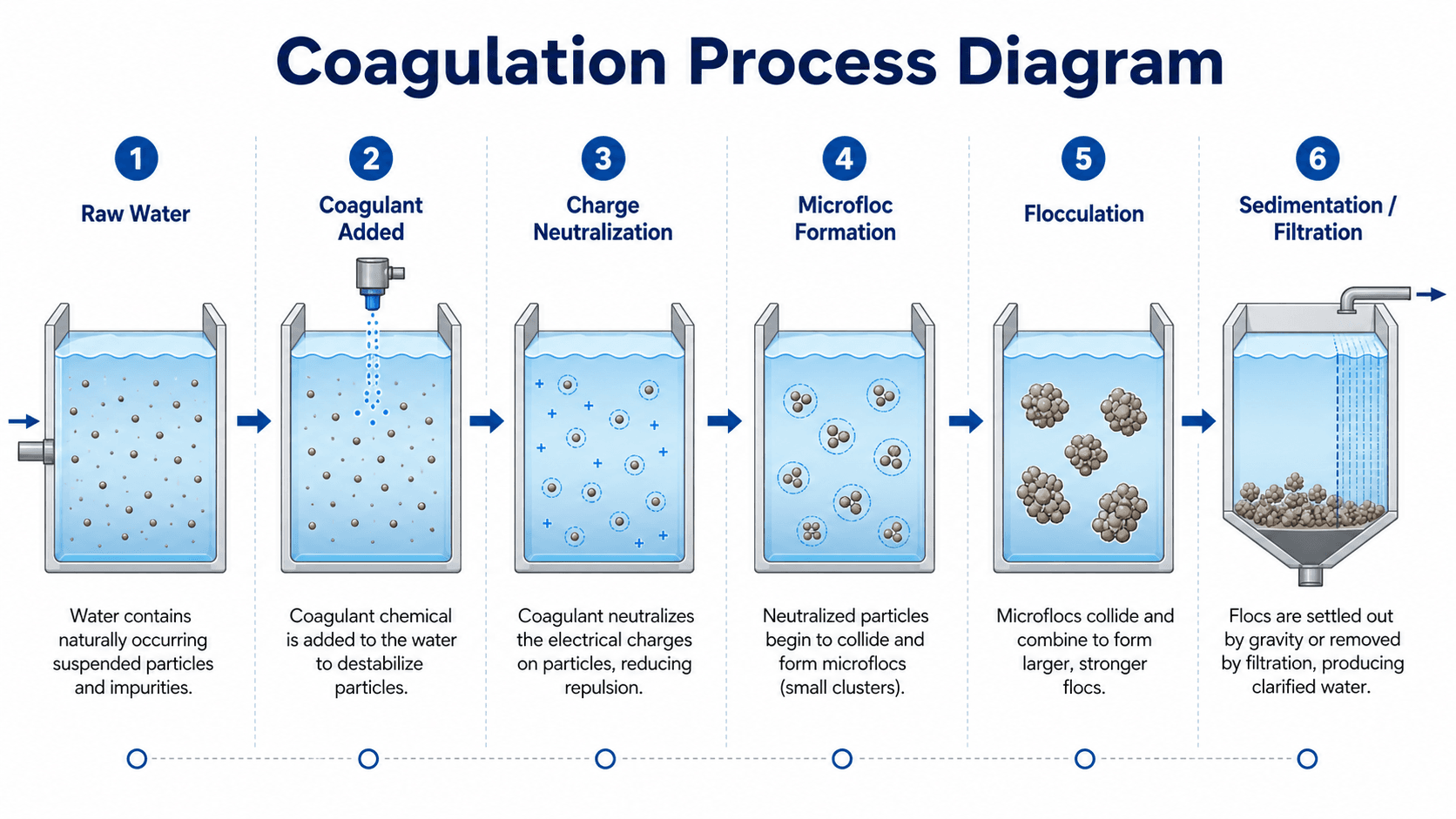
The most important idea in the diagram is that coagulation does not simply “make dirt settle.” It changes particle behavior so later processes can remove particles that would otherwise stay suspended.
What Is Coagulation in Water Treatment?
Coagulation is the chemical destabilization step used to treat water that contains fine suspended solids, colloids, color, algae, clay, silt, and natural organic matter. Many of these particles are too small to settle efficiently on their own. Some also carry surface charges that keep them separated from one another in the water column.
A coagulant such as aluminum sulfate, ferric chloride, ferric sulfate, or polyaluminum chloride is added during rapid mixing. The coagulant helps neutralize particle charges, compress the repulsive electrical layer around particles, and create conditions where particles can collide and begin forming microfloc.
The goal of coagulation is not only clear-looking water. The real engineering objective is to condition fine particles so clarification and filtration can consistently meet turbidity and particle removal goals under changing source water conditions.
How Coagulation Works
Coagulation works by changing the chemistry around suspended particles. In raw surface water, fine particles can remain dispersed because their surface charges repel one another. When the correct coagulant is rapidly mixed into the water, metal salts or pre-hydrolyzed coagulant species interact with those particles and reduce the repulsion that keeps them apart.
Rapid Mixing Disperses the Coagulant
The coagulant must contact particles quickly and evenly. Rapid mixing provides high-energy turbulence for a short time so the chemical can disperse through the water before reactions become uneven. Poor rapid mixing can create zones of underdosing and overdosing within the same basin.
Particle Destabilization Creates Microfloc
Once particle repulsion is reduced, small clusters begin to form. These early clusters are often called microfloc. They are not always large enough to settle efficiently yet, which is why coagulation is normally followed by slower flocculation mixing.
Flocculation Builds Larger Floc
Flocculation gently mixes the destabilized particles so they collide, attach, and grow into larger floc. Those larger floc particles can then be settled in a basin, removed in a clarifier, captured by filters, or treated by another downstream separation process.
Coagulation vs Flocculation
Coagulation and flocculation are often discussed together, but they are not the same process. Coagulation is mainly chemical. Flocculation is mainly physical. A treatment plant usually needs both because chemical destabilization must happen before particles can grow into strong, settleable floc.
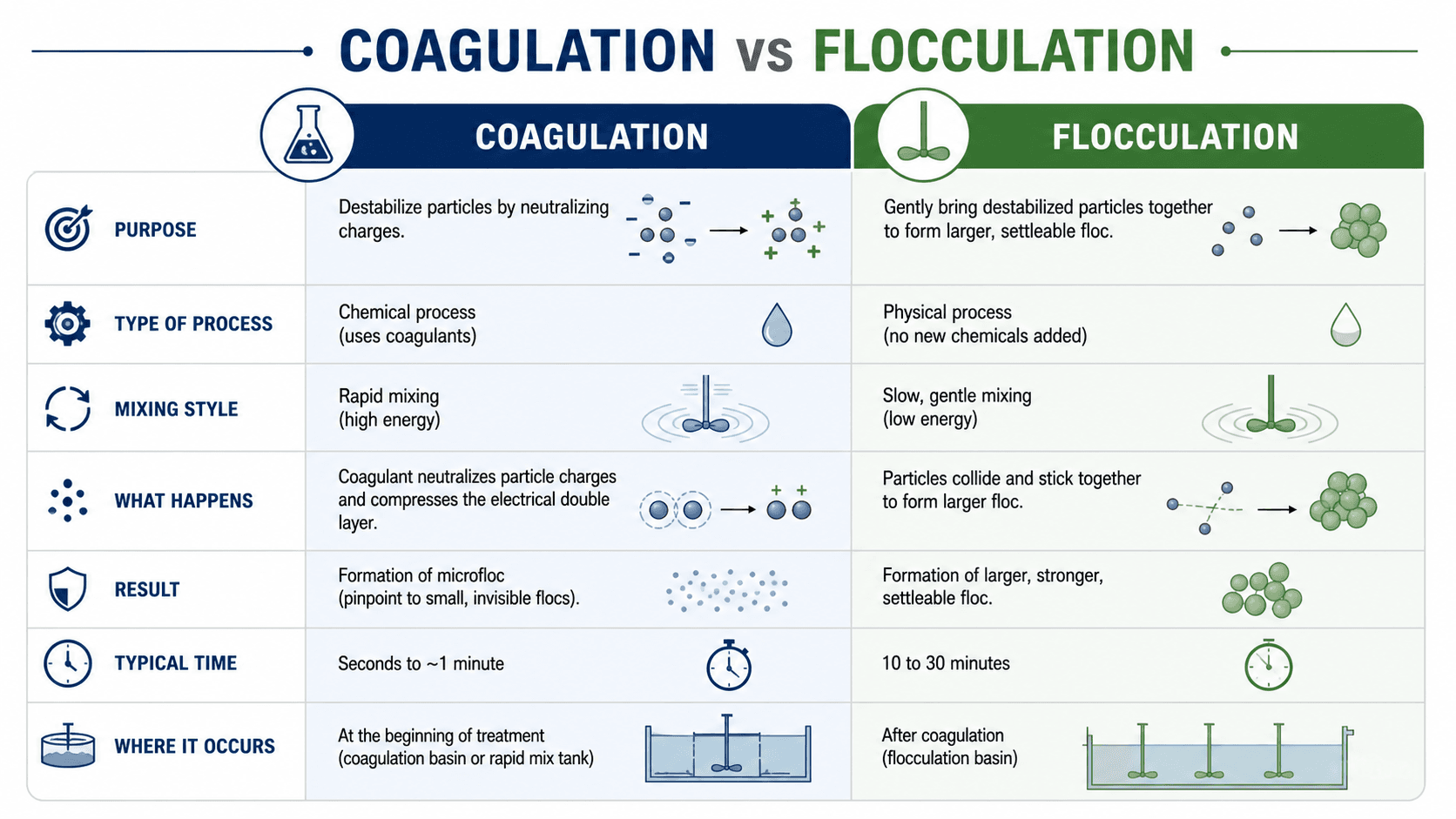
| Feature | Coagulation | Flocculation |
|---|---|---|
| Main purpose | Destabilize fine particles and colloids. | Grow destabilized particles into larger floc. |
| Process type | Chemical treatment step. | Physical mixing step. |
| Mixing style | Rapid, high-energy mixing for short contact time. | Slow, gentle mixing for longer contact time. |
| Typical result | Microfloc or destabilized particles. | Larger floc that can settle or be filtered. |
| Common basin | Rapid mix chamber or coagulation basin. | Flocculation basin or slow mix zone. |
Why Coagulation Is Needed
Raw water from rivers, reservoirs, lakes, and some reuse sources can contain particles that are difficult to remove by gravity alone. Coagulation turns a difficult particle removal problem into a treatment train problem: first destabilize the particles, then grow them, settle them, filter them, and disinfect the water.
- Turbidity control: Coagulation helps remove fine suspended solids that make water cloudy and can overload filters.
- Color and organic matter reduction: Some natural organic matter and color-causing compounds are better removed after chemical destabilization.
- Filter protection: Good coagulation reduces solids loading to filters and can extend filter run time.
- Disinfection support: Lower turbidity and better particle removal help downstream disinfection work more reliably.
Coagulation demand can change quickly after storms, algae blooms, seasonal turnover, wildfire runoff, or construction-related sediment pulses. A dose that worked yesterday may not produce the same settled water quality today.
Where Coagulation Fits in the Water Treatment Process
In a conventional treatment plant, coagulation usually occurs near the beginning of treatment after intake, screening, and sometimes presedimentation or chemical pre-treatment. The purpose is to prepare the water for flocculation and downstream solids separation.
Raw water intake → screening → rapid mix coagulation → flocculation → sedimentation or clarification → filtration → disinfection → finished water distribution.
This sequence is important because coagulation alone does not complete the treatment objective. It conditions particles so the following steps can remove them more effectively. For a broader overview of treatment sequencing, see water treatment processes.
Common Coagulants Used in Water Treatment
The best coagulant depends on source water chemistry, treatment goals, plant hydraulics, residuals handling, cost, chemical availability, and downstream requirements. Operators often compare coagulants through jar testing and plant-scale performance monitoring.
| Coagulant | Common role | Engineering notes |
|---|---|---|
| Aluminum sulfate, alum | Common coagulant for surface water treatment. | Often effective, but performance is sensitive to pH and alkalinity. |
| Ferric chloride | Iron salt used for turbidity, color, and organic matter control. | Can perform well over a range of conditions, but may affect pH and corrosion considerations. |
| Ferric sulfate | Iron-based coagulant for clarification applications. | Useful where ferric chemistry gives better floc formation or color removal. |
| Polyaluminum chloride, PACl | Pre-hydrolyzed aluminum coagulant. | May work at lower doses or with less alkalinity impact in some waters. |
| Polymers | Coagulant aid or floc aid. | Can improve floc strength, but overdosing may create sticky, weak, or difficult-to-handle sludge. |
Coagulation is one part of broader chemical treatment, but it should be controlled as a particle removal process, not simply as a fixed chemical feed rate.
Key Factors That Control Coagulation Performance
Coagulation performance depends on both chemistry and hydraulics. The same coagulant can perform very differently if pH, alkalinity, temperature, mixing, or raw water quality changes.
| Factor | Why it matters | Engineering implication |
|---|---|---|
| pH | Controls coagulant species, solubility, and metal hydroxide formation. | The optimum dose may fail if pH is outside the effective range for the selected coagulant. |
| Alkalinity | Buffers pH and can be consumed by metal salt coagulants. | Low alkalinity water may need pH or alkalinity adjustment for stable treatment. |
| Turbidity | Indicates the amount of suspended material that needs destabilization and removal. | Storm events or sediment pulses can require dose adjustments and closer jar testing. |
| Natural organic matter | Can increase coagulant demand and affect color, taste, odor, and disinfection byproduct precursors. | Enhanced coagulation may be considered when organic matter removal is a major goal. |
| Temperature | Cold water slows reactions, reduces collision efficiency, and can produce weaker floc. | Winter operation may need different dose, pH, or mixing settings than summer operation. |
| Rapid mix energy | Determines how evenly the coagulant disperses before reactions progress. | Poor mixing can create inconsistent floc even when the chemical dose appears correct. |
Jar Testing for Coagulant Dose Optimization
Jar testing is a bench-scale method used to compare coagulant doses before making full-scale process changes. Several beakers are filled with the same raw water, treated with different chemical doses, rapidly mixed, slowly mixed, allowed to settle, and then compared for clarity, floc quality, and turbidity.
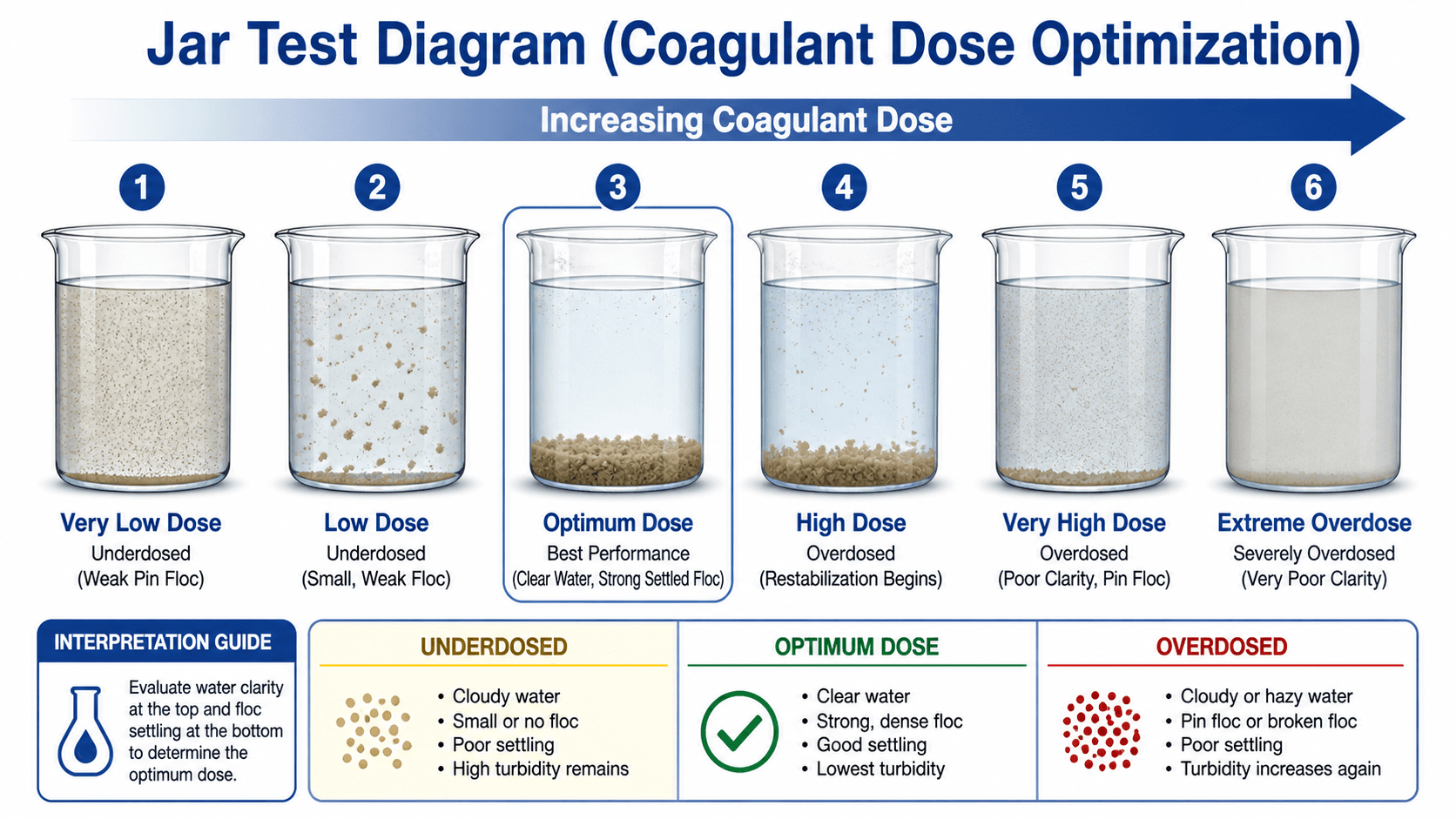
| Jar test result | What it looks like | Likely interpretation |
|---|---|---|
| Underdosed | Cloudy water, weak pin floc, little settling. | Particles remain stable because there is not enough coagulant. |
| Near optimum | Clear supernatant, strong settled floc, low turbidity. | Particles are destabilized and floc is forming effectively. |
| Overdosed | Hazy water, broken floc, poor settling, or turbidity increase. | Excess chemical may restabilize particles or produce weak floc. |
Coagulation Troubleshooting Workflow
When settled water turbidity rises or filter performance declines, the problem is not always the filter. Coagulation should be checked first because weak particle destabilization can send excess solids into every downstream unit process.
Check raw water change → confirm chemical feed and rapid mix → review pH and alkalinity → run jar test → compare floc strength and settled turbidity → adjust dose or pH → verify settled water and filter response.
| Check or decision | What to look for | Why it matters |
|---|---|---|
| Raw water trend | Recent storm, algae bloom, color increase, turbidity spike, or temperature change. | Changing source water can change chemical demand faster than normal operating settings respond. |
| Feed system verification | Pump calibration, chemical strength, feed line plugging, empty tanks, or incorrect setpoint. | A chemical dose shown on a screen may not match the actual dose reaching the rapid mix zone. |
| pH and alkalinity | pH drift, low buffering capacity, or excessive pH depression after coagulant addition. | Coagulant chemistry depends on pH; a good dose can fail under poor pH conditions. |
| Floc appearance | Pin floc, slow-forming floc, broken floc, floating floc, or floc carryover. | Floc structure gives early evidence of underdosing, overdosing, poor mixing, or weak coagulation chemistry. |
| Filter response | Short filter runs, early breakthrough, rapid headloss, or frequent backwashing. | Filters often reveal upstream coagulation problems before finished water quality becomes unacceptable. |
Why pH and Alkalinity Matter
pH and alkalinity control the chemical environment where coagulation happens. Metal salt coagulants form different dissolved and precipitated species depending on pH. If the pH is not compatible with the coagulant, particles may not destabilize well and the resulting floc may be weak or slow to settle.
Alkalinity matters because it buffers the water against pH changes. When coagulants consume alkalinity, low-alkalinity waters can experience a large pH drop. That pH shift can reduce performance, increase corrosivity concerns, or require chemical adjustment before or during coagulation.
If jar tests show a narrow optimum dose range or inconsistent floc, do not adjust dose alone. Check whether pH and alkalinity are moving outside the stable operating window for the selected coagulant.
What Coagulation Helps Remove
Coagulation is most useful for contaminants or water quality problems associated with particles, colloids, or material that can be converted into removable floc. It does not remove everything by itself, but it can make downstream removal much more effective.
- Turbidity: fine clay, silt, and suspended solids that scatter light.
- Colloids: small particles that resist gravity settling because of size and surface charge.
- Color and natural organic matter: some organic material can be captured through optimized coagulation.
- Algae and particle-associated microorganisms: cells and organisms attached to particles may be removed more effectively after floc formation.
- Some metals: removal may improve when metals adsorb to floc or precipitate under the right chemistry.
The key limitation is that coagulation prepares material for removal. Sedimentation, clarification, filtration, and disinfection still determine whether the finished water meets the treatment objective.
Engineering Judgment and Field Reality
Coagulation diagrams are clean and sequential, but full-scale treatment plants are dynamic. Operators and engineers must respond to changing raw water quality, hydraulic loading, basin short-circuiting, chemical storage conditions, sludge handling limits, and filter performance trends.
Good coagulation control is usually based on a combination of jar testing, online turbidity trends, visual floc observation, settled water monitoring, chemical feed verification, and filter performance. A single measurement rarely tells the whole story.
The “best” coagulant dose is not always the dose that produces the biggest floc in a jar. It is the dose that produces stable settled water quality, manageable sludge, acceptable residuals, reliable filter runs, and consistent downstream performance.
When This Breaks Down
Coagulation breaks down when the simplified assumption of stable raw water and ideal mixing no longer applies. In practice, changes in source water chemistry, plant hydraulics, and chemical feed accuracy can all reduce performance.
- Sudden raw water changes: storm runoff, reservoir turnover, algae blooms, or wildfire ash can change turbidity and organic matter quickly.
- Poor rapid mixing: coagulant may not disperse evenly, creating inconsistent destabilization across the flow stream.
- Wrong pH window: coagulant reactions may not form strong floc if pH and alkalinity are not controlled.
- Overdosing: too much coagulant can restabilize particles, waste chemicals, increase sludge, or leave undesirable residuals.
- Downstream hydraulic stress: even good floc can break apart if flocculation, clarification, or filtration hydraulics are too aggressive.
Common Mistakes and Practical Checks
The most common mistake is treating coagulation as a fixed chemical dose instead of a controlled process. Coagulation performance should be judged by raw water conditions, floc behavior, settled water turbidity, filter performance, residuals, and the overall treatment goal.
- Confusing coagulation with flocculation: coagulation destabilizes particles; flocculation grows them.
- Assuming higher dose always improves clarity: overdosing can reduce performance and increase sludge production.
- Ignoring alkalinity: low alkalinity can allow pH to shift enough to weaken treatment.
- Only looking at finished water: settled water and filter trends often reveal coagulation problems earlier.
- Skipping jar tests after source water changes: storm events and seasonal changes can make the old dose unreliable.
Do not judge coagulation only by how large the floc looks. Strong treatment performance depends on settled water clarity, filterability, chemical residuals, sludge handling, and consistency over changing flow and source water conditions.
Useful References and Design Context
Coagulation design and operation should be informed by water quality monitoring, jar testing, treatment objectives, plant hydraulics, regulatory requirements, and operator experience. Public guidance documents are useful for understanding how coagulation fits into broader surface water treatment requirements.
- U.S. Environmental Protection Agency: Surface Water Treatment Rule turbidity guidance manual explains turbidity monitoring and describes conventional filtration as a treatment sequence that includes coagulation, flocculation, sedimentation, and filtration for substantial particulate removal.
- Project-specific criteria: Final coagulant selection, dose control, residual limits, sludge handling, and monitoring requirements depend on utility standards, permit requirements, raw water quality, and treatment plant configuration.
- Engineering use: Engineers use jar tests, pilot tests, plant data, and turbidity trends to connect coagulant chemistry to reliable clarification, filtration, and finished water performance.
Frequently Asked Questions
Coagulation in water treatment is the chemical step where a coagulant is rapidly mixed into raw water to destabilize fine particles, colloids, and color-causing material. Once destabilized, those particles can form microfloc and be removed more effectively by flocculation, sedimentation, clarification, and filtration.
Coagulation is mainly the chemical destabilization step, while flocculation is the physical mixing step that helps destabilized particles collide and grow into larger floc. Coagulation usually needs rapid mixing, while flocculation uses slower, gentler mixing.
Common coagulants include aluminum sulfate, ferric chloride, ferric sulfate, and polyaluminum chloride. Polymers may also be used as coagulant aids or floc aids, but the best choice depends on raw water quality, pH, alkalinity, temperature, turbidity, and plant performance goals.
A jar test is used to compare different coagulant doses on a sample of raw water. Operators and engineers look at floc formation, settled water clarity, turbidity, and signs of underdosing or overdosing before adjusting full-scale chemical feed rates.
Summary and Next Steps
Coagulation in water treatment is the chemical destabilization step that makes fine particles, colloids, color-causing material, and some particle-associated contaminants easier to remove. It is most effective when paired with proper rapid mixing, flocculation, sedimentation or clarification, filtration, and disinfection.
The most important operating controls are coagulant dose, pH, alkalinity, raw water quality, temperature, and mixing energy. In real treatment plants, good coagulation control depends on jar testing, plant monitoring, floc observation, and field judgment rather than a fixed chemical dose.
Where to go next
Continue your learning path with related Turn2Engineering resources.
-
Water Treatment Processes
See how coagulation fits into the larger treatment train from raw water intake to finished water.
-
Flocculation and Coagulation
Compare the paired chemical and physical steps used to remove suspended solids and impurities.
-
Chemical Treatment
Learn how chemical addition supports pH adjustment, disinfection, contaminant removal, and water quality control.