
Key Takeaways
- Definition: Moment of inertia measures how area or mass is distributed relative to an axis, with farther material contributing more strongly.
- Main use: Area moment of inertia is used for beam bending and deflection; mass moment of inertia is used for rotational dynamics.
- Watch for: The most common mistake is mixing area moment units, such as \(m^4\), with mass moment units, such as \(kg \cdot m^2\).
- Outcome: After reading, you should be able to choose the correct form, define the axis, calculate a basic value, and check the result.
Table of Contents
How moment of inertia changes with axis and material distribution
Moment of inertia measures how strongly area or mass is spread away from an axis, controlling bending stiffness or rotational resistance.
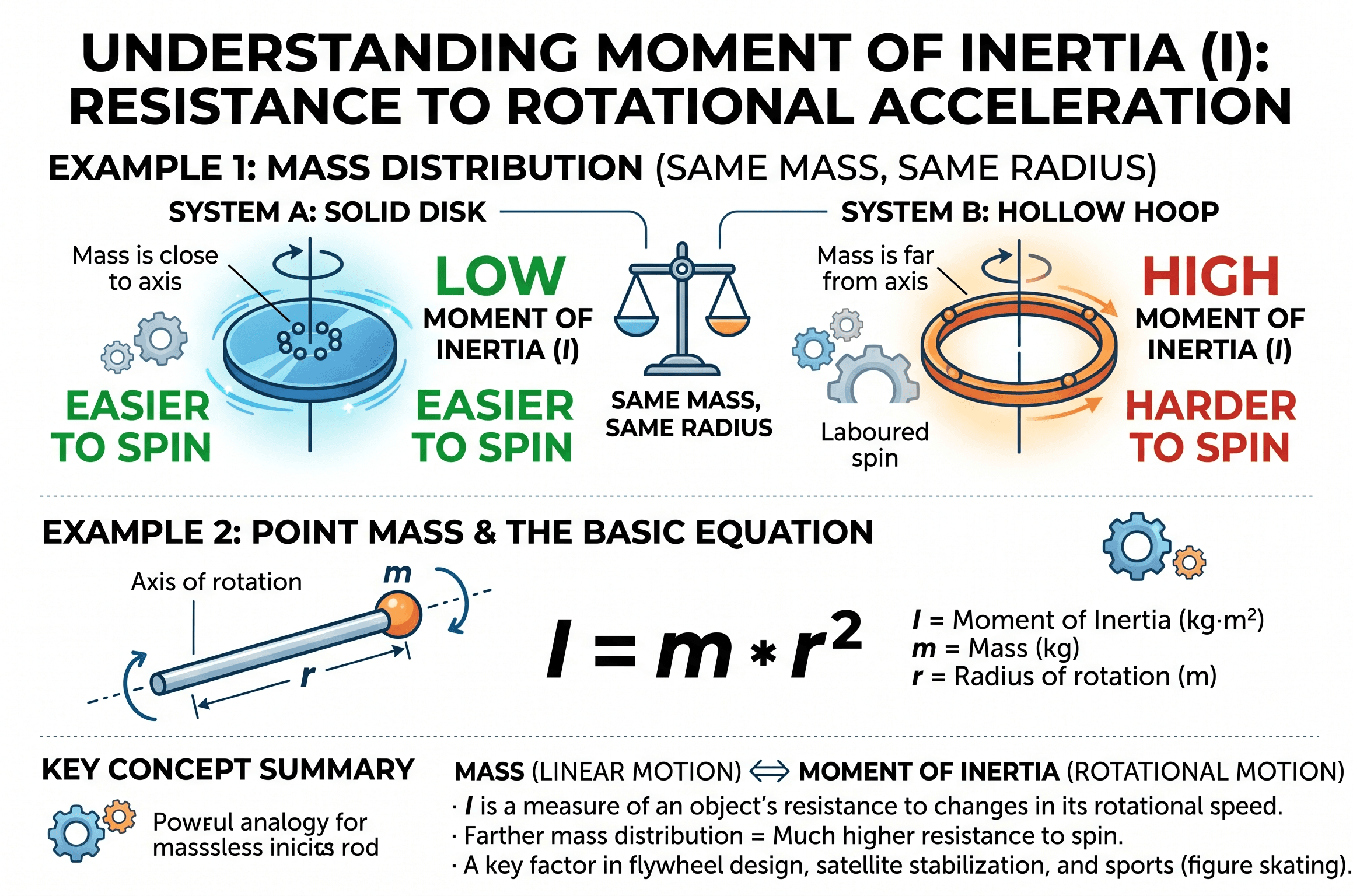
Notice the axis first. Moment of inertia is not a property of a shape or object by itself; it is a property about a specific axis. Moving the same area or mass farther from that axis increases the result because the distance term is squared.
What is moment of inertia?
Moment of inertia is a measure of distribution about an axis. In engineering, the phrase is used in two closely related ways: area moment of inertia for cross-sectional resistance to bending, and mass moment of inertia for resistance to angular acceleration.
The shared idea is simple: material farther from the axis matters more. A small amount of area far from a beam’s neutral axis can greatly increase bending stiffness. Similarly, a small amount of mass far from a shaft’s rotation axis can greatly increase the torque needed to spin it up.
In structural engineering, “moment of inertia” usually means second moment of area. In dynamics, it usually means mass moment of inertia. Always check the units to know which one is being used.
The moment of inertia formulas
The most general engineering forms are written as integrals. The area form sums small area elements by their squared distance from an axis. The mass form does the same with small mass elements.
This is the standard area moment of inertia about the \(x\)-axis. It is the form most commonly used in beam bending, flexural stress, deflection, and column buckling calculations.
This is the standard mass moment of inertia form used in rotational dynamics. Here, \(r\) is the perpendicular distance from the rotation axis to each mass element.
Common area moment formulas
For many basic shapes, engineers use closed-form section property formulas instead of performing the integral every time.
| Shape | Axis | Area moment of inertia | Use note |
|---|---|---|---|
| Rectangle | Centroidal \(x\)-axis through width | \(I_x = \frac{b h^3}{12}\) | Height controls strongly because it is cubed. |
| Rectangle | Centroidal \(y\)-axis through height | \(I_y = \frac{h b^3}{12}\) | Useful when bending is about the weak axis. |
| Circle | Centroidal diameter | \(I = \frac{\pi r^4}{4}\) | Equivalent to \(\frac{\pi d^4}{64}\). |
| Hollow circle | Centroidal diameter | \(I = \frac{\pi}{64}\left(D^4-d^4\right)\) | Common for tubes, pipes, and shafts. |
Because the distance term is squared, material near the outer fibers of a beam section contributes much more to bending stiffness than material near the neutral axis.
Variables and units
Moment of inertia calculations are axis-dependent, so the first “variable” to define is always the reference axis. A correct formula used about the wrong axis produces a wrong engineering answer.
- \(I_x\) Area moment of inertia about the \(x\)-axis; used in bending, deflection, and flexural stiffness calculations.
- \(I_y\) Area moment of inertia about the \(y\)-axis; often controls weak-axis bending or buckling checks.
- \(dA\) Differential area element; usually measured in \(m^2\), \(mm^2\), \(ft^2\), or \(in^2\).
- \(y\) Perpendicular distance from \(dA\) to the \(x\)-axis; must use the same length unit used for the section dimensions.
- \(I\) Mass moment of inertia about a rotation axis; used in dynamics and measured in \(kg \cdot m^2\) or \(slug \cdot ft^2\).
- \(r\) Perpendicular distance from a mass element to the rotation axis in mass moment of inertia calculations.
| Quantity | Meaning | SI units | US customary units | Common mistake |
|---|---|---|---|---|
| Area moment of inertia | Cross-section distribution about an axis | \(m^4\) or \(mm^4\) | \(ft^4\) or \(in^4\) | Reporting \(mm^4\) as \(m^4\), causing a \(10^{12}\) scale error. |
| Mass moment of inertia | Mass distribution about a rotation axis | \(kg \cdot m^2\) | \(slug \cdot ft^2\) | Using weight in pounds-force as if it were mass. |
| Polar moment of inertia | Area resistance to torsion about a centroidal axis | \(m^4\) or \(mm^4\) | \(in^4\) | Confusing polar area moment with mass moment of inertia. |
Area moment of inertia uses length to the fourth power. Converting from \(in^4\) to \(mm^4\), or from \(mm^4\) to \(m^4\), is not a simple length conversion.
Quick reference
Use this section when you need to quickly decide which version of moment of inertia applies to your problem.
| Question | Use this | Typical output | Engineering check |
|---|---|---|---|
| How stiff is this section in bending? | Area moment of inertia | \(m^4\), \(mm^4\), \(in^4\) | Confirm the bending axis and section orientation. |
| How much torque is needed to angularly accelerate a body? | Mass moment of inertia | \(kg \cdot m^2\) | Confirm mass, not weight, is being used. |
| How does moving material outward change stiffness? | Compare \(I\) values about the same axis | Ratio or percent change | Use the same reference axis for both sections. |
| How do I shift a known area moment to a parallel axis? | Parallel axis theorem | \(m^4\), \(mm^4\), \(in^4\) | Add \(A d^2\), not \(A d\). |
Useful related forms and rearrangements
Moment of inertia is not usually rearranged like a simple force equation. Instead, engineers commonly transform it, combine it, or use it inside related stiffness and stress equations.
Parallel axis theorem
Use the parallel axis theorem when you know the centroidal moment of inertia but need the moment of inertia about a different parallel axis.
Here, \(I_c\) is the centroidal area moment of inertia, \(A\) is the area, and \(d\) is the perpendicular distance between the centroidal axis and the new parallel axis.
Radius of gyration
Radius of gyration is a compact way to describe how far area is distributed from an axis. It appears often in column buckling and slenderness checks.
Section modulus
Section modulus connects moment of inertia to bending stress checks. It tells you how much section resistance is available at the extreme fiber.
When using a related form, confirm the axis did not change silently. \(I_x\), \(I_y\), polar \(J\), radius of gyration, and section modulus are not interchangeable.
Worked example: rectangular beam section
Example problem
A rectangular steel beam section is \(100 \, mm\) wide and \(200 \, mm\) deep. Estimate the centroidal area moment of inertia about the strong bending axis. Assume the section is a solid rectangle and bending occurs about the centroidal \(x\)-axis.
Substitute \(b = 100 \, mm\) and \(h = 200 \, mm\):
The result is large because area moment of inertia uses length to the fourth power. That is normal. For beam bending, this value would be paired with material stiffness \(E\) to estimate flexural rigidity \(EI\), or used with bending moment and extreme-fiber distance to estimate bending stress.
If the same rectangle is rotated so the 100 mm side becomes the depth, \(I\) drops sharply because depth is cubed in \(I_x = bh^3/12\). That is why orientation matters so much for beams.
Where engineers use moment of inertia
Moment of inertia appears anywhere distribution about an axis controls stiffness, stress, stability, or rotational response. The correct interpretation depends on whether the problem is cross-sectional or dynamic.
- Beam deflection: Area moment of inertia helps determine flexural rigidity \(EI\), which controls how much a beam bends under load.
- Bending stress: Section modulus \(S = I/c\) connects moment of inertia to extreme-fiber bending stress.
- Column buckling: Weak-axis moment of inertia is often critical because buckling capacity depends on flexural stiffness.
- Machine design: Mass moment of inertia affects motor sizing, flywheel behavior, angular acceleration, and startup torque.
- Composite sections: Built-up beams and transformed sections require careful use of centroid location and parallel-axis terms.
In real design, the tabulated moment of inertia may not match the installed member if holes, cutouts, corrosion, composite action, connection slip, or orientation changes alter the effective section.
Assumptions and limitations
Moment of inertia itself is a geometric or mass-distribution property, but the equations that use it depend on additional assumptions. Those assumptions should be checked before trusting the final engineering result.
- 1 The reference axis is defined correctly and matches the axis used in the downstream engineering equation.
- 2 The shape or body is represented accurately enough for the calculation, including holes, voids, or composite parts when they matter.
- 3 For beam formulas, the section properties correspond to the effective section actually resisting bending.
- 4 For rotational dynamics, mass is used instead of weight, and the rotation axis is physically correct.
What moment of inertia does not tell you by itself
- It does not tell you whether a material has yielded.
- It does not include connection behavior, boundary conditions, or load path by itself.
- It does not prove that a beam, shaft, or column is safe without the appropriate stress, deflection, strength, or stability checks.
- It does not automatically include local buckling, cracking, composite slip, or nonlinear material behavior.
Do not use a clean tabulated \(I\) as the final answer when the real section is cracked, perforated, built up from slipping components, locally buckled, or not acting as the assumed shape.
Common mistakes and engineering checks
Most moment of inertia errors are not difficult math errors. They are axis, unit, interpretation, or section-property errors.
- Using the wrong axis: A strong-axis \(I\) and weak-axis \(I\) can differ by an order of magnitude or more.
- Confusing area and mass forms: \(m^4\) or \(in^4\) is not the same kind of quantity as \(kg \cdot m^2\).
- Forgetting the parallel axis term: Composite or offset shapes often require \(I = I_c + A d^2\).
- Using diameter/radius incorrectly: Circular formulas often have both radius and diameter forms; mixing them creates large errors because the term is fourth power.
- Ignoring orientation: A rectangular member turned on its side can have the same area but a very different bending stiffness.
| Check item | What to verify | Why it matters |
|---|---|---|
| Units | Area moment uses length to the fourth power. | Prevents massive errors during \(mm^4\), \(m^4\), and \(in^4\) conversions. |
| Axis | The axis matches the bending, buckling, or rotation problem. | Moment of inertia is always axis-specific. |
| Magnitude | Increasing depth should strongly increase \(I\). | Depth usually dominates bending stiffness for beam sections. |
| Physical model | The assumed shape matches the real effective section. | Holes, cracks, cutouts, or composite slip can reduce effective stiffness. |
If you double the depth of a rectangular section while keeping width constant, \(I_x\) should increase by about eight times because \(h^3\) controls the strong-axis rectangle formula.
References and source notes
Moment of inertia is a foundational mechanics concept used across statics, mechanics of materials, structural analysis, machine design, and dynamics. In practice, engineers often take section properties from verified manufacturer tables, handbooks, CAD tools, or design software, then confirm the axis, units, and effective section assumptions before using the values in design equations.
For code-based design, moment of inertia is usually an input into a larger design check rather than a stand-alone code requirement. Always use the project’s governing design standard, material specification, and approved section-property source when performing final engineering work.
Frequently asked questions
Moment of inertia measures how area or mass is distributed away from an axis. In structural engineering it usually means area moment of inertia for bending stiffness, while in dynamics it usually means mass moment of inertia for rotational resistance.
Area moment of inertia uses area and has units such as \(m^4\) or \(in^4\). It is used for bending, deflection, and section stiffness. Mass moment of inertia uses mass and has units such as \(kg \cdot m^2\) or \(slug \cdot ft^2\). It is used for rotational dynamics.
Distance is squared in moment of inertia calculations. Moving area or mass farther from the reference axis increases the result much more strongly than adding the same amount near the axis.
A basic area or mass moment of inertia about a real axis is not negative because it is based on squared distance. Product of inertia, however, can be positive, negative, or zero depending on the coordinate axes.
Summary and next steps
Moment of inertia is one of the most important axis-based quantities in engineering. For beams and sections, it describes how cross-sectional area is distributed for bending and stiffness. For rotating bodies, it describes how mass is distributed for angular acceleration and torque response.
The most important practical checks are the axis, units, physical interpretation, and whether the assumed section or body actually represents the real system. A clean \(I\) value is useful only when it is paired with the right engineering model.
Where to go next
Continue your learning path with these related equation resources.
-
Prerequisite: Hooke’s Law
Review linear stiffness and elastic response before applying stiffness-based beam and structural equations.
-
Current topic: Moment of Inertia
Use this page for formulas, unit checks, axis selection, example calculations, and common mistakes.
-
Advanced: Euler’s Formula
See how moment of inertia affects elastic buckling capacity in slender column checks.