
Key Takeaways
- Core idea: A water treatment plant turns raw source water into finished water through a connected sequence of treatment steps, not one single cleaning process.
- Engineering use: Engineers arrange treatment steps to remove debris, turbidity, microorganisms, dissolved contaminants, taste, odor, and chemical instability.
- What controls it: Source water quality, flow variation, turbidity, pH, alkalinity, organic matter, pathogens, chemical demand, and residuals handling shape plant design.
- Practical check: A plant is only as reliable as its weakest barrier, so filtration, disinfection, monitoring, and operator response must work together.
Table of Contents
Introduction
Water treatment plants work by moving raw source water through a sequence of physical, chemical, and operational barriers that remove debris, suspended particles, microorganisms, dissolved contaminants, taste, odor, and instability before the water reaches storage, distribution, and ultimately the tap. In a conventional drinking water plant, the main path is intake, screening, coagulation, flocculation, sedimentation, filtration, disinfection, storage, and distribution.
Water Treatment Plant Process Diagram
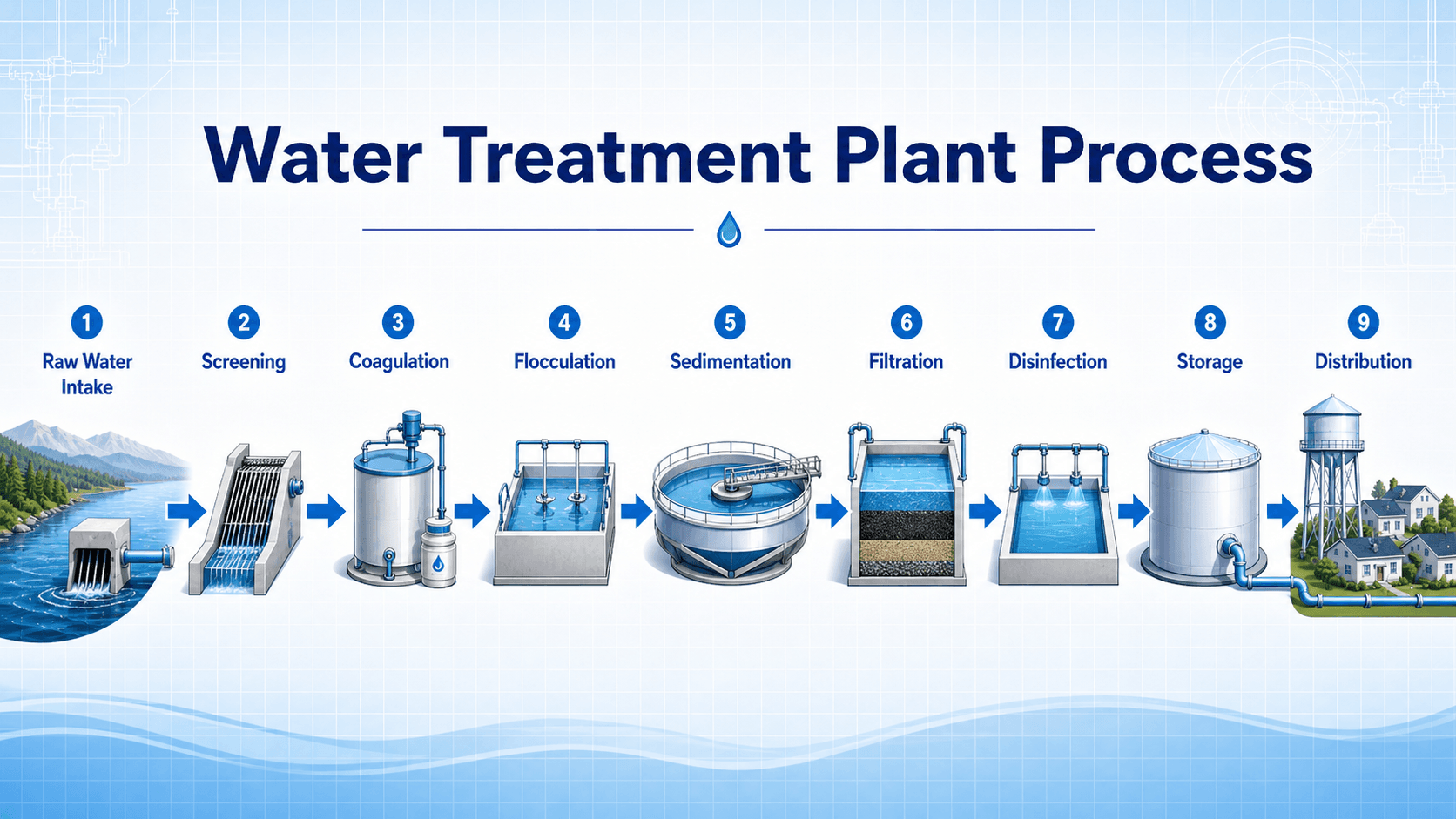
Read the diagram from left to right. The early steps protect downstream equipment and remove particles; the later steps polish, disinfect, store, and deliver finished water.
What Is a Water Treatment Plant?
A water treatment plant is an engineered facility that improves raw water quality so the water can be safely and reliably used for a defined purpose. For drinking water systems, the plant receives water from a river, lake, reservoir, well field, or blended source and treats it before storage and distribution.
In water resources engineering, a treatment plant sits between the natural water source and the built water supply system. The plant does not simply make water look clear. It must control particles, pathogens, dissolved constituents, chemical stability, taste, odor, operator safety, residuals, and the ability of the distribution system to maintain water quality after the water leaves the plant.
This is different from a wastewater treatment plant. A drinking water plant treats raw source water before use, while a wastewater plant treats used water after it has already passed through homes, businesses, institutions, or industrial systems.
Water Treatment Plants vs Wastewater Treatment Plants
Many people use the phrase water treatment plant for both drinking water and wastewater facilities, but they serve different purposes. A drinking water plant treats source water before use, while a wastewater plant treats used water after it leaves homes, businesses, and collection systems.
| Facility type | What enters the plant | Main goal | Common processes |
|---|---|---|---|
| Drinking water treatment plant | Raw water from a river, reservoir, lake, well, or blended source | Produce finished water for storage, distribution, and use | Screening, coagulation, flocculation, sedimentation, filtration, disinfection, stabilization |
| Wastewater treatment plant | Used water from homes, businesses, institutions, and industries | Treat wastewater before discharge, reuse, or return to the environment | Screening, primary clarification, biological treatment, secondary clarification, disinfection, solids handling |
How Water Treatment Plants Work Step by Step
A water treatment plant works as a sequence of barriers. Each step reduces a specific kind of risk and prepares the water for the next step. Screening removes large debris, clarification removes settleable and suspended solids, filtration captures remaining fine particles, and disinfection inactivates microorganisms before the water is stored and distributed.
1. Raw Water Intake
The process begins at the intake, where water is withdrawn from a source such as a river, reservoir, lake, or groundwater well. Intake structures, pumps, valves, and raw water mains must handle seasonal water levels, debris, algae, sediment, ice, floods, drought, and source water quality changes.
2. Screening
Screens remove leaves, sticks, trash, aquatic vegetation, fish, and other large material before the water reaches sensitive equipment. This step looks simple, but it protects pumps, chemical systems, basins, valves, and downstream processes from clogging and mechanical damage.
3. Coagulation
Coagulation adds chemicals that destabilize small particles that would otherwise remain suspended. Many fine particles and colloids carry surface charges that keep them separated in water. Coagulants help neutralize those charges so particles can begin forming larger clusters.
4. Flocculation
Flocculation uses gentle mixing to bring destabilized particles together. The goal is not violent turbulence; it is controlled contact. If mixing is too weak, particles do not collide enough. If mixing is too aggressive, the forming floc can break apart before it reaches the sedimentation basin.
5. Sedimentation or Clarification
Sedimentation allows larger floc to settle by gravity. Clarifiers and sedimentation basins slow the water so solids can drop to the bottom as sludge while clearer water moves forward. This step reduces the solids load on filters and makes filtration more stable.
6. Filtration
Filtration passes water through media such as sand, anthracite, gravel, or granular activated carbon. Filters remove remaining particles that escaped sedimentation and can improve clarity, taste, odor, and disinfection performance. Filters are periodically backwashed to remove accumulated solids.
7. Disinfection
Disinfection inactivates pathogens that may remain after clarification and filtration. Plants may use chlorine, chloramine, ozone, ultraviolet light, or a combination of methods. Chemical disinfectants also require enough contact time under the right water quality conditions, and many distribution systems maintain a disinfectant residual so water quality is protected after it leaves the plant.
8. Storage and Distribution
Finished water enters a clearwell, storage tank, or reservoir before being pumped into the distribution system. From there, water moves through transmission mains, pressure zones, storage tanks, valves, and local distribution pipes before reaching homes, businesses, and institutions.
Coagulation, Flocculation, and Sedimentation Explained
Coagulation, flocculation, and sedimentation are often grouped together because they solve the same practical problem: fine suspended material does not always settle on its own. The plant must first make small particles easier to remove, then give those particles time and space to settle.
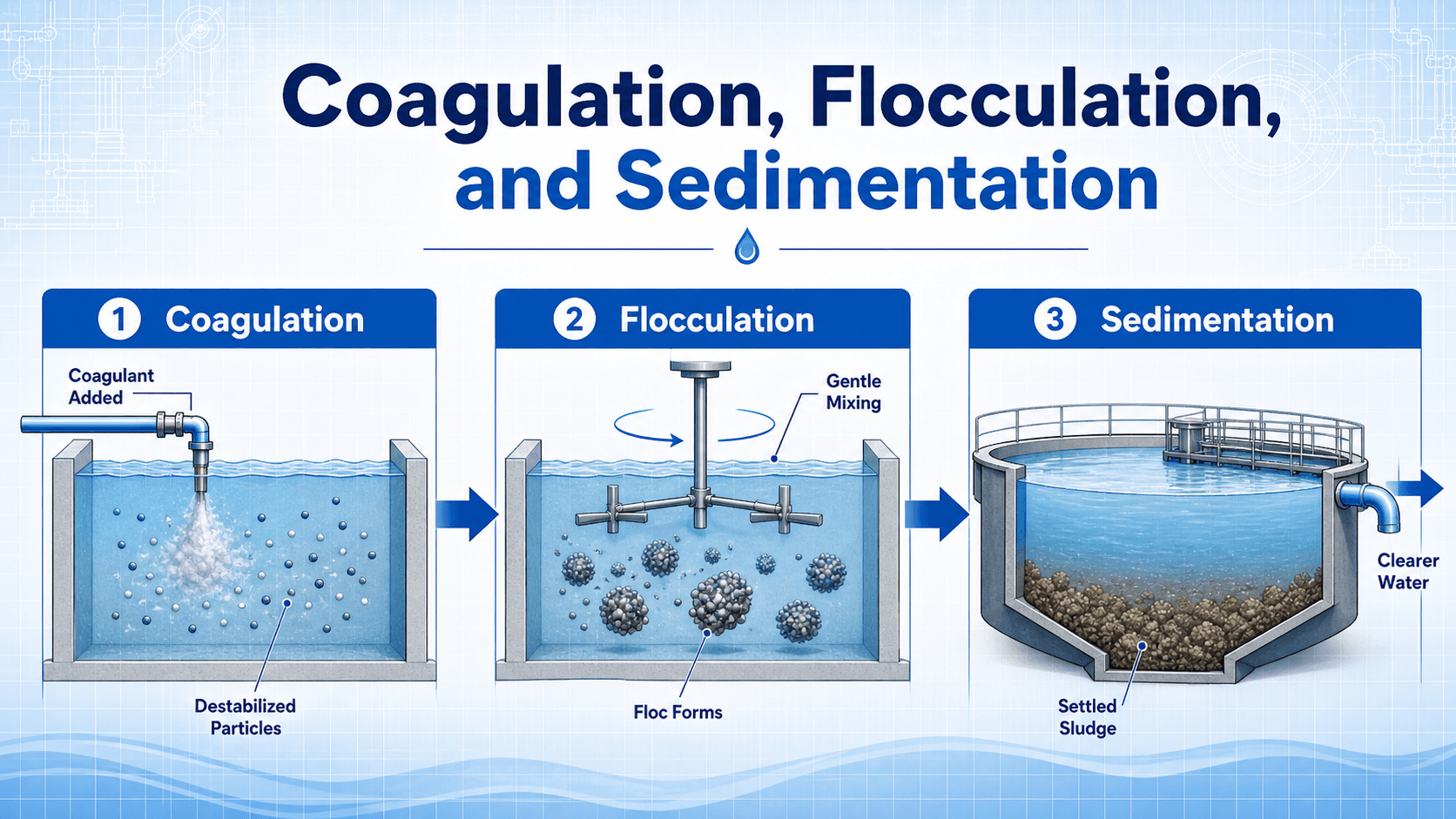
The engineering challenge is balancing chemistry, mixing energy, and basin detention time. A good jar test in the lab may suggest a coagulant dose, but the full-scale plant must still respond to temperature, pH, alkalinity, turbidity spikes, algae, organic matter, and flow changes.
If filters are clogging too quickly, the problem may not be the filter itself. Poor coagulation, weak floc formation, short-circuiting in sedimentation, or changing raw water conditions may be sending too much solids load downstream.
How Filtration Works Inside the Plant
Filtration is the polishing step that removes many of the fine particles left after clarification. A filter is not just a container full of sand. It is an engineered system with media layers, underdrains, hydraulic controls, headloss monitoring, backwash equipment, and finished water quality checks.
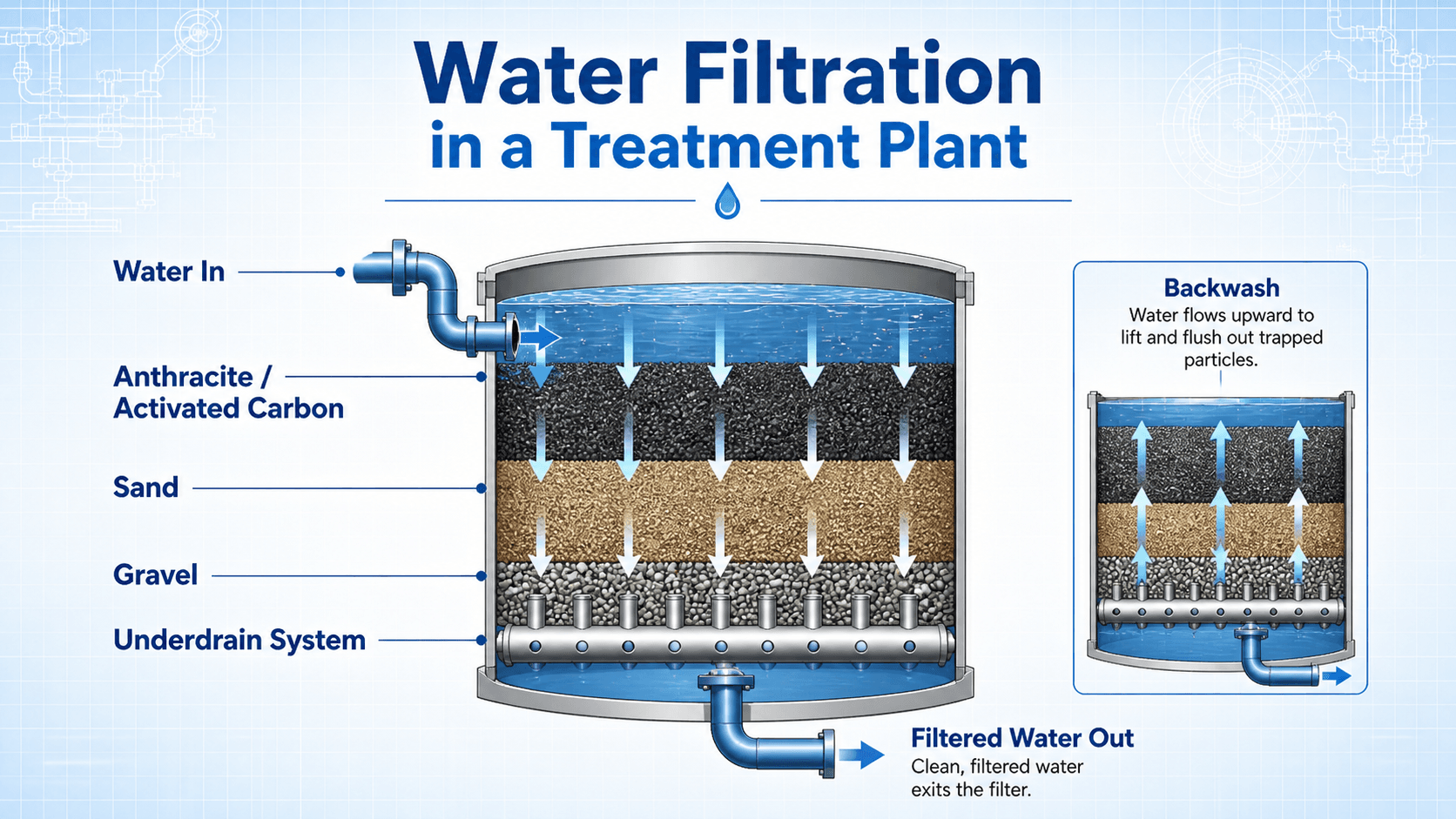
Operators watch filter effluent turbidity, headloss, run time, backwash performance, and signs of media problems. A filter may produce clear water visually while still performing poorly if breakthrough, mudball formation, air binding, or poor backwash distribution is occurring.
What Water Treatment Plants Remove
Different contaminants require different removal mechanisms. Large debris can be screened, but fine colloids may need chemical destabilization. Pathogens may require filtration and disinfection. Dissolved constituents such as hardness, nitrate, iron, manganese, taste-and-odor compounds, or PFAS may require more specialized processes.
| Water quality concern | Common examples | Typical treatment approach |
|---|---|---|
| Large debris | Leaves, sticks, trash, aquatic vegetation, fish, coarse solids | Intake protection, bar screens, traveling screens, strainers, presedimentation where needed |
| Suspended solids and turbidity | Clay, silt, fine organic matter, algae fragments, storm-driven sediment | Coagulation, flocculation, sedimentation, clarification, filtration |
| Microorganisms | Bacteria, viruses, protozoa, microbial indicators | Multiple barriers such as filtration, disinfection, contact time, and distribution residual control |
| Taste and odor compounds | Algae-related compounds, earthy or musty odors, natural organic matter | Activated carbon, oxidation, source control, operational adjustments, advanced treatment where needed |
| Dissolved inorganic constituents | Iron, manganese, hardness, arsenic, nitrate, salts | Oxidation and filtration, softening, ion exchange, adsorption, membranes, or source blending |
| Trace and emerging contaminants | PFAS, some industrial chemicals, some synthetic organic compounds | Granular activated carbon, ion exchange, high-pressure membranes, or other advanced treatment based on the contaminant |
When Advanced Water Treatment Is Added
Conventional treatment is effective for many surface water supplies, but some water quality problems require additional processes. Advanced treatment may be added when the concern is dissolved, persistent, taste-and-odor related, or difficult to control with clarification, filtration, and disinfection alone.
- Granular activated carbon: used for taste, odor, natural organic matter, and certain trace organic contaminants.
- Ion exchange: used for selected dissolved ions, including nitrate, hardness, and some emerging contaminants depending on resin selection.
- Membranes: used when tighter particle, microbial, salt, or trace contaminant removal is required.
- Oxidation: used for iron, manganese, taste, odor, and some organic compounds, depending on chemistry and downstream treatment.
- Softening: used where hardness control is a primary finished water objective.
Key Factors That Control Treatment Plant Performance
Water treatment plant performance depends on source water behavior, process control, hydraulic design, chemical feed reliability, and operator response. Two plants with the same process names can behave very differently if one treats stable groundwater and the other treats a flashy river with algae, storm turbidity, and seasonal temperature swings.
| Factor | Why it matters | Engineering implication |
|---|---|---|
| Source water type | Surface water, groundwater, and blended supplies have different contaminant patterns and seasonal behavior. | Controls whether the plant emphasizes clarification, filtration, softening, oxidation, advanced treatment, or disinfection strategy. |
| Turbidity and particle size | High turbidity increases solids loading and can reduce disinfection reliability if not controlled upstream. | Affects coagulant dose, flocculation energy, sedimentation loading, filter run length, and backwash frequency. |
| pH and alkalinity | Chemical performance, corrosion control, coagulation efficiency, and finished water stability are sensitive to pH and buffering capacity. | May require pH adjustment, alkalinity addition, corrosion control chemicals, or revised coagulant strategy. |
| Temperature | Cold water slows chemical reactions and can make floc formation more difficult. | May require dose changes, mixing adjustments, longer detention, or closer filter performance monitoring. |
| Organic matter and algae | Organic matter can increase chemical demand, taste and odor issues, and disinfection byproduct concerns. | May require carbon adsorption, oxidation strategy, source control, or tighter finished water monitoring. |
| Hydraulic loading | Higher flows reduce detention time and can push basins, filters, and contact tanks closer to their limits. | Controls basin sizing, redundancy, filter loading rate, contact time, pump operation, and peak demand planning. |
How Engineers Choose the Treatment Train
Engineers choose a treatment train by matching the water quality problem to the removal mechanism. The best plant layout is not always the most complex layout; it is the arrangement that reliably meets the finished water objective under normal operation, seasonal variation, and reasonable upset conditions.
Start with the source water. Identify the contaminants, variability, flow range, and finished water goals. Select the first barrier that protects equipment, then the particle removal steps, then the disinfection approach, then any chemical stabilization or advanced treatment needed before storage and distribution.
| Design decision | What to look for | Why it matters |
|---|---|---|
| Can large debris or grit reach the plant? | Trash, sticks, aquatic growth, sediment pulses, intake fouling, pump wear | Determines screening, intake protection, presedimentation, and maintenance access needs. |
| Are particles fine, stable, or colloidal? | Persistent turbidity, poor settling, color, organic matter, algae-related solids | Determines whether coagulation and flocculation are needed before sedimentation and filtration. |
| Is the water biologically or microbiologically vulnerable? | Surface water influence, watershed activity, pathogens, high turbidity, warm storage | Controls filtration, disinfection, contact time, monitoring, and distribution residual strategy. |
| Are dissolved contaminants the primary issue? | Hardness, nitrate, arsenic, PFAS, iron, manganese, salts, taste and odor compounds | May require adsorption, ion exchange, membranes, oxidation, softening, blending, or source changes. |
| Can the plant handle residuals? | Settled sludge, spent backwash water, chemical residuals, disposal requirements | Residuals handling can control site layout, operation cost, permitting, and long-term maintainability. |
What Operators Monitor During Treatment
A treatment plant is not a static diagram. Operators continuously watch the plant because raw water changes, flows fluctuate, equipment ages, chemicals vary, and distribution demands move throughout the day. Good operation depends on measuring the right indicators early enough to respond before finished water quality is affected.
- Turbidity: tracks particle removal through settled water, filter effluent, and finished water.
- pH and alkalinity: affect coagulation, corrosion control, chemical stability, and finished water quality.
- Disinfectant residual: verifies that disinfection control remains effective through storage and distribution.
- Filter headloss: shows how much resistance is building across the filter bed as solids accumulate.
- Flow rate: affects detention time, filter loading, chemical dose, and disinfection contact time.
- Chemical feed rates: confirm that coagulants, disinfectants, pH adjustment chemicals, and other additives are being dosed consistently.
- Backwash performance: helps operators identify media fouling, mudballs, poor expansion, or underdrain issues.
Many treatment problems begin upstream of where they become visible. A filter problem may trace back to coagulation control, a disinfection problem may trace back to turbidity or organic demand, and a taste-and-odor complaint may trace back to source water algae rather than the final process alone.
What Happens to Sludge and Backwash Water?
Water treatment plants also create residuals. Sedimentation basins produce settled sludge, and filters produce spent backwash water. These materials may contain solids, organic matter, coagulant residuals, metals, captured particles, and other constituents removed from the raw water.
Residuals may be thickened, dewatered, discharged under permit, hauled for disposal, sent to lagoons, recycled to the plant headworks where allowed, or managed through another approved approach. Poor residuals handling can reduce plant capacity, increase operational risk, create water quality issues, and make a well-designed treatment train difficult to operate.
Engineering Judgment and Field Reality
Real plants rarely operate under textbook conditions every day. A river can turn highly turbid after a storm, a reservoir can develop algae, cold water can slow floc formation, pumps can shift hydraulic loading, and distribution demand can change faster than expected. Engineers and operators need a process that is resilient, not just theoretically correct.
The most important design question is often not “Can the process work on average?” but “Can the process still produce reliable finished water when raw water quality, flow, temperature, chemical demand, or equipment availability changes?”
When This Breaks Down
The simplified treatment plant sequence is useful, but it can break down when readers assume every plant is conventional, every contaminant is removed by filtration, or every water source behaves the same way. The process shown in a basic diagram must be adapted to the actual raw water and finished water requirements.
- Source water changes quickly: storms, drought, algae blooms, temperature swings, wildfire runoff, or upstream land use can change chemical demand and solids loading.
- Dissolved contaminants dominate: filtration may not remove nitrate, salts, many dissolved metals, PFAS, or other trace contaminants without specialized treatment.
- Hydraulics short-circuit basins: water may pass through a basin faster than expected if inlet, outlet, baffle, or flow distribution problems occur.
- Filters are overloaded: poor clarification can shorten filter runs and increase the risk of particle breakthrough.
- Distribution water quality is ignored: water can leave the plant in good condition but change in storage tanks, dead ends, low-flow areas, or aging pipes.
Common Mistakes and Practical Checks
A strong water treatment explanation should avoid oversimplifying the plant into a single “dirty water in, clean water out” box. Treatment works because each step reduces a different risk, and the steps must be controlled together.
- Confusing drinking water and wastewater treatment: the goals, sources, processes, solids, biology, and discharge requirements are different.
- Assuming clear water is always safe: water can look clear while still needing disinfection, chemical stabilization, or dissolved contaminant removal.
- Thinking filtration removes everything: filters are powerful particle-removal barriers, but dissolved contaminants may need adsorption, ion exchange, membranes, oxidation, or other methods.
- Ignoring chemical conditions: pH, alkalinity, temperature, and organic matter can strongly change coagulation and disinfection behavior.
- Forgetting residuals: sludge and spent backwash water are part of the treatment system and must be handled reliably.
Do not evaluate a treatment plant one unit process at a time without checking the full treatment train. A downstream problem often starts with an upstream condition that changed the loading, chemistry, or hydraulics.
Useful References and Design Context
Public water treatment is guided by regulations, utility standards, source water studies, pilot testing, manufacturer data, and operator experience. For a general reader, the most useful starting reference is a clear agency explanation of the basic drinking water treatment sequence.
- CDC drinking water treatment overview: CDC explanation of how water treatment works outlines the conventional treatment steps of coagulation, flocculation, sedimentation, filtration, and disinfection in a public-health context.
- Project-specific criteria: utility standards, state drinking water rules, design criteria, pilot testing, source water reports, and owner requirements may control the final process arrangement.
- Engineering use: engineers combine source water data, treatment objectives, hydraulic capacity, process testing, residuals handling, constructability, operation staffing, and distribution system needs before selecting a final treatment train.
Frequently Asked Questions
The main steps in a conventional drinking water treatment plant are raw water intake, screening, coagulation, flocculation, sedimentation, filtration, disinfection, storage, and distribution. Some plants add advanced processes such as activated carbon, membrane filtration, ion exchange, softening, or oxidation depending on the source water and treatment goals.
Coagulation and flocculation are used before sedimentation because many suspended particles are too small or stable to settle by gravity on their own. Coagulant chemicals destabilize those particles, and gentle mixing helps them collide into larger floc that can settle more effectively in a basin or clarifier.
No. The treatment train depends on the water source, raw water quality, seasonal changes, flow demand, treatment objectives, regulations, available space, residuals handling, and operator capability. A groundwater plant may need iron or manganese removal, while a surface water plant often needs stronger particle removal and disinfection control.
A drinking water treatment plant treats raw source water before it is delivered to homes, businesses, and other users. A wastewater treatment plant treats used water after it leaves homes, industries, and collection systems so it can be discharged, reused, or returned to the environment under appropriate requirements.
Sludge from a water treatment plant usually comes from settled solids in clarification basins and solids removed during filter backwashing. It may be thickened, dewatered, discharged under permit, hauled for disposal, stored in lagoons, or managed through another approved residuals handling process.
Summary and Next Steps
Water treatment plants work by arranging physical, chemical, and operational barriers into a treatment train. Raw water enters the plant, large debris is screened out, fine particles are destabilized and settled, filters polish the water, disinfection controls pathogens, and finished water is stored before distribution.
The most important engineering lesson is that the process must be selected and controlled as a system. Source water quality, turbidity, pH, alkalinity, temperature, organic matter, hydraulic loading, chemical dosing, filtration, residuals, and distribution conditions all affect whether the plant performs reliably.
Where to go next
Continue your learning path with related Turn2Engineering resources.
-
Water Treatment Processes
Review the individual treatment processes used to remove particles, pathogens, dissolved contaminants, taste, odor, and other water quality concerns.
-
Water Supply Chain
See how source water, treatment, storage, distribution, demand, and management connect across a complete supply system.
-
Water Infrastructure
Explore the physical infrastructure that stores, conveys, treats, distributes, and manages water across communities.