
Direct Answer
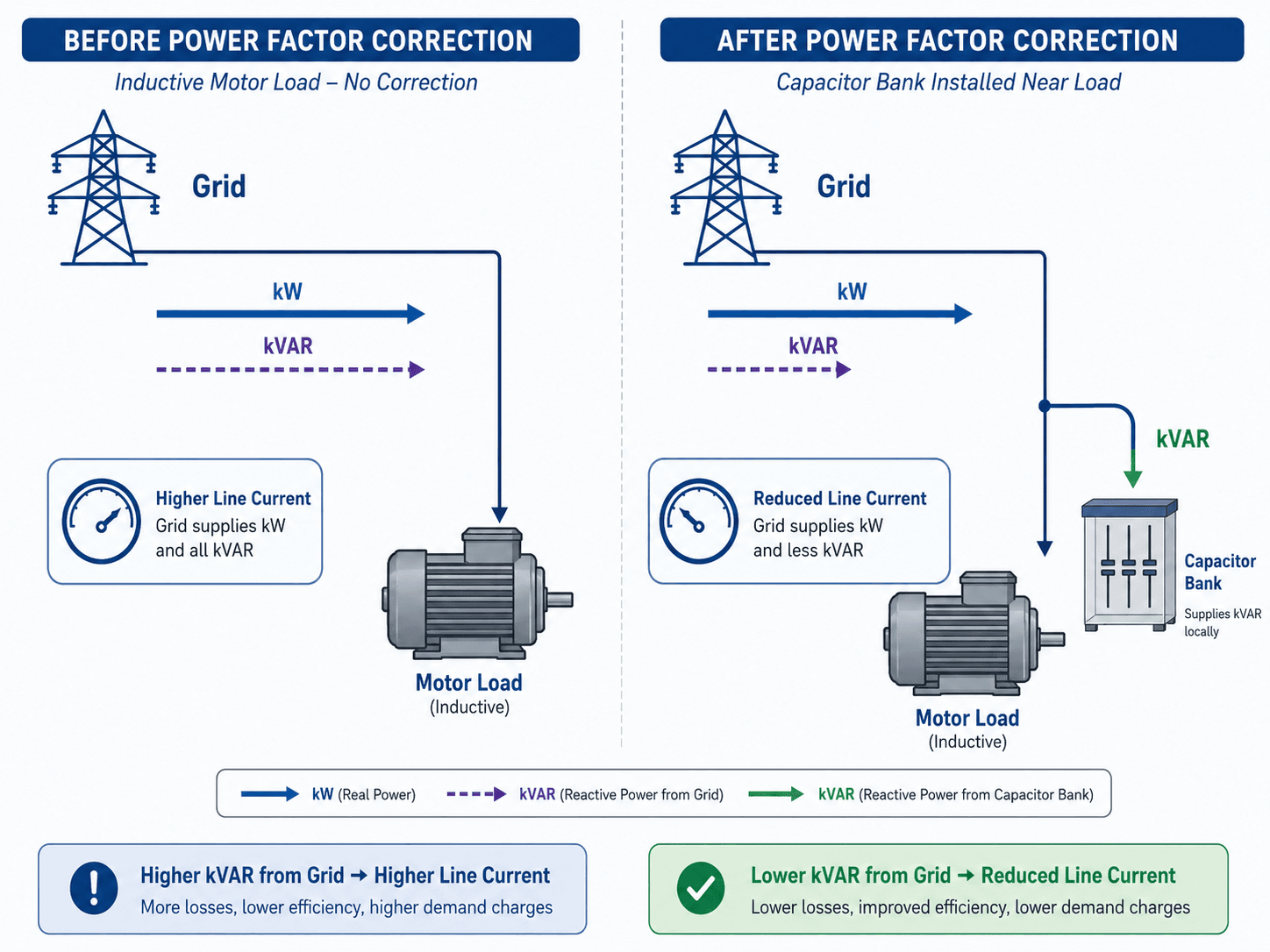
Power factor correction reduces the reactive power drawn from the upstream AC system so the same useful real power can be supplied with lower apparent power and lower current. In commercial and industrial systems, correction is commonly provided by shunt capacitor banks, although dynamic VAR devices and inverter-based controls may be used when reactive demand changes rapidly.
Power factor correction usually does not reduce the useful kW required by the load itself. Its value comes from lower kVA demand, lower current, reduced conductor and transformer losses, improved voltage performance, released electrical capacity, and avoidance of utility penalties or demand charges where those tariffs apply.
How Power Factor Correction Works
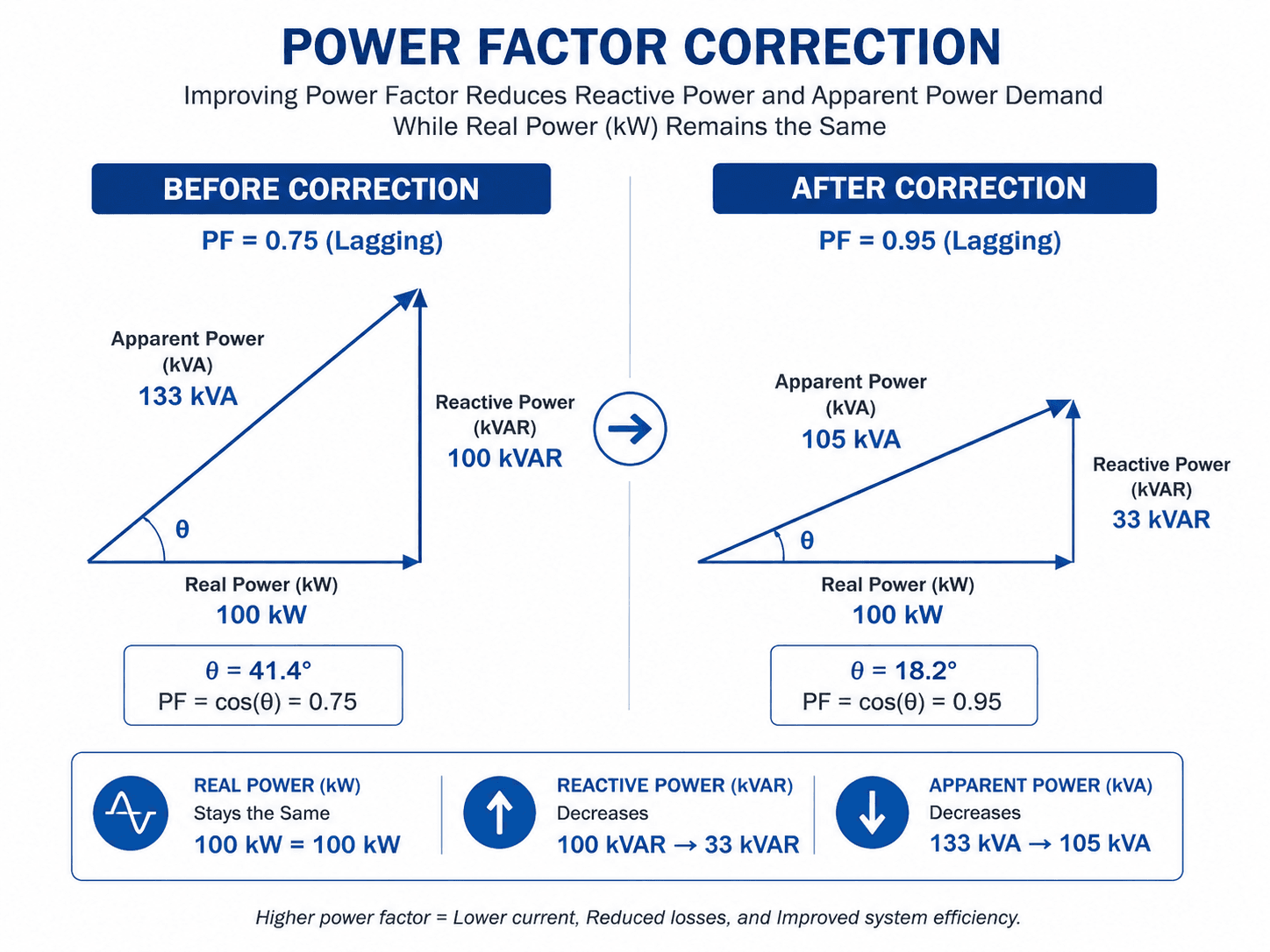
Power factor describes how much of the apparent power carried by an AC system is converted into useful real power. The power triangle connects real power \(P\), reactive power \(Q\), and apparent power \(S\).
Power Factor Equation
Power Triangle Relationship
- \(P\)Real power in kW—the power doing useful work.
- \(Q\)Reactive power in kVAR—the power associated with magnetic or electric fields.
- \(S\)Apparent power in kVA—the total electrical capacity the source must carry.
- \(\theta\)Displacement angle between the fundamental voltage and current waveforms.
Displacement Power Factor vs. True Power Factor
The simple power triangle describes displacement power factor. In systems with distorted current, true power factor also includes harmonic distortion. This matters because a facility can have an acceptable displacement PF while still drawing high RMS current because of VFDs, rectifiers, UPS systems, LED drivers, or other nonlinear loads.
Capacitors primarily correct lagging fundamental-frequency reactive power. They do not automatically correct harmonic distortion, and in some systems they can make harmonic problems worse.
What Power Factor Correction Does—and Does Not Do
Power factor correction improves how the upstream electrical system supplies the load. It does not normally reduce the mechanical or process work the load must perform.
| Quantity / outcome | Typical effect | Engineering meaning |
|---|---|---|
| Real power, kW | Usually little change | The load still needs approximately the same useful power for the same work |
| Reactive power from source, kVAR | Decreases | Capacitors supply part of the VAR requirement locally |
| Apparent power, kVA | Decreases | Less source, transformer, and feeder capacity is required |
| Line current | Decreases | Can free conductor, breaker, transformer, and switchgear capacity |
| \(I^2R\) loss | Usually decreases upstream of the capacitor | Lower current reduces resistive loss |
| Voltage drop | Often improves | Less current and local VAR support can improve voltage profile |
| Load kWh | Usually little change | The motor/process does not suddenly need less useful energy |
Swipe horizontally to view all table columns.
The U.S. Department of Energy notes that low power factor increases current, reduces distribution capacity, and can cause additional utility cost where low-PF charges apply. DOE — Reducing Power Factor Cost.
Power Factor Correction Formula and Capacitor kVAR Sizing
The standard sizing calculation finds how much reactive power must be supplied locally to move from the existing power factor to the target power factor.
- \(Q_c\)Required correction in kVAR.
- \(P\)Real load power in kW.
- \(\theta_1\)Existing power-factor angle.
- \(\theta_2\)Target power-factor angle.
Choosing the Target Power Factor
Do not choose 1.00 automatically. The practical target should be based on the utility tariff, load variability, minimum-load condition, capacitor step size, voltage behavior, harmonic conditions, and the risk of leading power factor. Many facilities choose a target modestly above the utility threshold rather than attempting to hold unity PF at every operating point.
There is no single correct PF target for every facility. A “0.95” or “0.98” target may be sensible in many applications, but the final target should follow the actual tariff and operating conditions.
Worked Example: 500 kW From 0.78 PF to 0.95 PF
Calculate capacitor kVAR and current reduction
Assume a balanced three-phase facility load of 500 kW at 480 V with an existing power factor of 0.78 lagging. The target is 0.95 lagging.
Calculate the power-factor angles
Calculate required correction
Calculate line-current reduction
\[ I_1=\frac{500{,}000}{\sqrt{3}(480)(0.78)} \approx771\text{ A} \]
\[ I_2=\frac{500{,}000}{\sqrt{3}(480)(0.95)} \approx633\text{ A} \]
Fixed, Automatic, Detuned, and Dynamic Power Factor Correction
The correct equipment type depends on how quickly reactive demand changes and whether harmonics are present.
| Type | Best application | Main advantage | Main risk / limitation |
|---|---|---|---|
| Fixed capacitor | Steady individual load or predictable feeder | Simple and low cost | Overcorrection when the load turns off or drops |
| Automatic stepped capacitor bank | Facility with varying kVAR demand | Matches correction to changing load | Switching duty, step selection, controller tuning, maintenance |
| Detuned capacitor bank | System with significant nonlinear load and harmonic risk | Reduces resonance risk compared with plain capacitors | Requires correct reactor/capacitor design and harmonic study |
| Active harmonic filter / dynamic VAR device | Fast-changing loads or combined harmonic/reactive problems | Fast controllable response | Higher cost and controls complexity |
| Synchronous condenser / inverter VAR control | Utility or large-system voltage/reactive support | Dynamic system-level reactive control | Project-specific controls and operating constraints |
Swipe horizontally to view all table columns.
Where Should Power Factor Correction Be Installed?
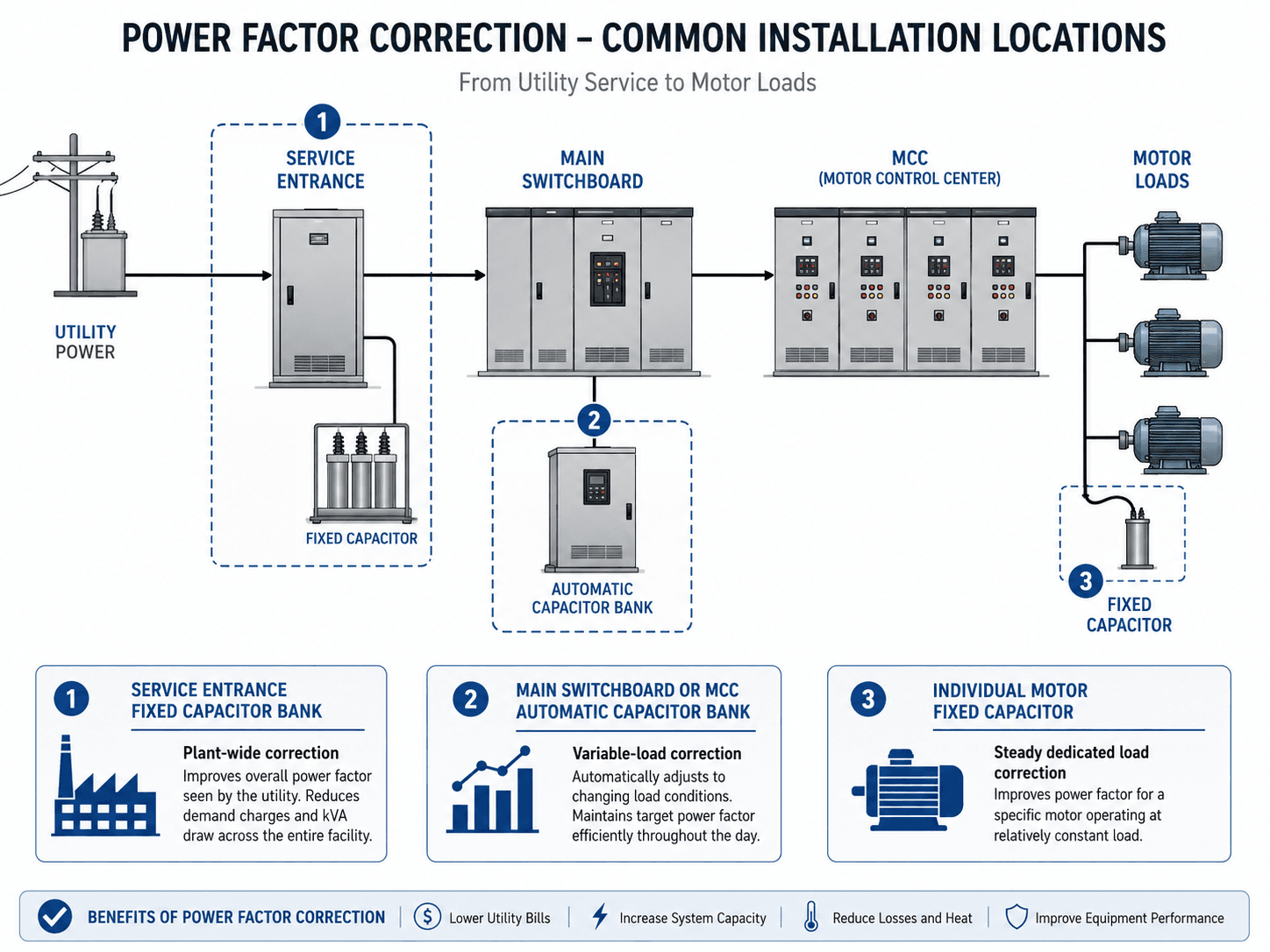
Placement should match the objective. Service-entrance correction may improve utility billing, while local correction can also reduce current in downstream feeders and transformers.
| Location | Best objective | What it does not necessarily solve |
|---|---|---|
| Service entrance | Improve PF at utility meter and reduce billed kVA / penalties | May not reduce current in all downstream feeders |
| Main switchboard / MCC | Correct a large group of changing loads | Requires automatic controls for large load variation |
| Feeder | Reduce local feeder current and voltage drop | May not correct unrelated loads elsewhere in facility |
| Individual motor | Reduce current upstream of a steady motor | Needs careful switching/interlocking and minimum-load review |
Swipe horizontally to view all table columns.
Put correction where it solves the actual problem. A bank selected only to satisfy the utility meter may not maximize feeder-capacity or voltage benefits.
Harmonics, Resonance, and Why Capacitors Can Make Things Worse
Capacitors change the electrical system’s impedance versus frequency. If capacitor reactance and system inductance create a resonance near a significant harmonic, voltage or current distortion can be amplified rather than reduced.
Common Harmonic Sources
- Variable frequency drives and six-pulse rectifiers
- UPS systems and battery chargers
- Electronic power supplies and LED drivers
- Welders and converters
- Solar and battery inverters
Measure Harmonics at the Right Point
IEEE 519-2022 defines steady-state harmonic design goals at the point of common coupling (PCC). A plant should not choose a capacitor or filter from one THD number alone; engineers need the harmonic spectrum, source impedance, capacitor size, operating cases, and resonance assessment.
IEEE 519-2022 — Standard for Harmonic Control in Electric Power Systems establishes steady-state voltage and current distortion goals at the PCC for systems containing harmonic-producing loads.
If a facility has a large percentage of VFD, UPS, rectifier, EV-charger, or inverter load, measure harmonics and assess resonance before installing a conventional capacitor bank.
For deeper waveform and measurement guidance, see Power Quality.
When Power Factor Correction Is Worth It
The best projects solve a measurable cost or capacity problem. Correcting PF simply because the number is below 1.00 is not enough justification.
| Condition | Strong business case | Weak business case |
|---|---|---|
| Utility tariff | PF penalty, kVA demand charge, reactive charge, minimum PF requirement | Only kWh billing with no demand/capacity issue |
| Load type | Large induction motors, transformers, welders, compressors, pumps | Small loads or mainly electronic loads with no PF charge |
| Capacity | Transformer, feeder, breaker, or switchgear near kVA/current limit | Large unused system capacity |
| Voltage | Reactive current materially contributes to voltage drop | Voltage already stable and PF does not control the problem |
| Harmonics | Low harmonic risk or properly engineered detuned/filtered solution | Significant harmonics with no resonance study |
Swipe horizontally to view all table columns.
What About Residential “Power Saver” Devices?
For most residential customers, standalone power factor correction offers little direct billing value because residential tariffs are usually based on kWh rather than PF or kVA demand. Plug-in “power saver” products should not be assumed to reduce household energy consumption simply because they contain capacitors.
Use the actual tariff and measured demand interval. The economic value of PFC can be very different from the theoretical electrical benefit.
Power Factor Correction Design, Commissioning, and Maintenance
A capacitor bank is real power equipment. Proper design includes ratings, switching, protection, discharge, ventilation, controls, harmonics, commissioning, and periodic inspection.
- Review metering and tariff.
Confirm actual PF, kW, kVA, kVAR, demand interval, minimum-load condition, and billing trigger.
- Calculate required kVAR.
Use measured load and a tariff/operating target rather than an arbitrary unity-PF target.
- Check harmonics and resonance.
Review nonlinear-load share, harmonic spectrum, PCC distortion, and system impedance before selecting capacitors.
- Select bank type and step size.
Choose fixed, automatic, detuned, filtered, or dynamic correction based on load variation and response needs.
- Verify equipment application.
Check voltage rating, kVAR, switching device duty, fuses/breakers, enclosure, ambient temperature, discharge provisions, and manufacturer requirements.
- Commission under multiple load conditions.
Verify PF, step operation, voltage, current, harmonic behavior, temperature, and no leading-PF condition at light load.
- Maintain the bank.
Inspect fuses, contactors, capacitors, reactors, ventilation, controller alarms, bulging/leakage, hot connections, and step balance.
Capacitor Equipment Standards
IEEE 18-2025 is the current IEEE standard for shunt power capacitors rated 216 V or higher and 2.5 kVAR or more for AC transmission and distribution applications. IEC 60831-1:2014 covers self-healing shunt capacitors and capacitor banks up to 1,000 V used particularly for power factor correction and filtering.
Do not consider the project complete when the controller displays 0.95 PF. Verify actual line current, bank step currents, voltage, temperatures, harmonic conditions, and light-load behavior.
Power Factor Correction Engineering References
Power factor correction combines utility economics, reactive-power theory, capacitor application, harmonic control, and facility-specific operating data.
- U.S. Department of Energy — Reducing Power Factor Cost Explains power factor, utility cost implications, increased current, voltage drop, and distribution-capacity effects.
- IEEE 18-2025 — Standard for Shunt Power Capacitors Current IEEE shunt-capacitor standard covering applicable AC power capacitors and ratings.
- IEEE 519-2022 — Harmonic Control in Electric Power Systems Current steady-state harmonic distortion framework at the point of common coupling.
- IEC 60831-1:2014 — Self-Healing Shunt Power Capacitors up to 1,000 V Performance, testing, rating, safety, installation, and operation requirements for capacitors used particularly for power factor correction.
Frequently Asked Questions
What is power factor correction?
Power factor correction reduces the reactive power drawn from the upstream AC system so the same useful kW can be supplied with lower kVA and lower current. Capacitor banks are the most common correction method for lagging industrial and commercial loads.
How do you calculate capacitor size for power factor correction?
A common sizing equation is \(Q_c=P(\tan\theta_1-\tan\theta_2)\), where \(P\) is real power in kW and \(\theta_1\) and \(\theta_2\) are the existing and target power-factor angles.
Does power factor correction reduce electricity consumption?
It usually does not significantly reduce the useful kWh consumed by the load itself. It can reduce upstream electrical losses, kVA demand, PF penalties, and current-related capacity requirements.
Should power factor be corrected to 1.00?
Not automatically. The target should be based on the utility tariff and operating range. Correcting too aggressively can create leading power factor during low-load periods.
Can capacitor banks cause harmonic problems?
Yes. Capacitors can interact with system inductance and create or amplify resonance. Facilities with significant nonlinear loads should review harmonic measurements and resonance risk before installing conventional capacitor banks.
What is the difference between fixed and automatic power factor correction?
A fixed capacitor provides one constant kVAR value and is best for steady loads. An automatic bank switches capacitor steps as reactive demand changes, making it better for facilities with variable load.
Is power factor correction worth it for a home?
Usually not for typical residential billing. Most homes are billed mainly for kWh and do not receive low-power-factor penalties or kVA demand charges, so standalone residential correction usually has little direct economic value.
Summary and Next Step
Power factor correction reduces reactive current drawn from the upstream AC system. Properly applied correction can lower current and kVA, release transformer and feeder capacity, reduce upstream losses and voltage drop, and lower utility costs where the tariff penalizes low power factor.
The design should begin with measured kW, kVAR, kVA, PF, load variation, and the utility tariff. Capacitor sizing is only one step: placement, minimum load, harmonics, resonance, switching, protection, commissioning, and maintenance determine whether the final system is actually better.