
Direct Answer
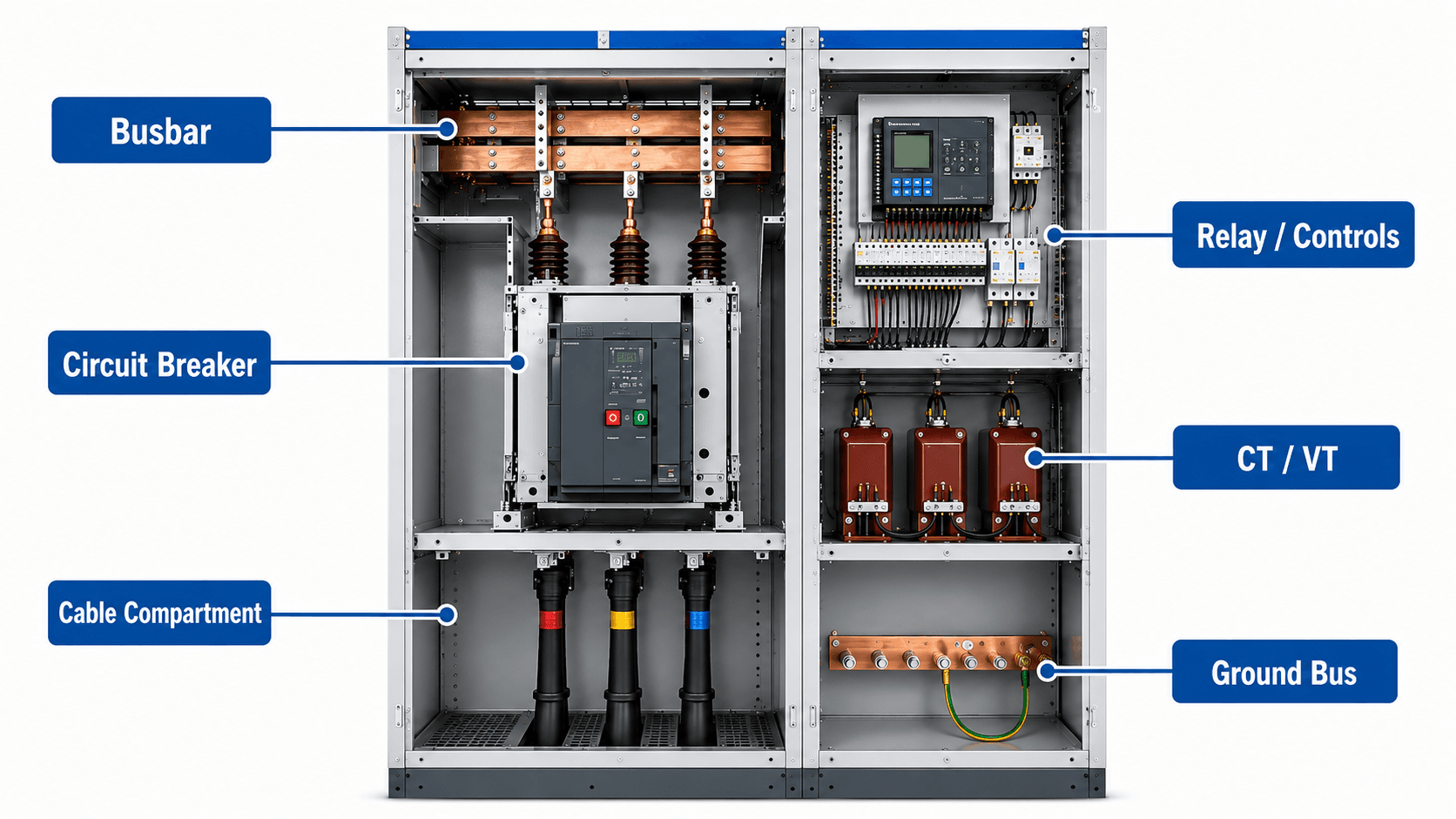
Switchgear is a coordinated assembly of switching, interrupting, protection, metering, and control equipment used to distribute electrical power and isolate abnormal conditions. A switchgear lineup commonly contains busbars, circuit breakers or switches, protective relays or trip units, CTs/VTs, cable compartments, control power, grounding, and metal enclosures.
Correct switchgear application depends on far more than amp rating. Engineers verify voltage class, continuous current, available fault current, breaker interrupting capability, assembly short-circuit/withstand rating, bus bracing, protection settings, selective coordination, arc-flash performance, enclosure/construction type, control power, maintainability, and the actual condition of the installed equipment.
Where Switchgear Fits in a Power System
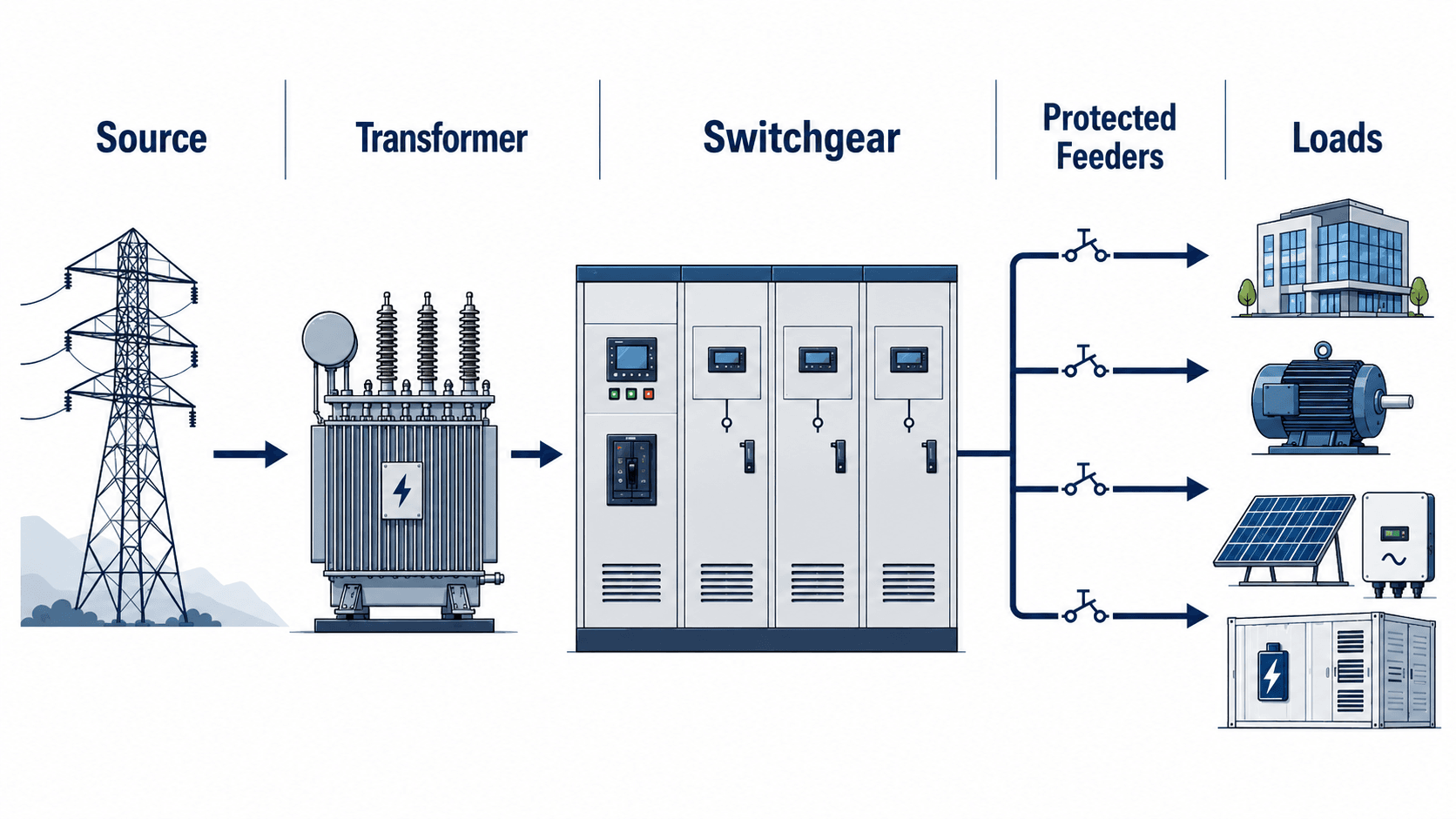
Switchgear sits at controlled distribution points between electrical sources and downstream circuits. It may be installed after a utility service, transformer, generator, battery inverter, renewable collector system, or upstream feeder and then distribute power to multiple protected circuits.
What Switchgear Actually Does
| Function | How the lineup performs it | Why it matters |
|---|---|---|
| Distribute power | Main/tie/feeder buses and breakers route power to outgoing circuits | Defines normal and alternate operating paths |
| Interrupt faults | Breakers/fuses open abnormal current within their ratings | Limits equipment damage and outage extent |
| Protect equipment | Trip units and relays detect overload, short circuit, ground fault, differential or other conditions | Ensures the correct circuit is isolated |
| Isolate equipment | Drawout breakers, disconnects, shutters, grounding provisions and procedures establish work boundaries | Supports maintenance and safe operating practice |
| Measure and control | CTs, VTs, meters, relays, IEDs, PLCs and communications provide data/control | Supports protection, automation and operator visibility |
Swipe horizontally to view all table columns.
A circuit breaker is one device. Switchgear is the complete assembly that combines breakers or switches with bus, protection, metering, controls, compartments, grounding, interlocks, and supporting structures.
Main Components Inside Switchgear
Modern switchgear is deliberately compartmentalized so the high-power path, protection system, control circuits, and cable terminations can be managed as a coordinated assembly.
| Component | Purpose | High-value engineering check |
|---|---|---|
| Main / feeder bus | Carries power through the lineup | Continuous current, fault withstand, bracing, joints, insulation |
| Circuit breaker | Switches and interrupts current | Voltage, continuous current, interrupting duty, mechanism, trip/close circuit |
| Protective relay / trip unit | Detects abnormal conditions | Pickup, delay, instantaneous, ground, differential and logic settings |
| CTs / VTs | Scale current and voltage for protection/metering | Ratio, polarity, accuracy, burden, saturation, wiring |
| Cable compartment | Terminates incoming/outgoing power cables | Stress control, phasing, shield grounding, bend radius, partial-discharge risk |
| Control power | Powers relays, trip/close coils, controls and communications | AC/DC source, battery/charger, fuses, trip-circuit supervision |
| Ground bus | Bonds equipment and carries fault current | Continuity, joints, grounding conductors, enclosure bonding |
| Interlocks / shutters | Restrict unsafe equipment operation or access | Mechanical/electrical interlock sequence and condition |
Swipe horizontally to view all table columns.
Types of Switchgear
Switchgear is classified by voltage class, breaker/switch technology, enclosure construction, compartmentalization, insulation system, and internal-arc performance.
Low-, Medium-, and High-Voltage Switchgear
| Class | Typical use | Common design focus |
|---|---|---|
| Low voltage | Services, data centers, plants, buildings, generators, distribution | Power breakers, LSIG settings, selective coordination, SCCR/fault duty, arc-energy reduction |
| Medium voltage | Substations, campuses, industrial feeders, renewable collector systems, large motors | Metal-clad/metal-enclosed construction, vacuum breakers, relays, CTs/VTs, BIL, arc resistance |
| High voltage | Transmission and utility substations | Breaker/switching duty, insulation coordination, TRV, GIS/AIS architecture, system protection |
Swipe horizontally to view all table columns.
Metal-Clad vs. Metal-Enclosed Switchgear
Metal-clad switchgear is a specific form of medium-voltage switchgear with grounded metal barriers separating major components and compartments. IEEE C37.20.2-2025 covers metal-clad switchgear with drawout electrically operated breakers from rated maximum voltages of 4.76 kV through 48.3 kV and specified main-bus current ratings.
Metal-enclosed switchgear is a broader equipment category and may use switches, fuses, stationary breakers, or other arrangements depending on the applicable standard and design. Do not use “metal-clad” as a generic synonym for all enclosed MV switchgear.
For many users, “medium-voltage switchgear” means drawout vacuum-breaker metal-clad equipment—but that is only one construction. Confirm the actual equipment standard and nameplate classification before assuming how the lineup is built.
Switchgear vs. Switchboard vs. Panelboard vs. MCC
These assemblies can perform overlapping functions, but their construction, ratings, accessibility, maintenance philosophy, and intended application differ.
| Equipment | Primary role | Typical distinguishing feature |
|---|---|---|
| Switchgear | Major power distribution, switching, protection, isolation | High-duty protective equipment, compartmentalization, maintainability, relaying/controls |
| Switchboard | Low-voltage service and feeder distribution | Typically less compartmentalized than LV power switchgear and may use molded-case/insulated-case devices |
| Panelboard | Branch-circuit and smaller feeder distribution | Compact cabinet closer to utilization loads |
| MCC | Control/protection of multiple motors | Motor starters, overload relays, contactors, VFDs and removable/fixed buckets |
| Disconnect / safety switch | Isolation and local switching | Single device, not a complete distribution/protection assembly |
Swipe horizontally to view all table columns.
Switchgear Ratings and Fault-Duty Checks
A switchgear lineup is only suitable if its ratings match both normal load and the worst credible electrical duty at its installation point.
| Rating / term | Meaning | What to compare it against |
|---|---|---|
| Rated maximum voltage | Voltage class of the assembly | System maximum operating voltage and insulation requirements |
| Continuous current | Bus/breaker current-carrying rating | Load current, growth, ambient/ventilation conditions |
| Breaker interrupting rating | Fault current the breaker can interrupt safely | Available short-circuit current at breaker location |
| Assembly short-circuit / withstand rating | Fault current the complete equipment can withstand under its rating basis | Calculated fault duty and clearing time |
| Peak / momentary withstand | Mechanical/electrodynamic fault-current capability | Asymmetrical/peak fault forces |
| BIL / dielectric withstand | Impulse/power-frequency insulation capability | System voltage and insulation-coordination study |
| Arc-resistant accessibility | Internal-arcing performance under specified test configuration | Actual installed/tested arrangement and accessibility type |
Swipe horizontally to view all table columns.
Available Fault Current
A breaker can have the correct ampere rating and still be unsafe if available short-circuit current exceeds its interrupting rating or the switchgear assembly’s applicable fault rating. Fault duty can increase after utility upgrades, transformer replacement, generator addition, closed bus ties, or other topology changes.
Interrupting Rating vs. Equipment SCCR / Withstand
Interrupting rating applies to the protective device’s ability to clear fault current. Equipment short-circuit ratings and withstand ratings apply to assemblies/components under their applicable standards. They are related but should not be treated as interchangeable values.
See Short Circuit Analysis for the system calculation behind these checks.
How Switchgear Protection and Coordination Work
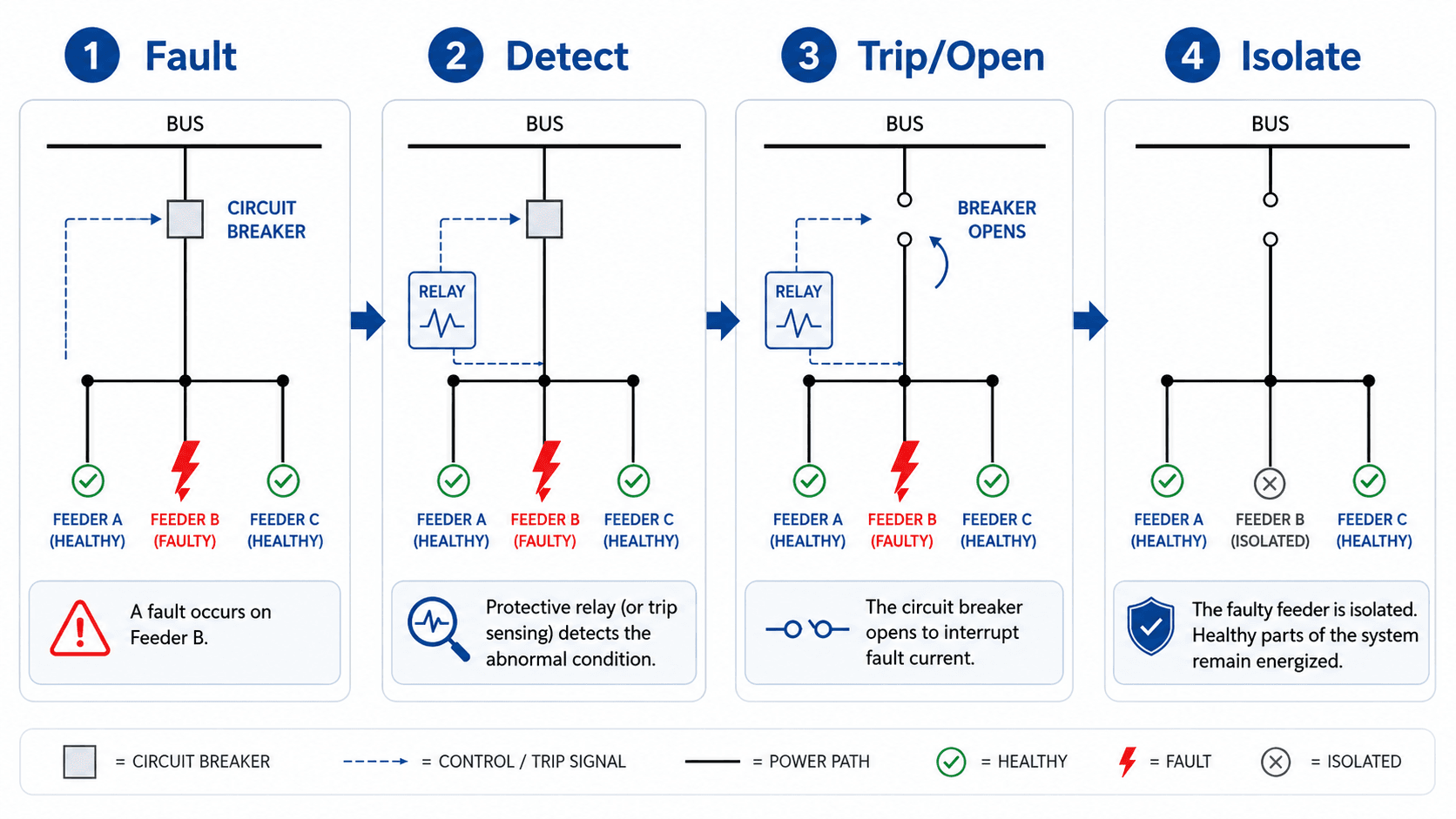
The switchgear itself does not decide every trip. Depending on voltage class and equipment, trip units or external protective relays process current/voltage measurements and command the breaker that should isolate the fault.
Low-Voltage LSIG Protection
Electronic low-voltage power-breaker trip units commonly provide some combination of long-time (L), short-time (S), instantaneous (I), and ground-fault (G) functions. Those settings determine overload protection, fault clearing speed, selective coordination, and often arc-flash incident energy.
Medium-Voltage Protective Relays
MV metal-clad switchgear commonly uses numerical relays supplied by CTs and VTs. Typical functions can include 50/51 overcurrent, 50N/51N ground, 67 directional overcurrent, 27/59 voltage, 81 frequency, 87 differential, breaker failure, synch-check, and communications-assisted logic depending on the protected equipment.
Selective Coordination
A good protection design allows the downstream device nearest a fault to clear before unnecessary upstream devices trip, when the application and required selectivity permit it. Engineers compare time-current curves, instantaneous pickups, relay delays, short-time withstand, equipment damage curves, and fault-current ranges—not just one pickup number.
Adding intentional delay can improve selective coordination but increase fault-clearing time and arc energy. Faster settings can reduce incident energy but may cause a larger upstream outage. Settings should be optimized as a system.
Arc-Resistant Switchgear and Arc-Flash Risk
Arc-resistant and arc-flash safe are not the same thing. Arc-resistant switchgear is tested to manage the products of an internal arcing fault under specified conditions. It does not eliminate arc-flash hazard, and its protection depends on the tested equipment configuration and how it is installed and operated.
IEEE C37.20.7 Internal-Arcing Tests
IEEE C37.20.7-2024 is the active recommended practice for testing switchgear rated up to 52 kV for internal arcing faults. It establishes test/evaluation procedures and methods for identifying the equipment’s internal-arcing capability.
What Can Invalidate the Protection Assumption?
- Doors or covers not secured as required by the tested configuration
- Incorrect plenum, duct, exhaust, or room installation
- Operating outside the specified accessibility configuration
- Unapproved modifications to compartments or ventilation
- Equipment damage or maintenance condition inconsistent with the tested design
Arc-Energy Reduction
Protection schemes may use maintenance switches, zone-selective interlocking, bus differential, high-speed relays, optical arc detection, or other energy-reduction methods to shorten clearing time. The final strategy should be evaluated with the facility’s arc-flash study and equipment design.
Switchgear Maintenance, Testing, and Failure Modes
Switchgear reliability changes with age and condition. A lineup that was properly rated at installation may still fail to operate correctly if breaker mechanisms, bus joints, cable terminations, insulation, control wiring, or protective devices deteriorate.
| Check | What it can reveal | Why it matters |
|---|---|---|
| Visual / mechanical inspection | Contamination, corrosion, loose parts, shutter/interlock condition | Prevents mechanical and insulation failures |
| Thermography | Hot bus joints, breaker stabs, cable terminations | Finds high-resistance connections under load |
| Breaker timing / mechanism test | Slow or inconsistent opening/closing | Clearing time affects equipment damage and arc energy |
| Primary / secondary injection | Trip pickup/timing and protection-chain performance | Confirms settings and operating logic |
| Insulation / partial-discharge evaluation | Degraded insulation, contamination or MV termination problems | Detects developing dielectric failure |
| Control-power test | Trip/close coil, relay, battery/charger or AC control issues | A fault cannot be cleared if the trip chain has no dependable control power |
| Relay/event review | Misoperations, abnormal currents, breaker performance | Supports root-cause and setting verification |
Swipe horizontally to view all table columns.
Common Switchgear Failure Modes
Recurring failure mechanisms include loose bus connections, damaged or contaminated insulation, failed breaker mechanisms, cable-termination distress, loss of control power, incorrect relay settings, aging components, moisture ingress, animal/debris intrusion, and undocumented field modifications.
An energized lineup is not proof of a healthy lineup. The critical test is whether the correct breaker can open fast enough on the next fault and whether the bus, insulation, controls, and protection system remain within their actual duty and condition limits.
Switchgear Selection and Engineering Review Checklist
| Review item | Verify | Risk if missed |
|---|---|---|
| Voltage / insulation | Rated maximum voltage, BIL/dielectric withstand, grounding system | Insulation failure or misapplication |
| Continuous current | Main bus, tie bus, feeder breakers, load growth, ambient | Overheating and reduced life |
| Fault duty | Available symmetrical/asymmetrical current and equipment ratings | Breaker or assembly unable to clear/withstand fault |
| Protection | Trip-unit/relay functions, CT/VT ratios, coordination, breaker failure | Wrong device trips or fault remains energized |
| Arc-flash | Arcing current, clearing time, labels, energy-reduction features | Personnel risk underestimated |
| Arc-resistant design | Accessibility type, plenum/duct, doors, installation configuration | Internal-arc performance assumption invalid |
| Control power | AC/DC source, battery/charger, trip/close circuits, supervision | Breaker cannot operate on command |
| Cable interfaces | Termination type, bend radius, shield grounding, compartment space | Termination failure or poor maintainability |
| Maintainability | Drawout/racking, isolation, shutters, access, spares, obsolescence | Unsafe or extended outage during maintenance |
| Documentation | One-line, settings, labels, schematics, manuals, test records | Unsafe switching or incorrect troubleshooting |
Swipe horizontally to view all table columns.
Switchgear Engineering References
- IEEE C37.20.2-2025 — Standard for Metal-Clad Switchgear Current IEEE standard covering compartmentalized metal-clad MV switchgear with drawout electrically operated circuit breakers, including ratings, insulation, temperature limitations, tests, and application.
- IEEE C37.20.7-2024 — Testing Switchgear for Internal Arcing Faults Active recommended practice for testing and evaluating internal-arcing performance of switchgear rated up to 52 kV.
- IEEE C37.13-2024 — Low-Voltage AC Power Circuit Breakers Used in Enclosures Active low-voltage power-circuit-breaker standard covering enclosed AC breakers through 1058 V and their service conditions, ratings, tests, and application.
- OSHA — Protecting Employees from Electric-Arc Flash Hazards Worker-safety context for arc-flash hazards, energized electrical work, hazard assessment, and protective practices around equipment such as switchgear.
Frequently Asked Questions
What is electrical switchgear?
Switchgear is an assembly of switching, interrupting, protection, metering, control, bus, grounding, and enclosure components used to distribute power and isolate electrical faults.
What is the difference between switchgear and a circuit breaker?
A circuit breaker is one interrupting device. Switchgear is the complete assembly containing breakers or switches plus busbars, relays or trip units, CTs/VTs, cable terminations, controls, grounding, and enclosures.
What is the difference between switchgear and a switchboard?
Both distribute and protect low-voltage power, but power switchgear is generally built around higher-duty power circuit breakers and greater compartmentalization/maintainability, while switchboards commonly use molded-case or insulated-case devices in a different assembly construction. The exact distinction depends on the applicable equipment standard.
What is metal-clad switchgear?
Metal-clad switchgear is a specific medium-voltage construction in which major components such as the breaker, main bus, instrumentation, and incoming/outgoing connections are separated by grounded metal barriers. IEEE C37.20.2-2025 governs this equipment category.
What is arc-resistant switchgear?
Arc-resistant switchgear is tested to direct or contain the effects of an internal arcing fault under specified conditions and accessibility arrangements. It does not eliminate arc-flash hazard and depends on correct installation and equipment condition.
What ratings are most important on switchgear?
Key ratings include maximum voltage, continuous current, breaker interrupting capability, assembly short-circuit/withstand rating, peak or momentary withstand, insulation/BIL where applicable, control voltage, enclosure/environmental rating, and internal-arcing classification when provided.
Why does switchgear need maintenance?
Breaker mechanisms, bus joints, cable terminations, insulation, relays, trip circuits, interlocks, and control power can degrade over time. Maintenance verifies that the equipment can still operate as required during a fault.
What causes switchgear to fail?
Common contributors include loose or overheated connections, insulation contamination, cable-termination problems, breaker mechanism failure, moisture, aging components, loss of control power, relay-setting errors, debris or animal intrusion, and fault duty beyond equipment ratings.
Where is switchgear used?
Switchgear is used in substations, utilities, industrial plants, commercial buildings, data centers, campuses, renewable-energy facilities, battery-storage plants, generating stations, and other systems requiring controlled power distribution and fault isolation.
Summary and Next Step
Electrical switchgear is a complete protection and distribution assembly, not simply a cabinet containing breakers. Its value comes from combining bus, interrupting devices, protection, metering, controls, grounding, cable interfaces, isolation, and operating logic into one coordinated system.
The highest-value engineering checks are voltage class, continuous current, fault duty, breaker/assembly ratings, protection settings, selective coordination, arc-flash clearing time, arc-resistant installation requirements, control-power reliability, maintenance condition, and documentation accuracy.