
Direct Answer
Fastener design is the engineering of the entire joint—not merely the choice of bolt diameter or grade. A reliable bolted joint must create and retain enough preload, transfer tension and shear through a deliberate load path, protect the internal and external threads, resist separation, slip, fatigue, loosening, corrosion, and local material failure, and still be manufacturable, inspectable, and serviceable.
For a practical mechanical joint, start by defining what the connection must do. Then calculate the external loads and eccentricity, choose the joint architecture and fastener family, establish a preload/assembly strategy, check bolt and parent-material failure modes, verify thread engagement and bearing areas, address fatigue and vibration, and finally specify the hardware, lubrication/coating condition, tightening method, sequence, locking features, and inspection criteria on the drawing or work instruction.
Fastener Design Workflow: What to Check Before Choosing a Bolt
The most useful fastener-design question is not “What bolt size should I use?” It is “How must this joint carry load without slipping, separating, stripping, loosening, or becoming impossible to assemble and inspect?”
Joint function, external tension and shear, eccentricity/prying, fatigue duty, clamped materials, temperature, vibration, corrosion, access, and whether the joint may slip or separate.
Fastener architecture, diameter/quantity, grip length, material/grade, preload, thread engagement, washers/bearing area, locking strategy, and load-sharing method.
Bolt tension, shear, combined loading, joint separation, slip, thread stripping, bearing, pull-through, edge failure, fatigue, preload loss, corrosion, manufacturability, and assembly control.
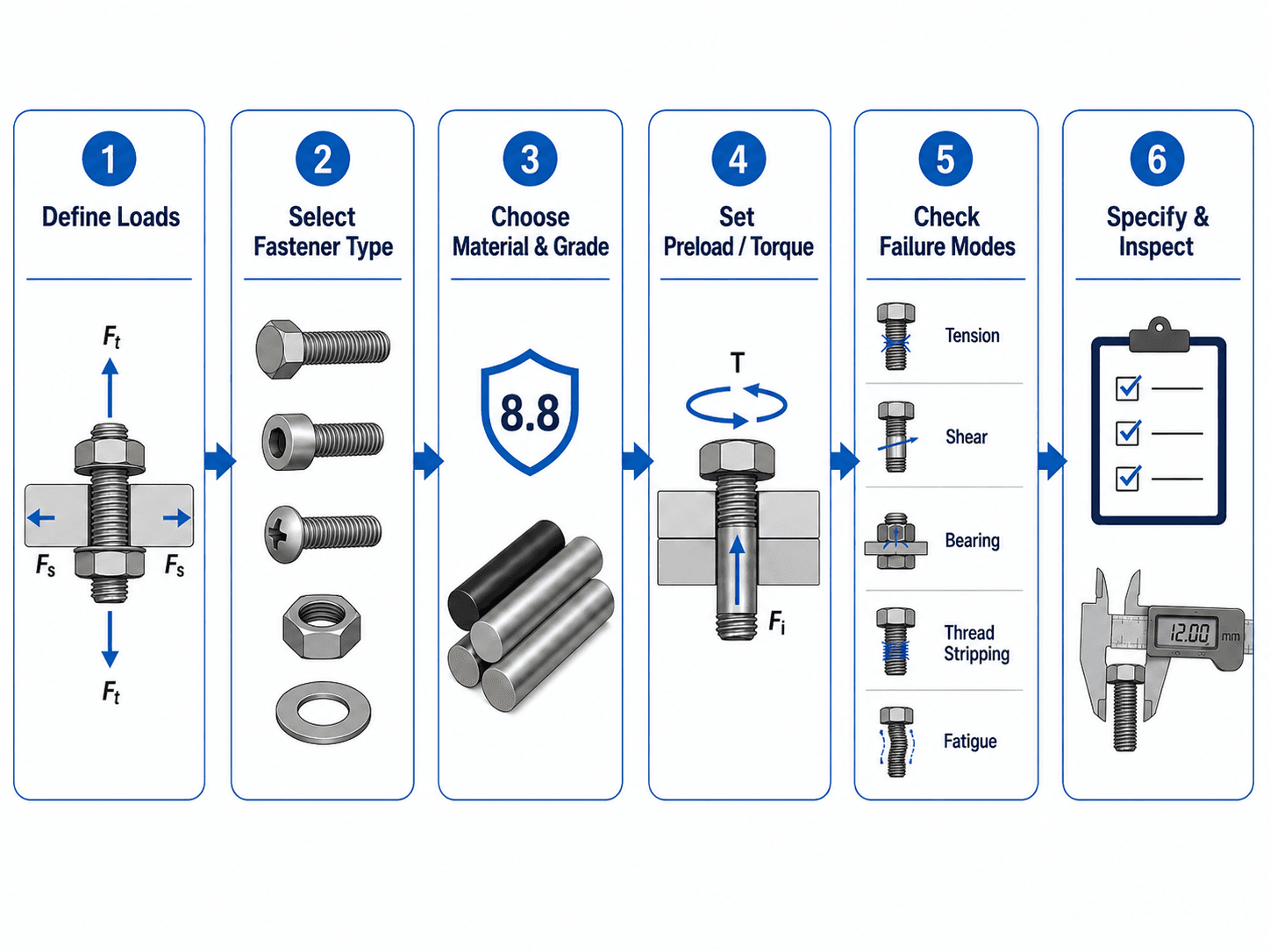
-
Define the joint function and failure consequences.
Determine whether the joint must clamp, seal, locate, transmit shear by friction, permit service, maintain alignment, or remain permanent. Identify what happens if it slips, opens, or loses preload.
-
Resolve the real load path.
Include direct tension, direct shear, moment, prying, eccentricity, cyclic load, thermal load, impact, vibration, pressure, and any preload-sensitive gasket or interface behavior.
-
Choose the joint architecture and preload method.
Decide through-bolt vs. tapped hole vs. stud/insert, fastener count and spacing, washer/bearing details, whether slip is permitted, and how clamp force will be created and controlled.
-
Close every failure mode and release detail.
Check the fastener, threads, parent material, clamped parts, fatigue, vibration, corrosion, assembly access, tightening sequence, inspection, and service replacement rules before release.
Keep the joint compressed and stable whenever the function allows it. A preloaded joint that remains clamped can experience a much smaller cyclic bolt-load range than an open or slipping joint, which is one reason preload and joint stiffness are central to fatigue-resistant fastener design.
Engineering basis: NASA Reference Publication 1228 — Fastener Design Manual treats temperature, corrosion, vibration, fatigue, initial preload, materials, finishes, lubricants, locking methods, washers, inserts, threads, and torque as interacting fastener-design concerns rather than isolated checks.
How a Preloaded Bolted Joint Actually Carries Load
Tightening stretches the bolt and compresses the joint members. External tensile load is then shared between additional bolt tension and loss of member compression until the joint approaches separation.
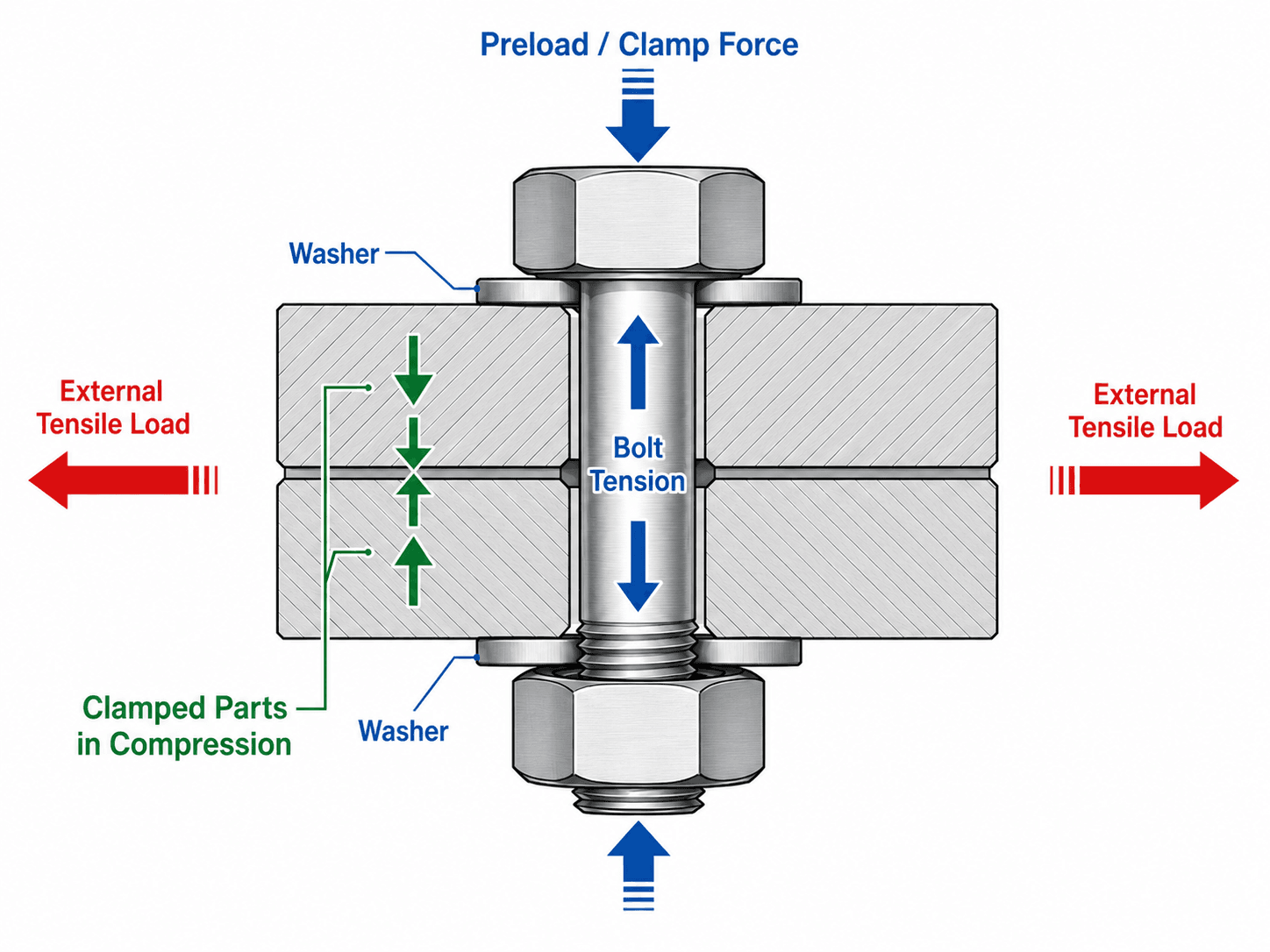
Bolt stiffness and member stiffness control load sharing
In the simplest linear spring model, the bolt and clamped members have effective stiffnesses. A useful stiffness fraction is:
- CjSimplified fraction of a centrally introduced external tensile load that increases bolt tension while the joint remains closed.
- kbEffective bolt stiffness over the tensile load path.
- kmEffective stiffness of the clamped members in the compressed load path.
In this simplified model, a stiffer clamped joint and a more compliant bolt produce a smaller Cj. That can reduce cyclic bolt-load variation. Real joints can deviate because load introduction is not always centered, member geometry is not a simple cone, interfaces settle, and contact regions change with load.
External tensile load increases bolt load and reduces clamp load
For a simplified centrally loaded joint that remains in contact:
This is the key concept: before separation, an external tensile load can mostly unload the compressed joint while only a fraction increases bolt tension. Once clamp load is exhausted locally, the load path changes and the simple linear relationship is no longer adequate.
Load-introduction location matters
NASA’s recent preloaded-joint research emphasizes that bolt tensile load and separation are influenced by where external load enters the clamped members and by the associated load-path stiffness. Therefore, the simple Cj model is educational and useful for preliminary design, but eccentric brackets, flanges, lugs, flexible plates, and prying joints may require a more detailed spring model, finite-element contact analysis, test data, or a validated industry method.
A bracket or flange can amplify fastener tension when the external force acts away from the joint interface and flexible material pries against the bolt. Do not divide an overturning moment equally among bolts without checking joint geometry and stiffness.
Preloaded-joint mechanics: NASA TM-106943 — Preloaded Joint Analysis Methodology for Space Flight Systems compiles basic equations for preloaded joints and common failure modes, while NASA — Mechanics of Preloaded Bolt Tensile Loading With Focus on Load Introduction Factor shows why external load introduction and load-path stiffness affect bolt tensile loading.
Choose the Joint Architecture Before the Fastener Grade
The best fastener type depends on access, serviceability, parent-material strength, joint thickness, load path, corrosion, production method, and how often the connection will be assembled.
| Joint Architecture | Good Fit | Primary Advantage | Key Failure / Design Check | Avoid or Reconsider When |
|---|---|---|---|---|
| Through bolt + nut | Both sides accessible; removable/serviceable joints. | Strong replaceable threads independent of parent material. | Grip length, washer/bearing area, nut engagement, tool clearance, protruding threads. | Back side is inaccessible or installation space is severely limited. |
| Cap screw into tapped hole | Blind-side installation, compact housings, machinery with controlled parent material. | Clean one-sided assembly. | Thread stripping, usable engagement, blind-hole depth, drill point, bottoming, repeated service. | Parent material is weak/thin or threads will be serviced frequently without an insert strategy. |
| Stud + nut | Frequently opened housings, hot joints, precision alignment, or parent threads that should remain undisturbed. | Repeated service occurs at the replaceable nut end. | Stud installation, parent-thread engagement, exposed length, nut engagement, corrosion. | Stud protrusion creates clearance or snag hazards. |
| Threaded insert | Aluminum, magnesium, plastic, composite, repair-prone, or repeatedly serviced tapped joints. | Improves durable internal-thread interface. | Insert pull-out, parent-material breakout, installation quality, locking, and replacement. | Boss geometry or parent material cannot support insert loads. |
| Rivet / permanent fastener | Thin sheet, high-rate production, permanent joints. | Fast installation without torque-controlled threads. | Hole quality, bearing, pull-through, sheet distortion, access, inspection. | Joint requires repeated service or adjustable preload. |
| Dowel/pin + clamping fasteners | Joint requires accurate location or repeatable shear transfer independent of clearance bolts. | Separates locating/shear function from clamp-force function. | Pin fit, hole tolerance, edge distance, fretting, assembly, differential expansion. | Overconstraint or tolerance stack makes assembly unreliable. |
Swipe horizontally to view all table columns.
Fastener strength is only one part of material selection
Higher-strength fasteners can support greater preload and bolt stress, but they can also increase parent-material bearing stress, thread-stripping demand, hydrogen-embrittlement sensitivity for some plated high-strength steels, galling risk for some stainless combinations, and installation sensitivity. Select grade/property class, alloy, coating, and lubrication as a system.
Grip length changes stiffness and fatigue behavior
A longer elastic grip can make the bolt more compliant relative to the joint, which can reduce the fraction of external cyclic tensile load entering the fastener in appropriate preloaded configurations. Avoid unnecessary threads in the grip or shear plane when a suitable partially threaded fastener is available.
Multi-fastener patterns need a load-sharing model
Do not assume N bolts always divide load into exactly P/N. Eccentric loads, prying, plate flexibility, hole clearance, manufacturing tolerance, and uneven preload can create nonuniform fastener loading. The joint geometry should determine how direct force and moment are distributed.
Bolt Preload, Tightening Torque, and Assembly Control
Preload is the tensile force intentionally established in the fastener during tightening. Torque is only one indirect method of creating that force. Friction at the threads and under the rotating bearing surface consumes much of the applied torque and creates substantial preload scatter.
Simplified torque–preload estimate
A common preliminary relationship is:
- TApplied tightening torque, e.g. N·m or lbf·in.
- KEmpirical nut factor representing thread and bearing-surface friction for the actual hardware condition.
- FiTarget initial preload/clamp-force magnitude.
- dNominal fastener diameter, in a unit consistent with the torque calculation.
NASA-STD-5020B’s public appendix explicitly treats preload from torque control as a statistical distribution and gives the nominal relationship in equivalent form, preload = T/(KD), while requiring preload variation to be considered for NASA spaceflight applications. That is an important general lesson even outside aerospace: a single torque value does not produce one exact preload.
Do not move a torque value from a dry plain fastener to a lubricated, plated, coated, prevailing-torque, reused, or anti-seize-treated joint without validated data. Lower friction can produce much higher preload at the same applied torque.
Choose the tightening method from required preload accuracy
Torque control
Best fit: General mechanical assemblies where moderate preload accuracy is acceptable and friction condition is controlled.
Tradeoff: Preload scatter is strongly influenced by thread and bearing friction.
Verify: Hardware condition, lubrication/coating, tool calibration, prevailing torque, tightening sequence, and any reuse policy.
Turn / angle control
Best fit: Applications with a defined snug condition and joint/fastener behavior suitable for rotation-based control.
Tradeoff: Requires a validated procedure and appropriate joint geometry; not a universal substitute for torque.
Verify: Snug definition, rotation, hardware condition, grip, and governing assembly specification.
Bolt stretch / tension measurement
Best fit: Critical joints where direct or indirect bolt elongation/tension measurement materially improves preload control.
Tradeoff: More instrumentation, access, calibration, and procedure control.
Verify: Effective length, elastic properties, measurement method, accessibility, and temperature.
Hydraulic tensioning
Best fit: Large studs/bolts and specialized flange or structural assemblies.
Tradeoff: Requires dedicated equipment and allowance for load transfer/set-down after tensioner release.
Verify: Tool access, residual preload, sequence, and governing procedure.
For general SAE/metric reference values and a transparent nut-factor sensitivity tool, use the Turn2Engineering Bolt Torque Chart & Preload Calculator. Its values are calculated starting estimates, not substitutes for an equipment manufacturer, structural specification, flange procedure, or safety-critical tightening specification.
Current public requirement context: NASA-STD-5020B — Requirements for Threaded Fastening Systems in Spaceflight Hardware is active and was revalidated January 5, 2026. Its preload appendix discusses torque-control preload variation. The standard is specific to NASA spaceflight hardware and should not be presented as a universal industrial requirement.
Thread Engagement, Tapped Holes, and Thread-Stripping Risk
Enough thread engagement means the internal and external thread shear capacity supports the intended fastener load without stripping the tapped material, insert, nut, or bolt threads before the intended joint limit is reached.
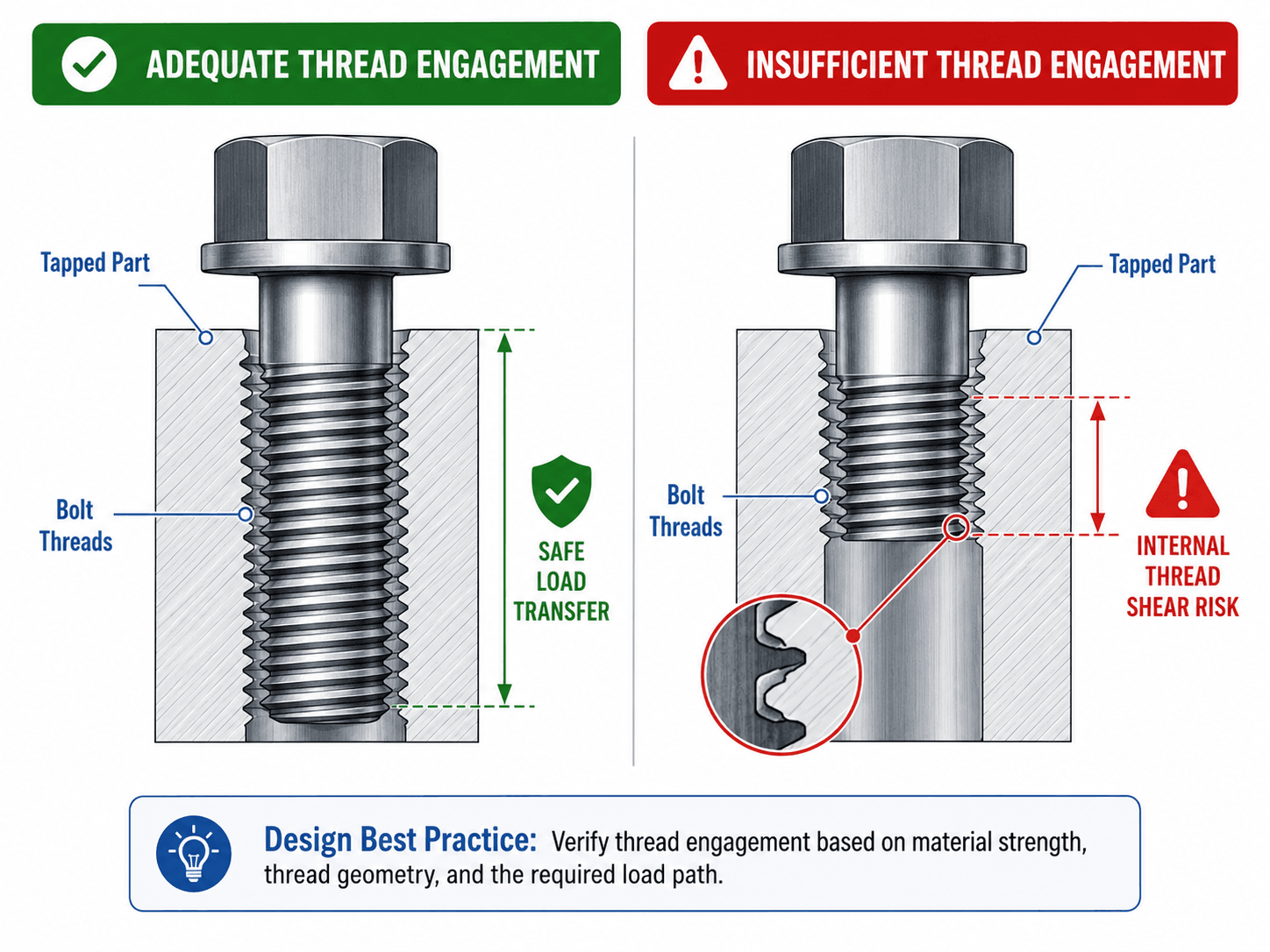
What must be checked in a tapped joint
| Check | Why It Matters | Typical Design Response | Common Error |
|---|---|---|---|
| Parent material strength | Soft aluminum, magnesium, plastic, composites, or weak cast material may strip before a high-strength bolt reaches its useful capacity. | Increase engagement/diameter, use an insert, improve boss geometry, or use a through bolt. | Upgrading bolt grade while leaving weak parent threads unchanged. |
| Usable full-thread depth | Chamfers, incomplete tap threads, drill-point clearance, and blind-hole bottom space reduce effective engagement. | Dimension usable thread and hole depth separately; prevent bottoming before clamp-up. | Calling out tapped depth equal to bolt penetration with no allowance for incomplete threads or debris. |
| Insert pull-out / breakout | An insert can move the weak link from thread stripping to parent-material pull-out. | Use manufacturer insert data and sufficient boss wall/edge material. | Assuming steel insert threads make a thin aluminum boss as strong as a steel nut. |
| Service cycles | Repeated installation can wear soft internal threads or damage coatings. | Use studs/inserts, define lubrication/replacement, or move the service interface to a replaceable nut. | Designing a frequently serviced aluminum tapped hole like a one-time assembly. |
| Thread class / tolerance | Fit affects assembly, plating allowance, galling risk, and thread geometry. | Use the governing thread standard and account for coating/plating. | Specifying a class without checking the finish and manufacturing process. |
Swipe horizontally to view all table columns.
Why there is no universal engagement multiple
Rules such as “one diameter in steel” or “two diameters in aluminum” can be convenient screening heuristics, but they are not universal design proof. Thread shear area, parent material allowable, fastener strength, pitch, engagement geometry, safety requirements, and inserts all matter. For a critical tapped joint, calculate or use a validated manufacturer/industry method for stripping capacity.
Keep threads out of a high-shear plane where practical
The threaded section has a smaller effective area and stronger stress concentration than the smooth shank. When direct bearing/shear transfer is intended, select grip and partially threaded fastener length so the smooth shank crosses the shear plane where feasible.
Thread-design basis: NASA Fastener Design Manual includes thread types/classes, inserts, materials, torque, fatigue, and fastener design criteria. Use current hardware standards and manufacturer data for final thread dimensions and product-specific capabilities.
Fastener and Joint Failure Modes You Must Check
A bolted connection is acceptable only when the fastener, threads, clamped members, interfaces, and assembly method all have adequate margin for the load cases and environment.
| Failure Mode | Mechanism | Evidence / Calculation | Design Lever |
|---|---|---|---|
| Bolt tensile overload | Preload + external tensile/bending load exceeds allowable fastener stress. | Tensile stress area, proof/yield/ultimate basis, preload scatter, external load, bending/prying. | Diameter/grade, quantity, geometry, preload strategy, load path. |
| Bolt shear | Shear force exceeds fastener/shank/thread shear capacity. | Shear-plane count/location, shank vs. threads, load distribution, combined tension. | Shank in shear plane, more/larger bolts, dowels, interface friction, geometry. |
| Combined tension + shear | Fastener experiences simultaneous axial and transverse stress. | Applicable interaction equation from governing design method/standard. | Load path, fastener count/size, preload, alignment, joint layout. |
| Thread stripping | Internal or external thread shear capacity is insufficient. | Thread shear area, engagement, parent/fastener material strengths, insert capability. | Engagement, diameter, insert, through bolt, material/boss design. |
| Bearing / hole elongation | Fastener bears into hole wall and locally crushes/deforms clamped material. | Bearing area, plate thickness/material, hole size, load direction. | Thickness, diameter, bush/dowel, washer/plate, load distribution. |
| Edge tear-out / breakout | Material shears between hole and free edge. | Edge distance, plate/boss thickness, material strength, load direction. | Increase edge distance/thickness, relocate bolt, add reinforcement. |
| Pull-through / embedment | Head/nut/washer crushes or pulls through thin/soft material. | Bearing pressure/contact area, washer hardness, local thickness, creep. | Larger/harder washer, load spreader, thicker material, insert/sleeve. |
| Joint separation | External tensile/prying load consumes clamp force locally. | Minimum preload, joint stiffness/load introduction, external load, prying/contact model. | Increase/retain preload, stiffen joint, relocate bolts/load, increase grip. |
| Joint slip | Transverse demand exceeds available interface friction or slip restraint. | Minimum clamp force, friction evidence, surface condition, transverse load. | Preload, interface treatment, dowels/shear keys, more bolts, geometry. |
| Fatigue | Cyclic tensile/bending stress initiates cracking at thread roots, runout, or under-head transitions. | Mean/alternating stress, preload, stiffness, load introduction, stress concentration, fatigue data. | Maintain clamp, compliant bolt/longer grip, rolled threads, geometry, load reduction. |
| Self-loosening / preload loss | Transverse slip, embedment, relaxation, creep, thermal cycling, or rotational loss reduces clamp force. | Joint slip, preload history, surface settling, locking method, temperature/duty. | Prevent slip, improve preload, control surfaces, locking feature, maintenance/inspection. |
| Corrosion / galling / embrittlement | Environment/material pairing degrades section, thread motion, or fastener ductility. | Material/coating process, galvanic couple, lubricant, temperature, exposure. | Compatible materials/coatings, isolation, lubricant, different fastener system. |
Swipe horizontally to view all table columns.
Vibration loosening is often a joint-slip problem
Locking devices can be useful, but they should not be used to hide an unstable joint. If transverse motion repeatedly slips the clamped interface, the connection can lose preload and experience fretting or self-loosening. First review clamp force, contact stiffness, grip, interface friction, bolt spacing, hole clearance, and joint deformation; then choose a locking strategy appropriate to the remaining risk.
Soft joints need relaxation and creep thinking
Gaskets, plastics, composites, paint, soft coatings, insulation, and thin sheets can embed or creep under clamp load. The preload immediately after tightening may not be the preload hours or months later. Use sleeves, harder bearing interfaces, controlled re-tightening, spring elements where validated, or different joint architecture when relaxation is material.
Corrosion and galling can change both strength and assembly behavior
Corrosion can reduce cross-section and lock threads; galvanic couples can attack the less noble material; and stainless threaded pairs can gall under unfavorable lubrication, surface, and installation conditions. Surface treatment also changes friction, so corrosion protection and torque/preload procedure must be developed together.
For broader load-path and fatigue methods, use the Turn2Engineering Stress Analysis guide.
Worked Example: Why Preload Reduces Bolt Load Cycling
Simplified centrally loaded joint
Assume a preloaded joint has an initial clamp force of 20 kN. A cyclic external tensile load rises from 0 to 8 kN. For this instructional example, the effective bolt stiffness fraction is Cj = 0.20 and the joint remains fully in contact. These values are assumptions chosen to demonstrate load sharing; they are not a design recommendation.
Calculate the increase in bolt tension
Only the stiffness-controlled fraction of the external load increases bolt tension in this simplified closed-joint model.
Calculate the loss of clamp force
The remaining portion of external load unloads the compressed joint members.
Interpret the fatigue implication
The important result is the bolt’s cyclic load range, not only the peak external joint load.
1.6 kN additional bolt load + 6.4 kN clamp reduction = the 8 kN applied external load.
The simple two-spring model can be inaccurate for eccentric load introduction, flexible flanges, changing contact, prying, and joints near separation.
Use minimum preload for separation/slip checks and maximum preload plus external load for fastener-strength checks under the governing method.
Senior Engineer Fastener Design Review Checklist
Use this release checklist after the preliminary joint has been sized. It is designed to catch the failures that a simple bolt-strength calculation misses.
- Joint function is explicit: The design states whether the connection clamps, seals, locates, transmits shear by friction or bearing, carries axial load, resists moment, or provides service access.
- Every external load case is represented: Direct tension/shear, eccentricity, prying, fatigue, pressure, vibration, thermal expansion, impact, and credible assembly loads are included.
- The load introduction is realistic: External forces enter the clamped members where the actual structure applies them; the bolt is not assumed to receive a convenient fraction without a stiffness/load-path basis.
- The fastener architecture matches access and service: Through bolt, tapped screw, stud, insert, rivet, dowel-assisted joint, or specialty fastener has a reason.
- Fastener quantity and pattern are justified: Bolt-group load sharing includes eccentricity, plate stiffness, prying, and hole clearances where material.
- Grip length is deliberate: Threads, washers, spacers, stack thickness, and shear-plane location are controlled; unnecessary threads are not placed in high-shear regions.
- Fastener material/grade is compatible with the joint: Proof/yield/ultimate strength, ductility, temperature, corrosion, coating, galling, and embrittlement risk are considered.
- Minimum and maximum preload are both considered: Minimum preload controls separation/slip risk; maximum preload can control bolt/parent-material overstress.
- The tightening method matches required accuracy: Torque, turn/angle, tension, elongation, or other method is supported by a validated procedure.
- Torque condition is fully specified: Lubricant/dry state, coating/plating, washer/bearing surface, prevailing torque, tool method, sequence, and reuse policy match the torque/preload basis.
- Thread engagement is calculated or otherwise validated: Internal and external thread strength, usable thread depth, insert pull-out, and parent-material breakout are checked.
- Blind holes cannot bottom before clamp-up: Bolt length, incomplete threads, chamfer, drill point, debris, and assembly tolerance leave adequate bottom clearance.
- Head/nut bearing surfaces are adequate: Washer diameter/hardness, local material thickness, embedding, pull-through, surface flatness, and countersink/counterbore details are checked.
- Joint separation and interface slip are checked where relevant: Minimum retained preload and interface friction/load path are adequate for required behavior.
- Bolt tension, shear, and interaction are checked: The governing design method uses the appropriate stress area, shear plane, allowable, preload, and external-load combination.
- Parent-material failures are checked: Hole bearing, edge tear-out, net section, pull-through, boss breakout, and insert pull-out cannot control unexpectedly.
- Fatigue is evaluated for cyclic joints: Alternating bolt load, mean stress, threads/runout, bending, preload retention, surface condition, and required life are addressed.
- Vibration strategy starts with joint stability: Slip, settling, stiffness, preload, and clamp length are reviewed before relying on a lock washer, adhesive, prevailing-torque feature, or safety wire.
- Thermal and soft-joint relaxation are addressed: Differential expansion, gasket/paint/plastic creep, embedment, and retorque requirements are included where material.
- Corrosion and galling are controlled: Material pair, coating, isolation, lubricant, environment, drainage/water traps, and future disassembly are considered.
- Manufacturing tolerances support assembly: Hole location, clearance, washer seating, countersinks, perpendicularity, stack height, and tool access are verified.
- The drawing/work instruction is complete: Fastener designation, grade/property class, length, finish, nut/washer/insert, lubricant, tightening requirement, sequence, locking feature, and inspection are stated where necessary.
- Service and replacement are defined: Reuse limits, replacement hardware, witness marks, inspection interval, access, and torque/tension procedure are practical in the field.
Do not release a critical fastened joint when the preload range is unknown, thread engagement is based only on a rule of thumb, an eccentric load is being divided equally among bolts without justification, the tightening procedure omits friction condition, or the connection depends on a locking device to compensate for an unresolved slip/separation problem.
The bolt group, hole locations, access, washer seats, and tolerances should also be reviewed through Design for Manufacturing and, where accumulated variation affects assembly, Tolerance Stack Up Analysis.
Fastener Design Engineering References
This page provides general mechanical-design guidance. Safety-critical aerospace, structural, pressure-boundary, lifting, automotive, medical, rotating-equipment, and other governed applications can have application-specific fastener standards and qualification requirements that supersede generic methods.
- NASA — Fastener Design Manual, Reference Publication 1228 Foundational public engineering reference covering fastener materials, finishes, lubricants, corrosion, locking methods, washers, inserts, threads/classes, fatigue, torque, and bolted-joint design considerations.
- NASA — NASA-STD-5020B, Requirements for Threaded Fastening Systems in Spaceflight Hardware Active NASA standard, revalidated January 5, 2026, for threaded fastening systems in spaceflight hardware. Used here specifically as a modern primary source on preload variation and fastener analysis concepts; its requirements are not generalized to ordinary industrial hardware.
- NASA — Preloaded Joint Analysis Methodology for Space Flight Systems, TM-106943 Compiles basic preloaded-joint equations and common failure modes; NASA notes that the fundamentals are applicable beyond spaceflight mechanical design even though the report’s original purpose was space hardware.
- NASA — Mechanics of Preloaded Bolt Tensile Loading With Focus on Load Introduction Factor Modern technical treatment of how load-introduction location and load-path stiffness influence bolt tensile loading and separation predictions.
- ASME — The Bolted Joint ASME training description covering bolted-joint mechanics, optimum assembly preload, bolt torque/stretch calculations, and assembly-method selection.
Frequently Asked Questions
What is the most important part of fastener design?
The most important step is defining the joint load path and function before choosing hardware. Bolt strength matters, but preload, joint stiffness, thread strength, parent-material failure, vibration, corrosion, and assembly control often determine whether the connection is reliable.
Is bolt torque the same as preload?
No. Torque is the applied turning moment; preload is the tensile force created in the fastener and corresponding clamp force in the joint. Thread and under-head/nut friction consume much of the torque, so friction variation creates preload scatter.
How much thread engagement is enough?
There is no universal engagement multiple that is correct for every fastener. Required engagement depends on thread geometry, nominal diameter and pitch, fastener strength, internal-thread material strength, insert/boss geometry, load, service cycles, and safety requirements. Critical tapped joints should be checked for thread stripping rather than relying only on a rule of thumb.
Why does preload help bolt fatigue life?
While a preloaded joint remains clamped, only part of an external tensile-load change normally becomes additional bolt tension; the rest unloads the compressed members. That can reduce the bolt’s alternating stress range. The benefit depends on joint stiffness, load introduction, preload retention, and keeping the joint from separating.
Why do fasteners loosen under vibration?
Vibration-related loosening can involve transverse slip, embedment, settling, relaxation, loss of clamp force, and relative motion in the joint. A locking feature can help in the right application, but the design should first address preload, slip, stiffness, grip length, interfaces, and the underlying vibration/load path.