
Direct Answer
Shaft design is the process of laying out, sizing, and detailing a rotating member so it can transmit torque, support gears or pulleys, resist bending and fatigue, maintain alignment, and operate away from damaging vibration conditions.
A reliable shaft is not sized from torque alone. Engineers map the complete load path, calculate bearing reactions and bending moments, check combined stress and fatigue at shoulders or keyways, verify deflection and critical speed, then coordinate fits, bearings, couplings, materials, manufacturing, assembly, and inspection. For the broader context, see the Mechanical Design guide.
Shaft Design Process: From Machine Layout to Release
A good shaft design begins with the machine arrangement, not with an isolated diameter equation. The shaft, bearings, gears, pulleys, couplings, seals, spacers, and retaining features form one load-bearing system.
Power, speed, duty cycle, component locations, support spacing, external loads, interfaces, and operating environment.
Torque flow, gear or belt forces, bearing reactions, bending moments, local stresses, fatigue demand, deflection, and critical speed.
Diameters, shoulders, fillets, fits, keyways or splines, material, surface finish, heat treatment, tolerances, assembly, and inspection.
-
Define operating requirements.
Establish power, RPM, torque direction, starts and stops, reversals, shock, expected life, environment, and any alignment or vibration limits.
-
Lay out the shaft and supports.
Place bearings, gears, pulleys, sprockets, couplings, seals, spacers, shoulders, grooves, and torque-transfer features in their actual axial positions.
-
Build the load model.
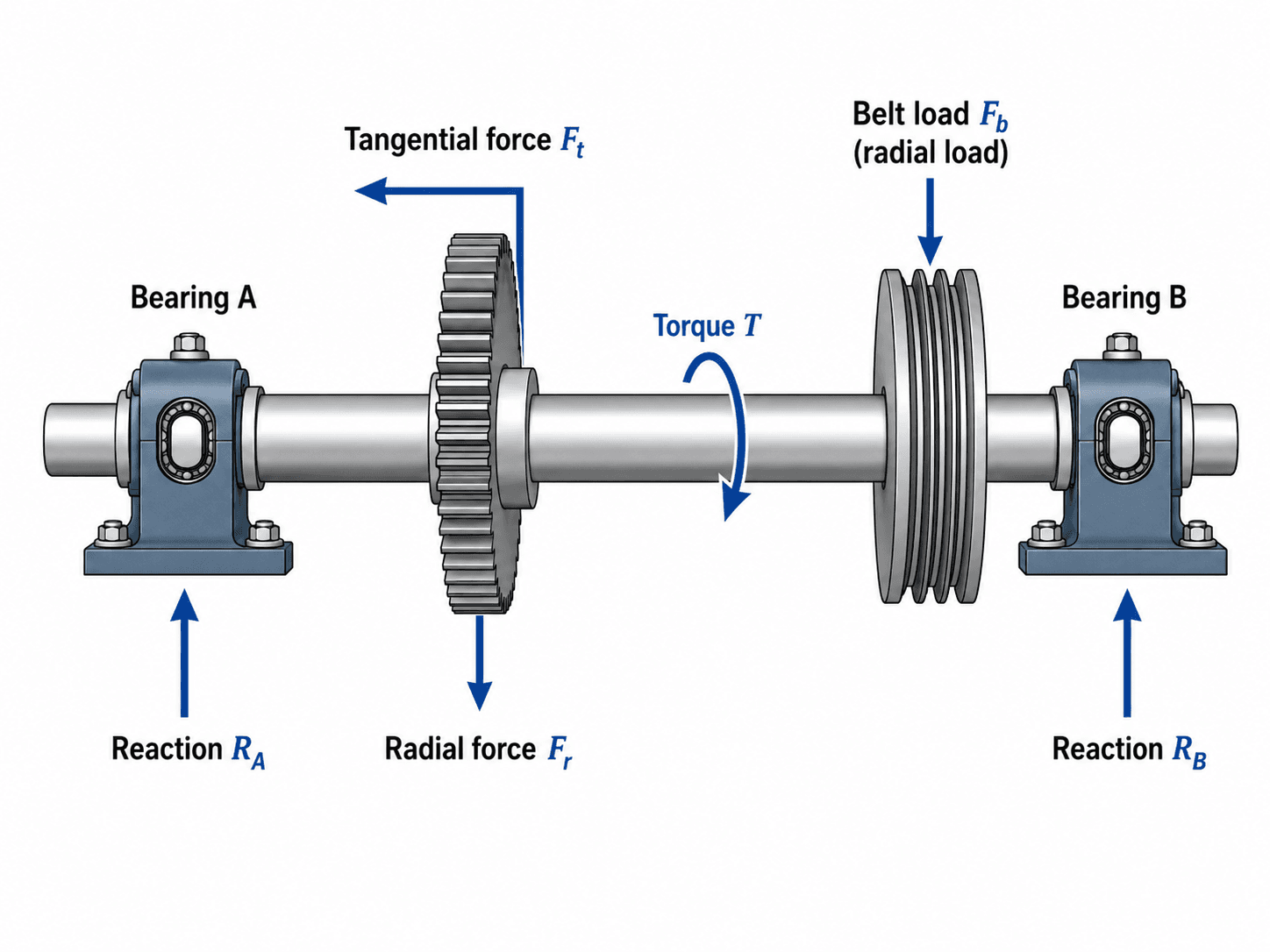
Calculate component forces and bearing reactions in each required plane, then create bending-moment and torque diagrams along the shaft.
-
Size critical sections.
Use preliminary static sizing, then check fatigue and stress concentration at shoulders, grooves, keyways, splines, cross-holes, and other discontinuities.
-
Verify stiffness and dynamics.
Check shaft deflection, slope, torsional twist, bearing alignment, gear mesh sensitivity, and critical speed where the application requires them.
-
Detail for manufacture and service.
Coordinate standard bearing and hub sizes, fits, fillet clearances, surface finish, heat treatment, assembly sequence, inspection, and maintenance access.
Key Takeaways
- Torque-only sizing is incomplete: bending, fatigue, deflection, fits, and vibration often control the final diameter.
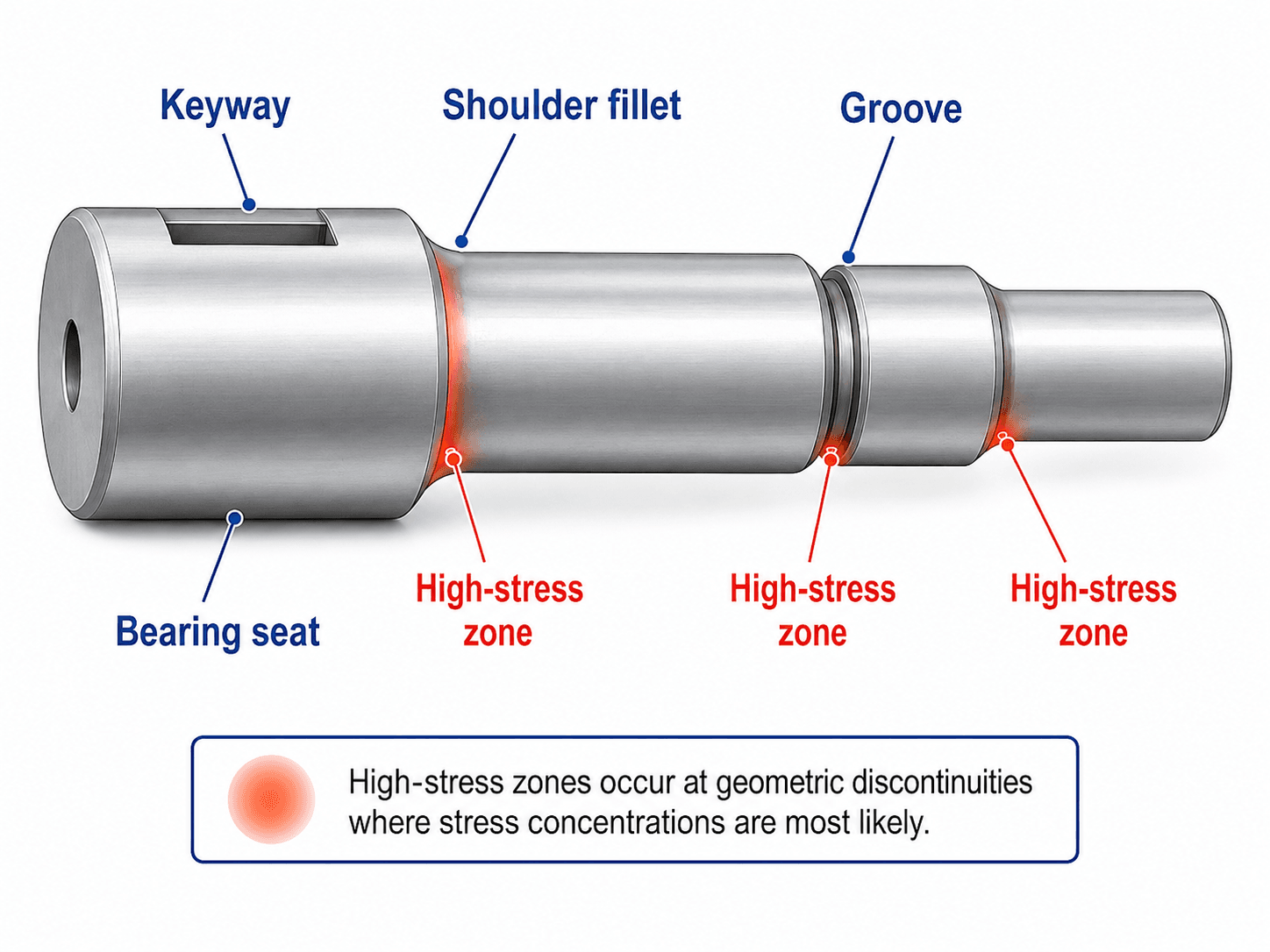
- Critical sections are local: shoulders, keyways, grooves, bearing seats, and overhung-load regions can govern even when the nominal shaft stress is modest.
- A shaft is part of a system: bearing spacing, gear or pulley location, coupling alignment, hub geometry, manufacturing, and maintenance can be more effective design levers than simply choosing a stronger steel.
Shaft Loads, Bearing Reactions, and Critical Sections
The most important input to shaft sizing is the actual load distribution along the shaft. Power and RPM determine torque, but mounted components determine where bending and axial loads enter the system.
Use transmitted power and shaft speed to establish torque at each drivetrain segment. Account for startup, jam, shock, or reversing conditions when credible.
Force directions depend on gear type and mesh geometry. Spur gears generate tangential and radial components; helical gearing also creates axial thrust.
Pulley and sprocket loads can create large bending moments, especially when mounted outside the bearing span.
Support spacing controls reaction forces, bending moment, deflection, and slope. Small layout changes can materially reduce shaft demand.
Mass distribution matters for gravity deflection, dynamic response, and critical-speed behavior in higher-speed systems.
Record the local diameter and geometry at every feature because the critical fatigue section may not coincide with the maximum nominal bending moment.
Resolve loading in the required planes
Gear and belt forces rarely align in one convenient plane. Calculate bearing reactions and bending moments in orthogonal planes, then combine the resulting bending moments at each axial station. This prevents a visually small force component from being omitted simply because it is out of the main sketch plane.
Watch overhung loads
A pulley, coupling, impeller, or gear outside the bearing span creates an overhung moment. Reducing that overhang or moving a bearing closer to the component can reduce both bending stress and deflection without changing material. That is often a better system-level fix than increasing the shaft diameter everywhere.
Before running a diameter calculation, sketch every bearing, mounted component, axial location, load direction, shoulder, keyway, groove, and torque path. A precise equation cannot compensate for an incomplete free-body diagram.
Shaft Sizing Formulas for Torque, Bending, and Combined Stress
These equations are useful for preliminary sizing of solid circular shafts. They do not replace fatigue, notch, deflection, fit, or dynamics checks, and the units must remain consistent throughout.
Torque from power and speed
If power is in kilowatts and speed is in rpm, a convenient SI form is:
Nominal bending and torsional stress
Preliminary combined static stress
- PTransmitted power. Use watts with rad/s in the base SI relationship, or kW in the 9550 convenience form.
- NRotational speed in revolutions per minute.
- TTorque at the shaft section being checked. Use N·m with meters or N·mm with millimeters consistently.
- MResultant bending moment at the same shaft section.
- dLocal solid shaft diameter.
- σeqEquivalent static stress for a preliminary combined bending-and-torsion check.
Engineering meaning: The diameter that satisfies nominal combined stress is a trial diameter. The final geometry still needs local fatigue, stress-concentration, stiffness, bearing-interface, manufacturing, and dynamic verification.
For related calculations, use the Torque Calculator or review the broader Stress Analysis guide.
Shaft Fatigue, Keyways, Shoulders, and Stress Concentrations
Fatigue often controls rotating shafts because a material point can experience repeated or fully reversed bending even when the external transverse load is steady in space.
Why steady transverse load can create alternating bending
Consider a shaft carrying a pulley load that is fixed vertically. The bending moment direction remains fixed in space, but each material point on the rotating shaft moves from tension to compression and back again once per revolution. That is why a seemingly steady external load can produce an alternating bending stress cycle in the shaft material.
Keyways and torque-transfer features
A keyway removes material and introduces notch geometry. The shaft, key, and hub should be treated as separate but interacting design checks: the shaft is affected by stress concentration and fatigue; the key sees shear and bearing load; and the hub must have sufficient material and engagement to transfer torque without fretting, crushing, or cracking. Splines, clamping hubs, press fits, and other connections shift the details but do not eliminate the need for local review.
Shoulders, fillets, and bearing seats
Shoulders locate bearings and hubs, but a small fillet radius can create a high local stress. Increasing the fillet radius generally reduces the theoretical stress concentration, but the radius must still clear bearing chamfers, spacers, seals, and mating component geometry. Relief grooves and undercuts can improve assembly or grinding access while introducing their own notch effects.
Fatigue strength is not a single material number
Practical shaft fatigue calculations can depend on surface condition, size, material strength, temperature, reliability, mean stress, notch sensitivity, and load spectrum. The exact method depends on the governing standard, design reference, company practice, and failure consequence.
The current DIN 743 series treats shaft and axle load capacity in dedicated parts. DIN 743-2 covers size and surface influences, theoretical stress concentration factors, and fatigue notch factors; DIN 743-3 provides material strength values; and DIN 743-4 covers fatigue/endurance under damage-equivalent stress amplitudes: DIN 743-2, DIN 743-3, and DIN 743-4.
Shaft Deflection, Alignment, Torsional Twist, and Critical Speed
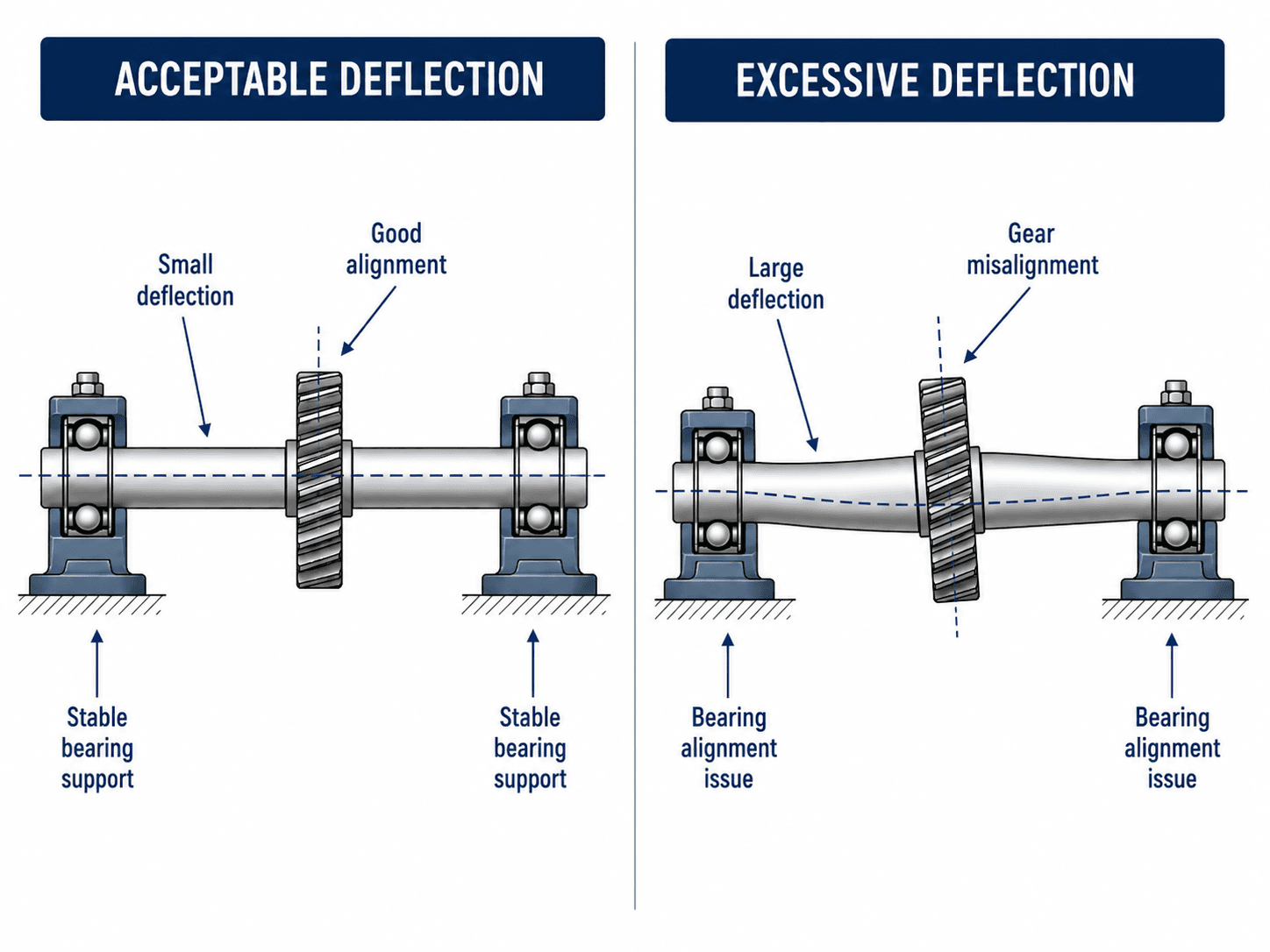
A shaft can pass every static stress check and still be unacceptable because excessive deflection, slope, twist, or resonant vibration damages bearings, seals, gears, couplings, or the driven process.
Deflection and slope
Deflection is the displacement of the shaft centerline under load; slope is the local angular rotation of that centerline. Gear mesh, rolling-element bearings, seals, couplings, impellers, and precision mechanisms can be sensitive to both. The allowable value is application-specific and should come from component guidance, system requirements, or validated design criteria rather than a generic universal limit.
Torsional twist
Long or relatively small-diameter shafts can twist enough to affect timing, servo response, indexing, torsional vibration, or coupling behavior even when shear stress is acceptable. Because torsional stiffness depends strongly on diameter, a modest diameter increase can reduce twist substantially, but it also changes bearing sizes, hubs, seals, mass, and inertia.
Critical speed and rotor dynamics
Critical speeds occur when rotational excitation interacts with a natural mode of the shaft-rotor-bearing system. The result depends on shaft stiffness, bearing and support stiffness, mass distribution, unbalance, damping, and operating conditions. Simple beam approximations can help screen a low-speed design, but higher-speed, flexible, or heavily loaded rotors may require dedicated rotordynamic analysis.
MIT’s Elements of Mechanical Design course treats shafts as a deformation-and-stress problem and fatigue as a separate design topic: MIT OpenCourseWare — Elements of Mechanical Design. SKF’s current single-shaft bearing simulation tools calculate shaft deflection alongside bearing loads, life, stress, and operating conditions: SKF SimPro Quick.
Shaft Materials, Bearing Fits, and Detail Design
The final shaft diameter is constrained by more than stress. Standard bearings, hubs, couplings, seals, keys, splines, retaining features, material availability, machining, heat treatment, and assembly can all set local geometry.
Carbon steel
Best fit: General machine shafts with moderate strength and common machining requirements.
Tradeoff: Corrosion protection, surface treatment, or local hardening may be needed depending on environment and wear.
Check: Actual material condition and mechanical properties, not just the alloy designation.
Alloy or heat-treated steel
Best fit: Higher-strength, higher-fatigue-demand, or wear-sensitive applications.
Tradeoff: Cost, heat-treatment distortion, machinability, grinding, and inspection requirements can increase.
Check: A higher-strength steel does not correct poor fillet geometry, misalignment, or excessive elastic deflection by itself.
Stainless steel
Best fit: Corrosive, washdown, hygienic, or cleanliness-sensitive environments.
Tradeoff: Cost, galling, machinability, heat treatment, fatigue behavior, and mating-material compatibility vary by grade.
Check: Corrosion mechanism and actual environment before assuming “stainless” solves every surface problem.
Solid vs. hollow shaft
Best fit: Solid shafts favor simplicity; hollow shafts can improve stiffness-to-mass or inertia performance where manufacturing supports them.
Tradeoff: Hollow shafts can complicate hub connections, shoulders, splines, welding, inspection, or procurement.
Check: Compare the complete component and connection system, not just cross-sectional efficiency.
Bearing seats and fits
Bearing-seat diameter, tolerance, surface finish, shoulder geometry, and axial retention should be coordinated with the actual bearing and its operating condition. Ring load direction, temperature, mounting method, and required serviceability influence fit selection. Too little interference can allow creep or fretting; too much can complicate assembly and change bearing internal clearance or stress.
Couplings, keys, splines, and hubs
The shaft-to-hub connection determines how torque actually enters or leaves the shaft. Coordinate it with the Coupling Design guide, gear or pulley hub geometry, key or spline standards, and required assembly/removal method. A mechanically adequate connection that cannot be serviced is still a poor machine design.
Manufacturing and inspection
Identify which seats need turning, grinding, heat treatment, coating, straightness control, runout control, or surface-finish requirements. Precision should be tied to function. Bearing seats and seal surfaces may justify tighter controls than nonfunctional spacers or shaft-end reliefs.
Shaft Diameter Worked Example: Combined Bending and Torsion
Preliminary sizing of a solid steel shaft
A solid shaft transmits 5.0 kW at 600 rpm. The shaft layout and bearing-reaction calculation give a resultant bending moment of 180 N·m at a smooth critical section. For this preliminary static sizing example, use an allowable equivalent stress of 80 MPa. This is a trial sizing exercise only; fatigue, notches, deflection, fits, and critical speed still require separate checks.
Calculate shaft torque
Convert power and rotational speed into torque at the section.
Write the combined-stress relation
Combine nominal bending stress and torsional shear using a Von Mises equivalent stress for the preliminary static check.
Solve and select a trial diameter
Use consistent SI units, then round the mathematical result to a practical trial size for the next design checks.
The bending moment is more than twice the torque magnitude in N·m, so it is physically reasonable that a torque-only shaft calculation would underpredict the required diameter.
The example intentionally excludes notch factors, fatigue modifiers, bearing fits, stress gradients, and dynamic effects.
Evaluate each real shaft discontinuity using its local loading and geometry, then check stiffness and interfaces before release.
Senior Engineer Shaft Design Review Checklist
Use this review before drawing release, prototype approval, or a significant drivetrain change. It is designed to catch the system-level issues that a single shaft-diameter calculation misses.
- Operating duty: Are power, speed, startup, braking, reversals, overloads, shock, expected life, and environmental conditions defined?
- Torque path: Is it clear where torque enters, how it passes through the shaft, and where it exits?
- External loads: Are gear, pulley, sprocket, coupling, axial, gravity, and overhung loads included in the correct directions?
- Bearing reactions: Have reactions and bending moments been calculated in all relevant planes using actual support locations?
- Critical sections: Are shoulders, keyways, grooves, splines, cross-holes, bearing seats, and other notches checked at their local moment and torque?
- Fatigue: Are alternating and mean stresses, surface condition, size, material, notch sensitivity, reliability, and load spectrum treated by the chosen design method?
- Deflection and slope: Are gear mesh, bearing, seal, coupling, and impeller alignment requirements satisfied?
- Dynamics: Is operating speed acceptably separated from critical speeds or torsional resonances where dynamics are relevant?
- Bearings and fits: Are shaft seats, shoulders, fillet clearances, fits, surface finish, axial retention, and mounting method compatible with the selected bearings?
- Torque-transfer features: Are keys, splines, clamp hubs, press fits, or other connections checked together with the shaft and hub?
- Manufacturing: Are turning, grinding, heat treatment, straightness, runout, coatings, inspection, and tolerances realistic and function-driven?
- Assembly and service: Can every bearing, gear, hub, seal, spacer, and retainer be installed, removed, and inspected in a practical sequence?
- Verification: Is the released design supported by appropriate calculations, component data, simulation, inspection, prototype testing, or validated field history?
Common Shaft Failure Modes and What They Usually Mean
A broken shaft often reveals a system problem rather than simply “insufficient diameter.” Fracture location, surface condition, fretting, wear pattern, and vibration history can point back to the controlling design assumption.
Fatigue crack at a shoulder
Likely contributors: high bending, small fillet, poor finish, corrosion, misalignment, or insufficient fatigue margin. Review local geometry and load rather than replacing the shaft with the same shape in a stronger material automatically.
Keyway or hub-interface damage
Likely contributors: notch fatigue, key bearing stress, inadequate engagement, micro-motion, loose fit, shock torque, or poor surface condition. Check the shaft, key, and hub as a system.
Bearing or seal distress
Likely contributors: excessive shaft slope, housing misalignment, incorrect fit, thermal growth, overhung load, or vibration. The shaft may be strong enough while the machine is too flexible or poorly supported.
- Torque-only sizing: ignores bending caused by gears, pulleys, sprockets, belt tension, chains, gravity, and overhung components.
- One diameter check for the whole shaft: misses local notch geometry and different moment/torque combinations at shoulders, grooves, and keyways.
- Using yield strength as the only criterion: misses fatigue, deflection, critical speed, fretting, wear, and interface limitations.
- Adding strength instead of fixing geometry: stronger material may provide little benefit when the real problem is stress concentration, alignment, support spacing, or stiffness.
- Ignoring bearing and coupling requirements: a shaft is only useful if the selected components fit, align, mount, and survive on it.
- Skipping field clues: repeated failure at the same feature should trigger root-cause analysis of loads, alignment, vibration, fit, and geometry rather than routine replacement.
Use more detailed fatigue, FEA, fracture, torsional-vibration, or rotordynamic methods when geometry is highly notched, loads are uncertain or transient, failure consequence is high, speed approaches structural resonances, or simplified beam-and-torsion assumptions no longer represent the machine.
Shaft Design Engineering References
Use project-specific requirements, current supplier data, applicable company standards, and the governing design method for the actual machine. The sources below support the shaft, fatigue, notch, material, and stiffness concepts discussed on this page.
- MIT OpenCourseWare — 2.72 Elements of Mechanical Design Includes dedicated lecture material on shafts and ways—deformation, stresses, and integration—followed by fatigue fundamentals and modeling methods.
- DIN 743-1 — Calculation of load capacity of shafts and axles, Part 1: General basics General foundation of the DIN 743 shaft and axle load-capacity series.
- DIN 743-2 — Theoretical stress concentration factors and fatigue notch factors Covers size and surface influences plus theoretical stress-concentration and fatigue-notch factors used in component fatigue-strength calculations.
- DIN 743-3 — Strength of materials Current material-strength portion of the DIN 743 series, published in July 2024.
- DIN 743-4 — Fatigue limit and endurance limit Covers damage-equivalent continuous stress amplitude for fatigue/endurance evaluation.
- SKF SimPro Quick — Bearing arrangement simulation Illustrates the system-level connection among shaft geometry, bearing loads, operating conditions, shaft deflection, stress, and bearing performance.
Frequently Asked Questions
How do you design a shaft in mechanical engineering?
Start with power, speed, duty cycle, bearing locations, mounted components, and external loads. Calculate torque, bearing reactions, bending moments, and critical sections; select trial diameters; then check fatigue, stress concentrations, deflection, slope, torsional twist, critical speed, fits, assembly, manufacturing, and verification requirements.
What formula is used to calculate shaft diameter?
There is no single final shaft-diameter formula. For a solid round shaft, nominal bending stress is σb = 32M/(πd³) and nominal torsional shear is τt = 16T/(πd³). Those can support preliminary static sizing, but final diameter may be controlled by fatigue, notches, deflection, critical speed, bearing seats, or other component geometry.
Why do shafts often fail at shoulders and keyways?
Shoulders, keyways, grooves, and similar discontinuities interrupt smooth stress flow and raise local stress. Under repeated rotating bending or fluctuating torque, those locations can become fatigue crack initiation sites, especially when the fillet, surface finish, corrosion condition, or load is unfavorable.
Can shaft deflection control before shaft strength?
Yes. Gears, bearings, seals, couplings, and precision rotating components can be sensitive to shaft slope and displacement. A shaft can remain below allowable stress and still cause poor gear mesh, bearing misalignment, seal wear, vibration, or process error because it is too flexible.
What is the difference between a shaft and an axle?
A shaft normally rotates and transmits torque or power, while an axle primarily supports rotating components and may remain stationary. Real applications can blur the terminology, so the actual load path and function matter more than the label.
Summary and Next Step
Good shaft design starts with the machine layout and load path, not a diameter guess. Torque, bending, fatigue, notches, deflection, speed, bearing support, fits, manufacturing, and assembly all interact.
The most important practical habit is to review the shaft section by section. The highest bending moment, smallest diameter, and largest stress concentration may occur at different locations, so the controlling section must be found rather than assumed.