
Direct Answer
Electrical engineers research, design, develop, test, troubleshoot, document, and improve electrical equipment, components, products, control systems, power systems, electronics, communication systems, and other technologies that use electrical energy or electrical signals.
Depending on the specialty, a typical day may include circuit or power-system calculations, schematics, one-line diagrams, simulations, component selection, programming, lab testing, data analysis, design reviews, field troubleshooting, manufacturing support, and coordination with technicians, electricians, suppliers, customers, and other engineers.
What Electrical Engineers Do at a Glance
Electrical engineers turn electrical requirements into systems that can be built, tested, operated, maintained, and trusted.
O*NET defines electrical engineers as professionals who research, design, develop, test, or supervise the manufacturing and installation of electrical equipment, components, or systems. That broad definition includes work ranging from utility power and industrial control systems to electronics, embedded devices, sensors, communication equipment, and renewable-energy systems.
| Responsibility | What the engineer does | Typical output | Why it matters |
|---|---|---|---|
| Define requirements | Clarify voltage, current, power, signal, safety, environment, controls, reliability, and performance needs. | Design criteria, requirements, specifications. | Gives the team a measurable target. |
| Design | Create circuits, power systems, controls, schematics, one-lines, layouts, or equipment configurations. | Schematics, drawings, one-lines, BOMs, settings. | Defines what will be built or configured. |
| Analyze | Check voltage drop, fault current, loading, signal integrity, stability, losses, thermal behavior, or control response. | Calculations, studies, simulations, review notes. | Finds risk before installation or production. |
| Test and troubleshoot | Measure performance, reproduce failures, compare actual behavior with requirements, and determine root causes. | Test plans, data, issue logs, corrective actions. | Verifies that the design works in reality. |
| Support implementation | Coordinate manufacturing, installation, commissioning, maintenance, or field changes. | Clarifications, revisions, settings, field recommendations. | Connects design intent to real hardware and operation. |
| Document decisions | Record assumptions, ratings, calculations, settings, revisions, and limits. | Reports, specifications, drawings, release records. | Makes the system understandable and maintainable. |
Swipe horizontally to view all table columns.
Occupational basis: O*NET OnLine — Electrical Engineers (17-2071.00) describes electrical engineers as professionals who research, design, develop, test, or supervise manufacturing and installation of electrical equipment, components, and systems.
What Do Electrical Engineers Do Day to Day?
A typical day combines technical analysis, design work, testing, documentation, and communication.
- Review the problem or requirement
Start with project requirements, field issues, test failures, customer needs, drawings, or system data.
- Perform engineering analysis
Run calculations, simulations, load studies, circuit checks, signal analysis, control review, or data analysis.
- Create or revise the design
Update a schematic, one-line, PCB, wiring plan, equipment selection, relay setting, control logic, or technical specification.
- Coordinate with other teams
Work with technicians, electricians, mechanical engineers, software teams, vendors, customers, manufacturing, operations, or project managers.
- Verify and document
Check ratings, assumptions, interfaces, measurements, test results, drawings, and release documentation before the decision is closed.
How much time is spent on computers?
Computer-based work is common. O*NET identifies working with computers, making decisions and solving problems, documenting information, and coordinating activities as important electrical-engineering work activities. The amount of field or lab work depends on the role.
Do electrical engineers code?
Some do. Programming is common in embedded systems, controls, test automation, signal processing, robotics, data analysis, and hardware validation. Power and building-system roles may use less software development but still rely on engineering software, spreadsheets, study tools, and configuration systems.
The Electrical Engineering Workflow
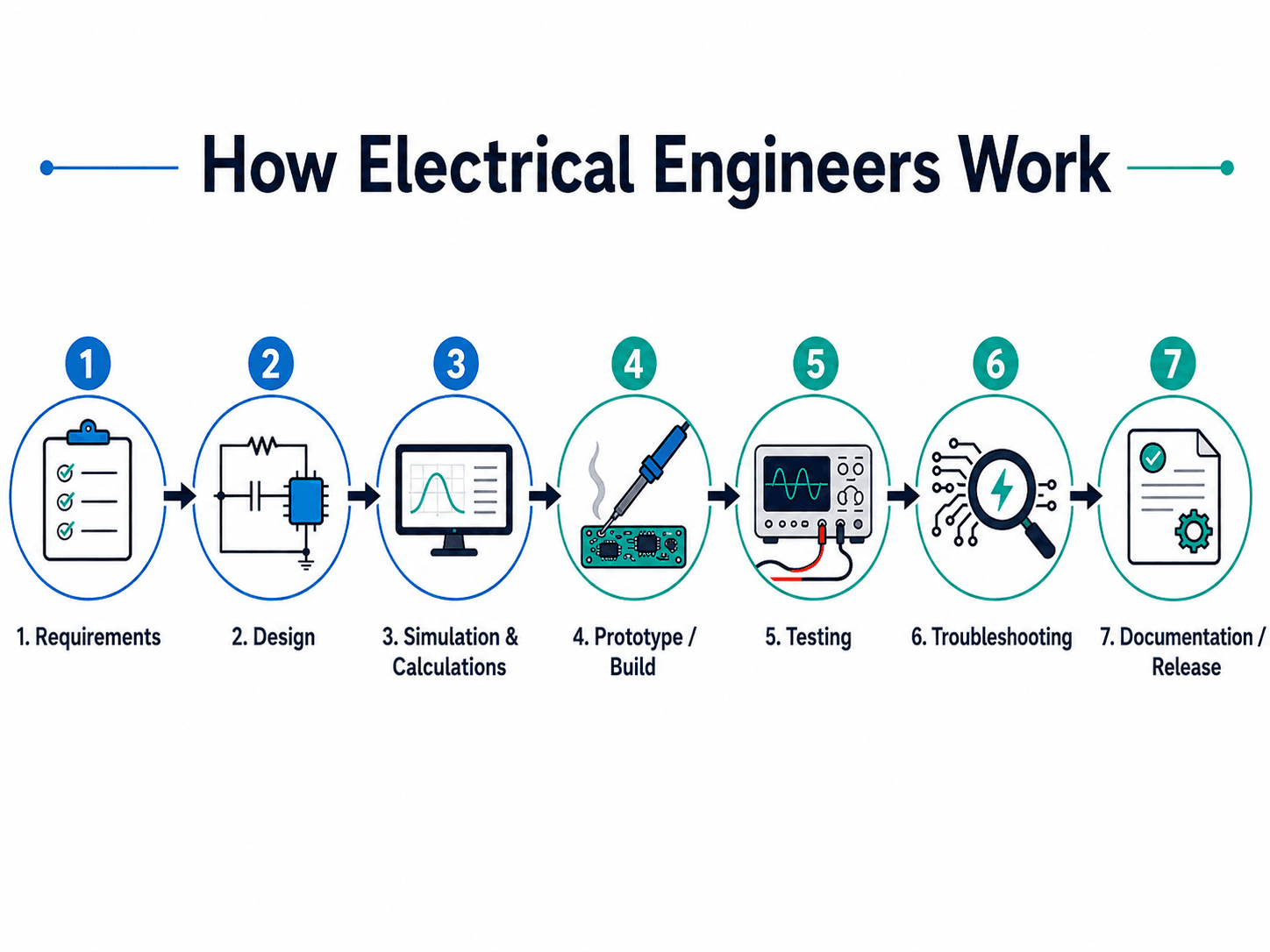
Most electrical engineering projects follow the same logic: define the requirement, design the system, analyze it, implement it, test it, and improve it.
A measurable electrical requirement, operating condition, problem, or failure.
Circuit theory, power analysis, controls, signal analysis, ratings, software tools, and engineering judgment.
Testing, measurements, simulation, peer review, commissioning, or field data.
1. Define requirements before design
Strong electrical engineering starts by identifying the voltage, current, power, signal, communication, control, safety, environmental, reliability, and maintenance requirements. The engineer also determines how success will be tested.
2. Design and analyze
The engineer selects components or equipment, creates the circuit or system architecture, checks ratings, and evaluates performance. Depending on the specialty, that may include fault-current studies, voltage-drop calculations, circuit simulation, control-loop analysis, signal-integrity review, or thermal checks.
3. Build, configure, or install
The design becomes hardware, wiring, a PCB, control logic, settings, panel configuration, or field equipment. Electrical engineers often support this stage by answering technical questions and resolving discrepancies between design intent and implementation.
4. Test, troubleshoot, and improve
Measurements reveal whether the system behaves as expected. Noise, heat, grounding problems, component variation, wiring errors, unexpected loads, software interactions, or field conditions may require another design iteration.
Electrical engineers do not only “draw circuits.” They make technical decisions across the full life cycle of electrical systems and products.
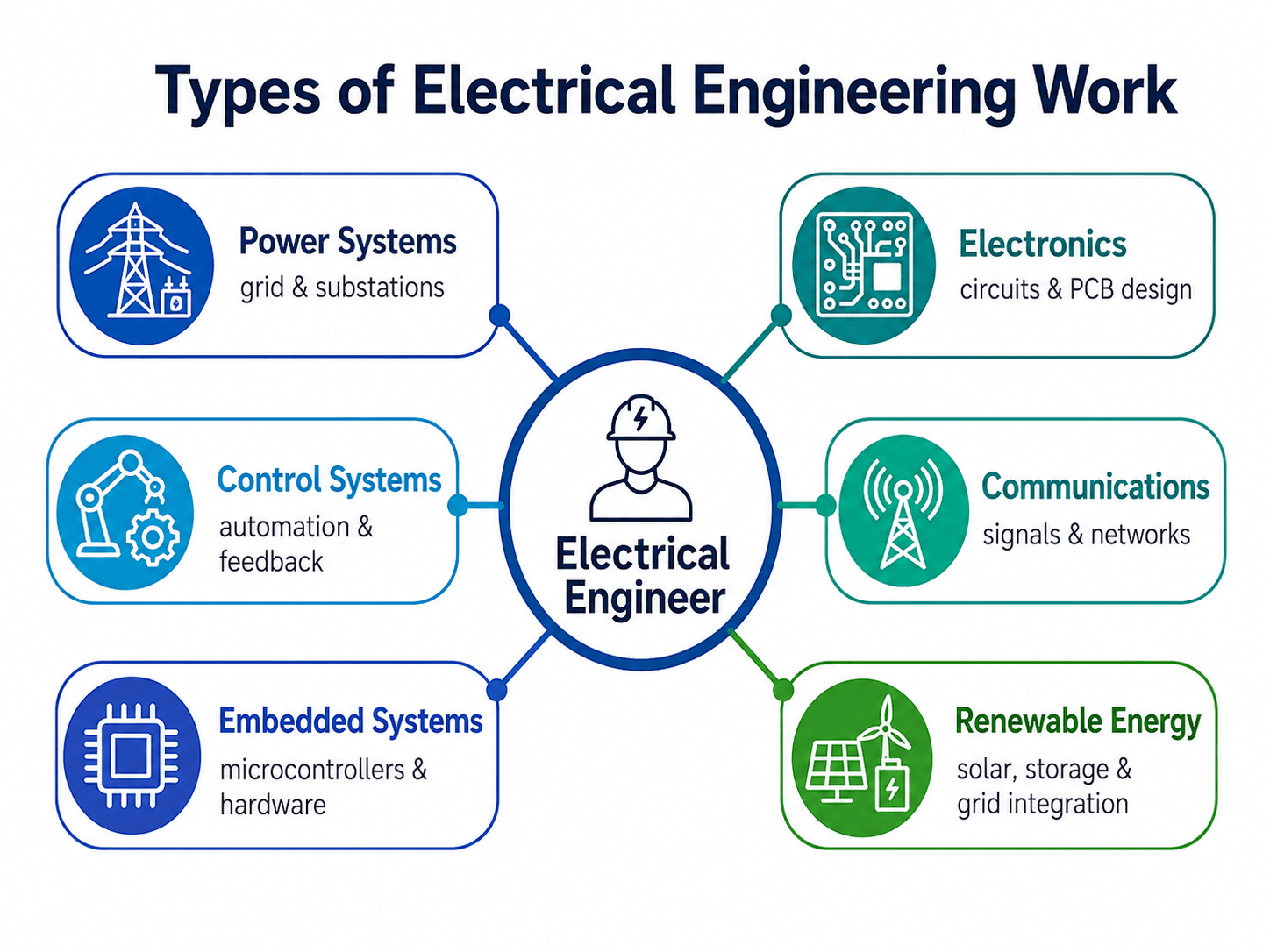
Types of Electrical Engineers and What They Do
Electrical engineering is a family of related careers rather than one narrow job.
| Specialty | Main focus | Typical work | Common output |
|---|---|---|---|
| Power systems engineer | Generation, substations, feeders, protection, grid reliability | Load flow, short circuit, protection, equipment ratings | Studies, one-lines, settings, specifications |
| Electronics engineer | Circuits, sensors, semiconductors, PCBs | Schematic design, component selection, prototype testing | Schematics, PCB releases, test reports |
| Controls engineer | Automation, feedback, sensors, actuators, motors | Control logic, tuning, I/O review, commissioning | Logic, settings, diagrams, test records |
| Embedded systems engineer | Hardware-software integration | Microcontrollers, interfaces, sensors, low-power design | Hardware designs, firmware-adjacent specifications, validation results |
| Communications engineer | Signals, networks, wireless, fiber, antennas | Link analysis, signal quality, network performance | Models, test data, network designs |
| Renewable-energy engineer | Solar, storage, inverters, interconnection | Power conversion, protection, grounding, grid compliance | Studies, settings, design packages, commissioning results |
| Test / validation engineer | Proving products and systems meet requirements | Fixtures, instrumentation, test procedures, failure reproduction | Test plans, datasets, validation reports |
| Electrical project engineer | Coordinating design, procurement, installation, and technical risk | Reviews, vendor coordination, specifications, field support | Submittals, design packages, action logs |
Swipe horizontally to view all table columns.
Tools and Software Electrical Engineers Use
Electrical engineers use a mix of engineering software, programming tools, test equipment, drawings, and data-analysis tools.
Design & Study Software
CAD, Revit, ETAP, SKM, circuit simulation, PCB tools, and other discipline-specific applications support drawings, studies, and system design.
Programming & Analysis
Python, MATLAB, C++, Excel, and custom scripts may support modeling, controls, signal processing, test automation, and data analysis.
Test Equipment
Multimeters, oscilloscopes, power analyzers, data-acquisition systems, signal generators, meters, relays, and specialized instruments support verification and troubleshooting.
Current O*NET employer-posting data lists AutoCAD, Microsoft Office, Python, Excel, Revit, MATLAB, ETAP, SKM Power Tools, C++, and PowerPoint among commonly requested software skills for electrical engineers.
Software is not the engineering decision. A correct result still depends on valid assumptions, correct inputs, appropriate models, realistic operating conditions, and independent checks.
Software-skill basis: O*NET — In-Demand Software Skills for Electrical Engineers summarizes employer-posting software mentions from 2025 U.S. job postings.
Where Do Electrical Engineers Work?
Electrical engineers may work in offices, laboratories, factories, control rooms, utilities, construction sites, data centers, renewable-energy plants, manufacturing facilities, or customer sites.
Office work
Drawings, calculations, studies, specifications, reports, meetings, and design reviews are common.
Laboratory work
Electronics, embedded, test, and validation engineers may spend significant time with prototypes and instrumentation.
Field work
Power, controls, commissioning, applications, and project engineers may travel to sites to troubleshoot or support installation.
Manufacturing work
Product and manufacturing-support engineers may work near production lines, test stations, and assembly equipment.
Is electrical engineering mostly desk work?
Many roles are computer-heavy, but the amount of hands-on work varies substantially. Electronics and test roles may spend more time in labs, while field, controls, and commissioning roles may spend more time around operating equipment.
Work-context basis: O*NET OnLine — Electrical Engineers identifies computer work, decision making, problem solving, documentation, and coordination as important work activities.
Electrical Engineer vs. Electrician vs. Electrical Technician
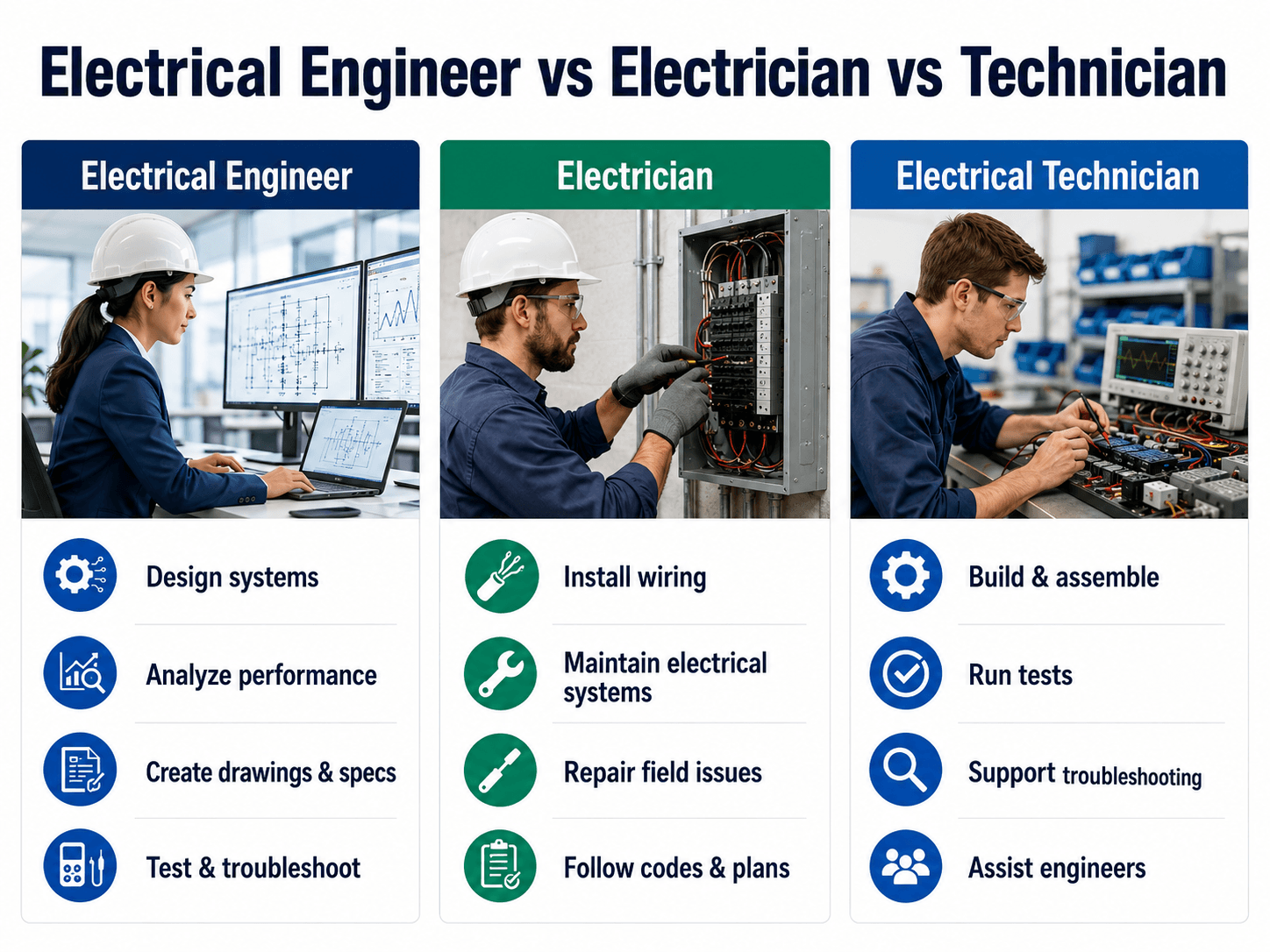
Electrical engineers typically design and analyze systems, electricians typically install and maintain field wiring and equipment, and technicians typically build, test, inspect, and support electrical hardware or systems.
| Role | Primary responsibility | Typical work | Typical output |
|---|---|---|---|
| Electrical engineer | Design and technical responsibility | Analysis, specifications, drawings, studies, testing | Design packages, calculations, settings, reports |
| Electrician | Installation and field maintenance | Wiring, conduit, terminations, repair, troubleshooting | Installed and maintained electrical systems |
| Electrical technician | Build, test, inspect, and support | Assembly, measurements, prototype support, diagnostics | Test results, assembled hardware, diagnostic records |
Strong engineers rely on electricians and technicians for practical installation, maintenance, test, and field feedback. Strong electricians and technicians rely on engineers for design intent, calculations, equipment ratings, and system-level decisions.
Electrical Engineering Education, Salary, and Job Outlook
A bachelor’s degree is the typical education path for electrical engineers, and current federal data shows a $120,630 national median annual wage with 7% projected employment growth from 2024 to 2034.
What degree do electrical engineers need?
Most electrical engineering roles use a bachelor’s degree in electrical engineering, electronics engineering, or a closely related engineering field as the standard entry path. ABET’s current electrical-program criteria require breadth and depth in relevant engineering topics, mathematics through calculus, advanced mathematics, science, and the engineering and computing topics needed to analyze and design complex electrical and electronic devices and systems.
How much do electrical engineers make?
Current 2025 BLS-sourced O*NET wage data shows a national median of $120,630 per year. The 25th percentile is $92,830, the 75th percentile is $152,950, and the 90th percentile is $184,300.
Is electrical engineering in demand?
O*NET reports 192,000 U.S. electrical engineers employed in 2024 and projects 205,700 by 2034, representing 7% growth and about 11,700 openings per year on average.
Career data: O*NET — Electrical Engineers National Wages uses 2025 Bureau of Labor Statistics wage data; O*NET — National Employment Trends reports BLS 2024–2034 projections.
Real Electrical Engineering Project Examples
The easiest way to understand the profession is to see how the work changes across real project types.
- Power system project: Review equipment ratings, create or update a one-line, run load-flow or fault-current studies, check protection, coordinate with the utility, and document required changes.
- Electronics project: Select components, create the schematic, review the PCB layout, prototype the board, measure signals and temperatures, troubleshoot failures, and release a revision.
- Controls project: Define control requirements, select sensors and actuators, configure logic, verify I/O, tune the system, test safety behavior, and support commissioning.
- Renewable-energy project: Review inverters, transformers, grounding, protection, monitoring, interconnection requirements, and measured performance.
- Test engineering project: Build or specify the test fixture, define pass/fail criteria, automate measurements, reproduce defects, analyze data, and report validation results.
Electrical projects often fail at interfaces: the circuit works but the enclosure overheats, the equipment is correctly rated but hard to maintain, the controls work in simulation but fail with noisy sensors, or the drawing is technically correct but confusing to install.
Common Misconceptions About Electrical Engineers
- “Electrical engineers mostly wire things”: Installation is usually performed by electricians; engineers generally focus on design, analysis, specification, testing, and technical responsibility.
- “All electrical engineers design circuit boards”: Many work in power, controls, communications, test, renewable energy, utilities, or industrial systems.
- “The job is only math”: Communication, documentation, testing, troubleshooting, and judgment are major parts of the profession.
- “Simulation proves the design works”: Simulations depend on assumptions and models; physical measurements and field behavior remain essential.
- “Electrical engineering is one job”: Daily work can look completely different across specialties.
Electrical Engineering Career References
These sources support the occupational duties, work activities, software skills, education context, wage data, and employment outlook used on this page.
- O*NET OnLine — Electrical Engineers (17-2071.00) Occupation definition, tasks, work activities, work context, education, and current career data.
- O*NET — In-Demand Software Skills for Electrical Engineers Employer-posting software skills from 2025 U.S. job postings.
- O*NET — Electrical Engineers National Wages 2025 BLS-sourced national wage percentiles.
- ABET — Criteria for Accrediting Engineering Programs, 2026–2027 Current electrical engineering program criteria for mathematics, science, computing, breadth, and depth.
Frequently Asked Questions
What do electrical engineers do every day?
Electrical engineers commonly review requirements, run calculations or simulations, create or update drawings, test hardware, troubleshoot systems, analyze data, document decisions, and coordinate with other technical teams.
Do electrical engineers work with circuits?
Many do, especially electronics and embedded engineers, but power, controls, communications, test, and renewable-energy engineers may work at a broader system level rather than designing small circuits every day.
What is the difference between an electrical engineer and an electrician?
Electrical engineers generally design, analyze, specify, test, and document electrical systems. Electricians generally install, wire, maintain, troubleshoot, and repair electrical systems in the field.
Do electrical engineers code?
Some do, especially in embedded systems, controls, signal processing, robotics, test automation, and data analysis. Other electrical engineering roles may use little software development.
What degree do electrical engineers need?
A bachelor’s degree in electrical engineering, electronics engineering, or a closely related engineering field is the typical entry path for electrical engineers.
How much do electrical engineers make?
Current 2025 BLS-sourced wage data reports a U.S. median annual wage of $120,630 for electrical engineers, with a 25th-to-75th percentile range of $92,830 to $152,950.
Is electrical engineering a good career?
Electrical engineering offers broad career options across power, electronics, controls, communications, embedded systems, energy, manufacturing, and testing. Current projections show 7% U.S. employment growth from 2024 to 2034 and about 11,700 openings per year.
What Electrical Engineers Do: The Bottom Line
Electrical engineers turn electrical requirements into systems that can be analyzed, built, tested, operated, and maintained. Their work may involve power grids, electronics, controls, communications, embedded hardware, renewable energy, industrial systems, or technical testing.
The profession is broader than circuit design alone. Strong electrical engineers combine technical fundamentals with testing, documentation, communication, and practical judgment about safety, reliability, maintainability, and real operating conditions.