
Direct Answer
An electrical engineering degree is a bachelor-level engineering program that prepares students to analyze, design, build, test, and improve electrical and electronic systems. Typical coursework includes calculus, physics, circuit analysis, electronics, digital systems, signals, electromagnetics, controls, power systems, programming, laboratories, technical electives, and a senior design project.
For U.S. students, the strongest program choice usually comes down to ABET accreditation, curriculum depth, hands-on lab work, specialization options, internship access, senior design quality, total cost, and whether the program fits the career path you want.
What Is an Electrical Engineering Degree?
An electrical engineering degree teaches students to use mathematics, science, computing, experimentation, and engineering design to solve problems involving electrical energy, circuits, electronics, signals, control, and hardware.
Electrical engineering is broader than building wiring or circuit boards. The same degree can lead to utility power, renewable energy, semiconductors, RF systems, embedded devices, robotics, industrial automation, medical devices, communications equipment, electric vehicles, data centers, and product development.
Common degree names
Schools may award a Bachelor of Science in Electrical Engineering, BSEE, Bachelor of Engineering, BSE, or a similarly named degree. The exact wording matters less than the program’s curriculum, accreditation, laboratory experience, design work, and technical depth.
Electrical engineering vs. electrical engineering technology
Traditional electrical engineering programs generally place greater emphasis on mathematical analysis, modeling, and engineering design. Electrical engineering technology programs generally place greater emphasis on application, implementation, testing, operation, and maintenance. Both can lead to technical careers, but employer expectations, graduate-school options, and licensure pathways may differ.
Education and occupation context: U.S. Bureau of Labor Statistics — Electrical and Electronics Engineers identifies a bachelor’s degree as the typical entry-level education for electrical and electronics engineers.
Electrical Engineering Degree Curriculum
A strong EE curriculum combines advanced mathematics and science with circuits, electronics, signals, electromagnetics, controls, computing, power systems, laboratories, and open-ended engineering design.
Course names differ by university, but the progression is usually similar because upper-level electrical engineering topics depend heavily on mathematics, physics, programming, and circuit fundamentals.
| Curriculum area | Common courses | What students learn | Typical applications |
|---|---|---|---|
| Mathematics & science | Calculus, differential equations, linear algebra, probability, physics | Model changing systems quantitatively | Circuits, signals, controls, electromagnetics, power |
| Circuits & electronics | DC/AC circuits, analog electronics, digital electronics, semiconductor devices | Analyze voltage, current, impedance, transients, amplification, and switching | Hardware, sensors, instrumentation, power supplies |
| Signals & systems | Signals, systems, transforms, sampling, digital signal processing | Analyze system behavior in time and frequency domains | Communications, sensing, audio, radar, data acquisition |
| Electromagnetics | Electric fields, magnetic fields, waves, transmission lines, antennas | Understand field behavior and propagation | RF, antennas, motors, high-frequency systems |
| Controls & embedded systems | Feedback, dynamic systems, microcontrollers, programming | Control physical systems and integrate hardware with software | Robotics, automation, vehicles, IoT |
| Power & energy | Power systems, machines, power electronics, renewable energy | Analyze energy conversion, generation, transmission, distribution, and loads | Utilities, industrial power, solar, storage, EVs |
| Labs & capstone | Measurements, instrumentation, experiments, senior design | Compare theory with hardware and complete an open-ended project | Testing, validation, design reviews, documentation |
Swipe horizontally to view all table columns.
Current ABET electrical engineering curriculum requirements
ABET’s 2026–2027 engineering criteria require electrical and similarly named engineering programs to provide both breadth and depth across the engineering topics implied by the program title. The curriculum must include probability and statistics, mathematics through differential and integral calculus, science, computing-related engineering topics needed to analyze and design complex electrical and electronic systems, and advanced mathematics such as differential equations, linear algebra, complex variables, and discrete mathematics.
General ABET engineering curriculum
ABET also requires at least 30 semester credit hours of college-level mathematics and basic sciences, at least 45 semester credit hours of engineering topics, a broad-education component, and a culminating major engineering design experience that incorporates engineering standards and multiple constraints.
Current accreditation criteria: ABET — Criteria for Accrediting Engineering Programs, 2026–2027 defines the current general and electrical-program curriculum requirements.
How Long Does an Electrical Engineering Degree Take, and How Hard Is It?
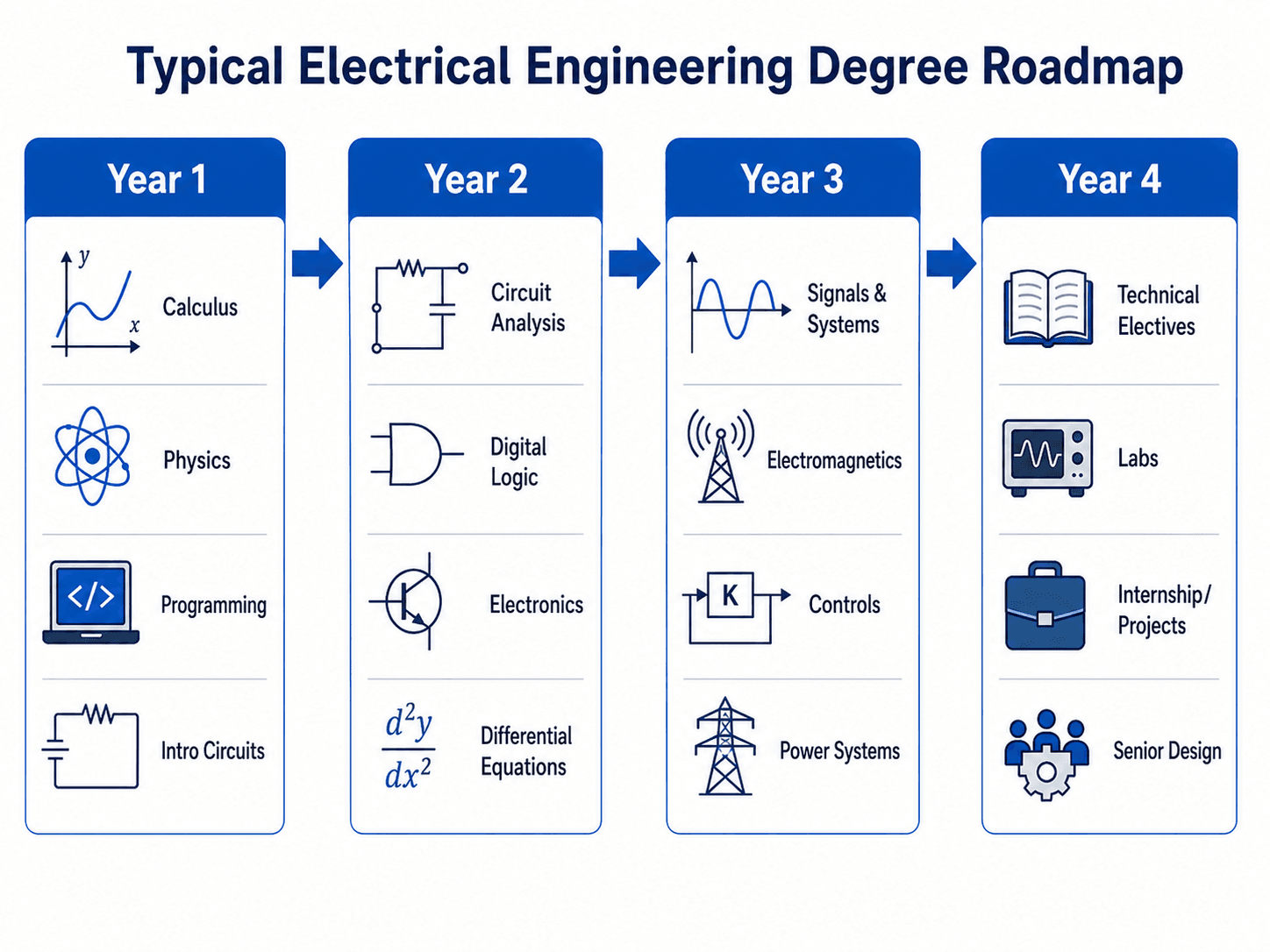
A bachelor’s EE program is commonly designed around four years of full-time study, but prerequisite chains, co-ops, transfers, part-time enrollment, and repeated courses can extend the timeline.
Year 1: Foundations
Calculus, physics, programming, introductory engineering, and basic circuits build the mathematical and scientific foundation.
Years 2–3: Core EE
Circuits, electronics, digital systems, signals, electromagnetics, probability, controls, and laboratories deepen the technical workload.
Year 4: Specialization & Design
Technical electives and capstone design bring earlier subjects together in open-ended system work.
Why electrical engineering is considered difficult
EE can be difficult because many important quantities are invisible. Students must reason about voltage, current, phase, frequency response, electromagnetic fields, stability, noise, and system behavior through models and measurements. Later courses also assume strong retention of earlier mathematics and circuit concepts.
| Challenge | Why it is difficult | Practical response |
|---|---|---|
| Circuit analysis | Signs, phase, impedance, and transients can feel abstract. | Draw reference directions and compare calculations with measurements. |
| Signals & systems | Students must think in time and frequency domains. | Connect transforms and filters to real signal examples. |
| Electromagnetics | Fields and waves are difficult to visualize. | Use diagrams and physical interpretation instead of memorization alone. |
| Electronics | Real components are non-ideal and tolerance-sensitive. | Compare simplified models with datasheets and lab data. |
| Controls | Feedback and stability can feel disconnected from physical systems. | Use motors, thermal systems, and step-response examples. |
Students usually do better when they solve problems consistently, build small projects, use labs to test theory, and ask whether a result makes physical sense rather than relying on memorization alone.
ABET Accreditation and Electrical Engineering Program Quality
Verify the exact program first, then compare the technical experiences that determine how well it prepares students for engineering practice.
Program-level accreditation and the exact degree title, campus, and delivery format.
Curriculum, lab depth, capstone quality, specialization tracks, faculty, internships, and employer access.
The program supports your intended career, graduate-school, transfer, or licensure path.
- Step 1: Verify that the specific electrical engineering program is accredited if accreditation matters for your goals.
- Step 2: Compare the curriculum with the specialty areas you may want to pursue.
- Step 3: Review laboratories, student design teams, capstone projects, internships, co-ops, and career fairs.
- Step 4: Compare total cost, transfer policies, graduation timeline, and likely employer access.
ABET accreditation applies to specific programs, not automatically to every degree at an accredited university. Confirm the exact program name and location.
Electrical Engineering Specializations
Most undergraduate EE programs provide a broad foundation first, then allow students to develop depth through electives, research, internships, projects, and senior design.
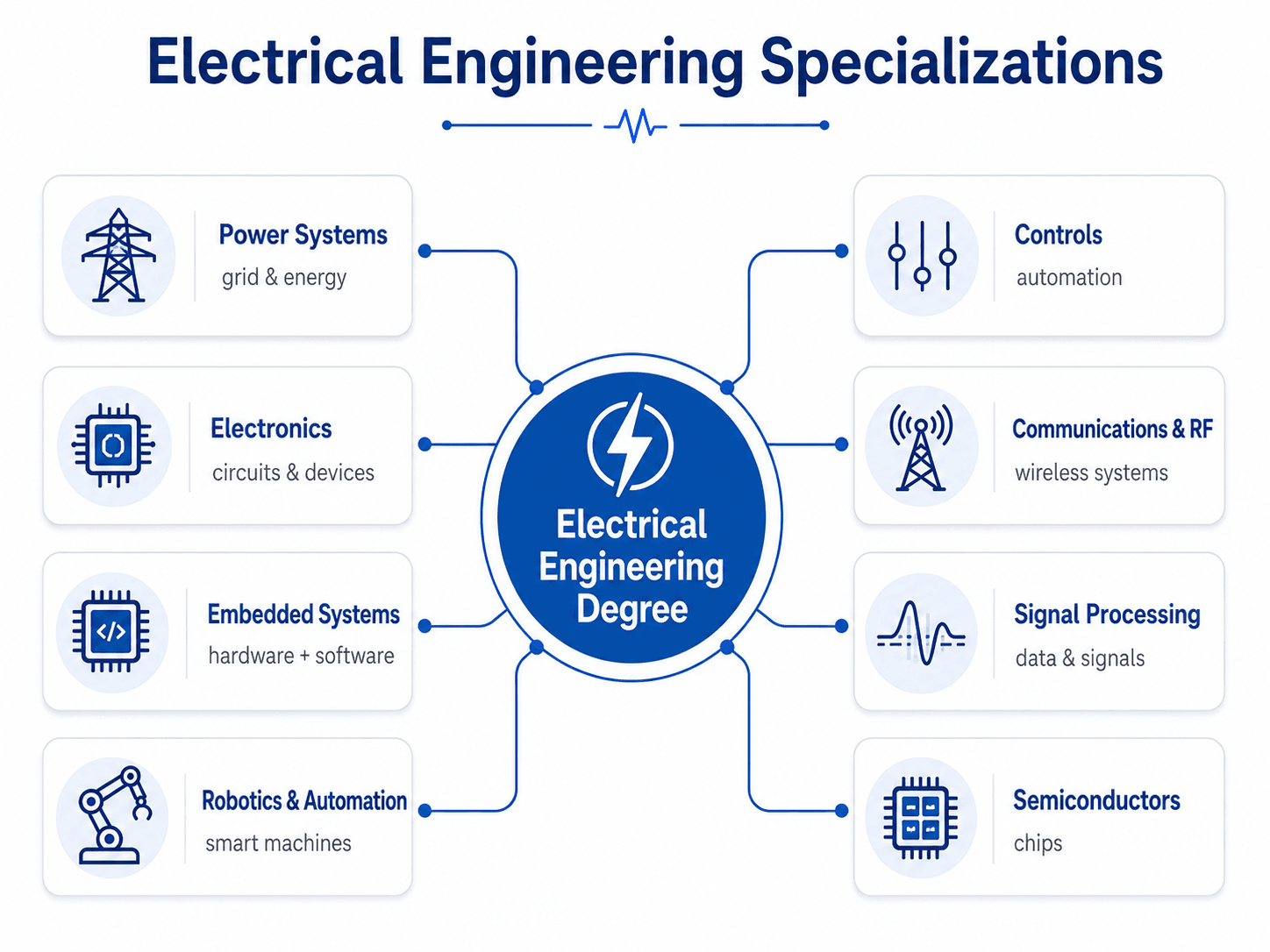
Power Systems
Best fit: Utilities, renewable energy, substations, grid reliability, industrial power.
Build: Power systems, machines, protection, renewable-energy electives.
Typical roles: Power engineer, utility engineer, protection engineer.
Electronics & Semiconductors
Best fit: Circuits, chips, sensors, PCBs, and hardware products.
Build: Analog/digital electronics, semiconductor devices, PCB and lab projects.
Typical roles: Electronics engineer, hardware engineer, device engineer.
Controls & Embedded
Best fit: Robotics, automation, microcontrollers, sensors, and feedback systems.
Build: Controls, programming, embedded systems, mechatronics projects.
Typical roles: Controls engineer, embedded engineer, robotics engineer.
Communications & RF
Best fit: Wireless systems, antennas, signals, and high-frequency design.
Build: Communications, DSP, electromagnetics, antennas, RF labs.
Typical roles: RF engineer, communications engineer, antenna engineer.
How to pick a specialization
Do not choose only by salary. Pay attention to which classes and projects make you willing to debug, test, and keep learning when the work is difficult. Then use electives and internships to test that interest before graduation.
What Jobs Can You Get With an Electrical Engineering Degree?
EE graduates can work across utilities, electronics, aerospace, semiconductors, controls, automation, embedded systems, communications, renewable energy, testing, and product development.
| Career path | Typical work | Useful student preparation | Related resource |
|---|---|---|---|
| Electrical engineer | Design, analysis, testing, troubleshooting, documentation | Broad EE foundation, labs, projects, internships | What Do Electrical Engineers Do? |
| Power systems engineer | Load flow, protection, substations, renewables, grid studies | Power electives, utility internship, study software | Power Systems Engineering |
| Electronics engineer | Circuits, PCBs, sensors, hardware, validation | Electronics labs, PCB projects, test equipment | Electronics Engineering |
| Controls engineer | Feedback, PLCs, motors, industrial automation | Controls, programming, robotics, dynamic systems | Control Systems Engineering |
| Embedded systems engineer | Microcontrollers, sensors, firmware-adjacent hardware | Programming, digital systems, embedded projects | Electrical Engineering Projects |
| Test / validation engineer | Test plans, instrumentation, data, failure analysis | Labs, instrumentation, statistics, technical writing | Electronics Testing Methods |
Swipe horizontally to view all table columns.
Industries that hire EE graduates
Electrical engineering graduates work in electric utilities, renewable energy, aerospace and defense, semiconductors, automotive and electric vehicles, industrial automation, telecommunications, medical devices, electronics manufacturing, controls, robotics, data centers, and engineering consulting.
Electrical Engineering Degree Salary and Job Outlook
The current U.S. median wage for electrical engineers is $120,630, and national employment is projected to grow about 7% from 2024 to 2034.
Current BLS-sourced O*NET data reports a 2025 national median of $120,630 per year, with the 25th percentile at $92,830 and the 75th percentile at $152,950. Electrical engineers numbered about 192,000 workers in 2024, with employment projected to reach roughly 205,700 by 2034 and about 11,700 openings per year on average.
Is an electrical engineering degree worth it?
It can be a strong investment for students who want careers involving circuits, power, electronics, controls, embedded systems, communications, semiconductors, automation, or energy. The return depends on total program cost, graduation time, internships, specialization, project experience, and local labor-market opportunities.
Current wage and employment data: O*NET — Electrical Engineers National Wages uses 2025 Bureau of Labor Statistics wage data; O*NET — Electrical Engineers reports 2024 employment and 2024–2034 projections.
How to Choose an Electrical Engineering Degree Program
Compare programs using the factors that will affect graduation, technical development, internships, employer access, and total cost—not school name alone.
- Verify the program
Confirm the exact degree title, campus, accreditation status, admissions path, and transfer policy.
- Read the curriculum
Compare circuits, electronics, signals, electromagnetics, controls, power, computing, labs, and technical electives.
- Evaluate hands-on engineering
Look for circuit labs, electronics labs, design teams, PCB work, embedded projects, power labs, test equipment, and capstone depth.
- Check employer access
Review internships, co-ops, career fairs, alumni outcomes, and industries that recruit from the program.
- Compare total cost and fit
Consider tuition, scholarships, housing, likely graduation time, class size, support, and specialization options.
Pass condition: Clear accreditation, rigorous curriculum, active labs, senior design, internships, and employer recruiting.
Evidence: Published degree plan, lab courses, project examples, co-op data, career fairs.
If it fails: Ask how students gain equivalent technical experience.
Pass condition: Requirements, transfer policies, labs, and career support are transparent.
Evidence: Clear catalog, advising resources, and program outcomes.
If it fails: Compare another program before committing.
Electrical engineering vs. related majors
Choose electrical engineering if you want the strongest focus on circuits, power, electronics, signals, controls, communications, and physical electrical systems. Computer engineering leans more toward computing hardware and embedded systems; computer science toward software; mechanical engineering toward forces, motion, heat, fluids, and machines.
Online Electrical Engineering Degrees: What to Check
An online EE degree can be viable, but accreditation, laboratory delivery, capstone quality, transfer rules, and employer access matter more than convenience alone.
Electrical engineering is harder to move fully online than some majors because students benefit from oscilloscopes, multimeters, circuit boards, test equipment, laboratories, team design, and hands-on debugging. Programs may use remote labs, mailed kits, simulation tools, local partnerships, or short in-person sessions.
Then: Verify exactly how circuit, electronics, controls, power, and other required laboratories are completed.
Then: Confirm how calculus, physics, programming, circuits, and labs transfer before assuming the graduation timeline.
- Accreditation: Verify the exact program and delivery format.
- Labs: Understand how physical measurements and hardware debugging are completed.
- Capstone: Check whether students design, build, test, document, and present a major project.
- Internships: Ask how remote students access co-ops, career fairs, and employer recruiting.
- Transfer credits: Obtain written confirmation before committing.
Common Mistakes When Choosing an Electrical Engineering Degree
- Choosing by university name alone: Curriculum, labs, cost, electives, and employer access matter more than branding by itself.
- Failing to verify program-level accreditation: Accreditation applies to a specific program, not automatically to every degree at an institution.
- Underestimating prerequisites: Missing calculus, physics, programming, or circuit courses can delay multiple later classes.
- Ignoring labs and projects: Measurement and debugging skills are major parts of becoming useful as an electrical engineer.
- Waiting too long to specialize: Use electives, projects, and internships intentionally by junior year.
- Confusing EE with electrical engineering technology: Curriculum emphasis, career positioning, and licensure pathways may differ.
Electrical Engineering Degree References
These sources support the education, accreditation, curriculum, wage, and employment-outlook information used on this page.
- ABET — Criteria for Accrediting Engineering Programs, 2026–2027 Current general engineering criteria and electrical-program curriculum requirements.
- U.S. Bureau of Labor Statistics — Electrical and Electronics Engineers Typical entry-level education, occupational context, duties, and career information.
- O*NET — Electrical Engineers National Wages 2025 BLS-sourced national wage benchmarks.
Frequently Asked Questions
Is an electrical engineering degree hard?
Yes. EE is challenging because it combines calculus, physics, circuits, electronics, signals, electromagnetics, programming, laboratories, and abstract system behavior. Consistent problem solving and hands-on projects make the material easier to connect to real systems.
How long does an electrical engineering degree take?
Many bachelor’s EE programs are designed around four years of full-time study. Co-ops, transfers, part-time study, repeated prerequisites, or changing majors can extend the timeline.
What jobs can you get with an electrical engineering degree?
Common paths include electrical engineer, power systems engineer, electronics engineer, controls engineer, embedded systems engineer, test engineer, hardware engineer, RF engineer, automation engineer, and semiconductor engineer.
Does ABET accreditation matter for electrical engineering?
Yes, especially for students who may pursue professional licensure, government or utility work, graduate school, transfer credit, or employers that screen for accredited engineering degrees. Always verify the exact program.
Is an electrical engineering degree worth it?
It can be a strong investment for students who want careers in power, electronics, controls, embedded systems, communications, semiconductors, automation, or energy. Value depends on cost, accreditation, internships, projects, specialization, and graduation time.
What is the current electrical engineering salary?
The 2025 U.S. median wage for electrical engineers is $120,630 per year, with the middle 50% earning about $92,830 to $152,950.
Can you get an electrical engineering degree online?
Yes, but students should verify the exact program’s accreditation, laboratory format, senior-design requirements, transfer rules, and employer recognition before enrolling.
Electrical Engineering Degree: Bottom Line
An electrical engineering degree is a broad technical path built around circuits, electronics, power, signals, controls, electromagnetics, computing, laboratories, and engineering design. It can lead to careers across utilities, aerospace, semiconductors, automation, communications, hardware, renewable energy, and embedded systems.
The strongest program is not automatically the highest-ranked or most expensive one. Compare accreditation, curriculum depth, labs, senior design, specialization tracks, internships, total cost, and employer access before deciding.