
Direct Answer
The U.S. median salary for electrical engineers is $120,630 per year, or $58.00 per hour, based on 2025 Bureau of Labor Statistics wage data. The middle 50% earn about $92,830 to $152,950, while the 10th and 90th percentile benchmarks are $76,550 and $184,300.
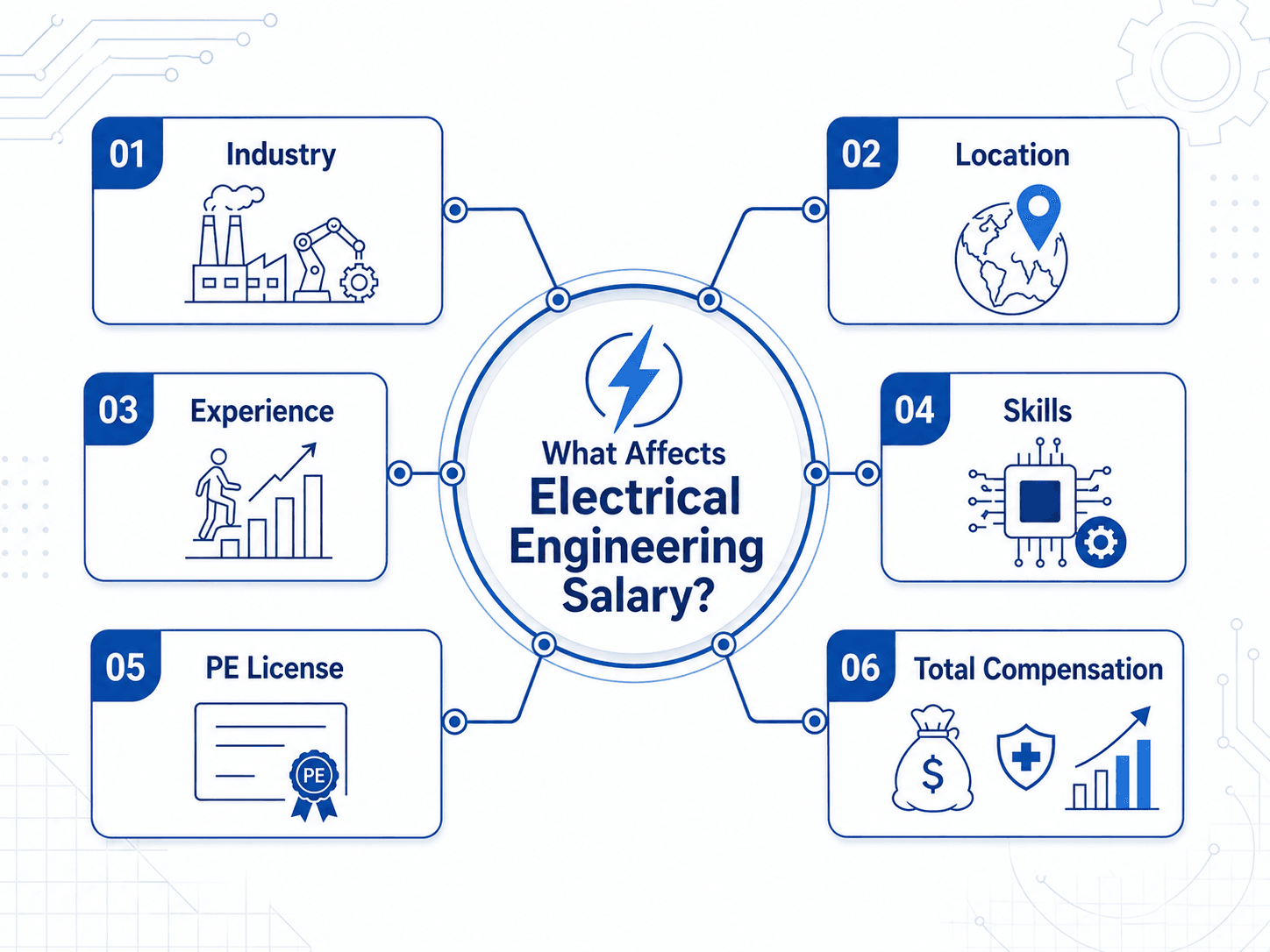
Actual pay depends on experience, industry, location, specialization, design ownership, field responsibility, credentials, and total compensation. Salary comparisons are most useful when the job’s real scope is matched to current local and industry data.
How to Read Electrical Engineering Salary Data
Start with the national wage distribution, then adjust for the actual job, location, industry, and compensation package.
The national median and 25th-to-75th percentile range for electrical engineers.
Experience, industry, location, specialty, technical responsibility, travel, and total compensation.
That the offer matches comparable current roles and builds useful technical or leadership responsibility.
- Step 1: Use the median as the national midpoint, not as a universal target for every job.
- Step 2: Use the 25th and 75th percentiles to understand the middle 50% of the profession.
- Step 3: Compare state, metro, and industry data for the actual labor market.
- Step 4: Compare base salary with bonus, overtime, equity, retirement, benefits, travel, and technical growth.
Key Takeaways
- National median: $120,630 per year based on 2025 BLS wage data.
- Middle 50%: Approximately $92,830 to $152,950 nationally.
- Upper-end benchmark: The national 90th percentile is $184,300.
- Career outlook: U.S. electrical engineer employment is projected to grow 7% from 2024 to 2034, with about 11,700 openings per year.
Electrical Engineering Salary Range and Percentiles
The national wage distribution is wide enough that a single “average electrical engineering salary” can hide important differences in experience, specialty, and market.
For 2025, the 10th percentile is $76,550, the 25th percentile is $92,830, the median is $120,630, the 75th percentile is $152,950, and the 90th percentile is $184,300.
| Percentile | Annual wage | Hourly wage | How to interpret it |
|---|---|---|---|
| 10th | $76,550 | $36.80 | Lower end of the national occupation; not an official entry-level salary. |
| 25th | $92,830 | $44.63 | Lower-quartile benchmark useful for early-career or lower-cost-market comparisons. |
| 50th / median | $120,630 | $58.00 | National midpoint: half earn more and half earn less. |
| 75th | $152,950 | $73.53 | Upper-quartile benchmark commonly associated with stronger markets, seniority, or specialization. |
| 90th | $184,300 | $88.61 | Upper-end national benchmark for the occupation. |
Median vs. average electrical engineering salary
Use the median when comparing a typical role. Mean or “average” figures can be pulled upward by high-paying metros, senior engineers, and specialized industries. Percentiles provide a better picture of where a specific offer sits within the national market.
Current wage data: O*NET — Electrical Engineers National Wages reports 2025 wage percentiles sourced from the U.S. Bureau of Labor Statistics.
Electrical Engineering Salary by Experience Level
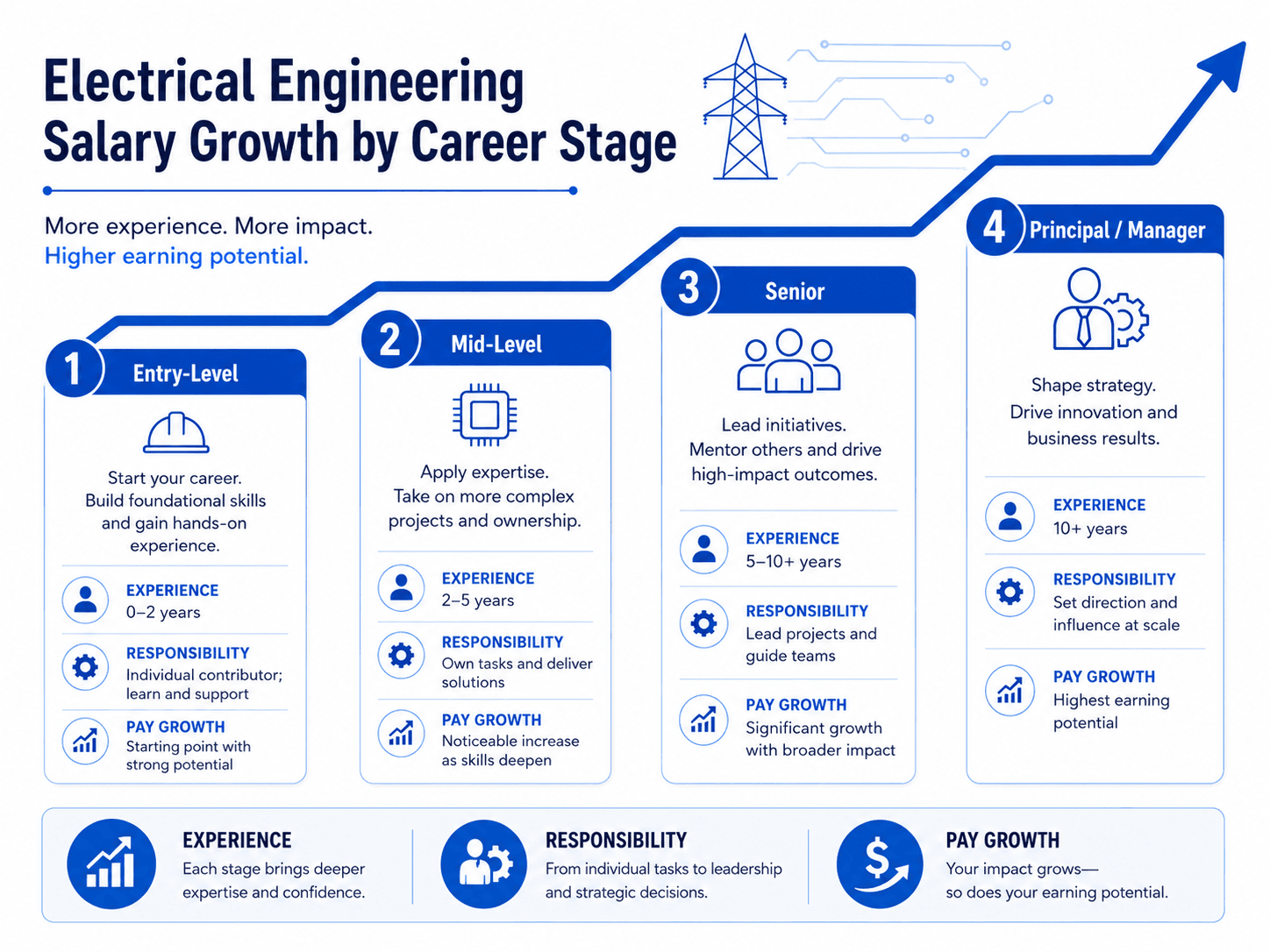
Electrical engineer pay generally rises as the role shifts from supervised execution to independent design ownership, technical review, risk management, mentoring, and system-level decisions.
BLS does not define fixed salary bands for “entry-level,” “mid-level,” and “senior” engineers. Titles vary by employer, so career stage should be interpreted by responsibility rather than years alone.
Entry-Level Engineer
Early-career engineers commonly support calculations, drawings, test work, simulations, documentation, and design reviews under supervision. Offers often fall below the national median but vary widely by specialty and region.
Mid-Level Engineer
Compensation strengthens when the engineer independently owns defined systems, vendor coordination, testing, commissioning, troubleshooting, or client-facing technical work.
Senior Engineer
Senior engineers are paid for judgment: design review, risk reduction, technical leadership, mentoring, system ownership, and resolving ambiguous problems.
Principal, lead, and manager roles
At higher levels, compensation reflects leverage. Principal engineers may define architecture or technical strategy across projects. Managers may own staffing, budgets, quality, schedule, and cross-functional delivery. Either path can move substantially above the median.
Do not equate the 10th percentile with “entry level” or the 90th percentile with “senior.” Percentiles describe the wage distribution, not official job titles.
Electrical Engineering Salary by Industry and Specialty
Industry and specialization matter because the economic value and consequence of electrical engineering decisions vary substantially across aerospace, utilities, electronics, controls, semiconductors, R&D, and consulting.
The latest BLS Occupational Outlook Handbook still shows May 2024 selected-industry medians, so those figures should be labeled by year rather than mixed into the 2025 national percentile table.
| Industry | Median annual wage | Why the work can command value | Relevant specialties |
|---|---|---|---|
| Aerospace product & parts manufacturing | $136,570 | High reliability, certification, avionics, controls, and complex program requirements | Aerospace electronics, test, controls, power systems |
| Scientific R&D services | $130,840 | Advanced design, experimentation, prototypes, and difficult technical problems | Electronics, RF, controls, embedded, research |
| Navigational, measuring & control instruments | $115,700 | Precision sensors, instrumentation, regulated products, and validation | Controls, sensors, embedded, electronics |
| Electric power generation, transmission & distribution | $114,720 | Grid reliability, substations, protection, regulated infrastructure, field risk | Power systems, protection, utility engineering |
| Engineering services | $103,450 | Client delivery, project scope, codes, licensure, and billable responsibility | Power, MEP, consulting, project engineering |
Swipe horizontally to view all table columns.
Which electrical engineering fields tend to pay the most?
Higher-paying paths often include semiconductor and hardware design, power-system studies and protection, aerospace and defense electronics, RF, embedded systems, controls, automation, and senior technical leadership. The strongest compensation usually appears where skills are scarce and mistakes are expensive.
Industry comparison: U.S. Bureau of Labor Statistics — Electrical and Electronics Engineers publishes the selected May 2024 industry medians shown here.
Electrical Engineering Salary by Location
Location can materially change salary, so national wage data should be paired with state or metro data before evaluating an offer.
For example, 2025 BLS-sourced O*NET data reports a Texas median of $129,450 compared with the $120,630 national median. Austin-Round Rock-San Marcos is higher still at $145,360.
| Location | 25th percentile | Median | 75th percentile |
|---|---|---|---|
| United States | $92,830 | $120,630 | $152,950 |
| Texas | $95,130 | $129,450 | $164,730 |
| Austin-Round Rock-San Marcos, TX | $110,310 | $145,360 | $202,060 |
| Massachusetts | $100,010 | $127,710 | $160,900 |
Salary vs. cost of living
A higher salary does not automatically mean stronger purchasing power. Housing, taxes, commute, insurance, and relocation costs can offset part of a nominal salary increase. Compare both compensation and real living costs.
Remote, hybrid, and regional pay
Some design, analysis, and documentation roles can be hybrid or remote, while commissioning, testing, manufacturing, utility, and field roles often require more in-person work. Employers may price compensation nationally, by office, or by employee location.
Location data: O*NET — Texas Electrical Engineer Wages and corresponding state/metro wage pages use 2025 Bureau of Labor Statistics wage data.
Highest-Value Electrical Engineering Skills and Career Paths
The strongest salary leverage usually comes from skills that reduce technical risk, improve uptime, accelerate product development, or support decisions that are expensive to get wrong.
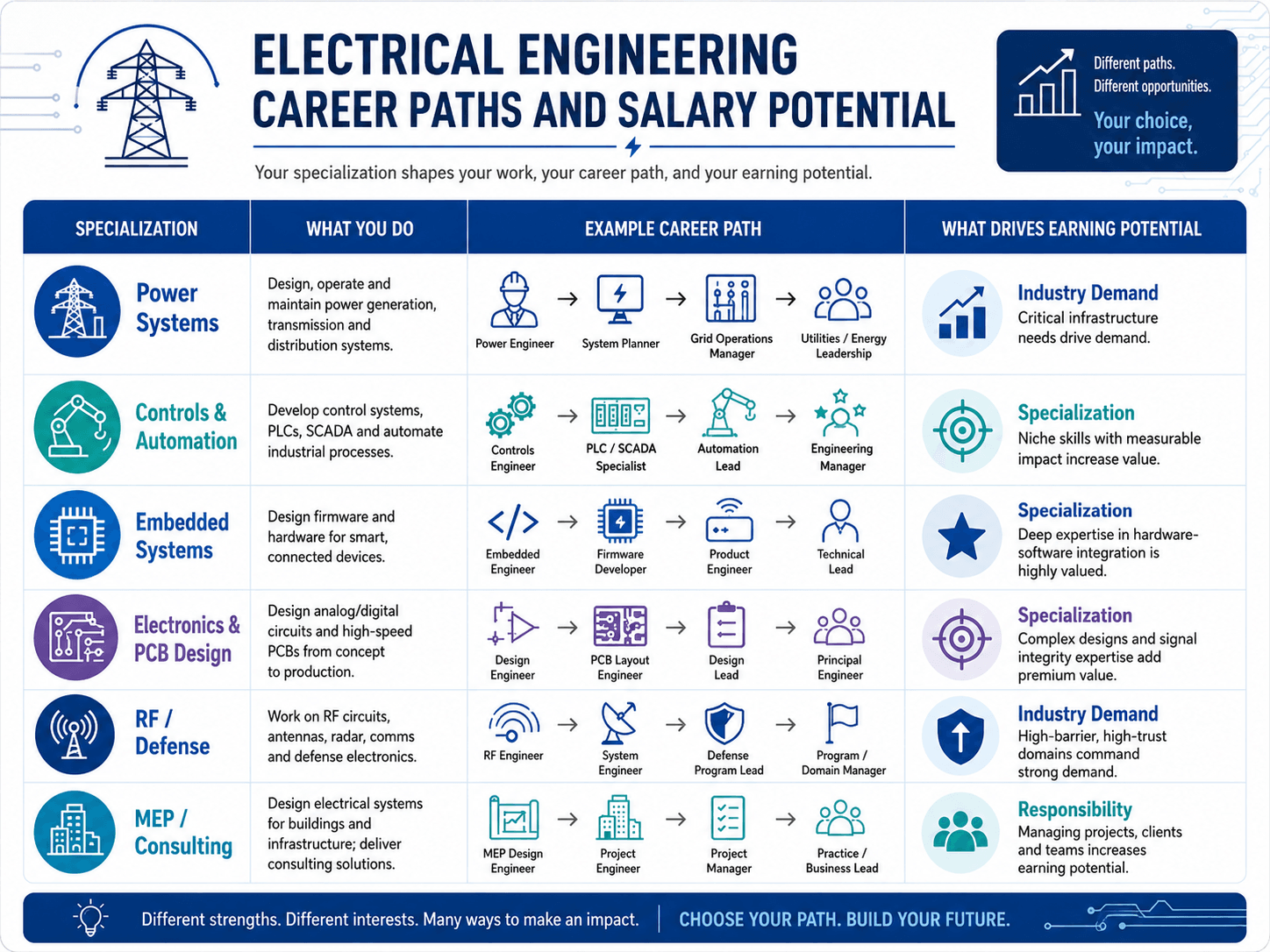
Power Systems & Protection
Best fit: Utilities, grid, renewables, industrial power, consulting.
Why it pays: Reliability, fault behavior, protection, and field decisions carry high consequence.
Build: ETAP/SKM, relay studies, one-lines, commissioning, PE path where relevant.
Electronics, Semiconductor & RF
Best fit: Hardware products, aerospace, communications, semiconductors.
Why it pays: Deep technical specialization and high product value can support premium compensation.
Build: Circuit design, PCB, signal integrity, RF, validation, lab skills.
Controls, Automation & Embedded
Best fit: Robotics, factories, industrial systems, products.
Why it pays: Good engineers can improve throughput, stability, safety, and uptime.
Build: PLCs, controls, Python/MATLAB, microcontrollers, sensors, test automation.
Technical Leadership & Management
Best fit: Engineers who enjoy architecture, reviews, mentoring, planning, and business execution.
Why it pays: Senior roles influence multiple projects, teams, or business outcomes.
Build: Communication, design review, risk management, mentoring, project leadership.
Electrical Engineering Job Outlook
Electrical engineer employment is projected to grow 7% from 2024 to 2034, with about 11,700 openings per year on average.
O*NET/BLS data shows about 192,000 electrical engineers employed in 2024 and about 205,700 projected in 2034. Demand is supported by continued investment in electrical and electronic devices, infrastructure, solar arrays, semiconductors, communications technology, grid modernization, and industrial systems.
Employment outlook: O*NET — Electrical Engineers Employment Trends reports BLS 2024–2034 projections.
How to Compare Electrical Engineering Job Offers
A strong offer combines competitive pay with useful technical responsibility, good mentorship, sustainable work conditions, and a path to higher-value engineering work.
- Benchmark the market
Compare national and local wage data, active job postings, employer level, and industry.
- Read the technical scope
Look for real ownership of studies, circuits, systems, testing, field support, commissioning, or design review.
- Calculate total compensation
Include bonus, equity, overtime, retirement, pension, relocation, travel pay, benefits, and PTO.
- Evaluate career capital
Ask whether the role builds scarce skills in power, protection, controls, electronics, RF, embedded systems, testing, or leadership.
- Check workload and mobility
Understand travel, on-call support, outages, field rotations, hybrid flexibility, and promotion mechanics.
Then: Look for compensating value such as exceptional mentorship, scarce-skill development, paid overtime, strong retirement benefits, lower cost of living, or a clearly defined promotion path.
Then: Check whether the role includes unusual travel, field support, on-call burden, clearance requirements, high responsibility, or weaker benefits.
Electrical Engineering Salary Negotiation and Career Growth
The strongest compensation case connects current market evidence with specialized capability, expanded responsibility, and measurable engineering impact.
Use current salary benchmarks
Compare the exact role, specialty, level, location, and industry—not only the national median.
Negotiation implication: Explain why the requested range fits the actual labor market.
Connect skills to business impact
Use examples such as improved uptime, avoided rework, faster commissioning, successful product validation, safer design, reduced field failures, or critical study ownership.
Negotiation implication: Make the request about value and responsibility, not tenure alone.
Negotiate beyond base salary
If the base band is constrained, ask about signing bonus, relocation, annual bonus, paid overtime, training, certification support, PTO, or an earlier review.
Negotiation implication: Improve the package even when base salary flexibility is limited.
Build scarce, transferable skills
Specialized analysis, testing, protection, controls, embedded systems, RF, field troubleshooting, and technical leadership can improve future bargaining power.
Negotiation implication: Choose roles that increase future market value as well as current pay.
Common Electrical Engineering Salary Research Mistakes
- Using 2024 salary data as if it were current: The latest BLS-sourced national wage distribution for electrical engineers is from 2025.
- Comparing electrical and electronics-engineer data interchangeably: BLS tracks them as separate occupations.
- Treating the 10th percentile as entry-level pay: It is a wage-distribution benchmark, not an official new-graduate salary.
- Ignoring location: State and metro wage distributions can differ materially from the national median.
- Ignoring total compensation: Bonus, equity, pension, overtime, travel, and retirement can change offer value substantially.
- Ignoring technical scope: Two jobs with the same title may carry very different responsibility and long-term salary leverage.
Electrical Engineering Salary References
These references support the wage, industry, location, education, and employment-outlook information used on this page.
- O*NET — Electrical Engineers National Wages 2025 BLS-sourced national wage percentiles and hourly equivalents.
- U.S. Bureau of Labor Statistics — Electrical and Electronics Engineers Occupational context, 2024–2034 outlook, and selected May 2024 industry medians.
- O*NET — Texas Electrical Engineer Wages 2025 state and metro wage benchmarks sourced from BLS wage data.
Frequently Asked Questions
How much do electrical engineers make?
The 2025 U.S. median wage for electrical engineers is $120,630 per year, or $58.00 per hour. The middle 50% earn approximately $92,830 to $152,950.
What is the entry-level electrical engineering salary?
There is no single official national starting salary. Entry-level pay varies by specialty, employer, region, internships, and technical scope. Use local Engineer I postings and current wage data instead of treating the national 10th percentile as a fixed starting salary.
Can electrical engineers make $150,000 or more?
Yes. The 2025 national 75th percentile is $152,950 and the 90th percentile is $184,300, so compensation above $150,000 is well within the observed wage distribution.
Which electrical engineering field pays the most?
There is no single highest-paying specialty everywhere. Higher-paying paths often include semiconductor and electronics design, RF, embedded systems, power-system studies and protection, aerospace and defense electronics, controls, automation, and senior technical leadership.
Does a master’s degree increase electrical engineering salary?
A master’s degree can improve earning potential when it supports a specialized role such as semiconductors, signal processing, controls, communications, advanced power systems, or R&D. In other roles, field experience, licensure, or design ownership may be more valuable.
Is electrical engineering a high-paying career?
Yes. The current national median is $120,630, and the field also has a broad set of higher-paying technical and leadership paths across utilities, electronics, controls, aerospace, semiconductors, energy, and automation.
Electrical Engineering Salary: Bottom Line
The current national median electrical engineering salary is $120,630, but the profession spans a broad wage distribution. Experience, location, industry, specialization, technical ownership, and total compensation determine where an individual offer sits within that range.
For career decisions, use salary data as a benchmark rather than a verdict. The strongest long-term compensation usually follows increasing technical judgment, scarce skills, field understanding, and responsibility for decisions that matter to reliability, safety, product performance, or business outcomes.