
Key Takeaways
- Core idea: BLS reports a May 2024 median annual wage of $111,910 for electrical engineers, but actual salary depends heavily on experience, industry, location, specialization, and responsibility.
- Engineering use: Salary research helps students, new graduates, and working engineers compare offers against real role scope instead of job title alone.
- What controls it: Pay usually rises when the engineer owns design decisions, scarce tools, field troubleshooting, regulated systems, high-reliability equipment, or technical leadership.
- Practical check: Compare base salary, bonus, equity, overtime, travel, cost of living, benefits, licensure support, and growth path before deciding whether an offer is strong.
Table of Contents
Introduction
Electrical engineering salary in the United States commonly centers around the low six figures, with BLS reporting a May 2024 median annual wage of $111,910 for electrical engineers. Actual pay varies widely by experience, industry, location, specialization, total compensation structure, and whether the engineer owns design, testing, field, or technical leadership decisions.
What Affects Electrical Engineering Salary?
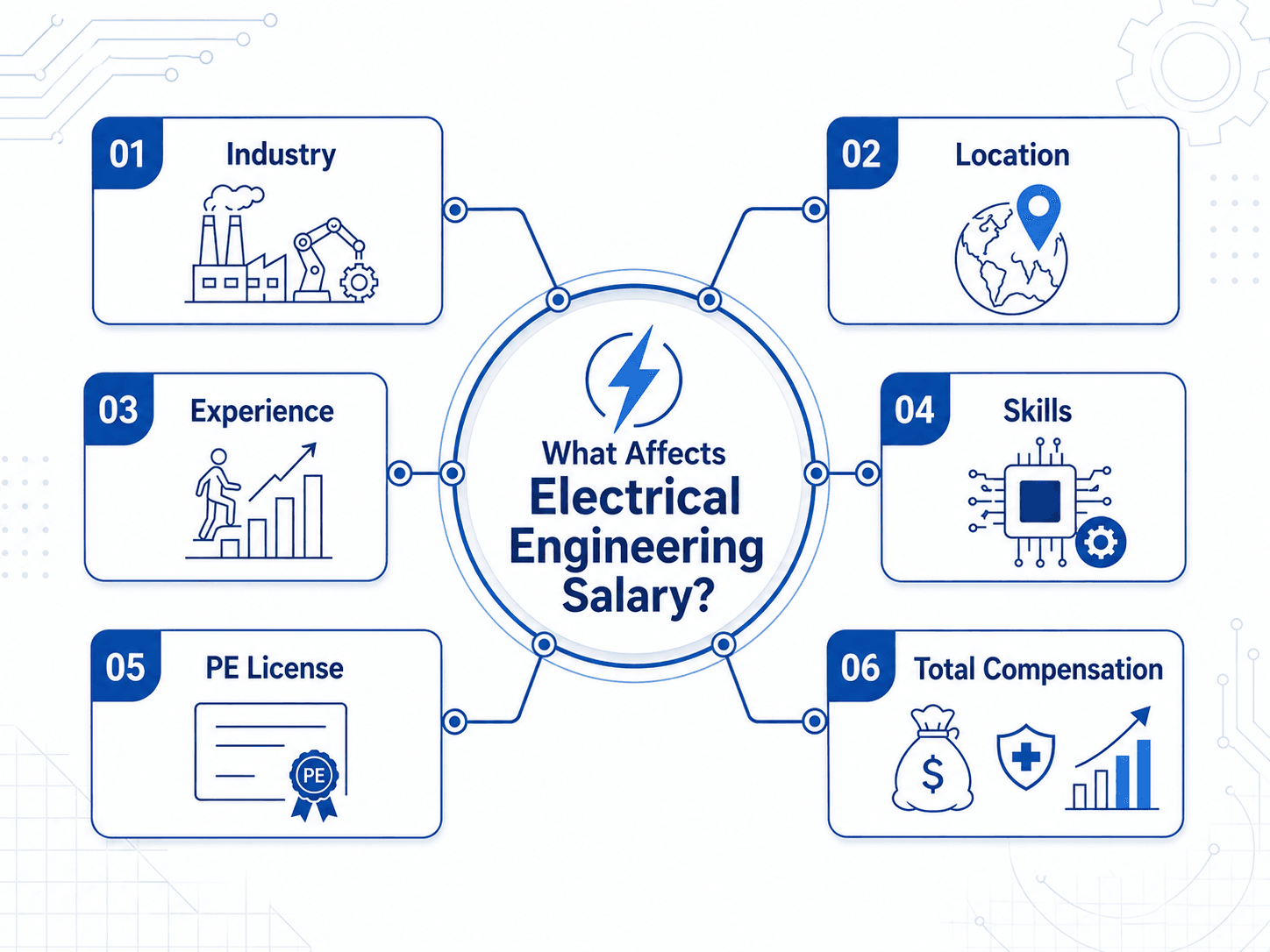
Start by separating the job title from the actual engineering responsibility. Two engineers may both be called “Electrical Engineer,” but one may be drafting low-voltage layouts while another owns grid interconnection studies, embedded hardware architecture, or protection settings.
Electrical Engineering Salary in the United States
The most useful salary starting point is a national wage baseline, then a role-specific adjustment. The BLS Occupational Outlook Handbook reports that electrical engineers had a median annual wage of $111,910 in May 2024. The lowest 10 percent earned less than $74,670, while the highest 10 percent earned more than $175,460.
Electrical engineers and electronics engineers are often grouped together in career discussions, but wage data can differ by occupation category. BLS reports a higher May 2024 median annual wage of $127,590 for electronics engineers, except computer. That difference is one reason salary pages should separate power, electronics, hardware, controls, RF, and embedded roles instead of treating all electrical engineering jobs as identical.
| Salary data point | Annual wage | How to interpret it |
|---|---|---|
| Electrical engineers, 10th percentile | Less than $74,670 | Often represents lower-experience roles, lower-paying regions, narrower responsibility, or positions outside high-paying specialties. |
| Electrical engineers, median | $111,910 | A strong national midpoint for salary comparisons, but not a guarantee for every location, company, or career stage. |
| Electrical engineers, 90th percentile | More than $175,460 | Often reflects seniority, specialized industries, management, technical leadership, scarce skills, or high-cost labor markets. |
| Electronics engineers, except computer, median | $127,590 | Useful comparison point for electronics-heavy, hardware, product, aerospace, defense, semiconductor, or high-reliability design roles. |
The median is not the “correct” salary for every engineer. It is a benchmark. A stronger comparison matches the salary number to job scope, location, experience level, industry, total compensation, and the type of electrical engineering work being performed.
Electrical Engineering Salary by Experience Level
Salary growth in electrical engineering usually follows responsibility growth. Early-career engineers are paid for fundamentals and learning speed. Mid-career engineers are paid for independent execution. Senior engineers and leads are paid for technical judgment, review authority, risk management, mentoring, and decisions that prevent expensive failures.
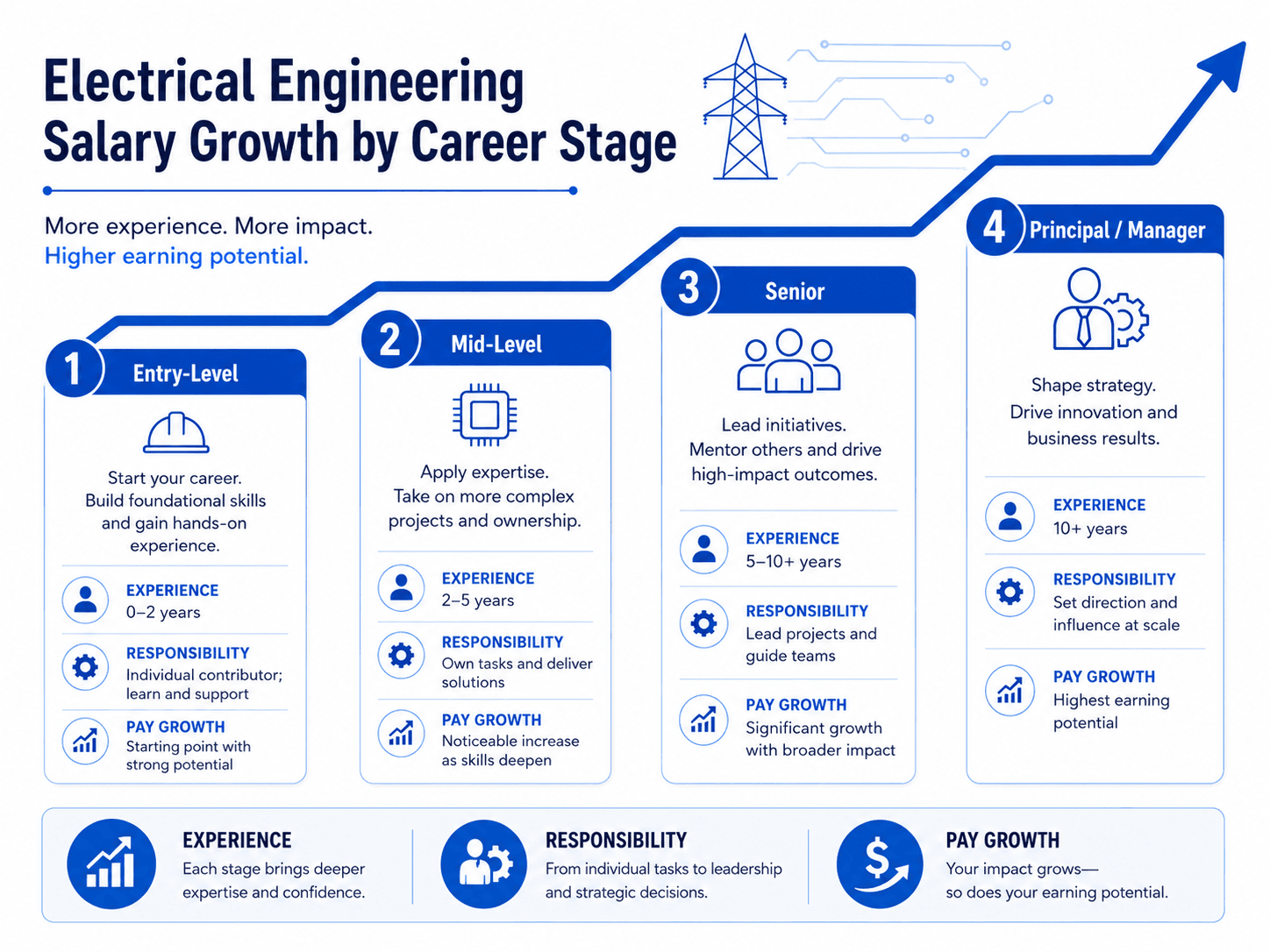
| Career stage | Typical responsibility | Salary context |
|---|---|---|
| Entry-level electrical engineer | Supports calculations, drawings, testing, documentation, simulations, field notes, and design reviews under supervision. | Often below the national median while the engineer builds tool fluency, judgment, and project experience. |
| Engineer I / Engineer II | Owns defined design tasks, performs analysis, coordinates with other disciplines, and resolves routine technical issues. | Compensation usually moves toward the national median as independence and reliable execution improve. |
| Mid-level electrical engineer | Handles larger portions of design, testing, commissioning, troubleshooting, specifications, vendor review, and client or operations coordination. | Pay often meets or exceeds the median when the engineer works in a strong market or valuable specialty. |
| Senior electrical engineer | Reviews work, owns technical decisions, mentors younger engineers, manages discipline risk, and solves ambiguous field or design problems. | Frequently above the median, especially in power, electronics, semiconductor, controls, aerospace, defense, and high-reliability roles. |
| Principal engineer / technical lead | Defines architecture, approves design approaches, resolves major technical issues, and guides standards, tools, or technical strategy. | Can move into upper-percentile compensation when the role carries broad technical authority or scarce expertise. |
| Engineering manager | Manages people, budgets, delivery, client expectations, technical quality, hiring, and cross-functional execution. | Pay depends heavily on company size, industry, team scope, business impact, and whether the manager retains technical responsibility. |
For students and early-career engineers, the strongest long-term salary path is usually not the easiest first job. It is the first job that builds design ownership, technical review habits, field awareness, and marketable specialization.
The Main Drivers of Electrical Engineering Pay
Electrical engineering pay rises when a role requires judgment that is difficult to replace. That can mean deep technical analysis, field troubleshooting, regulated design decisions, customer-facing responsibility, high-cost equipment, mission-critical reliability, or ownership of a system that affects safety, production, revenue, or uptime.
| Salary driver | Why it matters | Engineering implication |
|---|---|---|
| Specialization | Power studies, semiconductors, embedded systems, RF, controls, and protection work often require deeper tools and narrower experience. | Specialized engineers can command higher pay when the skill is scarce and directly tied to project risk or product value. |
| Industry | Aerospace, utilities, defense, semiconductor, software-adjacent hardware, automation, and energy roles often pay differently from general design services. | The same technical skill may be priced higher where reliability, certification, production delays, or failure costs are significant. |
| Location and labor market | High-cost metros and regions with heavy technology, defense, utility, or manufacturing demand often raise compensation expectations. | Engineers should compare salary against cost of living, commute, relocation, hybrid flexibility, and local advancement opportunities. |
| Design ownership | Pay tends to increase when the engineer is responsible for calculations, design decisions, field changes, test plans, or final recommendations. | A role with accountable decision-making usually has more compensation upside than a role limited to drafting, documentation, or routine support. |
| Credentials and licensure path | Some power, building systems, consulting, and public-facing engineering roles value FE, PE, or code-related experience. | Credentials matter most when they unlock stamped work, client trust, senior review roles, or regulatory responsibility. |
| Tool proficiency | Employers value engineers who can use analysis, simulation, testing, controls, CAD, PCB, or power system software without long ramp-up time. | Tools do not replace engineering judgment, but they can make an engineer productive faster and increase marketability. |
When comparing salaries, ask what decisions the engineer owns. A title tells you the discipline; responsibility tells you the market value.
Electrical Engineering Salary by Career Path
Electrical engineering career paths can produce very different salary outcomes because each path solves a different type of problem. A field power engineer may be valued for troubleshooting and commissioning. A semiconductor engineer may be valued for device-level expertise. A controls engineer may be valued for keeping industrial systems stable and productive.
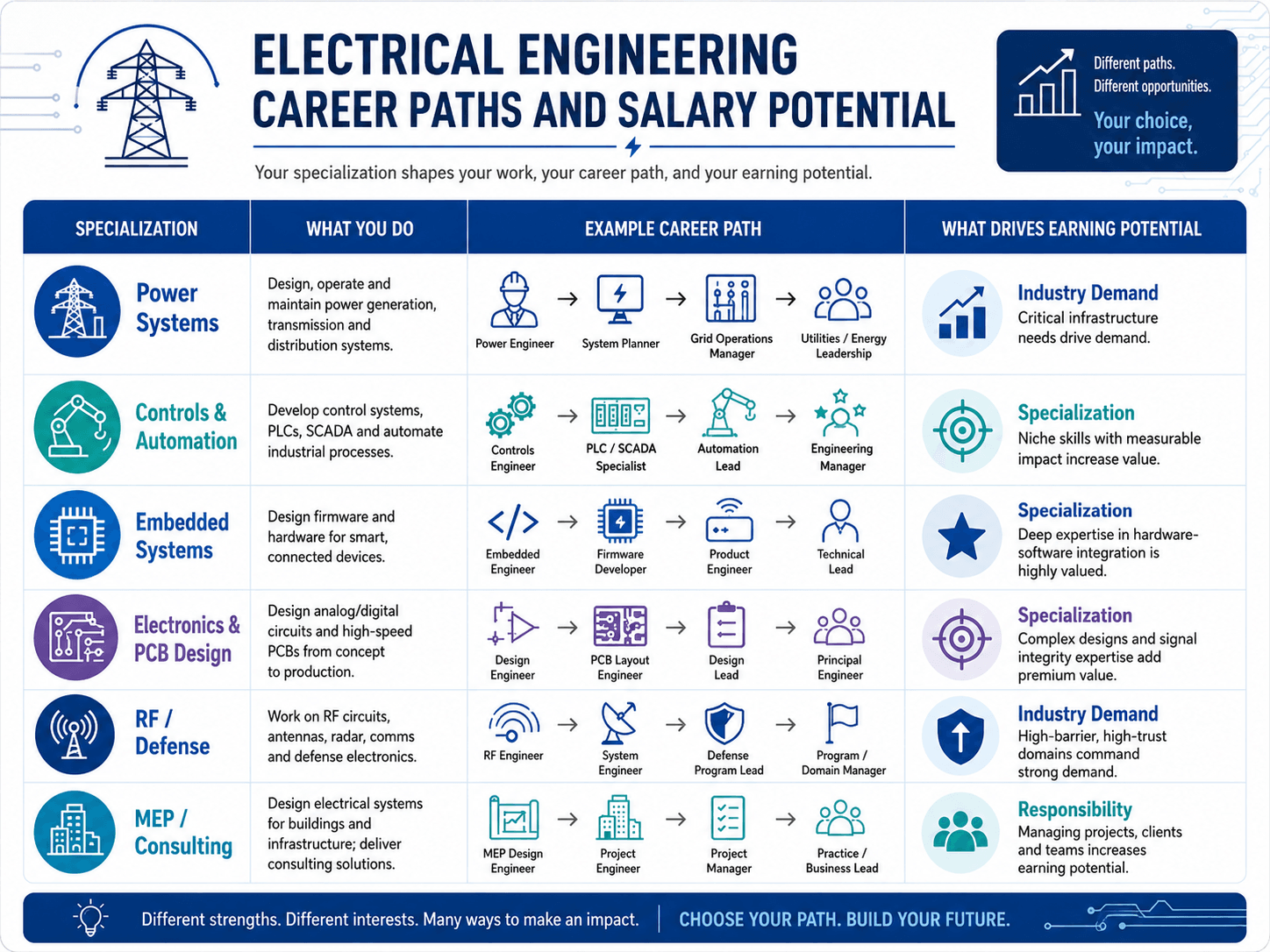
| Career path | Typical work | Salary upside usually improves when… |
|---|---|---|
| Power systems engineering | Load flow, short circuit, protection, substations, distribution, renewables, utility equipment, and grid studies. | The engineer owns studies, field troubleshooting, interconnection reviews, protection decisions, or PE-track design responsibility. |
| Electronics and PCB design | Schematic design, PCB layout review, components, test plans, signal integrity, power integrity, and manufacturability. | The engineer can take hardware from requirements through prototype, test, redesign, and production support. |
| Embedded systems | Microcontrollers, firmware-adjacent hardware, sensors, interfaces, board bring-up, and product integration. | The engineer bridges hardware and software well enough to debug real product behavior quickly. |
| Controls and automation | Feedback systems, PLCs, motor control, robotics, industrial automation, instrumentation, and process control. | The engineer improves uptime, safety, throughput, or system stability in production environments. |
| Communications and RF | Signals, antennas, wireless systems, modulation, networks, microwave links, and spectrum-related design constraints. | The engineer has scarce analysis skills and can solve performance problems that are difficult to diagnose visually. |
| Engineering management | Project delivery, staffing, budgets, client coordination, technical review, and cross-functional execution. | The manager keeps technical work accurate while improving schedule, quality, communication, and business outcomes. |
To understand how these paths connect to day-to-day work, see the related career guide on what electrical engineers do.
Electrical Engineering Salary by Industry
Industry can change salary as much as experience. Electrical engineering roles pay differently because industries place different values on reliability, production uptime, certification, intellectual property, field risk, safety, and product performance.
| Industry | Common electrical engineering work | Why salary may be higher or lower |
|---|---|---|
| Utilities and power | Transmission, distribution, substations, protection, grid studies, outage support, reliability, and equipment loading. | Pay improves when the engineer owns reliability-critical decisions, protection settings, field troubleshooting, or regulated infrastructure work. |
| Semiconductor and electronics | Device design, circuit design, PCB development, validation, signal integrity, manufacturing support, and failure analysis. | Specialized knowledge, high product value, and difficult debugging can support strong compensation. |
| Aerospace and defense | High-reliability electronics, power systems, avionics support, test systems, RF, controls, documentation, and compliance-driven design. | Pay can rise when work requires security clearance, certification discipline, reliability engineering, or scarce technical skills. |
| Renewable energy and grid interconnection | Solar, storage, inverter systems, collection systems, SCADA, studies, commissioning, and utility coordination. | Compensation improves when the engineer understands both electrical design and the commercial impact of interconnection, availability, and field performance. |
| Manufacturing and automation | Controls, PLCs, instrumentation, drives, robotics, production equipment, safety systems, and downtime troubleshooting. | Engineers who reduce downtime, improve throughput, or solve recurring controls problems can become highly valuable. |
| Consulting and building systems | Power distribution, lighting, fire alarm, low-voltage systems, construction documents, code coordination, and client deliverables. | Pay often improves with PE licensure, client trust, project leadership, and the ability to deliver accurate construction-ready designs. |
| Telecommunications and RF | Wireless systems, antennas, microwave links, signal behavior, spectrum constraints, field testing, and network performance. | Scarce RF and communications expertise can support higher pay when performance problems are difficult to diagnose and expensive to ignore. |
Electrical Engineering Salary by Location and Cost of Living
Location affects electrical engineering salary because employers compete in local labor markets. High-cost technology regions may advertise higher salaries, but the real value of an offer depends on housing, taxes, commute, relocation costs, hybrid work, and whether the area has multiple employers in the same specialty.
| Location factor | What to compare | Practical salary impact |
|---|---|---|
| High-cost metro areas | Base salary, rent or mortgage cost, commute, taxes, and competing employers. | Higher salary may not create higher disposable income if cost of living rises faster than pay. |
| Utility, energy, or industrial regions | Local power, manufacturing, petrochemical, renewables, data center, or infrastructure demand. | Strong technical demand can support good salaries outside traditional coastal technology hubs. |
| Defense and aerospace clusters | Clearance requirements, program stability, electronics work, test systems, and documentation expectations. | Specialized regional demand can raise compensation for engineers with relevant experience or clearance eligibility. |
| Remote or hybrid roles | Whether pay is priced nationally, locally, or by company compensation bands. | Remote flexibility may improve quality of life, but some employers adjust salary based on employee location. |
| Relocation offers | Moving support, temporary housing, signing bonus, relocation payback clauses, and long-term regional opportunity. | A strong relocation package can make an otherwise average offer more attractive, especially early in a career. |
State and metro wage data are useful, but they should not be used alone. A strong location comparison asks whether the region has multiple electrical engineering employers, whether the specialty is in demand, and whether the role builds skills that transfer to other markets.
Base Salary vs Total Compensation
Electrical engineering salary comparisons often break down when one offer has a higher base salary but weaker total compensation. Depending on the employer, a compensation package may include bonus, equity, overtime, retirement match, pension, per diem, relocation, travel premiums, on-call pay, or professional development support.
| Compensation item | Where it often appears | Why it matters |
|---|---|---|
| Base salary | Nearly all full-time engineering roles. | Sets stable income and is usually the easiest number to compare across offers. |
| Bonus | Corporate engineering, energy, manufacturing, technology, consulting, and management roles. | Can materially increase annual pay, but may depend on company results, individual performance, or project delivery. |
| Equity or RSUs | Technology, hardware product, semiconductor, and startup environments. | Can create upside, but value depends on vesting, company performance, liquidity, and risk. |
| Overtime or straight-time pay | Field engineering, commissioning, outage support, testing, and some consulting environments. | Can raise actual earnings, but should be weighed against workload, travel, and burnout risk. |
| Retirement match or pension | Utilities, public-sector roles, large industrial firms, and established corporations. | May make a lower base salary more competitive when long-term benefits are strong. |
| Licensure and training support | Consulting, power, public infrastructure, and professional services roles. | FE, PE, conferences, software training, and exam support can increase future earning power. |
Convert each offer into an annual total compensation estimate, then separately score the role for learning value. A slightly lower first-year package can be better if it builds a specialty that increases long-term salary.
How to Compare Electrical Engineering Job Offers
A strong electrical engineering offer is not always the highest base salary. Engineers should evaluate the full compensation package and the technical growth path. A slightly lower salary may be better if the role provides stronger design ownership, better tools, mentoring, licensure support, or access to a higher-value specialty.
Compare the base salary first, then adjust your view using total compensation, cost of living, technical responsibility, mentorship, advancement path, expected hours, travel, field exposure, and how well the role builds a scarce engineering skill.
| Offer check | What to look for | Why it matters |
|---|---|---|
| Base salary versus total compensation | Base pay, bonus, overtime, equity, retirement match, relocation, health benefits, and paid time off. | Total compensation can change the real value of an offer even when the base salary looks similar. |
| Technical growth path | Exposure to design reviews, studies, testing, field work, commissioning, customer issues, or production support. | Early access to real engineering responsibility can increase long-term earning power more than a small first-year salary difference. |
| Specialty development | Power studies, protection, PCB design, embedded systems, controls, RF, semiconductor, or automation tools. | Salary tends to improve when the engineer develops skills that are difficult to hire and directly tied to business value. |
| Mentorship and review quality | Senior engineers who review work, explain decisions, and let younger engineers learn from real projects. | Good technical review accelerates judgment, which is one of the biggest drivers of future pay. |
| Workload and travel expectations | Expected hours, field rotations, commissioning travel, on-call support, production outages, or customer escalation work. | A higher salary may not be better if it comes with unsustainable hours or travel that does not support your career goals. |
How to Increase Your Electrical Engineering Salary
Electrical engineers increase salary fastest when they move from task execution into accountable technical judgment. The market pays more for engineers who can prevent failures, reduce uncertainty, improve system performance, communicate tradeoffs, and solve problems that are expensive for the company to get wrong.
- Move from support work to design ownership: Build the ability to own calculations, drawings, specifications, test plans, reviews, and final recommendations.
- Develop a high-value specialty: Power systems, protection, controls, automation, embedded systems, RF, semiconductor, electronics, and high-reliability hardware can all support stronger salary paths.
- Learn tools that employers actually use: Power system software, PCB tools, SPICE, MATLAB, Python, PLC environments, CAD, data analysis, and test equipment can improve productivity and marketability.
- Gain field and test experience: Engineers who understand how real systems fail can make better design decisions than engineers who only work from idealized drawings.
- Document project impact: Track examples where your work reduced downtime, improved reliability, avoided rework, improved safety, supported commissioning, or solved a difficult technical issue.
- Pursue credentials where they matter: FE and PE credentials are especially useful in consulting, power, public infrastructure, building systems, and roles where stamped work or formal engineering responsibility matters.
- Improve technical communication: Engineers who can explain complex electrical issues to managers, technicians, clients, software teams, and operators often move into higher-responsibility roles faster.
A salary-building skill should do at least one of four things: reduce technical risk, improve system performance, make the engineer productive faster, or help the business make better decisions.
Electrical Engineering Salary Negotiation Checklist
Salary negotiation is strongest when it is based on evidence, not just a desired number. Electrical engineers should connect the request to role scope, market data, specialty value, project impact, and the cost of replacing or delaying the skill.
| Negotiation check | What to prepare | Why it strengthens your case |
|---|---|---|
| Market range | National wage baseline, local salary context, job posting ranges, and comparable role expectations. | Shows that the request is grounded in the market rather than arbitrary preference. |
| Specialized technical skill | Examples of tools, systems, studies, designs, test methods, or troubleshooting skills relevant to the role. | Scarce skills justify higher pay when they reduce ramp-up time or technical risk. |
| Project impact | Specific examples of reliability improvements, avoided rework, design ownership, commissioning support, or cost savings. | Employers respond better when compensation is connected to measurable value. |
| Credentials | FE, PE, security clearance, software certifications, safety training, or industry-specific qualifications where relevant. | Credentials can increase trust, expand what work you can perform, or reduce employer risk. |
| Total compensation gap | Differences in bonus, equity, retirement match, relocation, overtime, travel burden, and benefits. | A lower base salary may need adjustment if the overall package is weaker than alternatives. |
| Role expansion | New responsibility, larger systems, client ownership, field escalation, technical review, or mentoring expectations. | Higher responsibility is one of the strongest reasons to request higher compensation. |
Start with appreciation, state the role remains interesting, reference the market and responsibilities, connect your request to specific technical value, then ask whether the compensation package can be adjusted before you make a final decision.
Engineering Judgment and Field Reality
Salary surveys can hide major differences between similar titles. A consulting electrical engineer may spend time on construction documents, code coordination, and client deadlines. A utility engineer may work with outages, protection settings, equipment loading, and reliability. A product engineer may focus on prototypes, lab failures, component shortages, and manufacturing defects.
Field exposure also changes value. Engineers who can troubleshoot a real system, communicate with technicians, verify drawings against installed equipment, and translate field issues into design improvements often become more valuable than engineers who only understand idealized models.
Real compensation often follows risk. If an engineer’s decision can prevent an outage, failed prototype, unsafe installation, production delay, warranty issue, or expensive redesign, that responsibility usually has more salary leverage than routine documentation work.
When Salary Comparisons Break Down
Electrical engineering salary comparisons break down when readers compare numbers without matching the role, location, industry, and compensation structure. A national median, a self-reported salary website, a recruiter post, and a high-cost metro offer may all be “true” while describing different situations.
- Different roles share the same title: “Electrical Engineer II” may mean PCB work at one company, power design at another, and test engineering somewhere else.
- Cost of living changes the real value: A higher salary in a high-cost area may not create more disposable income than a lower salary in a lower-cost region.
- Total compensation is not always visible: Bonus, equity, overtime, benefits, pension, retirement match, and travel policies can materially change the offer.
- Industry cycles matter: Semiconductor, energy, utilities, defense, construction, and consumer electronics markets can heat up or slow down at different times.
- Remote and hybrid work affect comparison: A remote role may pay differently depending on whether the employer prices compensation nationally or locally.
Common Mistakes When Researching Electrical Engineering Salary
The biggest mistake is treating one salary number as the answer. Better salary research compares multiple sources, filters by role and region, and then asks whether the job builds skills that will matter five years later.
- Using average salary without context: Averages can be pulled upward by senior engineers, expensive metros, or specialized industries.
- Ignoring the actual engineering work: Design, testing, field support, commissioning, research, and management roles may have different pay curves.
- Overvaluing a degree alone: A degree opens the door, but internships, projects, tool fluency, communication, and technical ownership influence offers.
- Comparing base salary only: Bonus, equity, benefits, overtime, and retirement contributions can make two offers very different.
- Forgetting career trajectory: A job with strong mentorship and specialized work may outperform a slightly higher offer with limited growth.
Do not compare an entry-level electrical design role to a senior semiconductor, aerospace, utility protection, or technical management role and assume the difference is only negotiation. The role scope and labor market are different.
Salary Data Sources and Career Research Context
Electrical engineering salary research should start with a neutral labor-market source, then be refined using location, industry, specialization, career stage, and offer-specific compensation details.
- U.S. Bureau of Labor Statistics: BLS Occupational Outlook Handbook profile for electrical and electronics engineers provides national wage, education, work environment, and employment outlook context for electrical and electronics engineers.
- Employer and regional data: Company size, metro area, defense or utility demand, semiconductor hiring, renewable energy activity, and local cost of living can shift salary expectations away from national figures.
- Engineering use: Engineers should use salary data as a starting range, then evaluate whether the role builds technical depth, licensure path, project ownership, field judgment, and long-term career leverage.
Frequently Asked Questions
Electrical engineers commonly earn salaries in the low six figures nationally, with BLS reporting a May 2024 median annual wage of $111,910. Actual pay varies by experience, industry, location, specialization, and whether the engineer owns design, testing, field, or technical leadership decisions.
Entry-level electrical engineering salary is usually below the national median because new engineers are still building design judgment, tool fluency, field experience, and project ownership. Offers are stronger when the role includes mentorship, real design work, testing, commissioning exposure, or a high-value specialty path.
Higher-paying electrical engineering fields often include semiconductor design, power systems studies, protection engineering, aerospace and defense electronics, RF engineering, embedded systems, controls, automation, and senior technical leadership. The highest pay usually appears where scarce skills, high reliability requirements, and costly mistakes overlap.
A master’s degree can increase salary when it supports a specialized role such as semiconductor design, signal processing, controls, power systems, communications, research and development, or advanced electronics. It is less valuable when the role rewards field experience, licensure, project delivery, or hands-on testing more than graduate coursework.
Electrical engineers can increase salary by moving from support work into design ownership, building scarce technical skills, learning high-value tools, documenting project impact, gaining field or test experience, pursuing FE or PE credentials where relevant, and advancing into lead, principal, project engineer, or engineering management roles.
Summary and Next Steps
Electrical engineering salary is best understood as a combination of labor-market data and engineering responsibility. National data provides a useful baseline, but specialization, industry, location, experience level, total compensation, and technical ownership explain why two electrical engineers with similar titles may earn very different salaries.
Use the BLS median and percentile data as a starting point, then compare offers by role scope, career-stage growth, mentorship, travel expectations, field exposure, and whether the job builds valuable electrical engineering skills. The best salary decision is not just the highest number today; it is the role that improves long-term technical and career leverage.
Where to go next
Continue your learning path with related Turn2Engineering resources.
-
What Do Electrical Engineers Do?
See how electrical engineering work changes by industry, tools, project type, and career responsibility.
-
Electrical Engineering Degree
Learn which courses, labs, and project experiences support a strong entry-level engineering path.
-
Electrical Engineering Projects
Build practical project experience that can strengthen resumes, interviews, and technical confidence.