
Key Takeaways
- Core idea: Wastewater treatment plants clean used water by combining physical separation, biological treatment, polishing, disinfection, and solids handling into one connected treatment train.
- Engineering use: Engineers use wastewater treatment plants to protect public health, reduce pollutant loads, meet discharge permits, support water reuse, and protect rivers, lakes, groundwater, and coastal waters.
- What controls it: Flow rate, organic loading, suspended solids, nutrients, temperature, dissolved oxygen, clarifier settling, hydraulic detention time, and sludge processing capacity strongly affect performance.
- Practical check: A wastewater plant is both a water-cleaning system and a residuals-management system; failures often begin when solids, oxygen, flow variation, or sludge handling are not controlled.
Table of Contents
Introduction
Wastewater treatment plants work by moving sewage and used water through physical, biological, and chemical processes that remove debris, grit, settleable solids, organic matter, nutrients, pathogens, and sludge. The treated effluent can then be discharged or reused, while the separated solids are thickened, stabilized, dewatered, and managed as residuals or biosolids.
Wastewater Treatment Plant Process Diagram

Read the diagram from left to right first. The upper path follows the water from influent to effluent, while the lower path shows how primary sludge and waste activated sludge are thickened, digested, dewatered, and managed as biosolids.
What is a Wastewater Treatment Plant?
A wastewater treatment plant is an engineered facility that receives wastewater from homes, businesses, institutions, and sometimes industries, then removes pollutants before the treated water is discharged, reused, or sent to additional treatment. In municipal systems, most influent arrives through sanitary sewers, pump stations, and force mains.
The plant does not remove every contaminant with one piece of equipment. Instead, it uses a treatment train where each stage targets a different problem. Screens remove large debris, grit chambers remove heavy inorganic particles, clarifiers remove settleable solids, biological reactors remove organic matter, disinfection reduces pathogens, and sludge processes manage the solids separated from the water.
In water resources engineering, wastewater treatment connects water quality, public infrastructure, environmental discharge, reuse planning, and regulatory compliance. It also connects directly to water infrastructure because treatment plants depend on collection systems, pumps, outfalls, receiving waters, and long-term operations.
The Two Systems Inside a Wastewater Treatment Plant
The easiest way to understand how wastewater treatment plants work is to separate the facility into two linked systems. The liquid stream cleans the water. The solids stream handles the material removed from that water.
| System | What moves through it | Main goal | Typical units |
|---|---|---|---|
| Liquid treatment train | Influent wastewater moving toward final effluent | Remove debris, grit, solids, organic matter, nutrients, and pathogens | Headworks, clarifiers, aeration basins, filters, disinfection systems, outfall |
| Solids treatment train | Primary sludge, waste activated sludge, scum, and residuals | Reduce volume, stabilize organics, control odors, and prepare biosolids for reuse or disposal | Thickeners, digesters, dewatering equipment, storage, hauling, biosolids handling |
A plant is not performing well unless both paths are stable. Good effluent quality depends on reliable screening, settling, aeration, clarification, disinfection, and sludge removal working together.
How the Wastewater Treatment Process Works Step by Step
The process starts when wastewater enters the plant as influent. Treatment then moves from coarse removal to fine control: first protecting equipment, then separating solids, then using microorganisms to consume organic pollution, then clarifying, polishing, and disinfecting the water. The sequence is arranged this way because each step improves the performance of the next one.
1. Collection and influent flow bring wastewater to the plant
Wastewater reaches the plant through sanitary sewers, pump stations, and pressure mains. Influent flow changes throughout the day and can increase sharply during wet weather if stormwater or groundwater enters the sewer system. Those flow changes affect detention time, channel velocities, clarifier loading, disinfection contact time, and sludge handling.
2. Preliminary treatment protects equipment
Preliminary treatment removes materials that can clog pumps, damage equipment, reduce basin volume, or interfere with downstream treatment. Screens capture rags, wipes, plastics, sticks, and large debris. Grit chambers remove sand, gravel, eggshells, and heavy inorganic particles that would otherwise abrade pumps, settle in channels, and reduce usable tank volume.
3. Primary treatment settles solids and skims scum
Primary clarifiers slow the wastewater enough for heavier solids to settle and lighter grease or scum to float. Settled solids become primary sludge, while clarified wastewater leaves the tank for biological treatment. Primary treatment reduces the load on aeration basins, but it does not remove most dissolved organic matter by itself.
4. Secondary treatment uses biology to remove organic matter
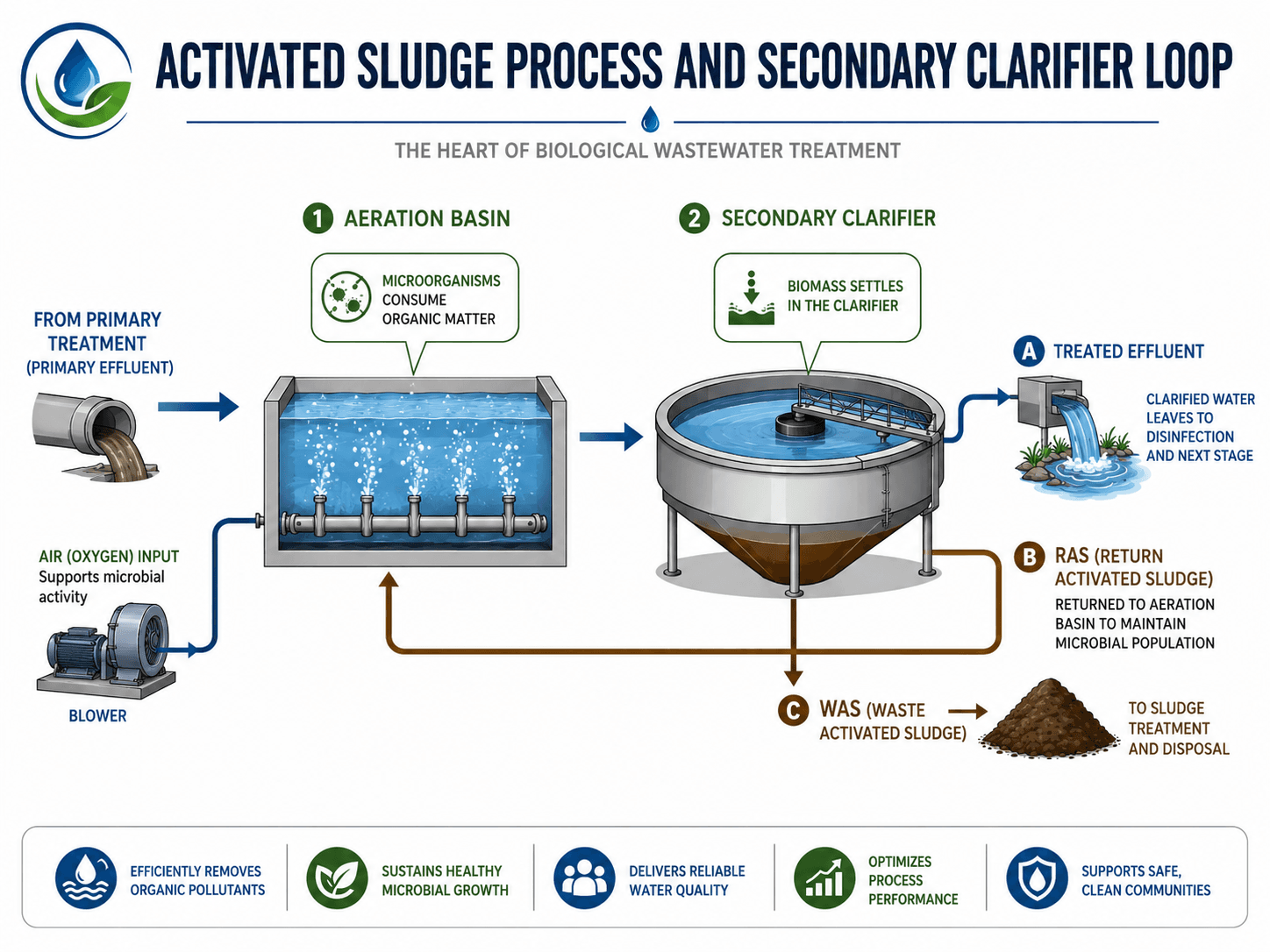
Secondary treatment is where much of the pollutant removal happens. In activated sludge systems, microorganisms are mixed with wastewater and oxygen in an aeration basin. The microbes consume biodegradable organic matter, grow into biological floc, and are later separated from treated water in secondary clarifiers.
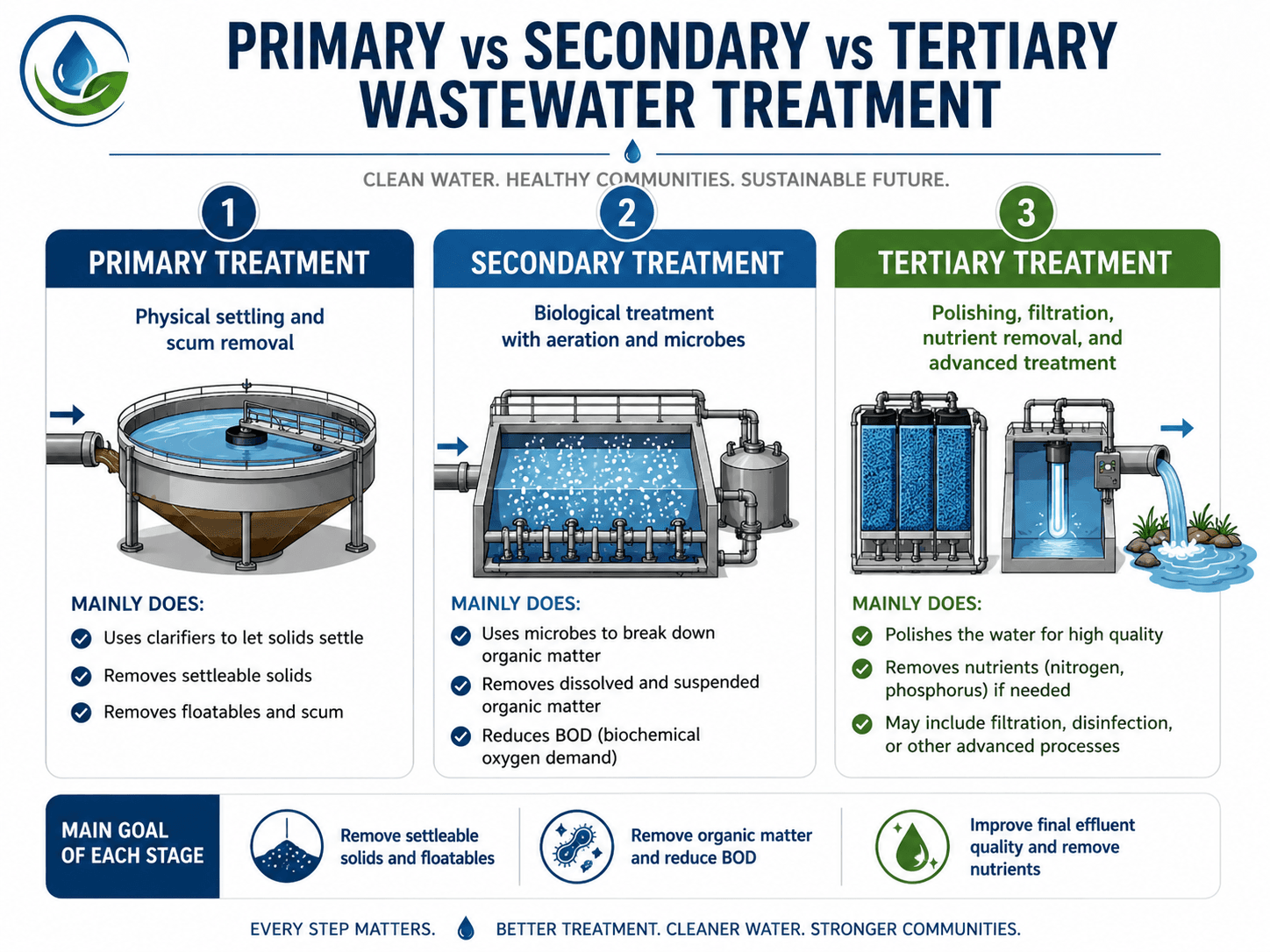
5. Tertiary treatment and disinfection polish the water
Tertiary treatment is added when final effluent must meet tighter requirements for suspended solids, nutrients, turbidity, reuse, or sensitive receiving waters. This may include filtration, membrane treatment, chemical phosphorus removal, biological nutrient removal, activated carbon, or other polishing processes. Disinfection then reduces pathogens using chlorine, ultraviolet light, ozone, or another approved method.
Activated Sludge and the Secondary Clarifier Loop
The activated sludge process is one of the most important concepts in municipal wastewater treatment. It is not just a tank with air bubbles. It is a controlled biological loop where microorganisms are grown, supplied with oxygen, settled, returned, and wasted at the right rate to keep the process stable.
Why return activated sludge matters
Return activated sludge, or RAS, sends settled microorganisms from the secondary clarifier back to the aeration basin. This maintains enough active biomass to keep removing organic matter. If too little biomass is returned, treatment can weaken. If solids are poorly controlled, clarifiers can overload and send solids into the effluent.
Why waste activated sludge matters
Waste activated sludge, or WAS, removes excess biomass from the system. Microorganisms grow as they consume organic matter, so the plant must regularly waste a portion of solids to control sludge age, mixed liquor concentration, settling behavior, oxygen demand, and downstream digestion capacity.
How this connects to biological treatment
For a deeper look at the biology behind this loop, see Biological Treatment. The important point here is that treatment performance depends on both microbial activity and solids separation. A biological reactor without reliable clarification is not a complete secondary treatment system.
In biological wastewater treatment, water quality depends on both the aeration basin and the clarifier. A plant can have enough oxygen and still fail if biomass does not settle well or if the RAS/WAS balance is poorly controlled.
What Each Wastewater Treatment Stage Removes
Each stage targets pollutants based on physical behavior, biological treatability, chemical form, and required effluent quality. Large debris can be screened, grit can be settled by weight, organic matter is often biologically degraded, nutrients may require special process control, and pathogens are primarily addressed near the end of the liquid treatment train.
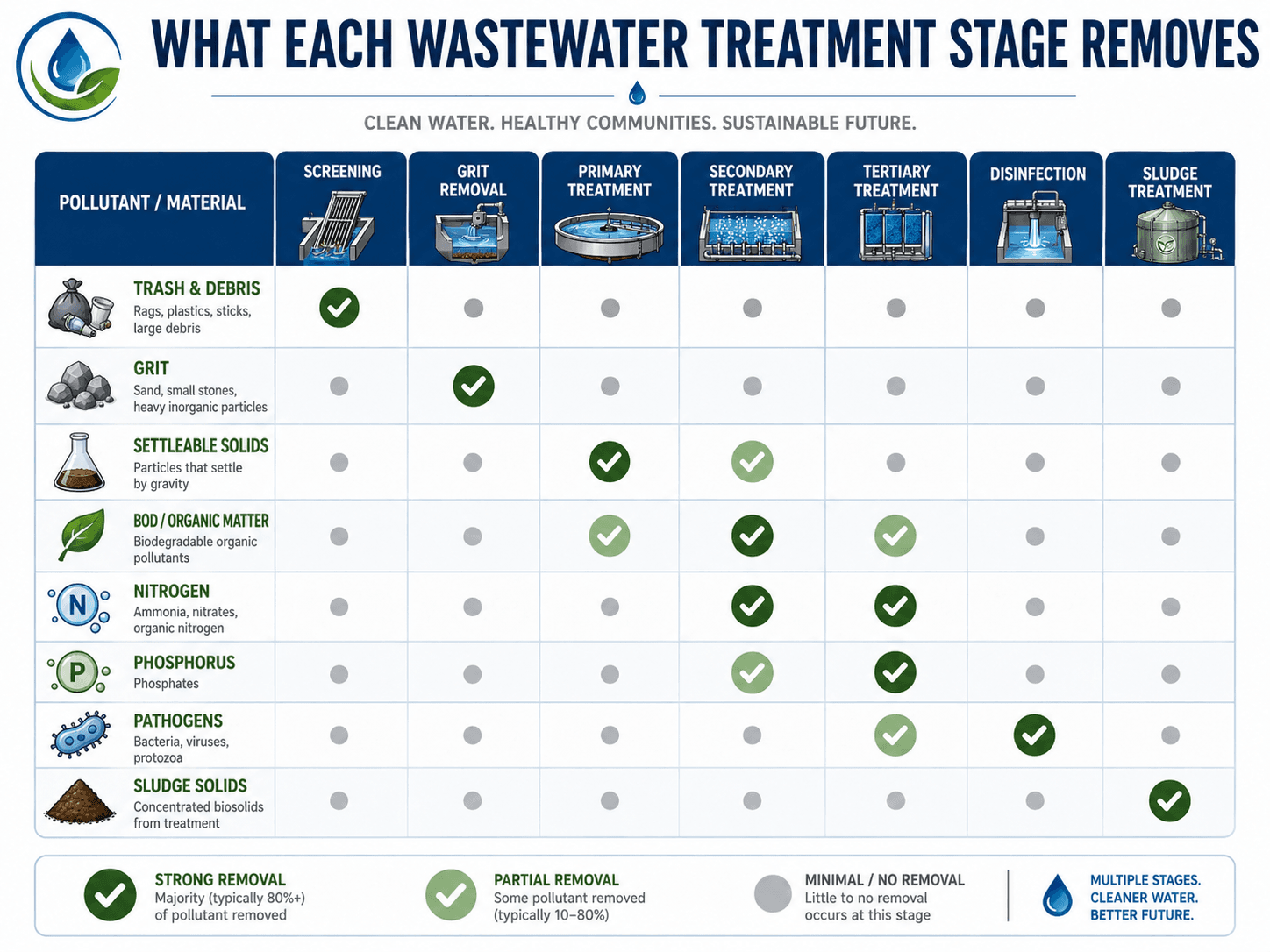
| Treatment stage | Main removal target | Engineering purpose |
|---|---|---|
| Screening | Rags, wipes, plastics, sticks, large debris | Protects pumps, channels, valves, and downstream equipment from clogging and damage. |
| Grit removal | Sand, gravel, eggshells, dense inorganic particles | Reduces abrasion, deposition, lost basin volume, and maintenance problems. |
| Primary treatment | Settleable solids, scum, some organic load | Reduces solids loading before biological treatment and produces primary sludge. |
| Secondary treatment | BOD, biodegradable organic matter, biological solids | Uses microorganisms and clarification to remove most conventional organic pollution. |
| Tertiary treatment | Fine solids, nutrients, additional polishing targets | Improves effluent quality when permit limits, reuse goals, or sensitive receiving waters require it. |
| Disinfection | Pathogens | Reduces bacteria, viruses, and other microorganisms before discharge or reuse. |
| Sludge treatment | Primary sludge and waste activated sludge | Thickens, stabilizes, dewaters, and manages residual solids from the plant. |
What Happens to Sludge in a Wastewater Treatment Plant?
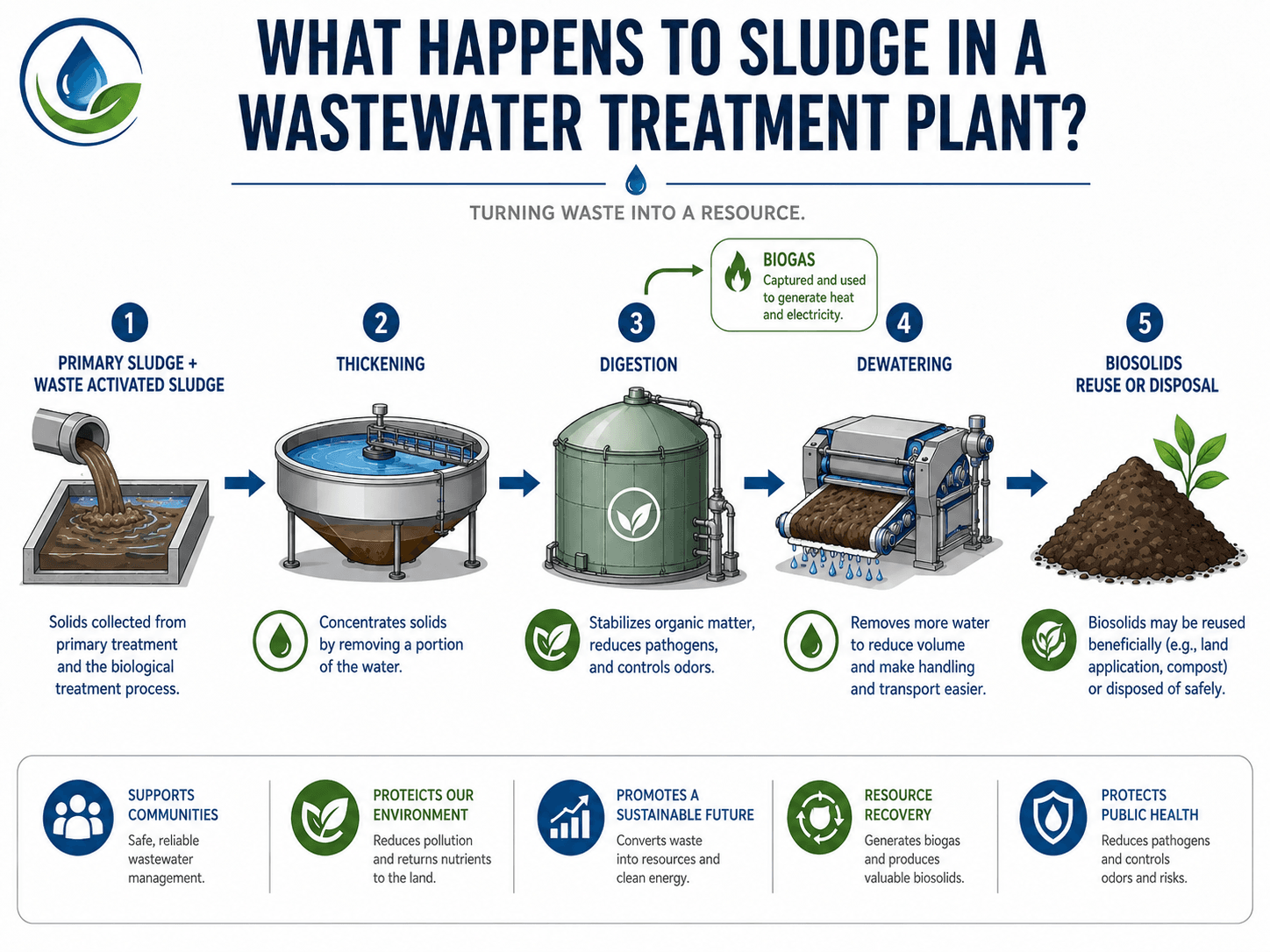
Sludge handling is a major part of how wastewater treatment plants work. Primary clarifiers produce primary sludge, while biological systems produce waste activated sludge. These solids contain water, organic material, microorganisms, grit, and concentrated pollutants, so they must be treated before reuse or disposal.
Thickening and digestion
Thickening removes a portion of the water so less volume must be digested or hauled. Digestion then stabilizes organic solids. Anaerobic digestion can also produce biogas, while aerobic digestion uses oxygen to reduce volatile solids and improve stability.
Dewatering and biosolids management
Dewatering equipment such as belt presses, centrifuges, or screw presses removes more water and produces a sludge cake that is easier to transport. The final material may be managed as biosolids, reused where allowed, composted, incinerated, landfilled, or otherwise disposed of depending on treatment quality and local requirements.
Key Factors That Control Plant Performance
Wastewater treatment performance depends on more than the number of tanks in the plant. Engineers and operators watch hydraulic loading, organic loading, solids inventory, oxygen transfer, temperature, nutrient goals, equipment reliability, and sludge handling capacity because each one can limit the whole process.
| Factor | Why it matters | Engineering implication |
|---|---|---|
| Influent flow variation | Peak wet-weather flow can reduce detention time and wash solids through clarifiers. | Plants need hydraulic capacity, flow splitting, equalization, and reliable collection-system control. |
| Organic loading | High BOD increases oxygen demand and biomass growth. | Aeration capacity, sludge wasting, and clarifier solids loading must be matched to actual load. |
| Temperature | Biological activity slows in colder water and can change nitrification performance. | Winter operation may require longer sludge age, more process volume, or tighter oxygen control. |
| Dissolved oxygen | Microorganisms need oxygen to remove organic matter and support nitrification in aerobic zones. | Blowers, diffusers, controls, and basin mixing become major energy and performance drivers. |
| Clarifier settling | Poor settling can carry biological solids into the effluent even when the aeration basin is working. | Engineers review solids loading, sludge blanket depth, return rates, floc condition, and hydraulic short-circuiting. |
| Sludge handling capacity | Solids removed from the liquid stream must be thickened, stabilized, dewatered, hauled, or reused. | A bottleneck in sludge processing can force poor wasting decisions and destabilize the biological process. |
Important Process Controls and Measurements
A top-level explanation of wastewater treatment should include the measurements that operators and engineers actually use. These values help show whether the plant is simply moving water through tanks or genuinely removing pollutants at the required rate.
| Measurement | What it indicates | Why it matters in plant operation |
|---|---|---|
| BOD | Biodegradable organic load | Drives oxygen demand, biological treatment sizing, aeration energy, and effluent compliance. |
| TSS | Total suspended solids | Shows solids loading and helps evaluate clarifier, filtration, and effluent quality. |
| Dissolved oxygen | Oxygen available to microorganisms | Controls biological performance, nitrification, blower operation, and energy use. |
| MLSS | Mixed liquor suspended solids in aeration | Represents biomass inventory and affects organic removal, settling, and sludge wasting decisions. |
| Sludge blanket depth | Depth of settled solids in clarifiers | Warns when clarifiers are at risk of solids carryover or poor sludge withdrawal. |
| Ammonia, nitrate, and phosphorus | Nutrient removal performance | Critical where permits or receiving-water protection require nitrogen or phosphorus control. |
| Disinfection residual or UV dose | Pathogen-control performance | Confirms the final treatment barrier is functioning before discharge or reuse. |
These measurements are why wastewater treatment is both a design problem and an operations problem. Good design gives the plant enough capacity and flexibility; good operation keeps the process inside the range where the biology, hydraulics, clarification, and disinfection systems work reliably.
Major Wastewater Treatment Plant Components
Wastewater plants vary in layout, but many municipal facilities contain the same families of equipment. Understanding these components helps connect the process diagram to real infrastructure such as basins, pumps, blowers, channels, clarifiers, filters, disinfection systems, digesters, and dewatering buildings.
- Influent pump station: lifts wastewater when gravity flow cannot carry it through the plant.
- Headworks: includes screens, grit removal, channels, gates, and flow measurement.
- Primary clarifiers: remove settleable solids and floating scum before biological treatment.
- Aeration basins: mix wastewater, microorganisms, and oxygen to remove biodegradable pollutants.
- Blowers and diffusers: transfer oxygen and provide mixing for aerobic biological treatment.
- Secondary clarifiers: separate biological solids from clarified effluent and support RAS/WAS control.
- Tertiary filters or membranes: polish effluent for fine solids, reuse, or stricter discharge requirements.
- Disinfection contact system: provides pathogen reduction using chlorine, UV, ozone, or another approved method.
- Digesters and dewatering systems: stabilize and reduce the volume of sludge removed from the liquid process.
- Outfall or reuse connection: conveys treated effluent to the receiving water, reuse system, or additional treatment.
Wastewater treatment components work as a chain. Oversizing one tank does not fix a bottleneck in screening, aeration, clarification, sludge wasting, disinfection, or residuals handling.
Where Treated Wastewater Goes After Treatment
After treatment and disinfection, the final effluent leaves the plant through an outfall, reuse system, infiltration system, or another approved discharge pathway. The destination matters because it controls the treatment targets. A plant discharging to a sensitive stream may need tighter nutrient and oxygen-demand limits than a plant with different receiving-water conditions.
- Surface-water discharge: treated effluent may flow to a river, stream, lake, reservoir, estuary, or ocean through a permitted outfall.
- Water reuse: additional treatment may allow nonpotable reuse for irrigation, industrial water, cooling, recharge, or other approved uses.
- Groundwater-related discharge: some systems discharge through infiltration, land application, or recharge pathways where local rules allow.
- Advanced treatment: reuse or sensitive discharge may require filtration, membranes, nutrient removal, advanced oxidation, or additional monitoring.
This is where water policy and regulation become part of engineering practice. The plant process is selected not only by what wastewater contains, but also by where the final effluent goes and what level of protection the receiving environment requires.
Plant Walkthrough Checklist: From Influent to Effluent
A practical way to understand a wastewater treatment plant is to trace one gallon of wastewater through the system and ask what problem each stage is solving. This checklist helps connect process flow, equipment, pollutant removal, and common operating concerns.
Start at the influent channel, confirm what the plant is protecting against, follow the water through each removal mechanism, then follow the solids leaving the liquid stream. If a step removes material from the water, ask where that material goes next.
| Check or decision | What to look for | Why it matters |
|---|---|---|
| Influent conditions | Dry-weather flow, wet-weather peaks, odor, grease, industrial contribution, debris, and unusual color or pH. | Influent variability controls the loading placed on every downstream unit. |
| Headworks protection | Screen capture, screenings handling, grit removal, channel velocities, and signs of clogging or deposition. | Headworks problems can damage equipment and reduce effective treatment capacity. |
| Primary settling | Sludge blanket depth, scum removal, surface turbulence, and short-circuiting. | Good primary treatment reduces organic and solids loading on biological treatment. |
| Aeration basin control | Dissolved oxygen, mixing, foam, MLSS, sludge age, nutrient control zones, and blower reliability. | Biological treatment depends on a stable microbial population and enough oxygen or anoxic control where required. |
| Secondary clarification | Settling quality, solids carryover, RAS rate, WAS rate, sludge blanket, and hydraulic loading. | Clarifier failure can make the effluent look poor even if the biology is active. |
| Disinfection and discharge | UV intensity, chlorine residual, contact time, dechlorination, turbidity, and receiving-water constraints. | Final pathogen control depends on both disinfection equipment and the quality of water entering it. |
| Sludge processing | Thickener performance, digester stability, dewatering solids, hauling capacity, odors, and biosolids destination. | The liquid stream cannot remain stable if solids are not removed and processed consistently. |
Engineering Judgment and Field Reality
Process diagrams make wastewater treatment look linear, but real plants are dynamic systems. Flow changes by hour, organic load changes by community activity, rainfall can enter the collection system, industrial discharges can shock the biology, and maintenance conditions can change how much capacity is actually available.
Experienced engineers and operators do not judge a plant only by whether each unit exists on a process flow diagram. They look at how the pieces behave together: whether solids are settling, whether oxygen transfer is adequate, whether return sludge is stable, whether filters are loading too quickly, whether disinfection has enough contact time, and whether residuals handling can keep up.
A treatment plant can meet its process sequence on paper and still struggle in the field if wet-weather inflow, grease, wipes, poor settling sludge, aging blowers, clogged diffusers, or limited sludge hauling capacity reduce the real operating margin.
When This Breaks Down
The simplified explanation of “screen, settle, aerate, clarify, disinfect” breaks down when the plant is controlled by flow variation, solids behavior, biological stability, nutrient limits, or residuals capacity instead of the normal dry-weather process sequence.
- Wet-weather inflow overwhelms hydraulic capacity: high peak flow can shorten detention time and carry solids through clarifiers.
- Biology is shocked: toxic discharges, low temperature, pH changes, or oxygen limitations can reduce microbial activity.
- Sludge does not settle: bulking sludge, rising sludge, or excessive solids loading can cause solids carryover.
- Disinfection demand is underestimated: high turbidity, solids, ammonia, or organic matter can reduce pathogen-control reliability.
- Sludge processing becomes the bottleneck: limited thickening, digestion, dewatering, or hauling capacity can destabilize wasting and solids control.
Common Mistakes and Practical Checks
Many misunderstandings come from treating a wastewater plant as a simple filter. In reality, most municipal treatment is a combination of separation, biology, chemistry, hydraulics, controls, maintenance, and residuals management.
- Confusing wastewater treatment with drinking water treatment: wastewater plants clean used water before discharge or reuse, while drinking water plants treat source water for potable distribution.
- Ignoring the solids stream: every removal step creates residuals that must be handled somewhere else in the plant.
- Assuming secondary treatment means final treatment: some plants need tertiary filtration, nutrient removal, or advanced treatment based on discharge limits or reuse goals.
- Thinking disinfection fixes poor upstream treatment: disinfection works better when solids, turbidity, and organic demand have already been controlled.
- Overlooking operations: blowers, pumps, sensors, sludge wasting, cleaning, and maintenance are central to treatment performance.
The biggest mistake is viewing a wastewater treatment plant as one machine instead of a connected process. If one stage removes pollutants, another stage must manage the separated solids, air demand, chemical demand, or operating consequence.
Useful References and Design Context
Wastewater treatment design and operation are shaped by discharge permits, treatment objectives, public health goals, receiving-water sensitivity, local utility standards, and operator capability. A general article can explain how the process works, but final requirements are normally governed by project-specific permits and regulatory criteria.
- U.S. Environmental Protection Agency: EPA Municipal Wastewater resources provide federal context for municipal wastewater treatment, NPDES permitting, discharge requirements, collection systems, and public wastewater treatment facilities.
- Project-specific criteria: Municipal permits, state environmental rules, utility standards, receiving-water limits, reuse requirements, and local operations practices may control the final treatment sequence and performance targets.
- Engineering use: Engineers use these references with influent data, flow projections, treatability assumptions, redundancy requirements, process modeling, equipment selection, and field operating data to develop reliable treatment plant designs.
Frequently Asked Questions
Wastewater treatment plants work by moving used water through a sequence of physical, biological, and chemical treatment steps. Large debris and grit are removed first, solids are settled, microorganisms break down organic pollution, clarified water is polished or disinfected, and the remaining sludge is treated separately.
The main stages are preliminary treatment, primary treatment, secondary biological treatment, secondary clarification, tertiary treatment when needed, disinfection, effluent discharge or reuse, and sludge treatment. Not every plant has the same layout, but most municipal plants follow this basic treatment-train logic.
Primary treatment mainly uses settling and skimming to remove solids and scum. Secondary treatment uses microorganisms, oxygen, and clarification to remove organic matter and biological solids. Tertiary treatment polishes the water further through filtration, nutrient removal, advanced treatment, or additional disinfection.
Sludge from primary clarifiers and waste activated sludge from biological treatment are usually thickened, stabilized by digestion, dewatered, and then managed as biosolids. Depending on treatment quality and local requirements, biosolids may be reused, composted, land-applied, incinerated, or disposed of.
No. Conventional wastewater treatment is designed to remove major pollutants such as suspended solids, organic matter, settleable solids, nutrients where required, and pathogens. Trace chemicals, dissolved salts, PFAS, pharmaceuticals, or industrial contaminants may require source control, pretreatment, advanced treatment, or separate regulatory controls.
Summary and Next Steps
Wastewater treatment plants work by moving used water through a connected treatment train that removes debris, grit, settleable solids, organic matter, nutrients, pathogens, and residual solids. The process is staged because each pollutant behaves differently and requires a different removal mechanism.
The most important engineering takeaway is that the liquid stream and solids stream must work together. Screening, grit removal, clarification, aeration, RAS/WAS control, disinfection, effluent discharge, and sludge handling all affect whether the final effluent can be discharged or reused reliably.
Where to go next
Continue your learning path with related Turn2Engineering resources.
-
Water Treatment Processes
Compare wastewater treatment logic with broader physical, chemical, and biological water treatment processes.
-
Biological Treatment
Learn how microorganisms are used to remove biodegradable pollutants in engineered treatment systems.
-
Disinfection Methods
Review chlorine, UV, ozone, and other methods used to reduce pathogens near the end of a treatment train.