
Key Takeaways
- Core idea: Chemical properties describe how a material reacts, degrades, burns, corrodes, oxidizes, or changes chemically in a service environment.
- Engineering use: Engineers use chemical properties to choose materials for outdoor exposure, chemical handling, marine service, high-temperature operation, coatings, and long service life.
- What controls it: Composition, surface condition, pH, temperature, oxygen, moisture, chlorides, concentration, exposure time, stress, coatings, and maintenance all affect chemical performance.
- Practical check: A material is not “chemically resistant” in general; it is resistant to specific chemicals under specific temperature, concentration, exposure, and maintenance conditions.
Table of Contents
Introduction
Chemical properties are material characteristics that describe how a substance or engineering material reacts, degrades, burns, corrodes, oxidizes, or changes into a new substance when exposed to its environment. In engineering, chemical properties help predict durability, compatibility, fire behavior, corrosion risk, oxidation resistance, and long-term service performance.
Chemical Properties vs Physical Properties
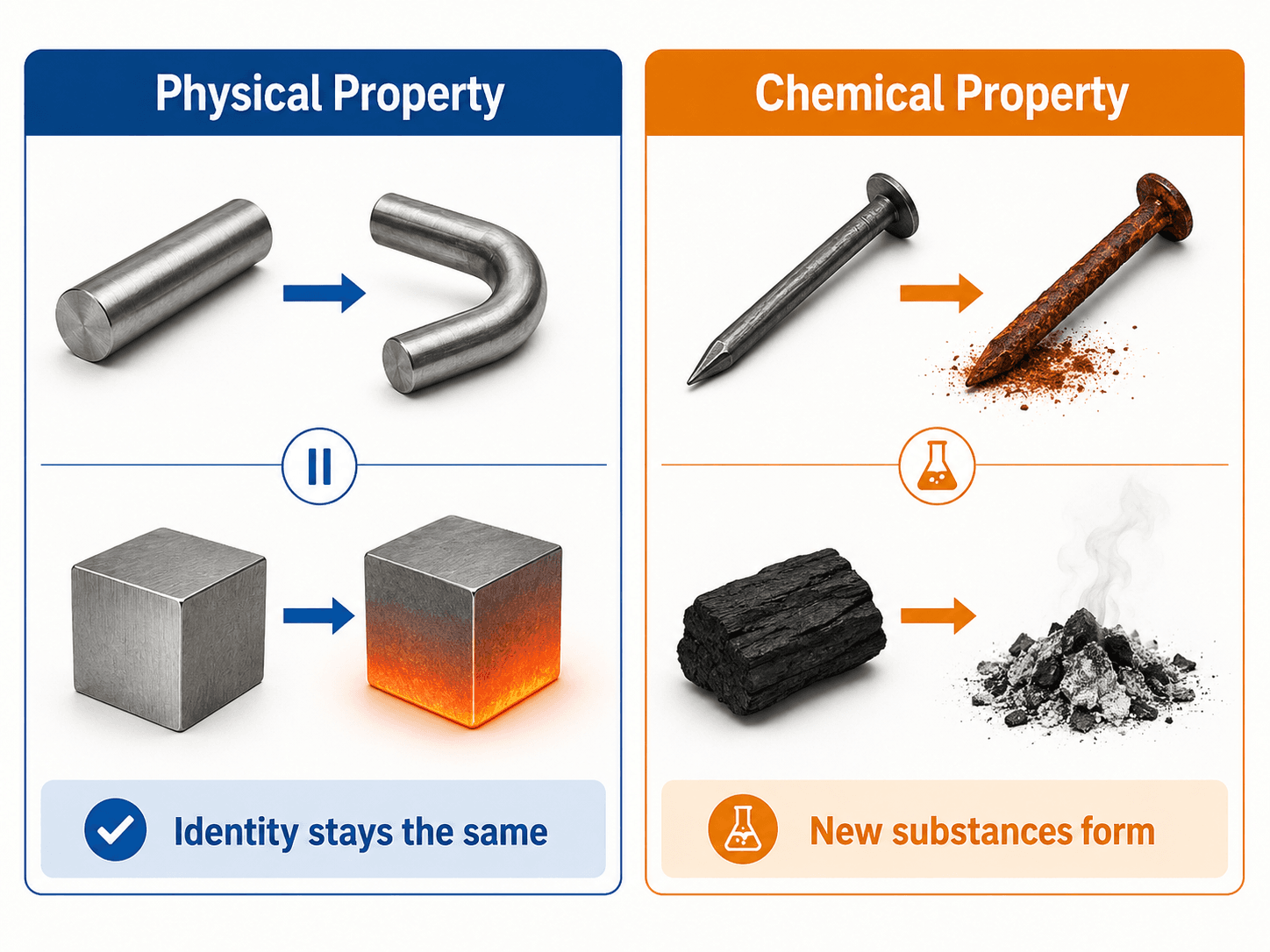
The key distinction is whether the material remains the same substance. Bending, heating, density, and melting behavior are physical-property ideas; corrosion, burning, oxidation, and chemical attack involve chemical behavior.
What Are Chemical Properties?
Chemical properties describe the way a material behaves when it reacts with oxygen, water, acids, bases, solvents, fuels, salts, heat, flame, or other chemicals. These properties are not just chemistry definitions; they are engineering design inputs because they help determine whether a part will corrode, oxidize, burn, swell, dissolve, embrittle, contaminate a process, or remain stable in service.
Common chemical properties of materials include corrosion resistance, oxidation resistance, chemical stability, reactivity, flammability, combustibility, toxicity, passivity, acid resistance, base resistance, solvent resistance, water resistance, and weathering resistance. For engineers, the value of these properties depends on the exact environment. Stainless steel may resist corrosion in many indoor environments but can still pit in chloride-rich seawater. A polymer may resist water but soften in an organic solvent.
Chemical property vs chemical composition
Chemical composition describes what a material is made of, such as the elements in an alloy or the repeat units in a polymer. Chemical properties describe how that material behaves when it reacts with its environment. Composition strongly affects chemical properties, but the two are not the same thing.
Chemical properties should always be read with the exposure condition attached. “Resistant to chemicals” is incomplete unless the chemical, concentration, temperature, exposure time, stress state, and maintenance condition are known.
Chemical vs Physical vs Mechanical Properties
Material property categories answer different engineering questions. Chemical properties ask whether the material reacts or degrades in its environment. Physical properties describe measurable characteristics such as density or melting point. Mechanical properties describe how a material responds to force, stress, impact, wear, or deformation.
| Property type | What it describes | Examples | Engineering question it answers |
|---|---|---|---|
| Chemical properties | How a material reacts, changes, corrodes, oxidizes, burns, or resists chemical attack. | Corrosion resistance, oxidation resistance, flammability, reactivity, passivity, chemical stability, solvent resistance. | Will this material survive the service environment without chemical degradation? |
| Physical properties | Characteristics that can be observed or measured without forming a new substance. | Density, melting point, color, porosity, moisture absorption, thermal expansion. | How heavy, stable, porous, or dimensionally sensitive is the material? |
| Mechanical properties | How a material responds to loads, deformation, impact, fracture, wear, and cyclic stress. | Yield strength, hardness, stiffness, toughness, ductility, fatigue strength. | Will this material bend, crack, yield, wear, or fracture under loading? |
The categories often interact. A metal bracket may be strong enough mechanically but fail chemically from corrosion. A polymer gasket may seal well at room temperature but swell in fuel. A ceramic may be chemically inert but brittle under impact. Material selection only works when the full property set matches the service condition.
Examples of Chemical Properties in Materials
The most useful chemical properties are the ones that connect directly to a failure mode or material selection decision. Instead of memorizing a list, think about what the material is exposed to and what reaction or degradation mechanism must be prevented.
| Chemical property | What it means | Engineering example | Design risk if ignored |
|---|---|---|---|
| Corrosion resistance | Ability to resist chemical or electrochemical attack from moisture, oxygen, salts, acids, or other environments. | Stainless steel hardware in humid or outdoor service. | Rust, pitting, section loss, leaks, seized fasteners, or structural weakening. |
| Oxidation resistance | Ability to resist reaction with oxygen, especially at elevated temperature. | High-temperature alloys in exhaust, furnace, or turbine-adjacent components. | Scale formation, surface loss, embrittlement, reduced heat-transfer performance, or premature failure. |
| Passivity | Formation of a thin protective surface film that reduces chemical reactivity. | Protective oxide films on aluminum or stainless steel. | Scratches, chlorides, poor surface condition, or crevices can break down protection. |
| Chemical stability | Ability to remain chemically unchanged under expected exposure conditions. | Ceramic linings, glass components, and chemically stable coatings. | Material breakdown, contamination, loss of function, or unexpected reaction products. |
| Reactivity | Tendency to react with oxygen, water, acids, bases, fuels, or other substances. | Reactive metals, chemical storage materials, and process equipment materials. | Heat generation, gas release, product contamination, unsafe reactions, or accelerated degradation. |
| Flammability and combustibility | Tendency of a material to ignite, burn, support flame spread, or produce heat and smoke. | Polymers, insulation, enclosure materials, textiles, and composites. | Fire growth, smoke hazards, loss of containment, or failure to meet safety requirements. |
| Solvent resistance | Ability to resist swelling, softening, dissolving, crazing, or cracking when exposed to solvents. | Polymer seals, gaskets, tanks, tubing, coatings, and adhesives. | Leakage, dimensional change, seal failure, loss of strength, or coating delamination. |
| Acid and base resistance | Ability to resist chemical attack in low-pH or high-pH environments. | Process piping, chemical tanks, drainage components, and protective liners. | Wall thinning, cracking, chemical attack, leaks, or unsafe containment failure. |
| Toxicity | Potential for a material, additive, reaction product, or degradation product to create a health or environmental hazard. | Coatings, flame retardants, plating materials, fumes, and chemical process components. | Unsafe exposure, unsuitable material choice, disposal concerns, or restricted use in sensitive applications. |
| Biocompatibility | Ability to contact biological tissue without unacceptable reaction, toxicity, or degradation. | Implants, medical devices, wearable sensors, and selected polymer or metal components. | Unsafe biological response, corrosion products, toxicity, rejection, or unsuitable medical use. |
Is corrosion a chemical property?
Yes. Corrosion is a chemical or electrochemical property because the material reacts with its environment and forms corrosion products such as oxides, hydroxides, or salts. In engineering, corrosion resistance is one of the most important chemical properties because it affects service life, safety, inspection frequency, and maintenance cost.
What Controls Chemical Properties?
Chemical properties are controlled by both the material itself and the environment around it. A datasheet may describe a material as resistant to corrosion, solvents, or heat, but that claim only becomes meaningful when the exposure condition is known.
| Control factor | Why it matters | Engineering implication |
|---|---|---|
| Chemical composition | Elements, alloying additions, polymer chemistry, additives, and impurities strongly affect reactivity. | Small composition differences can change corrosion resistance, oxidation behavior, toxicity, or chemical stability. |
| Microstructure | Grain structure, phases, inclusions, and heat treatment can create local chemical behavior differences. | Two materials with similar composition may corrode or crack differently after different processing routes. |
| Surface condition | Scratches, roughness, weld scale, contamination, and exposed edges can initiate chemical attack. | Surface preparation, cleaning, passivation, and coating quality often control field performance. |
| pH | Acidic or alkaline conditions can change reaction rate, oxide stability, and material compatibility. | A material compatible with neutral water may fail in acidic drainage or caustic cleaning solutions. |
| Temperature | Higher temperature usually accelerates chemical reactions, diffusion, oxidation, and polymer degradation. | Compatibility at room temperature may not apply at operating temperature. |
| Concentration | More concentrated acids, bases, salts, oxidizers, or solvents can create more severe exposure. | Material selection should use the actual concentration range, not just the chemical name. |
| Moisture and oxygen | Water and oxygen drive many corrosion and oxidation reactions. | Drainage, ventilation, sealing, and coating systems can reduce chemical degradation risk. |
| Chlorides and salts | Chlorides can break down passive films and drive pitting or crevice corrosion. | Marine, coastal, pool, and deicing-salt environments need special material review. |
| Exposure time | Short splash contact and continuous immersion can produce very different outcomes. | Design should distinguish between intermittent exposure, vapor exposure, and continuous contact. |
| Stress state | Chemical exposure combined with tensile stress can contribute to cracking or embrittlement. | Fasteners, bent parts, welds, and highly stressed components need closer review. |
| Coatings and maintenance | Protective systems can delay chemical attack but may fail from damage, UV, adhesion loss, or poor detailing. | Material selection should include coating inspection access, repair strategy, and realistic maintenance intervals. |
How Engineers Use Chemical Properties in Material Selection
Engineers use chemical properties to screen materials against the actual service environment. The best material is not always the strongest, lightest, or lowest-cost option. It is the material that satisfies the full combination of mechanical loading, temperature, chemical exposure, manufacturing process, inspection access, safety requirements, and expected service life.
- Outdoor equipment may require corrosion resistance, UV resistance, coating compatibility, and drainage-friendly detailing.
- Chemical tanks, piping, and seals may be controlled by acid, base, solvent, fuel, or water compatibility instead of strength alone.
- High-temperature parts may need oxidation resistance, thermal stability, and resistance to scale formation.
- Marine and deicing-salt environments often make chloride exposure and pitting resistance more important than generic corrosion resistance.
- Electrical enclosures and insulation may be governed by flammability, moisture resistance, chemical exposure, and thermal aging.
Start with the environment, not the material. Ask what the material will touch, how hot it will get, how long it will be exposed, whether the exposure is continuous or intermittent, and what failure mode would matter most.
Chemical Properties by Material Class
Different material families tend to fail chemically in different ways. Metals are often evaluated for corrosion, oxidation, passivity, and galvanic compatibility. Polymers are often evaluated for solvent resistance, swelling, thermal-chemical aging, and flammability. Ceramics may be chemically stable but vulnerable to fracture or thermal shock.
| Material class | Typical chemical-property strengths | Common chemical concerns | Engineering use |
|---|---|---|---|
| Metals and alloys | Can be alloyed, coated, plated, passivated, or protected for corrosion resistance. | Rust, pitting, galvanic corrosion, crevice corrosion, oxidation scaling, stress corrosion cracking. | Structures, machinery, fasteners, pressure components, vehicles, marine hardware, and energy systems. |
| Polymers | Can offer strong resistance to water, many chemicals, and electrical conduction. | Solvent swelling, softening, cracking, UV degradation, flammability, thermal aging. | Seals, gaskets, liners, tubing, cable insulation, housings, tanks, and coatings. |
| Ceramics and glass | Often chemically stable, oxidation-resistant, and resistant to many aggressive environments. | Brittleness, thermal shock, surface flaws, alkaline attack in some glass systems. | Insulators, linings, labware, high-temperature parts, wear surfaces, and chemically resistant barriers. |
| Composites | Can combine corrosion resistance, low weight, and tailored fiber direction. | Matrix degradation, moisture uptake, UV exposure, chemical attack at interfaces, fire behavior. | Marine structures, aerospace parts, tanks, panels, blades, and lightweight structures. |
| Coatings and surface treatments | Can add chemical resistance without changing the entire base material. | Scratches, pinholes, poor adhesion, underfilm corrosion, coating incompatibility, maintenance gaps. | Paint systems, galvanizing, anodizing, passivation, plating, liners, and barrier coatings. |
Two materials with the same broad label can behave very differently. “Steel,” “plastic,” or “stainless” is not enough for chemical compatibility; the exact grade, alloy, polymer family, additive package, surface treatment, and exposure condition matter.
Chemical Compatibility Workflow for Engineers
Chemical compatibility is the practical application of chemical properties. It asks whether a candidate material can survive a specific environment without unacceptable corrosion, swelling, oxidation, reaction, softening, embrittlement, contamination, or safety risk.
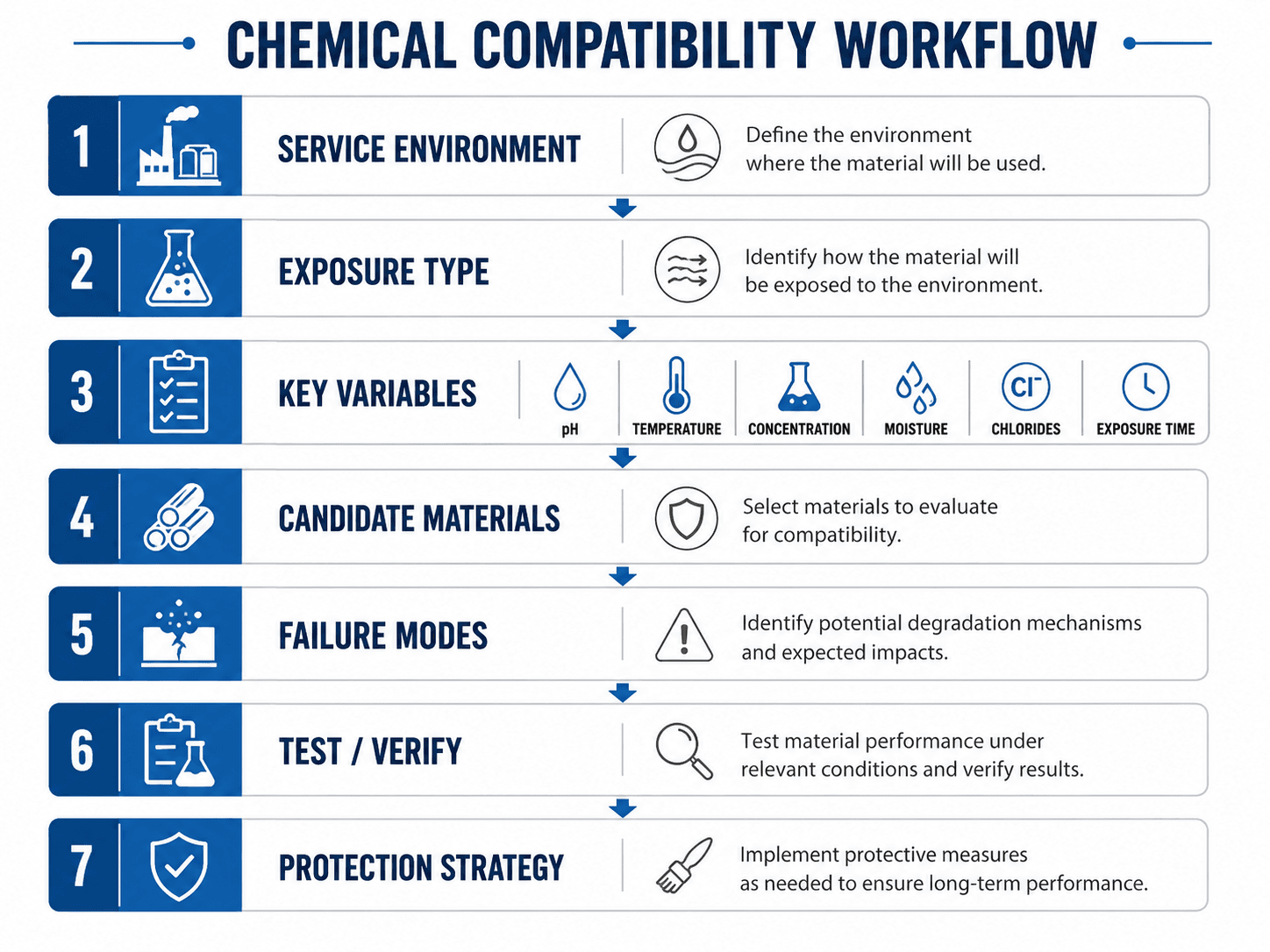
Define the environment first, then screen candidate materials against exposure type, pH, temperature, concentration, moisture, chlorides, oxygen, UV, pressure, flow, and exposure time. After screening, check the likely failure mode and decide whether the solution needs testing, coating, isolation, material substitution, or maintenance planning.
| Compatibility check | What to look for | Why it matters |
|---|---|---|
| Define the exact environment | Water, saltwater, acid, base, solvent, fuel, oxygen, heat, UV, soil, vapor, or mixed exposure. | Most chemical properties are environment-specific; a material may resist one chemical but fail quickly in another. |
| Identify exposure type | Immersion, splash, vapor, outdoor weathering, buried service, marine exposure, intermittent contact, or cleaning cycles. | Short splash exposure may be acceptable where continuous immersion would not be. |
| Check key variables | pH, concentration, temperature, oxygen, chlorides, flow velocity, pressure, exposure duration, and stress. | Higher temperature, stronger concentration, and longer exposure often accelerate degradation. |
| Match failure mode to material | Rust, pitting, crevice corrosion, oxidation scale, swelling, softening, cracking, embrittlement, or coating failure. | The right material depends on the degradation mechanism being prevented. |
| Verify with data or testing | Material datasheets, compatibility charts, corrosion data, immersion testing, exposure tests, or project qualification. | Generic property claims are not enough for critical service conditions. |
| Plan protection and maintenance | Coatings, sealants, passivation, galvanic isolation, inhibitors, cathodic protection, drainage, or inspection intervals. | Protection strategy can be as important as the base material choice. |
How Chemical Properties Are Tested and Verified
Chemical properties are usually verified by comparing the material against a known exposure condition. The goal is not just to ask whether a material is “good” or “bad,” but to identify what changes under exposure: mass loss, swelling, discoloration, cracking, surface attack, pitting, oxidation scale, coating breakdown, or loss of mechanical performance.
| Test or verification method | What it evaluates | Practical limitation |
|---|---|---|
| Immersion testing | Chemical resistance, swelling, softening, mass change, surface attack, and dimensional change after contact with a fluid. | May not represent splash exposure, vapor exposure, stress, abrasion, temperature cycling, or real maintenance chemicals. |
| Corrosion exposure testing | Material loss, rusting, pitting, crevice behavior, coating performance, and environmental durability. | Accelerated tests may not perfectly predict real outdoor or marine service life. |
| Oxidation or high-temperature exposure | Oxide scale growth, surface degradation, mass change, and stability at elevated temperature. | Thermal cycling, gas chemistry, and surface condition can change results significantly. |
| Weight-change measurement | Material loss, absorption, oxidation, or chemical uptake before and after exposure. | Average mass change can miss localized pits, cracking, or surface defects. |
| Visual and microscopic inspection | Rust, discoloration, blistering, cracking, pitting, swelling, coating damage, or surface deposits. | Qualitative unless paired with measurements, photographs, microscopy, or acceptance criteria. |
| Mechanical retesting after exposure | Loss of strength, stiffness, ductility, impact resistance, hardness, or sealing ability after chemical attack. | Requires a baseline comparison and test conditions that match the actual service environment. |
Chemical-property testing is only useful when the test condition resembles the real environment. Always compare chemical name, concentration, temperature, exposure duration, stress state, and acceptance criteria before relying on a test result.
Common Chemical Failure Modes
Chemical properties matter most when they connect to failure. A material that looks acceptable during installation can degrade over months or years if the environment attacks the surface, coating, internal structure, polymer matrix, or protective oxide layer.
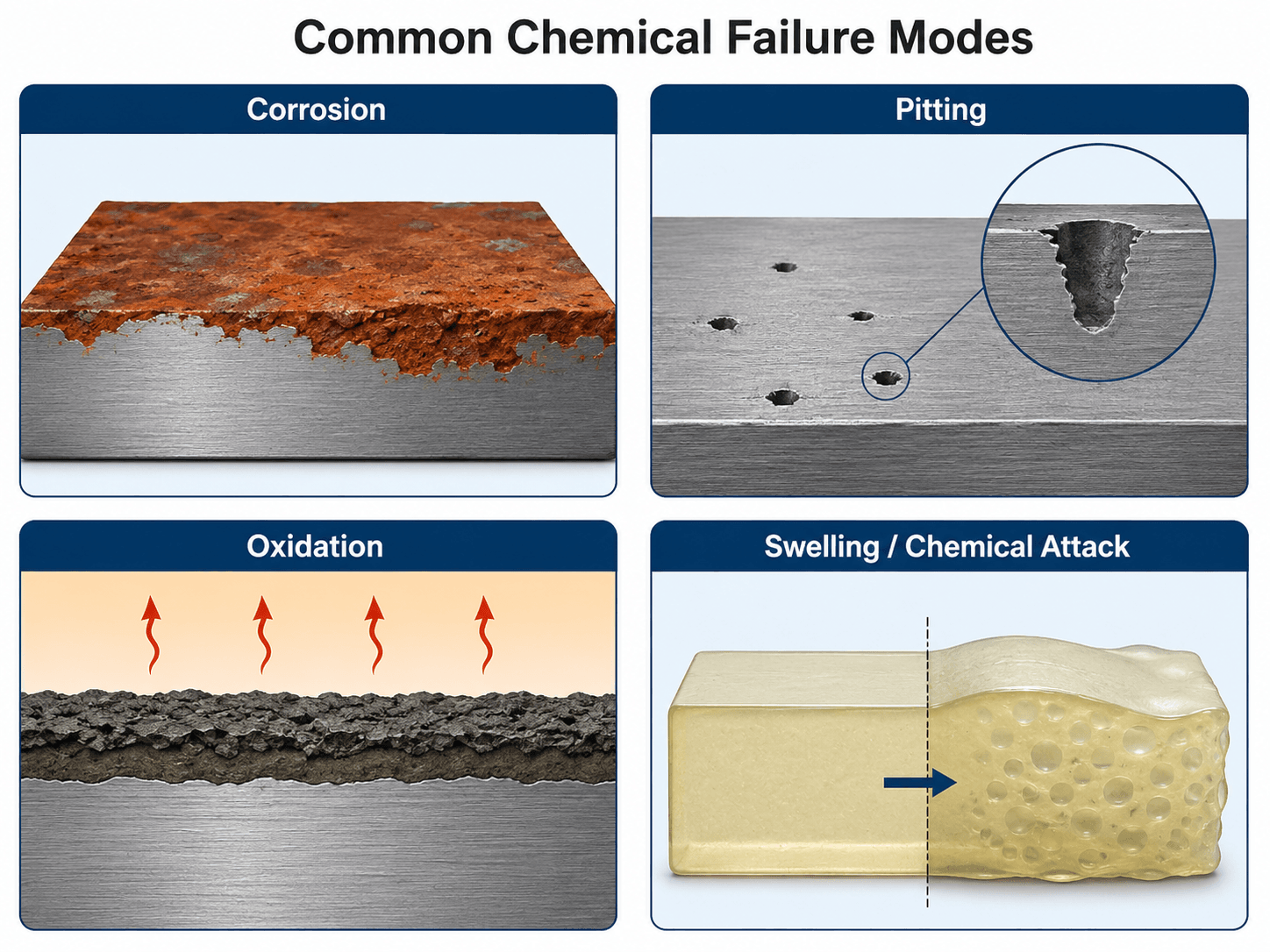
| Failure mode | What happens | Typical trigger | Practical check |
|---|---|---|---|
| Uniform corrosion | Material is lost across a broad exposed surface. | Moisture, oxygen, acids, bases, industrial atmosphere, or poor coating protection. | Check wall thickness, coating condition, drainage, and expected corrosion allowance. |
| Pitting corrosion | Small localized holes penetrate the surface and can grow deeply. | Chlorides, stagnant water, damaged passive film, or aggressive local chemistry. | Do not rely only on average corrosion rate; inspect for localized attack. |
| Crevice corrosion | Attack occurs in tight gaps where chemistry differs from the bulk environment. | Gaskets, lap joints, washers, deposits, threads, and stagnant zones. | Avoid trapped moisture and design assemblies so they drain and can be inspected. |
| Galvanic corrosion | One metal corrodes faster when dissimilar metals are electrically connected in an electrolyte. | Mixed metals, seawater, rainwater, conductive fluids, and poor isolation. | Review metal pairing, fastener choice, coating sequence, and electrical isolation. |
| Oxidation scaling | A surface oxide layer grows, flakes, or weakens the surface at elevated temperature. | Hot oxygen-containing environments, thermal cycling, exhaust gases, or furnaces. | Check operating temperature, thermal cycles, alloy selection, and scale behavior. |
| Polymer swelling or softening | A polymer absorbs chemicals, changes dimensions, loses stiffness, or becomes gummy. | Solvents, fuels, oils, cleaning agents, plasticizer extraction, or elevated temperature. | Verify chemical compatibility under actual exposure, not just room-temperature water exposure. |
Practical Example: Choosing a Material for a Wet Outdoor Bracket
Consider a small outdoor bracket that supports a light mechanical load and is exposed to rain, humidity, occasional cleaning chemicals, and possible deicing salt splash. A simple strength check might show that carbon steel, stainless steel, aluminum, or a coated steel part can all carry the load. The chemical-property review is what separates the realistic options.
| Material option | Chemical-property concern | Engineering decision |
|---|---|---|
| Uncoated carbon steel | High risk of rusting in wet outdoor exposure. | Usually unsuitable unless corrosion allowance, coating, or short service life is acceptable. |
| Painted carbon steel | Base steel is protected only while the coating remains intact. | Can be cost-effective if surface prep, edge protection, inspection, and repair are realistic. |
| Galvanized steel | Zinc coating provides sacrificial protection but can be consumed over time. | Often useful for outdoor hardware, but coating thickness and environment still matter. |
| Stainless steel | Passive film improves corrosion resistance, but chlorides can cause pitting. | Good candidate, but grade selection and chloride exposure need review. |
| Aluminum | Protective oxide layer helps, but galvanic contact and coating compatibility matter. | Useful when weight matters, but fastener pairing and surface treatment should be checked. |
The final choice depends on more than chemical resistance alone. Cost, fabrication, fasteners, appearance, inspection access, expected service life, and maintenance all matter. The chemical-property review prevents a mechanically adequate part from failing early because the exposure environment was underestimated.
Engineering Judgment and Field Reality
Chemical-property problems often appear after installation, not during the first design review. The drawing may specify an acceptable material, but field conditions can introduce trapped water, cleaning chemicals, dissimilar-metal contact, coating damage, temperature cycling, unexpected UV exposure, or contaminants that were not part of the original assumption.
Experienced engineers look for the actual exposure path. Where will water sit? Where can oxygen be depleted? What happens if a coating is scratched? Will a cleaner, fuel, lubricant, deicing salt, or process chemical contact the material? Will the part be stressed while exposed to a corrosive environment? These questions often matter more than a single datasheet claim.
Chemical degradation is often local. A part may look fine overall while a small crevice, pit, coating holiday, weld heat-affected zone, or fastener interface becomes the controlling failure location.
When Chemical Property Assumptions Break Down
Simplified chemical-property descriptions break down when the actual service condition differs from the test condition or marketing claim. A compatibility chart, datasheet, or material family description is a starting point, not a final guarantee for every environment.
- A “corrosion-resistant” metal may still pit in chloride environments, especially in stagnant water or crevices.
- A polymer rated for one solvent may swell, crack, or soften in a different solvent blend or at higher temperature.
- A coating may protect the base material until scratches, pinholes, poor adhesion, UV exposure, or edge damage allow underfilm corrosion.
- A material that is stable at room temperature may oxidize, embrittle, burn, or react differently at elevated temperature.
- A lab test may not capture mechanical stress, cyclic wetting and drying, contamination, abrasion, or real maintenance practices.
Common Mistakes and Practical Checks
The biggest mistake is treating chemical properties as universal material labels. In real engineering work, chemical behavior depends on the environment, exposure duration, material grade, surface finish, protection system, and acceptable failure consequence.
| Common mistake | Why it causes problems | Better engineering check |
|---|---|---|
| Assuming stainless steel is always corrosion-proof | Some stainless steels can pit or crevice-corrode in chloride-rich environments. | Check grade, chloride exposure, drainage, crevices, and cleaning chemicals. |
| Using a compatibility chart without reading conditions | Charts may be based on specific concentration, temperature, and exposure assumptions. | Compare the chart condition to actual service conditions before selecting the material. |
| Ignoring coatings, edges, welds, and fasteners | Chemical attack often starts at damaged coatings, cut edges, weld scale, threads, or dissimilar-metal contact. | Review the whole assembly, not just the main material. |
| Confusing composition with chemical behavior | Composition matters, but exposure environment and surface condition control many real failures. | Evaluate composition, surface state, and service environment together. |
| Choosing based only on strength or cost | A mechanically strong and low-cost material may fail early from corrosion, swelling, or chemical attack. | Balance mechanical, chemical, physical, thermal, cost, and maintenance requirements. |
The phrase “chemical resistant” should always trigger a follow-up question: resistant to what chemical, at what concentration, at what temperature, for how long, and under what stress or exposure condition?
Useful References and Design Context
Chemical properties are usually verified through material data, compatibility charts, exposure testing, corrosion testing, flammability evaluation, and project-specific requirements. For a broad engineering overview of material property categories, chemical resistance, and how properties support selection decisions, use a recognized materials engineering reference.
- ASM International: ASM International overview of material property types explains major material property categories and provides useful context for interpreting chemical resistance as part of engineering material selection.
- Project-specific criteria: Final material selection may also depend on owner specifications, supplier data, chemical compatibility charts, fire requirements, coating systems, inspection plans, and qualification testing.
- Engineering use: Use references to screen material families, then verify the exact grade, surface condition, exposure environment, and protection strategy before relying on a chemical property in design.
Frequently Asked Questions
Chemical properties describe how a material reacts chemically with its environment or changes into new substances. In materials science, common chemical properties include corrosion resistance, oxidation resistance, chemical stability, reactivity, flammability, toxicity, passivity, and resistance to acids, bases, solvents, water, or oxygen.
Examples of chemical properties include corrosion resistance, oxidation resistance, flammability, chemical reactivity, chemical stability, combustibility, toxicity, passivity, solvent resistance, acid resistance, base resistance, and moisture resistance. These properties matter because they affect whether a material will survive its actual service environment.
Physical properties can be observed or measured without changing the material into a different substance, while chemical properties describe how a material reacts or transforms chemically. Density, melting point, and thermal expansion are physical properties; corrosion, oxidation, and flammability are chemical properties.
Yes. Corrosion is a chemical or electrochemical property because the material reacts with its environment and forms corrosion products such as oxides, hydroxides, or salts. In engineering, corrosion resistance affects service life, safety, inspection frequency, and maintenance cost.
Yes. Flammability is a chemical property because burning involves a chemical reaction that forms new substances, releases heat, and may produce smoke, gases, or char. In engineering material selection, flammability matters for polymers, insulation, enclosures, composites, coatings, and safety-critical components.
Summary and Next Steps
Chemical properties describe how materials react, degrade, burn, corrode, oxidize, or remain stable in contact with their environment. They are a core part of materials science because real parts are exposed to moisture, oxygen, salts, solvents, fuels, acids, bases, heat, UV, and maintenance chemicals.
The most useful engineering approach is to define the environment first, identify the likely chemical failure mode, compare candidate materials, and verify the choice with reliable data or testing. Chemical properties should always be interpreted with temperature, concentration, exposure time, stress, surface condition, and protection strategy in mind.
Where to go next
Continue your learning path with related Turn2Engineering materials science resources.
-
Material Properties
Review the main categories of material properties and how engineers use them together in selection decisions.
-
Mechanical Properties
Compare chemical durability with strength, stiffness, ductility, hardness, toughness, and material behavior under load.
-
Physical Properties
Learn how density, melting point, porosity, thermal behavior, and other physical traits differ from chemical behavior.