
Key Takeaways
- Core idea: Physical properties are measurable characteristics of a material that can be observed or tested without changing its chemical identity.
- Engineering use: Engineers use physical properties to screen materials for weight, temperature limits, conductivity, absorption, expansion, and manufacturing fit.
- Common examples: Density, melting point, thermal conductivity, electrical conductivity, porosity, moisture absorption, specific heat, and thermal expansion are all physical properties.
- Practical check: A physical property is rarely enough by itself; final selection must also check strength, chemical exposure, cost, manufacturability, and failure mode.
Table of Contents
Introduction
Physical properties of materials are measurable characteristics that can be observed or tested without changing the material’s chemical identity. In engineering, properties such as density, melting point, thermal conductivity, electrical conductivity, thermal expansion, porosity, and moisture absorption help determine whether a material is suitable for a real design, product, process, or operating environment.
Physical Properties Map
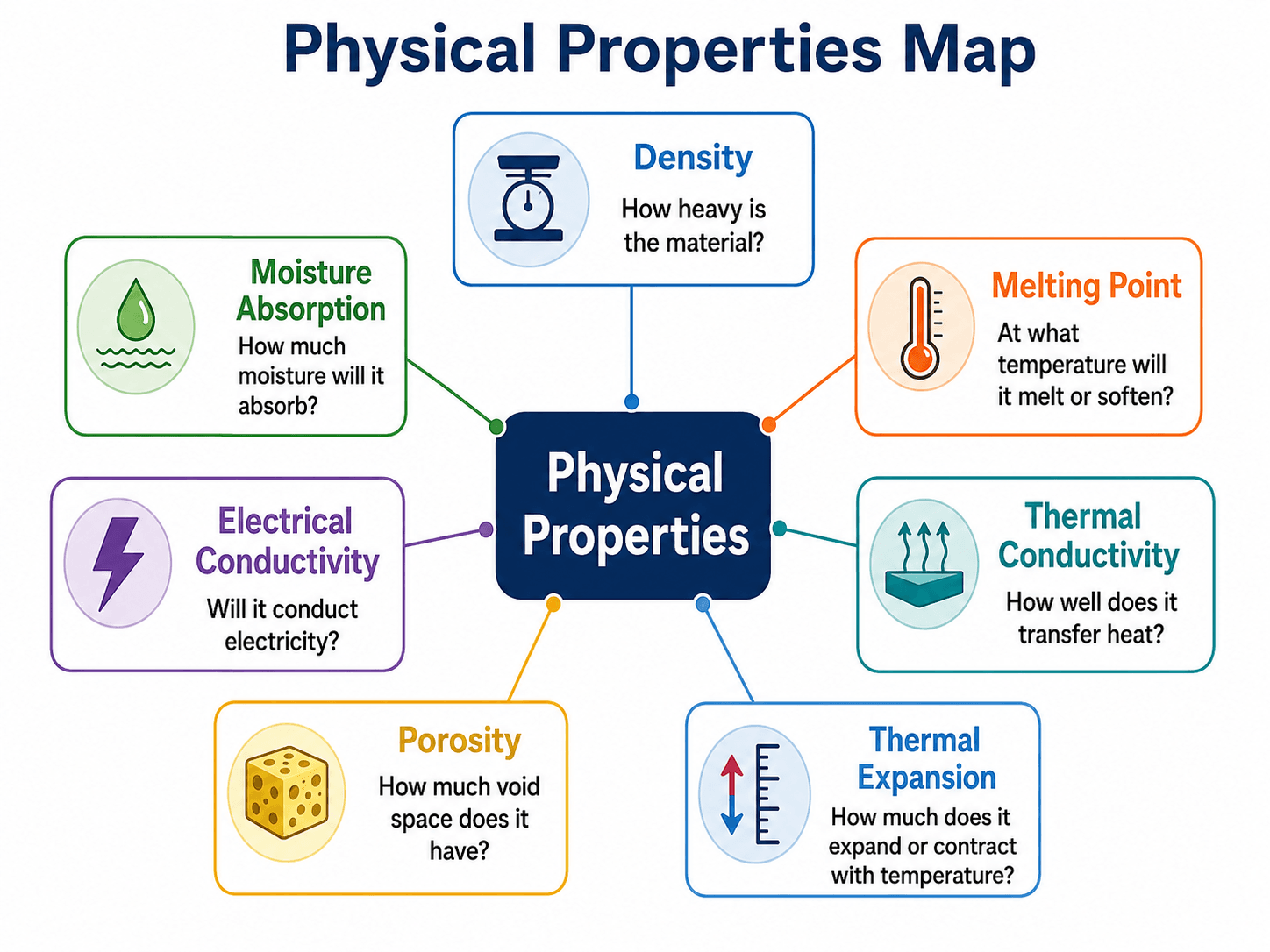
The most useful way to read this map is to connect each property to a decision. Density affects weight, melting point affects temperature limits, conductivity affects heat or current flow, and porosity or absorption affects environmental durability.
What Are Physical Properties?
Physical properties describe what can be measured about a material without causing a chemical reaction or turning it into a different substance. They include characteristics that can often be measured by weighing, heating, inspecting, electrically testing, thermally testing, optically observing, or exposing a sample to controlled moisture or temperature conditions.
In materials science, physical properties help connect a material’s structure, composition, and processing history to practical performance. A material may look suitable because it is strong, but it may still be rejected if it is too dense, expands too much with heat, absorbs moisture, conducts electricity when it should insulate, or softens near the operating temperature.
Physical properties are often used early in material screening because they quickly eliminate poor candidates. A lightweight enclosure, heat sink, electrical insulator, high-temperature seal, and moisture-resistant housing all require different physical property priorities before detailed strength or durability checks begin.
Common Physical Properties of Materials
Common physical properties include density, specific gravity, melting point, boiling point, thermal conductivity, electrical conductivity, electrical resistivity, coefficient of thermal expansion, specific heat, porosity, moisture absorption, color, transparency, reflectivity, and magnetic response. The most important property depends on the design problem.
| Physical property | Common units or description | Engineering use |
|---|---|---|
| Density | kg/m³, g/cm³, lb/ft³ | Controls weight, buoyancy, packaging mass, shipping loads, and lightweight design choices. |
| Specific gravity | Ratio relative to water | Useful for quick density comparison, fluids, plastics, aggregates, and buoyancy checks. |
| Melting point | °C, °F, K | Helps identify whether a material can survive high-temperature service, joining, casting, or processing. |
| Boiling point | °C, °F, K | Important for fluids, solvents, refrigerants, chemical processing, and phase-change systems. |
| Thermal conductivity | W/m·K, Btu/hr·ft·°F | Controls whether a material spreads heat, insulates, cools electronics, or resists heat loss. |
| Electrical conductivity or resistivity | S/m, Ω·m | Determines whether a material behaves as a conductor, resistor, shield, or insulator. |
| Coefficient of thermal expansion | 1/°C, µm/m·°C | Predicts how much a material expands or contracts as temperature changes. |
| Specific heat capacity | J/kg·K, Btu/lb·°F | Describes how much energy is needed to change temperature, which matters in thermal storage and transient heating. |
| Porosity | Percent voids or void ratio | Affects density, permeability, absorption, insulation, strength, and fluid movement through a material. |
| Moisture absorption | Percent mass gain or absorption rate | Important for polymers, wood, composites, insulation, coatings, and materials exposed to humid or wet environments. |
| Optical appearance | Color, transparency, reflectivity, opacity | Used for identification, surface quality, coatings, daylighting, optics, aesthetics, and heat absorption. |
| Magnetic response | Ferromagnetic, paramagnetic, diamagnetic, permeability | Important for motors, transformers, sensors, shielding, magnetic separation, and electromagnetic devices. |
The same material may be evaluated differently depending on the application. Copper is useful for electrical and thermal conductivity, polymer foam is useful for low density and insulation, glass is useful for transparency and chemical stability, and carbon fiber composites are useful when low density and directional performance are important.
Physical Property Examples in Engineering Materials
A physical property becomes useful when it answers a real engineering question. The table below shows how common properties translate into material selection decisions instead of remaining abstract definitions.
| Property | Example comparison | What the engineer learns |
|---|---|---|
| Density | Aluminum versus steel | Aluminum is often selected when weight reduction matters, while steel may be selected when strength, stiffness, cost, or wear resistance controls the design. |
| Thermal conductivity | Copper versus plastic | Copper spreads heat effectively, while many plastics reduce heat transfer and act as thermal insulators. |
| Electrical conductivity | Copper versus rubber | Copper is useful for conductors, while rubber-like materials are useful where electrical insulation is needed. |
| Melting point | Steel versus common thermoplastic | Steel can survive much higher processing and service temperatures, while many thermoplastics soften, creep, or deform long before a metal would melt. |
| Porosity | Foam versus solid polymer | Foam reduces density and improves cushioning or insulation, but voids may increase moisture uptake, reduce strength, or change durability. |
| Moisture absorption | Nylon versus polyethylene | Some polymers absorb moisture and change dimensions, while others resist absorption and remain more stable in wet environments. |
| Thermal expansion | Polymer housing versus metal insert | Different expansion rates can create gaps, binding, cracking, or thermal stress during temperature cycling. |
Intensive vs Extensive Physical Properties
Physical properties are often divided into intensive and extensive properties. This distinction matters because engineers usually compare materials using properties that do not depend on sample size.
| Property type | Meaning | Examples | Engineering use |
|---|---|---|---|
| Intensive physical property | Does not depend on how much material is present. | Density, melting point, boiling point, thermal conductivity, electrical resistivity, specific heat. | Useful for comparing material options fairly because the value describes the material, not the sample size. |
| Extensive physical property | Depends on the amount of material present. | Mass, volume, total heat capacity, total stored thermal energy. | Useful for analyzing a specific part, assembly, shipment, or system once the geometry and quantity are known. |
For material selection, density is usually more useful than mass because density lets engineers compare materials independently of part size. Mass becomes important after the part geometry and material choice are known.
Physical vs Mechanical vs Chemical Properties
Physical properties are easy to confuse with other material property categories because many real design problems involve several categories at the same time. The simplest distinction is this: physical properties describe measurable characteristics, mechanical properties describe response to force, and chemical properties describe behavior during chemical exposure or reaction.
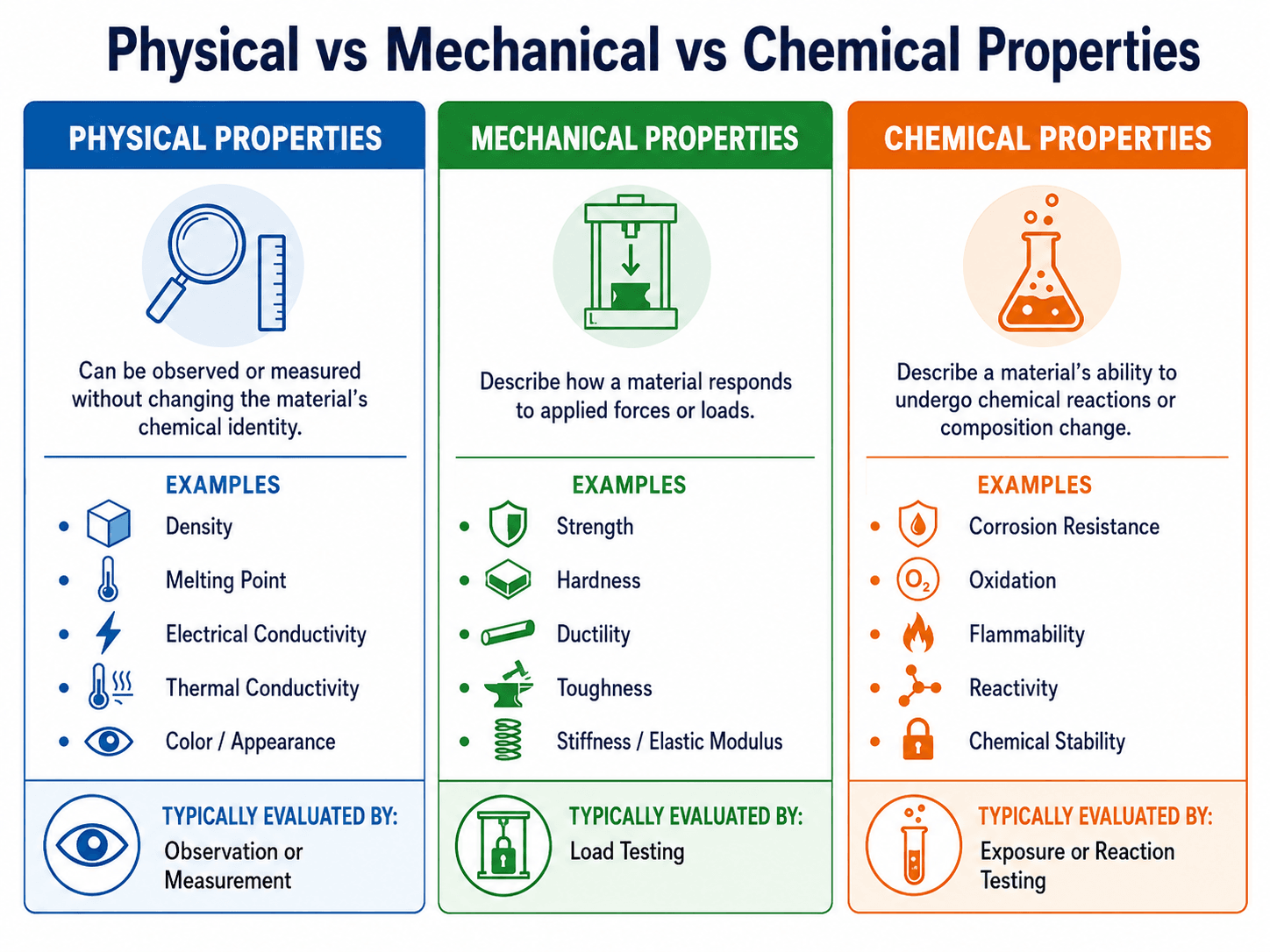
| Property category | What it describes | Examples | Typical engineering question |
|---|---|---|---|
| Physical properties | Measurable characteristics that do not require a chemical identity change. | Density, melting point, thermal conductivity, electrical conductivity, color, porosity. | Is the material too heavy, too conductive, too absorbent, or unsuitable for the temperature range? |
| Mechanical properties | How a material responds to force, stress, strain, deformation, or fracture. | Strength, stiffness, hardness, ductility, toughness, fatigue resistance. | Will the part bend, yield, crack, wear, or fail under load? |
| Chemical properties | How a material reacts, corrodes, oxidizes, burns, degrades, or changes composition. | Corrosion resistance, oxidation, flammability, reactivity, chemical stability. | Will the material survive the chemical environment without degradation? |
Thermal, electrical, optical, and magnetic properties are often grouped under physical properties in beginner explanations. In engineering design, they may be treated as separate property families when the details become important.
Are Thermal, Electrical, Optical, and Magnetic Properties Physical Properties?
Many thermal, electrical, optical, and magnetic behaviors are physical properties because they can be measured without changing the material’s chemical identity. However, engineering resources often separate them into their own categories because each group has specialized tests, units, design equations, and failure concerns.
| Property family | Why it can be considered physical | Why engineers may separate it |
|---|---|---|
| Thermal properties | Thermal conductivity, heat capacity, and expansion describe heat-related behavior without chemical change. | Heat transfer, thermal stress, cooling, insulation, and temperature cycling often require dedicated thermal analysis. |
| Electrical properties | Conductivity, resistivity, dielectric response, and insulation behavior describe electrical response without changing composition. | Electrical design may require safety, grounding, dielectric breakdown, leakage, shielding, and frequency-dependent behavior checks. |
| Optical properties | Transparency, opacity, reflectivity, color, and absorptivity describe how a material interacts with light. | Optical design may require wavelength-specific data, surface finish, coating performance, UV resistance, and solar heat gain checks. |
| Magnetic properties | Magnetic response can be measured without consuming or chemically changing the material. | Motors, transformers, sensors, shielding, and electromagnetic devices require deeper magnetic behavior than a general property list provides. |
How Engineers Use Physical Properties
Engineers use physical properties to narrow material choices before detailed analysis. A material that fails an early physical property screen may never reach the stage where stress analysis, fatigue checks, corrosion testing, manufacturing review, or cost optimization makes sense.
- Lightweight design: Density helps compare metals, polymers, foams, composites, and ceramics when mass is a design constraint.
- Temperature limits: Melting point, glass transition behavior, thermal conductivity, and expansion help determine whether a material can survive heating, cooling, or thermal cycling.
- Electrical performance: Conductivity and resistivity help engineers separate conductors, insulators, shields, and dielectric materials.
- Moisture exposure: Porosity and moisture absorption help predict swelling, weight gain, degradation, insulation loss, and dimensional change.
- Manufacturing fit: Density, melting point, viscosity, shrinkage, and thermal behavior affect casting, molding, extrusion, machining, welding, and joining.
Start with the service environment before comparing property values. Temperature range, humidity, fluid exposure, electrical requirements, part geometry, loading, manufacturing process, and allowable weight all affect which physical properties matter most.
How Physical Properties Are Measured
Physical properties are measured using different methods depending on the property and the material form. For an early engineering screen, the most important detail is not memorizing every test method; it is knowing that the value depends on how, when, and under what conditions the measurement was taken.
| Physical property | Common measurement approach | Important condition to check |
|---|---|---|
| Density | Mass and volume measurement, displacement, or calculated volume for regular shapes. | Porosity, temperature, trapped air, and moisture content can affect measured density. |
| Melting point | Controlled heating, thermal analysis, or phase-change observation. | Alloy composition, polymer formulation, heating rate, and purity can shift the observed transition. |
| Thermal conductivity | Heat flow testing through a sample under controlled conditions. | Temperature, contact resistance, moisture, density, and anisotropy can change the result. |
| Electrical resistivity | Electrical measurement using controlled sample geometry and contact conditions. | Temperature, moisture, surface contamination, and frequency can affect electrical behavior. |
| Thermal expansion | Dimensional measurement over a controlled temperature change. | Temperature range and material direction are critical, especially for composites and rolled products. |
| Moisture absorption | Mass gain after controlled humidity, immersion, or environmental exposure. | Exposure time, temperature, sample thickness, and surface condition affect absorption. |
| Porosity | Volume analysis, microscopy, fluid absorption, density comparison, or specialized porosity testing. | Open versus closed pores can produce very different performance in wet, pressurized, or insulating applications. |
Physical Properties by Material Class
Material classes tend to have recognizable physical property patterns, but the exact values still depend on grade, composition, processing, porosity, additives, fiber direction, and test conditions. Use these patterns for screening, not as final design data.
| Material class | Typical physical property behavior | Common engineering use | Practical caution |
|---|---|---|---|
| Metals and alloys | Often dense, thermally conductive, electrically conductive, and dimensionally responsive to temperature. | Structures, heat sinks, electrical conductors, machine parts, fasteners, pressure components. | High conductivity is useful in some designs and a liability in others, especially where insulation or thermal isolation is needed. |
| Polymers | Often lower density, lower thermal conductivity, variable moisture absorption, and lower temperature capability than metals. | Housings, insulators, seals, lightweight parts, consumer products, electrical isolation. | Temperature, UV exposure, moisture, and creep can change performance even when the initial physical properties look acceptable. |
| Ceramics and glasses | Often high melting temperature, low electrical conductivity, low ductility, and useful thermal or optical behavior. | Insulators, refractories, windows, sensors, cutting tools, thermal barriers. | Brittleness and thermal shock risk can control the design even when physical properties are favorable. |
| Composites | Physical properties can be directional and depend strongly on fiber, matrix, layup, voids, and moisture exposure. | Aircraft structures, sporting goods, panels, lightweight shells, marine and automotive components. | A single published value may not represent the actual laminate direction, fiber volume, or manufacturing quality. |
| Foams and porous materials | Low density, high void content, high absorption potential, and often strong insulation behavior. | Insulation, cushioning, acoustic control, lightweight cores, packaging, flotation. | Moisture uptake, compression, fire behavior, and long-term degradation can dominate performance. |
What Changes Physical Property Values?
Physical property values are not always fixed constants. Published values are usually measured under specific test conditions, and the real material in a part may differ because of grade, processing, temperature, moisture, porosity, orientation, aging, or additives.
| Control factor | Why it matters | Engineering implication |
|---|---|---|
| Temperature | Conductivity, expansion, specific heat, electrical behavior, and phase behavior can all change with temperature. | Use property data near the actual service temperature when thermal performance or dimensional fit matters. |
| Material grade and composition | Alloying elements, fillers, plasticizers, fiber content, and impurities change measured behavior. | Do not assume all steels, plastics, ceramics, or composites share the same physical properties. |
| Processing history | Heat treatment, molding, rolling, sintering, curing, and machining can change density, porosity, crystallinity, and anisotropy. | Check the actual product form, not only the generic material family. |
| Porosity and voids | Voids reduce density and can change absorption, insulation behavior, permeability, and mechanical reliability. | Porous materials may perform differently when wet, compressed, or exposed to pressure gradients. |
| Moisture and environment | Water absorption can change mass, dimensions, electrical behavior, insulation value, and long-term durability. | Dry-lab property data may not match outdoor, buried, submerged, or humid service conditions. |
| Directionality | Rolled metals, wood, laminates, and composites can have different values in different directions. | Match the property direction to the heat flow, load path, electrical path, or expansion direction in the part. |
How Physical Properties Guide Material Selection
Physical properties are most useful when they are tied to a design requirement. The workflow is not “pick the material with the best number.” It is to identify the service condition, decide which properties control that condition, compare candidate materials, then verify the data against the actual grade, temperature, process, and environment.
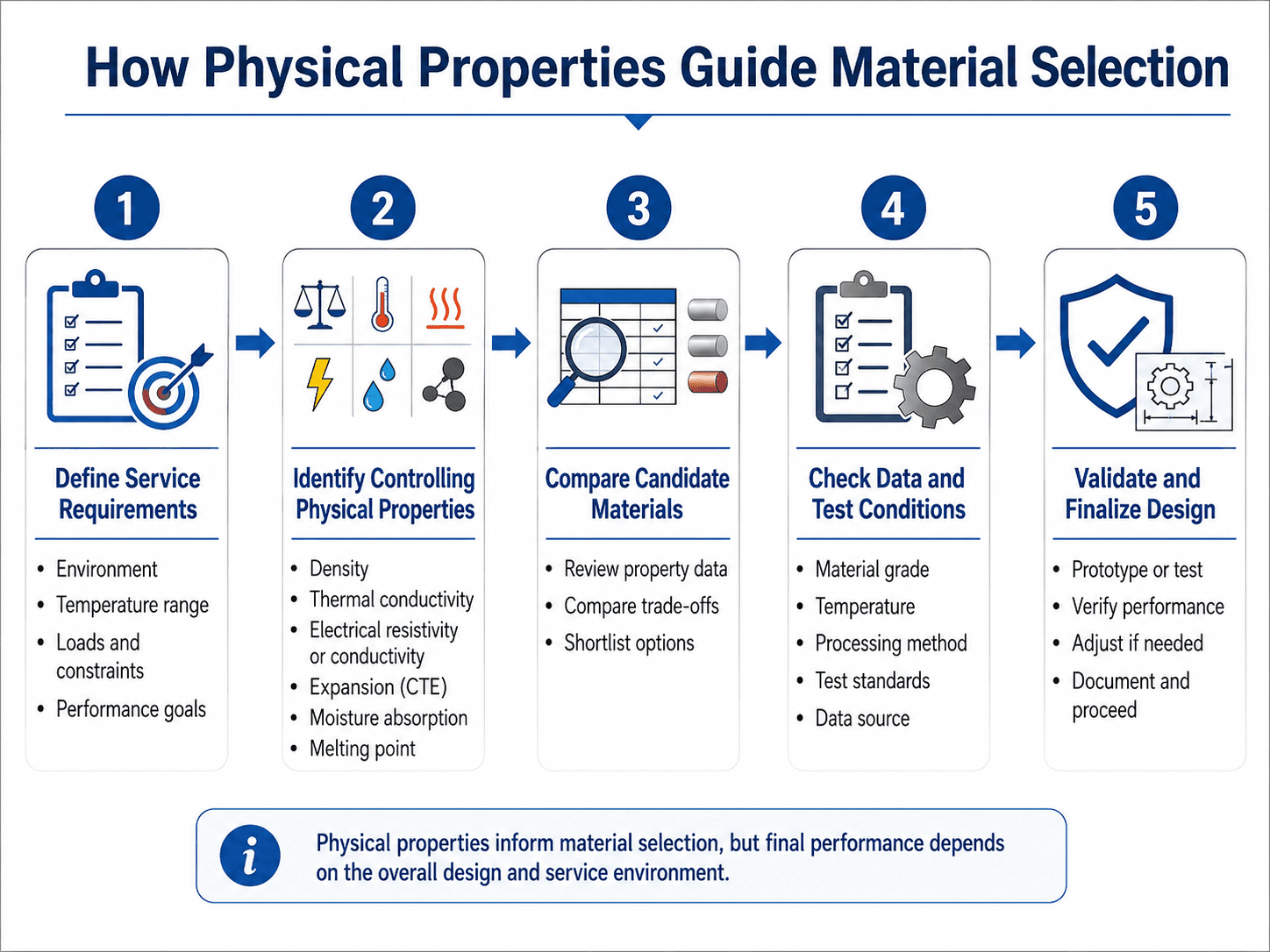
Define the environment first, then identify the physical properties that control performance. After that, compare candidate materials, check the exact data source and test conditions, and validate the final selection with mechanical, chemical, manufacturing, cost, and reliability checks.
| Design concern | Physical property to check | Why it matters | Common mistake |
|---|---|---|---|
| Lightweight part | Density and specific gravity | Controls part mass, handling load, transportation load, and system weight. | Selecting the lowest-density material without checking stiffness, strength, or temperature limits. |
| High-temperature service | Melting point, softening behavior, thermal expansion | Determines whether the material can survive heating, cycling, or joining operations. | Treating melting point as the only temperature limit. |
| Heat sink or insulation | Thermal conductivity and specific heat | Controls heat spreading, heat storage, temperature rise, and heat loss. | Ignoring geometry, contact resistance, airflow, or the actual heat path. |
| Electrical insulation | Electrical resistivity, dielectric behavior, moisture absorption | Prevents leakage, shorting, breakdown, or unsafe current paths. | Using dry-property data for a humid, contaminated, or outdoor environment. |
| Precision fit | Coefficient of thermal expansion | Predicts dimensional change, thermal stress, binding, and clearance loss. | Ignoring temperature range or combining materials with very different expansion rates. |
| Outdoor exposure | Moisture absorption, porosity, optical response | Affects swelling, mass gain, appearance, insulation behavior, and degradation. | Assuming indoor material data applies outdoors without environmental testing. |
Example: Choosing a Material for a Lightweight Housing
Consider a small protective housing for electronics. The part must be lightweight, resist normal handling, avoid overheating, protect the circuit, and remain stable in a warm indoor environment. Physical properties help narrow the material list before detailed structural and manufacturing checks.
Steel, Aluminum, or Polymer?
Steel may provide durability and stiffness, but its density can make the part heavier than necessary. Aluminum lowers weight and conducts heat well, which may help cool electronics but may also require electrical isolation. A polymer can reduce weight and provide insulation, but its temperature limit, moisture absorption, UV resistance, and dimensional stability must be checked.
Engineering Interpretation
The best choice depends on the controlling requirement. If heat removal matters most, aluminum may be attractive. If electrical insulation and low weight matter most, a polymer may be better. If impact resistance, stiffness, or low cost dominates, steel or a reinforced polymer may deserve a closer look. Physical properties guide the first cut, but final selection still depends on the complete design.
Engineering Judgment and Field Reality
In real projects, physical properties are screening tools, not final proof of performance. Published property values may come from ideal samples, controlled laboratory conditions, or a different material grade than the one actually purchased. Manufacturing variability, supplier substitutions, moisture exposure, surface condition, temperature cycling, and aging can all shift how a material behaves in service.
This is why physical properties should be paired with material selection judgment. A material can have excellent density and conductivity but poor durability, high cost, poor manufacturability, or unacceptable failure behavior. A practical review checks the property value, the condition under which it was measured, and the failure mode that matters most for the application.
The most dangerous use of physical property data is comparing generic values without matching grade, temperature, environment, orientation, and manufacturing form. A table value may be useful for screening but still be unsafe for final design without verification.
When This Breaks Down
The physical-properties approach breaks down when a simplified property list is treated as a complete design method. Real performance depends on how physical properties interact with mechanical loads, chemical exposure, geometry, manufacturing defects, and operating conditions.
- Temperature-dependent behavior: A value measured at room temperature may not represent hot, cold, or cyclic service.
- Multi-property tradeoffs: A lightweight material may have poor thermal stability, low stiffness, high moisture absorption, or limited fire performance.
- Material anisotropy: Wood, composites, rolled metals, and printed parts may behave differently depending on direction.
- Porous or wet conditions: Absorption and void content can change density, insulation value, dimensional stability, and long-term durability.
- Generic data use: Values from a broad material family may not match the exact grade, supplier, processing route, or product form.
Common Mistakes and Practical Checks
Most mistakes with physical properties come from using the right property for the wrong question or comparing values without context. The goal is not just to know a property name, but to understand what decision it supports.
- Confusing density with strength: A low-density material is not automatically strong enough for a load-bearing part.
- Using melting point as a service limit: Many polymers, solders, adhesives, and composites lose useful performance before melting.
- Ignoring thermal expansion: Materials with different expansion rates can create gaps, binding, cracking, or thermal stress.
- Calling every property physical: Strength, fatigue, corrosion, and flammability may require separate mechanical or chemical checks.
- Comparing values without units: Density, conductivity, heat capacity, and expansion data must be checked for units and test conditions.
- Ignoring moisture: Materials that absorb water may swell, gain mass, lose insulation performance, or change electrical behavior.
Do not select a material from a single physical property. A heat sink, enclosure, seal, bracket, insulator, or composite panel must satisfy the full service environment, not just one attractive value in a material table.
Material Data Sources and Design References
Physical property values should come from reliable technical sources, especially when the material will be used in a design decision. General web tables are useful for learning, but engineering work should trace values to a known source, grade, temperature, test method, and product form.
- NIST materials data: NIST materials property data resources provide authoritative material data references covering physical characteristics and related material property information.
- Supplier data sheets: Final material checks should use the actual grade, product form, processing condition, and certified data when available.
- Engineering use: Use reference data for screening, then validate the final material with project-specific requirements, testing, standards, and performance criteria.
Frequently Asked Questions
Physical properties of materials are measurable or observable characteristics that can be evaluated without changing the material’s chemical identity. Common examples include density, melting point, thermal conductivity, electrical conductivity, coefficient of thermal expansion, porosity, moisture absorption, color, transparency, and magnetic response.
Common examples of physical properties include density, specific gravity, melting point, boiling point, thermal conductivity, electrical conductivity, electrical resistivity, specific heat, coefficient of thermal expansion, porosity, moisture absorption, color, reflectivity, transparency, and magnetic behavior.
Yes. Density is a physical property because it describes mass per unit volume and can be measured without chemically changing the material. Engineers use density to compare weight, buoyancy, packaging mass, transportation loads, and lightweight design options.
Physical properties describe measurable characteristics such as density, melting point, conductivity, and expansion. Mechanical properties describe how a material responds to forces, loads, deformation, and fracture, such as strength, stiffness, hardness, ductility, and toughness.
Thermal and electrical conductivity are often treated as physical properties because they describe how a material transfers heat or electricity without changing chemical identity. In engineering, they may also be separated into thermal and electrical property categories when the design problem requires more detail.
Summary and Next Steps
Physical properties of materials describe measurable characteristics such as density, melting point, conductivity, expansion, porosity, and moisture absorption. They help engineers understand how a material behaves before chemical changes or mechanical failure are considered.
The practical value comes from connecting each property to a design decision. Weight, heat flow, electrical behavior, moisture exposure, dimensional stability, manufacturing method, and temperature range all determine which physical properties deserve the most attention.
Where to go next
Continue your learning path with related Turn2Engineering resources.
-
Material Properties
Review the broader material property categories used to compare engineering materials.
-
Mechanical Properties of Materials
Learn how strength, stiffness, hardness, ductility, and toughness differ from physical properties.
-
Material Selection
See how property data becomes a practical material choice in mechanical design.