
Key Takeaways
- Main formula: Darcy’s Law is commonly written as \(Q = -KA(dh/dL)\), or \(Q = KA(\Delta h/L)\) when using positive head loss magnitude.
- Key inputs: Hydraulic conductivity \(K\), cross-sectional flow area \(A\), head difference \(\Delta h\), and flow length \(L\).
- Best used when: Flow is through a saturated porous medium, remains approximately laminar, and the selected \(K\) value represents the material and flow direction.
- Practical check: Darcy flux is not the same as actual pore-water velocity; divide by effective porosity when average seepage velocity is needed.
Table of Contents
Introduction
Darcy’s Law describes how water or another fluid flows through a porous material when there is a hydraulic head difference. The standard form is \(Q = -KA(dh/dL)\), where discharge depends on hydraulic conductivity, flow area, and hydraulic gradient. Engineers use it for groundwater seepage, aquifer flow, permeability testing, and soil drainage checks.
Darcy’s Law Conceptual Drawing
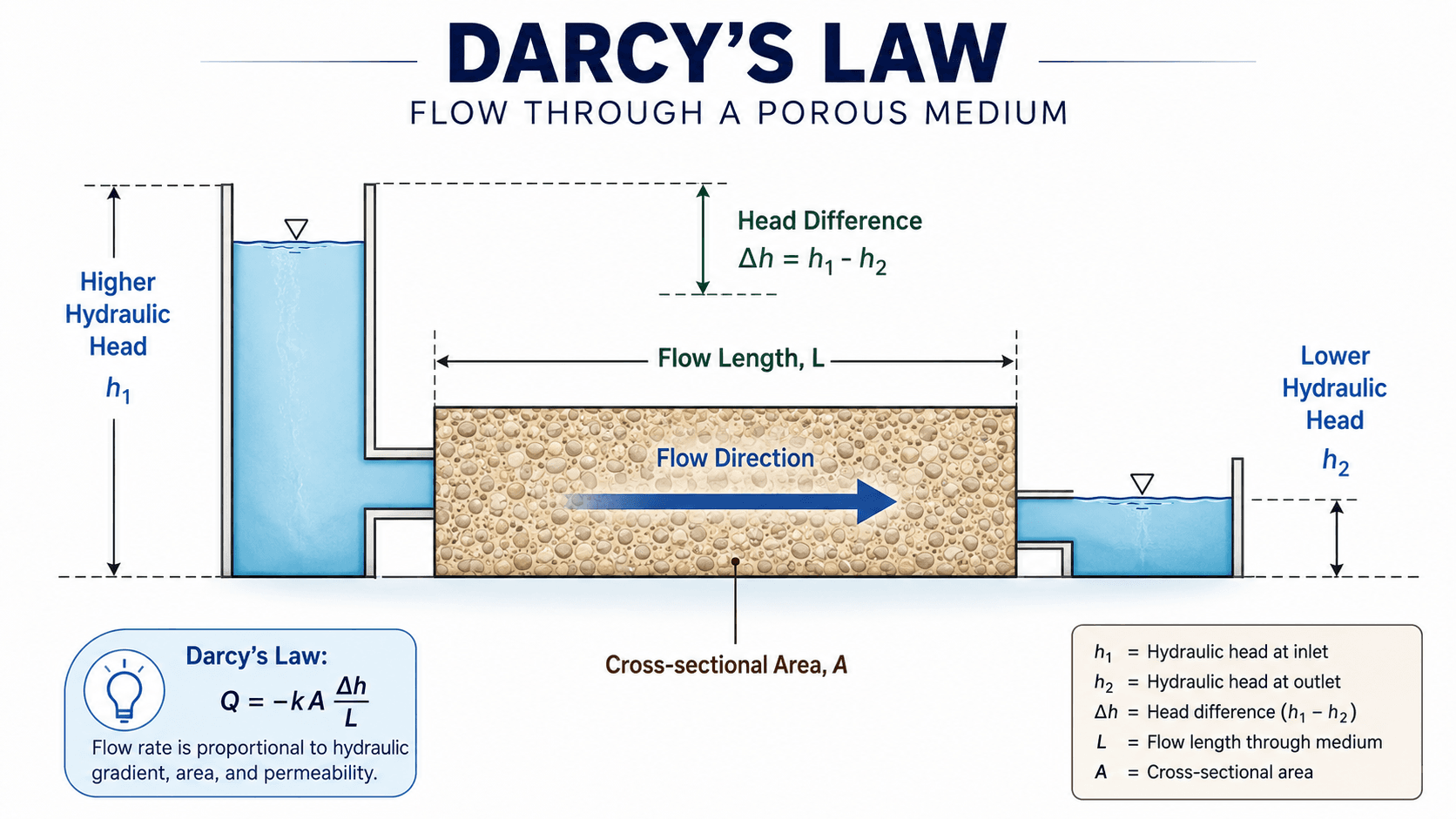
Notice that the arrows move through the soil or gravel, not across the surface like runoff and not through an open pipe. That distinction is the core concept behind Darcy’s Law.
The Darcy’s Law Formula
The standard one-dimensional form of Darcy’s Law relates flow rate to hydraulic conductivity, cross-sectional flow area, and the hydraulic head gradient along the flow path.
- Solves for Volumetric discharge \(Q\), usually in \(\text{m}^3/\text{s}\), \(\text{m}^3/\text{day}\), \(\text{ft}^3/\text{s}\), or \(\text{ft}^3/\text{day}\).
- Inputs Hydraulic conductivity \(K\), flow area \(A\), and hydraulic head gradient \(dh/dL\).
- Assumes Flow through a representative saturated porous medium where discharge is proportional to hydraulic gradient.
The negative sign indicates that flow occurs in the direction of decreasing hydraulic head. When engineers use a positive upstream-minus-downstream head loss, the same relationship is commonly written in magnitude form.
In this form, \(\Delta h\) is the positive head difference from upstream to downstream, \(L\) is the flow length, and \(i = \Delta h/L\) is the hydraulic gradient. This is often the clearest form for hand calculations, permeability examples, and seepage estimates.
Use \(Q = -KA(dh/dL)\) when the coordinate direction and signed head gradient matter. Use \(Q = KA(\Delta h/L)\) when you only need the positive magnitude of flow from high head to low head.
Variables and Units
Darcy’s Law is dimensionally consistent when \(K\) is a length-per-time value, \(A\) is an area, and the hydraulic gradient is dimensionless. The result is volume per time.
- \(Q\) Volumetric discharge through the porous medium.
- \(K\) Hydraulic conductivity, which represents how easily water moves through the soil, rock, or aquifer material.
- \(A\) Cross-sectional area perpendicular to the flow direction.
- \(i\) Hydraulic gradient, equal to head difference divided by flow length.
| Symbol | Meaning | SI units | US customary units | Practical note |
|---|---|---|---|---|
| \(Q\) | Volumetric discharge | \(\text{m}^3/\text{s}\) or \(\text{m}^3/\text{day}\) | \(\text{ft}^3/\text{s}\) or \(\text{ft}^3/\text{day}\) | Use consistent time units with \(K\). |
| \(K\) | Hydraulic conductivity | \(\text{m}/\text{s}\), \(\text{cm}/\text{s}\), or \(\text{m}/\text{day}\) | \(\text{ft}/\text{day}\), sometimes \(\text{ft}/\text{s}\) | Depends on both the porous medium and the fluid properties. |
| \(A\) | Area perpendicular to flow | \(\text{m}^2\) | \(\text{ft}^2\) | Do not use plan area unless it is perpendicular to the assumed flow direction. |
| \(\Delta h\) | Hydraulic head difference | \(\text{m}\) | \(\text{ft}\) | Use total head difference, not just water depth unless the datum is consistent. |
| \(L\) | Flow length | \(\text{m}\) | \(\text{ft}\) | Measure along the assumed flow path, not necessarily straight vertical depth. |
| \(i\) | Hydraulic gradient | dimensionless | dimensionless | Computed as \(i = \Delta h/L\). |
The hydraulic gradient \(i\) is dimensionless, but \(K\) controls the time unit. If \(K\) is in \(\text{m}/\text{s}\), the discharge will be in \(\text{m}^3/\text{s}\). If \(K\) is in \(\text{ft}/\text{day}\), the discharge will be in \(\text{ft}^3/\text{day}\).
Darcy Flux vs Seepage Velocity
A common mistake is treating Darcy’s Law as if it gives the actual speed of water through the pores. The equation first gives total discharge \(Q\), or Darcy flux \(q\) when discharge is divided by total cross-sectional area.
Darcy flux \(q\), also called specific discharge, is based on the total area of the soil or aquifer cross section. Actual water only moves through connected pore space, so average linear seepage velocity is usually higher than Darcy flux.
- \(q\) Darcy flux or specific discharge, based on total cross-sectional area.
- \(v\) Average linear groundwater velocity through connected pore space.
- \(n_e\) Effective porosity, expressed as a decimal.
If a contaminant transport or travel-time problem asks how fast groundwater moves, do not stop at \(q = Ki\). Estimate average pore-water velocity with \(v = q/n_e\) when effective porosity is known.
Which Darcy’s Law Form Should You Use?
Darcy’s Law appears in several equivalent forms. The best form depends on whether you need total flow, flow per unit area, hydraulic conductivity, flow direction, or average groundwater velocity.
| Goal | Use this form | Why it helps |
|---|---|---|
| Total discharge through a soil or aquifer section | \(Q = KAi\) | Uses hydraulic conductivity, area, and hydraulic gradient directly. |
| Positive hand-calculation flow rate | \(Q = KA(\Delta h/L)\) | Uses positive head loss from high head to low head. |
| Direction-aware flow expression | \(Q = -KA(dh/dL)\) | Keeps the sign convention tied to decreasing hydraulic head. |
| Flow per unit area | \(q = Q/A = Ki\) | Gives Darcy flux or specific discharge. |
| Hydraulic conductivity from a test | \(K = QL/(A\Delta h)\) | Rearranges Darcy’s Law for lab or field permeability interpretation. |
| Average linear groundwater velocity | \(v = q/n_e\) | Corrects Darcy flux for connected pore space. |
Quick Reference for Darcy’s Law
Use this quick reference to check whether Darcy’s Law fits the problem before substituting numbers.
| Item | What to know |
|---|---|
| What it calculates | Flow rate through a porous medium, or Darcy flux when divided by area. |
| Required inputs | Hydraulic conductivity, flow area, head difference, and flow length. |
| Common units | \(K\) in \(\text{m}/\text{s}\), \(A\) in \(\text{m}^2\), \(\Delta h\) and \(L\) in meters, \(Q\) in \(\text{m}^3/\text{s}\). |
| Best used when | The medium is saturated or appropriately modeled, and the flow remains approximately linear with hydraulic gradient. |
| Do not use when | Flow is turbulent, strongly unsaturated, multiphase, fracture-dominated, or outside the hydraulic conductivity estimate’s scale. |
| Common mistake | Using Darcy flux as actual pore-water velocity without accounting for effective porosity. |
How to Rearrange Darcy’s Law
Darcy’s Law is often rearranged to estimate hydraulic conductivity from a lab or field test when discharge, area, and hydraulic gradient are measured.
This form is useful for constant-head permeameter problems, seepage tests, and groundwater calculations where \(Q\), \(A\), \(\Delta h\), and \(L\) are known. The result has units of length per time.
This area form is useful when estimating the cross-sectional area required to pass a given seepage flow under a known hydraulic gradient and representative hydraulic conductivity.
If you solve for \(K\), the final unit should be length per time. If the answer comes out as area per time or volume per time, the area or gradient term was likely handled incorrectly.
Worked Example
Suppose groundwater flows through a sandy soil zone with hydraulic conductivity \(K = 2.0 \times 10^{-5}\ \text{m}/\text{s}\). The effective cross-sectional area perpendicular to flow is \(A = 12\ \text{m}^2\), the measured head difference is \(\Delta h = 0.75\ \text{m}\), and the flow length is \(L = 30\ \text{m}\).
Multiplying hydraulic conductivity, area, and hydraulic gradient gives:
This is equivalent to about \(0.52\ \text{m}^3/\text{day}\), or roughly \(0.36\ \text{L}/\text{min}\). That is a small but plausible seepage flow for a modest area of sandy material under a low hydraulic gradient.
The hydraulic gradient is only \(0.025\), so the discharge should be much smaller than \(KA\). Since \(KA = 2.4 \times 10^{-4}\ \text{m}^3/\text{s}\), multiplying by \(0.025\) gives \(6.0 \times 10^{-6}\ \text{m}^3/\text{s}\), which is consistent.
Typical Hydraulic Conductivity Guidance
Hydraulic conductivity varies widely because it depends on soil fabric, grain size, void structure, density, saturation, fluid properties, and field scale. The table below is a qualitative screening guide, not a substitute for laboratory or field testing.
| Material type | Relative hydraulic conductivity | Engineering note |
|---|---|---|
| Clay | Very low | Often controls seepage barriers, liners, and low-permeability zones. |
| Silt | Low to moderate | Can be sensitive to layering, structure, and gradation. |
| Sand | Moderate to high | Common material for groundwater-flow and seepage examples. |
| Gravel | High | Can transmit significant flow under modest gradients. |
| Fractured rock or karst | Highly variable | May require fracture-flow or site-specific groundwater modeling instead of a single uniform \(K\). |
Hydraulic conductivity is not the same as intrinsic permeability. Hydraulic conductivity \(K\) includes the effects of the porous medium and the fluid, while intrinsic permeability describes the medium itself.
Where Engineers Use Darcy’s Law
Darcy’s Law is a practical seepage and groundwater equation. Engineers use it when the question is controlled by hydraulic conductivity and hydraulic gradient rather than by open-channel hydraulics or pipe friction.
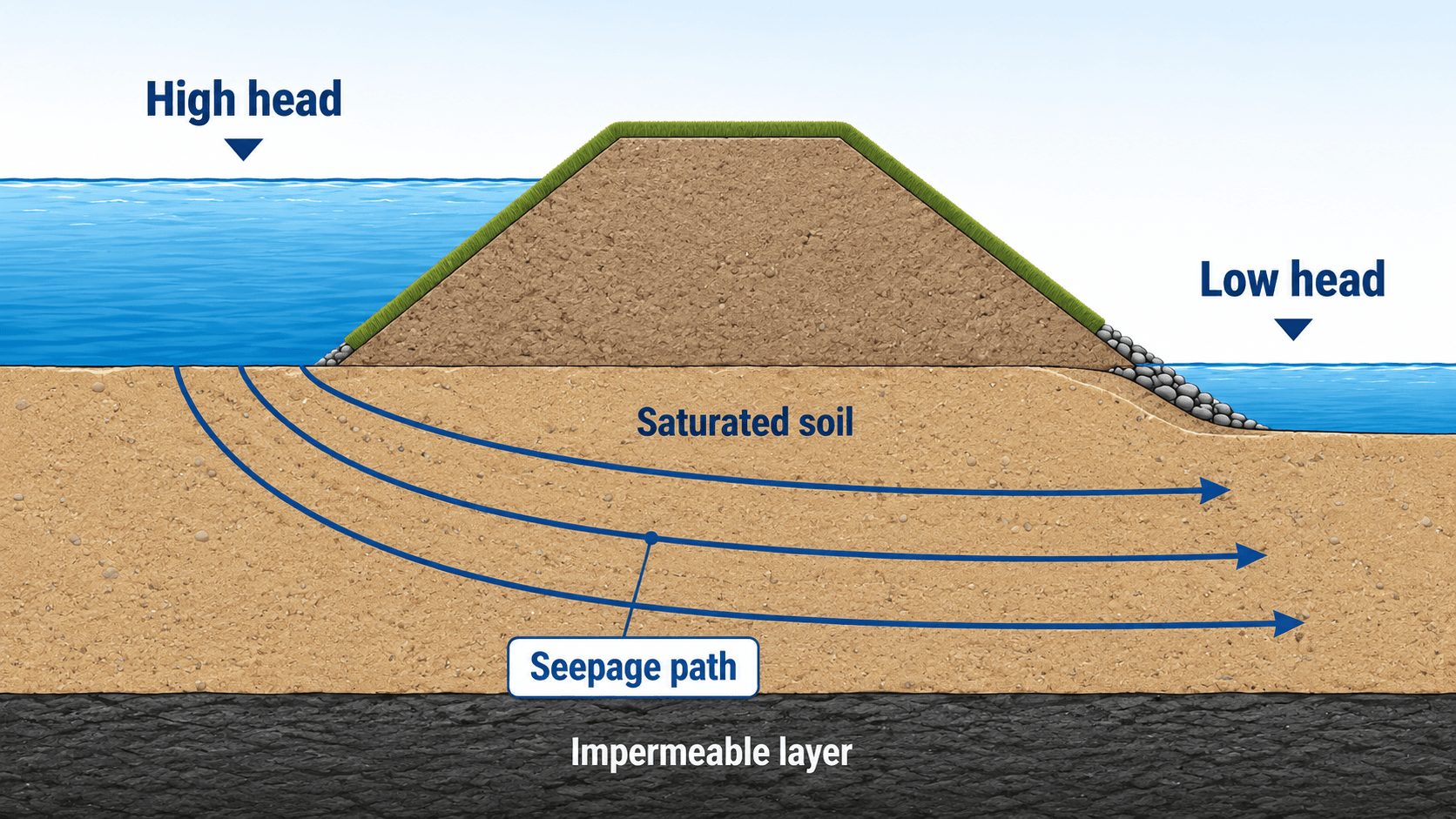
- Groundwater flow estimation: Hydrogeologists estimate groundwater discharge across a section of aquifer using measured hydraulic gradient and representative hydraulic conductivity.
- Seepage beneath dams or embankments: Geotechnical and water resources engineers estimate how much water may move through or below an earth structure before checking uplift, piping, or erosion risk.
- Permeability testing: Lab and field test data can be rearranged to estimate \(K\), which then supports drainage, dewatering, seepage, and groundwater modeling decisions.
- Contaminant transport screening: Darcy flux provides the flow component needed before estimating advective movement, while pore velocity requires a separate porosity correction.
Assumptions and Limitations
Darcy’s Law is powerful because it reduces porous-media flow to a simple proportional relationship. That simplicity only works when the material and flow conditions match the assumptions behind the equation.
- 1 The porous medium is saturated, or the hydraulic conductivity used has been adjusted for the actual saturation condition.
- 2 Flow remains approximately laminar and discharge is proportional to hydraulic gradient.
- 3 The hydraulic conductivity represents the scale, direction, and soil or aquifer zone being modeled.
- 4 The flow area and flow length are defined perpendicular and parallel to the assumed flow path.
- 5 Simple hand calculations often assume steady conditions, although Darcy’s Law can also appear inside transient groundwater-flow models.
Anisotropy and Directional Hydraulic Conductivity
Many soils and aquifers do not have the same hydraulic conductivity in every direction. Layered deposits may have a horizontal hydraulic conductivity that is much different from the vertical hydraulic conductivity. In those cases, engineers may use directional values such as \(K_x\), \(K_y\), and \(K_z\) instead of a single \(K\).
When This Breaks Down
Darcy’s Law becomes less reliable when the relationship between hydraulic gradient and flow is no longer linear. This can occur in turbulent flow, highly fractured or karst media, very high-conductivity flow paths, strongly unsaturated conditions, multiphase flow, or cases where one representative \(K\) value cannot describe the system.
Common Mistakes and Engineering Checks
Most Darcy’s Law errors come from using the right-looking equation with the wrong physical interpretation. Check the gradient, area, conductivity scale, and velocity meaning before trusting the result.
| Mistake | Why it causes error | Engineering check |
|---|---|---|
| Using Darcy flux as pore velocity | Darcy flux is based on total cross-sectional area, not only connected pore space. | Use \(v = q/n_e\) when average groundwater velocity is needed. |
| Using the wrong flow area | Area must be perpendicular to flow, not just the visible plan area of the site. | Sketch the assumed flow path and mark the area normal to that path. |
| Mixing time units | \(K\) may be reported in \(\text{m}/\text{s}\), \(\text{cm}/\text{s}\), \(\text{ft}/\text{day}\), or \(\text{m}/\text{day}\). | Convert \(K\) before calculating \(Q\). |
| Treating one \(K\) value as universal | Hydraulic conductivity varies with soil type, direction, density, fabric, saturation, and scale. | Use representative field values and note whether \(K\) is horizontal, vertical, lab-scale, or field-scale. |
| Ignoring the sign convention | The negative sign indicates flow toward lower head, but magnitude calculations often use positive head loss. | State whether \(\Delta h\) is a signed head change or a positive upstream-minus-downstream head loss. |
Do not use Darcy’s Law as if it describes water flowing through an empty pipe. The equation describes seepage through the interconnected voids of a porous material.
How to Check a Darcy’s Law Answer
Before using a Darcy’s Law result in a design check or groundwater estimate, run through a quick engineering review. This helps catch unit errors, unrealistic gradients, and misinterpreted velocities.
- Units Confirm \(K\), \(Q\), and time units are consistent.
- Gradient Check whether \(i = \Delta h/L\) is physically reasonable for the site or test setup.
- Area Confirm the area is perpendicular to the assumed flow direction.
- Velocity If travel time matters, convert Darcy flux to seepage velocity using effective porosity.
- Scale Confirm the selected \(K\) value represents the soil layer, direction, and field scale being modeled.
Darcy’s Law vs Darcy-Weisbach Equation
Darcy’s Law and the Darcy-Weisbach Equation are often confused because their names are similar. They solve different flow problems.
| Equation or method | Best used for | Main assumption | Common limitation |
|---|---|---|---|
| Darcy’s Law | Groundwater flow and seepage through porous media | Flow is proportional to hydraulic gradient | Not reliable for strongly non-Darcian, turbulent, or poorly represented heterogeneous flow |
| Darcy flux \(q = Ki\) | Flow per unit cross-sectional area through porous media | Uses total bulk area, not only pore area | Not the same as actual pore-water velocity |
| Seepage velocity \(v = q/n_e\) | Average linear groundwater velocity through connected pores | Effective porosity is known or estimated | Sensitive to porosity assumptions and preferential flow paths |
| Darcy-Weisbach Equation | Friction head loss in full pipes or closed conduits | Pipe-flow resistance can be represented with a friction factor | Not a porous-media seepage equation |
| Bernoulli’s Equation | Energy relationship between pressure, elevation, and velocity | Idealized streamline energy balance | Does not directly model porous-media resistance |
Darcy’s Law is for porous media. Darcy-Weisbach is for pipe friction. If the problem involves water moving through soil pores, start with Darcy’s Law; if it involves head loss in a pipe, start with Darcy-Weisbach or another pipe-flow equation.
References and Source Notes
Darcy’s Law is widely presented in groundwater references as a proportional relationship between discharge, hydraulic conductivity, flow area, and hydraulic gradient. These references were used to verify the formula form, variable meanings, limitations, and interpretation of Darcy flux.
- The Groundwater Project: Darcy’s Law in hydrogeologic properties and groundwater flow explains hydraulic conductivity, head difference, flow length, and hydraulic gradient in groundwater flow.
- The Groundwater Project: Applicability of Darcy’s Law discusses where Darcy’s Law is applicable and when nonlinear or non-Darcian behavior may occur.
Frequently Asked Questions
Darcy’s Law calculates the volumetric discharge through a porous medium when hydraulic conductivity, flow area, and hydraulic gradient are known. It is most often used for groundwater seepage, aquifer flow, soil permeability problems, and laboratory permeameter interpretation.
Hydraulic gradient is the change in hydraulic head divided by the flow length. In the magnitude form of Darcy’s Law, \(i = \Delta h/L\), and it represents the driving force for groundwater flow through the porous medium.
No. Darcy’s Law usually gives discharge or Darcy flux, which is flow rate per total cross-sectional area. Actual average pore-water velocity is higher because water only moves through connected pore space, so it is commonly estimated by dividing Darcy flux by effective porosity.
The negative sign shows that flow occurs in the direction of decreasing hydraulic head. If the calculation uses positive upstream-minus-downstream head loss, many practical examples use the magnitude form \(Q = KA(\Delta h/L)\).
Darcy’s Law should not be used blindly for turbulent flow, strongly unsaturated flow without corrections, highly fractured or karst media treated as uniform soil, multiphase flow, or cases where hydraulic conductivity changes strongly with direction, stress, saturation, or scale.
Summary and Next Steps
Darcy’s Law is the core equation for estimating seepage and groundwater flow through porous media. It relates discharge to hydraulic conductivity, area, and hydraulic gradient, making it useful for aquifer flow, permeability testing, seepage checks, and groundwater screening calculations.
The most important checks are unit consistency, correct flow area, representative hydraulic conductivity, and proper interpretation of Darcy flux versus actual pore-water velocity. If the soil is unsaturated, fractured, turbulent, strongly anisotropic, or highly heterogeneous, a more advanced method may be needed.
Where to go next
Continue your learning path with related Turn2Engineering equation resources.
-
Bernoulli’s Equation
Review hydraulic head, pressure head, velocity head, and energy balance concepts that help explain why water flows from high head to low head.
-
Hazen-Williams Equation
Compare porous-media seepage with empirical pipe-flow head loss for water distribution and pressurized flow problems.