
Acoustic Properties
How materials absorb, reflect, transmit, damp, and carry sound energy in engineering applications.
Key Takeaways
- Acoustic properties describe how materials absorb, reflect, transmit, damp, and carry sound waves.
- Sound absorption, sound isolation, acoustic impedance, and damping are related but different engineering concepts.
- Frequency matters because low-frequency sound has longer wavelengths and usually needs thicker materials, air gaps, mass, or tuned systems.
- Real acoustic performance depends on material properties, test method, installation quality, boundary conditions, and the full assembly.
Acoustic properties are the material characteristics that control how sound is absorbed, reflected, transmitted, damped, or carried as a wave. Engineers use these properties to select materials for room acoustics, sound isolation, vibration control, noise reduction, ultrasonic testing, and acoustic performance in buildings, machines, vehicles, and products.
What Are Acoustic Properties?
Acoustic properties are the measurable behaviors that describe how a material interacts with sound energy. They explain whether sound is absorbed into a material, reflected from a surface, transmitted through an assembly, dissipated as heat, or carried through a solid, liquid, or gas as a wave.
In materials science, acoustic performance is not one single value. It is controlled by density, stiffness, porosity, damping, surface texture, internal structure, thickness, air gaps, and frequency. A porous material may reduce room echo, while a dense and airtight assembly may reduce sound transmission between spaces.
Engineering Insight
Acoustic performance is always tied to the problem being solved. A material that is effective at absorbing high-frequency reflections may be poor at blocking low-frequency equipment noise, and a material that blocks airborne sound may not control structure-borne vibration.
How Sound Waves Interact With Materials
When a sound wave reaches a material surface, the sound energy does not all behave the same way. Part of the energy can bounce back as reflected sound, part can be dissipated inside the material as absorbed energy, and part can pass through as transmitted sound.
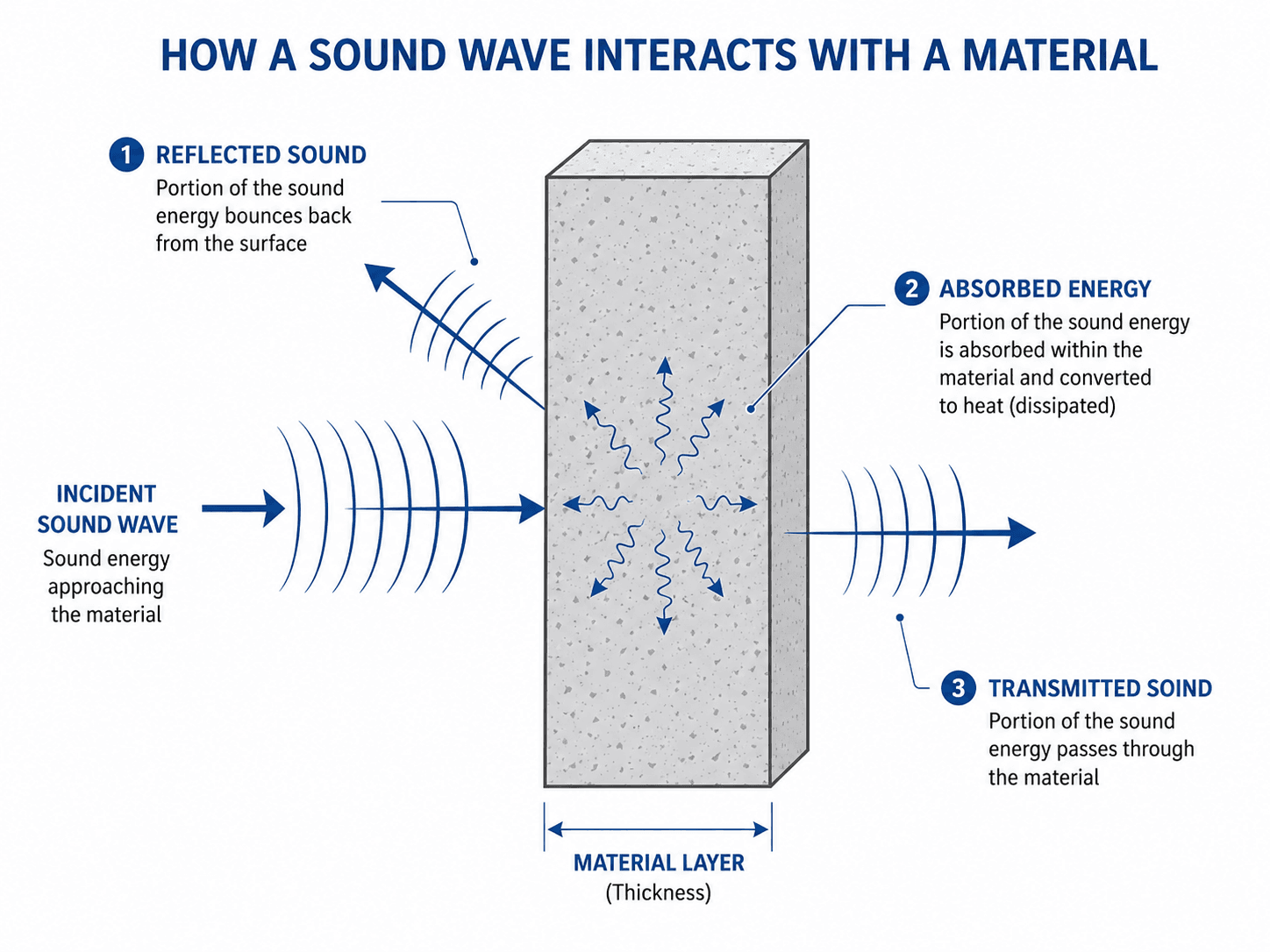
This is why the same material can behave differently depending on the application. A soft porous panel may reduce reflected sound inside a room, but that does not mean it will stop sound from passing through a wall. A dense concrete wall may reduce transmission better, but it can also reflect sound strongly back into the room.
Main Acoustic Properties of Materials
The most important acoustic properties are usually absorption, reflection, transmission, impedance, wave speed, attenuation, and damping. Each property answers a different engineering question, so they should not be treated as interchangeable ratings.
| Acoustic Property | What It Describes | Why It Matters in Engineering |
|---|---|---|
| Sound absorption coefficient | The fraction of incident sound energy that is not reflected back under a specific test condition. | Used for room acoustics, acoustic panels, ducts, enclosures, and echo control. |
| Sound reflection | The portion of sound energy that bounces back from a surface. | Important for auditoriums, studios, classrooms, equipment rooms, and spaces where echo or clarity matters. |
| Sound transmission loss | How much airborne sound is reduced as it passes through a material or assembly. | Used for walls, floors, doors, windows, noise barriers, and equipment enclosures. |
| Acoustic impedance | The resistance a material or medium presents to sound wave motion. | Controls reflection and transmission at boundaries between air, solids, liquids, and layered materials. |
| Speed of sound in a material | The speed at which acoustic waves travel through the material. | Used in ultrasonic testing, vibration analysis, nondestructive evaluation, and material characterization. |
| Damping | The ability of a material to dissipate vibrational or acoustic energy. | Important for machine vibration, impact noise, vehicle panels, flooring systems, and mechanical isolation. |
Characteristic Acoustic Impedance
Characteristic acoustic impedance helps explain why some material boundaries reflect sound strongly while others allow more sound to pass through. A large impedance mismatch between two media usually causes stronger reflection.
Variables
- \(Z\) = characteristic acoustic impedance, commonly expressed in rayl or \( \text{Pa} \cdot \text{s}/\text{m} \)
- \(\rho\) = density of the medium, typically \( \text{kg}/\text{m}^3 \)
- \(c\) = speed of sound in the medium, typically \( \text{m}/\text{s} \)
Surface or Specific Acoustic Impedance
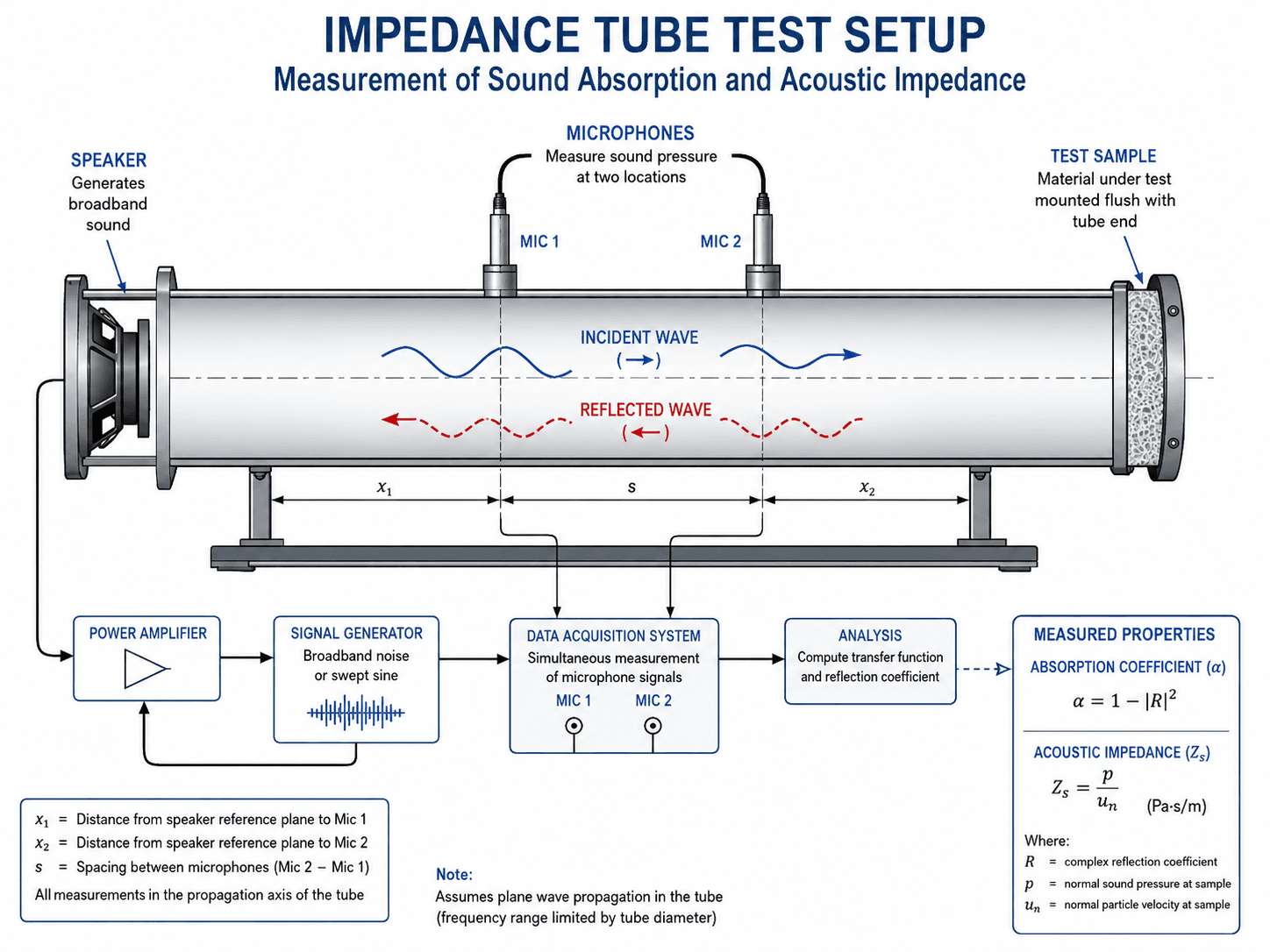
In material surface testing and impedance tube analysis, acoustic impedance may also be expressed as the ratio of sound pressure to normal particle velocity at the material surface. This is often called surface impedance or specific acoustic impedance.
Variables
- \(Z_s\) = surface or specific acoustic impedance, typically \( \text{Pa} \cdot \text{s}/\text{m} \)
- \(p\) = sound pressure at the material surface, typically \( \text{Pa} \)
- \(u_n\) = normal particle velocity at the material surface, typically \( \text{m}/\text{s} \)
Sound Absorption Coefficient
The absorption coefficient, commonly written as \(\alpha\), describes the fraction of incident sound energy that is not reflected back under a specific test condition. Depending on the setup, that nonreflected energy may be dissipated inside the material, transmitted through it, or otherwise removed from the reflected field.
For most introductory interpretation, absorption coefficients are treated as ranging from 0 to 1. In measured data, values can sometimes vary outside the ideal range because of test setup, edge effects, sample mounting, and calculation method. This is one reason acoustic data should always be interpreted with its test condition.
Acoustic Properties vs Acoustic Ratings
Acoustic properties describe physical behavior. Acoustic ratings summarize that behavior for specific use cases, frequency ranges, or test methods. Confusing the two can lead to poor material selection.
| Term | What It Measures | Best Used For | Common Misunderstanding |
|---|---|---|---|
| Absorption coefficient | How much incident sound is not reflected at a specific frequency or frequency band. | Evaluating acoustic panels, porous absorbers, and surface treatments. | It is often mistaken for sound blocking performance. |
| NRC | A simplified average sound absorption rating across selected frequency bands. | Quick comparison of room acoustic treatments. | It can hide poor low-frequency absorption. |
| STC | A single-number rating for airborne sound isolation of an assembly. | Walls, floors, doors, windows, and partitions. | It does not fully describe low-frequency noise or field leakage. |
| Transmission loss | Sound reduction through a material or assembly over frequency. | Sound isolation design and noise barrier evaluation. | It depends heavily on the full assembly, not only the material layer. |
| Acoustic impedance | Resistance to sound wave motion at a medium or surface. | Wave reflection, transmission, ultrasonic testing, and impedance tube analysis. | It is not simply a “higher is better” rating. |
Sound Absorption, Sound Isolation, and Damping Are Not the Same
Many acoustic material mistakes come from treating absorption, sound isolation, and damping as the same goal. They are related, but they solve different engineering problems.
| Concept | Main Goal | Typical Material Behavior | Example Use |
|---|---|---|---|
| Sound absorption | Reduce reflected sound inside a space. | Porous, fibrous, or textured materials that dissipate airborne sound energy. | Reducing echo in a classroom, studio, office, or equipment room. |
| Sound isolation | Reduce sound transmission between spaces. | Mass, airtightness, decoupling, resilient layers, and assembly-level detailing. | Reducing noise through a wall, door, window, floor, or enclosure. |
| Damping | Reduce vibration energy and ringing. | Viscoelastic layers, rubber, constrained-layer damping, and energy-dissipating materials. | Reducing panel vibration in vehicles, machines, ducts, or metal enclosures. |
| Reflection control | Redirect or shape sound energy. | Hard surfaces, diffusers, angled panels, curved geometry, and controlled reflectors. | Shaping sound in auditoriums, lecture halls, and performance spaces. |
Airborne Sound vs Structure-Borne Sound
Airborne sound travels through air as pressure fluctuations. Structure-borne sound travels through solids as vibration. Porous absorbers can help with airborne reflections, while rubber mounts, damping layers, and resilient connections are often more relevant for structure-borne vibration.
Why Frequency and Thickness Change Acoustic Performance
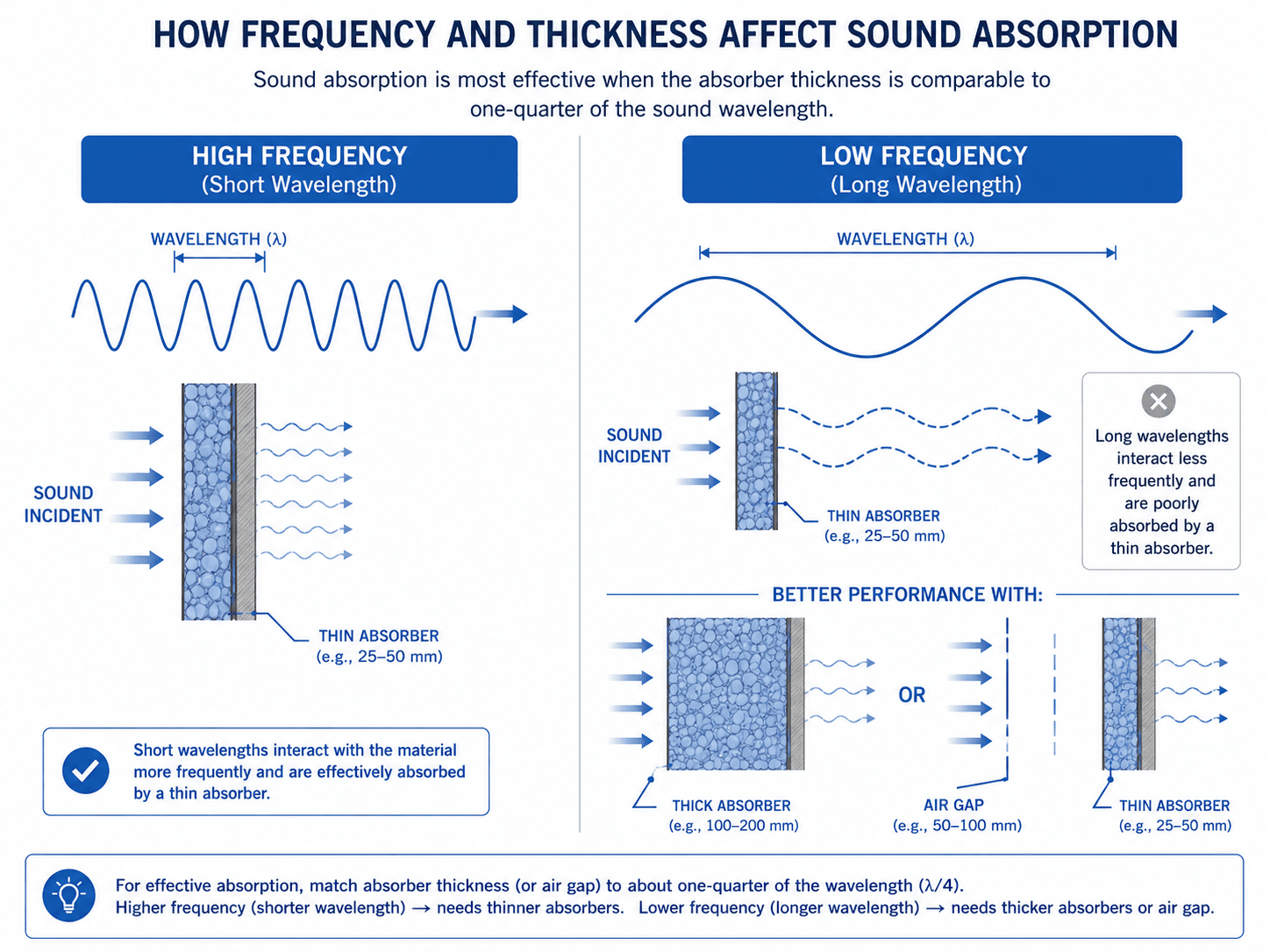
Sound frequency changes wavelength, and wavelength changes how strongly sound interacts with a material. High-frequency sound has a shorter wavelength and can often be treated with thinner absorbers. Low-frequency sound has a longer wavelength and usually requires thicker materials, deeper air spaces, tuned systems, or more massive assemblies.
Wavelength Relationship
Wavelength connects sound speed and frequency. This relationship is one reason acoustic materials are rarely described by one universal performance value.
Variables
- \(\lambda\) = wavelength, typically \( \text{m} \)
- \(c\) = speed of sound in the medium, typically \( \text{m}/\text{s} \)
- \(f\) = frequency, typically \( \text{Hz} \)
Simple Example: Why Low-Frequency Sound Is Harder to Absorb
If a low-frequency sound is 100 Hz and the speed of sound in air is approximately \(343 \text{ m/s}\), the wavelength is:
A quarter wavelength is:
This does not mean every absorber must be 0.86 m thick, but it explains why thin 25–50 mm foam panels often have limited effect on deep bass, HVAC rumble, or low-frequency machinery noise. Low-frequency treatment usually requires more depth, mass, tuned resonance control, or assembly-level design.
What Controls a Material’s Acoustic Properties?
Acoustic behavior comes from the interaction between sound waves and material structure. In materials science, the most important controls are not just “soft” or “hard.” Density, stiffness, pores, damping, and geometry all influence how sound energy moves.
| Material Factor | How It Affects Acoustic Behavior | Engineering Interpretation |
|---|---|---|
| Density | Influences acoustic impedance and sound transmission behavior. | Higher mass can help sound isolation, but it may also increase reflection. |
| Stiffness | Affects wave speed, resonance behavior, and vibration response. | Stiff lightweight panels can radiate sound if not damped or isolated. |
| Porosity | Allows air motion inside a material, enabling viscous and thermal losses. | Porous materials are often useful for absorption, especially at mid and high frequencies. |
| Flow resistivity | Describes resistance to air movement through porous material. | Too little resistance may pass sound through; too much may reflect sound before it penetrates. |
| Thickness | Changes how much of the wave can interact with the material depth. | Thicker absorbers generally improve lower-frequency performance. |
| Air gap | Changes the effective depth and boundary condition behind an absorber. | An air gap can improve absorption without using a thicker material layer. |
| Internal damping | Dissipates vibrational energy inside the material. | Important for reducing panel ringing, impact noise, and structure-borne vibration. |
| Layering | Combines mass, absorption, damping, and decoupling in one assembly. | Many real acoustic solutions depend on layered systems, not single materials. |
Acoustic Behavior of Common Materials
Materials do not have one fixed acoustic value that applies everywhere. Their performance depends on the acoustic goal, frequency range, material thickness, installation details, and whether the material is used alone or as part of an assembly.
| Material Type | Typical Acoustic Behavior | Best Use Case | Common Misuse |
|---|---|---|---|
| Open-cell foam | Absorbs some mid- and high-frequency sound by allowing air motion through pores. | Reducing reflections, flutter echo, and harshness inside a space. | Assuming foam will isolate a room or block low-frequency noise by itself. |
| Fiberglass or mineral wool | Porous absorbers with good broadband potential when installed with proper thickness and air gaps. | Wall cavities, acoustic panels, ceiling treatments, equipment enclosures, and duct liners. | Ignoring facing materials, compression, gaps, or poor edge sealing. |
| Concrete or masonry | Dense and massive, often useful for reducing transmission but highly reflective on exposed surfaces. | Sound isolation, barriers, foundations, equipment rooms, and heavy partitions. | Using hard exposed surfaces in rooms where echo control is needed. |
| Wood panels | Can reflect, resonate, or absorb depending on thickness, mounting, perforation, backing, and cavity depth. | Architectural acoustics, diffusers, panel absorbers, and tuned room treatments. | Treating all wood surfaces as acoustically identical. |
| Glass | Reflective and stiff, with transmission behavior controlled by thickness, lamination, seals, and framing. | Windows, partitions, façade systems, and architectural barriers. | Ignoring frame leakage and flanking paths around the glass. |
| Rubber and elastomers | Useful for damping vibration and isolating structure-borne sound when properly loaded. | Machine mounts, pads, flooring underlayments, and vibration isolation details. | Using the wrong stiffness or compression range for the equipment load. |
| Metals | Stiff and reflective; thin metal panels can vibrate and radiate noise unless damped or stiffened. | Machinery guards, ductwork, vehicle panels, enclosures, and industrial systems. | Assuming metal thickness alone solves resonance or panel vibration. |
Common Misconceptions About Acoustic Materials
| Misconception | Better Engineering Explanation |
|---|---|
| Foam soundproofs a room. | Foam mainly treats reflections inside a room. Sound isolation usually requires mass, airtightness, decoupling, and assembly-level detailing. |
| Higher density always means better acoustics. | Density can help sound isolation, but it can also make surfaces more reflective. The right property depends on the acoustic goal. |
| NRC tells the full acoustic story. | NRC is a simplified average and may hide low-frequency weakness or installation-specific behavior. |
| One material has one acoustic value. | Acoustic behavior changes with frequency, thickness, mounting condition, air gaps, and test method. |
| Lab performance equals field performance. | Field performance can be reduced by gaps, flanking paths, compression, framing, fasteners, and poor installation. |
Acoustic Material Selection Decision Table
The best acoustic material depends on the problem. A material chosen for echo control may be the wrong choice for sound isolation, and a material chosen for vibration damping may not help airborne sound transmission.
| Engineering Problem | Property to Prioritize | Material Behavior Needed | Practical Design Check |
|---|---|---|---|
| Room echo, flutter, or harsh speech reflections | Absorption coefficient and frequency response | Porous, fibrous, or textured materials that dissipate airborne sound energy. | Check the target frequency range before choosing thickness. |
| Noise passing through a wall, door, or enclosure | Transmission loss, airtightness, and mass | Dense layers, sealed joints, decoupling, and assembly-level sound isolation. | Look for leaks, flanking paths, and weak doors or penetrations. |
| Low-frequency rumble or bass buildup | Wavelength, depth, damping, and resonance control | Thicker absorbers, air gaps, diaphragmatic absorbers, or tuned acoustic systems. | Do not expect thin foam to solve long-wavelength sound. |
| Machine vibration and structure-borne noise | Damping and vibration isolation | Elastomers, isolation mounts, damping layers, resilient connectors, or mass-spring systems. | Match mount stiffness and load range to the machine. |
| Ultrasonic testing or material inspection | Sound speed and acoustic impedance | Consistent wave propagation, known coupling behavior, and predictable reflections. | Confirm material condition, coupling quality, and calibration reference. |
| Auditorium or studio sound shaping | Balance of reflection, absorption, and diffusion | Controlled surface geometry, absorbers, diffusers, and reflective elements. | Match the surface treatment to listener position and frequency range. |
How Acoustic Properties Are Tested
Acoustic data is only useful when the test method is understood. A value measured in a small laboratory tube may not represent the same condition as a full wall assembly, a large room, or a machine enclosure in the field.
The schematic below shows the basic measurement path: a controlled sound source sends waves down the tube, microphones compare the incident and reflected wave fields, and the mounted sample controls the measured absorption and impedance.
Impedance Tube Testing
An impedance tube test is commonly used to evaluate normal-incidence sound absorption and acoustic impedance. The sample is mounted at the end of a tube, sound is generated inside the tube, and microphones measure the incident and reflected wave behavior.
Variables
- \(\alpha\) = normal-incidence absorption coefficient
- \(R\) = complex reflection coefficient
Reverberation Room Testing
Reverberation room testing measures how a material affects sound decay in a controlled room. This is useful for estimating random-incidence absorption behavior, especially for materials used in rooms, ceilings, and wall treatments.
Transmission Loss Testing
Transmission loss testing evaluates how well an assembly reduces sound passing from one side to the other. This matters for walls, floors, doors, windows, barriers, and equipment enclosures where sound isolation is the design goal.
Engineering Judgment and Field Reality
Acoustic properties measured in a lab do not automatically guarantee installed performance. Sound can leak through small gaps, pass around a barrier through flanking paths, excite lightweight panels, or bypass an absorber through poor detailing.
| Field Issue | Why It Matters | Engineering Check |
|---|---|---|
| Air leaks and gaps | Small openings can dominate sound transmission through otherwise strong assemblies. | Check seals, penetrations, door sweeps, joints, and perimeter details. |
| Flanking paths | Sound can travel around the treated material through floors, ceilings, framing, ducts, or structure. | Review the full assembly, not just the visible panel. |
| Wrong frequency target | A material may test well at one frequency range and poorly at another. | Match material data to the actual noise spectrum. |
| Compression of porous materials | Compressing fibrous materials can change flow resistance and reduce intended acoustic behavior. | Install to the specified thickness and density. |
| Rigid short-circuiting | Fasteners or hard connections can bypass resilient layers and transmit vibration. | Check isolation details and avoid unintended rigid bridges. |
When Acoustic Assumptions Break Down
Simple acoustic assumptions break down when the material is part of a complex assembly, when the sound field is not uniform, when low-frequency resonance dominates, or when installation details create leaks and rigid connections. For engineering design, acoustic performance should be evaluated at the assembly level whenever the consequence of noise, vibration, or sound transmission is important.
Useful Reference and Test Method Context
For laboratory measurement of acoustic absorption and impedance, one relevant technical reference is the ASTM E1050 impedance tube test method for acoustic absorption and impedance. It connects the acoustic properties discussed here to a recognized test setup using a tube, microphones, and frequency analysis.
Standards and test methods do not replace engineering judgment. They define how a property is measured under controlled conditions, while the designer must still decide whether that property applies to the actual material thickness, mounting, frequency range, boundary condition, and installation condition.
Frequently Asked Questions About Acoustic Properties
Acoustic properties are the characteristics that describe how a material interacts with sound, including absorption, reflection, transmission, acoustic impedance, damping, and sound wave speed through the material.
Sound absorption reduces reflected sound within a space, while sound isolation reduces sound transmission between spaces. Porous foam may help reduce echo, but dense, sealed, and decoupled assemblies are usually needed to block sound.
Frequency controls wavelength, and wavelength affects how sound interacts with material thickness, pores, cavities, and surfaces. High-frequency sound is often easier to absorb with thinner materials, while low-frequency sound usually requires more depth, mass, or tuned systems.
Sound absorption is affected by porosity, thickness, density, flow resistivity, surface texture, air gaps, mounting condition, damping, and frequency. The same material can perform differently if its thickness or installation condition changes.
Acoustic impedance describes how much a material or medium resists sound wave motion. It helps explain how much sound is reflected or transmitted when a sound wave reaches a boundary between different materials or media.
Summary and Next Steps
Acoustic properties describe how materials interact with sound through absorption, reflection, transmission, damping, impedance, and wave speed. These properties are essential for room acoustics, noise control, sound isolation, machine vibration, building assemblies, and nondestructive material evaluation.
The most important engineering step is to match the material property to the actual acoustic problem. Echo control, sound isolation, low-frequency treatment, vibration damping, and ultrasonic inspection each require different acoustic behavior.
Where to Go Next
- Review Material Properties to see how acoustic behavior fits into the broader materials science property framework.
- Study Mechanical Properties to connect stiffness, damping, density, and vibration behavior to material performance.
- Explore Materials Science for related topics on material structure, processing, and performance.