
Direct Answer
The best mechanical engineering projects are scoped tightly enough to finish, but deep enough to show real engineering judgment. Strong projects include a clear problem, measurable requirements, analysis, CAD or modeling, a build or simulation, test data, and at least one documented design improvement.
If you need an idea quickly, good starting points include a two-stage gear train, four-bar linkage, 3D printed bracket load test, robotic gripper, pump test bench, thermal insulation test box, automated fixture, or shaft-and-bearing assembly.
How to Choose a Mechanical Engineering Project Fast
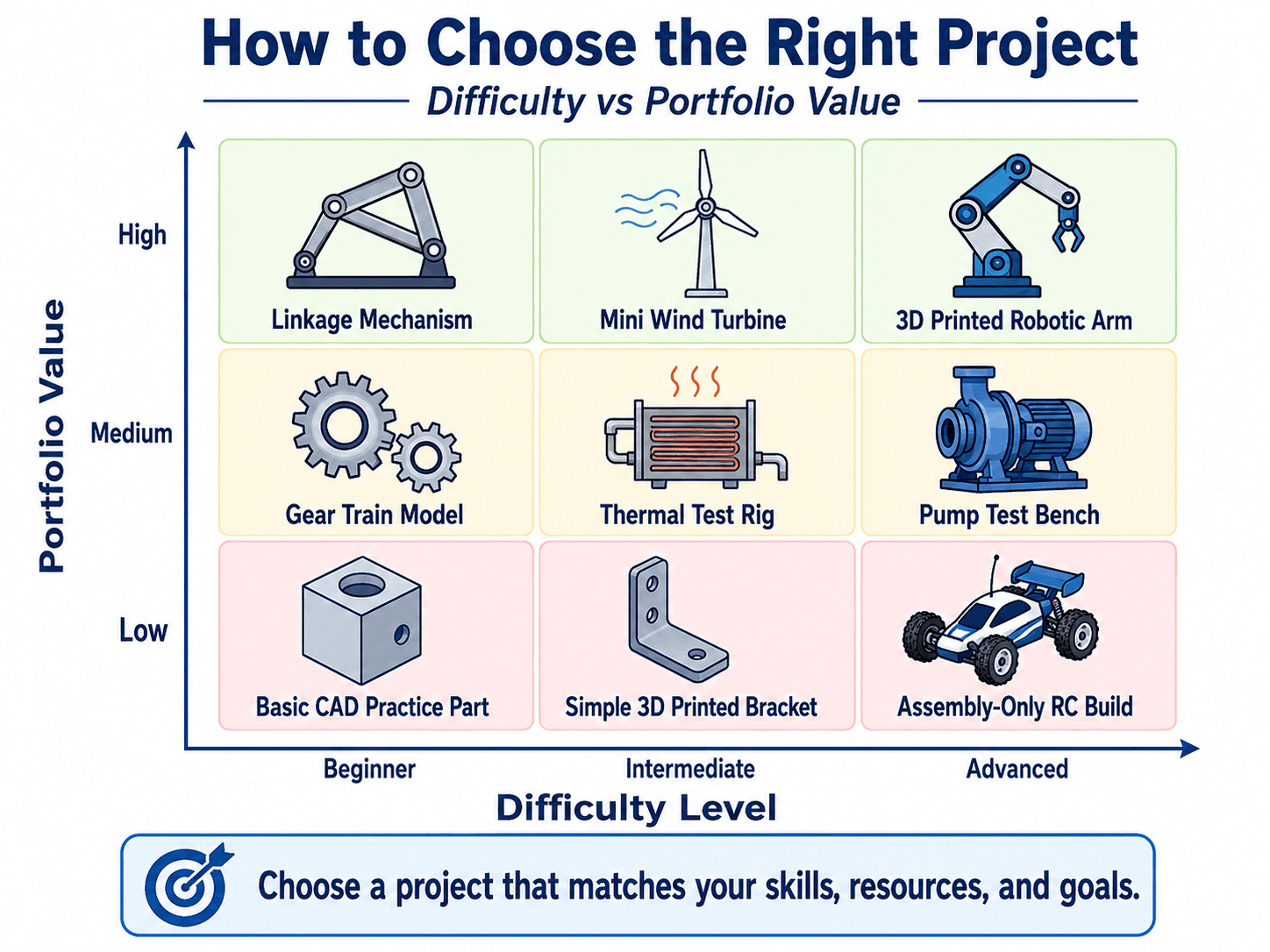
Choose the simplest project that still lets you demonstrate the engineering skill you want to show.
Your skill level, budget, time, tools, safety limits, and portfolio goal.
A project with at least one meaningful calculation, model, design decision, or measurable performance target.
You can build or simulate it, test it, explain the result, and document at least one iteration.
- Step 1: Pick one primary skill to demonstrate: mechanics, thermal, fluids, CAD, manufacturing, robotics, or testing.
- Step 2: Define one measurable success metric such as load, speed, temperature, flow, accuracy, stiffness, or repeatability.
- Step 3: Reduce the scope until the project can be completed with the tools, time, and budget you actually have.
- Step 4: Make sure the final result can be documented with CAD, calculations, photos, data, and a clear design change.
Key Takeaways
- Best beginner projects: Gear trains, linkages, bracket tests, spring tests, simple thermal boxes, and low-pressure fluid demonstrations.
- Best resume projects: Projects that show CAD, calculations, prototype or simulation, test data, and design iteration.
- Best capstone projects: Real needs with measurable requirements, safety review, system integration, and a defined acceptance test.
- Best project strategy: Finish and validate a focused subsystem instead of attempting an oversized system that never reaches reliable testing.
Best Mechanical Engineering Projects by Goal
The best project depends on what you want the finished work to prove.
| Goal | Best project choices | What the project can demonstrate | Good measurable result |
|---|---|---|---|
| Best beginner project | Gear train, linkage, spring test, simple bracket | Mechanics, CAD, geometry, fit, load paths | RPM, force, displacement, deflection, or failure load |
| Best low-cost project | 3D printed bracket, friction test, mini wind turbine, insulation box | Design comparison and simple measurement | Load, distance, voltage, temperature, or friction force |
| Best resume project | Robotic gripper, pump test bench, thermal rig, automated fixture | CAD, calculations, prototyping, testing, iteration | Grip force, flow, temperature, repeatability, or cycle time |
| Best CAD portfolio project | Gearbox, shaft-and-bearing layout, enclosure, fixture | Assemblies, drawings, interfaces, fits, tolerances | Clearance, alignment, deflection, or assembly repeatability |
| Best Arduino / mechatronics project | Sorter, robotic arm, test rig, sensor-controlled gripper | Mechanical design plus actuation and system integration | Position accuracy, cycle time, success rate, or repeatability |
| Best capstone project | Industry fixture, heat recovery system, automated test stand, mobility subsystem | Requirements, analysis, safety, integration, validation | Acceptance-test pass rate or performance against requirements |
Swipe horizontally to view all table columns.
50 Mechanical Engineering Project Ideas
These ideas span mechanics, machine design, thermal systems, fluids, manufacturing, robotics, testing, product design, and vehicle systems.
Choose by the engineering evidence you can collect, not by how advanced the title sounds.
| Project idea | Category | Best for | Engineering evidence to collect |
|---|---|---|---|
| Two-stage gear train model | Machine design | Beginner / CAD | Gear ratio, RPM, backlash, alignment, torque tradeoff |
| Four-bar linkage mechanism | Mechanisms | Beginner / kinematics | Motion range, pivot spacing, mechanical advantage |
| 3D printed bracket load test | Materials / manufacturing | Beginner / resume | Load capacity, deflection, failure location, redesign |
| Mini wind turbine test | Energy / fluids | Beginner / low cost | Blade geometry, RPM, voltage, airflow condition |
| Rubber-band powered car | Dynamics | Beginner / classroom | Distance, wheel diameter, friction, energy loss |
| Cam and follower demo | Machine design | Beginner / mechanisms | Follower displacement, cam profile, contact behavior |
| Pulley speed-ratio test | Power transmission | Beginner | Input/output RPM, slip, pulley diameter, belt behavior |
| Manual scissor lift model | Mechanisms / structures | Beginner–intermediate | Load, lift height, geometry, stability |
| Adjustable mechanical clamp | Product design | Beginner / CAD | Clamp force, handle geometry, material choice |
| Desktop tensile test fixture | Testing / materials | Intermediate | Specimen geometry, load, failure mode, repeatability |
| Robotic gripper | Mechatronics | Resume / Arduino | Grip force, success rate, actuator sizing, repeatability |
| Automated sorting mechanism | Automation | Intermediate / capstone | Throughput, jam rate, timing, failure analysis |
| Pump test bench | Fluid mechanics | Intermediate / fluids | Flow, pressure, head, pump speed |
| Pipe head-loss test loop | Fluid mechanics | Intermediate | Flow rate, pressure drop, fittings, uncertainty |
| Thermal insulation test box | Heat transfer | Intermediate / low cost | Temperature, thickness, time response, heat loss |
| Heat sink comparison test | Thermal design | Intermediate | Surface temperature, airflow, fin geometry |
| Small heat exchanger demo | Thermal / fluids | Intermediate | Inlet/outlet temperatures, flow, effectiveness |
| Solar thermal collector | Energy systems | Intermediate | Temperature rise, weather conditions, efficiency estimate |
| Motorized conveyor prototype | Manufacturing / automation | Intermediate | Belt speed, load, torque, alignment |
| Small CNC plotter | Manufacturing / mechatronics | Intermediate | Accuracy, backlash, axis motion, repeatability |
| 3D printed gearbox | CAD / machine design | Intermediate / portfolio | Ratio, housing alignment, support, backlash |
| Bearing support bracket | Mechanical design | CAD / stress | Load path, fit, stiffness, fastener placement |
| Shaft-and-bearing test rig | Rotating equipment | Intermediate–advanced | Shaft size, bearing spacing, speed, deflection, vibration |
| Flywheel energy-storage demo | Dynamics | Advanced | Moment of inertia, speed, stored energy, guarding |
| Vibration isolation platform | Dynamics / testing | Intermediate | Frequency response, damping, acceleration |
| Mass-spring-damper experiment | Dynamics | Beginner–intermediate | Natural frequency, damping, displacement |
| Braking system test fixture | Vehicle systems | Advanced / capstone | Brake force, temperature, friction, safety |
| Suspension geometry model | Vehicle dynamics | Advanced / CAD | Travel, camber change, packaging, load path |
| Steering linkage prototype | Mechanisms / vehicle | Advanced | Steering angle, interference, backlash |
| Lightweight frame member study | Structures / materials | Intermediate–advanced | Weight, stiffness, load capacity, failure |
| Automated bottle capper/opener | Product design / automation | Intermediate | Torque, fixture design, repeatability, safety |
| Pick-and-place mechanism | Robotics | Intermediate / Arduino | Cycle time, positioning, payload, repeatability |
| Self-balancing platform | Mechatronics / controls | Advanced | Center of mass, motor sizing, control response |
| Mini hydraulic lift | Fluid power | Intermediate | Load, pressure, leakage, lift height |
| Pneumatic gripper demo | Fluid power / automation | Intermediate | Grip force, pressure, response time, leakage |
| Cooling fan shroud optimization | Thermal / fluids | Intermediate | Airflow, temperature reduction, pressure loss |
| Water bottle rocket test stand | Fluids / dynamics | Intermediate | Pressure, range, stability, nozzle geometry |
| Ergonomic lifting aid | Product design | Capstone / industry | Load reduction, user feedback, safety factor |
| Assembly fixture | Manufacturing | Capstone / resume | Repeatability, tolerances, clamping, inspection |
| Go/no-go inspection gauge | Manufacturing quality | Intermediate | Critical dimension, repeatability, tolerance logic |
| Material wear comparison rig | Materials / tribology | Intermediate | Wear rate, load, contact, material comparison |
| Friction coefficient setup | Mechanics / materials | Beginner–intermediate | Normal force, pull force, surface, uncertainty |
| Ball launcher with range prediction | Dynamics | Beginner–intermediate | Angle, spring force, range, repeatability |
| Spring force test stand | Mechanics | Beginner | Force, displacement, spring constant, hysteresis |
| Phone or laptop stand optimization | Product design | Beginner / CAD | Load support, stability, material, user testing |
| Adjustable nozzle/diffuser test | Fluids | Intermediate | Flow pattern, pressure change, velocity estimate |
| Mini wind tunnel visualization | Fluids / aerodynamics | Intermediate | Airflow path, test section, fan behavior |
| Heat recovery ventilation prototype | Thermal systems | Advanced / capstone | Temperatures, airflow, pressure loss, effectiveness |
| Automated material feeder | Manufacturing automation | Advanced / capstone | Feed rate, jam rate, motor sizing, reliability |
| Modular robotic arm joint | Robotics / machine design | Advanced / portfolio | Torque, backlash, stiffness, motion, repeatability |
Swipe horizontally to view all table columns.
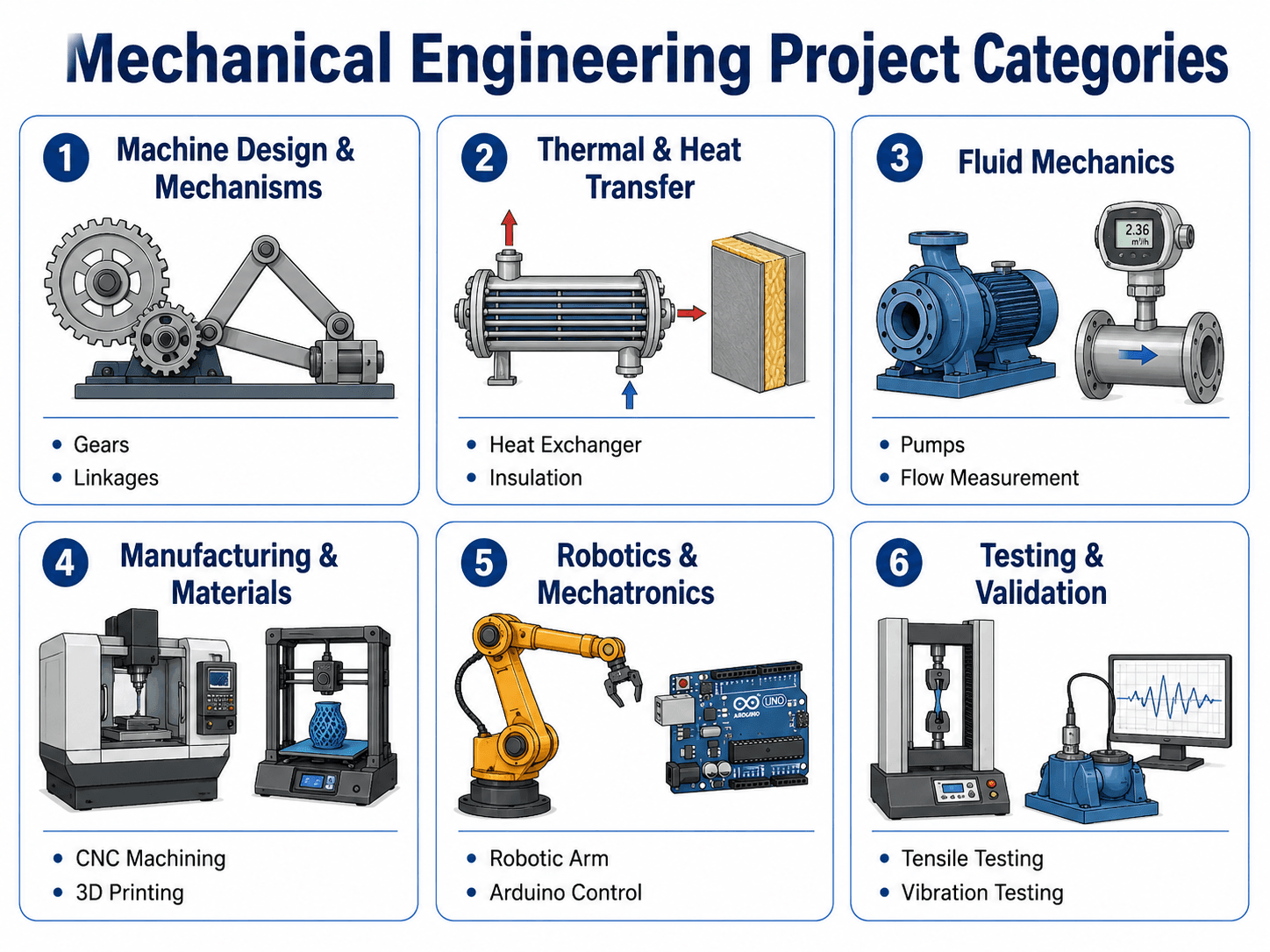
Mechanical Engineering Project Categories
Choose the category that matches the engineering skill you want the finished project to demonstrate.
Machine Design
Gear trains, linkages, shafts, bearings, clamps, lifts, transmissions, and mechanical assemblies show motion, loads, support conditions, and manufacturability.
Thermal & Fluids
Heat exchangers, insulation tests, cooling systems, pump loops, pressure-loss tests, and airflow experiments show energy and transport behavior.
Manufacturing, Robotics & Testing
Fixtures, automated mechanisms, robots, test stands, gauges, and validation rigs show integration, repeatability, practical design, and measurement.
Beginner and Low-Cost Mechanical Engineering Projects
Beginner projects should be inexpensive, safe, mechanically focused, and simple enough to finish with meaningful test data.
Gear Train
Best fit: Learning speed ratio, torque tradeoffs, alignment, backlash, and CAD.
Tradeoff: Poor shaft support or spacing can dominate the result.
Measure: Input/output RPM and load capability.
Four-Bar Linkage
Best fit: Kinematics, geometry, mechanical advantage, and motion.
Tradeoff: Packaging and pivot clearances matter more than expected.
Measure: Travel, angle, mechanical advantage, repeatability.
Bracket Load Test
Best fit: Stress, stiffness, materials, 3D printing, and redesign.
Tradeoff: Print orientation and fixture stiffness can affect failure.
Measure: Load, deflection, and failure location.
Thermal Test Box
Best fit: Heat transfer, insulation, temperature measurement, and simple experiments.
Tradeoff: Ambient conditions and sensor placement affect data quality.
Measure: Temperature response and relative heat loss.
How much should a student project cost?
Many strong beginner projects can be completed for under $50 with simple materials, 3D printing, common hardware, and basic measurement tools. Intermediate projects often fall into the $50–$250 range. Spend money on measurement quality and a reliable prototype before spending it on unnecessary system complexity.
A simple scale, thermometer, tachometer, gauge, or low-cost sensor can turn a basic build into an engineering experiment by making performance measurable.
Intermediate, Advanced, and Capstone Mechanical Engineering Projects
Advanced projects should show system integration and capstones should be scoped like small professional design problems with measurable acceptance criteria.
| Project | Engineering focus | Useful deliverables | Best level |
|---|---|---|---|
| Robotic gripper | Mechanisms, actuator sizing, force, control | CAD, force estimate, prototype, repeatability chart | Intermediate |
| Pump test bench | Flow, head, pressure, pump behavior | Schematic, pressure data, flow data, performance discussion | Intermediate |
| Automated sorting mechanism | Motion, sensing, timing, reliability | Assembly, timing data, jam analysis, test plan | Intermediate–advanced |
| Suspension or steering subsystem | Kinematics, loads, packaging, safety | CAD, motion study, load estimates, design review | Advanced |
| Heat recovery system | Thermal design, fluid flow, efficiency | Thermal model, test data, efficiency estimate, tradeoff summary | Advanced / capstone |
| Industry fixture or test stand | Requirements, repeatability, manufacturing, safety | Requirements, drawings, validation plan, measured repeatability | Capstone |
Swipe horizontally to view all table columns.
A focused subsystem with a real user, clear requirements, and excellent validation is usually stronger than an oversized system that never reaches reliable testing.
Mechanical Engineering Project Workflow
Use the same design logic for a small bracket test, CAD portfolio project, or senior capstone.
- Define the problem
State the user need, failure, performance gap, or design objective.
- Write measurable requirements
Define performance targets and constraints such as load, speed, flow, temperature, size, cost, or repeatability.
- Generate concepts
Compare at least two feasible approaches before locking into purchased parts or one geometry.
- Analyze the design
Use calculations, free-body diagrams, simulation, sizing, thermal estimates, flow analysis, or other relevant engineering checks.
- Build or simulate
Create the minimum prototype, test article, CAD model, or simulation needed to test the primary claim.
- Test against requirements
Measure performance with a repeatable method and compare the result to the acceptance criterion.
- Iterate
Use the data, failure, or limitation to drive one documented design improvement.
- Document the result
Show CAD, calculations, photos, plots, test results, failures, and lessons learned.
Worked example: gear train project
A two-stage gear train becomes a strong engineering project when it is tied to a real requirement. Define a target output speed and load, calculate the gear ratio and expected torque, design the shaft spacing and supports, build the prototype, measure actual input and output RPM, identify backlash or alignment problems, and revise the design based on test results.
Real projects rarely work perfectly on the first attempt. Binding, loosened fasteners, warped prints, sensor drift, misalignment, vibration, leakage, and thermal issues are valuable engineering evidence when they are measured and used to improve the design.
Best Mechanical Engineering Projects for a Resume and Portfolio
A portfolio-ready project makes the problem, design decisions, engineering analysis, test result, and iteration understandable without requiring a long verbal explanation.
| Portfolio element | What to include | What it proves |
|---|---|---|
| Project summary | Problem, solution, and measurable result in one or two sentences | Clear technical communication |
| CAD and drawings | Assembly views, exploded views, interfaces, dimensions, tolerances | Geometry, packaging, manufacturability |
| Calculations | Relevant torque, stress, heat, flow, power, speed, stiffness, or efficiency checks | Engineering reasoning |
| Prototype evidence | Photos, fabrication notes, materials, print or machining details | Implementation skill |
| Test results | Data, graph, acceptance criterion, comparison with prediction | Validation discipline |
| Lessons learned | Failure, design change, and next improvement | Iteration and judgment |
Resume bullet examples
| Weak | Stronger |
|---|---|
| Built a robotic arm for class. | Designed and tested a 3D printed robotic gripper, improving repeatable object pickup after linkage geometry and grip-surface redesign. |
| Made a gear project. | Modeled, fabricated, and tested a two-stage gear train, comparing calculated gear ratio with measured output RPM and documenting backlash improvements. |
| Worked on a heat transfer project. | Built an insulation test box and collected temperature data to compare material performance, heat-loss trends, and prototype design changes. |
Mechanical Engineering Project Safety and Feasibility
Student projects should stay within appropriate limits for speed, pressure, temperature, stored energy, voltage, load, tooling, and supervision.
| Project type | Main concern | Safer direction |
|---|---|---|
| Pressure / compressed air | Stored energy, rupture, fittings failure | Use low pressure, water where practical, approved components, and supervised lab procedures. |
| High-speed rotor / flywheel | Imbalance, fragmentation, bearing failure | Keep stored energy low, use guarding, and test under supervision. |
| Combustion / flame | Fire, fumes, burns, fuel handling | Use electric heating or a controlled thermal experiment when possible. |
| Heavy lifting device | Crush hazard, tipping, structural failure | Use scaled loads, mechanical stops, stable fixtures, and controlled testing. |
| Machining | Cuts, chips, entanglement, setup error | Use trained supervision, guards, PPE, safe workholding, and shop procedures. |
Swipe horizontally to view all table columns.
Projects to avoid as a beginner
Full CNC machines, complete drones, powered vehicles, high-pressure launchers, combustion-engine builds, and humanoid robots usually combine too many subsystems or introduce unnecessary safety and integration risk. Reduce the idea to one testable subsystem instead.
Instead of building a full robot, build and validate one gripper. Instead of building a full CNC machine, build and measure one linear axis.
Common Mechanical Engineering Project Mistakes
- Starting with purchased parts instead of requirements: Define what the system must do before selecting components.
- Choosing too much scope: Define a minimum working version and one primary performance test.
- No calculations: Add at least one meaningful force, torque, stress, speed, thermal, fluid, stiffness, or energy check.
- No test data: Measure performance and compare it to the requirement.
- Ignoring manufacturing and assembly: Review clearances, tolerances, fasteners, access, tooling, and adjustment early.
- Documenting only the final build: Show the design process, failures, data, and iteration.
Mechanical Engineering Project References
These references support the engineering-design and academic context used to evaluate student and capstone projects.
- ABET — Criteria for Accrediting Engineering Programs, 2026–2027 Current engineering student outcomes and curriculum context related to problem solving, design, experimentation, communication, judgment, and engineering constraints.
- Turn2Engineering — Mechanical Design Process Companion resource for requirements, concepts, analysis, prototyping, testing, and design iteration.
Frequently Asked Questions
What are good mechanical engineering projects for beginners?
Good beginner projects are safe, low-cost, measurable, and small enough to finish. Strong options include gear trains, four-bar linkages, bracket load tests, spring test stands, friction experiments, simple thermal test boxes, and small fluid demonstrations.
What mechanical engineering projects look good on a resume?
The strongest resume projects show a clear problem, requirements, CAD or modeling, calculations, a prototype or simulation, test data, and at least one design change based on evidence.
What is a good final-year mechanical engineering project?
A strong final-year project has a real need, measurable requirements, defined constraints, engineering analysis, buildable geometry, safety considerations, a validation plan, and a final report or presentation that explains tradeoffs and results.
Can mechanical engineering projects use Arduino or electronics?
Yes. Arduino and electronics are common in robotics, automation, mechatronics, and test rigs. The project should still contain meaningful mechanical engineering through mechanisms, structures, loads, motion, thermal behavior, fluids, manufacturing, or physical testing.
How much should a mechanical engineering student project cost?
Many useful beginner projects can be completed for under $50. Intermediate projects often cost $50–$250. Spend money where it improves the prototype or measurement quality rather than on unnecessary complexity.
What are good mechanical engineering projects without electronics?
Good non-electronics projects include gear trains, linkages, cam-and-follower mechanisms, scissor lifts, clamps, spring test stands, bracket load tests, friction experiments, shaft-and-bearing layouts, and manual fixtures.
Choose Your Mechanical Engineering Project
Pick one project that matches your current skill level, resources, and career goal. Before buying parts, write at least three measurable requirements such as target load, speed, temperature difference, flow rate, deflection, accuracy, or repeatability.
Then build the smallest prototype or model that can test those requirements. If you can analyze it, build or simulate it, measure the result, and explain one design iteration, you have the foundation of a strong mechanical engineering project.