
Direct Answer
Gear design is the process of turning a required speed ratio and torque transfer into a gear system with suitable tooth geometry, load capacity, materials, backlash, lubrication, accuracy, and support stiffness.
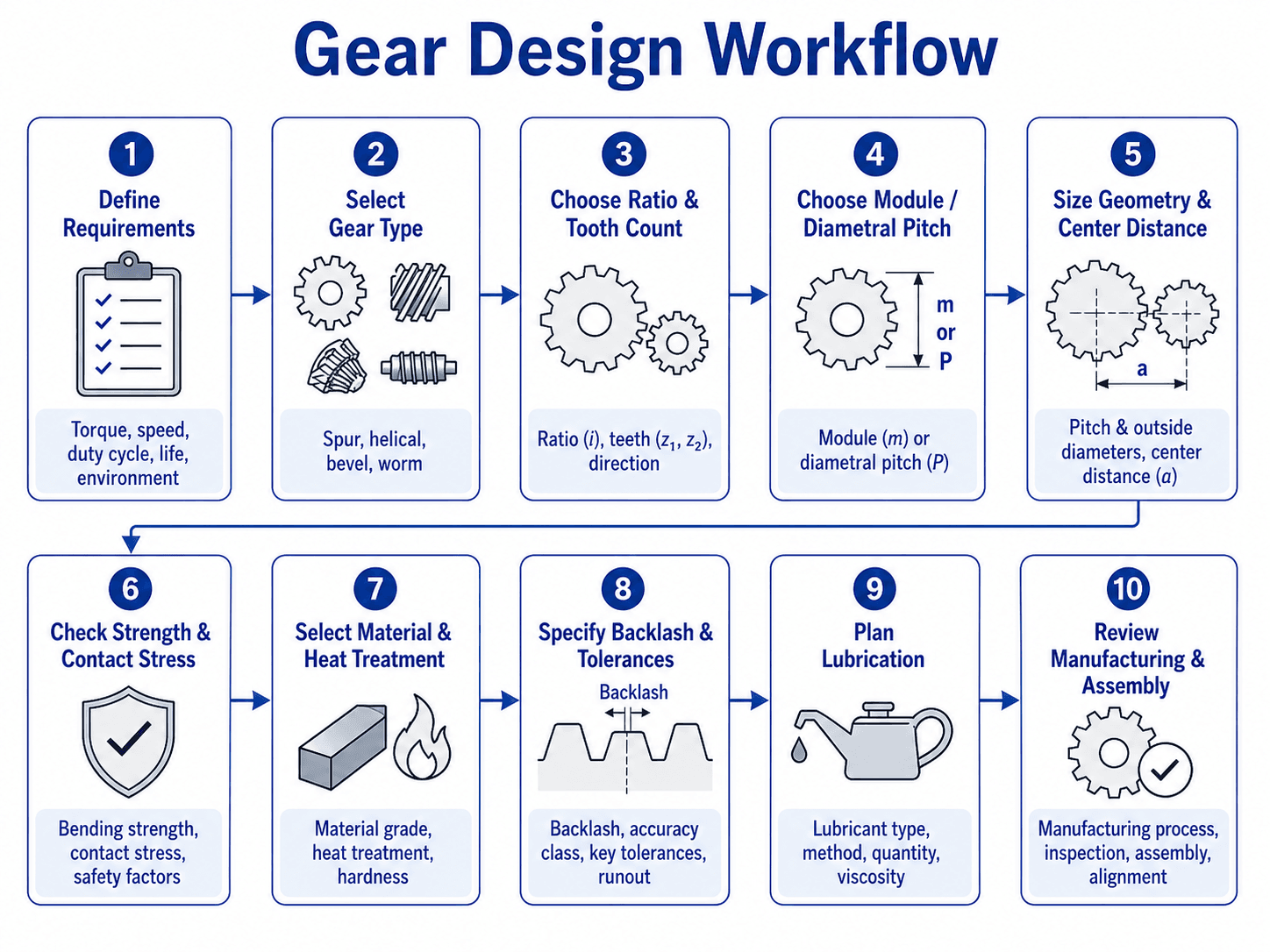
A useful design starts with power, torque, RPM, ratio, duty cycle, shaft arrangement, life, and packaging. Engineers then choose a gear type, select tooth counts and module or diametral pitch, calculate pitch diameters and mesh forces, check tooth-root bending and surface durability using an appropriate rating method, and verify that shafts, bearings, housing, lubrication, tolerances, and manufacturing quality keep the teeth correctly aligned in service.
Gear Design Process: From Requirements to a Rated Gearset
Gear design is most reliable when tooth geometry comes after the operating requirements are defined. A gear pair that gives the correct ratio in CAD can still be a poor design if the load spectrum, contact stress, lubrication, alignment, or manufacturing quality is wrong.
Power, torque, input/output speed, ratio, duty cycle, life, shock, shaft arrangement, package space, noise, environment, and maintenance needs.
Gear type, tooth counts, module or diametral pitch, pressure angle, face width, center distance, materials, heat treatment, backlash, and lubrication.
Tooth-root bending, surface durability, variable-load life, shafts, bearings, housing stiffness, alignment, temperature, accuracy, inspection, and field service.
-
Define motion and duty.
Establish input power and speed, required output speed and torque, ratio, direction, starts and stops, reversals, shock, operating hours, target life, and expected overloads.
-
Select the gear architecture.
Choose spur, helical, bevel, worm, planetary, or another arrangement based on shaft orientation, ratio, torque density, efficiency, noise, packaging, and manufacturing constraints.
-
Set first-pass geometry.
Select tooth counts, module or diametral pitch, pressure angle, center distance, face width, profile details, and standard components that meet the motion and packaging requirements.
-
Calculate the load path.
Convert torque into tangential tooth force, resolve radial and axial reactions, and pass those loads into the shafts, bearings, and housing.
-
Rate strength and durability.
Check tooth-root bending, pitting/surface durability, variable-load life, scuffing or other application-specific risks using a recognized rating method where required.
-
Finalize the real machine.
Coordinate backlash, tooth accuracy, heat treatment, lubrication, shaft stiffness, bearing arrangement, housing deflection, assembly, inspection, cooling, and maintenance before release.
MIT mechanical-design coursework treats gear kinematics, strength, and gear trains as linked design topics rather than geometry alone: MIT OpenCourseWare — Design and Manufacturing I.
Key Takeaways
- Ratio is only the beginning: tooth count and pitch diameter establish kinematics, but strength, pitting resistance, alignment, lubrication, and quality determine whether the gearset survives.
- The pinion deserves special attention: it usually has fewer teeth, smaller diameter, more load cycles, and can be more sensitive to undercut, bending fatigue, and surface durability.
- Support stiffness is part of gear design: a strong gear can still fail if shaft deflection, bearing movement, housing distortion, or thermal growth pushes tooth contact to one edge.
Spur, Helical, Bevel, Worm, and Planetary Gear Selection
The best gear type depends on shaft orientation and the system-level tradeoff among efficiency, noise, torque density, ratio, thrust, packaging, cost, and manufacturability.
Spur gears
Best fit: Parallel shafts, simple reductions, moderate speeds, straightforward manufacturing, and high efficiency.
Tradeoff: Tooth engagement is relatively abrupt, which can increase excitation and noise as speed rises.
Do not choose automatically: Low-noise or high-speed systems may benefit from helical gearing or improved tooth modifications and quality.
Helical gears
Best fit: Parallel-shaft drives that benefit from smoother engagement, higher contact ratio, and reduced mesh noise.
Tradeoff: Helix angle creates axial thrust that changes bearing selection and housing load paths.
Check: Thrust capacity, overlap/contact ratio, manufacturing accuracy, and the distinction between normal and transverse geometry.
Bevel gears
Best fit: Intersecting shafts and directional changes, commonly around 90°.
Tradeoff: Mounting distance, bearing stiffness, alignment, and tooth contact pattern are especially sensitive.
Check: Use rating and geometry methods appropriate to bevel gears rather than spur-gear equations transplanted without justification.
Worm gears
Best fit: Compact right-angle arrangements and high reduction in one stage.
Tradeoff: Sliding contact can reduce efficiency and increase heat, wear, and lubricant sensitivity.
Check: Thermal capacity, lubricant, material pairing, duty cycle, efficiency, and whether self-locking is actually guaranteed for the operating conditions.
Planetary gearsets
Best fit: Coaxial layouts, compact torque density, multiple ratios, and load sharing across planets.
Tradeoff: Load sharing is not automatically equal; carrier, ring, planet position, bearing, and manufacturing errors influence the real distribution.
Check: Assembly tolerance, planet phasing, floating members, bearing arrangement, and system-level deflection.
Standard vs. custom gears
Best fit: Use standard gears where catalog geometry and ratings satisfy the duty; customize where packaging, life, noise, ratio, material, or accuracy genuinely requires it.
Tradeoff: Custom gearing adds tooling, inspection, lead time, supplier qualification, and replacement burden.
Check: Make the custom features earn their lifecycle complexity.
For quick drivetrain comparisons before detailed design, use the Gear Ratio Calculator.
Gear Geometry, Ratio, Module, Pitch, and Center Distance
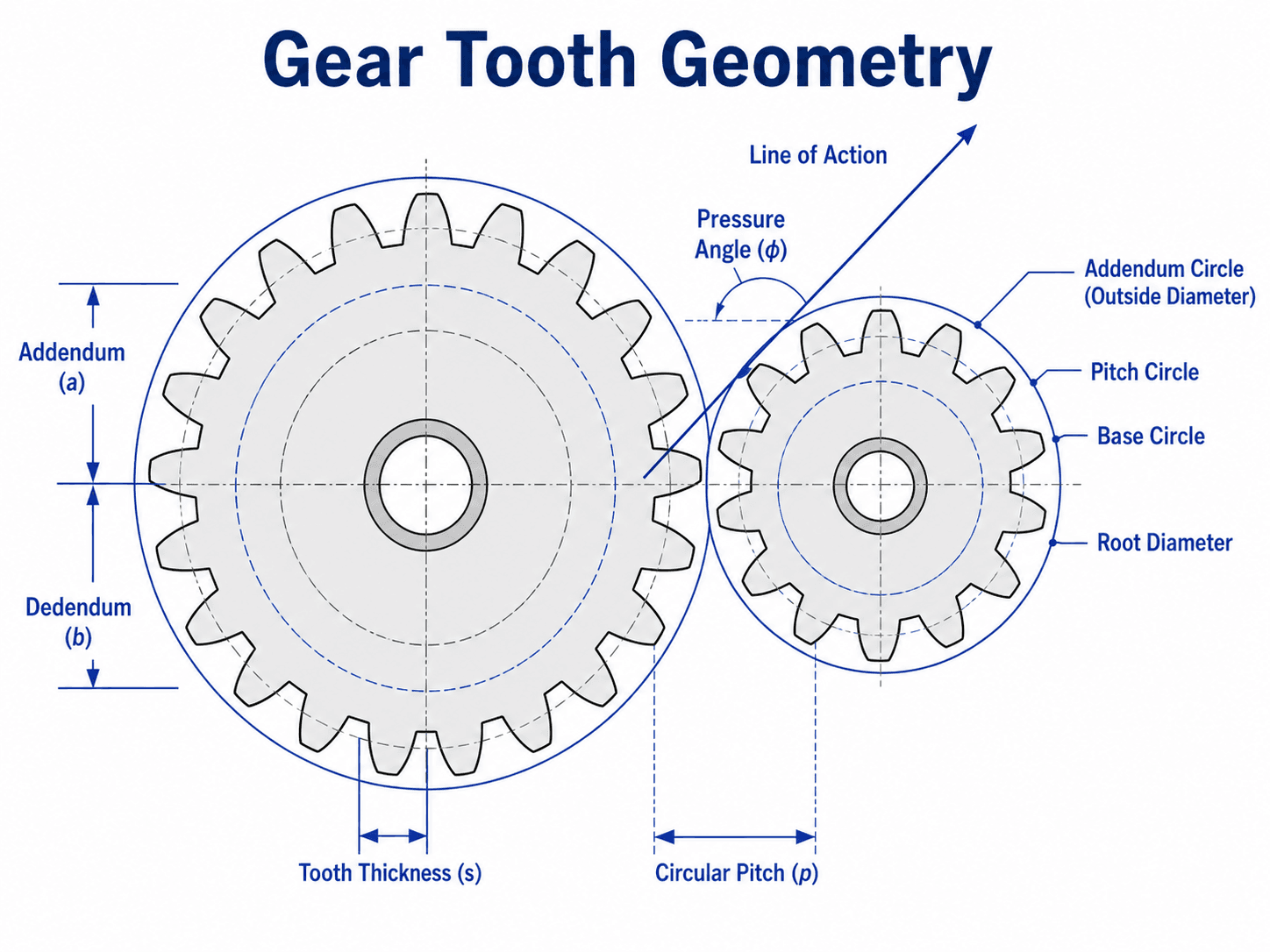
Gear geometry turns the required speed ratio into compatible teeth and pitch circles that can mesh at the intended center distance without interference, binding, or unacceptable tooth form.
Gear ratio and speed
For a simple external pair, the gears rotate in opposite directions. In an ideal lossless reduction, output torque increases approximately in proportion to the ratio while output speed decreases; real torque is lower because efficiency is less than 100%.
Metric module
Module \(m\) is pitch diameter per tooth, typically expressed in millimeters. Larger module means larger teeth. Two mating standard spur gears require compatible module and pressure-angle geometry.
Diametral pitch
Diametral pitch \(P_d\) is the number of teeth per inch of pitch diameter. Unlike module, a larger diametral pitch means smaller teeth.
Center distance
Pressure angle and tooth form
The pressure angle affects the direction of the mesh force, tooth-root proportions, contact behavior, and radial bearing load. Standardized pressure angles simplify tooling and interchangeability, but tooth count, addendum modification/profile shift, helix angle, internal vs. external gearing, and other geometry can alter the limits for undercut or interference.
Avoid oversimplified minimum-tooth rules
Low pinion tooth counts can create undercut or unfavorable tooth form, but there is not one universal minimum tooth count for every gear. Pressure angle, profile shift, addendum system, helix angle, and manufacturing method matter. Use the actual tooth-system geometry or applicable standard rather than relying on one memorized number.
Gear Mesh Forces, Shaft Loads, and Bearing Reactions
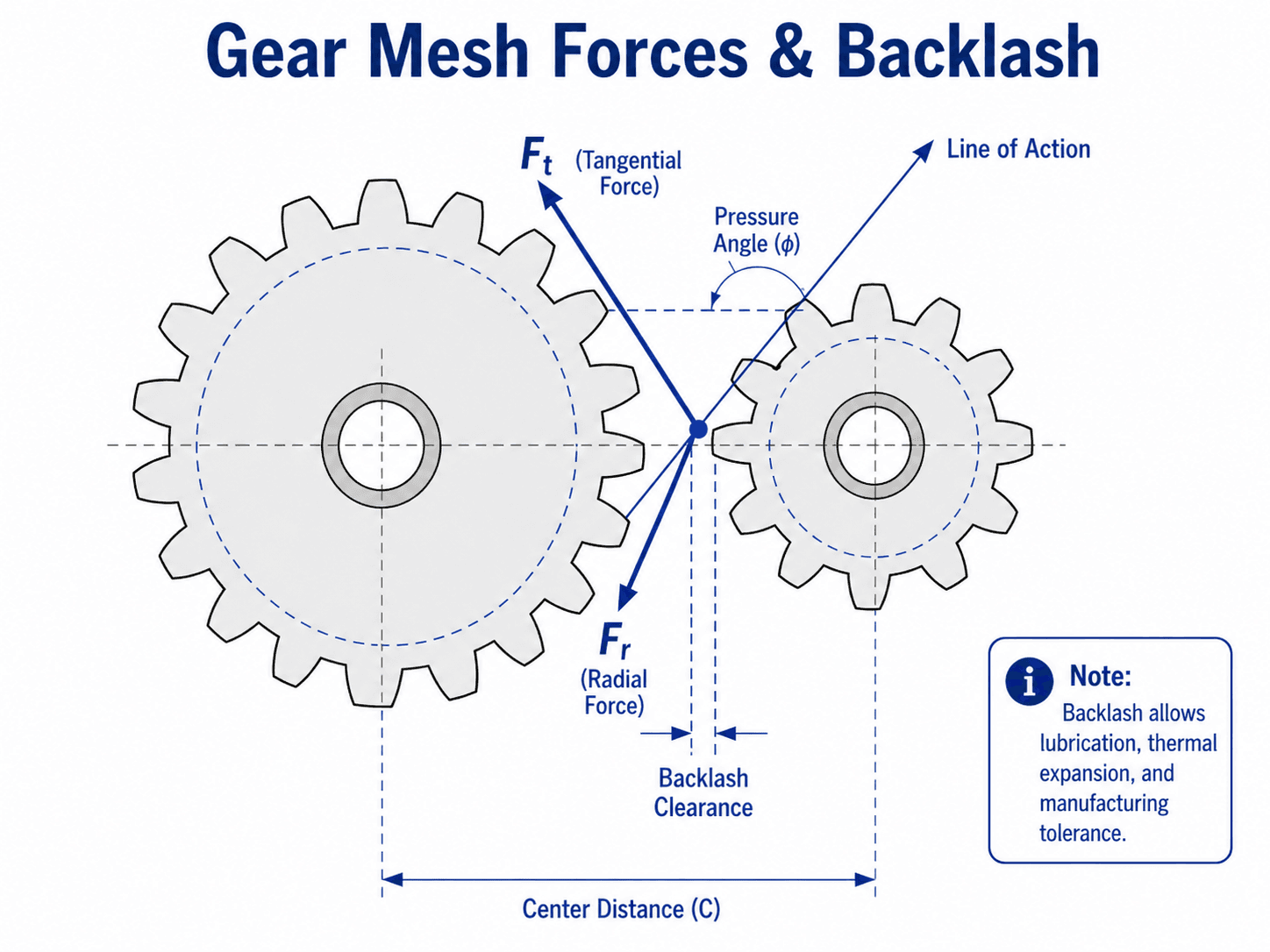
Gear teeth convert shaft torque into force at the pitch circle. That force is then reacted by shafts, bearings, and the housing. A tooth-strength calculation is incomplete if the support system allows the gears to move out of alignment under those same loads.
Torque from power and speed
Tangential tooth force
Spur-gear radial force
Normal mesh force
Pitch-line velocity
- TTorque at the gear shaft. Use a consistent unit system with pitch diameter when calculating force.
- dPitch diameter of the gear where the force is evaluated.
- FtTangential force that transmits torque and is a primary input to tooth-root bending calculations.
- FrRadial separating force for the simple spur-gear case.
- φPressure angle for the spur-gear force resolution shown here.
- vPitch-line velocity. Higher values increase the importance of dynamic behavior, accuracy, lubrication, noise, and heat.
The spur-gear equations above do not capture the axial thrust created by helical, bevel, or worm gearing. Use the geometry and force equations appropriate to the actual gear type before sizing bearings or shafts.
Pass the resulting loads into the Shaft Design and Bearing Selection checks rather than treating the gearset as an isolated component.
Gear Tooth Strength: Bending, Pitting, and Formal Rating
A gear can fail either because the tooth root cannot carry repeated bending or because the tooth flanks cannot survive repeated contact stress, so a meaningful rating normally considers both bending strength and surface durability.
Tooth-root bending
Each tooth behaves partly like a short cantilever as it carries mesh force. The highest root stress depends on transmitted load, tooth form, face width, size, load distribution, dynamics, rim support, stress concentration, and other factors. Smaller pinions can be critical because they combine smaller geometry with more stress cycles.
Lewis equation as an educational first-pass model
The Lewis equation is useful for understanding how tangential force, face width, tooth size, and tooth-form factor influence nominal tooth-root bending. In one common metric form:
Here \(b\) is face width, \(m\) is module, and \(Y\) is a tooth-form factor defined by the chosen Lewis convention. This simplified model is valuable for intuition and preliminary sizing but does not include the full set of geometry, dynamic, load-distribution, life, reliability, material, and manufacturing factors used in modern rating standards.
Surface durability and pitting
Repeated rolling/sliding contact creates high localized stress in the tooth flanks. Excessive contact stress can cause pitting or other flank damage even when the tooth root is strong enough. Surface durability depends on geometry, load, elastic properties, hardness, surface finish, lubricant film, contamination, alignment, and load distribution. ISO 6336-2 is primarily framed for oil-lubricated cylindrical transmissions, with only limited approximate use for sufficiently lubricated slow-running grease applications.
Variable loads and service life
Real gearboxes rarely see one constant torque forever. Starts, stops, production cycles, transient overloads, reversing loads, and different operating points can change cumulative damage. A design intended for long service should use a load spectrum or duty cycle appropriate to the selected rating method rather than one convenient nominal torque alone.
Use current rating standards for final capacity
For cylindrical involute spur and helical gears within its stated scope, the ISO 6336 series provides standardized methods for load capacity. Bevel, worm, hypoid, and other gear types require methods appropriate to those geometries. ISO 6336-2:2019 addresses surface durability (pitting), ISO 6336-3:2019 addresses tooth bending strength, and ISO 6336-6:2019 addresses service life under variable load. MPMA/AGMA also maintains current gear design and rating standards used in U.S. practice.
Current primary sources: ISO 6336-2:2019 — Surface durability (pitting), ISO 6336-3:2019 — Tooth bending strength, ISO 6336-6:2019 — Service life under variable load, and Motion + Power Manufacturers Alliance — Standards & Technology.
AGMA and ISO rating methods use defined factors, terminology, material data, and assumptions. Use one coherent current method for the formal rating unless a documented comparison or project requirement explicitly calls for something else.
Backlash, Lubrication, Gear Accuracy, and Alignment
Many field gear failures are driven by alignment, lubrication, heat, contamination, or accuracy problems rather than an incorrect nominal gear ratio.
Backlash provides operating clearance
Backlash is clearance between mating tooth flanks measured in a defined direction and condition. It provides space for manufacturing variation, lubricant film, thermal expansion, center-distance variation, runout, and assembly tolerances. Too little backlash can cause tight mesh, heat, noise, accelerated wear, or seizure; too much can increase impact, rattle, reversal error, and positioning uncertainty.
Backlash should be treated as a tolerance-stack and operating-condition problem rather than a single arbitrary gap. If positioning is important, connect the gear mesh to the broader Tolerance Stack-Up Analysis.
Lubrication is a design input
Lubricant viscosity, type, delivery method, operating temperature, pitch-line velocity, load, contamination, and sealing strategy influence wear, scuffing, pitting, efficiency, and heat. An oil bath, splash system, forced lubrication, grease, or open-gear lubricant can be appropriate in different applications. The correct choice should come from the gear rating/design method, lubricant supplier guidance, and the real duty—not from a generic “gear oil” assumption.
Gear accuracy should match speed and function
Pitch error, profile error, helix/lead error, runout, tooth thickness variation, surface finish, and assembly eccentricity affect load sharing, transmission error, vibration, and noise. High-speed or precision gears typically demand better manufacturing and inspection control than low-speed utility gears.
Do not specify the highest available gear quality by default. Select tooth-flank accuracy, runout, profile/helix control, and inspection requirements that are justified by speed, noise, transmission error, load distribution, and positioning needs.
Shaft and housing stiffness protect the contact pattern
A wider face width does not automatically increase capacity if the gear pair deflects enough to carry load on one edge. Shaft bending, bearing internal clearance, bearing-seat fits, housing deformation, thermal growth, and mounting alignment can all shift the tooth contact pattern. Improve the system stiffness or alignment before assuming a wider gear will distribute load evenly.
Materials and heat treatment
Through-hardened steels, case-carburized alloy steels, nitrided steels, cast irons, bronzes, and engineering polymers can all be appropriate depending on load, speed, wear, noise, environment, cost, and manufacturing. Material condition, hardness profile, case depth, core toughness, surface finish, and heat-treatment distortion should match the selected rating assumptions.
Worked Spur Gear Example: Ratio, Size, and Mesh Forces
First-pass 3:1 spur gear reduction
A motor delivers 2.0 kW at 1,800 rpm to a spur-gear pinion. The target reduction is 3:1. Choose a 20-tooth pinion and 60-tooth driven gear with a first-pass module of 3 mm and a 20° pressure angle. Calculate ratio, output speed, pitch diameters, center distance, input torque, and the idealized spur-gear mesh forces.
Calculate ratio and output speed
Confirm that the selected tooth counts satisfy the required kinematics before evaluating load.
Calculate pitch diameters and center distance
Turn the selected module and tooth counts into first-pass physical gear size and shaft spacing.
Calculate torque and tooth forces
Convert motor power into pinion torque, then into the tangential and radial loads transmitted through the mesh.
Torque recovered from \(F_t r\) matches the power-derived pinion torque within rounding.
The example does not rate tooth bending, pitting, service life, dynamics, lubrication, backlash, face load distribution, materials, heat treatment, or shaft/housing deflection.
Choose a trial face width and material, apply the selected AGMA/ISO or manufacturer rating method, then size shafts and bearings from the actual gear reactions.
Senior Engineer Gear Design Review Checklist
Use this review before drawing release, custom gear purchase, prototype approval, or a major duty-cycle change.
- Requirements: Are power, speed, torque, ratio, duty cycle, design life, shock/overload, reversals, noise, efficiency, environment, and maintenance needs defined?
- Architecture: Does the selected spur, helical, bevel, worm, planetary, or other arrangement fit the shaft orientation and system priorities?
- Tooth geometry: Are tooth counts, module/diametral pitch, pressure angle, helix angle or profile modifications, center distance, and interference/undercut risks intentionally addressed?
- Pinion cycles: Is the higher cycle count and potentially less favorable geometry of the pinion included in life and material decisions?
- Mesh forces: Are tangential, radial, and—where applicable—axial reactions calculated and transferred into shafts, bearings, and housing?
- Bending capacity: Is tooth-root bending rated with the actual duty, material, face width, geometry, dynamics, and load distribution?
- Surface durability: Is pitting/contact capacity checked independently from tooth-root bending?
- Variable load: If the duty varies, is the load spectrum represented rather than reduced to an unjustified single nominal torque?
- Backlash: Is operating backlash defined with manufacturing, center distance, runout, thermal growth, deflection, and lubricant needs?
- Alignment: Are shaft bending, bearing movement, housing deformation, assembly tolerance, and thermal effects compatible with the intended face-load distribution?
- Material/heat treatment: Are alloy, hardness, case depth, core properties, surface finish, heat-treatment distortion, and allowable rating data consistent?
- Lubrication/thermal: Is lubricant viscosity/type, delivery, sealing, contamination control, operating temperature, heat generation, and cooling addressed?
- Accuracy and inspection: Do profile, pitch, lead/helix, runout, tooth thickness/backlash, surface finish, and inspection requirements match speed/noise/life needs?
- Manufacturing and service: Can the gears be cut, heat treated, finished, inspected, assembled, lubricated, adjusted, and replaced practically?
- Rating basis: Is the final capacity based on a current, coherent AGMA/ISO, manufacturer, or project-specific method rather than a mixture of unrelated simplified equations?
Common Gear Failure Modes and What They Usually Mean
Gear failures are often system-level evidence: the damage pattern can point to load, material, lubrication, alignment, heat, contamination, manufacturing, or duty-cycle problems that tooth geometry alone cannot explain.
Tooth-root bending fatigue
Typical sign: A crack initiates near the root and grows until the tooth fractures. Review root stress, pinion cycles, overloads, material, fillet/root geometry, face load distribution, and misalignment.
Pitting or micropitting
Typical sign: Surface damage develops in the contact zone. Review contact stress, hardness, lubricant film, roughness, sliding/rolling conditions, contamination, temperature, and alignment.
Scuffing, scoring, or seizure
Typical sign: Smeared, torn, or heavily scored flanks. Review sliding velocity, temperature, lubricant viscosity/additives, surface finish, load, and lubricant delivery.
- Edge contact: Often points to shaft/housing deflection, bearing movement, misalignment, lead error, or poor mounting rather than insufficient nominal face width.
- Rapid wear: Investigate contamination, lubricant delivery, surface hardness/finish, material pairing, misalignment, and operating temperature.
- Unexpected noise: Check transmission error, gear accuracy, backlash, runout, resonance, bearing condition, housing modes, load, and contact pattern.
- Overheating: Review efficiency, churning, sliding, preload, bearing losses, lubricant selection, oil level/flow, seals, overload, and heat rejection.
- Broken teeth after jams or starts: Compare transient torque and drivetrain inertia with the rating load instead of assuming steady motor torque represents the event.
- Repeated failure after replacement: Treat the gear as evidence and investigate root cause before installing the same geometry/material again.
Failure surfaces and wear patterns are valuable clues, but a defensible root-cause investigation combines operating history, lubricant condition, contact pattern, alignment, material/heat-treatment records, dimensional inspection, load data, and fracture/wear evidence.
For broader mechanical failure context, see Failure Modes and the Stress Analysis guide.
Gear Design Engineering References
These sources support the gear kinematics, load-capacity, bending, pitting, variable-load, and standards context used on this page. The final design should use the current project-specific standard, verified material data, supplier capabilities, and application requirements.
- ISO 6336-2:2019 — Calculation of load capacity of spur and helical gears, Part 2: Surface durability (pitting) Current ISO method addressing surface durability for cylindrical involute gears within the ISO 6336 scope.
- ISO 6336-3:2019 — Calculation of load capacity of spur and helical gears, Part 3: Tooth bending strength Current ISO method for tooth-root bending-strength calculation within the ISO 6336 scope.
- ISO 6336-6:2019 — Calculation of load capacity of spur and helical gears, Part 6: Service life under variable load Addresses service-life calculation for gears subjected to variable loading.
- Motion + Power Manufacturers Alliance — Standards & Technology MPMA is the U.S. focal point for gearing standards and supports AGMA and ISO gear standardization.
- MIT OpenCourseWare — Design and Manufacturing I Mechanical-engineering lecture material covering gear basics, terminology, involute geometry, strength, and gear trains.
Frequently Asked Questions
What is the first step in gear design?
Define the required power, torque, input and output speed, gear ratio, duty cycle, life, shock loading, shaft arrangement, package space, environment, lubrication approach, and noise or positioning requirements before selecting tooth geometry.
What is the difference between module and diametral pitch?
Module is the metric pitch diameter divided by tooth count, commonly expressed in millimeters. Diametral pitch is tooth count divided by pitch diameter in inches. Larger module means larger teeth, while larger diametral pitch means smaller teeth.
Why is backlash needed between gears?
Backlash provides operating clearance for tooth thickness variation, center-distance tolerance, runout, lubricant film, thermal expansion, shaft and housing deflection, and assembly variation. Too little can create tight mesh and heat; too much can increase impact, noise, and positioning error.
How do you calculate the force on a spur gear tooth?
The tangential force at the pitch circle is \(F_t=2T/d\). For a simple spur gear with pressure angle \(\phi\), the radial separating force is \(F_r=F_t\tan\phi\). These are nominal mesh forces; rating calculations add factors for the actual gear geometry, dynamics, load distribution, life, and material.
Do simple gear formulas replace AGMA or ISO rating calculations?
No. Simple ratio, pitch-diameter, torque, and force equations are excellent for layout, learning, and independent checks. Final capacity for critical or production gearing should use the applicable current AGMA, ISO, manufacturer, or project-specific rating method for tooth bending, surface durability, life, and application factors.
Summary and Next Step
Good gear design connects kinematics to durability. Ratio, tooth count, module, and center distance establish the geometry, while mesh forces, tooth-root bending, surface durability, duty cycle, materials, lubrication, backlash, accuracy, shafts, bearings, and housing determine whether that geometry works in a real machine.
The most useful design habit is to treat the gearset as part of a drivetrain rather than as two isolated toothed wheels. If the support system cannot keep the teeth aligned and lubricated under the actual load and temperature, a theoretically strong gear rating will not guarantee reliable service.