
Key Takeaways
- Core idea: Heat transfer is thermal energy movement caused by a temperature difference, usually through conduction, convection, radiation, or a combination of all three.
- Engineering use: Engineers use heat transfer to size insulation, cool equipment, design heat exchangers, evaluate HVAC systems, and manage temperatures in engines and electronics.
- What controls it: Temperature difference, surface area, material conductivity, fluid motion, emissivity, geometry, and boundary conditions usually control the heat transfer rate.
- Practical check: The right equation depends on the dominant heat transfer mode; using a conduction equation for a convection-controlled problem can produce a misleading result.
Table of Contents
Introduction
Heat transfer is the movement of thermal energy from a hotter region to a colder region because of a temperature difference. In mechanical engineering, it explains how walls lose heat, how heat exchangers transfer energy, how electronics stay cool, and why real systems rarely behave like perfectly insulated textbook examples.
How Heat Transfer Works
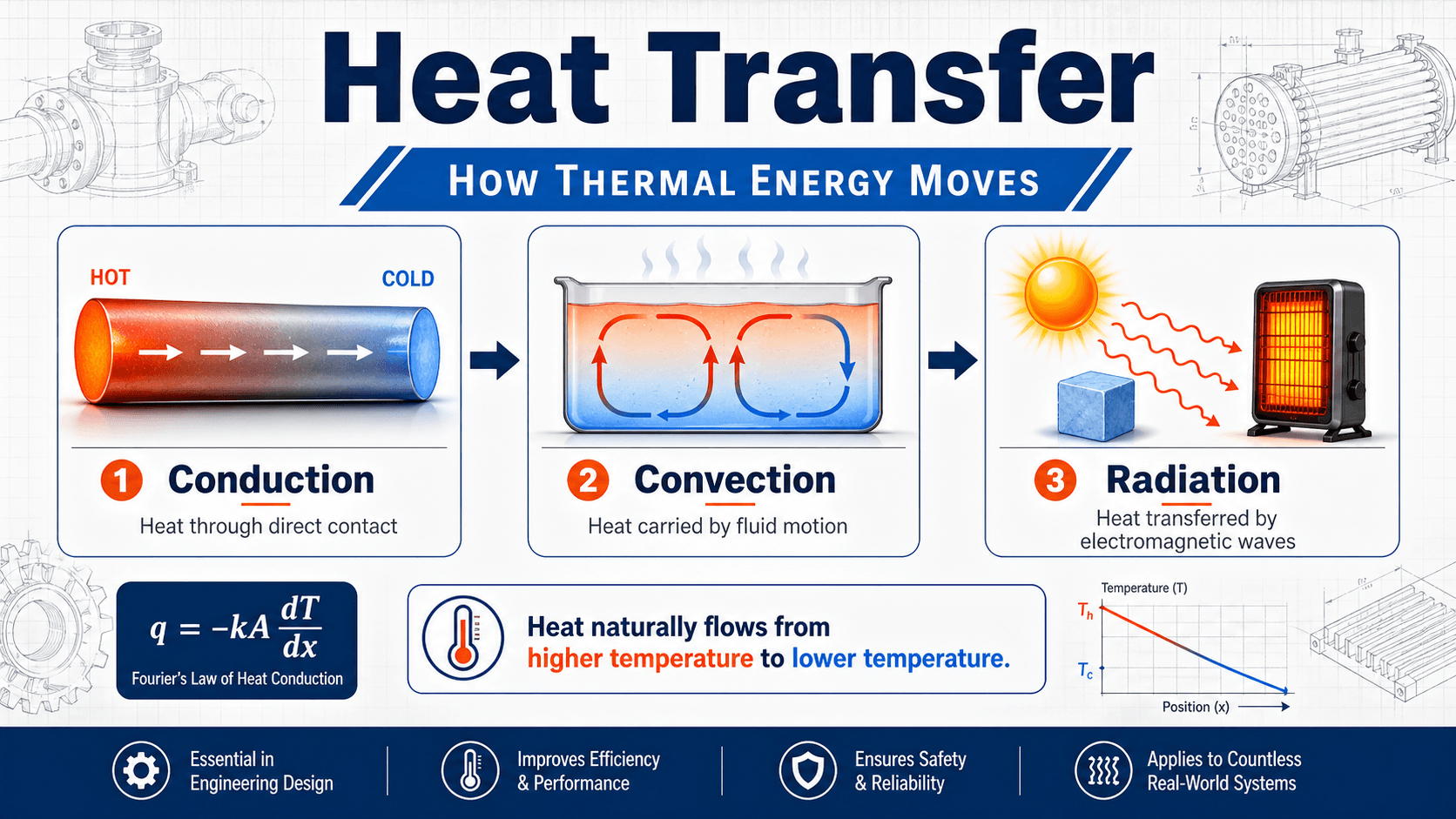
The first thing to notice is that heat transfer is driven by temperature difference, but the path depends on the material and environment. A metal wall, moving air stream, and hot radiating surface can all move thermal energy in different ways.
What is Heat Transfer?
Heat transfer describes the rate and path by which thermal energy crosses from one region, object, or fluid to another. It is closely related to thermodynamics, but it answers a more practical engineering question: not just how much energy is involved, but how fast that energy moves and what controls the movement.
In an ideal energy balance, heat may be treated as a single input or output. In real mechanical systems, the details matter. A hot pipe can lose heat through the pipe wall by conduction, from the outer surface to air by convection, and from the surface to surrounding objects by radiation. The total result depends on all of those resistances acting together.
This is why heat transfer is essential in equipment design. A component may satisfy an energy balance and still fail if heat cannot leave fast enough, if insulation is too thin, if airflow is restricted, or if the assumed surface temperature is not realistic.
The Three Modes of Heat Transfer
Most heat transfer problems begin by identifying the dominant mode. Some problems are almost pure conduction, such as heat moving through a flat wall. Others are convection-controlled, such as air cooling a hot surface. Radiation becomes important when surfaces are very hot, exposed to the sky, or separated by a space where electromagnetic exchange matters.
Conduction
Conduction is heat transfer through a material or between materials in direct contact. It is controlled by the material’s thermal conductivity, the temperature gradient, the heat flow area, and the distance heat must travel. Metals conduct heat well, while insulation materials resist conductive heat flow.
Convection
Convection is heat transfer between a surface and a moving fluid, such as air, water, refrigerant, oil, or combustion gas. It depends on fluid velocity, viscosity, density, thermal properties, surface geometry, and whether the flow is natural or forced. A fan, pump, or wind stream can dramatically increase convective heat transfer.
Radiation
Radiation is heat transfer by electromagnetic waves. It does not require a material medium, which is why the Sun can warm the Earth through space. In engineering, radiation is often affected by absolute temperature, surface emissivity, view factor, and whether nearby surfaces absorb or reflect thermal radiation.
How Engineers Use Heat Transfer
Mechanical engineers use heat transfer whenever temperature affects safety, energy efficiency, comfort, reliability, or process control. The same basic physics appears in small components and large industrial systems, but the controlling mode and assumptions can change completely.
- Heat exchangers: transferring energy between fluids without mixing them, often using conduction through a wall and convection on both sides.
- HVAC and building systems: estimating heat gain, heat loss, insulation performance, duct losses, coil capacity, and occupant comfort.
- Engines and power systems: managing combustion heat, cooling jackets, exhaust temperatures, condensers, boilers, and thermal efficiency.
- Electronics cooling: moving heat from chips to heat sinks, air streams, liquid loops, or equipment enclosures.
- Manufacturing: controlling heating, cooling, drying, casting, welding, curing, and thermal processing rates.
Before choosing an equation, ask what physically limits the heat flow: material resistance, fluid-side convection, surface radiation, contact resistance, fouling, or a combination of several layers.
Key Factors That Control Heat Transfer
Heat transfer is not controlled by temperature difference alone. Two systems can have the same hot and cold temperatures but very different heat transfer rates because of area, material, airflow, surface finish, thickness, insulation, or geometry.
| Factor | Why it matters | Engineering implication |
|---|---|---|
| Temperature difference | A larger difference creates a stronger driving force for heat flow. | Equipment may transfer heat quickly at startup but slow down as temperatures approach each other. |
| Thermal conductivity | High-conductivity materials move heat more easily by conduction. | Metals are useful for heat sinks, while low-conductivity materials are useful for insulation. |
| Surface area | More area provides more path for heat exchange. | Fins, coils, plates, and tube bundles increase area to improve heat transfer. |
| Fluid velocity | Moving fluid can reduce the thermal boundary layer near a surface. | Fans and pumps often improve cooling, but they add pressure drop, noise, and energy use. |
| Surface condition | Roughness, fouling, oxidation, paint, and contact quality affect heat flow. | Dirty coils, scale buildup, poor thermal paste, or loose contact can reduce performance. |
| Geometry and thickness | Heat flow path length and shape affect resistance. | A flat wall, cylindrical pipe, finned surface, and compact heat exchanger require different assumptions. |
Core Heat Transfer Equations
The most useful heat transfer equations are selected by mode. For many introductory engineering problems, the goal is to estimate heat transfer rate, usually in watts, from a known temperature difference and a physical resistance path.
Conduction through a flat layer
This steady one-dimensional conduction equation is commonly used for a wall, plate, insulation layer, or other simple layer where heat flows through thickness \(L\). It assumes constant thermal conductivity and a clear temperature difference across the material.
Convection from a surface
This relationship estimates heat transfer between a surface and a surrounding fluid. The heat transfer coefficient \(h\) is not a universal material property; it depends on fluid behavior, flow regime, surface geometry, and boundary conditions.
Thermal radiation between surfaces
Radiation depends strongly on absolute temperature because temperatures are raised to the fourth power. Kelvin or Rankine must be used in radiation calculations, not Celsius or Fahrenheit temperature differences.
- q Heat transfer rate, usually watts or Btu/hr.
- k Thermal conductivity, often W/m·K or Btu/hr·ft·°F.
- A Heat transfer area, usually m² or ft².
- L Conduction path length or material thickness.
- h Convection heat transfer coefficient, usually W/m²·K.
- ε Surface emissivity, ranging from near 0 for highly reflective surfaces to near 1 for strong emitters.
- σ Stefan-Boltzmann constant used in thermal radiation calculations.
Which Heat Transfer Method Should You Use?
A strong heat transfer solution starts with mode selection. The most common mistake is choosing an equation because it looks familiar instead of matching it to the physics of the problem.
Start with the heat path. If heat crosses a solid or stationary layer, check conduction. If heat leaves a surface into air, water, oil, refrigerant, or combustion gas, check convection. If a hot surface sees another surface or open surroundings, check radiation. If more than one path exists, build a thermal resistance network instead of forcing a single equation.
| Problem situation | Best starting method | Why it matters |
|---|---|---|
| Heat moving through a wall, roof, pipe wall, plate, or insulation layer | Conduction or thermal resistance | The material thickness and thermal conductivity usually control the heat flow. |
| Air or water cooling a hot surface | Convection | The fluid-side boundary layer and heat transfer coefficient often control performance. |
| A very hot surface exposed to surroundings | Radiation plus convection | Radiation can become significant at high absolute temperatures or with large exposed surfaces. |
| Two fluids separated by a wall | Overall heat transfer coefficient | Both fluid films, the wall, fouling, and geometry may all contribute resistance. |
| Cooling fins or heat sinks | Conduction inside the fin plus convection from the surface | More surface area helps only if heat can conduct through the fin effectively. |
| Transient warm-up or cool-down | Transient heat transfer model | Thermal mass and time dependence matter, so steady-state equations may be misleading. |
Worked Example: Heat Loss Through an Insulated Wall
Consider a mechanical room wall with an indoor surface at \(21^\circ C\), an outdoor side at \(1^\circ C\), an area of \(12 \, m^2\), insulation thermal conductivity of \(0.04 \, W/m \cdot K\), and insulation thickness of \(0.10 \, m\). A simple steady conduction estimate can show the order of magnitude of heat loss through the insulated layer.
Assumptions
This estimate assumes one-dimensional steady heat flow, constant thermal conductivity, uniform wall area, and no thermal bridging. It also ignores inside and outside air-film resistance, moisture effects, fasteners, framing, gaps, and radiation exchange.
Engineering meaning
The result is useful as a first-pass check, but not a complete building envelope calculation. If the wall includes metal studs, air gaps, wet insulation, or high infiltration, the actual heat loss can be much higher than the simplified conduction result suggests.
Engineering Judgment and Field Reality
Textbook heat transfer problems often isolate one mode and assume clean surfaces, constant properties, perfect contact, and simple geometry. Real mechanical systems are messier. Heat exchanger tubes foul, insulation gets compressed, thermal paste is applied unevenly, ducts leak, fans underperform, and surfaces radiate to surroundings that are not at a single uniform temperature.
Experienced engineers usually look for the limiting resistance. Adding a better metal heat sink may not help if the real bottleneck is poor airflow. Increasing airflow may not help if the heat source is poorly bonded to the sink. Adding insulation may not solve heat loss if thermal bridges bypass it.
Heat transfer calculations are most reliable when boundary conditions are realistic. A guessed heat transfer coefficient, idealized surface temperature, or ignored contact resistance can dominate the final answer.
When This Breaks Down
Basic heat transfer equations are powerful, but they become unreliable when the assumptions behind them no longer match the system. The issue is not that the physics stops working; the issue is that the simplified model may no longer represent the real heat path.
- Multi-dimensional heat flow: corners, fins, fasteners, thermal bridges, and irregular geometry may require a more detailed model.
- Transient behavior: startup, shutdown, thermal cycling, and heat storage require time-dependent analysis.
- Changing material properties: conductivity, viscosity, density, and specific heat can vary with temperature.
- Phase change: boiling, condensation, melting, freezing, and evaporation involve latent heat and specialized correlations.
- Uncertain convection: heat transfer coefficients can vary widely with flow regime, surface shape, and fluid properties.
- Radiation complexity: view factors, surface emissivity, reflected radiation, and surrounding temperatures may control the result.
Common Mistakes and Practical Checks
Many heat transfer errors come from using the right-looking equation under the wrong assumptions. A practical review should check the mode, units, temperature scale, area definition, and whether the chosen model represents the actual heat path.
- Confusing heat and temperature: temperature is a state property, while heat is energy crossing a boundary because of temperature difference.
- Using Celsius in radiation temperature powers: radiation equations require absolute temperature, such as Kelvin.
- Ignoring area: heat transfer rate depends on total area, while heat flux is rate per unit area.
- Treating \(h\) as a fixed material property: convection coefficients depend on the fluid, surface, velocity, and flow regime.
- Skipping contact resistance: imperfect contact between parts can dominate small electronics or heat sink problems.
- Forgetting fouling and aging: scale, dust, corrosion, and biological buildup can reduce heat exchanger and coil performance.
Do not assume the largest temperature difference automatically means the largest heat transfer rate. Resistance, area, geometry, and fluid motion can matter just as much as temperature difference.
Useful References and Design Context
Heat transfer is a foundational topic rather than a single code-controlled design method. Engineers usually combine first-principles equations, textbook correlations, manufacturer data, and project-specific requirements.
- Heat transfer textbooks: Common engineering references cover conduction, convection, radiation, heat exchangers, fins, transient conduction, and empirical correlations.
- ASHRAE guidance: HVAC work often relies on industry guidance for loads, equipment performance, comfort, air-side heat transfer, and building-system assumptions.
- Manufacturer data: Heat exchangers, coils, fans, pumps, insulation, thermal interface materials, and heat sinks should be checked against tested performance data when available.
- Computational tools: CFD, finite element thermal models, and heat exchanger rating software are useful when geometry, turbulence, transient behavior, or coupled modes exceed simple hand calculations.
Frequently Asked Questions
The three main types of heat transfer are conduction, convection, and radiation. Conduction moves heat through direct molecular interaction, convection moves heat through fluid motion, and radiation transfers thermal energy by electromagnetic waves.
There is no single formula for every heat transfer problem. Engineers usually choose between Fourier’s law for conduction, Newton’s law of cooling for convection, and the Stefan-Boltzmann relationship for radiation, depending on the physical mechanism controlling the heat flow.
Mechanical engineers use heat transfer to design heat exchangers, HVAC equipment, engines, refrigeration systems, electronics cooling, insulation, thermal storage, boilers, condensers, and manufacturing processes where temperature control affects safety, efficiency, or performance.
Heat transfer rate is the total amount of thermal energy moving per unit time, usually measured in watts. Heat flux is the rate per unit area, usually measured in watts per square meter, and is useful when comparing surfaces of different sizes.
Summary and Next Steps
Heat transfer explains how thermal energy moves because of temperature difference. The most important modes are conduction through materials, convection between surfaces and fluids, and radiation between surfaces by electromagnetic energy.
In engineering work, the key is choosing the right model for the heat path. Start by identifying the dominant mode, then check the variables that control the result: area, temperature difference, conductivity, fluid motion, surface condition, geometry, and boundary conditions.
Where to go next
Continue your learning path with related Turn2Engineering resources.
-
Fourier’s Law
Learn the foundational conduction equation used to estimate heat flow through materials.
-
Heat Exchangers
See how heat transfer is applied between two fluids in practical mechanical equipment.
-
Heat Transfer Calculator
Estimate steady-state conductive heat flow through walls, roofs, insulation, or simple layers.