
Direct Answer
A fuse is a one-time overcurrent protection device that opens a circuit when excessive current heats and melts a calibrated fusible element. The fuse must then extinguish the arc created as the element separates so the fault current is safely interrupted.
Correct fuse application depends on more than amp rating. Engineers also verify voltage rating, interrupting rating, AC/DC suitability, time-current behavior, fuse class or type, current-limiting performance, inrush tolerance, conductor protection, equipment SCCR, selective coordination, and replacement control.
How Does an Electrical Fuse Work?
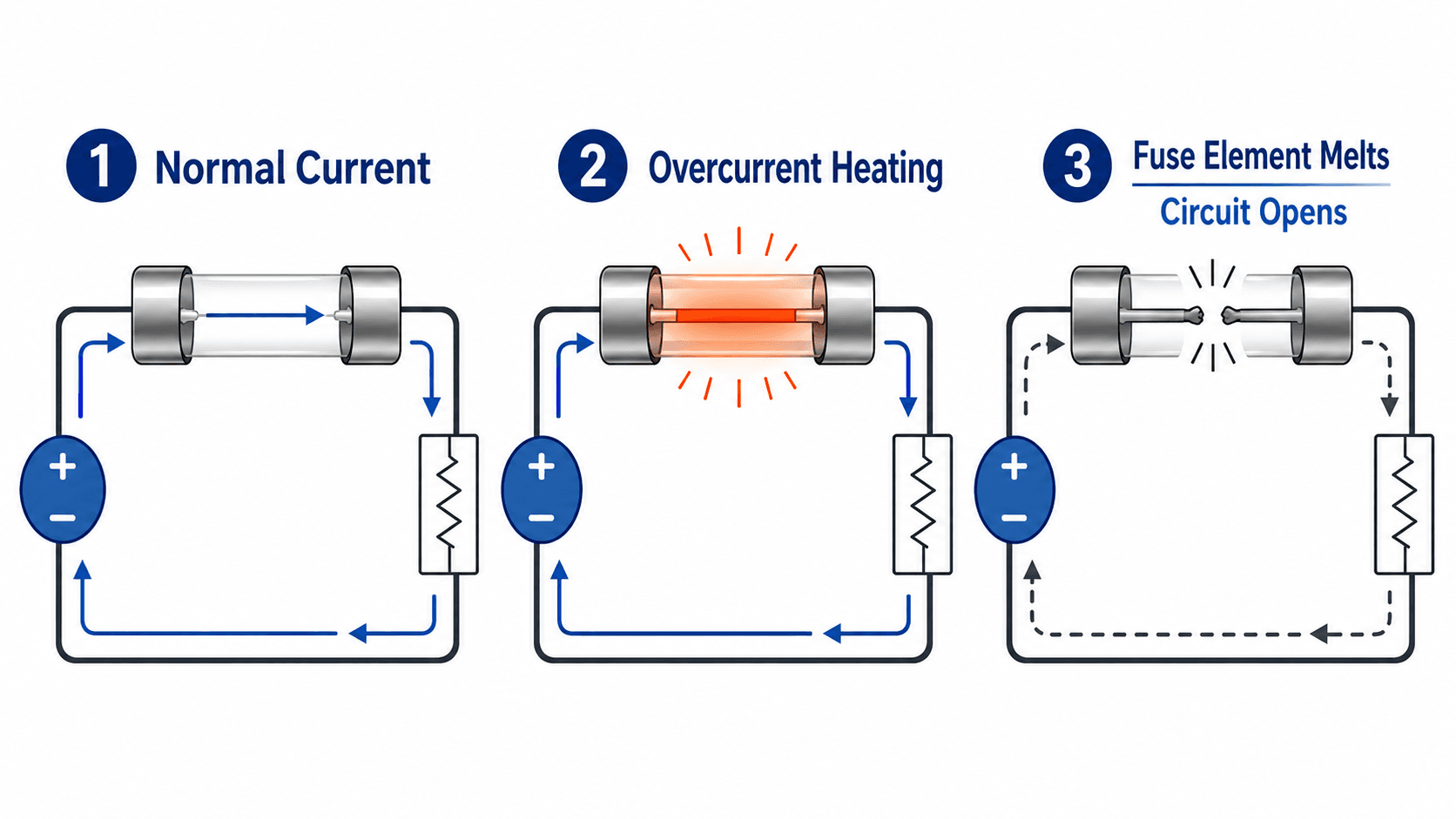
A fuse is installed in series with the circuit. Under normal conditions, current passes through the fuse element and produces limited \(I^2R\) heating. When current becomes too high for too long, the element reaches its melting point, separates, and creates an arc that must be extinguished inside the fuse body.
Why Current Makes a Fuse Melt
Because heating increases with the square of current, a large fault current can heat a fuse element extremely quickly. Smaller overloads produce less heating and therefore usually take longer to operate the fuse.
A fuse does not open at exactly one current value after exactly one time. Fuse operation is time-dependent: the greater the overcurrent, the faster the fuse generally operates.
Fuse Parts and Construction
Although fuse construction varies by voltage class and application, the same core functions appear repeatedly: carry normal current, melt predictably during overcurrent, contain the arc, and safely interrupt the circuit.
| Part | Function | Why it matters |
|---|---|---|
| Fuse element | Melts when heating exceeds its designed limit | Controls time-current behavior and energy let-through |
| Fuse body | Contains the element and interruption process | Must withstand voltage, heat, arc pressure, and fault energy |
| Arc-quenching filler | Helps cool and extinguish the arc in many current-limiting fuses | Supports high interrupting capability and reduced let-through current |
| End caps / blades | Connect the fuse to the holder or equipment | Contact condition affects heating and reliability |
| Indicator / striker | Provides visible indication or mechanical operation in some designs | Can assist fault identification or operate associated switching mechanisms |
Swipe horizontally to view all table columns.
Fuse Ratings Explained
Fuse ratings describe different limits and functions. The most common mistake is treating the amp rating as if it describes everything about the fuse.
| Rating / characteristic | Meaning | What to compare it against |
|---|---|---|
| Current rating | Nominal current the fuse is intended to carry under specified conditions | Load current, conductor ampacity, duty cycle, ambient conditions |
| Voltage rating | Maximum system voltage at which the fuse can safely interrupt | Actual circuit voltage and AC/DC application |
| Interrupting rating | Maximum fault current the fuse can safely interrupt at rated voltage | Available short-circuit current at the fuse location |
| Speed / time delay | How the fuse responds to temporary and sustained overcurrent | Motor starting, transformer inrush, capacitor inrush, sensitive loads |
| Current limitation | Ability to interrupt before full prospective peak current develops | Equipment short-circuit stress and let-through energy |
| Fuse class / type | Standardized family with dimensional and performance limits | Holder compatibility, rejection features, replacement control |
Swipe horizontally to view all table columns.
A fuse may carry only tens of amps during normal operation yet be designed to interrupt tens or hundreds of kiloamps during a short circuit. These are completely different ratings.
Types of Electrical Fuses
Fuse types differ because motors, transformers, control circuits, semiconductors, PV strings, batteries, and medium-voltage feeders do not have the same overcurrent behavior.
| Fuse type | Typical use | Main characteristic |
|---|---|---|
| Fast-acting fuse | Control circuits, electronics, low-inrush loads | Opens quickly when current exceeds its operating curve |
| Time-delay fuse | Motors, transformers, circuits with temporary inrush | Allows short-duration overcurrent without unnecessary opening |
| Current-limiting fuse | Industrial distribution, equipment protection, high fault-current locations | Reduces peak let-through current and energy |
| Semiconductor fuse | Drives, rectifiers, inverters, UPS, power electronics | Very low let-through energy for sensitive semiconductor devices |
| PV fuse | Solar strings and combiner circuits | Designed for DC voltage and PV-specific operating conditions |
| Battery / DC fuse | Battery banks, DC buses, BESS and DC equipment | Designed for DC interruption where no natural current zero exists |
| High-voltage current-limiting fuse | Medium-voltage transformers and equipment | Interrupts high fault current rapidly in MV applications |
| Expulsion fuse | Distribution transformers, cutouts, overhead distribution protection | Uses arc-extinguishing action suited to outdoor distribution applications |
Swipe horizontally to view all table columns.
Low-Voltage Fuse Classes
In North American industrial systems, classes such as CC, J, RK1, RK5, T, G, and L identify fuse families with specific dimensions and performance characteristics. These classes help control replacement compatibility and can prevent unsafe substitution when rejection-style holders are used.
How to Read a Fuse Time-Current Curve
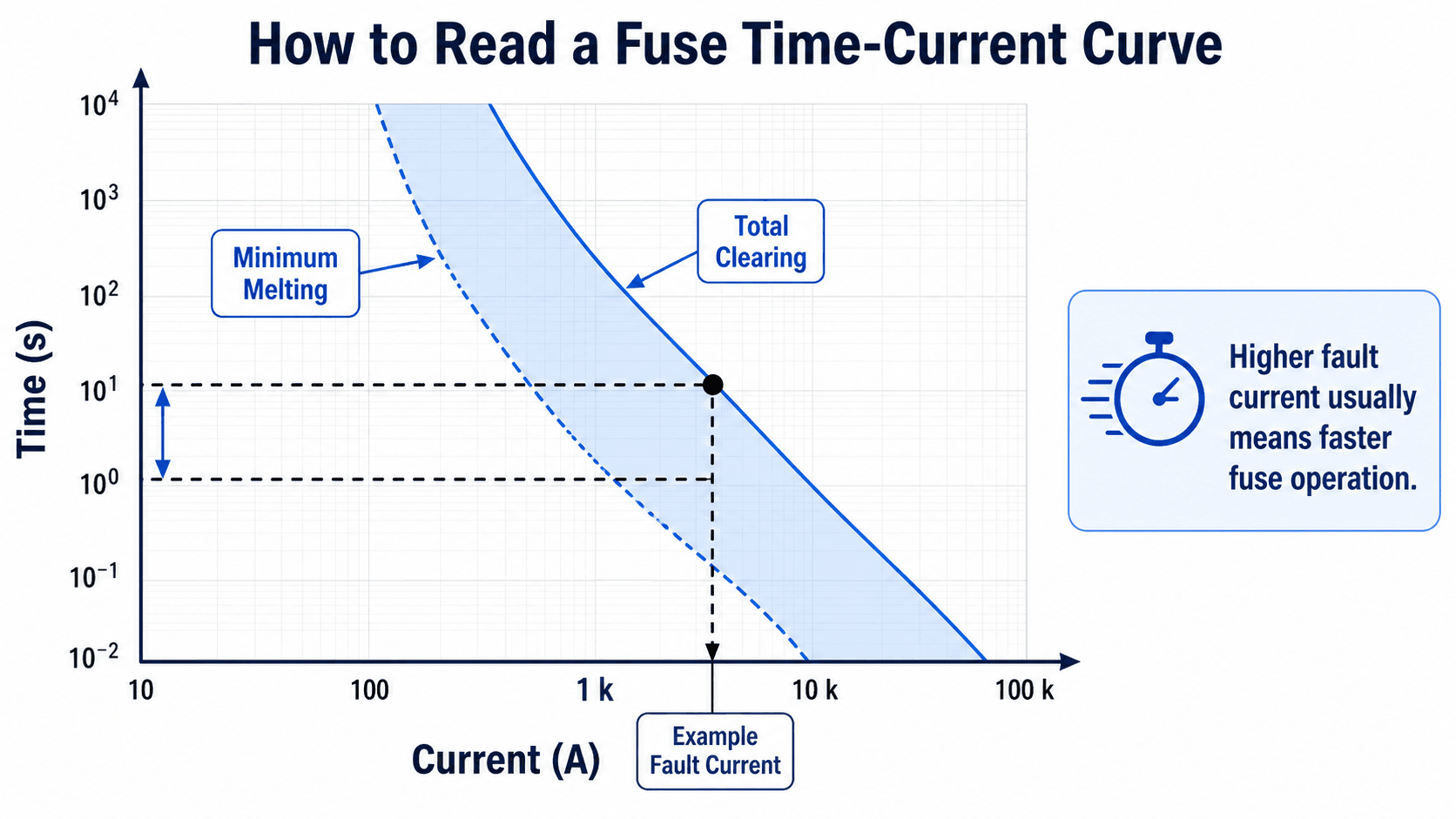
A fuse time-current curve shows how long the fuse is expected to take to melt and fully clear at different current levels. Current is plotted on the horizontal axis and time on the vertical axis, usually using logarithmic scales.
Minimum Melt vs. Total Clearing
Minimum melting is the approximate time when the fuse element begins to melt. Total clearing includes the entire interruption process through arc extinction. Coordination studies often compare both curves.
Why Fuse Curves Matter for Coordination
A downstream branch fuse should usually clear a local fault before an upstream feeder fuse or breaker opens, when the protection philosophy requires selective coordination. Engineers compare the device curves over the expected fault-current range instead of checking only one current point.
Move horizontally from the fault current until you reach the fuse curve, then read the corresponding time vertically. On a banded curve, actual operation occurs within the published tolerance band rather than at one exact line.
Current-Limiting Fuses, Peak Let-Through, and I²t
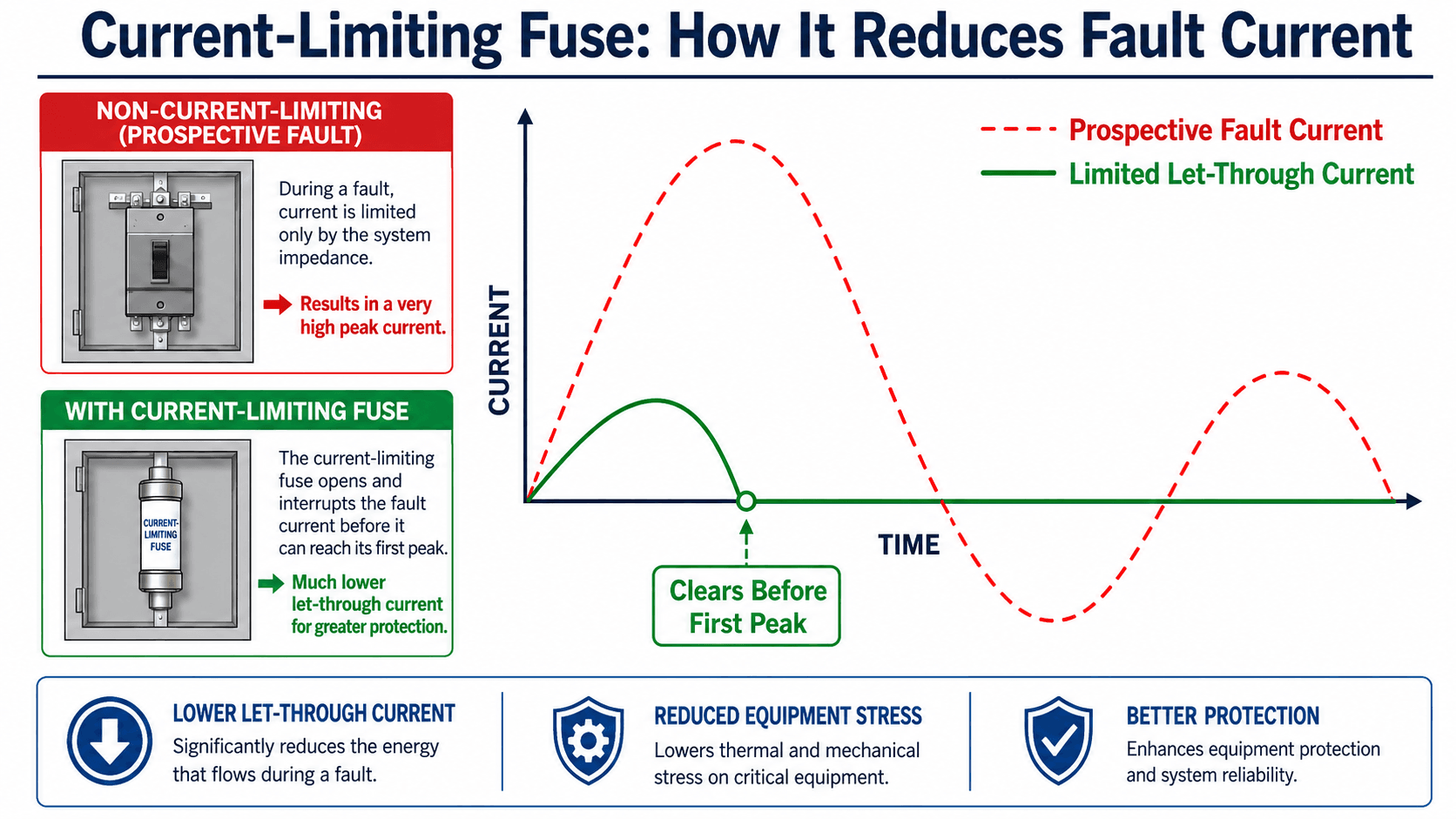
A current-limiting fuse clears a sufficiently high fault before the prospective current reaches its first full peak. This can sharply reduce the mechanical and thermal stress experienced by downstream equipment.
What Does I²t Mean?
I²t is a measure related to thermal energy passed through the fuse during an overcurrent event. Lower let-through I²t generally means less heating stress on protected conductors and components.
Engineers should use tested manufacturer let-through data rather than trying to estimate current-limiting behavior from amp rating alone.
AC Fuses vs. DC Fuses
The main difference is arc interruption. AC current naturally crosses zero every cycle; DC current does not, making sustained DC arcs harder to extinguish.
| Factor | AC circuit | DC circuit |
|---|---|---|
| Current zero crossing | Occurs naturally every half cycle | Does not occur naturally |
| Arc interruption | Generally easier | More demanding at the same voltage/current |
| Voltage rating | Must meet AC system requirement | Must specifically meet DC system requirement |
| Common applications | Feeders, motors, transformers, panels | PV, batteries, DC drives, DC links, control power |
Swipe horizontally to view all table columns.
Fuse vs. Circuit Breaker
Fuses and circuit breakers both protect against overcurrent, but fuses are one-time devices while breakers are resettable switching and protection devices.
| Decision point | Fuse | Circuit breaker |
|---|---|---|
| After operation | Replace the fuse | Investigate the fault, then reset if safe and permitted |
| Adjustability | Fixed by fuse type and rating | Many breakers have adjustable trip functions |
| Current limitation | Excellent with current-limiting fuse designs | Depends on breaker type and design |
| Switching function | Fuse alone is not a switch | Breaker commonly provides switching and interruption |
| Maintenance risk | Wrong replacement fuse can defeat original design | Improper reset or changed settings can defeat protection philosophy |
Swipe horizontally to view all table columns.
See Circuit Breakers and Overcurrent Protection for deeper coverage.
Where Fuses Are Used in Power Systems
| Application | What the fuse protects | Key application issue |
|---|---|---|
| Branch circuit | Conductors and connected equipment | Load current, conductor ampacity, short-circuit current |
| Motor circuit | Conductors and short-circuit/ground-fault protection | Motor starting current and overload-device coordination |
| Transformer | Primary feeder and transformer fault isolation | Magnetizing inrush and downstream coordination |
| PV string | String conductors/modules during reverse-current faults | DC voltage, source contribution, temperature, fuse rating |
| Battery / BESS | DC bus, strings, conductors and equipment | High DC fault energy and arc interruption |
| Semiconductor equipment | Power semiconductors | Extremely low I²t and fast current limitation |
| Distribution transformer cutout | Overhead transformer / lateral | Fuse-link curve, transformer inrush and feeder coordination |
Swipe horizontally to view all table columns.
Why Fuses Blow and What to Check
A blown fuse is evidence that enough current and time occurred to operate the fuse. The correct response is to identify why the fuse opened before simply replacing it.
| Cause | What may be happening | Engineering check |
|---|---|---|
| Overload | Current remains above normal design load | Measure load current and compare with circuit/equipment ratings |
| Short circuit / ground fault | Very high current from insulation or conductor failure | Inspect downstream equipment before replacement |
| Normal inrush | Motor, transformer or capacitor produces temporary high current | Check fuse speed and time-current curve |
| High-resistance fuse clip | Loose or corroded connection heats the fuse end | Inspect holder, clips, contact pressure and discoloration |
| Wrong fuse class | Replacement has different performance than original | Verify class, voltage, interrupting rating and time-delay behavior |
| High ambient temperature | Enclosure heat changes fuse operating margin | Review manufacturer derating/application data |
Swipe horizontally to view all table columns.
Installing a larger fuse without reviewing the conductors, load, equipment, inrush, fault duty, and protection requirements can leave the circuit underprotected.
Fuse Engineering References
- Eaton Bussmann — How to Read a Fuse Time-Current Curve Practical technical reference for interpreting fuse time-current curves and applying them in protection and coordination studies.
- Littelfuse — Fuse Technical Resources Educational material covering fuse fundamentals, terminology, fuse types, application concepts, and protection behavior.
- Mersen — Fuse and Overcurrent Protection Technical Context Industry reference for current-limiting, semiconductor, photovoltaic, and industrial fuse application concepts.
Frequently Asked Questions
What is an electrical fuse?
An electrical fuse is a one-time overcurrent protection device that melts a calibrated internal element and opens the circuit when excessive current flows long enough to create damaging heat.
How does a fuse work?
Current produces heat in the fuse element. When overcurrent raises the element temperature beyond its designed limit, the element melts and the fuse extinguishes the resulting arc to interrupt current.
What is the difference between a fuse and a circuit breaker?
A fuse is replaced after it operates, while a circuit breaker can normally be reset after the fault is investigated. Fuses can provide very fast current limitation, while breakers often provide switching and adjustable protection.
What does fuse interrupting rating mean?
Interrupting rating is the maximum available fault current the fuse is designed to safely interrupt at its rated voltage. It must exceed the prospective short-circuit current at the installed location.
What is a time-delay fuse?
A time-delay fuse intentionally tolerates temporary overcurrent such as motor starting or transformer inrush while still opening for sustained overloads and short circuits.
What is a current-limiting fuse?
A current-limiting fuse clears a sufficiently high short circuit before the prospective current reaches its full first peak, reducing peak current and let-through energy.
Can an AC fuse be used on DC?
Only if the fuse has an appropriate DC rating for the circuit voltage and fault duty. DC arcs are harder to extinguish because the current does not naturally cross zero every half cycle.
Why does a fuse keep blowing?
Possible causes include overload, short circuit, ground fault, normal inrush with the wrong fuse type, high ambient temperature, a damaged fuse holder, or an incorrect replacement fuse.
Can I replace a fuse with a higher amp rating?
Not without engineering review. A larger fuse can leave the conductors and equipment underprotected, even if it stops nuisance blowing.
Summary and Next Step
Fuses are simple in concept but sophisticated in application. The fuse element responds to overcurrent by heating and melting, but safe protection depends on whether the fuse can carry normal load, tolerate legitimate inrush, interrupt the available fault current, and coordinate with the rest of the protection system.
The most important informational takeaway is that fuse amp rating alone is never the whole answer. Voltage rating, interrupting rating, time-current behavior, current limitation, AC/DC suitability, fuse class, holder condition, and equipment SCCR all matter.