
Key Takeaways
- Core idea: Hybrid power systems combine two or more sources or storage technologies, such as solar, wind, batteries, generators, and grid power.
- Engineering use: They are used to improve resilience, reduce fuel use, support critical loads, integrate renewables, and manage local power quality.
- What controls it: Load profile, critical loads, renewable resource data, battery reserve, inverter behavior, generator limits, and control strategy shape the design.
- Practical check: A hybrid system should be designed around operating modes and load requirements first, not around a preferred equipment package.
Table of Contents
Introduction
Hybrid power systems are electrical systems that combine multiple power sources or storage technologies, such as solar PV, wind turbines, batteries, diesel or natural gas generators, and the utility grid. In power systems engineering, the purpose is to serve loads reliably while balancing resilience, cost, emissions, fuel logistics, equipment limits, and control complexity.
Hybrid Power System Architecture Diagram
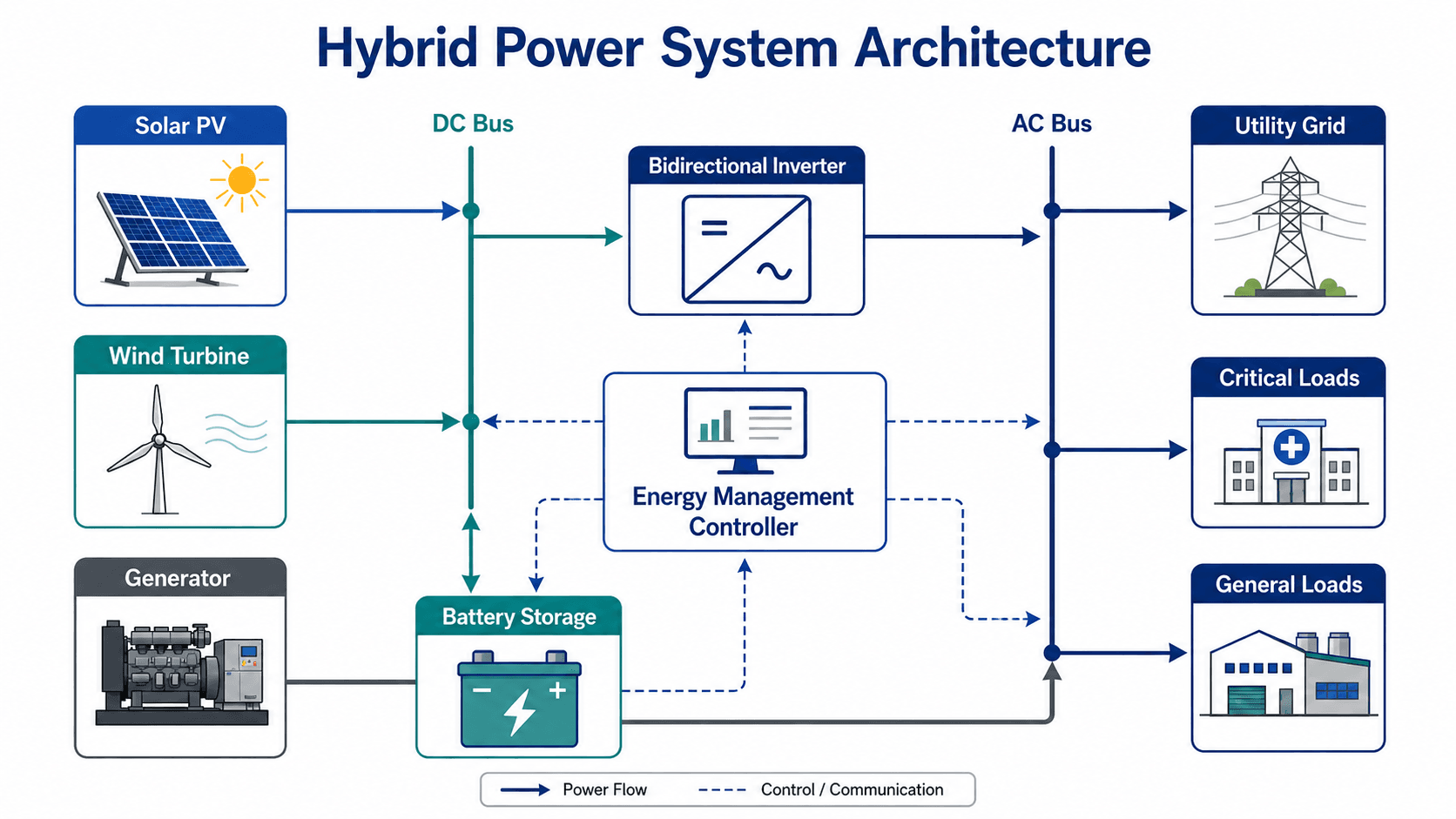
The most important idea is separation of roles: power flows through conductors, converters, buses, and switchgear, while the energy management controller monitors the system and decides when each source should operate.
What Is a Hybrid Power System?
A hybrid power system is a coordinated electrical system that uses more than one generation source, storage technology, or grid connection to supply a load. The “hybrid” part refers to the source mix, not a single piece of equipment. A system might combine solar PV and batteries, wind and solar, batteries and the grid, or renewable generation with a backup generator.
The key engineering point is coordination. A solar array, battery, and generator placed at the same site do not automatically form a high-quality hybrid system. They must be integrated through suitable inverters, switchgear, protection, metering, communications, and control logic so the load receives stable voltage and frequency under normal and abnormal conditions.
| Term | What it means | Typical example |
|---|---|---|
| Hybrid power system | A power system using multiple sources or storage technologies to serve local or grid-connected loads. | Solar PV, battery storage, and a generator serving a remote facility. |
| Hybrid renewable energy system | A hybrid system where renewable resources are a major part of the source mix. | Solar, wind, and batteries used to reduce diesel runtime. |
| Hybrid power plant | A larger generation facility that combines resources and may participate in grid operation or markets. | Wind, solar, and battery storage connected at a common grid interconnection point. |
| Microgrid | A controllable local electrical network that can often operate connected to or disconnected from the main grid. | A campus electrical system with PV, battery storage, generators, switchgear, and islanding controls. |
This page is about electrical power systems, not hybrid vehicles. The same word is used in transportation, but in power systems engineering it describes coordinated generation, storage, grid connection, and control.
How Hybrid Power Systems Work
Hybrid power systems work by matching available generation and stored energy to the load in real time. Renewable sources may fluctuate with weather, batteries can absorb or supply energy, generators can provide dispatchable backup, and the utility grid may import or export power when the system is grid-connected.
Sources connect through AC and DC buses
Solar PV and batteries are naturally DC resources, while many loads and generators are AC. Inverters, rectifiers, DC/DC converters, transformers, and switchgear connect these sources to a common AC bus, DC bus, or hybrid AC/DC arrangement. The architecture affects efficiency, protection, controls, and expansion options.
The controller manages dispatch
The energy management controller monitors load, renewable output, battery state of charge, generator availability, grid status, and operating limits. It may prioritize renewable energy, preserve battery reserve, start a generator at a defined state-of-charge threshold, shed noncritical loads, or limit grid exports.
Operating modes matter as much as hardware
The same equipment can behave very differently depending on its control mode. Hybrid systems must be reviewed for normal grid-connected operation, outage operation, battery backup, generator support, and reconnection to the utility grid.
| Operating mode | What happens | Engineering concern |
|---|---|---|
| Renewable-first dispatch | Solar or wind serves the load first, while surplus energy charges the battery or is exported when allowed. | Battery reserve, curtailment, inverter limits, and export constraints must be controlled. |
| Battery backup | The battery and inverter support critical loads during grid outages or generator transitions. | Usable capacity, inverter kW rating, discharge duration, and low-SOC limits must be realistic. |
| Generator support | A diesel or gas generator starts when load is high, renewable production is low, or battery state of charge falls below a threshold. | Minimum loading, start reliability, fuel storage, emissions limits, and maintenance intervals affect resilience. |
| Grid-connected import/export | The utility grid balances surplus and deficit power when interconnection rules allow it. | Anti-islanding, voltage regulation, export limits, and utility coordination become part of the design. |
| Islanded operation | Local sources maintain voltage and frequency without the utility grid. | Grid-forming controls, load shedding, protection settings, and reconnection logic must be tested. |
AC-Coupled, DC-Coupled, and Hybrid AC/DC Architectures
Hybrid power systems are commonly arranged around an AC bus, a DC bus, or a mixed AC/DC layout. Blue paths in the diagram represent AC power flow, while teal paths represent DC power flow. The best architecture depends on whether the project is a retrofit, new build, renewable-heavy design, or mixed-load system.
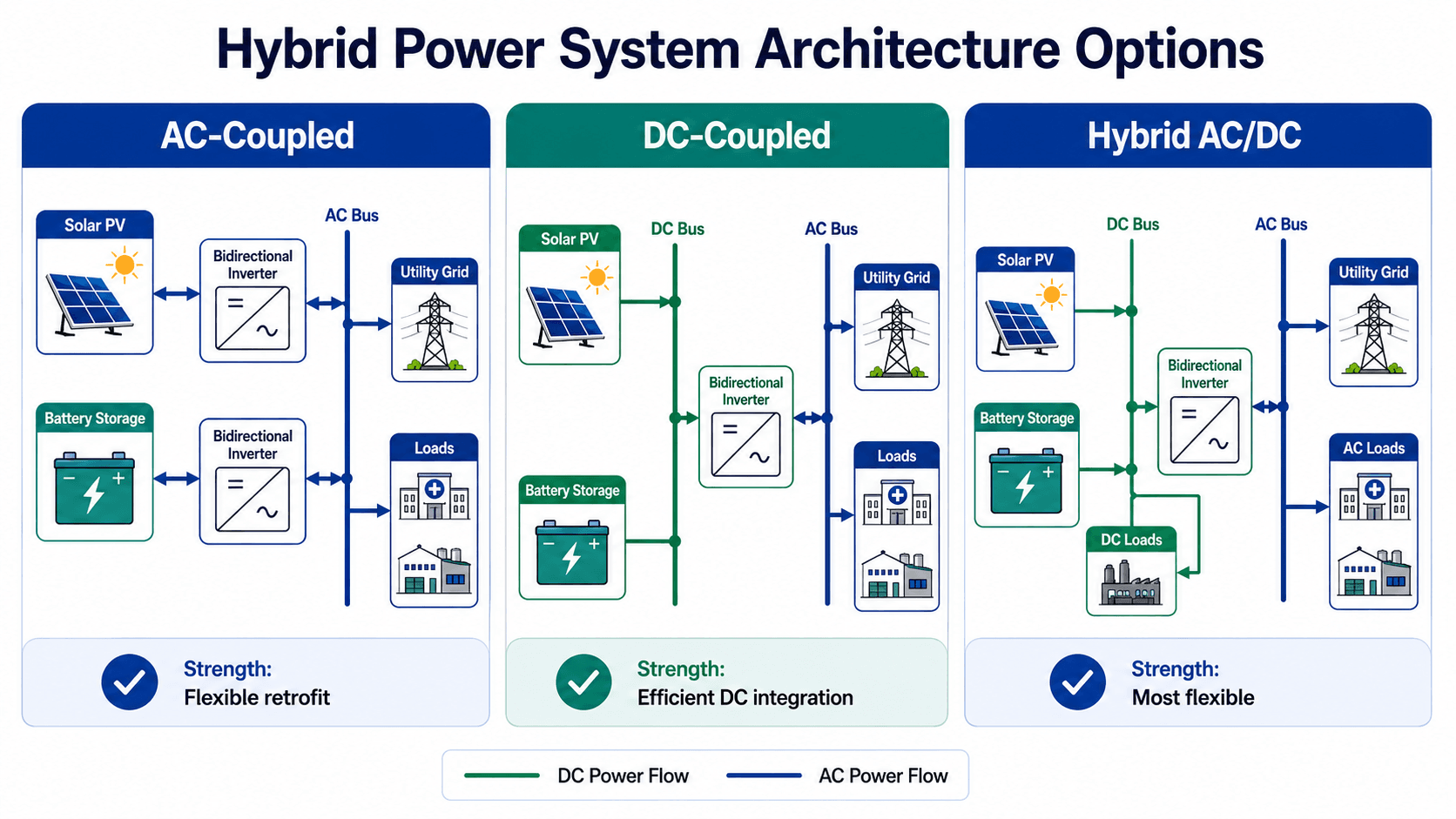
AC-coupled systems
AC-coupled systems connect sources and storage through inverters to a common AC bus. They are often practical when adding batteries to an existing PV system, generator-backed facility, or commercial electrical system because the existing AC distribution backbone can remain the main connection point.
DC-coupled systems
DC-coupled systems connect PV and battery storage on the DC side before conversion to AC. This can reduce conversion steps and improve renewable-plus-storage integration, but the design must handle DC voltage windows, converter limits, fault isolation, and controls carefully.
Hybrid AC/DC systems
Hybrid AC/DC systems use both AC and DC buses. They can support AC loads, DC loads, renewable generation, batteries, and grid connection, but they also require more detailed controls, protection coordination, and maintenance procedures.
Hybrid Power System Design Workflow
A strong hybrid power system design follows a load-first workflow. Engineers define what must be powered, how long it must remain powered, which resources are available, how storage and backup generation will operate, and what controls and protection must be verified.
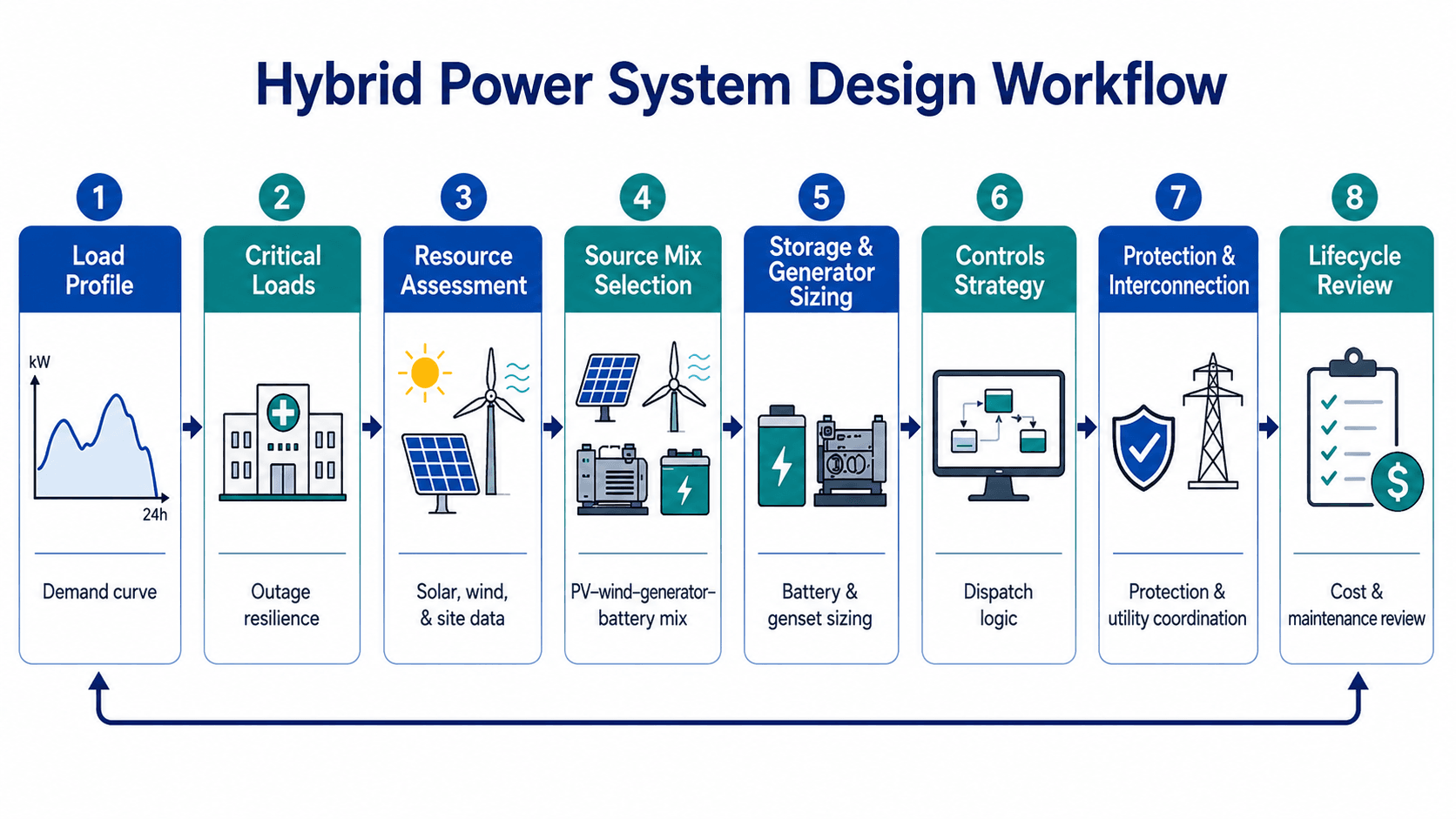
Start with the load profile
Annual kWh is not enough. Engineers need the peak kW, daily kWh, short-duration surges, nighttime load, seasonal variation, and critical-load priority. A hybrid system that balances annual energy can still fail during a cloudy evening peak, generator outage, or extended low-renewable period.
Separate critical loads from general loads
Hospitals, water systems, telecom sites, industrial controls, data centers, and emergency systems often have loads that must remain energized when noncritical loads can be shed. Critical-load separation can reduce the required battery and generator size while improving resilience.
Review controls before assuming savings
Fuel savings, battery life, renewable utilization, and outage performance depend on dispatch settings. A system that starts the generator too often may waste fuel; a system that discharges batteries too deeply may shorten battery life; a system that reserves too little energy may fail during an outage.
Where Hybrid Power Systems Are Used
Hybrid power systems are used wherever a single power source is not reliable, economical, resilient, or clean enough for the operating objective. The same basic concept can apply to small remote systems, commercial facilities, industrial sites, utility-connected resources, and microgrid-style local networks.
| Application | Why hybrid power helps | Main design priority |
|---|---|---|
| Remote communities | Solar, wind, and batteries can reduce diesel runtime while keeping firm backup generation available. | Fuel logistics, winter resource data, generator reliability, and maintainable controls. |
| Critical facilities | Batteries and generators can support essential loads when the utility grid is unavailable. | Critical-load separation, transfer scheme, outage duration, and commissioning tests. |
| Telecom and communications sites | Storage and renewable generation reduce generator starts and support uptime at isolated locations. | Battery autonomy, enclosure temperature, maintenance access, and alarm communications. |
| Industrial and mining sites | Hybrid generation can serve high loads where grid supply is weak, expensive, or unavailable. | Load steps, motor starts, generator coordination, and rugged maintenance planning. |
| Commercial buildings | Grid, PV, and battery storage can support demand management, backup power, and self-consumption. | Utility tariff logic, export limits, inverter rating, and backup-load panel design. |
| Utility-scale hybrid plants | Wind, solar, and storage can share interconnection infrastructure and improve output flexibility. | Interconnection studies, dispatch limits, power plant controls, and grid support requirements. |
What Controls Hybrid Power System Performance?
Hybrid system performance is controlled by both the physical equipment and the operating logic. Two systems with similar PV arrays, batteries, and generators can perform very differently if the load profile, battery reserve, generator dispatch, interconnection rules, or inverter controls are different.
| Control factor | Why it matters | Engineering implication |
|---|---|---|
| Peak demand | Determines the maximum instantaneous power the system must supply. | Drives inverter rating, generator rating, transformer size, and overload strategy. |
| Daily and seasonal energy use | Shows how much energy must be produced or stored over time. | Controls PV size, wind contribution, battery capacity, and fuel consumption estimates. |
| Renewable penetration | Indicates how much of the load is served by renewable resources over a defined period. | Higher penetration may reduce fuel use but usually increases controls, storage, curtailment, and stability challenges. |
| Battery state-of-charge window | Defines how much of the battery is actually usable while preserving reserve and limiting degradation. | Nameplate kWh should not be treated as fully usable backup energy. |
| Round-trip efficiency | Battery charging and discharging lose energy through power electronics and internal losses. | Stored energy should be derated when estimating how much load can be served later. |
| Generator operating window | Generators have practical minimum and maximum loading ranges. | Light loading, frequent cycling, and poor dispatch can increase maintenance and reduce reliability. |
| Grid-forming vs grid-following inverter behavior | Islanded systems need a stable voltage and frequency reference. | Grid-following inverters usually need an external reference, while grid-forming controls can help establish one. |
| Protection coordination | Fault current can change between grid-connected, generator-supported, and inverter-supported modes. | Relays, breakers, fuses, and switchgear must be checked for each credible operating mode. |
Simple Energy Balance and First-Pass Sizing Logic
Detailed hybrid power system design usually requires time-series modeling, but the first-pass logic starts with energy balance. Over a defined period, the load must be served by renewable generation, battery discharge, generator output, and grid imports after accounting for conversion losses and required reserves.
This is a boundary check, not a final design method. \(E_{battery}\) should represent usable discharge energy, not nameplate battery capacity. Usable storage depends on reserve state of charge, depth-of-discharge limits, degradation allowance, temperature, inverter limits, and round-trip efficiency.
- \(E_{load}\) Electrical energy required by the load, usually in kWh or MWh over a defined operating period.
- \(E_{battery}\) Usable battery discharge energy after reserve, depth-of-discharge, efficiency, and temperature limits.
- \(E_{losses}\) Losses from inverters, transformers, wiring, battery charge/discharge, controls, and auxiliary loads.
First-pass sizing questions
- What is the maximum load in kW, including motor starts or short-duration surges?
- What is the daily energy use in kWh/day during typical and worst-case seasons?
- Which loads are critical, and which loads can be shed during outages?
- How many hours or days of autonomy are required without the utility grid?
- What is the worst-month solar or wind resource, not just the annual average?
- What minimum battery state of charge must be reserved for resilience?
- What generator loading range is acceptable for reliability and maintenance?
- Will the system be grid-connected, islanded, or required to operate in both modes?
Energy balance does not prove that the system can support peak power, motor starts, fault conditions, voltage regulation, islanded frequency control, or protection coordination. Power, energy, and operating mode must be checked separately.
Hybrid Power System Configuration Decision Table
Use this decision table as a practical first-pass selection tool. It does not replace detailed modeling, but it connects the operating objective to the most likely architecture and the checks that deserve early engineering attention.
Start with the required operating mode. If the goal is outage resilience, separate critical loads first. If the goal is fuel reduction, review renewable resource quality and generator loading. If the goal is grid support, review interconnection, export limits, and inverter control capability.
| Operating goal | Likely hybrid approach | What to check first | Why it matters |
|---|---|---|---|
| Reduce diesel fuel at a remote site | Solar PV + battery + diesel generator | Generator minimum load, worst-month solar production, battery reserve, and fuel delivery interval. | The system may save fuel on average but still fail during long cloudy periods if backup runtime is underestimated. |
| Improve resilience for a grid-connected facility | Grid + battery + solar PV with critical-load separation | Islanded operation capability, transfer scheme, inverter mode, and backup panel configuration. | Many grid-tied PV systems shut down during outages unless designed with backup-capable controls and protection. |
| Support a renewable-heavy off-grid community | Solar + wind + battery + generator microgrid-style system | Seasonal resource diversity, spinning reserve, generator dispatch, and operator maintenance capacity. | Higher renewable penetration can reduce fuel use but increases controls, stability, and maintenance complexity. |
| Reduce peak demand charges | Grid + battery storage, often with solar PV | Utility tariff, peak window, battery power rating, and dispatch forecasting logic. | The battery must discharge at the right time, not merely store energy. |
| Integrate PV and storage efficiently | DC-coupled PV + battery with AC output | DC voltage range, converter limits, clipping recovery, DC protection, and controller settings. | DC coupling can improve integration but changes fault behavior, curtailment strategy, and maintenance procedures. |
| Serve mixed AC and DC loads | Hybrid AC/DC architecture | Load type, bus voltage, conversion losses, protection zones, and maintenance skill level. | Flexibility improves, but the system becomes harder to protect, operate, and troubleshoot. |
Engineering Judgment and Field Reality
In the field, hybrid power systems are judged by uptime, maintainability, operating cost, and how well they respond to non-ideal conditions. A design that looks strong in a one-line diagram can disappoint if sensors fail, diesel fuel delivery is unreliable, batteries operate outside their preferred temperature range, or operators do not understand the control sequence.
Experienced engineers pay close attention to interfaces: inverter-to-generator coordination, controller-to-switchgear communication, grid reconnection logic, load-shed priority, battery reserve thresholds, and the difference between grid-connected and islanded fault behavior.
| Commissioning check | What to verify | Why it matters |
|---|---|---|
| Generator start test | Generator starts automatically at the intended load or battery state-of-charge threshold. | Confirms backup power is available before batteries are depleted. |
| Load step test | System voltage and frequency remain acceptable when loads change quickly. | Reveals inverter, generator, and controls response problems. |
| Islanded operation test | Critical loads remain supported when grid power is unavailable, if islanding is part of the design. | Proves the system can actually deliver the resilience claimed in the design. |
| Low-SOC response test | Controller starts backup generation or sheds loads at the correct battery reserve level. | Prevents battery over-discharge and preserves outage reserve. |
| Grid reconnection test | System resynchronizes and reconnects without unsafe transitions or nuisance trips. | Reduces operational risk after outages or islanded operation. |
| Communications failure test | Equipment moves to a safe fallback mode if a controller, meter, or network signal fails. | Prevents hidden single points of failure in the control system. |
The best hybrid system is not always the most complex one. A remote site with limited maintenance support may need conservative controls and fewer operating modes, while a campus or utility-scale project may justify more advanced optimization and automation.
When This Breaks Down
Simplified hybrid power system explanations break down when they treat the system as a clean source mix instead of a dynamic electrical system. Real systems must handle transients, startup loads, faults, weather variability, communications delays, maintenance outages, and protection behavior across multiple operating modes.
- Average energy hides peak power: A system can meet daily kWh on paper but still fail when a motor starts or a facility reaches peak demand.
- Renewable averages hide outage risk: Monthly solar or wind averages do not capture multi-day low-resource events that control battery and generator requirements.
- Grid-tied does not mean backup capable: Solar and battery systems may not serve loads during an outage unless designed with transfer, islanding, protection, and control capability.
- Generator backup is not unlimited resilience: Fuel delivery, minimum loading, emissions limits, starting reliability, and maintenance can all limit runtime.
- Protection assumptions change by mode: Fault current from the utility grid, a generator, and inverter-based resources may be very different.
Common Mistakes and Practical Checks
Most hybrid power system mistakes come from oversimplifying the load, assuming ideal renewable production, ignoring control behavior, or treating storage as a perfect backup source. The following checks help catch weak assumptions before the system is built.
- Using annual kWh as the main sizing basis: Annual energy does not show peak demand, outage duration, or critical-load priority.
- Oversizing PV without a curtailment strategy: Excess renewable production may be wasted if the battery is full, export is limited, or the load is low.
- Ignoring usable battery capacity: Nameplate capacity is not the same as usable capacity after reserve, degradation, depth-of-discharge, and temperature limits.
- Letting the generator run lightly loaded: Diesel generators can experience poor efficiency and maintenance issues when operated below practical loading ranges for long periods.
- Skipping protection coordination review: Fault current and trip behavior can change between grid-connected, generator-supported, and inverter-supported operation.
- Assuming the controller will solve everything: Controls need verified settings, fallback modes, tested communications, and commissioning under realistic scenarios.
The most common mistake is designing around preferred equipment instead of a verified operating objective. Define the load profile, critical-load requirement, resilience target, and operating modes before choosing the source mix.
Engineering References and Design Guidance
Hybrid power system design often overlaps with distributed generation, storage, microgrids, interconnection, and resilience planning. A strong technical reference helps engineers understand how source combinations affect critical-load support, reserve capacity, and outage performance.
- National Renewable Energy Laboratory: NREL hybrid power plant resilience case study reviews how hybrid power plants can support distribution grid resilience, including critical-load service, reserve capacity, and renewable resource contribution during outages.
- Project-specific criteria: Final requirements may be controlled by utility interconnection rules, owner resilience goals, adopted electrical codes, generator emissions limits, equipment listings, and site operating procedures.
- Engineering use: Engineers use references like this to frame resilience objectives, operating modes, hybrid resource value, and the difference between a simple source mix and a coordinated power system.
Frequently Asked Questions
A hybrid power system is an electrical system that combines two or more power sources or storage technologies to serve a load. Common examples include solar plus battery storage, solar plus diesel generation, wind plus solar plus batteries, and grid-connected systems that use on-site generation and storage for resilience.
A hybrid power system describes the mix of power sources and storage, while a microgrid describes a controllable local electrical network that can often operate connected to or disconnected from the main grid. A microgrid may use a hybrid power system, but not every hybrid power system is designed for islanded operation.
Batteries store surplus energy, reduce generator runtime, smooth renewable output, support peak loads, and provide reserve capacity during outages. Their useful role depends on usable energy capacity, power rating, state-of-charge limits, round-trip efficiency, temperature, cycle life, and the control strategy.
No. Many hybrid systems include renewable sources such as solar or wind, but hybrid simply means the system combines multiple power sources or storage technologies. A hybrid system may include utility grid power, diesel generators, natural gas generators, batteries, fuel cells, solar PV, wind turbines, hydro, or other resources.
The difficult part is coordinating the whole system, not just choosing equipment. Engineers must verify load profiles, renewable resource data, inverter ratings, battery reserve, generator minimum loading, protection coordination, grid interconnection rules, controls logic, commissioning tests, maintenance access, and lifecycle cost assumptions.
Summary and Next Steps
Hybrid power systems combine multiple generation, storage, and grid resources into one coordinated electrical system. The value comes from matching the source mix to the load, resilience target, site resources, operating modes, and maintenance reality.
The most important design checks are load profile, critical-load separation, usable battery capacity, generator operating range, inverter control mode, protection coordination, grid interconnection, and commissioning under realistic scenarios.
Where to go next
Continue your learning path with related Turn2Engineering power systems resources.
-
Distributed Generation Systems
Learn how smaller generation resources connect near loads and support the broader distributed energy resource concept.
-
Power Generation
Review how different sources produce electrical energy before they are integrated into a hybrid system.
-
Switchgear
Understand the switching, isolation, and protection equipment that supports safe multi-source power systems.