
Key Takeaways
- Core idea: Stormwater management controls runoff volume, peak flow, drainage paths, erosion risk, and pollutant movement after rainfall.
- Engineering use: Engineers use it to design storm drains, swales, culverts, detention basins, retention ponds, stormwater BMPs, and site drainage systems.
- What controls it: Rainfall intensity, watershed area, soil type, slope, impervious cover, storage, tailwater, and maintenance condition drive performance.
- Practical check: A system that handles peak flow but ignores water quality, clogging, downstream erosion, or long-term maintenance is not a complete stormwater solution.
Table of Contents
Introduction
Stormwater management is the engineering practice of controlling rainfall runoff so developed sites do not create flooding, erosion, drainage failure, or water quality problems. It combines hydrology, hydraulics, site grading, conveyance, storage, infiltration, and treatment practices to manage how runoff is collected, slowed, filtered, reused, or safely released downstream.
How Stormwater Management Works
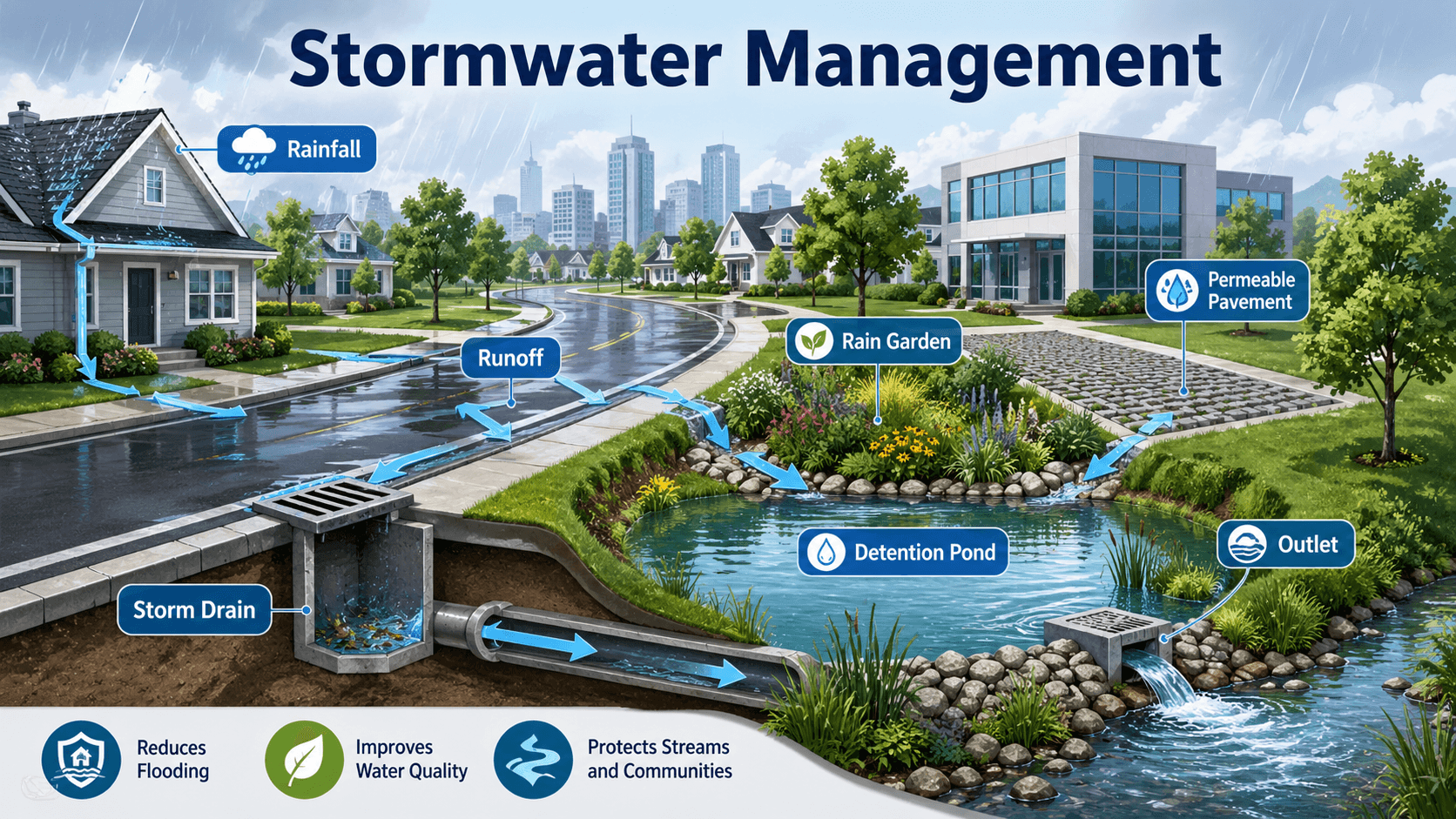
Start by following the rainfall after it lands on roofs, pavement, landscaped areas, and open ground. The important engineering question is not only where the water goes, but how quickly it gets there, how much is stored, how much infiltrates, and what pollutants are carried along the way.
What is Stormwater Management?
Stormwater management is the planning, design, operation, and maintenance of systems that handle runoff from rain and snowmelt. In natural watersheds, a portion of rainfall infiltrates into soil, is intercepted by vegetation, evaporates, or moves slowly toward streams. In developed areas, impervious surfaces such as roofs, streets, parking lots, sidewalks, and compacted soils reduce infiltration and speed up runoff.
For a water resources engineer, stormwater management is a balance between runoff quantity and runoff quality. Quantity focuses on peak discharge, runoff volume, flooding, drainage capacity, and downstream channel stability. Quality focuses on sediment, nutrients, metals, hydrocarbons, trash, temperature, and other pollutants that wash off developed surfaces during storms.
A stormwater system is not just a pipe network. It is a connected watershed response system made of land cover, grading, inlets, pipes, open channels, storage, infiltration, overflow paths, and maintenance access.
How Stormwater Moves Through a Site
Stormwater design begins with the rainfall-to-runoff process. A storm delivers rainfall over a drainage area. Some water is intercepted, some infiltrates, some is stored in surface depressions, and the remainder becomes runoff. The runoff then travels overland, enters inlets or swales, moves through pipes or channels, reaches storage or treatment features, and eventually discharges to a receiving system.
Runoff generation
Runoff generation depends heavily on soil condition, land cover, antecedent moisture, slope, rainfall intensity, and impervious area. A compacted clay parking lot can produce runoff almost immediately, while a vegetated sandy area may absorb a meaningful portion of the same storm. This is why two sites with the same rainfall depth can create very different peak flows and runoff volumes.
Conveyance and timing
Conveyance controls how quickly runoff reaches the design point. Curbs, gutters, storm sewers, lined channels, and smooth pavement shorten travel time and can increase peak discharge. Rough swales, shallow sheet flow, floodplain storage, and distributed green infrastructure can slow the hydrograph and reduce the peak.
Storage and release
Detention and retention features change the timing and volume of runoff. Detention temporarily stores water and releases it through an outlet structure. Retention, infiltration, reuse, and evapotranspiration-based practices attempt to reduce the total runoff volume leaving the site. In practice, many stormwater systems use both strategies.
How Engineers Use Stormwater Management
Engineers use stormwater management to translate rainfall, land use, and watershed conditions into design decisions. The work may support a subdivision, roadway, solar site, industrial facility, commercial development, campus, park, or municipal drainage improvement. The goal is to provide a drainage system that performs during frequent storms and has safe overflow behavior during larger events.
- Site drainage design: grading, inlets, storm sewers, swales, culverts, and overflow paths that prevent nuisance flooding and protect structures.
- Peak flow control: detention basins, outlet structures, and routing calculations that reduce downstream peak discharge.
- Water quality treatment: sediment forebays, bioretention, filtration, wet ponds, wetlands, and treatment trains that reduce pollutant loading.
- Erosion and channel protection: energy dissipation, stable outlets, riprap, vegetation, and flow-duration control that reduce downstream scour.
- Resilience planning: major overflow routes, emergency spillways, climate-adjusted rainfall checks, and flood-sensitive site planning.
Always separate the minor system from the major system. The minor system handles routine drainage through inlets, pipes, and swales. The major system defines where water safely flows when the minor system is exceeded, clogged, or overwhelmed.
Explore Stormwater Management Topics
Stormwater management is easier to learn when the system is broken into clear pieces. The topics below act as the main learning path for this pillar page, moving from rainfall and runoff to drainage design, storm drain systems, culverts, storage, water quality, green infrastructure, urban systems, and flood risk.
If you are new to the subject, start with runoff and hydrology. If you are focused on design, move into drainage design, storm drain design, culvert design, Rational Method calculations, and runoff coefficients. If you are focused on water quality or resilience, review stormwater BMPs, rain gardens, retention ponds, and flood management.
| Stormwater topic | What you’ll learn | Where it fits |
|---|---|---|
| Stormwater Runoff | How rainfall becomes surface runoff and why development increases runoff volume, peak flow, and pollutant washoff. | Starting point for understanding why stormwater controls are needed. |
| Hydrology | How rainfall, infiltration, drainage area, watershed timing, and hydrographs describe runoff behavior. | Technical foundation for stormwater calculations. |
| Rational Method | How engineers estimate peak runoff using drainage area, rainfall intensity, and runoff coefficient. | Common small-site peak flow method. |
| Runoff Coefficient | How pavement, roofs, soil condition, slope, and land cover affect the fraction of rainfall that becomes runoff. | Key input for Rational Method calculations. |
| Stormwater Drainage Design | How engineers plan grading, inlets, swales, culverts, storm drains, outfalls, storage, and overflow paths. | Main engineering design process for developed sites. |
| Storm Drain Design | How runoff is collected and conveyed through inlets, pipes, manholes, junctions, hydraulic grade lines, and outfalls. | Closed-conduit drainage and conveyance design. |
| Culvert Design | How culverts are sized for road crossings, ditches, channels, and concentrated stormwater flow paths. | Hydraulic crossing design for roads, sites, and drainage channels. |
| Stormwater Retention Ponds | How permanent-pool ponds store runoff, support settling, improve water quality, and reduce downstream impacts. | Storage and treatment practice. |
| Detention Pond vs Retention Pond | The difference between temporary detention storage and permanent-pool retention storage. | Basin selection and storage comparison. |
| Stormwater BMPs | Best management practices for reducing sediment, pollutants, erosion, runoff volume, and downstream degradation. | Water quality and site-control strategy. |
| Rain Garden | How shallow planted depressions capture, filter, and infiltrate runoff from small drainage areas. | Small-scale green infrastructure practice. |
| Urban Stormwater Management | How cities manage runoff from streets, buildings, parking lots, storm sewers, green infrastructure, and receiving waters. | City-scale stormwater planning. |
| Flood Management | How drainage systems, storage, floodplains, conveyance improvements, and planning reduce flood risk. | Downstream resilience and flood-risk planning. |
What Controls Stormwater Design?
Stormwater design is controlled by both hydrologic and hydraulic factors. Hydrology estimates how much runoff is produced and when it arrives. Hydraulics checks whether the physical system can safely carry, store, release, or treat that runoff. Field conditions, maintenance, and downstream constraints often control the final design as much as the calculation method.
| Factor | Why it matters | Engineering implication |
|---|---|---|
| Rainfall intensity and duration | Short intense storms often control inlet, pipe, and peak flow design, while longer storms can control storage volume. | Select design storms and rainfall data that match the drainage objective being checked. |
| Impervious cover | Pavement and roofs reduce infiltration and increase runoff volume and peak discharge. | More impervious area usually requires more conveyance capacity, storage, treatment, or infiltration strategy. |
| Soil and infiltration capacity | Soil texture, compaction, groundwater depth, and antecedent moisture affect how much water can soak in. | Infiltration practices need field-tested rates, pretreatment, and separation from groundwater or limiting layers. |
| Slope and flow path length | Steeper and smoother paths move runoff faster, reducing time of concentration. | Faster response can increase peak flow and may require additional storage or energy dissipation. |
| Downstream tailwater | High water levels in receiving channels can reduce outlet capacity and back water into the site. | Outlet structures, pipes, and emergency spillways should be checked under downstream constraint conditions. |
| Maintenance condition | Sediment, trash, vegetation, and clogging can reduce treatment and conveyance capacity over time. | Designs should include access, pretreatment, cleanout points, and inspection-friendly layouts. |
Common Stormwater Methods and Equations
Stormwater calculations vary by project scale and review requirements. Small site conveyance checks often use the Rational Method. Larger watersheds and storage routing often use hydrograph methods, curve number runoff, unit hydrographs, or continuous simulation models. The method should match the problem being solved.
The Rational Method estimates peak runoff for small drainage areas where the rainfall intensity is assumed uniform over the watershed response time. The runoff coefficient represents how strongly the land surface converts rainfall into runoff. This method is useful for preliminary inlet, gutter, pipe, and small catchment checks, but it does not describe full runoff volume, storage routing, or long-duration hydrograph behavior.
- Q Peak discharge, commonly in cubic feet per second or cubic meters per second.
- C Runoff coefficient representing land cover, imperviousness, soil response, and drainage condition.
- i Rainfall intensity for the selected duration and return period, commonly in inches per hour or millimeters per hour.
- A Drainage area contributing to the design point, commonly in acres or hectares depending on the unit system.
When to use hydrograph methods
Hydrograph methods are more useful when detention storage, routing, flood volume, pond outlet control, or downstream timing matters. A hydrograph shows flow over time, so it can represent peak flow, runoff volume, time to peak, recession, and storage effects better than a single peak-flow equation.
When to use continuous simulation
Continuous simulation is useful when long-term water balance, water quality, green infrastructure performance, or volume control is important. Instead of testing only one design storm, the model simulates many storms, dry periods, soil moisture changes, infiltration recovery, and seasonal behavior.
Stormwater Design Review Checklist
A strong stormwater review checks the full drainage story: how runoff is created, how it moves, where it is stored, how it is treated, and what happens when the design event is exceeded. The checklist below helps catch issues that are easy to miss when a design focuses only on pipe sizing or pond volume.
Define the drainage area → choose rainfall criteria → estimate runoff volume and peak flow → lay out safe conveyance → provide storage and treatment → check outlet and tailwater conditions → verify overflow paths → confirm maintenance access.
| Check or decision | What to look for | Why it matters |
|---|---|---|
| Drainage area mapping | Confirm divides, bypass flow, off-site run-on, roof leaders, sump discharge, and low points. | A small mapping error can send runoff to the wrong inlet, basin, or downstream property. |
| Minor system capacity | Check inlet spacing, gutter spread, pipe slope, hydraulic grade line, and junction losses. | The system may fail even when the basin is sized correctly if runoff cannot reach it safely. |
| Major overflow route | Identify where water flows when inlets clog, pipes surcharge, or rainfall exceeds the design event. | Safe overflow routing protects buildings, roads, embankments, and adjacent properties. |
| Storage routing | Review stage-storage, stage-discharge, outlet controls, emergency spillway, and drawdown time. | Peak flow control depends on how storage and outlet capacity interact over time. |
| Water quality pretreatment | Look for sediment forebays, sumps, vegetated pretreatment, or upstream capture of coarse material. | Many green infrastructure practices fail early when sediment loads clog the treatment surface. |
| Maintenance access | Confirm access routes, cleanout points, forebay access, safe slopes, and inspection visibility. | A stormwater feature that cannot be maintained will lose hydraulic and treatment performance over time. |
Example: Why Peak Flow and Volume Are Different
Consider a small commercial site that is converted from grass and compacted gravel to buildings, pavement, sidewalks, and landscaped islands. After development, rainfall reaches storm drains more quickly, and less water infiltrates into the soil. The peak discharge increases because runoff arrives faster, and the runoff volume increases because more of the rainfall becomes surface flow.
Design interpretation
A detention basin can reduce the post-development peak discharge by temporarily storing water and releasing it through an outlet. However, detention alone may not reduce the total runoff volume. If the receiving stream is sensitive to erosion, the engineer may also need volume reduction, infiltration, extended detention, or distributed green infrastructure to reduce flow duration and runoff energy.
Water quality interpretation
The same development can increase pollutant washoff from pavement, vehicles, exposed soil, and landscaped areas. A water quality strategy may use pretreatment, filtration, settling, vegetation, and infiltration to capture sediment and reduce pollutant loads before discharge. Good stormwater management often uses a treatment train instead of relying on one practice to solve every problem.
Engineering Judgment and Field Reality
Real stormwater systems rarely behave exactly like a clean model. Inlets clog with leaves, sediment fills forebays, outlet orifices block with debris, underdrains lose capacity, vegetation changes roughness, and downstream channels create tailwater conditions that were not obvious during desktop design. Field judgment means checking whether the assumed flow path is still the flow path that water will actually take.
The most important field insight is that stormwater follows low points, not design intent. If grading creates an unintended sag, if curb cuts are too high, if a swale has construction sediment, or if a berm blocks sheet flow, runoff may bypass the planned treatment feature entirely. Small elevation differences can control whether a stormwater practice receives water or sits dry.
A good stormwater inspection starts during a rain event when possible. Flow patterns, ponding, bypass, erosion, and clogged structures are easier to diagnose when the system is actually being loaded.
When This Breaks Down
Stormwater assumptions break down when the selected method, design storm, maintenance condition, or site representation no longer matches reality. A calculation may be mathematically correct and still produce a poor design if it ignores routing, downstream constraints, water quality, long-term clogging, or extreme overflow behavior.
- Peak-flow-only thinking: A design can meet a peak discharge target while still increasing runoff volume, flow duration, and downstream erosion.
- Unverified infiltration rates: Infiltration practices can fail when design rates are based on soil maps instead of field testing and seasonal groundwater checks.
- Ignored tailwater: A pond outlet or pipe may not discharge as expected when the downstream channel, ditch, or storm sewer is already high.
- Clogging and sediment loading: Pretreatment is critical where sediment, leaves, trash, or construction debris can block inlets, media, or underdrains.
- No emergency overflow path: A system that has no safe route for exceedance storms can shift flood risk to buildings, roads, embankments, or neighboring properties.
Common Mistakes and Practical Checks
Stormwater mistakes often come from treating drainage as a single calculation rather than a connected site system. A strong design checks hydrology, hydraulics, grading, water quality, constructability, long-term operation, and downstream behavior together.
- Using one design storm for every question: inlet spread, pipe capacity, pond routing, water quality capture, and emergency overflow may require different checks.
- Forgetting off-site run-on: water entering the site from upstream areas can overwhelm a design that only accounts for on-site runoff.
- Oversizing pipes without controlling release: faster conveyance can transfer flooding or erosion problems downstream.
- Ignoring construction-phase sediment: new stormwater practices can be damaged before final stabilization if sediment controls fail.
- Designing green infrastructure without maintenance: bioretention, permeable pavement, and infiltration features need pretreatment and routine inspection to keep working.
Do not assume that reducing peak discharge automatically solves stormwater impacts. Runoff volume, pollutant loading, flow duration, downstream channel condition, and overflow routing may still control the project.
Useful Stormwater Manuals and Design References
Stormwater design is often governed by local criteria, but several widely used references help engineers understand hydrology, hydraulics, modeling, and best management practices. Use the references below as starting points for deeper technical study, then always check the governing local stormwater manual for project-specific requirements.
- EPA Storm Water Management Model: The EPA Storm Water Management Model is a widely used resource for planning, analysis, and design related to stormwater runoff, drainage systems, and urban hydrology.
- FHWA HEC-22 Urban Drainage Design Manual: The FHWA HEC-22 Urban Drainage Design Manual provides practical guidance for storm drainage systems associated with transportation facilities, including collection, conveyance, and discharge of stormwater.
- NRCS TR-55 and curve number methods: Frequently used for small watershed runoff estimates, time of concentration, runoff depth, and hydrograph development.
- State and local stormwater manuals: Often define design storms, water quality volume, detention criteria, allowable release rates, maintenance requirements, and accepted practices.
Frequently Asked Questions
The main purpose of stormwater management is to control where runoff goes, how fast it moves, how much water leaves a site, and what pollutants it carries. A good system reduces flooding, protects downstream channels, limits erosion, improves water quality, and helps developed areas behave more like the natural watershed.
Detention temporarily stores runoff and releases it at a controlled rate, usually to reduce peak discharge. Retention keeps water on site for a longer period through infiltration, evaporation, reuse, or permanent pool storage, which can reduce runoff volume and improve water quality when designed correctly.
Impervious cover such as pavement, roofs, and compacted surfaces reduces infiltration and shortens the time it takes rainfall to become runoff. That usually increases peak flow, total runoff volume, pollutant washoff, and downstream erosion risk unless stormwater controls provide storage, infiltration, filtration, or controlled release.
Common stormwater management practices include storm sewers, swales, culverts, detention basins, retention ponds, bioretention areas, rain gardens, permeable pavement, infiltration trenches, constructed wetlands, green roofs, and treatment trains that combine several practices to manage both runoff quantity and quality.
Summary and Next Steps
Stormwater management is the engineering practice of controlling runoff from developed land so rainfall does not become a flooding, erosion, drainage, or water quality problem. It connects hydrology, hydraulics, grading, storage, infiltration, treatment, and maintenance into one site-scale and watershed-scale strategy.
The most important design checks are runoff generation, conveyance capacity, storage routing, outlet control, downstream tailwater, water quality treatment, emergency overflow, and long-term maintenance. A strong stormwater design does not just move water away quickly; it manages timing, volume, pollutants, and downstream impacts.
Use the topic guide above to move deeper into the specific part of stormwater engineering you are trying to understand, whether that is runoff generation, drainage design, peak flow calculations, culvert hydraulics, stormwater storage, BMP selection, urban systems, or flood risk.