
Key Takeaways
- Core idea: High rise buildings are tall multi-story structures where height changes the importance of lateral loads, vertical transportation, fire safety, foundations, and serviceability.
- Engineering use: Structural engineers design high rises as complete load-resisting systems, not as isolated beams, columns, walls, slabs, or foundations.
- What controls it: Wind, seismic demand, slenderness, floor plan, stiffness, foundation behavior, construction sequence, column shortening, and occupant comfort often control the design.
- Practical check: A high rise can be strong enough but still perform poorly if drift, acceleration, façade movement, elevator coordination, vibration, or settlement is not controlled.
Table of Contents
Introduction
High rise buildings are tall multi-story buildings where vertical transportation, fire/life safety systems, lateral load resistance, foundations, drift control, and service coordination become major design requirements.
High rise buildings are not just taller versions of low-rise buildings. As height increases, the structure becomes more sensitive to wind, seismic response, lateral drift, acceleration, overturning, column shortening, foundation settlement, façade movement, elevator tolerance, construction sequence, and the way loads move through the entire building system.
This page explains the structural engineering concepts behind high rise buildings. Actual building design must follow the adopted building code, project-specific loads, geotechnical recommendations, fire/life safety requirements, and the authority having jurisdiction.
Quick Answers About High Rise Buildings
These short answers summarize the main ideas before the article explains each topic in more detail.
| Question | Short answer |
|---|---|
| What is a high rise building? | A high rise building is a tall multi-story building where elevators, fire protection, lateral load resistance, vertical services, and serviceability become major design requirements. |
| How do high rise buildings stay standing? | They use a continuous load path that carries gravity loads downward and transfers wind or seismic forces into cores, frames, shear walls, outriggers, foundations, and the ground. |
| What is the main structural challenge? | The main challenge is usually not only strength. Engineers must also control drift, acceleration, overturning, torsion, settlement, shortening, façade movement, and constructability. |
| What systems are commonly used? | Common systems include shear wall cores, braced frames, moment frames, tube systems, diagrids, composite systems, and core-and-outrigger systems. |
Visual Guide to High Rise Building Behavior
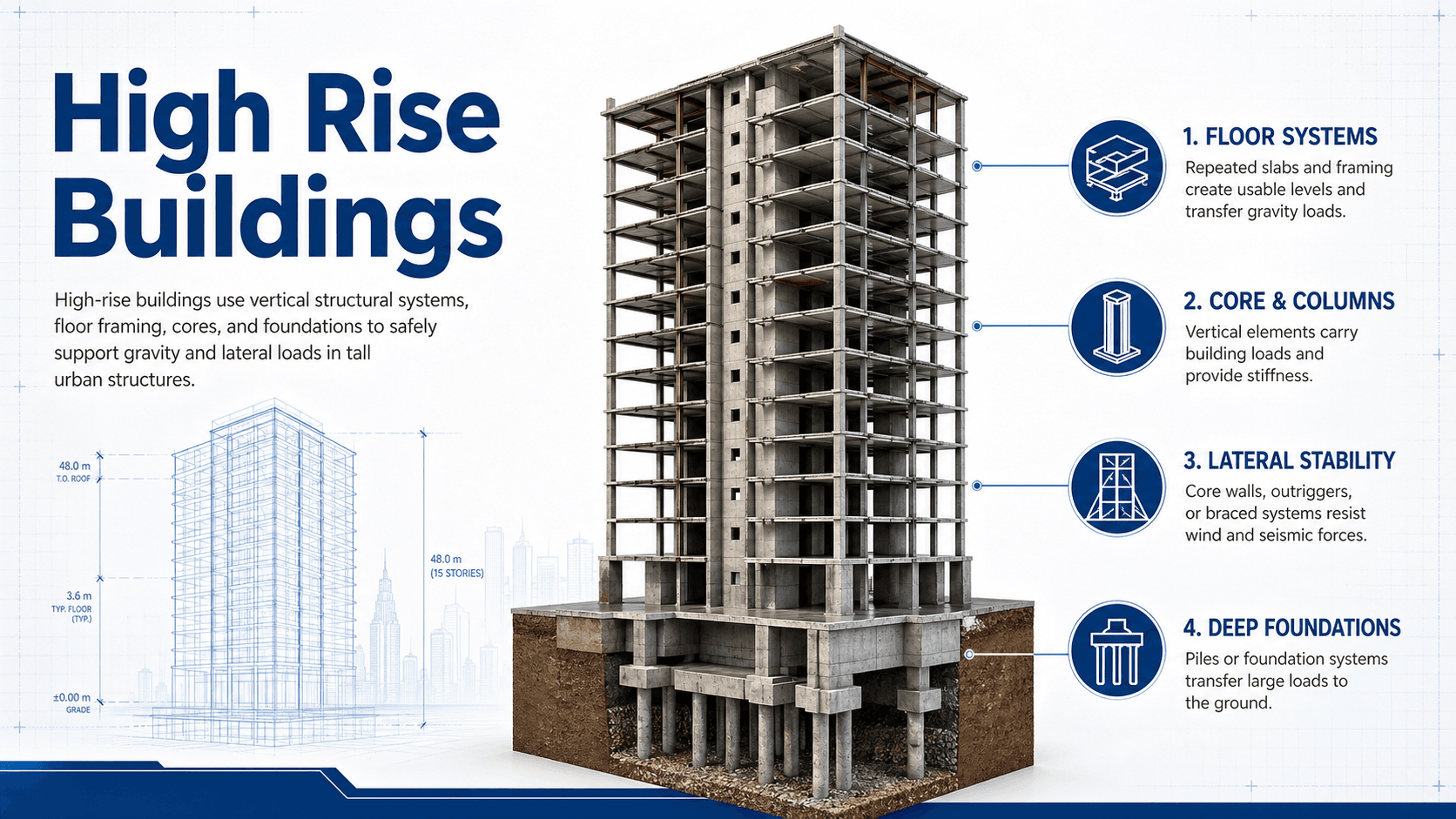
Start by noticing the vertical core, floor framing, perimeter columns, lateral-resisting system, and foundation support. In a tall building, these elements do not act independently; each decision affects stiffness, rentable area, construction sequence, safety, and long-term performance.
What Are High Rise Buildings?
A high rise building is a tall building where normal low-rise design assumptions no longer tell the full story. The building height makes elevators essential, increases fire and evacuation complexity, amplifies wind effects, and requires a deliberate lateral force-resisting system. Some definitions use a story count or height threshold, while others focus on whether the building requires mechanical vertical transportation and high-rise life safety provisions.
From a structural engineering standpoint, the exact label matters less than the behavior. A 12-story building, a 35-story residential tower, and a 70-story mixed-use tower all carry gravity loads, but they do not respond to lateral loads in the same way. As buildings get taller and more slender, the structure starts acting more like a vertical cantilever fixed at the foundation. That is why stiffness, drift, acceleration, foundation settlement, and façade movement become central design concerns.
| Term | Common meaning | Engineering significance |
|---|---|---|
| Low-rise building | Few stories, often controlled by gravity loads and simple lateral systems. | Member strength and local load paths often dominate. |
| Mid-rise building | Intermediate height where elevators and lateral design become more important. | Wind, seismic drift, and fire/life safety coordination become more visible. |
| High rise building | Tall multi-story building requiring vertical transportation and specialized systems. | Lateral stiffness, foundation performance, MEP routing, and safety systems strongly influence design. |
| Skyscraper | A very tall or skyline-defining high rise. | Advanced systems such as outriggers, tube action, damping, and wind studies may be needed. |
| Supertall building | A very tall tower often discussed in tall-building classification systems. | Wind engineering, vertical transportation, damping, foundation interaction, and construction logistics become major drivers. |
The important question is not only whether a building is called a high rise or skyscraper. The important question is whether the building height, slenderness, occupancy, site hazards, structural system, and foundation conditions require special attention to lateral behavior and serviceability.
How Loads Move Through a High Rise Building
The most important concept in high rise design is load path analysis. Gravity loads from people, furniture, partitions, floor finishes, equipment, slabs, beams, and walls must move down through columns, core walls, transfer elements, foundations, and finally into soil or rock. Lateral loads from wind and earthquakes must move horizontally through diaphragms and vertically through the lateral system to the foundation.
Gravity Load Path
Gravity load usually starts at the floor system. A concrete slab, composite deck, or beam-and-slab system collects floor loads and transfers them to beams, girders, walls, or columns. Those vertical elements stack load floor by floor, so lower columns and core walls carry much larger cumulative forces than the same elements near the roof.
Lateral Load Path
Wind and seismic loads enter through the façade, floor diaphragms, cladding connections, mass distribution, and structural frame. Floor diaphragms distribute these forces into shear walls, braced frames, moment frames, cores, outriggers, or perimeter systems. The foundation then resists base shear, overturning moment, compression, uplift, sliding, and settlement demands.
If the gravity system and lateral system are described separately, confirm how they connect. The floor diaphragm, collector elements, transfer levels, core openings, and foundation tie-down details are often where simplified diagrams hide the real engineering work.
High Rise Building Load Path Diagram
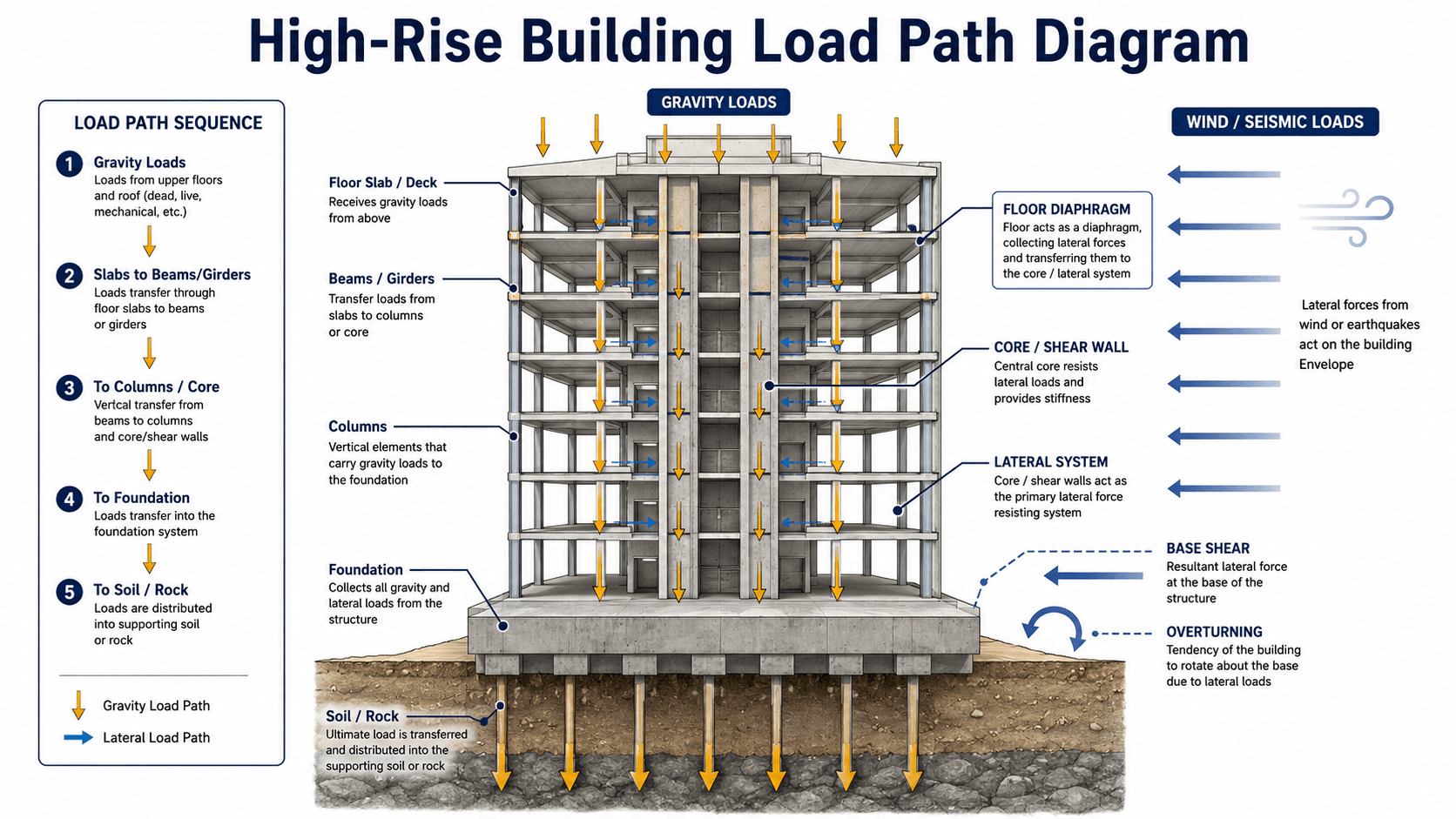
This diagram is useful because it shows that a high rise is not designed one member at a time. The roof, floor slabs, beams, girders, columns, core walls, diaphragms, transfer elements, mat foundation, piles, and soil or rock support all participate in the load path. A weak or discontinuous link can change how forces move through the building.
| Load type | Typical source | Primary path through the building | Key design concern |
|---|---|---|---|
| Gravity loads | Dead load, live load, partitions, equipment, and floor finishes. | Slab or deck → beams/girders → columns/core walls → foundation → soil or rock. | Column load accumulation, foundation pressure, transfer floors, settlement, and differential shortening. |
| Wind loads | Pressure and suction on the building envelope. | Cladding → floor diaphragms → lateral system → foundation. | Drift, acceleration, cladding movement, torsion, overturning, and occupant comfort. |
| Seismic loads | Ground motion acting on building mass. | Mass/floors → diaphragms → seismic force-resisting system → foundation. | Ductility, detailing, interstory drift, torsion, redundancy, and energy dissipation. |
| Overturning effects | Lateral loading acting over the building height. | Core, frames, outriggers, perimeter columns, and foundation system. | Compression, uplift, sliding, pile tension, mat behavior, and foundation stiffness. |
Structural Systems Used in High Rise Buildings
High rise buildings use structural systems that balance strength, stiffness, open floor area, construction speed, material efficiency, and architectural goals. A short, stocky building may work with a conventional frame and shear walls, while a tall slender tower may need a stiff core, perimeter columns, belt trusses, outriggers, or damping systems to control movement.
System selection is closely related to structural analysis, structural loads, concrete design, steel design, and foundation design. A system that looks efficient in elevation may still fail as a project solution if it creates unusable floor space, complex transfers, difficult construction sequencing, or façade coordination problems.
| System | Best use | Main advantage | Common limitation |
|---|---|---|---|
| Shear wall core | Residential, hotel, and mixed-use towers with repeated floor plates. | Efficient stiffness around elevators, stairs, and service shafts. | Core openings and irregular layouts can reduce efficiency. |
| Moment frame | Buildings needing open plans and fewer diagonal braces. | Architectural flexibility and ductile frame behavior. | Can become drift-controlled as height increases. |
| Braced frame | Steel buildings where diagonal members can be integrated into the layout. | Efficient lateral strength and stiffness. | Braces can conflict with windows, doors, corridors, or façade rhythm. |
| Tube system | Very tall buildings using closely spaced perimeter columns. | Turns the exterior frame into a stiff vertical tube. | Perimeter spacing and façade coordination become design drivers. |
| Core and outrigger | Tall slender towers needing reduced drift and overturning demand. | Uses perimeter columns to help the central core resist overturning. | Requires careful mechanical-floor, transfer, and construction coordination. |
| Diagrid or exoskeleton | Architecturally expressive towers with efficient exterior triangulation. | High stiffness with visible structural expression. | Complex joints, fabrication tolerances, and façade interfaces. |
Why Lateral Stiffness Often Controls
In many tall buildings, the members are not sized only because they might fail in strength. They are often sized because the building would otherwise move too much. Excessive lateral drift can damage cladding, crack partitions, affect elevator rails, stress MEP connections, and make occupants uncomfortable during wind events.
High Rise Structural Systems Comparison
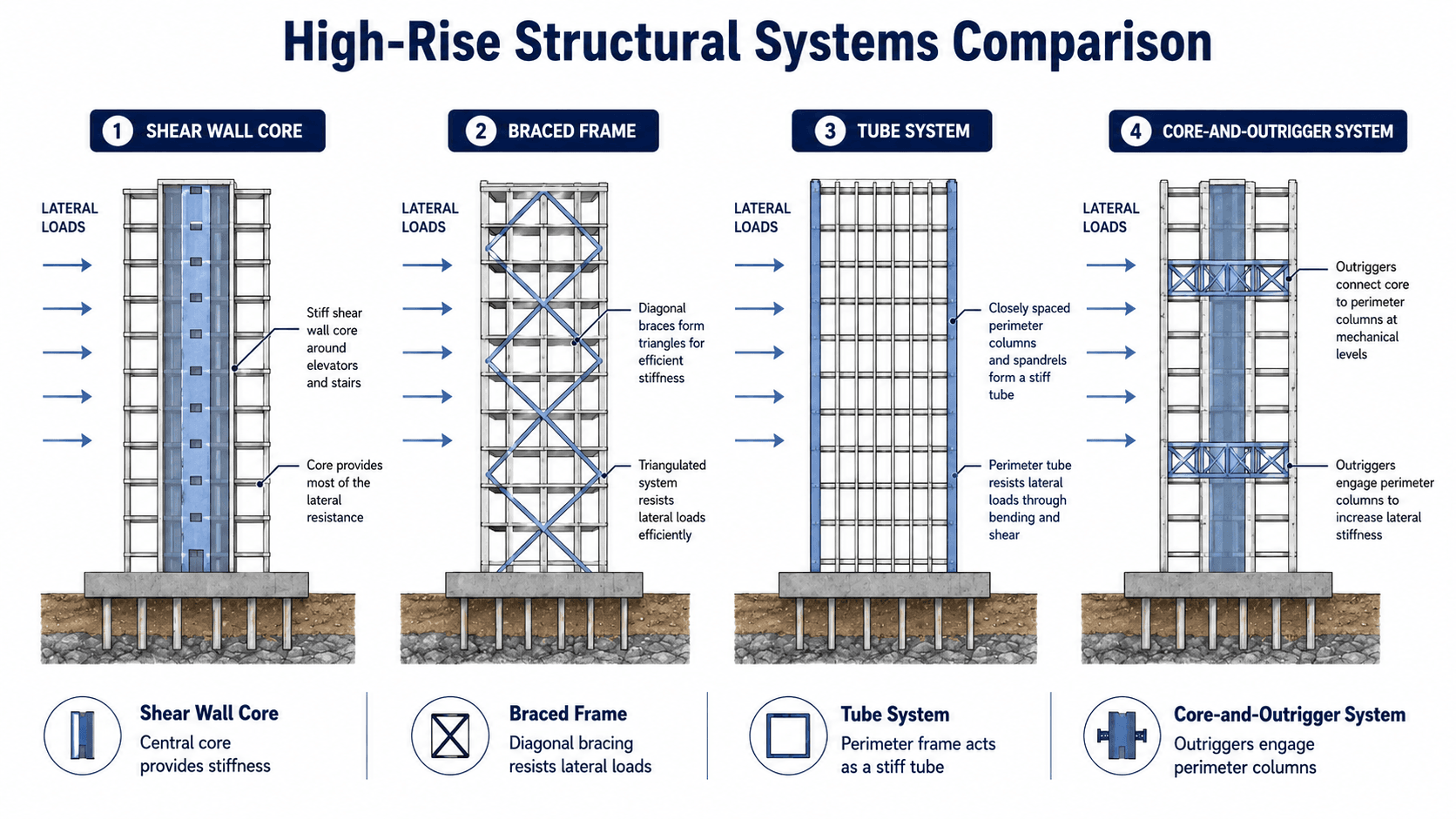
The structural system controls how the building responds to wind, seismic forces, gravity loads, drift, torsion, and overturning. It also affects rentable area, elevator core layout, mechanical floors, façade rhythm, material quantities, foundation demand, and construction speed.
The best high-rise structural system is usually the one that provides enough stiffness and strength without creating excessive cost, unusable floor space, difficult construction details, or conflicts with elevators, mechanical systems, façades, and architectural layouts.
Main Structural Parts of a High Rise Building
A high rise building works because many structural and nonstructural systems are coordinated together. The primary frame, lateral system, foundation, façade, elevators, stairs, MEP shafts, and fire/life safety systems must all tolerate movement and support the building’s intended use.
| Part | Primary role | Why it matters in high rises |
|---|---|---|
| Floor system | Supports occupants, finishes, partitions, equipment, and local floor loads. | Controls floor depth, vibration, fire rating, construction cycle, and diaphragm behavior. |
| Core | Houses elevators, stairs, shafts, and often major shear walls. | Often provides the main source of lateral stiffness and organizes vertical services. |
| Columns and walls | Carry gravity loads and may contribute to lateral resistance. | Lower levels carry large accumulated loads and may require special shortening or transfer checks. |
| Diaphragms and collectors | Move lateral forces from floors into the vertical lateral system. | Critical at transfer levels, setbacks, core openings, podium transitions, and irregular plans. |
| Foundation system | Transfers vertical, lateral, uplift, and overturning demands into soil or rock. | Settlement, stiffness, pile group behavior, uplift, and mat action can affect the full tower response. |
| Façade and cladding | Encloses the building and transfers wind pressure to the structure. | Must accommodate drift, thermal movement, shortening, anchorage loads, and water control. |
Wind and Seismic Design in High Rise Buildings
Wind and seismic loading both push buildings laterally, but they do not behave the same way. Wind is an external pressure acting on the building surface and can create along-wind, crosswind, torsional, and comfort-related response. Earthquake forces come from ground motion acting on the building mass, stiffness distribution, ductility, and dynamic properties.
Wind Behavior
Tall buildings are sensitive to exposure, shape, height, surrounding terrain, nearby towers, and aerodynamic response. A rectangular tower, tapered tower, rounded tower, and stepped tower can experience different wind behavior even if their heights are similar. For very slender towers, serviceability checks such as drift and acceleration may be as important as strength checks.
Wind can produce along-wind response in the direction of wind flow, crosswind response caused by vortex shedding, and torsional response when pressure patterns twist the building. For unusual, very tall, or very slender towers, wind tunnel testing may be used to better understand cladding pressure, structural loading, acceleration, and occupant comfort.
Seismic Behavior
In seismic regions, engineers focus on mass, stiffness, ductility, redundancy, drift, torsion, foundation interaction, and energy dissipation. The goal is not simply to make the building rigid. A seismic system must provide a reliable load path, controlled yielding, deformation capacity, and predictable behavior during strong ground shaking.
Simplified Cantilever Deflection Concept
This simplified cantilever deflection relationship is not a full high-rise analysis method, but it helps explain why height matters. For a cantilever-like system, lateral displacement grows rapidly as height increases. Real tall building analysis uses three-dimensional modeling, dynamic behavior, code load combinations, stiffness modifiers, diaphragm assumptions, soil-structure interaction, and serviceability checks.
Do not use this simplified equation as a complete high-rise design method. It is only a teaching tool for understanding why height and stiffness matter. Actual tall building design requires project-specific loads, code combinations, material models, dynamic analysis where required, and professional engineering judgment.
- \( \Delta \) Lateral deflection or drift, commonly checked in inches or millimeters.
- \( P \) Representative lateral load in the simplified cantilever model.
- \( L \) Height or cantilever length; increasing height strongly increases displacement demand.
- \( EI \) Flexural stiffness; increasing stiffness reduces lateral movement.
What Controls High Rise Building Design?
High rise design is controlled by more than height. A 40-story building with a compact floor plate may be easier to design than a shorter but extremely slender tower with irregular setbacks, large transfer floors, weak soils, and aggressive architectural openings. Engineers evaluate both the global system and the local details that make the system buildable.
| Factor | Why it matters | Engineering implication |
|---|---|---|
| Slenderness | Tall, narrow towers move more under wind and can be comfort-controlled. | May require outriggers, deeper cores, stiffer perimeter columns, damping, or shape changes. |
| Floor plate and core layout | Elevators, stairs, restrooms, shafts, and walls influence structural stiffness. | A compact, well-placed core improves load path and reduces inefficient transfer demands. |
| Material system | Concrete, steel, composite, and mass timber behave differently in stiffness, weight, speed, and fire strategy. | Material choice affects column sizes, floor depth, construction schedule, vibration, fire protection, and embodied carbon. |
| Foundation and ground conditions | High axial loads and overturning moments concentrate demand below grade. | Mat foundations, piles, drilled shafts, or piled rafts may be needed to control settlement and uplift. |
| Wind and seismic exposure | Hazard level changes force demand, detailing, drift limits, and dynamic response. | System selection must match both strength and serviceability requirements. |
| Construction sequence | Tall buildings are built over time, not instantly as complete structural models. | Temporary stability, creep, shortening, tolerances, crane logistics, and staged loading must be considered. |
High Rise Building Design Checks Engineers Review
A high rise building may require many rounds of analysis before the structural system is efficient, buildable, and coordinated. The checks below are not a design checklist for a specific project, but they show the types of issues engineers commonly review when evaluating tall building performance.
| Check | What it evaluates | Why it matters |
|---|---|---|
| Strength | Whether members and connections resist required load combinations. | Prevents unsafe member failure, connection failure, or instability. |
| Story drift | Relative lateral movement between floors. | Protects cladding, partitions, stairs, elevators, piping, and nonstructural systems. |
| Overall drift | Total lateral displacement over the building height. | Controls global serviceability and façade movement. |
| Acceleration | How building motion may be felt by occupants during wind events. | Important for occupant comfort in slender towers. |
| Overturning | Rotational demand caused by wind or seismic forces acting over height. | Controls core forces, perimeter column demands, mat behavior, pile uplift, and foundation compression. |
| Torsion | Twisting caused by eccentric mass, stiffness, or wind pressure. | Can increase drift, cladding movement, and member demand at building edges. |
| Settlement | Vertical foundation movement and differential settlement. | Affects columns, core walls, façade joints, floors, and MEP connections. |
| Construction stage behavior | How the building behaves before the final system is complete. | Temporary stability, sequencing, shortening, crane loads, and tolerances can control details. |
Foundations, Cores, Façades, and Building Services
High rise buildings depend on coordination between structural engineering, geotechnical engineering, architecture, façade design, fire protection, elevators, plumbing, HVAC, electrical systems, and construction planning. A tall building is not just a taller version of a smaller building; the vertical stacking of people and systems creates new coordination problems.
Foundation Systems
High rise foundations may use mat foundations, pile groups, drilled shafts, caissons, rock sockets, or piled rafts. The foundation must handle vertical gravity load, overturning compression, possible uplift, lateral shear, basement wall pressure, groundwater pressure, and differential settlement. Foundation stiffness can also affect the building’s modeled lateral response.
Core and MEP Coordination
The building core often contains elevators, stairs, shafts, restrooms, risers, and sometimes major shear walls. Mechanical floors may be used to transfer services, support outriggers, house equipment, or divide pressure zones. Poor coordination can force late openings through walls, awkward transfer framing, congested reinforcement, and reduced lateral stiffness.
Façade Movement
Curtain walls and cladding systems must tolerate interstory drift, thermal movement, shortening, anchorage loads, water control, air leakage, and maintenance access. In high rises, façade performance is closely tied to the structural system because small movements repeated over many floors can create serviceability issues.
High Rise Building Design Review Checklist
A practical high rise review should start with the global system before moving into individual members. The checklist below helps identify whether the building concept is likely to work as an integrated structure, not just as a collection of beams, columns, and walls.
Start with the site hazards and building geometry. Confirm the load path. Select a lateral system that fits the floor plan. Check drift, acceleration, overturning, and foundation behavior. Then review transfer levels, core openings, diaphragm collectors, façade movement, construction sequence, and MEP conflicts before final member optimization.
| Check or decision | What to look for | Why it matters |
|---|---|---|
| Height and slenderness | Building height compared with plan width, core size, and perimeter stiffness. | Slender towers are more likely to be controlled by drift, acceleration, and overturning. |
| Lateral system continuity | Shear walls, braces, frames, outriggers, and collectors that align through the building. | Discontinuities create transfer demands, torsion, and difficult detailing. |
| Core openings | Doorways, shafts, embeds, coupling beams, and penetrations through core walls. | Openings can reduce stiffness and create heavily loaded coupling elements. |
| Transfer levels | Column offsets, podium transitions, amenity floors, hotel-to-residential transitions, or large open lobbies. | Transfer floors can become expensive, congested, and schedule-critical. |
| Serviceability | Drift, acceleration, vibration, façade joint movement, and elevator rail tolerance. | Strength alone does not guarantee a comfortable or damage-resistant high rise. |
| Foundation response | Settlement, differential settlement, uplift, bearing, pile group behavior, and basement restraint. | Foundation flexibility changes force distribution and long-term building movement. |
How High Rise Buildings Are Constructed
Construction sequence affects structural performance. The final analytical model may show a complete building, but the real structure is built floor by floor while loads, shortening, temperature effects, temporary bracing, cranes, and tolerances change over time. This is why constructability is part of engineering judgment, not just a contractor preference.
Common Construction Considerations
Concrete high rises may use jump forms, self-climbing forms, pumping systems, post-tensioned slabs, and repetitive floor cycles. Steel high rises may use staged erection, bolted and welded connections, composite decking, fireproofing, and crane picks. Composite towers combine the speed or strength advantages of steel and concrete while adding coordination demands at connections and transfer zones.
Column Shortening and Tolerances
Tall buildings experience elastic shortening, creep, shrinkage, settlement, and construction tolerances that accumulate over many floors. Engineers may need to account for differential shortening between core walls and perimeter columns, especially where outriggers, belt trusses, cladding, or rigid MEP connections tie different parts of the building together.
Engineering Judgment and Field Reality
High rise design is full of tradeoffs. A larger core can improve stiffness but reduce rentable floor area. A lighter steel system can reduce foundation loads but require more fire protection and vibration review. A transfer floor can unlock an architectural layout but add cost, depth, reinforcement congestion, and construction risk. A highly efficient structural system may still fail as a project solution if it conflicts with elevators, mechanical floors, façade anchors, or construction logistics.
The cleanest structural diagram is not always the best building. The best high rise system is usually the one that provides a continuous load path, acceptable movement, buildable details, predictable sequencing, coordinated services, and enough architectural flexibility to survive real project changes.
When Simplified High Rise Explanations Break Down
Simplified explanations of high rise buildings break down when they treat the tower as a perfectly regular vertical cantilever, ignore construction sequence, or separate architecture from structural behavior. Real towers include transfer levels, setbacks, podiums, irregular openings, stiffness changes, soil flexibility, equipment loads, and MEP penetrations that can alter the load path.
- Assuming a regular floor plate when the tower has setbacks, re-entrant corners, transfer floors, or major core interruptions.
- Checking strength but underestimating drift, acceleration, cladding movement, vibration, or occupant comfort.
- Ignoring soil-structure interaction, differential settlement, foundation uplift, or basement restraint.
- Relying on idealized stiffness when cracked concrete, connection flexibility, creep, shrinkage, and staged construction affect behavior.
- Treating MEP shafts, elevator cores, façade anchors, and fire safety systems as late coordination items instead of early design constraints.
Common Mistakes and Practical Checks
The biggest mistakes in understanding high rise buildings come from reducing them to height alone. Height matters, but performance depends on geometry, stiffness, mass, damping, foundation conditions, code requirements, construction methods, and how well the structural and nonstructural systems work together.
- Confusing strength with stiffness: A member can be strong enough but still allow too much movement.
- Ignoring torsion: Offset cores, asymmetric plans, and uneven stiffness can twist the building under lateral loads.
- Underestimating transfer floors: Large column transfers can dominate cost, depth, reinforcement, coordination, and schedule.
- Forgetting nonstructural systems: Façade joints, partitions, elevators, stairs, piping, and fire systems must tolerate movement.
- Overlooking constructability: A theoretically efficient system can be poor if it is difficult to form, erect, inspect, or coordinate.
Do not evaluate a high rise only by whether the primary frame resists code-level forces. Also check drift, acceleration, load path continuity, foundation behavior, façade movement, transfer levels, and the construction sequence that gets the building to its final condition.
Useful References and Design Context
High rise building design depends on project location, occupancy, height, risk category, material system, and authority having jurisdiction. The references below are commonly relevant starting points for understanding the design context, but actual project requirements must be established for each building.
- International Building Code: Establishes high-rise provisions, occupancy requirements, fire/life safety concepts, egress requirements, structural design references, and jurisdictional adoption framework.
- ASCE/SEI 7: Provides minimum design loads for buildings, including wind, seismic, snow, rain, flood, load combinations, risk categories, and related load criteria used in structural design.
- ACI 318: Provides requirements for structural concrete design, including reinforced concrete walls, columns, slabs, frames, and detailing provisions commonly used in concrete high rises.
- AISC 360: Provides specification requirements for structural steel buildings, including steel members, connections, stability, and composite construction.
- CTBUH resources: Useful for tall building terminology, case studies, research, and discussions of high-rise structural systems, outriggers, damping, sustainability, and tower performance.
Frequently Asked Questions
A high rise building is generally a tall multi-story building where elevators, fire/life safety systems, lateral load resistance, vertical service coordination, and serviceability become major design requirements. Exact height thresholds vary, but the engineering issue is that height changes how the structure behaves under wind, seismic, gravity, drift, and foundation demands.
High rise buildings stay standing through a continuous load path. Gravity loads move downward through slabs, beams, columns, core walls, and foundations, while wind and seismic forces are collected by floor diaphragms and transferred into shear walls, frames, outriggers, tube systems, and the foundation.
High rise buildings may use reinforced concrete cores, shear walls, moment frames, braced frames, tube systems, core-and-outrigger systems, diagrids, or composite steel-concrete systems. The best choice depends on building height, slenderness, floor plan, wind exposure, seismic risk, construction speed, material availability, and architectural constraints.
Wind is important because tall buildings behave like vertical cantilevers. As height and slenderness increase, wind can control lateral drift, overturning forces, cladding pressure, torsional response, and occupant comfort. A building may be strong enough for code-level loads but still need more stiffness or damping to control movement.
A high rise building is a broad term for a tall building that requires vertical transportation and special design systems. A skyscraper is usually used for a much taller or skyline-defining high rise. The boundary is not universal, so engineers focus less on the label and more on structural behavior, safety, serviceability, and constructability.
The main challenge is not only making the building strong. Engineers must also control drift, acceleration, torsion, overturning, settlement, column shortening, façade movement, elevator tolerances, construction sequencing, and long-term serviceability.
Summary and Next Steps
High rise buildings are tall structures where gravity load, lateral load resistance, vertical transportation, fire safety, foundations, façades, MEP systems, and construction sequencing must be designed as one coordinated system. The defining challenge is not just making the building tall; it is making it safe, stable, usable, comfortable, and buildable.
The most important engineering ideas are load path continuity, lateral stiffness, wind and seismic response, foundation performance, serviceability, transfer conditions, and field coordination. A strong high rise design controls both ultimate safety and day-to-day performance.
Where to go next
Continue your learning path with related Turn2Engineering resources.
-
Structural Loads
Learn how dead, live, wind, seismic, snow, rain, and construction loads are categorized before they are applied to building systems.
-
Load Path Analysis
Understand how loads move through slabs, beams, columns, walls, diaphragms, foundations, and soil support.
-
Structural Analysis
Review how engineers model forces, stiffness, supports, load paths, and member behavior in structural systems.
-
Structural Dynamics
Explore natural frequency, damping, resonance, vibration, and dynamic response, which are especially important in tall buildings.