
Key Takeaways
- Main equation: The most common form is \(F_c=\dfrac{mv^2}{r}\), where force increases with mass and the square of tangential speed.
- Physical meaning: Centripetal force is directed toward the center of the circular path, even when the object’s velocity is tangent to the path.
- Unit warning: Use consistent units; mixing feet, meters, rpm, and seconds without conversion is the fastest way to get a wrong force.
- Engineering check: Because velocity is squared, small speed increases can create large force increases in rotating equipment and vehicle-path problems.
Table of Contents
Circular motion diagram showing inward centripetal force
The centripetal force equation calculates the inward force needed to keep a mass moving along a curved or circular path.
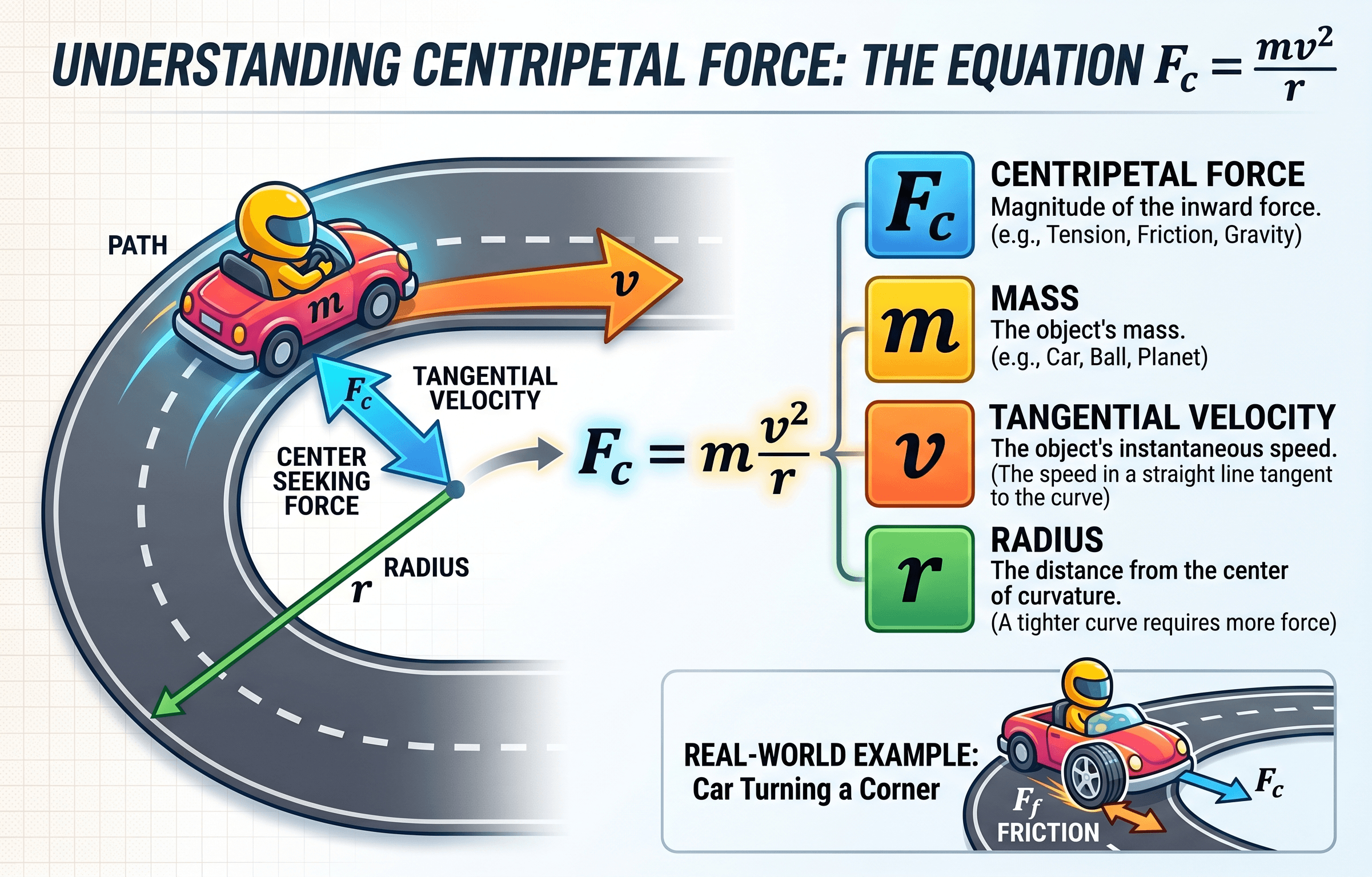
Notice the direction difference first. The object is not being pulled in the direction it is moving; it is being accelerated inward so its velocity direction keeps changing.
What is the centripetal force equation?
The centripetal force equation describes the net inward force required to make an object follow a circular path. In engineering terms, it connects mass, speed, radius, and radial acceleration so you can estimate how much force must be supplied by tension, friction, gravity, a track, a bearing, or another constraint.
The word centripetal means “center-seeking.” That does not mean the object is moving toward the center. It means the acceleration and net force point toward the center while the instantaneous velocity remains tangent to the circular path.
Readers usually search for this equation when they need to solve a rotating-system problem, check whether friction can keep an object on a curve, estimate load in a spinning component, or understand why speed changes affect force so dramatically.
The centripetal force equation formula
The most common form uses mass, tangential velocity, and radius. It is the best starting point when the object’s speed along the circular path is known.
This equation says the required inward force increases linearly with mass, decreases as the curve radius increases, and increases with the square of speed. The squared speed term is what makes rotating machinery, flywheels, centrifuges, and high-speed vehicle curves sensitive to relatively small speed changes.
When angular velocity is known instead of tangential velocity, engineers often use the angular form. This is common for rotating shafts, disks, centrifuges, pulleys, and systems described in radians per second.
The two forms are equivalent because tangential speed and angular velocity are related by \(v=\omega r\). Use the velocity form for path-speed problems and the angular form for rotating-equipment problems.
Which centripetal force formula should you use?
Choose the form based on the motion data you actually know. Both force equations describe the same radial requirement.
| If you know | Use | Required inputs | Typical application |
|---|---|---|---|
| Tangential speed | \(F_c=\dfrac{mv^2}{r}\) | \(m,\ v,\ r\) | Vehicles, track motion, rotating masses |
| Angular velocity | \(F_c=m\omega^2r\) | \(m,\ \omega,\ r\) | Rotors, disks, centrifuges, shafts |
| RPM | \(\omega=\dfrac{2\pi N}{60}\) | \(N\) in rpm | Convert first, then use \(m\omega^2r\) |
| Available inward force | \(v=\sqrt{\dfrac{F_cr}{m}}\) | \(F_c,\ r,\ m\) | Maximum sustainable speed checks |
Variables and units
The centripetal force equation only works cleanly when all variables are expressed in a consistent unit system. In SI units, the result is force in newtons. In US customary calculations, be especially careful with mass versus weight.
- \(F_c\) Centripetal force, or the net inward radial force required for circular motion. SI unit: newton, \(N\).
- \(m\) Mass of the moving object. SI unit: kilogram, \(kg\). Do not substitute weight in pounds-force without conversion.
- \(v\) Tangential speed along the circular path. SI unit: meters per second, \(m/s\).
- \(r\) Radius of curvature measured from the center of rotation to the object’s path. SI unit: meter, \(m\).
- \(\omega\) Angular velocity. SI unit: radians per second, \(rad/s\). Convert rpm before using the angular form.
If speed is given in rpm, do not place rpm directly into \(F_c=m\omega^2r\). Convert it first using \(\omega = 2\pi N/60\), where \(N\) is rotational speed in revolutions per minute.
| Variable | Meaning | SI units | US customary note | Common mistake |
|---|---|---|---|---|
| \(F_c\) | Required inward force | \(N = kg \cdot m/s^2\) | Often converted to lbf after calculation | Treating it as an extra force instead of the net inward force |
| \(m\) | Mass | \(kg\) | Use slugs if working directly in ft-lbf-s units | Using pounds-force as mass |
| \(v\) | Tangential speed | \(m/s\) | \(ft/s\) | Using angular speed where tangential speed is required |
| \(r\) | Radius of path | \(m\) | \(ft\) | Using diameter instead of radius |
| \(\omega\) | Angular velocity | \(rad/s\) | Convert rpm to rad/s | Entering rpm directly into \(\omega^2\) |
Doubling speed makes centripetal force four times larger. If your result barely changes when speed changes a lot, check whether velocity was squared correctly.
Centripetal force and radial acceleration
The centripetal-force equation is Newton’s Second Law applied in the radial direction. The required inward acceleration is:
Multiplying the radial acceleration by mass gives the inward net force:
A body moving at constant speed can still have nonzero acceleration because velocity includes direction. In uniform circular motion, the speed stays constant while the velocity vector continuously turns toward the center.
How to calculate centripetal force from RPM
Rotating equipment is often specified in revolutions per minute rather than radians per second. Convert RPM first:
Then substitute into \(F_c=m\omega^2r\). Combining the two steps gives:
Because RPM is squared through \(\omega^2\), doubling rotational speed increases the centripetal-force requirement by a factor of four when mass and radius stay unchanged.
How to rearrange the centripetal force equation
The equation is often rearranged to solve for speed, radius, or mass. In engineering checks, the velocity form is especially useful because it shows whether a proposed speed is feasible for a given force capacity and radius.
Use this form when the available inward force is known and you want the maximum speed that can be sustained on a curve or rotating path.
Use this form when you need the required curve radius for a given mass, speed, and available force.
After rearranging, check the trend before trusting the number. Higher speed should require more force or a larger radius. A smaller radius should require more force at the same speed.
Where the equation comes from
The centripetal force equation comes from combining Newton’s Second Law with the acceleration of circular motion. For an object moving at constant speed around a circle, the speed magnitude can remain constant while the velocity direction changes continuously.
Newton’s Second Law says net force equals mass times acceleration. Substituting the inward radial acceleration into \(F=ma\) gives the standard centripetal force equation.
The important idea is that centripetal force is not a new type of force. It is the name for the net inward force that creates the radial acceleration required for circular motion.
Where engineers use the centripetal force equation
Engineers use the centripetal force equation any time a mass is constrained to move along a curved path. The “force provider” changes by application, but the inward-force requirement remains the same.
- Rotating equipment: estimating loads in rotors, flywheels, pulleys, centrifuges, fans, and unbalanced rotating components.
- Vehicle dynamics: checking whether tire-road friction can provide enough inward force on a curve.
- Mechanical design: estimating tension, bearing reactions, or retention loads in parts moving around a circular path.
- Physics and engineering education: connecting force, acceleration, velocity, and radius in circular-motion problems.
In real rotating systems, the calculated centripetal force may become a bearing load, fastener load, tensile stress, track reaction, or friction demand. The equation gives the required radial force; the engineer still has to identify what physical component supplies it.
Centripetal force on a vehicle turning on a flat curve
On a level road, tire-road friction usually supplies the horizontal inward force needed for a vehicle to follow a curve. If the available friction is insufficient, the vehicle cannot maintain the intended path.
If the maximum available friction force is approximated as \(\mu mg\), then a simplified no-slip condition is:
This is a simplified flat-curve model. Real vehicle limits depend on tire characteristics, road condition, banking, load transfer, aerodynamics, suspension, braking or acceleration, and stability-control behavior.
Worked example
Example problem
A 2.0 kg object moves in a circular path with a radius of 0.75 m at a tangential speed of 6.0 m/s. Find the required centripetal force.
Square the velocity first, then multiply by mass and divide by radius. Keeping the units visible helps confirm the result becomes \(kg \cdot m/s^2\), which is a newton.
Example problem — rotating mass at 1200 rpm
A \(0.50\ \text{kg}\) mass rotates at a radius of \(0.20\ \text{m}\) and \(1200\ \text{rpm}\). Estimate the required inward force.
The required inward force is about \(1.58\ \text{kN}\). This shows why even a small rotating mass can create a large radial load at high speed.
A 96 N inward force is required to maintain this motion. If the available tension, friction, or structural restraint is less than this value, the object cannot follow the stated circular path at that speed.
Centripetal force equation vs. related equations
The centripetal force equation is closely related to acceleration, Newton’s Second Law, angular velocity, and centrifugal-force calculations. The difference is usually not the algebra, but the reference frame and the physical interpretation.
| Equation / concept | Best used for | Key relationship | Main caution |
|---|---|---|---|
| \(F_c=\dfrac{mv^2}{r}\) | Known tangential speed and radius | Force required for circular motion | Force points inward, not along the velocity vector |
| \(F_c=m\omega^2r\) | Rotating systems with angular velocity | Uses angular speed instead of tangential speed | Convert rpm to rad/s before calculating |
| \(F=ma\) | General force-acceleration problems | Centripetal force is a specific radial case | Do not treat centripetal force as separate from net force |
| Centrifugal force | Rotating reference frames and apparent outward effects | Same magnitude in many simple cases, opposite apparent direction | Reference frame must be clear |
Centripetal force is not an additional force that gets added on top of tension, friction, gravity, or normal force. It is the inward net result of whatever real forces act on the object.
Centripetal acceleration in g
Radial acceleration is often compared with standard gravitational acceleration to make the magnitude easier to interpret.
A value of \(2g\) means the radial acceleration magnitude is about twice standard gravitational acceleration. This comparison is useful in centrifuges, rotating test rigs, vehicle dynamics, and other high-acceleration systems.
Assumptions behind the centripetal force equation
The standard centripetal force equation is powerful because it is simple, but that simplicity depends on assumptions. In real engineering systems, these assumptions should be checked before treating the result as a design load.
- 1 The radius of curvature is known and represents the actual path of the mass center.
- 2 The speed used is tangential speed at the radius being analyzed, not an unrelated shaft or surface speed.
- 3 The object can be modeled as a particle or as a mass concentrated at a known radius.
- 4 The force being calculated is the required inward net force, not necessarily a single physical load applied by one component.
Neglected factors
The basic equation does not automatically include deformation, vibration, aerodynamic drag, rolling resistance, bearing losses, surface roughness, transient speed changes, or distributed-mass effects.
- Distributed mass: a rotating disk, shaft, or blade may require stress analysis instead of treating the whole part as a point mass.
- Changing speed: if angular speed is increasing or decreasing, tangential acceleration and torque may also matter.
- Real contact conditions: tires, belts, tracks, and wheels may slip before the required force can be developed.
When the simple centripetal-force model is not enough
The equation does not necessarily break down mathematically, but the simple model can stop representing the real system. This happens when the object is not well modeled as a point mass, the radius is not constant, the motion is not constrained, or the available force mechanism is more complicated than the equation assumes.
Be careful using \(F_c=mv^2/r\) as a final design load for high-speed rotating components. At high rpm, stress distribution, material strength, fatigue, balance, vibration, and containment requirements can control the design.
For a simple classroom problem, the equation may be enough. For an engineered rotor, a vehicle safety check, or a machine guarding problem, it is usually one part of a broader analysis.
Common mistakes and engineering checks
- Using diameter instead of radius: the radius is measured from the center of rotation to the path of the mass.
- Putting rpm directly into the equation: rpm must be converted to radians per second before using \(F_c=m\omega^2r\).
- Mixing mass and weight: in SI, use kilograms for mass. In US customary work, convert carefully instead of treating lbf as mass.
- Forgetting that velocity is squared: a 10% increase in speed produces about a 21% increase in centripetal force.
- Calling centripetal force a separate force: it is the required inward net force created by real physical forces.
| Check item | What to verify | Why it matters |
|---|---|---|
| Direction | Force and acceleration point toward the center | Prevents confusing radial force with tangential velocity |
| Speed term | Velocity is squared before multiplying by mass | Speed dominates the result |
| Radius | Use actual radius of path, not diameter | Using diameter cuts the force estimate in half |
| Units | Use consistent mass, length, and time units | Mixed units can create large hidden errors |
If the radius gets smaller while mass and speed stay the same, the required centripetal force must increase. If your result does the opposite, the equation was rearranged or entered incorrectly.
Frequently asked questions
The centripetal force equation is \(F_c=mv^2/r\). It calculates the inward net force required to keep a mass moving in a circular path.
In SI units, use kilograms for mass, meters per second for velocity, meters for radius, and newtons for force. If angular velocity is used, convert rpm to radians per second first.
Starting with \(F_c=mv^2/r\), multiply by radius, divide by mass, and take the square root: \(v=\sqrt{F_cr/m}\).
No. Centripetal force is the inward net force required for circular motion. Centrifugal force is an apparent outward force used when describing motion from a rotating reference frame.
Summary and next steps
The centripetal force equation calculates the inward net force required to keep an object moving along a circular path. The most common form, \(F_c=mv^2/r\), shows why mass, speed, and radius strongly control curved-motion and rotating-system loads.
The biggest practical checks are unit consistency, correct radius selection, velocity-squared sensitivity, and identifying what real force supplies the required inward net force.
Where to go next
Continue your learning path with these curated next steps.
-
Prerequisite: Acceleration Formula
Understand how changing velocity direction creates acceleration even when speed is constant.
-
Apply it: Centripetal Force Calculator
Use the equation with practical inputs, units, and quick result checks.
-
Advanced: Law of Universal Gravitation
Extend force and radial acceleration concepts into gravitational and orbital motion.