
Key Takeaways
- Core idea: A wastewater treatment plant removes solids, organic matter, nutrients, pathogens, and other pollutants before treated water is discharged or reused.
- Engineering use: Engineers arrange unit processes into a treatment train so each stage prepares the wastewater for the next stage.
- What controls it: Flow variation, BOD, TSS, nitrogen, phosphorus, temperature, oxygen demand, sludge settleability, and effluent limits strongly affect performance.
- Practical check: A plant is not only a liquid-treatment system; sludge handling, return flows, wet-weather peaks, odors, maintenance access, and operator control often determine reliability.
Table of Contents
Introduction
Wastewater treatment plants are engineered facilities that clean used water before it is discharged, reused, or returned to the environment. They combine physical, biological, and chemical processes to remove grit, suspended solids, organic matter, nutrients, pathogens, and sludge so communities can protect public health and downstream water quality.
How Wastewater Treatment Plants Work
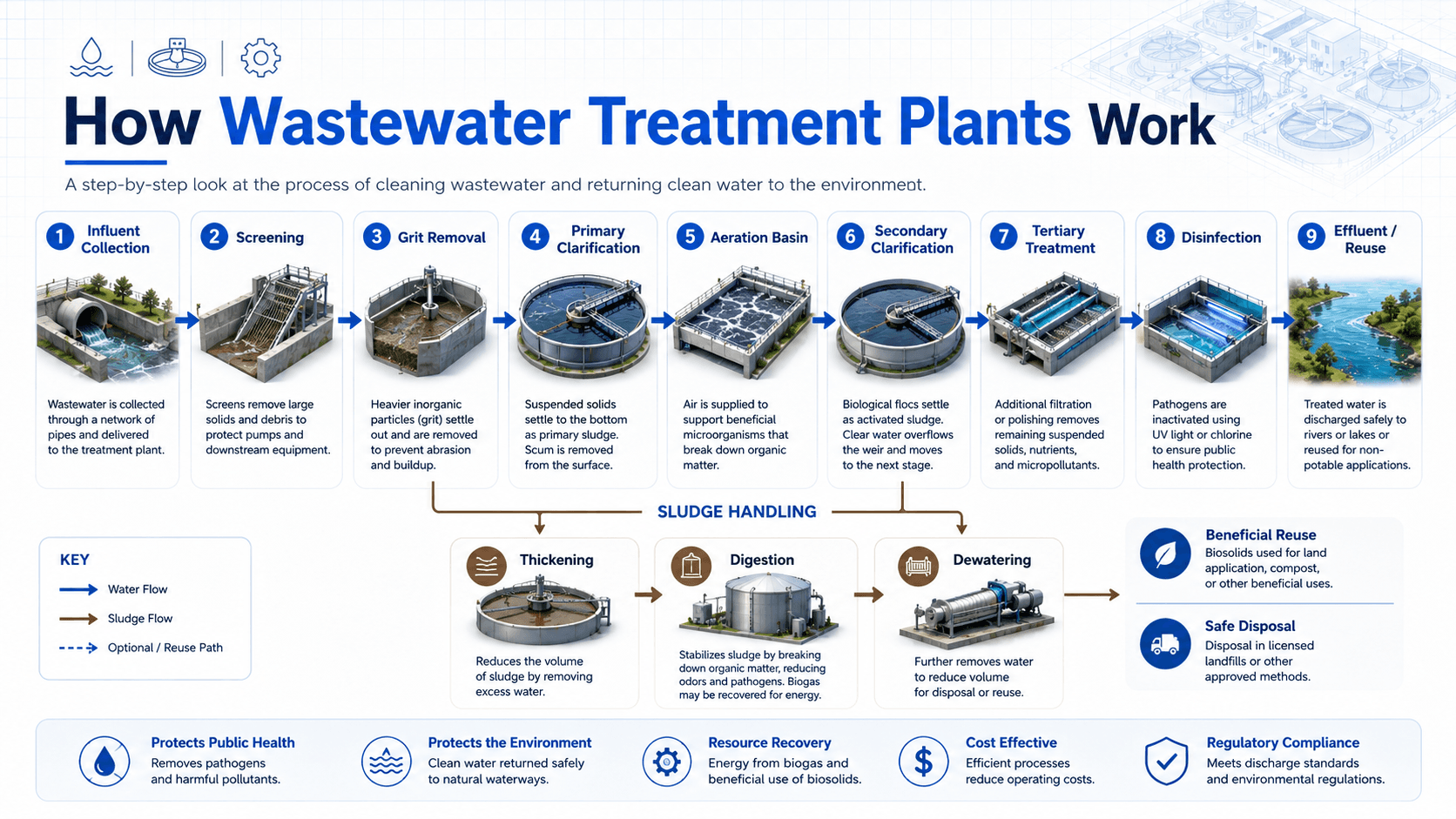
Notice that each stage solves a different problem. Screens protect equipment, grit removal prevents abrasion, clarifiers remove solids, aeration removes organic matter, disinfection reduces pathogens, and solids handling controls the sludge produced by treatment.
What is a Wastewater Treatment Plant?
A wastewater treatment plant receives used water from homes, businesses, institutions, and sometimes industries, then treats it so the final effluent can meet a defined discharge or reuse objective. In municipal systems, this usually means reducing organic matter, suspended solids, nutrients, pathogens, and process residuals before the treated water reaches a river, lake, ocean outfall, reuse system, or land application system.
In water resources engineering, wastewater treatment plants sit at the intersection of water quality, public health, hydraulics, infrastructure, operations, and environmental protection. They are part of the broader family of water treatment processes, but wastewater plants require special attention to biological treatment, sludge handling, return flows, odor control, and effluent discharge requirements.
The important engineering idea is that a plant is a system, not a collection of isolated tanks. A weak headworks can damage downstream pumps, a poorly settling biological process can overload clarification, and an unstable sludge stream can create odor, disposal, and compliance problems even when the liquid stream appears to be working.
Explore Each Part of a Wastewater Treatment Plant
A strong wastewater treatment plant page should help readers move from the whole system to the major subtopics. Use the table below as a learning path through the main process areas and related Turn2Engineering resources.
| Topic | What you learn | Where it fits in the plant |
|---|---|---|
| Water Treatment Processes | How physical, biological, and chemical treatment processes are combined into treatment trains. | Full treatment concept |
| Biological Treatment | How microorganisms remove organic matter and nutrients from wastewater. | Secondary treatment |
| Disinfection Methods | How chlorine, UV, ozone, and other methods reduce pathogens before discharge or reuse. | Final treatment |
| Water Recycling | How treated wastewater can become reclaimed water for reuse applications. | Effluent reuse |
| Water Quality Management | How pollutants, monitoring, treatment goals, and protection strategies shape plant objectives. | Effluent quality and receiving water protection |
Wastewater Treatment Plant Process
Most wastewater treatment plants use a staged process: preliminary treatment protects equipment, primary treatment removes settleable solids, secondary treatment removes organic matter biologically, tertiary treatment polishes the effluent when needed, and disinfection reduces pathogens before discharge or reuse. The exact layout depends on wastewater strength, flow variation, receiving water requirements, reuse goals, plant age, and available site area.
Preliminary treatment protects the plant
Preliminary treatment usually includes bar screens, fine screens, grit removal, flow measurement, and sometimes influent pumping or equalization. This stage does not make the wastewater clean by itself. Its main job is to remove rags, wipes, plastics, sand, gravel, and other debris that can clog pumps, damage valves, accumulate in basins, or reduce downstream process capacity.
Primary treatment removes settleable solids
Primary clarifiers slow the flow so heavier suspended solids can settle and floatable material can be skimmed from the surface. The settled material becomes primary sludge. Primary treatment reduces the solids and organic load entering biological treatment, which can reduce aeration demand and improve downstream stability.
Secondary treatment removes organic matter biologically
Secondary treatment is where most municipal plants remove biodegradable organic matter. In an activated sludge plant, aeration basins supply oxygen and mixing so microorganisms can consume organic material. The mixed liquor then flows to secondary clarifiers, where biological solids settle and clarified water moves forward.
Tertiary treatment and disinfection polish the effluent
Tertiary treatment may include filtration, nutrient removal, membranes, chemical polishing, or other advanced processes. Disinfection commonly follows when pathogen reduction is required. Chlorine, ultraviolet light, ozone, or other methods may be used depending on the permit, effluent quality, maintenance capacity, and reuse or discharge goal.
Main Components of a Wastewater Treatment Plant
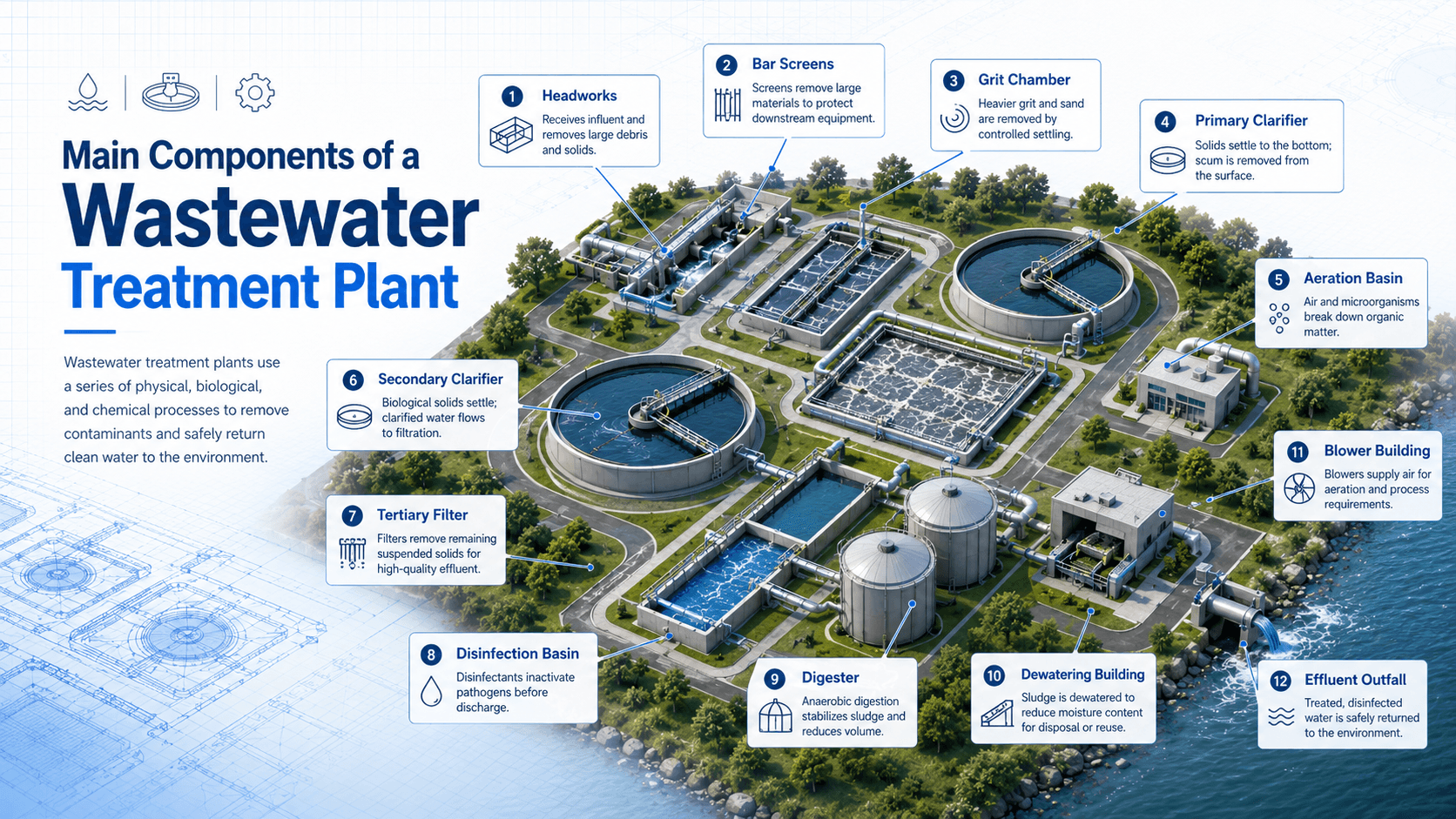
A wastewater treatment plant has two major physical systems: the liquid treatment train and the solids handling train. The liquid train treats the water. The solids train manages primary sludge, waste activated sludge, thickening, stabilization, dewatering, biosolids, and residual disposal or reuse.
| Component | Main purpose | Engineering implication |
|---|---|---|
| Headworks and screens | Remove large debris, rags, wipes, plastics, and floatables. | Protects pumps, valves, channels, and downstream basins from clogging and mechanical damage. |
| Grit chamber | Removes sand, grit, gravel, and dense inorganic particles. | Reduces abrasion, sediment buildup, and loss of treatment volume in downstream units. |
| Primary clarifier | Settles solids and removes scum before biological treatment. | Controls solids loading and organic loading to the secondary process. |
| Aeration basin | Supplies oxygen and mixing for microorganisms that remove organic matter. | Often drives energy use, process control needs, and biological treatment stability. |
| Secondary clarifier | Separates biological solids from clarified water. | Controls effluent solids, return sludge flow, and activated sludge inventory. |
| Tertiary treatment | Polishes effluent through filtration, nutrient removal, or advanced treatment. | Used when discharge limits or reuse goals require higher effluent quality. |
| Disinfection system | Reduces pathogens before discharge or reuse. | Performance depends on upstream turbidity, contact time, dose, UV transmittance, or chlorine demand. |
| Solids handling | Thickens, stabilizes, dewaters, and manages sludge. | Can control odor, hauling cost, biosolids quality, and long-term plant operability. |
Primary, Secondary, and Tertiary Treatment
Primary, secondary, and tertiary treatment describe the broad level of treatment applied to wastewater. These terms are useful for learning, but they can oversimplify real plant performance. A facility may also include sidestream treatment, chemical addition, biological nutrient removal, odor control, equalization, return sludge pumping, and specialized solids treatment.
| Treatment stage | What it removes | Typical equipment | Practical design concern |
|---|---|---|---|
| Preliminary | Rags, wipes, plastics, grit, gravel, and large debris. | Screens, grit chambers, channels, compactors, washers. | Equipment protection and maintenance access. |
| Primary | Settleable solids, scum, and part of the organic load. | Primary clarifiers and sludge collectors. | Surface overflow rate, sludge removal, scum handling, and hydraulic short-circuiting. |
| Secondary | Biodegradable organic matter and biological suspended solids. | Aeration basins, activated sludge systems, secondary clarifiers, trickling filters, or sequencing batch reactors. | Oxygen transfer, sludge age, settling behavior, return sludge rate, and process stability. |
| Tertiary | Remaining suspended solids, nutrients, turbidity, or trace contaminants. | Filters, membranes, chemical feed systems, nutrient removal systems, advanced treatment units. | Effluent limits, backwash handling, chemical demand, and lifecycle cost. |
| Disinfection | Pathogens and indicator organisms. | UV channels, chlorine contact basins, ozone systems, or other disinfection processes. | Contact time, dose, turbidity, maintenance, safety, and dechlorination if chlorine is used. |
Do not judge a wastewater treatment plant only by the number of treatment stages. A “secondary” plant with stable biology, good clarification, and strong solids handling may outperform a more complex plant that has poor sludge control, wet-weather overload, or inconsistent operations.
Liquid Stream vs Solids Stream
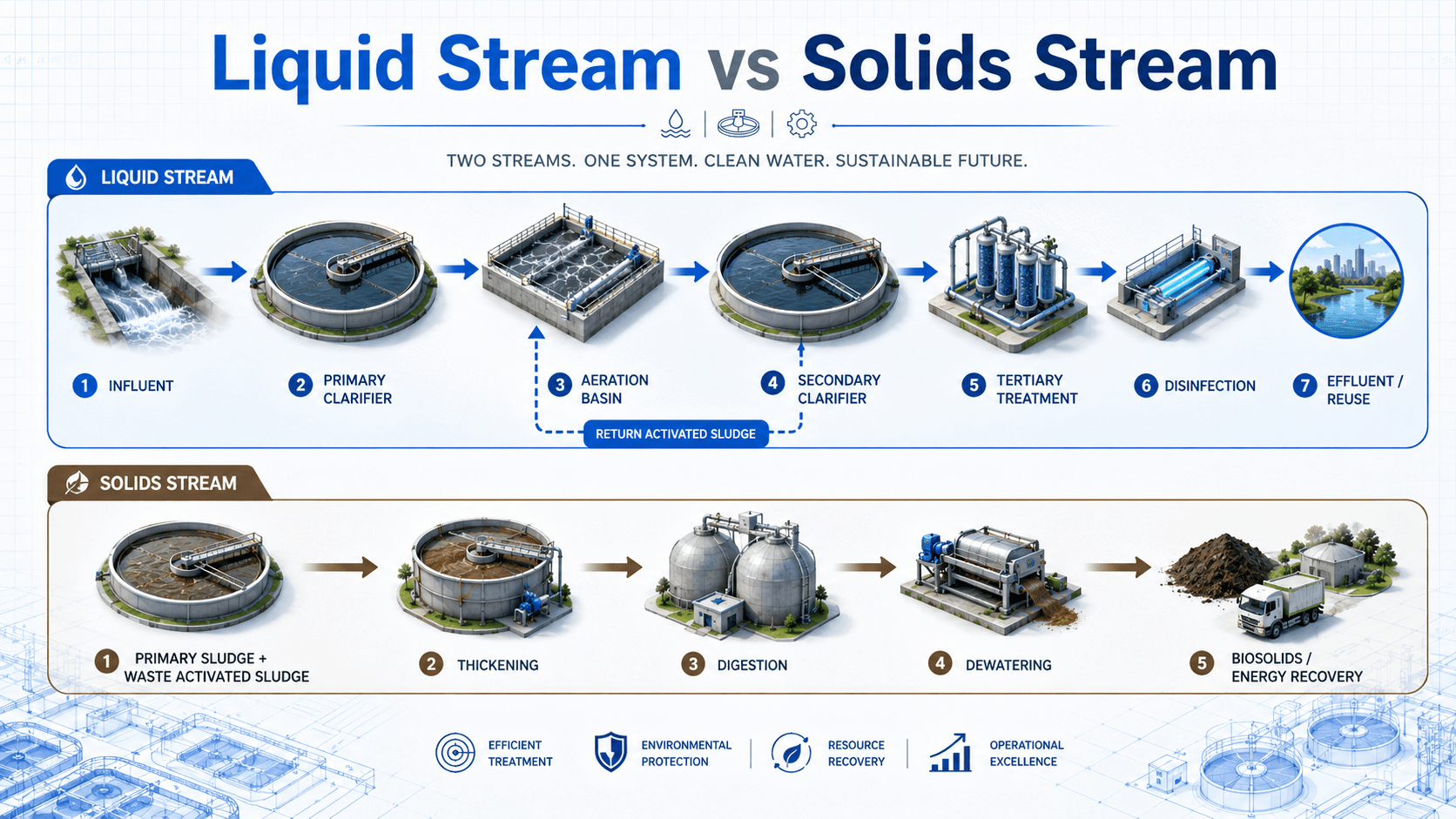
One of the most important ways to understand a wastewater treatment plant is to separate the liquid stream from the solids stream. The liquid stream is what most diagrams show first, but the solids stream is just as important because every clarification and biological process produces residuals that must be handled reliably.
The liquid stream controls effluent quality
The liquid stream is responsible for meeting final water quality goals. Operators watch flow, dissolved oxygen, turbidity, ammonia, nitrate, phosphorus, solids, and disinfection performance to determine whether the plant is producing acceptable effluent.
The solids stream controls plant stability
The solids stream controls sludge inventory, odor potential, hauling volume, digestion performance, dewatering efficiency, and biosolids quality. If solids are not removed, stabilized, and dewatered properly, they can recycle problems back into the liquid train through sidestream flows, supernatant, filtrate, or poor return sludge control.
The return activated sludge loop connects both systems
In activated sludge plants, settled biological solids are partly returned to the aeration basin as return activated sludge. This loop maintains the microorganism population needed for treatment. Excess solids are wasted from the system as waste activated sludge so the plant does not carry too much biomass.
What Controls Wastewater Treatment Plant Performance?
Wastewater treatment performance depends on both the incoming load and the plant’s ability to respond. Two plants with the same flow can behave very differently if one receives stronger wastewater, more industrial discharge, higher wet-weather inflow, lower temperature, or a more restrictive nutrient limit.
| Factor | Why it matters | Engineering implication |
|---|---|---|
| Average and peak flow | Flow controls hydraulic loading, detention time, clarifier loading, and disinfection contact time. | Wet-weather peaks can wash solids through the plant even when average-day performance looks acceptable. |
| BOD and COD | Organic load drives oxygen demand and biological treatment requirements. | Higher organic strength can require more aeration, more biomass, and more sludge handling capacity. |
| Total suspended solids | Suspended solids affect primary settling, clarifier load, filtration, and effluent turbidity. | Poor solids capture can overload downstream processes and reduce disinfection effectiveness. |
| Nitrogen and phosphorus | Nutrients may need removal to protect receiving waters from eutrophication. | Nutrient removal can require aerobic, anoxic, anaerobic, chemical, or tertiary treatment steps. |
| Temperature | Biological treatment rates and oxygen transfer change with temperature. | Cold weather can slow nitrification and require longer solids retention time. |
| Sludge settleability | Clarifiers must separate biological solids from treated water. | Bulking, foaming, or poor floc formation can cause solids carryover and permit problems. |
| Operator control and maintenance | Wastewater plants are dynamic systems that require adjustment. | Instrumentation, maintenance access, redundancy, and operator training affect real reliability. |
Wastewater Treatment Plant Review Workflow
A useful way to review a wastewater treatment plant is to follow the load from the sewer system to the outfall, then follow the solids produced along the way. This keeps the review from focusing only on tanks and missing the operating conditions that actually control performance.
Start with influent flow and loading. Confirm the headworks can protect the plant. Check primary settling, biological capacity, oxygen delivery, clarifier performance, tertiary polishing, disinfection reliability, and effluent limits. Then trace sludge from primary and secondary removal through thickening, digestion, dewatering, storage, hauling, and sidestream return loads.
| Review step | What to check | Why it matters |
|---|---|---|
| Influent characterization | Average flow, peak flow, BOD, TSS, nitrogen, phosphorus, pH, temperature, industrial contributors, and wet-weather inflow. | The entire treatment train depends on the actual hydraulic and pollutant load entering the facility. |
| Hydraulic path | Channels, pumps, weirs, bypasses, equalization, bottlenecks, and high-flow operating modes. | Hydraulic overload can reduce detention time and cause solids washout even when biological capacity is adequate. |
| Biological process | Dissolved oxygen, sludge age, mixed liquor concentration, return sludge rate, wasting rate, and nutrient removal zones. | Biological treatment must maintain the right microbial population for the load and effluent goal. |
| Clarification | Surface overflow rate, solids loading, sludge blanket depth, weir condition, short-circuiting, and scum removal. | Clarifiers often reveal process instability before other equipment appears to fail. |
| Solids handling | Thickening capacity, digester stability, dewatering performance, odor control, storage, hauling, and sidestream returns. | Solids handling can become the limiting system even if the liquid treatment units are sized well. |
| Effluent compliance | BOD, TSS, ammonia, nitrogen, phosphorus, bacteria, turbidity, residual chlorine, and any site-specific limits. | The final plant performance is judged at the discharge or reuse point, not by individual unit processes alone. |
Example: Reading a Wastewater Treatment Train
Consider a municipal plant that receives domestic wastewater, moderate commercial flow, and significant wet-weather infiltration. The liquid stream includes screening, grit removal, primary clarification, activated sludge aeration, secondary clarification, tertiary filtration, ultraviolet disinfection, and discharge to a river. The solids stream includes primary sludge, waste activated sludge, thickening, anaerobic digestion, and dewatering.
What the layout tells you
The plant is designed for more than basic screening and settling. Activated sludge indicates biological organic removal, tertiary filtration suggests the effluent target is stricter than simple secondary treatment, and UV disinfection means turbidity and suspended solids upstream must be controlled so light can reach pathogens effectively.
What an engineer would check first
The first questions would be whether peak wet-weather flow reduces clarifier detention time, whether the aeration system can meet oxygen demand during high organic loading, whether the secondary clarifier can maintain a stable sludge blanket, and whether digester and dewatering capacity are adequate for the solids produced.
Why the solids stream matters
If the plant cannot waste sludge at the right rate, the biological process can become unstable. If digestion or dewatering is undersized, sludge storage becomes a bottleneck. If sidestream flows return high ammonia or phosphorus loads, the liquid stream may see a load that is not obvious from influent sampling alone.
Wastewater Treatment Plants vs Drinking Water Treatment Plants
Wastewater treatment plants and drinking water treatment plants both protect public health, but they start with different water and solve different engineering problems. A wastewater plant cleans used water before discharge or reuse, while a drinking water plant treats source water so it can be safely distributed for potable use.
| Comparison point | Wastewater treatment plant | Drinking water treatment plant |
|---|---|---|
| Starting water | Used water from sewers, homes, businesses, and sometimes industries. | Raw water from a river, lake, reservoir, groundwater well, or other source. |
| Main goal | Remove pollutants before discharge, reuse, or return to the environment. | Produce potable water suitable for distribution and consumption. |
| Common processes | Screening, grit removal, clarification, biological treatment, filtration, disinfection, and sludge handling. | Coagulation, flocculation, sedimentation, filtration, disinfection, corrosion control, and storage. |
| Solids issue | Produces primary sludge, waste activated sludge, and biosolids. | Produces treatment residuals such as settled solids, filter backwash, and chemical sludge. |
| Related resource | Biological Treatment | Drinking Water Treatment |
For a broader view of plant layouts, treatment trains, and facility-level water treatment concepts, see Water Treatment Plants and Water Treatment Processes.
Engineering Judgment and Field Reality
Wastewater treatment plants are affected by conditions that simplified process diagrams do not show. Stormwater entering sanitary sewers can create peak flows. Grease, wipes, and grit can overwhelm headworks. Industrial discharges can change pH, toxicity, temperature, or organic strength. Cold weather can slow biology, and deferred maintenance can turn a well-designed process into an unreliable one.
Experienced engineers also look beyond the design flow. They ask how operators will access equipment, how a unit can be taken out of service, how sludge will be hauled during bad weather, how odors will be controlled near neighbors, and how the plant will behave during power loss, high flows, low flows, or seasonal load changes.
The cleanest process diagram usually hides the hardest operating problem: treatment depends on timing, solids control, recycle flows, equipment redundancy, and operator response. A plant that looks simple on paper may be difficult to operate if one bottleneck controls the entire system.
When This Breaks Down
The standard wastewater treatment plant sequence breaks down when the actual flow, pollutant load, wastewater characteristics, or operating conditions fall outside what the treatment train can handle. Many failures are not caused by one broken tank; they happen when upstream conditions overwhelm downstream processes.
- Wet-weather overload: Inflow and infiltration can reduce detention time, increase clarifier loading, and carry solids through the plant.
- Poor screening or grit removal: Rags, wipes, grit, and plastics can damage pumps, clog equipment, and reduce basin volume.
- Biological upset: Toxic discharges, low dissolved oxygen, cold temperatures, nutrient imbalance, or poor sludge wasting can destabilize treatment.
- Clarifier solids carryover: Poor settling, hydraulic short-circuiting, high sludge blankets, or excessive solids loading can send biomass into the effluent.
- Disinfection interference: High turbidity, high organic demand, poor UV transmittance, or inadequate contact time can reduce pathogen control.
- Solids handling bottlenecks: Digestion, dewatering, storage, or hauling limitations can force process compromises in the liquid train.
Common Mistakes and Practical Checks
Wastewater treatment plant concepts are often explained as a simple sequence of tanks, but real plant performance depends on hydraulic loading, biological control, solids inventory, recycle streams, maintenance, and permit limits. These common mistakes can lead to poor understanding or poor design review.
- Ignoring peak flow: Average flow does not show whether clarifiers, channels, contact basins, or filters can perform during high-flow events.
- Treating sludge as a side issue: Sludge management affects cost, odor, process stability, recycle loads, and long-term plant reliability.
- Assuming tertiary treatment fixes everything: Filtration or polishing works best when upstream solids, biology, and clarification are already stable.
- Forgetting return flows: Supernatant, filtrate, centrate, and return activated sludge can recycle nutrients and solids back into the liquid train.
- Overlooking operator access: A process that is difficult to inspect, clean, isolate, or maintain may perform poorly even when the design concept is sound.
Do not evaluate a wastewater treatment plant only by whether it has primary, secondary, and tertiary treatment. The critical question is whether the whole system can reliably handle the actual flow, pollutant load, solids production, maintenance needs, and permit requirements.
Useful References and Design Context
Wastewater treatment plant design and operation are usually controlled by discharge permits, state and local requirements, owner criteria, process design standards, and site-specific wastewater characteristics. General educational references are useful for understanding the treatment train, but project decisions should be tied to the applicable permit and design basis.
- U.S. Environmental Protection Agency: EPA municipal wastewater treatment resources provide background on municipal wastewater treatment, NPDES permitting, secondary treatment standards, and related treatment resources.
- Project-specific criteria: Final design requirements may depend on the receiving water, reuse goal, average and peak flow, influent strength, nutrient limits, biosolids plan, odor constraints, and local permitting authority.
- Engineering use: Engineers use public guidance, discharge limits, design manuals, pilot data, historical plant records, and process modeling to select unit processes, size equipment, and review operational reliability.
Frequently Asked Questions
A wastewater treatment plant is an engineered facility that removes solids, organic matter, nutrients, pathogens, and other pollutants from used water before the treated effluent is discharged, reused, or returned to the environment.
The main stages are preliminary treatment, primary clarification, secondary biological treatment, secondary clarification, tertiary treatment when required, disinfection, effluent discharge or reuse, and solids handling for sludge treatment.
Primary treatment removes settleable solids and floatables, secondary treatment uses biological processes to remove organic matter and suspended biomass, and tertiary treatment polishes the effluent by removing remaining solids, nutrients, turbidity, or trace contaminants.
Sludge is typically thickened, stabilized through digestion or another treatment process, dewatered, and then managed as biosolids, disposed of, or used for resource recovery when allowed by the treatment goals and regulatory requirements.
Summary and Next Steps
Wastewater treatment plants clean used water through a connected sequence of physical, biological, and chemical processes. The main treatment train typically includes screening, grit removal, clarification, biological treatment, polishing, disinfection, and final discharge or reuse.
The practical engineering lesson is that plant performance depends on the whole system. Flow variation, organic loading, solids handling, oxygen delivery, sludge settleability, return flows, disinfection reliability, and permit limits all affect whether the plant works reliably in the field.
Where to go next
Continue your learning path with related Turn2Engineering resources.
-
Water Treatment Processes
Learn how physical, biological, and chemical treatment processes are combined into complete treatment trains.
-
Biological Treatment
Go deeper into the microorganisms, aeration, and biological processes that drive secondary wastewater treatment.
-
Water Recycling
Explore how treated wastewater can become a resource for reuse, conservation, and long-term water planning.