
Direct Answer
A relay is an electrically controlled switching or decision device. A basic relay uses an input signal to change one or more output contacts, allowing a low-power control circuit to switch, isolate, interlock, or command another circuit.
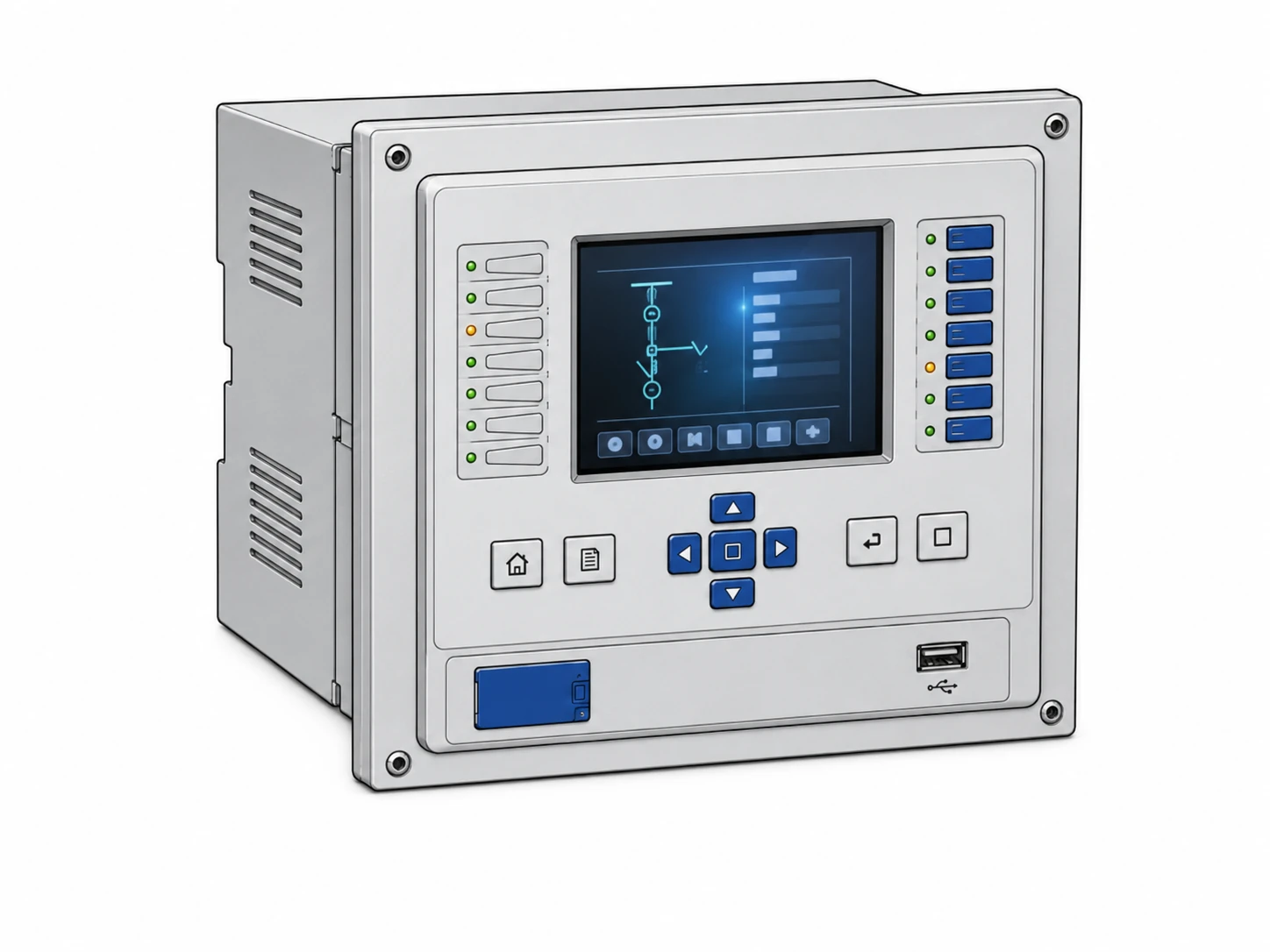
Relays range from small plug-in electromechanical devices and solid-state relays to microprocessor protective relays used in power systems. Selecting the right relay requires more than matching coil voltage: engineers also check contact arrangement, AC/DC switching rating, load type, inrush, isolation, timing, environment, failure mode, and the consequence of incorrect operation.
Relay at a Glance
How an Electrical Relay Works
A relay separates the input or control side from the output or switched side. The input changes the relay state; the contacts or electronic output then control another circuit.
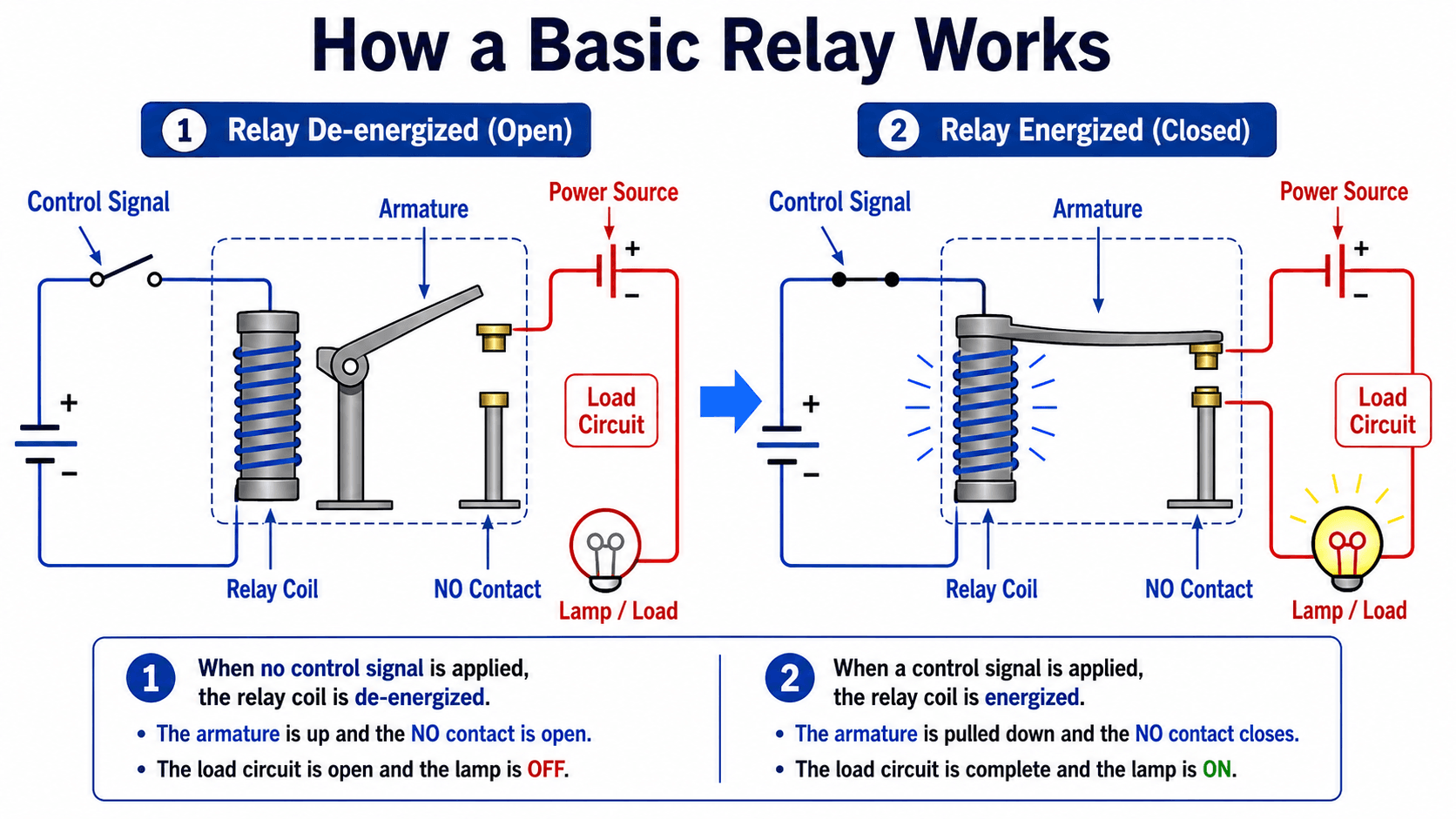
A control voltage, current, digital signal, or measured electrical condition tells the relay to operate.
An electromechanical relay moves contacts; a solid-state or digital relay uses semiconductor logic and outputs.
The relay opens, closes, transfers, alarms, interlocks, or commands another device or circuit.
Electromechanical Relay Operation
When the coil is energized, magnetic force moves an armature. The armature changes one or more contacts from their normal state. When the coil is de-energized, a spring or magnetic arrangement returns the contacts to their normal position unless the relay is designed to latch.
Why Relays Are Useful
A relay can provide galvanic isolation, voltage-level separation, additional contacts, logic, and a clear control boundary. For example, a 24 VDC PLC output may energize an interposing relay whose contacts switch a 120 VAC control circuit.
A relay is a control or decision device. It is not automatically a circuit breaker, fuse, contactor, overload device, or fault-current interrupting device.
Relay Parts and Internal Construction
A basic electromechanical relay contains a coil, magnetic core, armature, spring or return mechanism, movable contact, fixed contacts, terminals, and an insulating body. Understanding those parts makes relay symbols and failure modes much easier to interpret.
| Part | Function | Common issue |
|---|---|---|
| Coil | Creates magnetic field when energized | Wrong voltage, overheating, open winding |
| Core / yoke | Concentrates magnetic flux | Corrosion, contamination, residual magnetism |
| Armature | Moves when magnetic force develops | Sticking, wear, mechanical misalignment |
| Contacts | Open, close, or transfer the output circuit | Pitting, welding, oxidation, contact bounce |
| Spring / return | Returns contacts to normal state | Fatigue or changed pickup/dropout behavior |
| Auxiliary indication | Shows relay state in some designs | Indication can disagree with actual field circuit if wiring is wrong |
Swipe horizontally to view all table columns.
Relay Contacts, NO/NC Logic, and Common Contact Arrangements
Relay contacts are described in their normal, de-energized state. A normally open contact closes when the relay operates; a normally closed contact opens when the relay operates.
| Contact type | Meaning | Typical use |
|---|---|---|
| NO / Form A | Open when de-energized; closes on operation | Turn on a load, alarm, permissive, or command after relay pickup |
| NC / Form B | Closed when de-energized; opens on operation | Fail-safe logic, shutdowns, permissives, loss-of-power indication |
| Changeover / Form C | One common transfers between NC and NO contacts | Status transfer, alarm logic, circuit selection |
| SPST | Single pole, single throw | Simple on/off switching of one circuit |
| SPDT | Single pole, double throw | One common transfers between two paths |
| DPDT | Double pole, double throw | Two isolated circuits transfer together |
Swipe horizontally to view all table columns.
What “Normally” Means
“Normally” means the relay is in its normal de-energized or unoperated condition unless a schematic or manufacturer specifically defines another reference state. This matters because many safety and shutdown circuits depend on what happens when control power is lost.
Contact Logic Is Not Contact Rating
A contact symbol only shows switching logic. It does not prove the contact can safely make, carry, or break the connected load. The load may be resistive, inductive, capacitive, lamp, motor, solenoid, DC coil, or electronic, and those loads can impose very different switching stress.
Common Types of Electrical Relays
The correct relay type depends on whether the job is simple switching, isolation, timing, latching, high-frequency switching, monitoring, overload response, or power-system protection.
| Relay type | Best fit | Important tradeoff |
|---|---|---|
| Electromechanical relay | General control, interlocks, isolation, auxiliary logic | Contacts wear and switching speed is limited by mechanical motion |
| Solid-state relay | Fast or frequent switching with no moving contacts | Leakage current, semiconductor heat, transient sensitivity, AC/DC output limits |
| Interposing relay | PLC isolation, voltage-interface changes, extra contacts | Adds another device, wiring point, and failure mode |
| Time-delay relay | Sequencing, delayed start/stop, alarms, process logic | Pickup/dropout timing must match the application |
| Latching relay | Retaining state after the input signal is removed | Reset method and fail-safe behavior must be deliberate |
| Reed relay | Low-current instrumentation and small-signal switching | Not intended for high-energy load switching |
| Thermal / overload relay | Motor and equipment overload protection | Responds to overload/thermal behavior rather than high-speed short-circuit duty |
| Protective relay | Feeders, transformers, buses, generators, motors, lines | Requires sensing inputs, settings, testing, coordination, and a trip path |
Swipe horizontally to view all table columns.
IEC 61810-1 provides general and safety requirements for electromechanical elementary relays used in low-voltage equipment and covers applications across industrial control, automation, telecommunications, transportation, and other electrical/electronic systems: IEC 61810-1.
Electromechanical Relay vs. Solid-State Relay
Electromechanical relays provide physical contacts and clear galvanic separation; solid-state relays eliminate moving contacts but introduce semiconductor leakage, heat, voltage drop, and different failure behavior.
| Characteristic | Electromechanical relay | Solid-state relay |
|---|---|---|
| Switching element | Physical contacts moved by magnetic force | Semiconductor output device |
| Mechanical wear | Contacts and moving parts wear over time | No mechanical contact wear |
| Switching speed | Usually slower, may have contact bounce | Usually faster and suitable for frequent switching |
| Off-state behavior | Open contacts can provide a physical air gap | May allow leakage current when commanded off |
| Heat | Coil heating plus contact losses | Output semiconductor voltage drop can create significant heat |
| Failure mode | May fail open, chatter, stick, or weld contacts | May fail shorted, leak current, or overheat |
| Best use | General-purpose control, isolation, auxiliary switching | High-cycle, quiet, fast switching where thermal design is acceptable |
Swipe horizontally to view all table columns.
Solid-state relays are not automatically superior. The correct choice depends on switching frequency, load type, leakage tolerance, heat dissipation, isolation, expected life, failure mode, and whether the output is AC- or DC-rated.
Relay Ratings That Matter in Real Circuits
Relay selection fails most often when only the nominal coil voltage and contact current are checked. The actual application may be limited by switching voltage, inrush, inductive energy, DC arc behavior, temperature, duty cycle, or insulation.
Nominal AC or DC voltage, pickup, dropout, coil burden, tolerance, and control-power source.
Make, carry, and break rating; AC/DC voltage; resistive versus inductive duty; inrush; electrical life.
Coil-to-contact insulation, contact-to-contact separation, creepage, clearance, and application voltage.
Ambient temperature, panel temperature rise, vibration, moisture, contamination, enclosure, and altitude.
| Rating / condition | What to verify | Why it matters |
|---|---|---|
| Coil voltage | Nominal voltage, AC/DC type, pickup and dropout range | Wrong voltage can cause chatter, failure to pick up, nuisance dropout, or overheating |
| Contact voltage | Maximum rated switching voltage for AC or DC | DC arcs are harder to interrupt; AC and DC ratings are not interchangeable |
| Contact current | Make, carry, and break current—not only steady current | A contact may carry a current safely but be unable to interrupt it repeatedly |
| Load type | Resistive, inductive, capacitive, lamp, solenoid, motor, electronic | Inrush and stored energy can be much more severe than steady-state current |
| Electrical life | Expected operations at the actual load category | Mechanical life can greatly exceed electrical life under load |
| Temperature | Relay and enclosure temperature under continuous operation | Coil and semiconductor heating can reduce margin and life |
Swipe horizontally to view all table columns.
IEC 61810-1 addresses general functional and safety requirements for electromechanical elementary relays, while IEC 61810-10 adds requirements for high-capacity relay applications including energy storage, solar PV, EV, battery, and power-electronic systems: IEC 61810-1 and IEC 61810-10.
Control Relays vs. Protective Relays
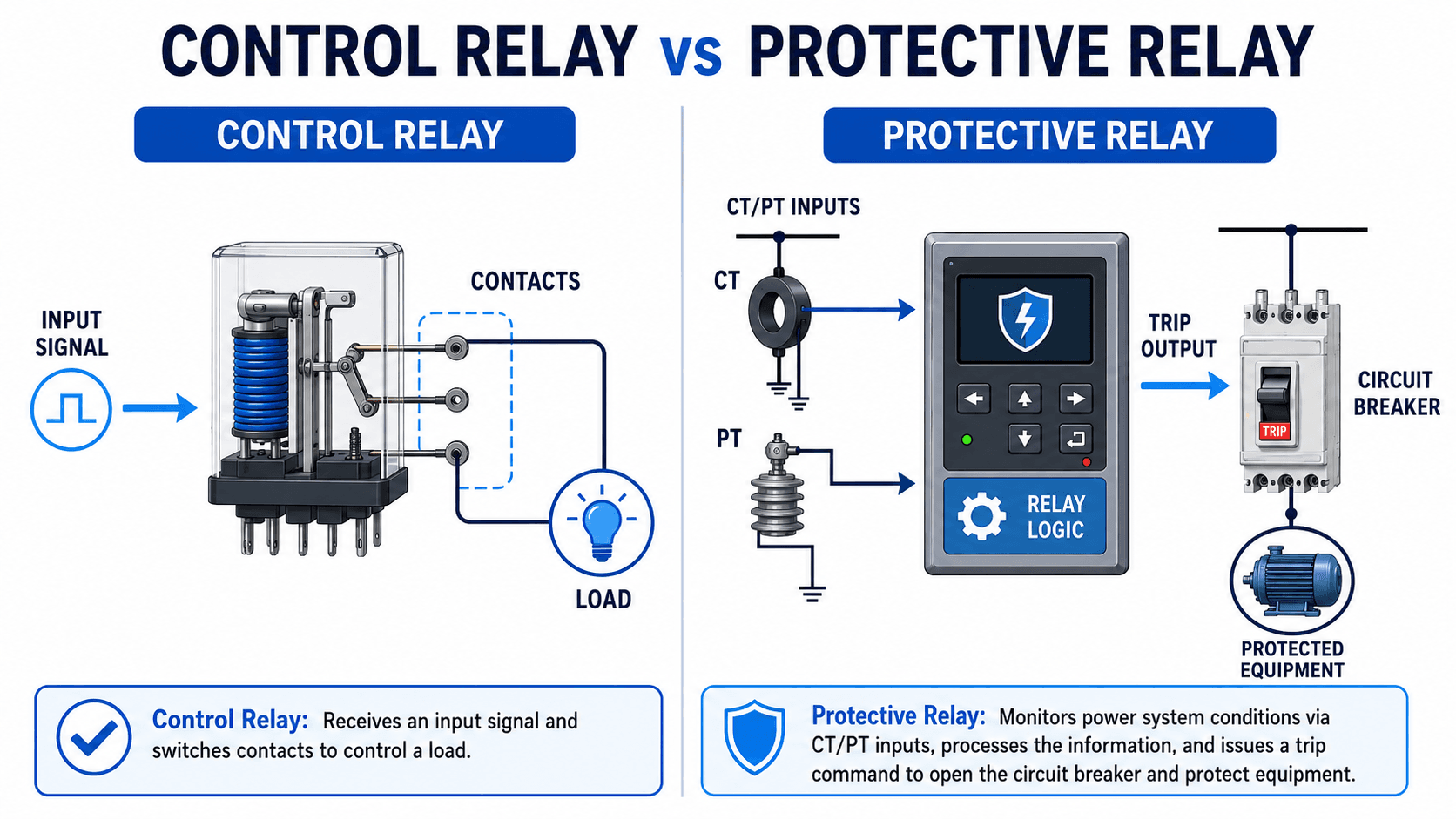
A control relay normally switches auxiliary logic or smaller control circuits. A protective relay measures power-system quantities, applies protection logic, and commands a breaker or other interrupting device when abnormal conditions are detected.
| Category | Control relay | Protective relay |
|---|---|---|
| Primary purpose | Switch, isolate, interlock, or multiply control signals | Detect abnormal system conditions and initiate protection action |
| Typical inputs | PLC output, selector switch, limit switch, permissive, control voltage | CTs, VTs/PTs, frequency, impedance, digital status, communications |
| Typical outputs | Contacts to lamps, contactor coils, PLC inputs, alarms, interlocks | Trip, alarm, lockout, reclosing, blocking, communications, event records |
| Engineering focus | Contact duty, isolation, control logic, coil voltage, timing | Protected zone, settings, CT/VT performance, coordination, trip circuit, testing |
Swipe horizontally to view all table columns.
For detailed coverage of 50/51, 67, 87, 21, 27/59, 81, synch-check, reclosing, relay zones, settings, and coordination, see the dedicated Protective Relays guide.
IEC 60255-1:2022 establishes common requirements for measuring relays and protection equipment used in power-system protection, including protection schemes that incorporate control, monitoring, communications, and process-interface equipment: IEC 60255-1:2022.
Relay vs. Circuit Breaker vs. Contactor vs. Fuse
Relays decide, signal, isolate, or switch control-level circuits; breakers, contactors, and fuses are selected primarily for interrupting or repeatedly switching power circuits.
| Device | Primary job | Typical relationship to a relay |
|---|---|---|
| Relay | Sensing, logic, isolation, auxiliary switching, or trip command | May directly switch a small rated load or command another device |
| Circuit breaker | Open a power circuit and interrupt current within its rating | Protective relay commonly sends the trip command |
| Contactor | Repeatedly switch motors, heaters, lighting, or other power loads | Relay may energize the contactor coil or provide interlocks |
| Fuse | Open once when overcurrent melts the fuse element | Relay may coordinate with fuses but does not replace their interrupting function |
| Recloser | Detect and interrupt distribution faults and automatically reclose | Modern reclosers integrate relay logic and power interruption in one assembly |
Swipe horizontally to view all table columns.
Do not assume a relay contact can replace a contactor or breaker simply because its current rating appears high enough. Switching category, inrush, fault duty, DC arc behavior, endurance, and applicable product ratings all matter.
How to Select and Review a Relay
Relay selection should begin with the job the relay must perform and the consequence of wrong operation, then work through the input, output duty, logic, environment, and testing requirements.
- Define the relay function.
Decide whether the relay is switching a load, isolating a PLC output, multiplying contacts, timing a sequence, latching an alarm, monitoring a condition, or performing power-system protection.
- Verify the input or coil.
Check AC/DC type, nominal voltage, pickup, dropout, control-power source, burden, and what happens during undervoltage or loss of control power.
- Verify the output duty.
Check make, carry, and break current; AC/DC voltage; load category; inrush; inductive energy; switching frequency; and electrical life.
- Confirm contact logic and failure state.
Determine the correct NO/NC arrangement and whether loss of control power should create an alarm, shutdown, trip, permissive removal, or no action.
- Check environment and isolation.
Verify temperature, enclosure, vibration, contamination, isolation voltage, creepage/clearance requirements, and whether circuits use different grounding references.
- Plan testing and maintenance.
Consider indication, removable terminals, test switches, spare contacts, replacement availability, event records, and how the complete controlled circuit will be functionally tested.
Example: PLC Output Driving a Solenoid Valve
- Input: A 24 VDC PLC output is available.
- Load: The field solenoid uses a different control voltage and is inductive.
- Decision: Use an interposing relay only if its coil matches the PLC and its contacts are explicitly rated to switch the solenoid voltage and inductive current.
- Check: Review coil suppression or load suppression so inductive switching transients do not damage the PLC output or relay contacts.
A relay can appear to operate correctly at the device while the controlled system still fails because of loose terminals, blown control fuses, weak DC station batteries, failed trip coils, welded contacts, wrong CT/VT wiring, or incorrect field logic. Functional testing should verify the complete signal-to-action path.
Common Relay Failure Modes and Troubleshooting Clues
Relay failures can be electrical, mechanical, thermal, or logic-related. The relay itself may be healthy while the controlled circuit still fails because of control power, wiring, field devices, or the device being commanded.
| Symptom | Possible cause | What to check |
|---|---|---|
| Relay will not pick up | Low coil voltage, open coil, wrong coil rating, failed driver | Measure coil voltage, check polarity where applicable, verify coil resistance and control source |
| Relay chatters | Marginal coil voltage, unstable supply, mechanical problem | Pickup/dropout voltage, control supply, loose wiring, vibration |
| Contacts weld closed | Excess make current, wrong load category, arc damage | Inrush, contact rating, suppression, switching frequency |
| Contacts fail to conduct | Pitting, oxidation, contamination, low contact force | Contact resistance and physical condition |
| SSR leaks when off | Normal semiconductor leakage or failed output device | Off-state leakage spec, load sensitivity, output condition |
| Protective relay trips incorrectly | Settings, CT/VT wiring, logic, communication, process input issue | Event report, oscillography, wiring, settings, test results |
Swipe horizontally to view all table columns.
Relay Engineering References
The relevant standard depends on the relay category. Elementary control relays and power-system protective relays are not evaluated under the same application requirements.
- IEC 61810-1 — Electromechanical Elementary RelaysGeneral and safety requirements for electromechanical elementary relays incorporated into low-voltage equipment.
- IEC 61810-10 — High-Capacity Electromechanical RelaysAdditional requirements for high-capability relay applications, including energy storage, solar PV, EV, battery, and power-electronic systems.
- IEC 60255-1:2022 — Measuring Relays and Protection EquipmentCommon requirements for measuring relays and power-system protection equipment.
- NERC — Protection and Control StandardsCurrent reliability requirements affecting protection systems on the Bulk Electric System, including maintenance, coordination, relay performance, and misoperations.
Frequently Asked Questions
What is a relay in electrical engineering?
A relay is an electrically controlled switching or decision device. It uses an input signal to change one or more output contacts or electronic outputs so another circuit can be switched, isolated, interlocked, alarmed, or commanded.
What is the difference between NO and NC relay contacts?
A normally open contact is open when the relay is de-energized and closes when it operates. A normally closed contact is closed when the relay is de-energized and opens when it operates.
What is the difference between a relay and a circuit breaker?
A relay senses, switches, or makes a control decision. A circuit breaker opens a power circuit and interrupts current within its rating. In protection systems, the relay often detects the fault and sends a trip command to the breaker.
What is the difference between a control relay and a protective relay?
A control relay normally switches auxiliary logic, interlocks, contactor coils, indicators, or small control loads. A protective relay measures power-system quantities and applies protection logic to determine whether to trip or alarm.
Are solid-state relays better than electromechanical relays?
Not universally. Solid-state relays offer fast, quiet, high-cycle switching without moving contacts, but they can have leakage current, heat-dissipation requirements, transient sensitivity, and different failure modes. Electromechanical relays remain useful where physical contacts, isolation, low off-state leakage, or general control flexibility matter.
Why do relay contacts have different AC and DC ratings?
DC is generally harder to interrupt because current does not naturally cross zero every half-cycle as AC does. The arc can persist longer, so the same relay contact may have a lower DC switching rating than its AC rating.
What does a relay do in a circuit?
A relay uses an electrical input to change an output state. Depending on the design, it may open or close contacts, transfer between contacts, provide isolation, create an interlock, add timing, or issue a trip or alarm command.
Why use a relay instead of a switch?
A relay lets one electrical signal control another circuit remotely or automatically. It can also provide isolation, multiple contacts, voltage-level interfacing, logic, and fail-safe control that a simple manual switch cannot provide.
Can a relay switch DC loads?
Yes, but only within its published DC switching ratings. DC arcs are harder to extinguish than AC arcs, so a relay may have a much lower DC break rating than its AC rating.
What causes relay contacts to weld?
High inrush current, excessive make or break current, inductive or capacitive loads, contact bounce, insufficient suppression, or switching beyond the relay’s rated electrical life can weld or severely damage contacts.
Summary and Next Step
Relays provide controlled switching, isolation, logic, timing, and protection interfaces. The simplest relay uses a coil and contacts; more advanced relays use semiconductor or microprocessor logic.
For practical selection, define the relay’s job first, then verify input voltage, NO/NC logic, switching duty, AC/DC contact rating, inrush, isolation, timing, environmental conditions, expected life, failure mode, and testing requirements.