
Direct Answer
A mechanical engineering degree is a bachelor-level engineering program that prepares students to analyze, design, build, test, and improve physical systems, machines, mechanical components, and thermal-fluid systems. Typical coursework includes calculus, physics, statics, dynamics, mechanics of materials, thermodynamics, fluid mechanics, heat transfer, manufacturing, controls, CAD, laboratories, and a senior design project.
For most U.S. engineering roles, the standard entry path is a bachelor’s degree. When comparing programs, the most important checks are ABET accreditation, curriculum depth, labs and design projects, internship or co-op access, technical electives, cost, and whether the program fits the career path you want.
What Is a Mechanical Engineering Degree?
A mechanical engineering degree teaches students to use mathematics, science, engineering analysis, design, experimentation, and modern engineering tools to solve problems involving physical systems.
Mechanical engineering is broader than engines or machine parts. The discipline covers forces and motion, materials, heat, fluids, energy conversion, manufacturing, controls, testing, and mechanical design. A graduate might work on a pump, HVAC system, robot, aircraft mechanism, manufacturing line, battery cooling system, medical device, turbine, vehicle subsystem, or consumer product.
Common degree names
Schools may award a Bachelor of Science in Mechanical Engineering, Bachelor of Engineering, BSME, BSE, or a similarly named degree. The exact title matters less than the actual curriculum, accreditation status, and the technical experiences the program provides.
What the degree prepares you to do
The degree is designed to prepare students for professional engineering work: defining requirements, analyzing systems, selecting materials, creating designs, using computational tools, conducting experiments, interpreting data, communicating technical results, and making decisions under real constraints such as safety, manufacturability, cost, reliability, and environmental impact.
Education and occupation context: U.S. Bureau of Labor Statistics — Mechanical Engineers identifies a bachelor’s degree as the typical entry-level education for mechanical engineers.
Mechanical Engineering Degree Curriculum
A strong mechanical engineering curriculum combines mathematics and basic science with engineering mechanics, thermal-fluid systems, design, manufacturing, experimentation, computing, and a major capstone design experience.
Course names differ by school, but the progression is usually similar because advanced mechanical engineering subjects depend on earlier mathematics, physics, and engineering fundamentals.
| Curriculum area | Common courses | What students learn to do | Where it is used |
|---|---|---|---|
| Mathematics & basic science | Calculus, multivariable calculus, differential equations, physics, chemistry, statistics | Model physical behavior quantitatively and solve engineering problems. | Every upper-level mechanical engineering subject. |
| Engineering mechanics | Statics, dynamics, mechanics of materials | Analyze forces, motion, stress, strain, deformation, stiffness, and failure risk. | Structures, machines, mechanisms, vehicles, equipment, and product design. |
| Thermal-fluid systems | Thermodynamics, fluid mechanics, heat transfer | Analyze energy, pressure, flow, temperature, efficiency, and thermal performance. | HVAC, energy, engines, pumps, turbines, cooling systems, and process equipment. |
| Design & manufacturing | CAD, machine design, manufacturing processes, materials, tolerances, design projects | Turn requirements and analysis into buildable parts, assemblies, and systems. | Product development, machinery, automation, aerospace, automotive, and manufacturing. |
| Controls & computing | Dynamic systems, controls, programming, numerical methods, mechatronics | Model dynamic behavior, process data, automate calculations, and control systems. | Robotics, automation, vehicles, test systems, smart products, and simulation. |
| Labs & capstone | Measurements, instrumentation, experiments, senior design, technical communication | Compare theory with real data and complete an open-ended engineering project. | Testing, validation, design reviews, reports, presentations, and team-based engineering work. |
Swipe horizontally to view all table columns.
What ABET requires in an accredited engineering curriculum
For the 2026–2027 accreditation cycle, ABET’s Engineering Accreditation Commission requires at least 30 semester credit hours of college-level mathematics and basic sciences, at least 45 semester credit hours of engineering topics, a broad-education component, and a culminating major engineering design experience. ABET does not prescribe a single fixed list of course titles.
Mechanical-engineering-specific content
ABET’s mechanical and similarly named engineering criteria require mathematics including multivariable calculus and differential equations; application of engineering, science, and mathematics to modeling, analysis, design, and realization of physical systems; coverage of both thermal and mechanical systems; and in-depth coverage of at least one of those system areas.
Accreditation criteria: ABET — Criteria for Accrediting Engineering Programs, 2026–2027 defines the current general curriculum requirements for accredited engineering programs; ABET’s mechanical-program criteria define discipline-specific coverage.
How Long Does a Mechanical Engineering Degree Take, and How Hard Is It?
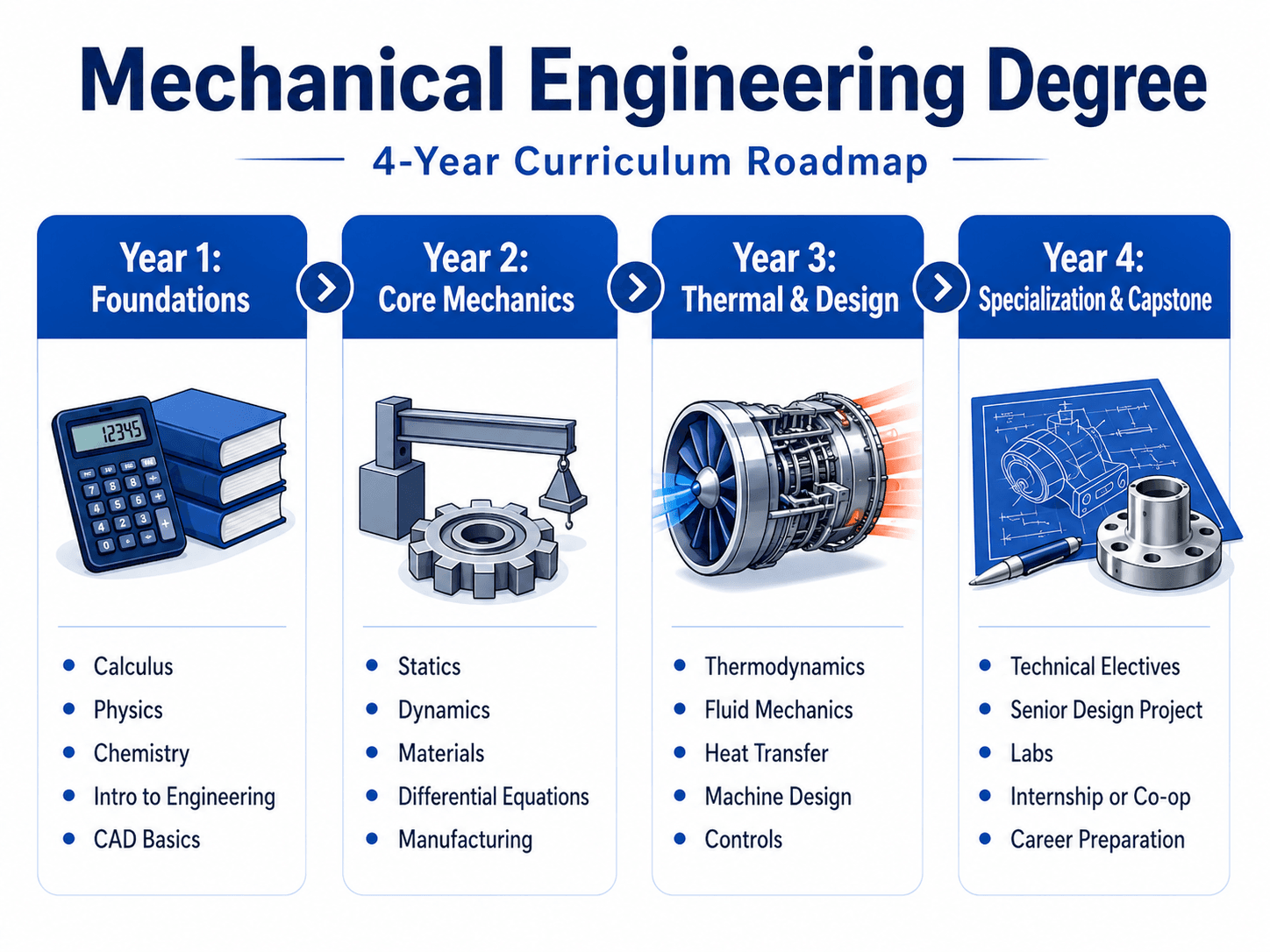
A mechanical engineering bachelor’s degree is commonly planned as a four-year full-time program, but prerequisite chains, co-ops, transfers, part-time enrollment, repeated courses, and added minors can extend the timeline.
Year 1: Foundations
Calculus, physics, chemistry, introductory engineering, computing, and general education establish the math and science base for later courses.
Years 2–3: Core Engineering
Statics, dynamics, mechanics of materials, thermodynamics, fluids, heat transfer, manufacturing, controls, and laboratories make the curriculum significantly more technical.
Year 4: Design & Specialization
Machine design, electives, advanced labs, and capstone projects combine earlier subjects into more open-ended engineering work.
Why mechanical engineering is considered difficult
The major is challenging because courses build on one another. A student may need calculus and physics before statics, statics before mechanics of materials, and thermodynamics and fluids before later thermal-system courses. Problems also become less structured over time: students must choose assumptions, define systems, interpret results, and justify designs rather than only substitute numbers into equations.
| Challenge | Why it is difficult | Best response |
|---|---|---|
| Calculus & physics | They support nearly every later analytical subject. | Strengthen algebra, trigonometry, units, and problem setup early. |
| Statics & dynamics | Students must convert real objects into idealized force and motion models. | Draw clear diagrams before writing equations. |
| Thermodynamics & fluids | Problems rely on assumptions, control volumes, properties, and physical interpretation. | Focus on the physical system and track units carefully. |
| Design courses | Several constraints can be valid at once, and there may be no single correct design. | Practice tradeoffs among strength, cost, manufacturability, safety, and reliability. |
| Capstone projects | They combine teamwork, schedule, budget, design, testing, and communication. | Develop project, CAD, testing, and documentation habits before senior year. |
Mechanical engineering becomes more manageable when students treat the curriculum as one connected system. Statics, materials, thermodynamics, fluids, manufacturing, controls, and CAD eventually meet inside the same real design problem.
ABET Accreditation and Mechanical Engineering Program Quality
For U.S. students, verify the exact program first, then compare the technical experiences that determine how well the degree prepares you for engineering work.
Program-level accreditation and the exact campus, degree title, and delivery format.
Curriculum, labs, capstone, faculty depth, electives, internship access, and employer recruiting.
The program supports your intended career, graduate-school, transfer, or licensure path.
- Step 1: Verify the specific mechanical engineering program—not only the institution—is accredited if accreditation matters for your goals.
- Step 2: Compare the curriculum against the technical areas you want to study.
- Step 3: Review laboratory facilities, capstone expectations, student design teams, internships, co-ops, and career fairs.
- Step 4: Compare total cost, transfer rules, graduation timeline, and likely employer access before deciding.
ABET accreditation applies to specific programs, not simply to an entire university. Confirm the exact program name and campus or delivery format in the official ABET program search when accreditation affects your decision.
Mechanical Engineering vs. Mechanical Engineering Technology
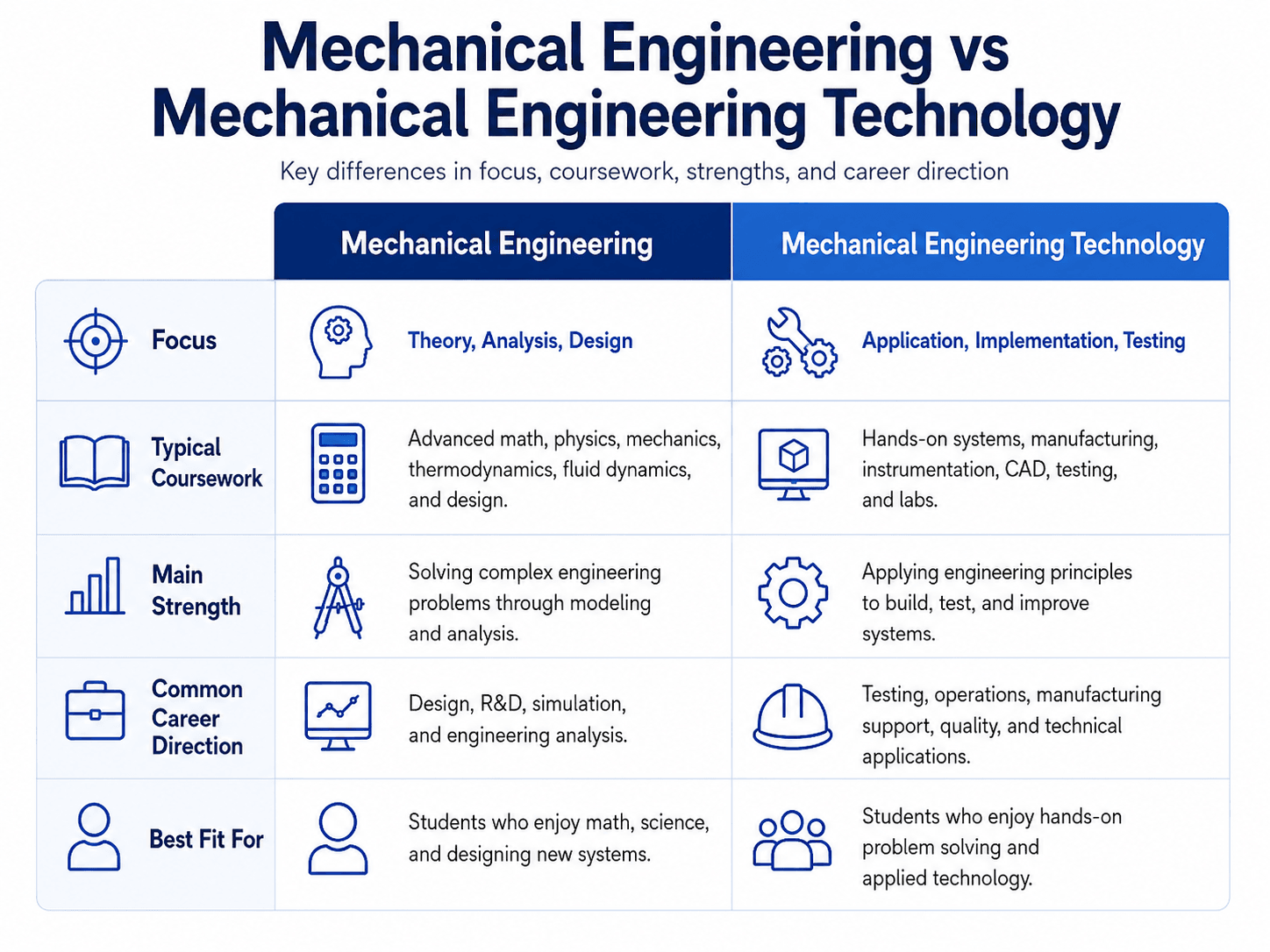
Mechanical engineering generally emphasizes deeper mathematical analysis, modeling, and engineering design, while mechanical engineering technology generally emphasizes application, implementation, testing, manufacturing, instrumentation, and hands-on systems.
| Area | Mechanical Engineering | Mechanical Engineering Technology | Why the difference matters |
|---|---|---|---|
| Math & theory | Typically more calculus, differential equations, modeling, and analytical depth. | Typically more application-focused math and technical implementation. | Can affect access to analysis-heavy, R&D, graduate-study, or certain licensure paths. |
| Design emphasis | Strong emphasis on analysis and engineering design decisions. | Strong emphasis on application, realization, testing, and operation. | Employers may map the degrees to different job families. |
| Hands-on emphasis | Labs and projects are important but balanced with analytical coursework. | Often more directly oriented toward equipment, instrumentation, manufacturing, and implementation. | May better fit students who prefer highly applied technical work. |
| Career fit | Design, analysis, R&D, thermal systems, product development, systems engineering. | Testing, manufacturing support, installation, maintenance, technical sales, implementation. | The exact role depends on employer, degree level, experience, and local regulations. |
Swipe horizontally to view all table columns.
Program emphasis: ABET — Criteria for Accrediting Engineering Technology Programs, 2026–2027 describes mechanical engineering technology programs as emphasizing practical knowledge, problem solving, hands-on skills, design, installation, manufacturing, testing, maintenance, and related mechanical-system work.
What Jobs Can You Get With a Mechanical Engineering Degree?
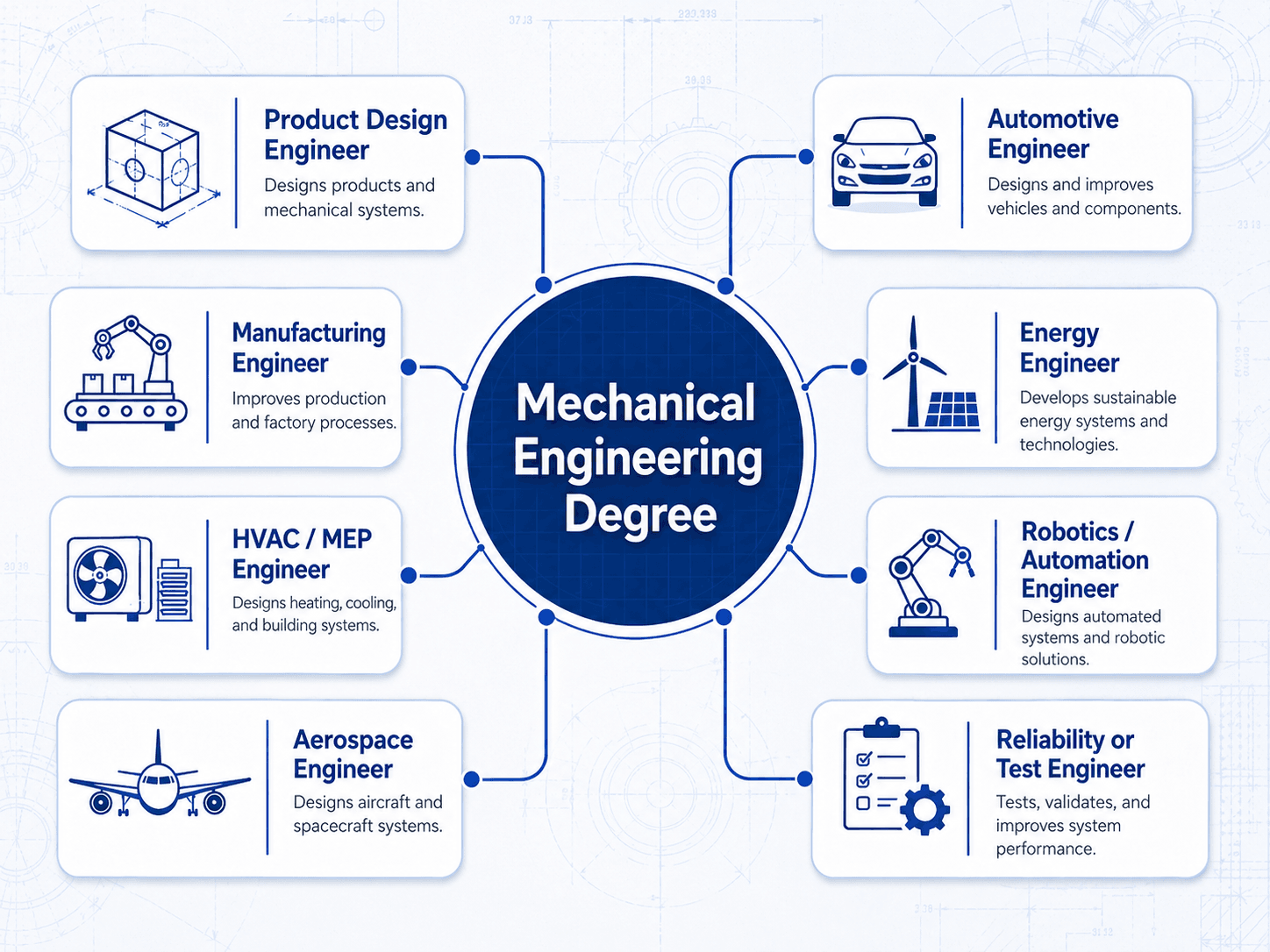
Mechanical engineering graduates can work across product design, manufacturing, aerospace, automotive, HVAC, energy, robotics, automation, reliability, testing, plant engineering, consulting, and project engineering.
| Career path | Typical work | Useful college preparation | Related Turn2Engineering topic |
|---|---|---|---|
| Mechanical design engineer | Parts, assemblies, mechanisms, housings, fixtures, drawings, design reviews. | CAD, machine design, GD&T, materials, tolerances, design teams. | Mechanical Design |
| Manufacturing engineer | Production processes, tooling, assembly, quality, automation, throughput. | Manufacturing processes, statistics, tooling, internships, shop-floor exposure. | Mechanical Engineering |
| HVAC / MEP engineer | Heating, cooling, ventilation, pumps, piping, and building mechanical systems. | Thermodynamics, fluids, heat transfer, energy, codes, and building systems. | HVAC Engineering |
| Robotics / automation engineer | Mechanisms, actuators, sensors, machines, automated equipment, testing. | Controls, mechatronics, programming, CAD, electronics basics, project teams. | Engineering Calculators |
| Reliability / test engineer | Validation, test plans, failure investigation, durability, root cause, data analysis. | Instrumentation, statistics, materials, testing labs, failure analysis. | Failure Mechanisms |
| Thermal / energy engineer | Heat transfer, cooling, energy systems, thermal performance, fluid systems. | Thermodynamics, heat transfer, fluids, numerical analysis. | Heat Transfer |
Swipe horizontally to view all table columns.
The degree opens the door, but internships, co-ops, electives, project teams, CAD or coding ability, testing experience, and industry exposure often determine which door opens first.
Mechanical Engineering Degree Salary and Job Outlook
Mechanical engineering offers a strong overall career outlook: BLS projects 9% employment growth from 2024 to 2034 and about 18,100 openings per year on average.
The latest May 2025 Occupational Employment and Wage Statistics release reports a mean annual wage of $113,610 for mechanical engineers and a median hourly wage of $50.05. The BLS Occupational Outlook Handbook currently displays a May 2024 median annual wage of $102,320, so the two BLS pages should not be treated as if they are from the same data year.
Does the degree guarantee a high salary?
No. Compensation varies by region, industry, specialization, employer, role level, internships, technical skills, and responsibility. A graduate who has strong co-op experience, CAD, testing, manufacturing exposure, and a project portfolio may enter the market differently from a graduate with only classroom experience.
Is a mechanical engineering degree worth it?
It can be a strong choice for students who want a broad technical career involving physical products, machines, energy systems, manufacturing, vehicles, buildings, automation, or hardware. The return depends heavily on program cost, graduation time, internships, project experience, and how intentionally the student builds a career direction.
Current wage and outlook data: BLS — National Employment and Wage Data, May 2025 reports May 2025 occupational wage statistics, while BLS — Mechanical Engineers, Occupational Outlook Handbook reports the 2024–2034 employment projection and currently displays May 2024 median annual pay.
How to Choose a Mechanical Engineering Degree Program
Compare programs using the factors that will affect graduation, technical development, internships, employer access, and total cost—not school name alone.
-
Verify the program
Confirm the exact degree title, campus, accreditation status, admission path, transfer policy, and required prerequisite sequence.
-
Read the curriculum
Compare mechanics, thermal-fluid systems, manufacturing, controls, CAD, computing, laboratories, electives, and capstone requirements.
-
Evaluate hands-on engineering
Look for student design teams, labs, prototyping, machine shops, testing facilities, senior design depth, internships, and co-ops.
-
Check employer access
Review career fairs, industry partnerships, regional employers, placement outcomes, and whether companies recruit directly from the program.
-
Compare total cost and fit
Consider tuition, housing, scholarships, likely graduation time, co-op impact, commute, class size, support, and whether the program fits your intended career.
Evidence: Clear accreditation status, rigorous curriculum, active labs, capstone work, internships, design teams, and employer recruiting.
Why it matters: These experiences build both engineering competence and evidence employers can evaluate.
If missing: Ask how students obtain equivalent experience before enrolling.
Evidence: Vague program details, unclear lab delivery, weak internship access, few technical electives, or unclear transfer/graduation requirements.
Why it matters: Hidden gaps can increase cost, delay graduation, or reduce career flexibility.
If present: Compare another program before committing.
Online Mechanical Engineering Degrees: What to Check
An online mechanical engineering degree can be viable, but students should verify accreditation, laboratory delivery, capstone requirements, transfer rules, and employer access before enrolling.
Mechanical engineering is not purely lecture-based. Measurement, instrumentation, laboratories, prototyping, testing, manufacturing exposure, and team design work matter. Online programs may handle these requirements through home lab kits, local partnerships, short campus residencies, transferred lab courses, or other arrangements.
Then: Verify exactly how labs, team projects, proctored exams, capstone work, and hands-on requirements are completed.
Then: Confirm how calculus, physics, chemistry, statics, dynamics, labs, and other prerequisites transfer before assuming the degree timeline.
- Accreditation: Verify the exact program and delivery format.
- Labs: Understand where and how required experimental work is completed.
- Capstone: Check whether students design, build, test, document, and present a major project.
- Internships: Ask how remote students access co-ops, career fairs, and employer recruiting.
- Transfer credits: Obtain written confirmation of accepted credits before committing.
Common Mistakes When Choosing a Mechanical Engineering Degree
- Choosing by university name alone: The actual program curriculum, labs, electives, cost, and employer access matter more than branding by itself.
- Failing to verify program-level accreditation: Accreditation applies to a specific program, not automatically to every degree at a university.
- Ignoring prerequisite chains: Missing one calculus, physics, or mechanics prerequisite can delay several later courses.
- Waiting until senior year for experience: Internships, co-ops, design teams, CAD, programming, testing, and manufacturing exposure are much more useful when built over several years.
- Assuming ME and MET are interchangeable everywhere: Employers, graduate programs, and licensing rules may treat the degrees differently.
- Choosing electives randomly: Electives are one of the best ways to build depth toward design, energy, aerospace, robotics, manufacturing, HVAC, controls, or testing.
Mechanical Engineering Degree References
These references support the education, accreditation, curriculum, wage, and employment-outlook information used on this page.
- ABET — Criteria for Accrediting Engineering Programs, 2026–2027 Current general engineering curriculum criteria and accreditation requirements.
- ABET — Criteria for Accrediting Engineering Technology Programs, 2026–2027 Current engineering technology criteria, including mechanical engineering technology program emphasis.
- U.S. Bureau of Labor Statistics — Mechanical Engineers Typical entry-level education, occupational context, licensure information, and 2024–2034 employment outlook.
- U.S. Bureau of Labor Statistics — National Employment and Wage Data, May 2025 Current national employment, mean wage, and median hourly wage data for mechanical engineers.
Frequently Asked Questions
What is a mechanical engineering degree?
A mechanical engineering degree is a bachelor-level engineering program focused on analyzing and designing physical systems. Coursework typically includes advanced math, mechanics, materials, thermodynamics, fluid mechanics, heat transfer, manufacturing, controls, CAD, labs, and capstone design.
How long does a mechanical engineering degree take?
Many U.S. bachelor’s programs are structured around four years of full-time study. Co-ops, transfers, prerequisite gaps, part-time attendance, repeated courses, minors, or dual degrees can extend the timeline.
Is a mechanical engineering degree hard?
Yes. The degree is demanding because the courses are cumulative and combine calculus, physics, modeling, laboratories, design, programming, technical communication, and open-ended problem solving. Strong fundamentals and consistent practice make the workload more manageable.
What jobs can you get with a mechanical engineering degree?
Common paths include mechanical design, manufacturing, HVAC, aerospace, automotive, energy, robotics, automation, reliability, testing, plant engineering, consulting, and project engineering.
Do I need an ABET-accredited mechanical engineering degree?
Not every mechanical engineering job legally requires an ABET-accredited degree, but accreditation can matter for employer screening, graduate study, and especially U.S. professional-licensure pathways. Verify the requirements for your intended career and jurisdiction.
Is mechanical engineering better than mechanical engineering technology?
Neither is universally better. Mechanical engineering is generally the more analytical and design-oriented path, while mechanical engineering technology is generally more application and implementation oriented. The better choice depends on the work you want to do and the degree requirements employers or licensing boards use in your target market.
Summary and Next Step
A mechanical engineering degree is a broad engineering pathway built around mechanics, thermal-fluid systems, materials, manufacturing, controls, experimentation, computing, and design. It can lead to careers across product development, manufacturing, aerospace, energy, HVAC, robotics, automation, testing, and reliability.
The strongest program is not automatically the most famous one. Compare accreditation, curriculum, labs, capstone work, internships, co-ops, employer access, electives, total cost, and fit with your intended career.