
Table of Contents
Introduction
Sensible heat changes air temperature, while latent heat is associated with a phase change and, in HVAC systems, usually means adding or removing moisture. Air conditioners remove sensible heat by lowering dry-bulb temperature and remove latent heat when water vapor condenses on a cold cooling coil.
A thermostat mainly responds to sensible temperature. It does not fully describe the moisture condition of the air. That is why a room can reach its temperature setpoint but still feel humid, clammy, or uncomfortable.
Key Takeaways
- Sensible heat: Changes dry-bulb temperature without changing the phase of water.
- Latent heat: Is associated with evaporation or condensation and changes the air’s moisture content.
- Total cooling load: Equals the sensible cooling load plus the latent cooling load.
- Equipment check: Nominal tonnage alone does not show whether a system can meet the required temperature and humidity loads.
How a Cooling Coil Removes Sensible and Latent Heat
Warm, humid return air can lose both temperature and moisture as it passes across an evaporator coil. The two effects occur through related but distinct processes.
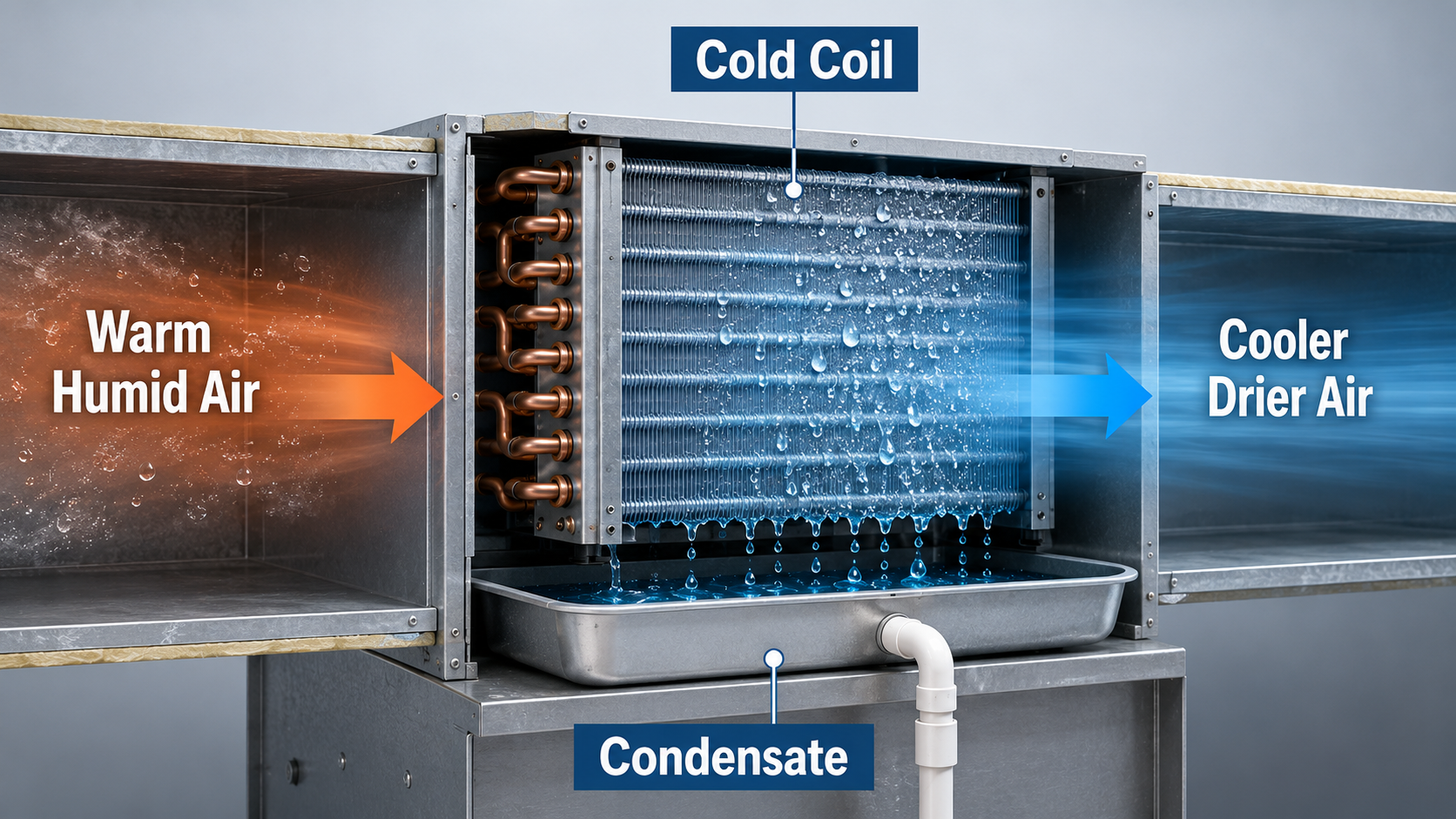
The water collected in the condensate pan is direct evidence of latent moisture removal. Cooling the air without producing condensation is primarily a sensible-cooling process.
Sensible Heat vs Latent Heat at a Glance
The fastest way to distinguish sensible heat from latent heat is to identify what changes. Sensible heat changes temperature. Latent heat accompanies a phase change and, in air-conditioning work, normally changes the amount of water vapor in the air.
| Characteristic | Sensible Heat | Latent Heat |
|---|---|---|
| Primary effect | Changes dry-bulb temperature | Accompanies a phase change and changes moisture content |
| Simple example | Cooling air from 80°F to 75°F without changing humidity ratio | Condensing water vapor into liquid water on a cooling coil |
| Observed with | Dry-bulb thermometer or temperature sensor | Humidity ratio, dew point, condensate rate, or moisture measurements |
| Typical building sources | Solar gain, envelope conduction, lights, motors, and electronics | Occupants, humid outdoor air, showers, cooking, pools, and wet processes |
| Cooling-coil effect | Lowers the temperature of the airstream | Condenses water vapor and lowers humidity ratio |
| Psychrometric direction | Horizontal at constant humidity ratio | Vertical in an idealized constant-temperature moisture change |
Most real buildings and HVAC processes involve both load types at the same time. Occupants, ventilation air, infiltration, cooking, and many industrial processes add a combination of temperature and moisture load.
If only dry-bulb temperature changes, the process is primarily sensible. If water evaporates or condenses, latent heat is involved. If temperature and moisture both change, the process has both sensible and latent components.
What Is Sensible Heat?
Sensible heat is thermal energy that causes a measurable temperature change without causing a phase change. Adding sensible heat raises dry-bulb temperature. Removing sensible heat lowers it.
The word sensible refers to the fact that the temperature effect can be directly sensed or measured. In a building, sensible gains heat the air, walls, floors, furnishings, equipment, and other surfaces.
Common Sources of Sensible Cooling Load
- Solar radiation: Sunlight heats windows, floors, walls, roofs, and interior surfaces.
- Envelope conduction: Heat moves through roofs, walls, doors, windows, and other assemblies.
- Lighting: Electrical input ultimately becomes heat within or near the conditioned space.
- Dry equipment: Computers, motors, appliances, transformers, and process equipment release heat.
- Occupants: People release sensible body heat in addition to latent moisture.
- Outdoor air: Ventilation and infiltration add sensible load when outdoor air is warmer than indoor air.
Simple Sensible-Heat Example
Suppose air enters a cooling device at 80°F and leaves at 75°F while its humidity ratio remains unchanged. The temperature reduction represents sensible cooling because the air has not lost moisture.
Building sensible loads are closely related to the conduction, convection, and radiation processes described in the Turn2Engineering guide to heat transfer.
What Is Latent Heat?
Latent heat is energy absorbed or released during a phase change. For HVAC applications, the most important phase changes are evaporation of liquid water into vapor and condensation of water vapor into liquid.
Water absorbs latent energy when it evaporates. That energy is released when the vapor condenses. A cooling coil must remove this released energy while collecting and draining the condensed water.
Common Sources of Latent Cooling Load
- Occupants: Breathing and perspiration release water vapor into the space.
- Outdoor ventilation air: Humid outside air may contain substantially more moisture than the indoor design condition.
- Infiltration: Uncontrolled air leakage transports outdoor moisture through the building envelope.
- Cooking and dishwashing: Steam, boiling, and evaporation increase indoor moisture.
- Showers and wet rooms: Warm water evaporates and becomes a latent load.
- Pools and open water: Continuous surface evaporation can create a major dehumidification requirement.
- Commercial and industrial processes: Washing, drying, food preparation, and other wet processes may dominate the latent load.
Latent Heat Is Not Simply Another Word for Humidity
Humidity describes how much water vapor is present or how close the air is to saturation. Latent heat describes the energy associated with changing the phase or quantity of that moisture. The concepts are connected, but they are not interchangeable.
A thermostat may show the correct temperature while occupants still feel clammy because the system has removed enough sensible heat but not enough moisture.
Sources of Sensible and Latent HVAC Loads
Classifying each load source correctly is the first step toward understanding the temperature and moisture requirements of a building.

The classification identifies the type of load, not the load magnitude. Actual heat and moisture gains still depend on climate, construction, occupancy, operating schedule, ventilation, infiltration, equipment use, and indoor design conditions.
Sensible or Latent? HVAC Load Classification Tool
Use this matrix as a first-pass check when reviewing the sources included in a cooling-load calculation.
| Load Source | Classification | What Changes | Review Check |
|---|---|---|---|
| Solar gain through glazing | Primarily sensible | Surface and air temperature | Check orientation, shading, glazing properties, and time of peak load. |
| Roof, wall, door, and window conduction | Primarily sensible | Temperature | Check area, thermal resistance, temperature difference, and thermal storage. |
| Lighting and dry electrical equipment | Primarily sensible | Temperature | Check actual wattage, diversity, usage, and whether heat leaves through another path. |
| Occupants | Both | Temperature and moisture | Check occupant count, activity level, schedule, and appropriate sensible-latent split. |
| Outdoor ventilation air | Usually both | Temperature and humidity ratio | Compare indoor and outdoor design states and verify outdoor-air quantity. |
| Infiltration | Usually both | Temperature and humidity ratio | Check envelope leakage, pressure relationships, door use, and exhaust airflow. |
| Cooking | Both | Temperature and moisture | Separate appliance heat from steam and evaporation; account for exhaust capture. |
| Showers, pools, and wet processes | Primarily latent, often with sensible load | Humidity ratio and sometimes temperature | Check evaporation rate, water temperature, surface area, covers, and exhaust. |
| Server room or data equipment | Primarily sensible | Temperature | Use actual electrical load and account for standby, redundancy, and heat rejection. |
A source classified as “both” must be separated into sensible and latent components. It should not be entered at its full value in both categories. Project design should use an accepted load-calculation method and documented assumptions.
Total Cooling Load and Sensible Heat Ratio
Total cooling load includes the energy required to lower temperature and the energy required to remove moisture.
- \(\dot{Q}_{total}\) Total cooling load or capacity, expressed in W, kW, Btu/h, or another consistent heat-rate unit.
- \(\dot{Q}_{sensible}\) Cooling rate associated with reducing dry-bulb temperature.
- \(\dot{Q}_{latent}\) Cooling rate associated with moisture removal and phase change.
The sensible heat ratio, commonly abbreviated SHR, is the sensible portion of the total load:
The corresponding latent fraction is:
How to Interpret SHR
A higher SHR means temperature reduction represents a larger share of the total cooling requirement. A lower SHR means moisture removal represents a larger share.
SHR is not a universal efficiency score. A high or low value is not automatically good or bad. The important question is whether the equipment’s available sensible and latent capacities match the building load at the expected operating conditions.
- Hot, dry climate: Sensible cooling commonly represents a larger portion of the total load.
- Hot, humid climate: Outdoor air and infiltration can create a larger latent requirement.
- High-performance envelope: Insulation and high-performance glazing may reduce sensible gains more than occupant and ventilation moisture loads.
- High occupancy: People can add substantial sensible heat and water vapor.
- Wet process: Pools, commercial kitchens, laundry areas, and industrial processes may require dedicated moisture control.
Do not select equipment using nominal total capacity alone. Review total capacity, sensible capacity, moisture-removal capability, airflow, entering-air condition, coil performance, and part-load operation.
Sensible and Latent Heat Equations
Mass-flow equations provide a consistent basis for evaluating air-side sensible, latent, and total cooling. All properties and units must use the same dry-air mass-flow basis.
Sensible Heat Equation
For an air stream with a known dry-air mass flow and a modest temperature range, sensible cooling can be approximated as:
- \(\dot{m}_{da}\) Dry-air mass flow rate, such as kg/s or lbm dry air/h.
- \(c_{p,ma}\) Specific heat of moist air per unit mass of dry air, using units consistent with the calculation.
- \(T_1-T_2\) Dry-bulb temperature reduction across the cooling process.
Approximate Latent Heat Equation
When the moisture-removal rate is known, the latent cooling rate may be approximated using the heat of vaporization:
- \(\dot{m}_{da}\) Dry-air mass flow rate.
- \(h_{fg}\) Latent heat of vaporization of water at the selected reference condition.
- \(\omega_1-\omega_2\) Decrease in humidity ratio, expressed as mass of water vapor per mass of dry air.
This latent expression is an approximation used to isolate the moisture-related portion of the load. A complete cooling-and-dehumidification process is more accurately evaluated from the moist-air enthalpy difference.
Total Cooling from Moist-Air Enthalpy
- \(h_1\) Entering moist-air enthalpy per unit mass of dry air.
- \(h_2\) Leaving moist-air enthalpy per unit mass of dry air.
The Turn2Engineering guide to enthalpy explains why enthalpy differences are useful for HVAC coils and other steady-flow thermal equipment.
Do not mix volumetric airflow with mass-flow equations unless air density is included. Also confirm whether enthalpy and humidity ratio are expressed per unit mass of dry air or per unit mass of moist air.
Sensible and Latent Heat on a Psychrometric Chart
A psychrometric chart plots dry-bulb temperature horizontally and humidity ratio vertically. The direction of movement between two state points shows how temperature and moisture change.

How to Read the Process Directions
- Move right: Sensible heating increases dry-bulb temperature without adding moisture.
- Move left: Sensible cooling lowers dry-bulb temperature while humidity ratio stays constant.
- Move up: Humidification increases humidity ratio.
- Move down: Dehumidification decreases humidity ratio.
- Move down and left: Cooling and dehumidification occur together.
Before condensation begins, cooling may move the air horizontally to the left. Once the air reaches its dew point and moisture starts condensing, the process moves toward both a lower dry-bulb temperature and a lower humidity ratio.
Relative-humidity curves are not constant moisture-content lines. Humidity ratio is read from the vertical scale, while relative humidity changes when temperature, moisture content, or both change.
Worked Example: Calculate Total Load and SHR
Assume a zone has a calculated sensible cooling load of 36,000 Btu/h and a latent cooling load of 12,000 Btu/h. These loads have already been separated using an appropriate load-calculation method.
- Identify the sensible load: \(\dot{Q}_{sensible}=36{,}000\ \text{Btu/h}\).
- Identify the latent load: \(\dot{Q}_{latent}=12{,}000\ \text{Btu/h}\).
- Calculate total load: \(\dot{Q}_{total}=36{,}000+12{,}000=48{,}000\ \text{Btu/h}\).
- Calculate SHR: \(SHR=36{,}000/48{,}000=0.75\).
- Calculate latent fraction: \(1-0.75=0.25\), so latent cooling represents 25% of the total load.
What the Result Means
The zone load is 75% sensible and 25% latent. The required total capacity is 48,000 Btu/h, which is equivalent to 4 tons of refrigeration using the conventional conversion of 12,000 Btu/h per ton.
However, selecting any nominal 4-ton unit would not complete the equipment review. The selected system must provide at least 36,000 Btu/h of sensible capacity and 12,000 Btu/h of latent capacity at the relevant entering-air condition, outdoor condition, and airflow.
For example, equipment that delivers 48,000 Btu/h total but only 8,000 Btu/h of latent capacity would not meet the example moisture load, even though its nominal total capacity appears adequate.
Compare building loads with manufacturer capacity data at the actual design condition. Do not compare only the building load to the unit’s model-name tonnage.
This example demonstrates the load split only. Final equipment selection also requires design airflow, entering dry-bulb and wet-bulb conditions, outdoor conditions, ventilation requirements, controls, and manufacturer performance data.
Common Sensible and Latent Heat Misconceptions
Several simplified explanations create confusion when they are applied to actual HVAC systems.
“Latent Heat Has Nothing to Do with Temperature”
Latent heat is associated with phase change rather than a direct dry-bulb temperature change. However, temperature still determines saturation, dew point, evaporation, condensation, and the amount of energy involved in real moisture-control processes.
“Relative Humidity Measures the Amount of Water in the Air”
Relative humidity expresses how close the air is to saturation at its current temperature. The same moisture content can produce different relative-humidity values at different temperatures. Humidity ratio or dew point is usually more useful for comparing actual moisture content.
“Enough Total Capacity Means the System Is Correctly Sized”
Total capacity can hide a poor sensible-latent split. A system may have adequate total capacity but insufficient moisture-removal capability, especially during humid or low-sensible-load conditions.
“A Larger Air Conditioner Controls Humidity Better”
Larger equipment may cool the space faster and shorten compressor runtime. Short cycles can reduce the amount of time available for steady condensate removal and worsen humidity control.
“Any Condensate Means Humidity Control Is Adequate”
Condensate confirms that some moisture is being removed. It does not prove that the removal rate is sufficient for the building load or that humidity remains controlled throughout the occupied period.
Why a Room Can Feel Cool but Humid
A cool but clammy room usually means the sensible load is being satisfied more effectively than the latent load. The thermostat reaches its setpoint before enough moisture has been removed.
Humidity Troubleshooting Sequence
- Confirm the complaint: Measure dry-bulb temperature, relative humidity, and preferably dew point with reliable instruments.
- Check operating time: Determine whether the compressor runs steadily or repeatedly short cycles.
- Review equipment sizing: Oversized equipment may lower temperature quickly and shut off before completing adequate moisture removal.
- Verify airflow: Airflow affects coil surface temperature, sensible capacity, latent capacity, comfort, and freeze risk.
- Inspect the evaporator coil: Check cleanliness, refrigerant-side performance, air bypass, and whether the coil becomes cold enough for condensation.
- Inspect condensate removal: Confirm that water reaches the pan and drains without overflow, blockage, or re-evaporation.
- Evaluate outdoor air: Review ventilation, infiltration, pressure relationships, door use, exhaust systems, and envelope leakage.
- Review fan controls: Continuous fan operation after compressor shutdown may re-evaporate moisture remaining on the coil in some systems.
- Compare actual capacity: Review equipment sensible and latent performance at the actual airflow and entering-air condition.
- Assess part-load strategy: Variable-speed operation, enhanced dehumidification, reheat, or dedicated dehumidification may be needed for some applications.
Common Causes of Poor Latent Control
- Oversized equipment: Rapid temperature pull-down produces short operating cycles.
- Excessive airflow: Higher airflow can shift more capacity toward sensible cooling and reduce moisture removal.
- Coil surface above dew point: Little or no condensation occurs.
- Unexpected outdoor-air load: Ventilation or infiltration introduces more moisture than the design assumed.
- Mild but humid weather: The moisture load remains while the sensible load is too low to create long cooling cycles.
- Control conflicts: Thermostat logic, fan schedules, economizer settings, or ventilation controls may reduce dehumidification performance.
- Wet internal sources: Showers, cooking, leaks, pools, wet materials, or process loads may exceed design assumptions.
Condensate volume alone is not a complete performance test. Moisture removal must be evaluated against airflow, entering and leaving air conditions, runtime, building moisture sources, and the indoor humidity target.
HVAC Sensible and Latent Load Review Checklist
Use this checklist when reviewing a load report, equipment schedule, commissioning result, or humidity complaint.
- Confirm that sensible and latent loads are reported separately.
- Verify indoor and outdoor dry-bulb and moisture design conditions.
- Check occupant count, activity level, diversity, and schedule.
- Include required ventilation air and a defensible infiltration assumption.
- Identify showers, kitchens, pools, open water, plants, drying, and other moisture sources.
- Calculate total cooling load and building SHR.
- Review equipment total, sensible, and latent capacities at the selected operating condition.
- Confirm that design airflow matches the airflow used in the equipment capacity data.
- Evaluate mild-humid and other part-load operating conditions.
- Review evaporator-coil condition, air bypass, condensate drainage, and fan controls.
- Determine whether dedicated outdoor-air treatment, reheat, or separate dehumidification is needed.
- Document design assumptions so measured performance can be compared with the original intent.
Separating sensible and latent requirements improves load calculations, equipment selection, control design, commissioning, and troubleshooting. It also prevents nominal cooling tonnage from being treated as a complete description of system performance.
Sensible and Latent Heat Engineering References
These authoritative resources support the psychrometric, cooling-load, and humidity-control concepts used on this page.
- 2025 ASHRAE Handbook—Fundamentals Table of Contents Identifies the current ASHRAE Fundamentals chapters covering psychrometrics, thermodynamics, heat transfer, ventilation, infiltration, and cooling-load calculations.
- ASHRAE Psychrometrics Resources Provides official psychrometric charts and resources for moist-air properties, HVAC processes, and analysis in SI and I-P units.
- U.S. Department of Energy Low-Load Heating, Dehumidification, and Air-Conditioning Research Explains why high-performance buildings may have reduced sensible loads while retaining meaningful latent and dehumidification requirements.
Frequently Asked Questions
Yes. Most real HVAC loads and processes involve both. Occupants add body heat and moisture, outdoor air may differ in temperature and humidity, and a cooling coil often lowers dry-bulb temperature while condensing water vapor.
The system may remove enough sensible heat to satisfy the thermostat but not enough latent heat to control moisture. Short cycling, oversized equipment, high airflow, outdoor-air moisture, or part-load control problems are common causes.
In an idealized pure latent process, moisture content changes without a dry-bulb temperature change. Real HVAC processes usually include sensible and latent effects together, so temperature and humidity ratio commonly change at the same time.
Total cooling capacity includes sensible temperature reduction and latent moisture removal. Sensible capacity includes only the temperature-related portion. The difference between total and sensible capacity represents the latent portion at the stated operating condition.
The building SHR describes its required temperature-to-moisture cooling split. Equipment should provide sufficient total, sensible, and latent capacity at the applicable airflow and entering-air conditions rather than being selected from nominal tonnage alone.
Summary and Next Steps
Sensible heat changes temperature, while latent heat is associated with moisture and phase change. HVAC equipment must handle both, and total cooling load is the sum of the sensible and latent components.
The most important practical check is to compare the building’s load split with the equipment’s actual performance. A system that meets nominal tonnage but does not provide the required sensible and latent capacities may control temperature poorly, humidity poorly, or both.
Where to Go Next
-
HVAC Engineering Resources
Explore HVAC systems, components, calculations, air processes, filtration, and design fundamentals.
-
Enthalpy
Learn how moist-air enthalpy represents total energy and supports cooling-coil calculations.
-
Heat Transfer
Review how conduction, convection, and radiation create and move sensible loads.