
Direct Answer
Power system stability is the ability of an electric power system to remain in, or recover to, an acceptable operating equilibrium after a disturbance while keeping the important system variables bounded and the overall system intact.
The three classic stability categories are rotor angle stability, voltage stability, and frequency stability. Engineers study them with steady-state power flow, time-domain dynamic simulation, modal analysis, PV/QV analysis, frequency-response studies, and—in converter-dominated or weak-grid cases—electromagnetic-transient models.
Main Types of Power System Stability
Power system stability is classified by the physical variable and mechanism that become unstable. The classic categories remain the best starting point for most engineering studies.
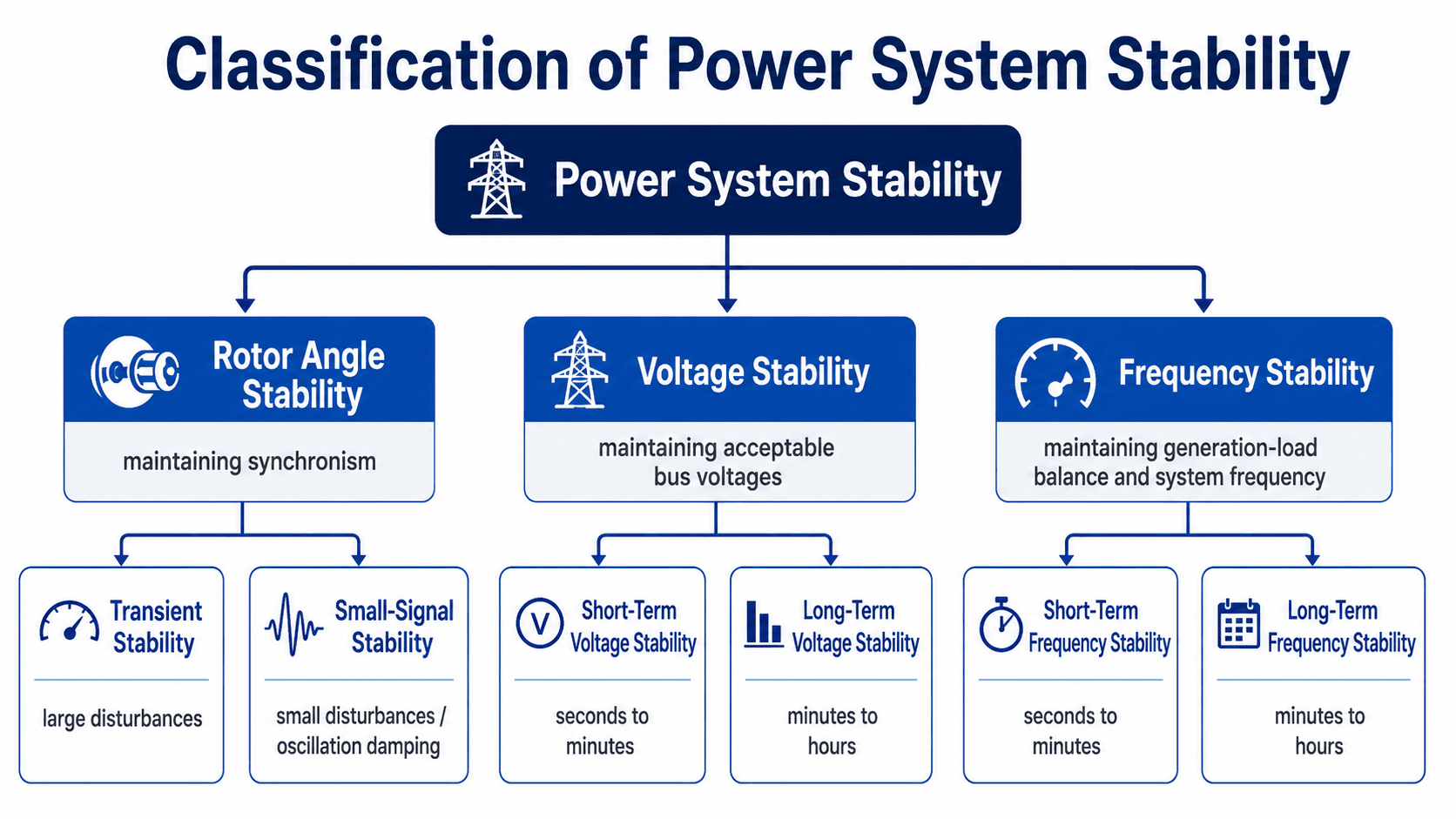
| Stability type | Primary variable | Typical trigger | What failure looks like |
|---|---|---|---|
| Rotor angle stability | Generator angle and electromechanical synchronism | Fault, line trip, generator trip, heavy transfer | Growing angle separation or loss of synchronism |
| Voltage stability | Bus voltage and reactive-power balance | Heavy loading, weak grid, reactive-power shortage, stalled motors | Voltage fails to recover or progressively collapses |
| Frequency stability | System frequency and active-power balance | Large generation loss, load rejection, islanding | Frequency continues moving outside acceptable range |
Swipe horizontally to view all table columns.
Transient vs. Small-Signal Stability
Transient stability deals with large disturbances such as short circuits, major switching events, or generator trips. Small-signal stability deals with small disturbances around an operating point and focuses on whether electromechanical oscillations are adequately damped.
Modern converter-dominated grids have introduced additional discussion around converter-driven, harmonic, and sub-/supersynchronous phenomena. These are important, but the classic rotor-angle, voltage, and frequency classes remain the core framework for most stability studies.
What Stable and Unstable Power-System Response Looks Like
A stable system does not remain perfectly flat after a disturbance. It may oscillate, dip in voltage, or deviate in frequency—but the response must recover or settle within acceptable limits.
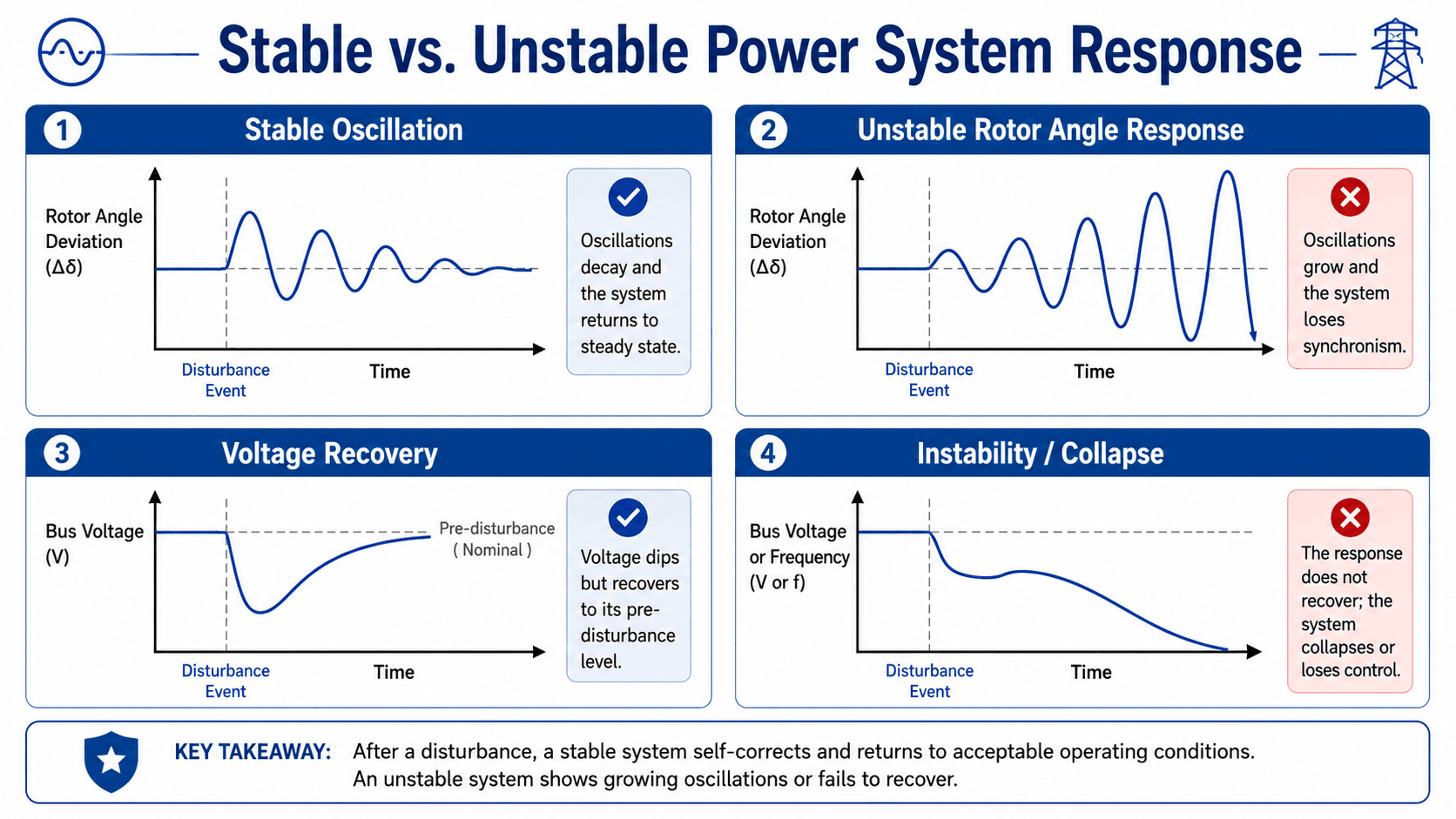
| Observed response | Likely issue | Engineering interpretation |
|---|---|---|
| Oscillations decay | Stable rotor-angle or control response | System has positive damping and returns toward equilibrium |
| Oscillations grow | Small-signal or transient instability | Damping or synchronizing margin is inadequate |
| Voltage dips then recovers | Stable voltage response | Reactive support and controls restore acceptable voltage |
| Voltage remains depressed | Voltage instability or delayed recovery | Reactive reserve, load behavior, controls, or system strength may be inadequate |
| Frequency reaches a nadir then recovers | Stable frequency response | Primary response and balancing action arrest the imbalance |
| Frequency continues falling | Frequency instability | Generation-load imbalance is not corrected fast enough |
Swipe horizontally to view all table columns.
Rotor Angle Stability, the Swing Equation, and Critical Clearing Time
Rotor angle stability is the ability of synchronous machines to remain in synchronism after a disturbance. The key physical balance is between mechanical input power and electrical output power.
Swing Equation
If mechanical power exceeds electrical power, the rotor accelerates relative to the system reference. If electrical power exceeds mechanical input, the rotor decelerates. Stability depends on whether those accelerating and decelerating periods keep the machine within a recoverable angle range.
Power-Angle Relationship
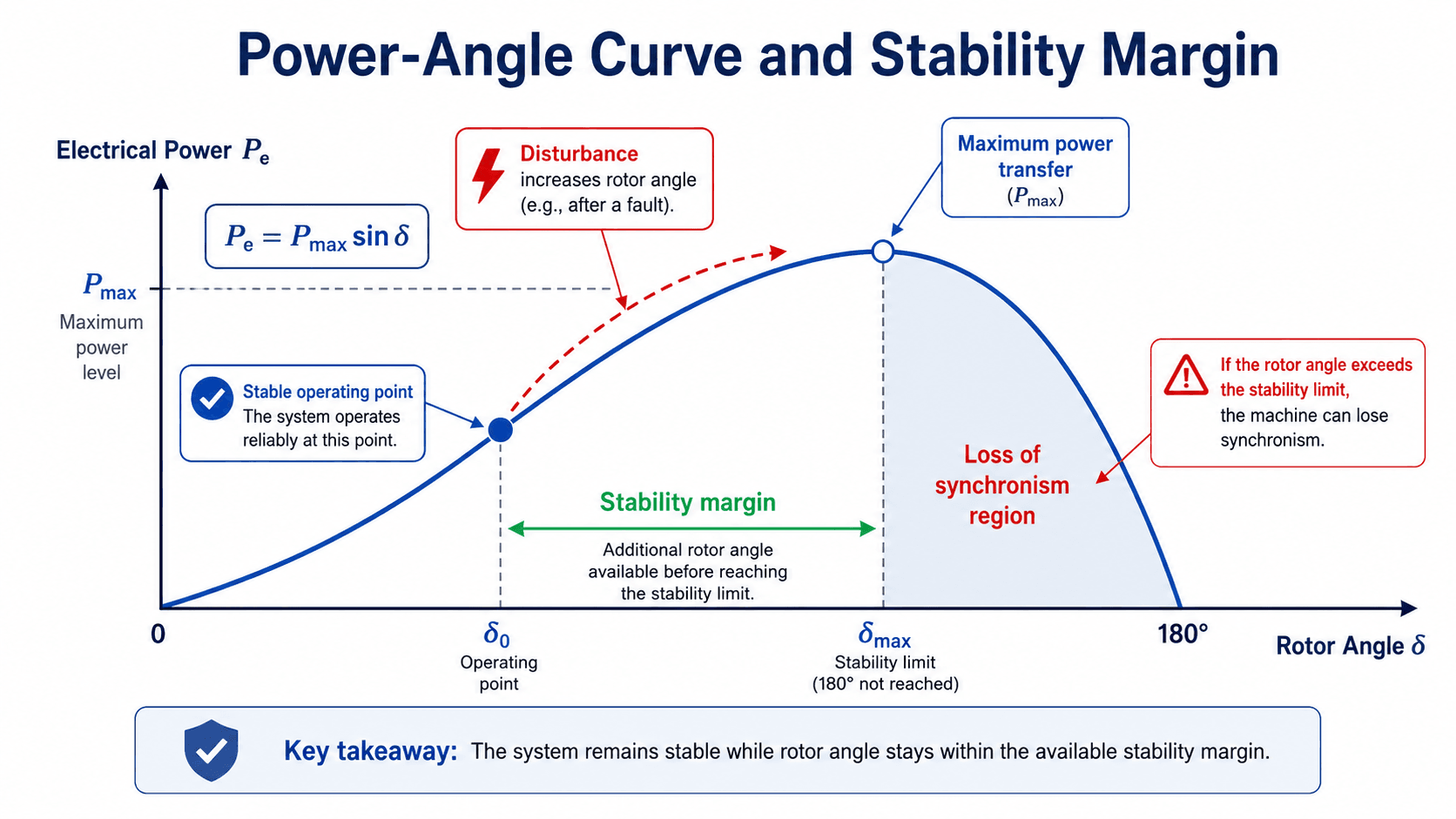
Critical Clearing Time
During a severe fault, electrical transfer can fall sharply while turbine or engine mechanical input changes much more slowly. The generator accelerates. If protection clears the fault quickly enough, the post-fault network can decelerate the machine and preserve synchronism. If clearing is too slow, the rotor angle may move beyond the recoverable region.
Breaker clearing time and relay operation can directly change transient-stability margin. Faster fault clearing can be a stability improvement, not just a protection improvement.
Voltage Stability and Frequency Stability
Voltage stability is primarily tied to voltage/reactive-power behavior and load response, while frequency stability is primarily tied to active-power imbalance and the speed of system response.
Voltage Stability
Voltage stability asks whether bus voltages remain acceptable or recover after loading changes and disturbances. Important drivers include transmission strength, reactive reserve, transformer taps, generator/inverter Q limits, motor behavior, load recovery, capacitor/reactor switching, and FACTS or dynamic reactive support.
| Tool | What it shows | Typical use |
|---|---|---|
| PV curve | Voltage versus increasing transfer or load | Loading margin and proximity to the nose/collapse point |
| QV curve | Reactive power required to hold voltage | Reactive margin and weak-bus assessment |
| Dynamic voltage simulation | Voltage recovery after a fault or disturbance | Motor stalling, control interaction, delayed voltage recovery |
Frequency Stability
Frequency stability depends on the balance between electrical load and real-power supply. A sudden generator trip causes frequency to decline; a large load rejection causes frequency to rise. The response is shaped by inertia or equivalent fast response, governor action, inverter controls, storage, load relief, reserves, and underfrequency or overfrequency schemes.
| Quantity | Meaning | Why it matters |
|---|---|---|
| RoCoF | Rate of change of frequency | Shows how quickly frequency moves immediately after imbalance |
| Frequency nadir | Lowest frequency after a generation deficit | Determines proximity to protection and load-shedding thresholds |
| Primary response | Fast autonomous response from governors, loads, inverters, and storage | Arrests the initial frequency excursion |
| Recovery | Return toward scheduled frequency | Shows whether longer-term balancing action is sufficient |
How Engineers Analyze Power System Stability
Stability is not one study type. Engineers choose the analysis method that matches the instability mechanism and time scale they need to evaluate.
| Method | Best suited for | Typical outputs |
|---|---|---|
| Load flow | Initial steady-state operating condition | Voltage, angle, MW/MVAR flow, loading, reactive reserve |
| Time-domain RMS simulation | Transient angle, voltage, and frequency response | Rotor angle, speed, voltage, frequency, controller traces |
| Small-signal / modal analysis | Oscillation damping around an operating point | Eigenvalues, damping ratios, mode frequencies, participation |
| PV / QV analysis | Voltage-stability margin | Loading margin, reactive margin, weak-bus behavior |
| Frequency-response simulation | Large active-power imbalance | RoCoF, nadir, primary response, load-shedding response |
| EMT simulation | Fast converter and weak-grid interactions | High-resolution voltages/currents, control interactions, switching/transient response |
Swipe horizontally to view all table columns.
- Build a credible base case.
Start with a validated Load Flow Analysis case matching the operating condition of interest.
- Validate dynamic models.
Confirm generator, exciter, governor, PSS, load, inverter, storage, and plant-controller models.
- Apply realistic disturbances.
Use credible faults, trips, outages, generation losses, load changes, or control events with realistic clearing and switching times.
- Review time-domain response.
Check rotor angles, voltage recovery, frequency, control response, relay operation, and equipment limits.
- Run sensitivity cases.
Test stressed transfers, lower inertia, weaker grids, high renewable output, equipment outages, and alternative controller settings.
What Controls Power System Stability?
Stability margin is controlled by the initial operating point, network strength, disturbance severity, protection speed, dynamic controls, reactive support, active-power response, and the quality of the models used to represent those behaviors.
| Factor | Primary stability impact | Typical mitigation |
|---|---|---|
| Fault clearing time | Transient rotor-angle margin | Faster protection, faster breakers, improved schemes |
| Transfer level | Angle and voltage margin | Redispatch, topology changes, transmission reinforcement |
| Reactive reserve | Voltage recovery and voltage margin | Generators, capacitors, STATCOM/SVC, inverter VAR support |
| Inertia / fast active response | Frequency RoCoF and nadir | Governor response, storage, grid-forming/fast inverter controls, reserves |
| Damping | Small-signal oscillation decay | PSS tuning, controller tuning, transfer limits |
| Load dynamics | Voltage and frequency recovery | Accurate load models, motor protection, UVLS/UFLS where appropriate |
Swipe horizontally to view all table columns.
Inverter-Based Resources and Modern Grid Stability
Inverter-based resources are not inherently unstable, but they can change short-circuit strength, voltage control, frequency response, oscillation modes, fault behavior, and the time scales that matter in stability studies.
Model Accuracy Matters
Solar, battery, and many wind plants rely on software-based controls. Plant controller settings, current limits, phase-locked-loop behavior, voltage control, active-power control, ride-through settings, and grid-forming or grid-following behavior can materially change the simulated response.
Weak-Grid Interaction
At low system strength, inverter controls may interact more strongly with the network and with nearby converters. In those cases, positive-sequence RMS simulation may not capture all relevant behavior and EMT analysis can become necessary.
Ride-Through and Protection Interaction
A disturbance that the grid could otherwise survive can become more severe if multiple inverter-based plants trip unnecessarily. Protection settings, voltage/frequency ride-through, plant controls, and disturbance response therefore must be studied together.
NERC currently maintains reliability guidance specifically for EMT studies of inverter-based-resource interconnections and for verification of IBR dynamic models against installed equipment behavior: NERC Reliability Guidelines.
NERC PRC-028-1 is already mandatory and requires disturbance data from applicable inverter-based resources so ride-through performance and model validity can be evaluated after system disturbances: NERC PRC-028-1.
A plant’s MW rating does not describe its stability behavior. Engineers need the actual inverter and plant-controller models, settings, reactive capability, current limits, ride-through logic, and the grid strength at the point of interconnection.
Power System Stability Model QA and Study Review Checklist
A stability result is only as credible as the initial operating case, dynamic models, disturbance assumptions, protection timing, and model validation behind it.
| Review item | What to verify | Risk if wrong |
|---|---|---|
| Initial load flow | Dispatch, transfers, taps, shunts, voltages, reactive reserve | Dynamic study begins from the wrong operating point |
| Generator models | Machine, exciter, governor, PSS, limits, parameters | Incorrect rotor-angle, voltage, or frequency response |
| Load models | Static/dynamic mix, induction motors, voltage/frequency dependence | Voltage recovery and frequency response can be wrong |
| IBR models | Inverter controls, plant controller, ride-through, limits, model validation | Weak-grid and disturbance behavior may be misrepresented |
| Fault clearing | Fault type/location, relay time, breaker time, reclosing, backup clearing | Transient-stability conclusion can reverse |
| Sensitivity cases | High transfer, low inertia, equipment outages, alternate dispatch | Study may overstate margin by testing only one easy case |
| Response metrics | Angle separation, damping, voltage recovery, frequency nadir/RoCoF | System may “survive” but still violate acceptance criteria |
Swipe horizontally to view all table columns.
Do not call a system stable because it survives one fault in one operating case. Stability margin should be tested across the credible operating conditions and disturbances that can actually control the system.
Recent CIGRE work continues to treat rotor-angle, voltage, and frequency stability as the established core classes while also examining sub-/supersynchronous and harmonic phenomena that become increasingly important in converter-dominated systems: CIGRE Science & Engineering — Stability Classification.
Power System Stability Engineering References
Stability analysis is highly model- and system-specific. Formal studies should use current utility, owner, interconnection, reliability, and manufacturer requirements alongside validated equipment models.
- CIGRE Science & Engineering — Suitable Classification of Power System Stability Phenomena Modern discussion of classic rotor-angle, voltage, and frequency classes and emerging multi-frequency stability phenomena.
- NERC — Reliability Guidelines Current guidance on IBR EMT studies, inverter model verification, frequency control, battery/DER behavior, and related stability-relevant topics.
- NERC PRC-028-1 — Disturbance Monitoring and Reporting Requirements for Inverter-Based Resources Current mandatory disturbance-data requirements supporting IBR ride-through assessment and model validation.
Frequently Asked Questions
What is power system stability?
Power system stability is the ability of an electrical power system to maintain or regain an acceptable operating equilibrium after a disturbance while keeping the important system variables bounded.
What are the main types of power system stability?
The three classic types are rotor angle stability, voltage stability, and frequency stability. Rotor angle concerns synchronism, voltage stability concerns bus-voltage recovery and reactive support, and frequency stability concerns active-power balance.
What is transient stability?
Transient stability is rotor-angle stability following a large disturbance such as a severe fault, line trip, or generator outage. The study focuses on whether generators remain synchronized during the first seconds after the event.
What is small-signal stability?
Small-signal stability concerns the system response to small disturbances around an operating point and focuses on whether electromechanical oscillations are adequately damped.
How do engineers improve power system stability?
Common measures include faster fault clearing, improved excitation and PSS tuning, reactive-power support, redispatch, operating limits, stronger transmission, governor or fast-frequency response, load shedding, and properly tuned inverter controls.
Why do inverter-based resources affect stability studies?
Inverter-based resources use fast software-controlled power electronics. Their voltage, frequency, current-limit, ride-through, and plant-controller behavior can change system dynamics, especially in weak grids or systems with high inverter penetration.
Summary and Next Step
Power system stability determines whether the grid can recover after disturbances without losing synchronism, acceptable voltage, or frequency control. Rotor-angle, voltage, and frequency stability remain the central engineering categories.
Strong stability studies begin with a credible load-flow case, validated dynamic models, realistic protection and disturbance assumptions, and sensitivity cases that test the system near its actual operating limits. In modern grids, inverter controls and model validation are increasingly important alongside traditional generator, load, and network dynamics.