
Key Takeaways
- Core idea: Electrical engineering projects turn circuits, sensors, power, controls, embedded systems, and measurement concepts into working prototypes.
- Project ideas: This guide includes beginner, mini, final-year, Arduino, electronics, power, IoT, controls, and resume-worthy project ideas.
- What controls it: The best project depends on scope, voltage level, safety, testability, available tools, required documentation, and the skill you want to demonstrate.
- Practical check: A strong project includes a schematic, bill of materials, prototype, test data, troubleshooting notes, and at least one improvement.
Table of Contents
Introduction
Electrical engineering projects are hands-on builds that use circuits, sensors, microcontrollers, power electronics, motors, controls, or measurement systems to solve a specific problem. A strong project is not just a working device; it shows how the design was planned, built, tested, troubleshot, documented, and improved.
How to Choose the Right Electrical Engineering Project
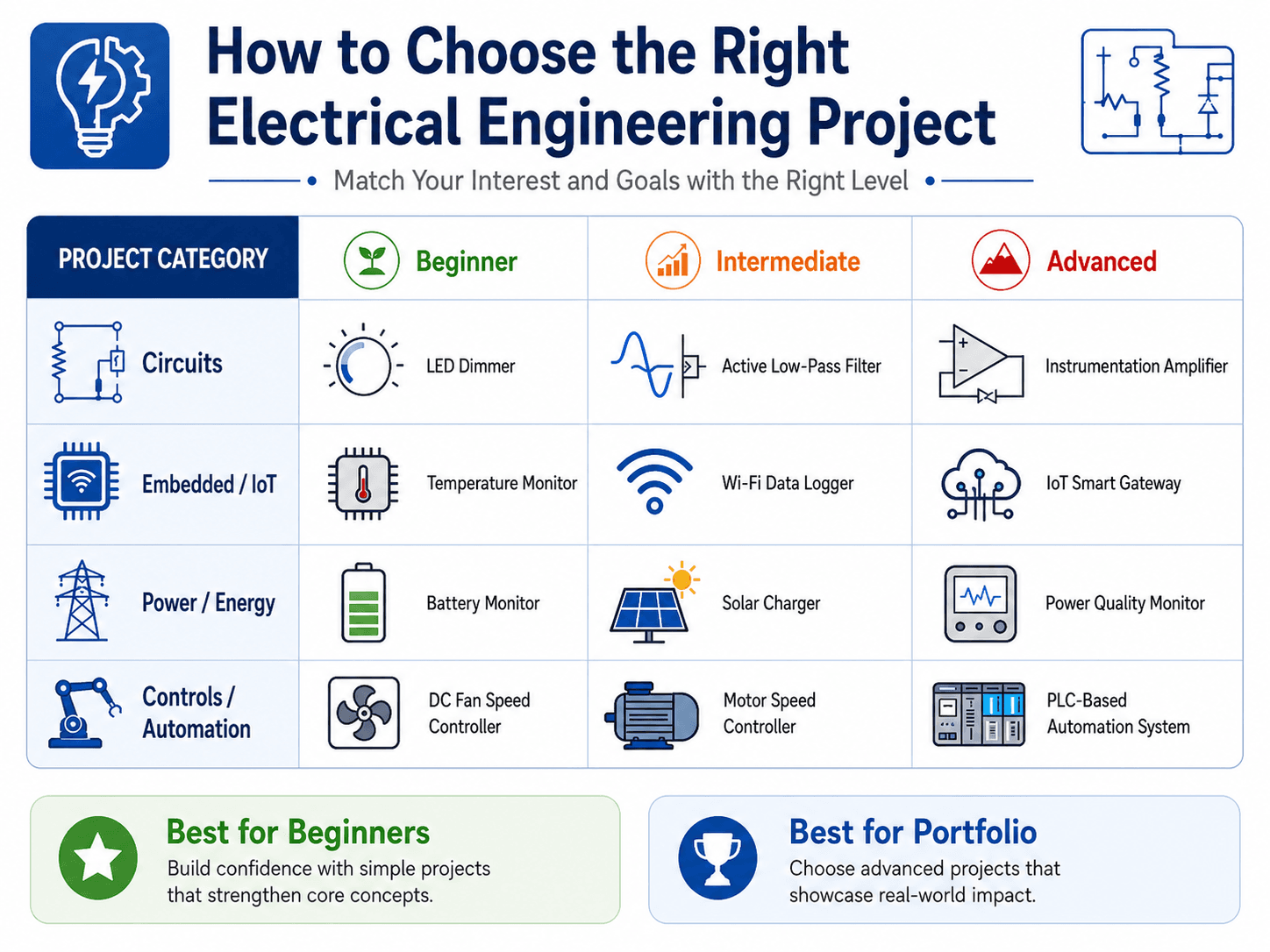
Start with the project category that matches your interest, then choose the difficulty level based on time, safety, tools, and whether the final result can be measured.
What Are Electrical Engineering Projects?
Electrical engineering projects are practical design exercises that turn theory into a measurable system. They may involve analog circuits, digital electronics, sensors, embedded controllers, motors, relays, solar charging, battery monitoring, wireless communication, power quality measurement, or automation.
The difference between a project idea and an engineering project is validation. “Build a solar charger” is only an idea. A stronger engineering project defines the panel, charge method, battery type, protection circuit, expected voltage range, current limit, efficiency test, and measured output.
Before choosing a project, ask: can I draw the schematic, explain the signal path, measure the important outputs, and show proof that the design works?
50 Electrical Engineering Project Ideas by Category
Searchers looking for electrical engineering project ideas usually need more than a title. The table below groups project ideas by category and shows what each project can demonstrate. Choose a project that is safe, testable, and realistic for your deadline.
| Project idea | Category | Difficulty | Skills demonstrated | Best for |
|---|---|---|---|---|
| LED dimmer circuit | Circuits | Beginner | PWM, current limiting, brightness control | Mini project |
| Automatic night light | Circuits | Beginner | Light sensing, switching, threshold behavior | Beginner project |
| Battery level indicator | Circuits | Beginner | Voltage division, LED indication, measurement | Student lab project |
| RC timer circuit | Circuits | Beginner | Capacitance, time constant, transient response | Concept demonstration |
| Simple alarm circuit | Circuits | Beginner | Switching, buzzer output, trigger logic | Mini project |
| Clap switch circuit | Circuits | Beginner | Microphone input, amplification, switching | Electronics project |
| Op-amp comparator circuit | Analog electronics | Intermediate | Threshold detection, reference voltage, output switching | Electronics portfolio |
| Active low-pass filter | Analog electronics | Intermediate | Filtering, cutoff frequency, op-amp behavior | Signals project |
| Audio amplifier | Analog electronics | Intermediate | Amplification, gain, distortion, power output | Hardware project |
| Instrumentation amplifier | Analog electronics | Advanced | Low-noise measurement, gain, common-mode rejection | Advanced electronics |
| Temperature monitor | Embedded systems | Beginner | Sensor input, display, calibration basics | Arduino project |
| Humidity and temperature data logger | Embedded systems | Intermediate | Sensor reading, logging, timestamped data | Course project |
| Wi-Fi sensor dashboard | IoT | Intermediate | Wireless communication, cloud logging, data display | IoT project |
| IoT smart gateway | IoT | Advanced | Edge processing, communications, system integration | Final-year project |
| Bluetooth-controlled relay board | Embedded systems | Intermediate | Wireless control, relay isolation, output driving | Automation project |
| Smart energy meter prototype | Power and IoT | Advanced | Power measurement, data logging, load monitoring | Final-year project |
| Battery monitor with display | Power electronics | Beginner | Voltage sensing, display output, state indication | Mini project |
| Solar battery charger | Renewable energy | Intermediate | Charging behavior, regulation, protection, efficiency | Power project |
| MPPT solar charge controller demo | Renewable energy | Advanced | Power optimization, control logic, efficiency testing | Final-year project |
| Power factor correction model | Power systems | Advanced | AC power, reactive power, load behavior | Power engineering project |
| Power quality monitor | Power systems | Advanced | Voltage waveform, harmonics, data acquisition | Capstone project |
| DC fan speed controller | Controls | Beginner | PWM, transistor driving, speed control | Mini project |
| Temperature-controlled fan | Controls | Beginner | Sensor input, threshold control, output driving | Student project |
| DC motor speed controller | Controls | Intermediate | PWM, motor driver, current draw, feedback basics | Controls project |
| PID motor control demo | Controls | Advanced | Feedback control, tuning, response measurement | Portfolio project |
| PLC-based automation system | Automation | Advanced | Process logic, sensors, outputs, control sequencing | Final-year project |
| Line-following robot | Robotics | Intermediate | Sensors, motor control, feedback, embedded logic | Student competition |
| Obstacle-avoidance robot | Robotics | Intermediate | Ultrasonic sensing, motor control, decision logic | Embedded project |
| Wireless sensor network demo | Communications | Advanced | Sensor nodes, radio links, data aggregation | Capstone project |
| RF signal strength mapper | Communications | Advanced | Signal measurement, mapping, wireless testing | Communications project |
| Custom sensor PCB | PCB design | Intermediate | Schematic capture, layout, connectors, test points | Hardware portfolio |
| Microcontroller expansion board | PCB design | Intermediate | Pin mapping, headers, power distribution, layout | PCB project |
| Power regulator PCB | PCB design | Advanced | Regulation, heat, layout, input/output testing | Hardware design project |
| Load monitoring system | Power and measurement | Advanced | Current sensing, logging, load behavior | Power engineering portfolio |
| Motor protection relay prototype | Power and controls | Advanced | Fault detection, protection logic, current monitoring | Final-year project |
Mini Projects for Electrical Engineering Students
Mini projects should be simple enough to finish quickly but still clear enough to demonstrate a real electrical concept. The best mini projects use low-voltage DC, common components, simple measurement, and a clear final output.
| Mini project | Main concept | Typical components | How to validate it |
|---|---|---|---|
| Automatic night light | Light-dependent switching | LDR, resistor, transistor, LED | Measure the turn-on threshold under different light levels |
| LED dimmer | PWM or variable resistance control | LED, resistor, potentiometer, timer IC or controller | Record brightness change and output duty cycle if using PWM |
| Fire alarm circuit | Temperature or smoke-triggered alarm | Sensor, comparator, buzzer, LED | Test the trigger point and reset behavior |
| Rain detector | Conductivity sensing | Sensor plate, transistor, buzzer, LED | Compare dry, damp, and wet sensor behavior |
| Battery level indicator | Voltage measurement | Battery, resistors, LEDs, comparator or controller | Measure input voltage and corresponding LED indication |
| Temperature-controlled fan | Sensor-based output control | Temperature sensor, controller or comparator, transistor, fan | Measure fan turn-on temperature and current draw |
| Door alarm circuit | Switch sensing and alarm output | Magnetic switch, buzzer, transistor, battery | Verify alarm behavior when the switch opens and closes |
| Simple DC motor speed controller | Motor drive control | Motor, MOSFET or driver module, diode, potentiometer | Measure motor speed range and supply current |
For mini projects, the report should be short but complete: problem statement, schematic, parts list, test method, measured output, and one improvement idea.
Final Year Electrical Engineering Project Ideas
Final year electrical engineering projects should show stronger system thinking than a mini project. A good final-year topic usually combines multiple subsystems, measurable performance, practical constraints, and clear documentation.
| Final-year project idea | Core engineering focus | Suggested measurable output | Scope warning |
|---|---|---|---|
| Smart EV charging prototype | Load control, charging logic, user interface | Charging current, voltage behavior, load state | Use low-voltage modeling unless supervised |
| Solar MPPT charge controller | Renewable energy, control, power conversion | Input power, output power, efficiency estimate | Keep power level modest and protected |
| Power quality monitoring system | Measurement, harmonics, data acquisition | Voltage waveform, frequency, distortion indicators | Use isolated sensors and safe measurement methods |
| Battery management system demo | Battery monitoring, protection logic, balancing concept | Cell voltage, pack voltage, temperature, alarm state | Avoid high-energy battery packs without supervision |
| Microgrid monitoring prototype | Energy monitoring, distributed resources, data logging | Source/load status, voltage, current, logged trends | Use a low-voltage educational model |
| Fault detection in distribution system model | Protection, sensing, decision logic | Fault type, detection time, relay output | Model the system safely rather than using utility voltage |
| PLC-based sorting or control system | Automation, sensors, actuators, sequencing | Cycle count, response time, error states | Mechanical moving parts need guarding and safe voltages |
| Wireless energy monitoring network | IoT, power measurement, communications | Sample rate, packet delivery, measured load data | Define a small number of monitored loads |
| Inverter control demonstration | Power electronics, switching, waveform generation | Output waveform, frequency, switching behavior | Use low voltage and supervised lab practices |
| Motor protection relay prototype | Current sensing, protection logic, motor behavior | Trip threshold, delay time, fault indication | Test with a small motor and current-limited supply |
A final-year project should be judged by the quality of the engineering process, not only by how advanced the title sounds.
Electrical Engineering Projects Without Arduino
Arduino and microcontroller projects are popular, but not every electrical engineering project needs coding. Projects without Arduino can be better for learning analog electronics, power circuits, filtering, timing, switching, and measurement fundamentals.
| Project without Arduino | Main concept | What to measure |
|---|---|---|
| Active low-pass filter | Frequency response and analog filtering | Output amplitude at different input frequencies |
| Voltage regulator circuit | Power supply regulation | Output voltage under different loads |
| Audio amplifier | Gain and signal amplification | Input signal, output signal, distortion signs |
| LED driver | Current limiting and switching | LED current, voltage drop, brightness behavior |
| Op-amp comparator | Threshold detection | Reference voltage and switching point |
| RC timing circuit | Transient response | Charge/discharge time and output delay |
These projects are especially useful for students who want to understand what happens inside modules rather than relying only on prebuilt boards.
What a Strong Electrical Engineering Project Includes
Most strong student projects can be described as a system, not just a circuit. There is usually an input, a signal path, a controller or logic stage, an output, a power supply, and a way to measure whether the project works.
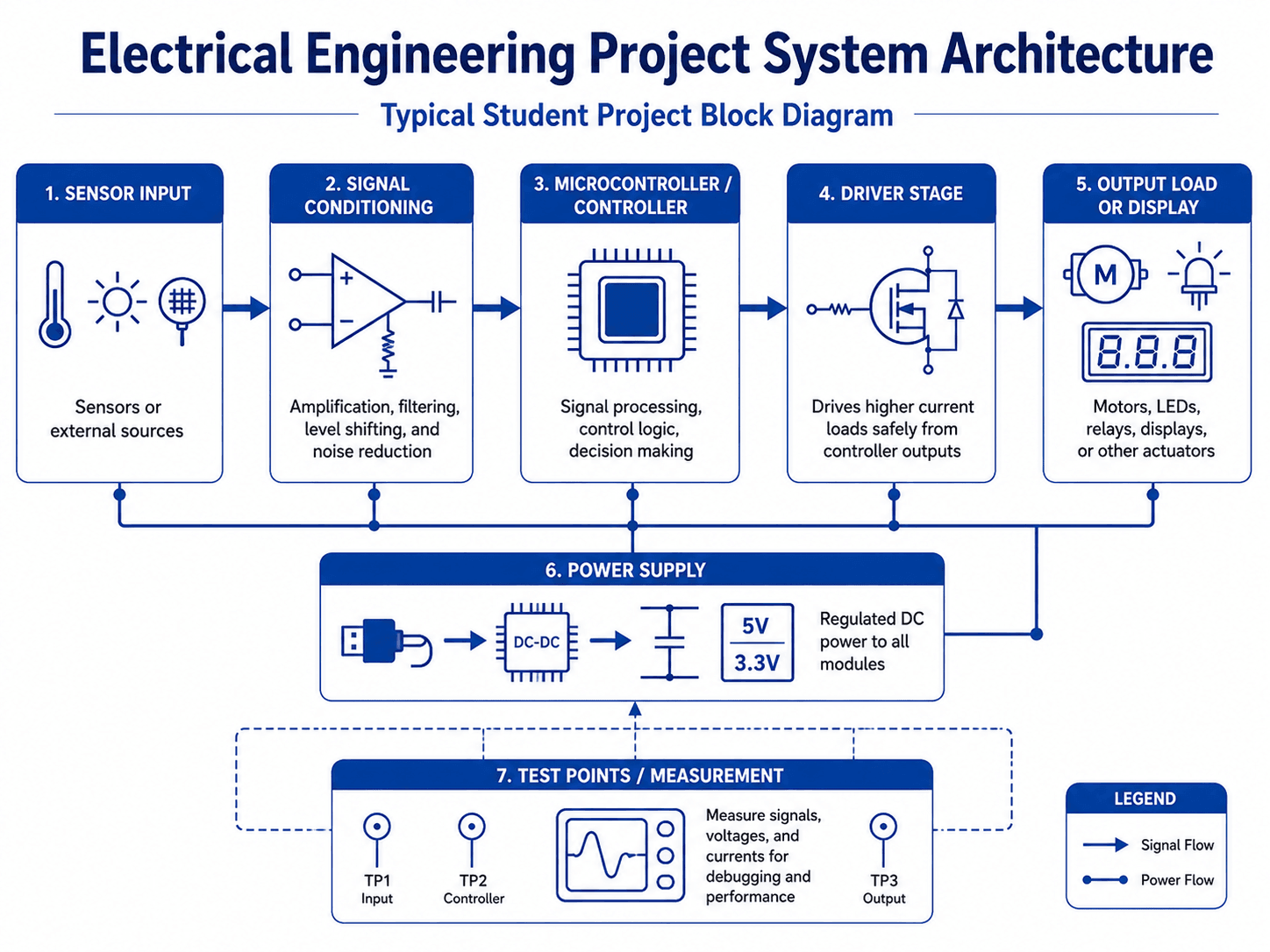
Inputs, signal conditioning, and control logic
Many projects start with a sensor, switch, waveform, or external signal. That signal may need filtering, amplification, level shifting, or noise reduction before a microcontroller or controller can use it reliably. This is where projects begin to show real electrical engineering thinking rather than simple module assembly.
Power supply, driver stage, and output load
Outputs such as motors, relays, LEDs, displays, buzzers, and actuators often need more current than a controller pin can safely provide. A driver stage, current-limiting component, flyback diode, MOSFET, relay module, or motor driver may be needed depending on the load.
Test points and measurement plan
Good projects include obvious places to measure voltage, current, sensor response, output behavior, and timing. A schematic with labeled test points makes troubleshooting faster and makes the final report much stronger.
Electrical Engineering Project Workflow
A reliable project workflow moves from problem definition to measurement. Skipping steps often leads to a project that powers on but cannot be explained, tested, or improved.
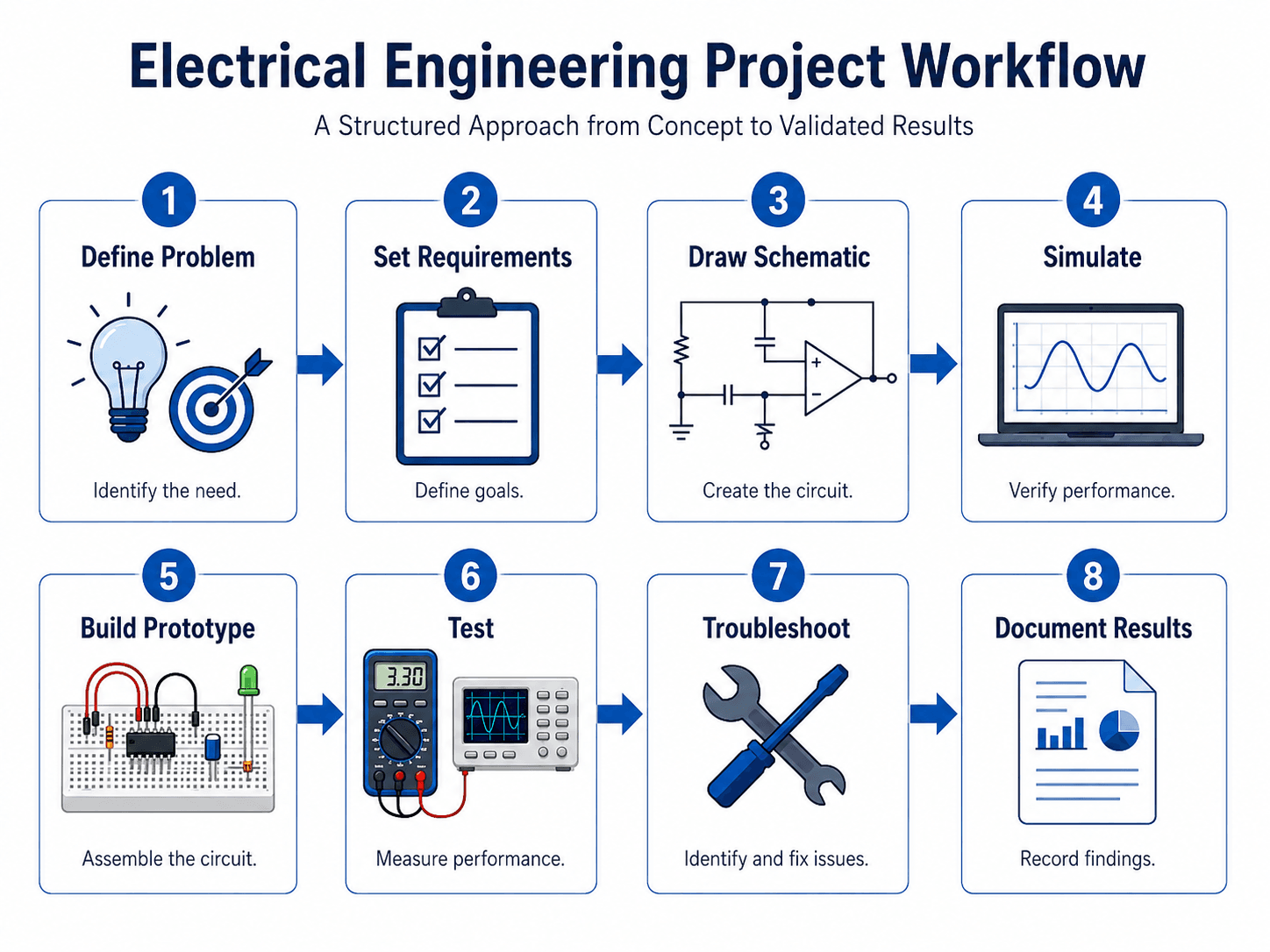
Define the problem before choosing parts
A project should start with a problem statement such as “measure battery voltage,” “control fan speed based on temperature,” or “log sensor data wirelessly.” If the goal is vague, the parts list and test method will also be vague.
Simulate or prototype before committing to the final build
Simple circuits can often be tested on a breadboard first. More complex circuits should be simulated or divided into smaller blocks before the full system is assembled. For hardware-heavy projects, prototyping in electronics helps reduce design risk before moving to soldered hardware or PCB layout.
Test the project against measurable requirements
Instead of saying “the project works,” define what working means. Examples include output voltage range, current draw, response time, temperature accuracy, motor speed range, battery state-of-charge indication, or data logging interval.
Difficulty, Time, Budget, and Tool Planning
Before choosing a project, estimate the practical effort. A project that fits the deadline and available tools is more likely to be finished, tested, and documented well.
| Difficulty level | Typical time | Typical budget | Tools usually needed | Best project type |
|---|---|---|---|---|
| Beginner | 2–8 hours | Low | Multimeter, breadboard, jumper wires, basic parts | Mini project or first electronics build |
| Intermediate | 1–3 weeks | Low to moderate | Multimeter, soldering tools, microcontroller, simulator | Course project or portfolio starter |
| Advanced | 3–10+ weeks | Moderate or higher | Oscilloscope, bench supply, PCB tools, data logging, supervised lab equipment | Final-year project or capstone concept |
These ranges are approximate. Cost and time depend heavily on parts already available, lab access, whether a PCB is required, and how much testing the project needs.
Best Electrical Engineering Projects by Career Goal
A project becomes more valuable when it points toward a skill or career path. The best electrical engineering projects for a resume show the type of engineering work you want to do next.
| Career goal | Best project types | Why it helps |
|---|---|---|
| Power engineering | Solar charger, power factor correction, power quality monitor, load monitoring system | Shows power flow, measurement, protection, and energy system thinking. |
| Electronics design | Active filters, amplifiers, sensor boards, PCB projects | Shows circuit design, component selection, signal behavior, and hardware testing. |
| Embedded systems | Data logger, motor controller, IoT gateway, sensor dashboard | Shows firmware and hardware integration with real inputs and outputs. |
| Controls and automation | PID motor controller, PLC demo, fan control, relay automation | Shows feedback, sequencing, actuator control, and response measurement. |
| Hardware or PCB design | Custom sensor PCB, power regulator board, microcontroller expansion board | Shows schematic capture, layout, connectors, grounding, and test-point planning. |
What to Include in an Electrical Engineering Project Report
A strong project report explains the engineering process, not just the final result. It should show what the project was supposed to do, how the design was created, how the prototype was tested, and what changed during troubleshooting.
| Report section | What to include | Why it matters |
|---|---|---|
| Problem statement | The specific problem the project solves or demonstrates | Clarifies scope and prevents vague project goals |
| Requirements | Target voltage, current, trigger point, speed, accuracy, timing, or output behavior | Makes the project measurable |
| Block diagram | Input, controller, power supply, driver, output, and test points | Shows system-level understanding |
| Schematic | Actual circuit connections and component values | Documents the electrical design |
| Bill of materials | Parts, ratings, quantities, and important specifications | Explains what was selected and why |
| Test procedure | How each output was measured and what tools were used | Proves the result was validated |
| Test data | Measured values, tables, plots, screenshots, or photos | Supports the final conclusion with evidence |
| Troubleshooting notes | Failures, fixes, design changes, and remaining limitations | Shows practical engineering judgment |
| Future improvements | PCB, enclosure, calibration, protection, better sensors, or safer power design | Shows design maturity beyond the first prototype |
Worked Example: Temperature-Controlled Fan Project
A temperature-controlled fan is a good example because it can be built as a beginner or intermediate project. It includes a sensor input, control decision, driver stage, output load, power supply, and clear test points.
Project goal
The goal is to turn on a small DC fan when temperature rises above a selected threshold. The project can use an Arduino or a comparator circuit, but the engineering value comes from defining the threshold, driving the fan safely, and measuring the behavior.
System blocks
The input is a temperature sensor. The controller reads the sensor or compares it to a reference threshold. The output stage uses a transistor, MOSFET, or driver module so the controller does not directly power the fan. The power supply must support both the logic circuit and the fan current.
Test plan
Measure the sensor reading, fan turn-on temperature, fan current, supply voltage during operation, and whether the fan turns off cleanly when temperature drops. If the fan chatters near the threshold, add hysteresis or adjust the control logic.
Portfolio value
This project becomes stronger when the report includes a schematic, measured temperature response, fan current draw, driver stage explanation, troubleshooting notes, and a short discussion of how the design could be improved with an enclosure or PCB.
Overused Projects and How to Improve Them
Some electrical engineering projects are common because they are useful learning exercises. They become weak only when copied without measurements, design explanation, or improvement. The table below shows how to turn common projects into stronger engineering projects.
| Overused project | Why it can feel generic | How to improve it |
|---|---|---|
| Automatic street light | Often copied as a simple LDR switch | Add adjustable threshold, power measurement, and day/night test data |
| Fire alarm circuit | Usually shown as a simple buzzer trigger | Add calibration, trigger temperature testing, and reset behavior |
| Arduino temperature monitor | Often uses a sensor module with copied code | Add calibration, data logging, display design, and error discussion |
| Smart energy meter | Can become too broad without defined measurement goals | Limit the scope to specific loads, parameters, sample rate, and data output |
| Solar charger | The title sounds advanced but may lack testing | Add charge profile, battery protection, efficiency estimate, and load test |
Project Selection and Documentation Checklist
Use this checklist before committing to an electrical engineering project. It helps confirm that the idea is safe, realistic, measurable, and strong enough for a class project, portfolio, or final-year report.
Choose the category first, narrow the project scope, confirm the voltage and current are safe, list the required tools, define the test method, then decide what documentation will prove the design worked.
| Project check | What to look for | Why it matters |
|---|---|---|
| Problem statement | A clear sentence explaining what the project measures, controls, powers, detects, or communicates. | Prevents the project from becoming a random collection of modules. |
| Safety level | Low-voltage DC, limited current, safe battery handling, and no exposed mains voltage for unsupervised builds. | Protects the builder and keeps the project appropriate for a student environment. |
| Core electrical concept | At least one clear electrical concept such as filtering, PWM, voltage division, regulation, sensing, or driver design. | Shows that the project teaches engineering, not just assembly. |
| Required tools | Multimeter, breadboard, power supply, soldering tools, oscilloscope, simulator, or programming environment. | Confirms the project can actually be built and tested with available resources. |
| Test method | Measurable output such as voltage, current, frequency, temperature, speed, response time, or logged data. | Turns the project from a demo into a validated engineering result. |
| Documentation package | Schematic, bill of materials, photos, code, test data, troubleshooting notes, and improvement ideas. | Creates a stronger report, portfolio entry, or interview discussion point. |
Safety and Scope Checks for Student Projects
Electrical engineering projects can involve stored energy, moving parts, heat, high current, or shock risk. For student projects, it is usually better to create a safe low-voltage demonstration than to work directly with hazardous power levels.
| Project area | Main risk | Safer student version |
|---|---|---|
| Mains voltage | Shock, arc, fire, and unsafe exposed conductors | Use a low-voltage DC model or supervised isolated test setup |
| Large batteries | High current, heat, short circuit, and thermal risk | Use small protected battery packs with fusing and current limits |
| Motors | Stall current, heat, moving parts, and electrical noise | Use a small DC motor with a proper driver and current measurement |
| Inverters | High voltage, switching transients, and stored energy | Use simulation or a low-voltage inverter demonstration |
| Capacitors | Stored charge and unexpected discharge | Use small values, discharge paths, and voltage measurement before handling |
If the project requires hazardous voltage, large batteries, high current, or exposed rotating machinery, reduce the scope or complete it only in a supervised lab environment.
Engineering Judgment and Field Reality
Real electrical projects rarely work perfectly on the first build. Breadboard connections can be loose, sensor outputs can be noisy, power supplies can sag under load, motors can create electrical noise, and code can hide hardware problems. Testing each subsystem separately is usually better than wiring the entire project at once.
Field reality also affects scope. A project that is safe and easy to demonstrate on a desk may become much more complicated when exposed to heat, vibration, moisture, battery aging, long wires, electromagnetic noise, or user error.
If a project behaves differently every time it runs, the issue is often power stability, grounding, loose wiring, sensor noise, or an output load pulling more current than expected.
When This Breaks Down
Electrical engineering project planning breaks down when the project idea is too broad, unsafe, untestable, or built around components the student does not understand. A project should be complex enough to teach something, but not so complex that debugging becomes impossible.
- The project uses unsafe power levels: Mains voltage, high-current batteries, large capacitors, and high-power motors require supervision, isolation, proper protection, and safe work practices.
- The design cannot be measured: If there is no voltage, current, timing, speed, temperature, waveform, or data output to check, the project is difficult to validate.
- The scope depends on too many unknowns: Combining custom PCB design, wireless communication, power electronics, app development, and mechanical packaging may be too much for one project timeline.
- The project is only copied assembly: A copied module build without schematic understanding, test results, or troubleshooting notes has limited engineering value.
Common Mistakes and Practical Checks
Many electrical engineering projects fail for practical reasons rather than theoretical ones. The most common mistakes are usually related to scope, power, measurement, and documentation.
- Skipping the schematic: Photos are useful, but a schematic is what shows the actual electrical design.
- Ignoring current draw: Loads such as motors, relays, LEDs, and wireless modules may need more current than the controller or supply can provide.
- Driving outputs directly: Microcontroller pins usually need a driver stage when controlling motors, relays, solenoids, or high-brightness LED arrays.
- Testing only at the end: Subsystems should be tested as they are built, especially power supply, sensor input, controller logic, and output stage.
- Leaving out failure notes: Troubleshooting history often demonstrates more engineering maturity than a perfect-looking final build.
Do not choose a project only because it sounds advanced. Choose one you can build safely, explain clearly, and validate with real measurements.
For deeper testing concepts, the electronics testing methods guide is a useful next step after selecting a project.
Useful References and Design Context
Electrical engineering projects are usually educational prototypes, but they still benefit from structured design thinking. A good reference should help the reader think in terms of design constraints, testing, teamwork, and practical engineering outcomes.
- IEEE TryEngineering: IEEE TryEngineering hands-on engineering lesson plans provide useful examples of structured engineering activities, constraints, design challenges, and learning-focused project development.
- Project-specific criteria: School rubrics, instructor requirements, lab rules, safety requirements, and available tools should control the final project scope.
- Engineering use: Treat outside project ideas as starting points, then add your own requirements, test plan, measurements, and documentation.
Frequently Asked Questions
The best beginner electrical engineering projects are low-voltage, easy to test, and focused on core concepts. Good examples include an LED dimmer, battery monitor, temperature sensor, automatic night light, RC timing circuit, simple alarm circuit, voltage divider sensor reader, or DC fan speed controller.
Good final year electrical engineering projects usually combine hardware, testing, documentation, and a real design objective. Strong examples include a solar MPPT charge controller, power quality monitor, battery management demo, smart energy meter, motor protection prototype, microgrid monitoring system, or PLC-based automation project.
Arduino projects are useful when they include real electrical engineering work such as sensor selection, signal conditioning, power control, motor driving, testing, and documentation. They are less valuable if the project is only copied code with little circuit understanding.
Yes. Many electrical engineering projects can be built with little or no coding, especially analog circuits, filters, LED drivers, power supply experiments, battery monitors, timing circuits, op-amp comparator circuits, motor control circuits, and measurement-based projects.
Summary and Next Steps
Electrical engineering projects connect theory to real hardware, measurement, and problem solving. The best projects are scoped clearly, built safely, tested carefully, and documented well enough that another person can understand the design decisions.
Start with a project category, choose a realistic difficulty level, define measurable requirements, build the system in stages, test each subsystem, and document what changed during troubleshooting. That process is what turns a student project into an engineering resource, portfolio piece, or final-year project.
Where to go next
Continue your learning path with related Turn2Engineering resources.
-
Electrical Engineering
Return to the main electrical engineering hub for related topics, calculators, and learning paths.
-
Electronics Engineering
Learn the circuit and hardware concepts behind many electrical engineering projects.
-
Embedded System Tools
Explore the tools used for microcontroller, firmware, and connected-device projects.