
Key Takeaways
- Core idea: Rainwater management systems control where rainfall runoff goes after it lands on roofs, pavement, and landscaped areas.
- Engineering use: They reduce flooding, erosion, pollutant transport, nuisance ponding, and storm sewer demand while supporting reuse or infiltration where feasible.
- What controls it: Drainage area, rainfall depth, soil infiltration, available storage, water quality needs, overflow route, and maintenance access drive the design.
- Practical check: A system is not complete unless it has pretreatment, safe overflow, realistic drawdown, and a maintenance plan.
Table of Contents
Introduction
Rainwater management systems collect, convey, store, infiltrate, treat, reuse, or safely discharge rainfall runoff before it causes flooding, erosion, or water quality problems. In water resources engineering, these systems are used to manage runoff from roofs, pavement, parking lots, sidewalks, landscaped areas, and developed sites where natural infiltration has been reduced.
How a Rainwater Management System Works
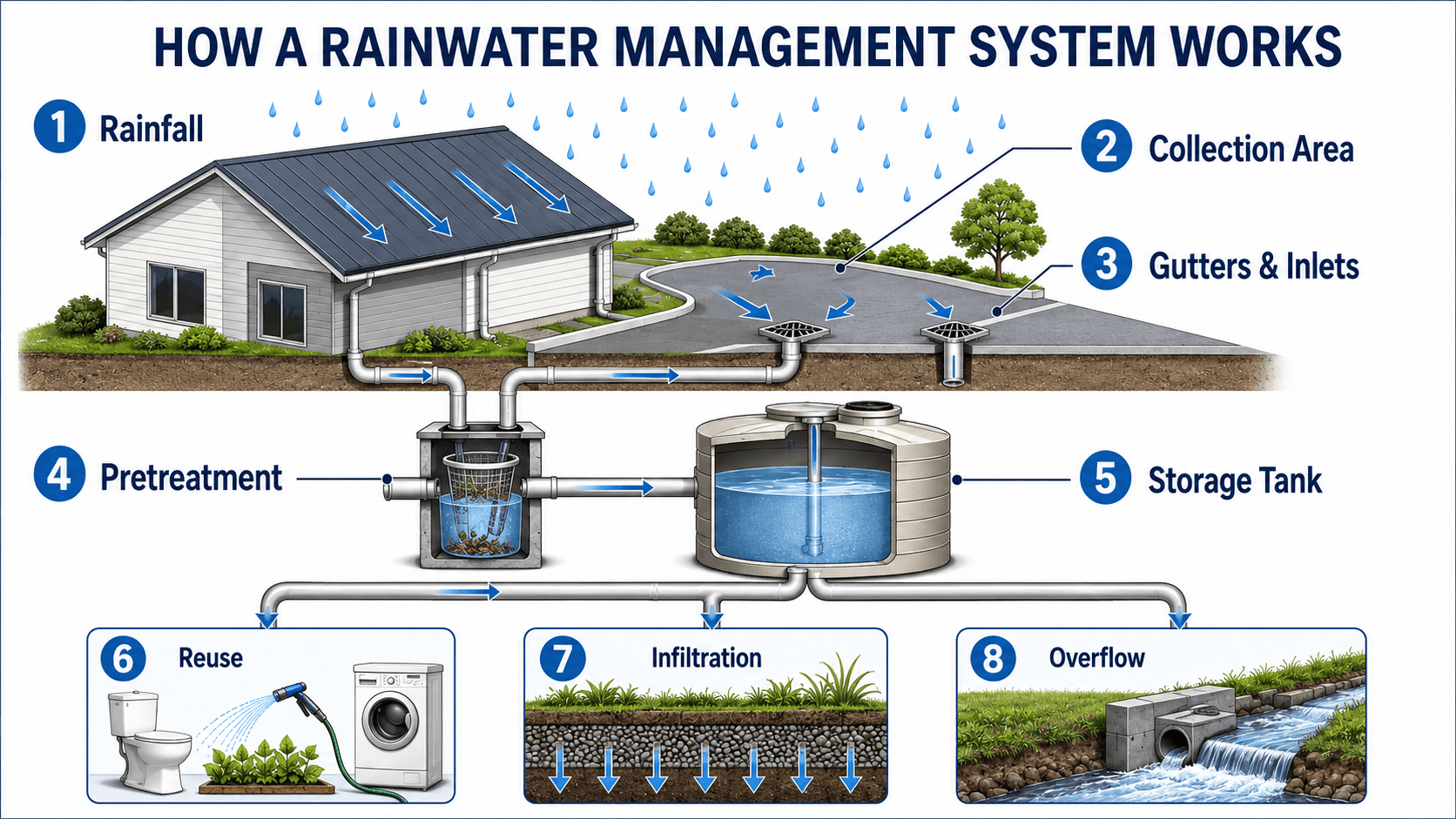
The most important detail is the branching at the end of the system. Captured water can be reused, infiltrated, detained, or released, but every path must be intentional and sized for the site conditions.
What Is a Rainwater Management System?
A rainwater management system is the collection of drainage features, storage elements, treatment practices, and overflow controls used to manage rainfall after it lands on a developed surface. It can be as simple as a roof, gutter, downspout, and rain garden, or as complex as a sitewide network of inlets, underground storage, bioretention cells, permeable pavement, pumps, sensors, and controlled discharge structures.
The key distinction is that rainwater management is broader than rainwater harvesting. Harvesting focuses on collecting rainwater for later use, while rainwater management also includes stormwater runoff reduction, infiltration, water quality treatment, detention, erosion control, and safe overflow routing. For a water resources engineer, the system is evaluated by how it changes runoff volume, peak flow, timing, pollutant load, and downstream impact.
Do not judge a rainwater system only by the size of its tank. A small tank with a safe overflow route and reliable pretreatment can perform better than a large tank that clogs, bypasses, or discharges water toward a building foundation.
Rainwater Management vs Rainwater Harvesting vs Stormwater Management
Searchers often use these terms interchangeably, but they are not identical. Rainwater management is the broader system-level concept. Rainwater harvesting is one possible strategy inside that system. Stormwater management usually refers to the larger civil engineering and regulatory framework for controlling runoff from developed land.
| Term | Primary goal | Typical components | Where it fits |
|---|---|---|---|
| Rainwater management | Control rainfall runoff quantity, quality, storage, infiltration, reuse, and overflow. | Gutters, inlets, pipes, filters, cisterns, bioretention, permeable pavement, swales, outlet structures. | Building-scale and site-scale runoff strategy. |
| Rainwater harvesting | Collect and store rainwater for later use. | Roof catchment, downspouts, first-flush diverter, filter, cistern, pump, reuse plumbing, overflow. | A subset of rainwater management focused on reuse. |
| Stormwater management | Reduce flooding, control peak flow, protect water quality, and meet drainage criteria. | Detention, retention, inlets, storm drains, BMPs, outlet controls, treatment systems, flood routing. | The broader civil engineering and regulatory context. |
| Green infrastructure | Use vegetation, soil, storage, and natural processes to manage runoff near the source. | Rain gardens, bioswales, green roofs, permeable pavement, tree trenches, infiltration areas. | A nature-based approach often used within rainwater and stormwater systems. |
Rainwater management systems are often part of low impact development, sustainable drainage, or green infrastructure strategies, depending on the terminology used by the local stormwater program.
Main Components of Rainwater Management Systems
Most systems follow the same basic sequence: collect runoff, move it, remove debris or sediment, store or treat it, then release or reuse it. The components may look different on a house, school, commercial building, parking lot, or roadway, but the engineering logic is similar.
| Component | What it does | Design concern |
|---|---|---|
| Collection area | Includes roofs, pavement, sidewalks, courtyards, plazas, or landscaped drainage areas that generate runoff. | The drainage area controls the runoff volume entering the system. |
| Gutters, downspouts, and inlets | Capture water from roof edges, low points, paved areas, or curb lines. | They must be placed where water actually concentrates during storms. |
| Conveyance piping or channels | Moves water from collection points to storage, treatment, infiltration, or discharge features. | Undersized or poorly sloped pipes can back up and create surface flooding. |
| Pretreatment | Removes leaves, trash, grit, sediment, and roof debris before water enters a tank, rain garden, or infiltration bed. | Pretreatment protects the system from clogging and reduces maintenance frequency. |
| Storage tank or cistern | Holds rainwater for irrigation, toilet flushing, process water, detention, or later release. | Storage should be matched to rainfall, contributing area, reuse demand, and overflow capacity. |
| Infiltration or bioretention area | Allows runoff to soak into engineered soil media, gravel, or native soils while providing treatment. | Soil infiltration, groundwater depth, and clogging potential determine feasibility. |
| Overflow outlet | Provides a controlled path when the system receives more water than it can store, infiltrate, or reuse. | Overflow should discharge to a stable and approved location without causing erosion or damage. |
| Maintenance access | Allows screens, filters, tanks, inlets, pumps, and vegetation to be inspected and cleaned. | A system that cannot be maintained will usually lose performance over time. |
First flush and pretreatment
The first portion of runoff from a roof or paved surface often carries the highest concentration of dust, pollen, bird droppings, leaves, grit, roof particles, and organic debris. A first-flush diverter, leaf screen, filter basket, sump, or sediment forebay helps keep that material out of cisterns, pumps, infiltration media, and underdrains.
First-flush diversion is most common in rainwater harvesting systems, but the same design principle applies to larger rainwater management systems: remove debris before it reaches the component that is hardest to clean. Pretreatment does not replace water-quality treatment when water is reused indoors, but it greatly improves reliability.
Common Types of Rainwater Management Systems
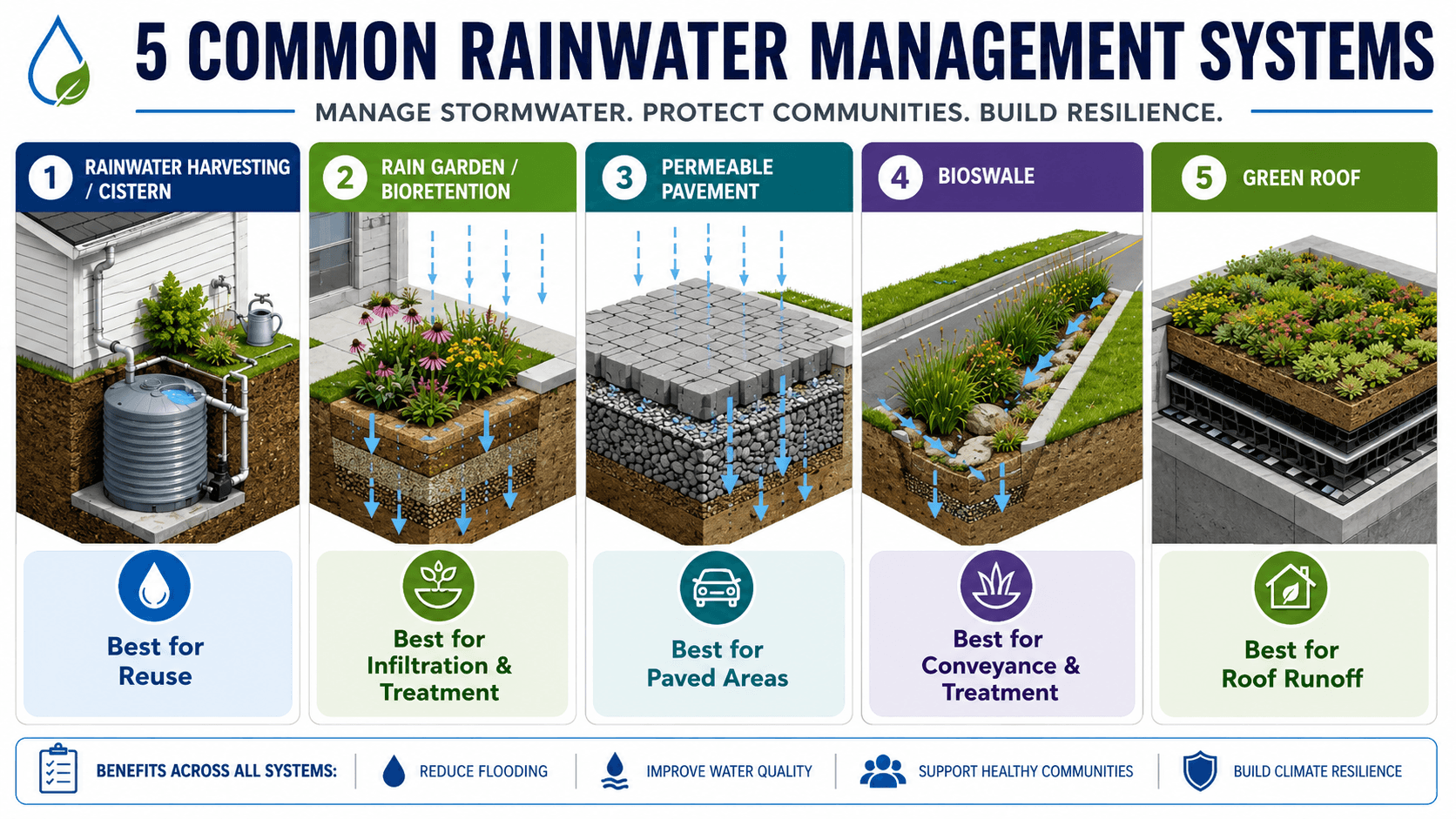
The best system type depends on whether the primary goal is reuse, infiltration, water quality treatment, peak flow reduction, site drainage, or compliance with stormwater criteria. Many projects combine multiple practices because no single feature solves every runoff problem.
| System type | Best use | Watch for |
|---|---|---|
| Rainwater harvesting / cistern | Capturing roof runoff for irrigation, toilet flushing, washing, or non-potable reuse. | Needs pretreatment, water quality controls, overflow routing, and a real reuse demand. |
| Rain garden / bioretention | Treating and infiltrating runoff from roofs, sidewalks, parking lots, and landscaped areas. | Requires suitable soil media, surface storage, stable inflow, and maintenance of vegetation. |
| Permeable pavement | Reducing runoff from driveways, parking stalls, sidewalks, plazas, and low-speed paved areas. | Can fail if sediment clogs surface voids or if heavy loads exceed structural capacity. |
| Bioswale | Conveying runoff while slowing flow, encouraging infiltration, and improving water quality. | Longitudinal slope, erosion protection, vegetation health, and bypass capacity must be checked. |
| Green roof | Reducing roof runoff volume and delaying runoff from flat or low-slope roof areas. | Structural loading, waterproofing, drainage layers, plant survival, and roof access control the design. |
| Underground detention or infiltration | Managing runoff where surface space is limited, such as dense sites or parking areas. | Inspection access, sediment pretreatment, groundwater separation, and long-term clogging are critical. |
How to Choose the Right Rainwater Management System
System selection should begin with the site problem. A roof with irrigation demand may need storage and reuse, while a parking lot may need pretreatment, water quality treatment, and controlled overflow. A tight urban site may require underground storage, and a clay soil site may need underdrains instead of relying on infiltration alone.
| Site condition or goal | Strong system options | Verify before selecting |
|---|---|---|
| Roof runoff with irrigation demand | Cistern, downspout filter, first-flush diversion, pump, irrigation reuse, overflow outlet. | Reuse demand, storage drawdown, roof material, water quality needs, and overflow route. |
| Parking lot runoff | Bioretention, bioswale, permeable pavement, sediment forebay, underdrain, controlled discharge. | Sediment load, oil and grease risk, pavement grades, inlet spacing, and maintenance access. |
| Clay soil or poor infiltration | Underdrained bioretention, detention storage, controlled release, lined planter, or hybrid green-gray system. | Do not assume infiltration will work without testing; check ponding duration and outlet capacity. |
| Tight urban site | Underground detention, modular storage, cistern, green roof, tree trench, or compact bioretention planter. | Utility conflicts, structural loading, inspection access, confined-space issues, and maintenance plan. |
| Water quality treatment | Bioretention, bioswale, vegetated filter strip, permeable pavement with pretreatment, or treatment vault. | Pollutant source, sediment capture, media selection, bypass design, and maintenance requirements. |
| Peak flow reduction | Detention basin, underground storage, outlet control structure, cistern with drawdown, distributed green infrastructure. | Stage-storage relationship, release rate, downstream timing, emergency overflow, and design storm criteria. |
The most reliable projects use a treatment train: source control, conveyance, pretreatment, storage or treatment, reuse or infiltration, and a safe overflow route.
Rainwater Management Design Workflow
A useful design workflow starts with the site objective, not the product. A system designed for irrigation reuse will look different from one designed for water quality treatment, flood reduction, or peak discharge control.
- Define the objective: Identify whether the system is intended for reuse, infiltration, detention, treatment, erosion control, or a combination of goals.
- Map the drainage area: Separate roof runoff, pavement runoff, landscaped runoff, and off-site flow because each source may have different quality and quantity concerns.
- Estimate runoff volume: Use rainfall depth, contributing area, and a runoff coefficient or site runoff method appropriate to the level of design.
- Check soils and groundwater: Infiltration practices depend on soil permeability, depth to groundwater, depth to bedrock, and contamination risk.
- Select the treatment train: Choose pretreatment, storage, infiltration, reuse, and overflow elements that work together instead of acting as disconnected features.
- Design overflow early: Decide where excess water will go before finalizing tank size, basin elevation, or underdrain layout.
- Plan maintenance access: Make sure filters, screens, sediment forebays, inlets, outlets, vegetation, pumps, and valves can be inspected.
Basic Sizing and Runoff Volume
Early rainwater management planning often begins with a simple runoff volume estimate. This does not replace a detailed stormwater model or local design manual, but it helps determine whether a proposed cistern, rain garden, infiltration bed, or detention feature is in the right range.
- \(V\) Estimated runoff volume, usually converted to cubic feet, cubic meters, gallons, or liters.
- \(P\) Rainfall depth over the drainage area, such as inches or millimeters from a design storm or observed event.
- \(A\) Contributing area, such as roof area, pavement area, or a defined drainage subcatchment.
- \(C\) Runoff coefficient or adjustment factor representing how much rainfall becomes runoff from that surface.
Example: estimating roof runoff from a small building
Suppose a building has a 2,000 square foot roof, a 1 inch rainfall event, and a runoff coefficient of 0.95 for a mostly impervious roof surface. Convert 1 inch to \(1/12\) foot before calculating cubic feet.
A 1 inch storm on this roof can produce roughly 1,180 gallons of runoff before losses. That does not automatically mean the cistern must be 1,180 gallons. Storage sizing also depends on reuse demand, available drawdown between storms, overflow design, cost, and the design objective.
Storage volume is only useful if the system has empty capacity before the next storm. A tank that stays full because water is not reused has little value for runoff reduction during the next rainfall event.
Design Checks Engineers Should Not Skip
Rainwater systems often fail because one part of the system is treated as the whole design. The tank, rain garden, pavement section, or swale may be well drawn, but performance depends on how the full system handles debris, water quality, storage, infiltration, overflow, and inspection.
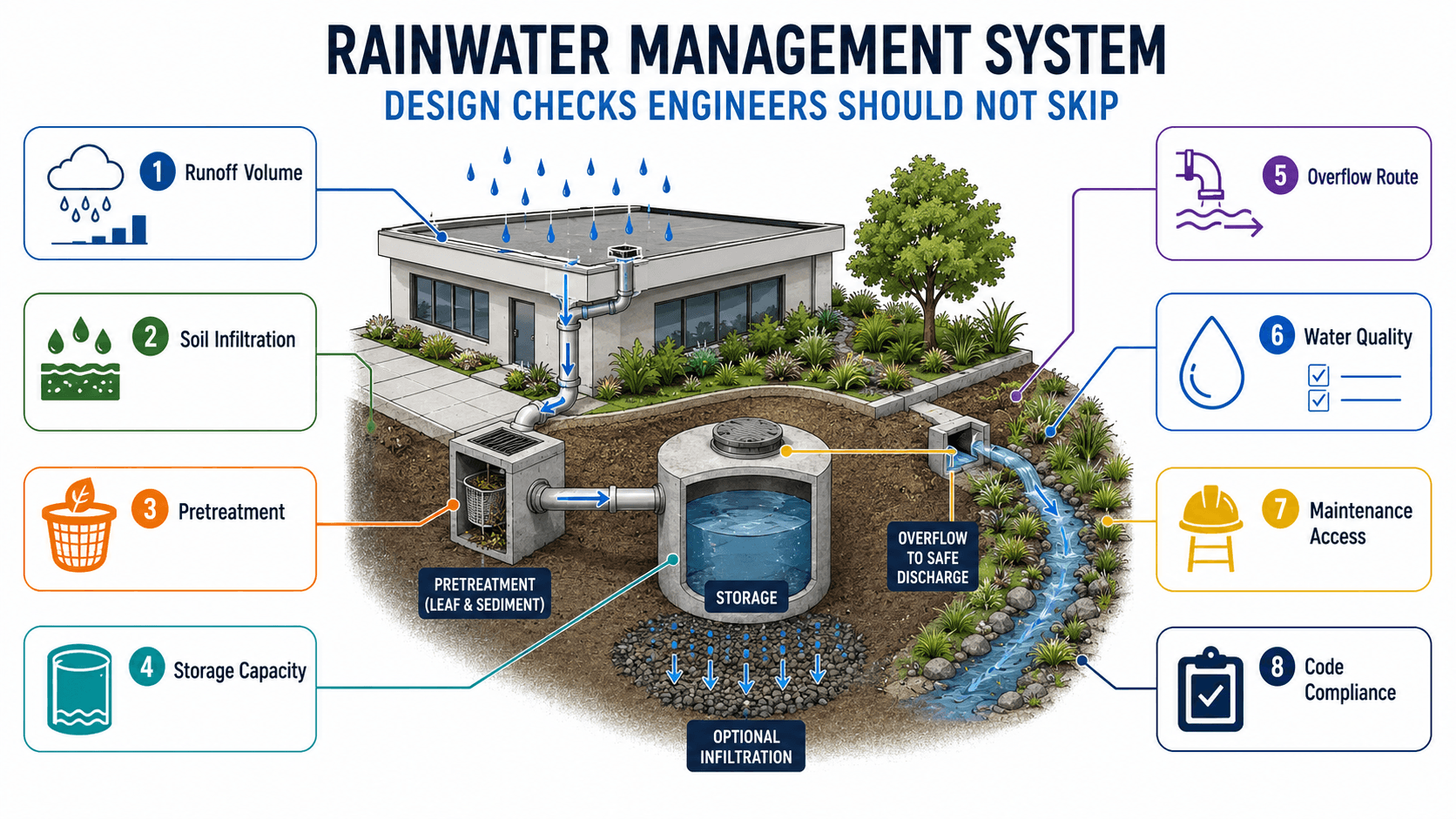
Start with the drainage area and design storm, then trace water through the system: collection surface → inlet or gutter → pretreatment → storage or treatment → reuse, infiltration, or controlled discharge. At each step, ask what happens during the storm that exceeds the intended design capacity.
| Design check | What to look for | Why it matters |
|---|---|---|
| Runoff volume | Defined drainage area, realistic rainfall depth, and surface-specific runoff behavior. | Undercounting roof or pavement area causes undersized tanks, basins, inlets, and overflows. |
| Soil infiltration | Infiltration rate, soil texture, compaction, groundwater depth, and seasonal wetness. | Infiltration systems cannot perform if water ponds too long or if the soil cannot accept flow. |
| Pretreatment | Leaf screens, sediment sumps, forebays, cleanouts, or filter baskets upstream of sensitive components. | Sediment and organic debris can clog tanks, underdrains, permeable pavement, and bioretention media. |
| Storage capacity | Tank volume, basin surface storage, void storage in aggregate, and available drawdown between storms. | Storage is only useful if it has empty volume before the next storm arrives. |
| Overflow route | Stable discharge point, emergency flow path, erosion protection, and separation from building openings. | Overflow is the difference between a resilient system and a system that floods the wrong place. |
| Water quality | Expected pollutants, reuse purpose, sediment load, roof material, and need for filtration or disinfection. | The required treatment level depends on whether water is infiltrated, discharged, or reused. |
| Maintenance access | Reachable cleanouts, removable screens, access lids, safe entry points, and visible inspection locations. | Performance declines quickly when routine inspection is difficult or ignored. |
| Code compliance | Local stormwater manual, plumbing requirements, reuse restrictions, setbacks, and owner criteria. | Rainwater systems must satisfy project-specific requirements, not just conceptual best practices. |
Residential vs Commercial Rainwater Management Systems
Residential and commercial systems often use similar principles, but they differ in scale, review requirements, maintenance responsibility, and risk. A homeowner may need to redirect roof runoff away from a foundation, while a commercial project may need to meet stormwater detention, water quality, and long-term inspection requirements.
| Project type | Common system focus | Engineering concern |
|---|---|---|
| Residential | Downspout disconnection, rain barrels, cisterns, yard drainage, rain gardens, foundation protection, irrigation reuse. | Overflow should not discharge toward basements, crawlspaces, neighboring lots, sidewalks, or unstable slopes. |
| Commercial building | Roof runoff capture, cisterns, underground detention, green roofs, bioretention, controlled outlets, water quality treatment. | Maintenance access, plumbing separation, outlet control, structural loading, and code review are usually more significant. |
| Parking lot or roadway edge | Inlets, bioswales, bioretention cells, permeable pavement, sediment pretreatment, underdrains, stable overflow routes. | Sediment, trash, oil residue, winter maintenance, traffic loading, and clogging must be considered early. |
| Campus or municipal site | Distributed green infrastructure, storage, educational signage, visible treatment features, and maintenance programs. | Operations staff must understand how each system works and how often components should be inspected. |
Rainwater Management System Maintenance Checklist
Maintenance is not an afterthought; it is part of the design. Many rainwater systems lose capacity slowly as sediment, leaves, mulch, trash, and biological growth accumulate. A maintenance checklist helps keep performance close to the original design intent.
| Component | What to inspect | Typical issue |
|---|---|---|
| Gutters and downspouts | Leaves, disconnected joints, crushed pipes, splash blocks, and discharge direction. | Bypass flow, roof overflow, foundation ponding, and uncontrolled runoff paths. |
| Inlets and grates | Trash, sediment, pavement settlement, blocked openings, and standing water. | Surface flooding and bypass around the intended collection point. |
| Pretreatment chamber | Sediment depth, leaf baskets, screens, odor, standing water, and cleanout access. | Clogging, mosquito risk, reduced conveyance, and debris entering downstream components. |
| Cistern or storage tank | Water level, sediment accumulation, access lid, overflow pipe, pump intake, and leaks. | Lost storage capacity, poor water quality, pump problems, and uncontrolled overflow. |
| Pumps and valves | Operation, controls, check valves, leaks, pressure, and seasonal shutdown needs. | Reuse system failure or inability to draw down storage before the next storm. |
| Rain garden or bioretention cell | Ponding duration, mulch displacement, erosion, plant health, sediment buildup, and inlet condition. | Reduced infiltration, poor treatment, dead vegetation, and surface bypass. |
| Permeable pavement | Surface sediment, weeds, ponding, joint material, and damaged pavers. | Loss of infiltration capacity and surface runoff over a pavement intended to absorb water. |
| Overflow and outfall | Blockage, erosion, riprap movement, undermining, slope instability, and downstream obstruction. | Damage during large storms when the overflow path is most important. |
The best time to inspect a rainwater management system is shortly after a storm, when ponding, clogging, bypass flow, erosion, and overflow behavior are easiest to see.
Engineering Judgment and Field Reality
Rainwater management diagrams often show clean blue arrows, but real runoff carries leaves, grit, trash, pollen, roof granules, oil residue, nutrients, and sediment. The system also receives storms that do not match the ideal design event. Good designs accept that uncertainty and provide redundancy, bypass paths, and inspection points.
Site grading is often more important than the device itself. A cistern, rain garden, or infiltration trench can only work if surface runoff is directed toward it without creating ponding against walls, accessibility problems, or nuisance flows across sidewalks. Small elevation errors can change the whole drainage pattern.
The most expensive rainwater system on a site may still fail if the inlet is too high, the overflow has no safe outfall, or sediment reaches the infiltration layer before it can be removed.
When Rainwater Management Systems Break Down
A rainwater management system stops performing when the assumptions behind collection, storage, infiltration, or release no longer match field conditions. The most common breakdowns are not dramatic structural failures; they are gradual losses of hydraulic capacity.
- Clogged pretreatment or infiltration media: Leaves, sediment, mulch, and fine particles can block screens, voids, and soil media.
- No reliable drawdown: A tank or basin that remains full between storms has little remaining capacity for the next rainfall event.
- Poor overflow routing: Excess water can erode slopes, flood walkways, enter buildings, or damage neighboring properties.
- Unsuitable soils: Heavy clay, compacted fill, shallow bedrock, karst conditions, or high groundwater can make infiltration impractical without underdrains or alternative controls.
- Potentially contaminated runoff: Industrial yards, fuel loading areas, dumpster pads, and high-pollutant surfaces may require special pretreatment or may not be appropriate for direct infiltration.
- Maintenance gaps: A system that looks good at installation may lose performance if inspection and cleaning are not built into operations.
- Water quality mismatch: Water collected for reuse may need more treatment than water routed to landscape irrigation or infiltration.
Common Mistakes and Practical Checks
The most common mistakes come from designing a rainwater feature as an isolated object instead of part of a drainage system. The practical check is to trace water during a small storm, a design storm, and an extreme storm.
| Mistake | Why it causes problems | Practical check |
|---|---|---|
| Sizing storage without checking reuse demand | A cistern can stay full if water is not used between storms. | Compare tank volume with irrigation, toilet flushing, or process water demand over time. |
| Sending dirty runoff directly into infiltration media | Sediment can clog pores and reduce infiltration capacity. | Add accessible pretreatment before the infiltration layer. |
| Ignoring bypass or overflow | Storms larger than the design event still occur. | Show the overflow path on the grading plan and confirm it reaches a stable discharge point. |
| Using green infrastructure where soils cannot support it | Poor infiltration can create long ponding durations or saturated planting zones. | Check soil testing, groundwater depth, and underdrain requirements before selecting the practice. |
| Forgetting maintenance access | Filters and sediment traps eventually need cleaning. | Confirm that crews can physically reach and service each component. |
Never assume captured rainwater disappears. If it is not reused, infiltrated, evaporated, or detained and released through a controlled outlet, it will find another path through the site.
Useful References and Design Context
Rainwater management design is usually controlled by local stormwater manuals, plumbing rules, owner requirements, and site-specific constraints. A national reference is useful for understanding green infrastructure practices, but final design criteria should come from the project jurisdiction and the applicable design documents.
- U.S. Environmental Protection Agency: EPA guide to types of green infrastructure explains practices such as bioretention, rain gardens, green roofs, permeable pavement, and other runoff management approaches that support site-scale rainwater control.
- Project-specific criteria: Local stormwater manuals may set water quality volume, detention, infiltration testing, drawdown time, outlet control, inspection, and maintenance requirements.
- Engineering use: Designers use these references to select practices, check assumptions, and confirm that a proposed system satisfies both performance goals and review requirements.
Frequently Asked Questions
A rainwater management system is a connected set of practices that captures, conveys, stores, infiltrates, treats, reuses, or safely releases rainfall runoff. It may include roof drainage, inlets, filters, cisterns, rain gardens, permeable pavement, bioswales, green roofs, detention, infiltration, and overflow controls.
No. Rainwater harvesting is one type of rainwater management focused on collecting and storing runoff for later use. Rainwater management is broader because it can also include infiltration, detention, filtration, peak flow reduction, erosion control, safe overflow routing, and water quality protection.
Common parts include the collection area, gutters, downspouts, inlets, conveyance pipes, pretreatment screens or sediment traps, storage tanks, pumps, overflow outlets, infiltration beds, underdrains, vegetated treatment areas, and maintenance access points.
A properly designed system routes excess water through a safe overflow path. That overflow may discharge to a storm drain, vegetated swale, stabilized outfall, infiltration area, or other approved location without causing erosion, flooding, or damage to nearby structures.
The best system depends on the site objective, rainfall depth, drainage area, soil infiltration rate, available space, groundwater depth, reuse demand, maintenance access, and local design requirements. Many projects use a combined approach rather than one single practice.
Summary and Next Steps
Rainwater management systems are engineered approaches for controlling rainfall runoff from developed surfaces. A complete system does more than collect water; it manages flow paths, debris, storage, treatment, infiltration, reuse, and overflow so the site performs better during and after storms.
The strongest designs start with hydrology and site constraints, then select components that work as a treatment train. Runoff volume, soil infiltration, pretreatment, storage capacity, overflow route, water quality, maintenance access, and local criteria should all be checked before the system is considered complete.
Where to go next
Continue your learning path with related Turn2Engineering resources.
-
Hydrology
Learn how rainfall, infiltration, runoff, storage, and watershed response form the basis for rainwater system design.
-
Urban Water Management
See how stormwater, water supply, reuse, and infrastructure planning interact in developed environments.
-
Groundwater Management
Understand how infiltration, recharge, groundwater depth, and subsurface constraints affect water resources decisions.