
Key Takeaways
- Core idea: Mechanical properties describe how materials respond to force, deformation, impact, wear, repeated loading, and fracture.
- Engineering use: Engineers use these properties to check yielding, deflection, surface damage, impact fracture, fatigue, creep, and serviceability.
- What controls it: Performance depends on load type, geometry, temperature, strain rate, microstructure, defects, processing, and material condition.
- Practical check: Strength, stiffness, hardness, and toughness are not interchangeable; each property answers a different design question.
Table of Contents
Introduction
Mechanical properties of materials describe how a material behaves when it is loaded, stretched, compressed, bent, impacted, worn, or driven toward failure. They include strength, stiffness, hardness, toughness, ductility, elasticity, fatigue resistance, creep resistance, and fracture behavior, helping engineers predict whether a component will bend, yield, crack, wear, or break in service.
Mechanical Properties on a Stress-Strain Curve
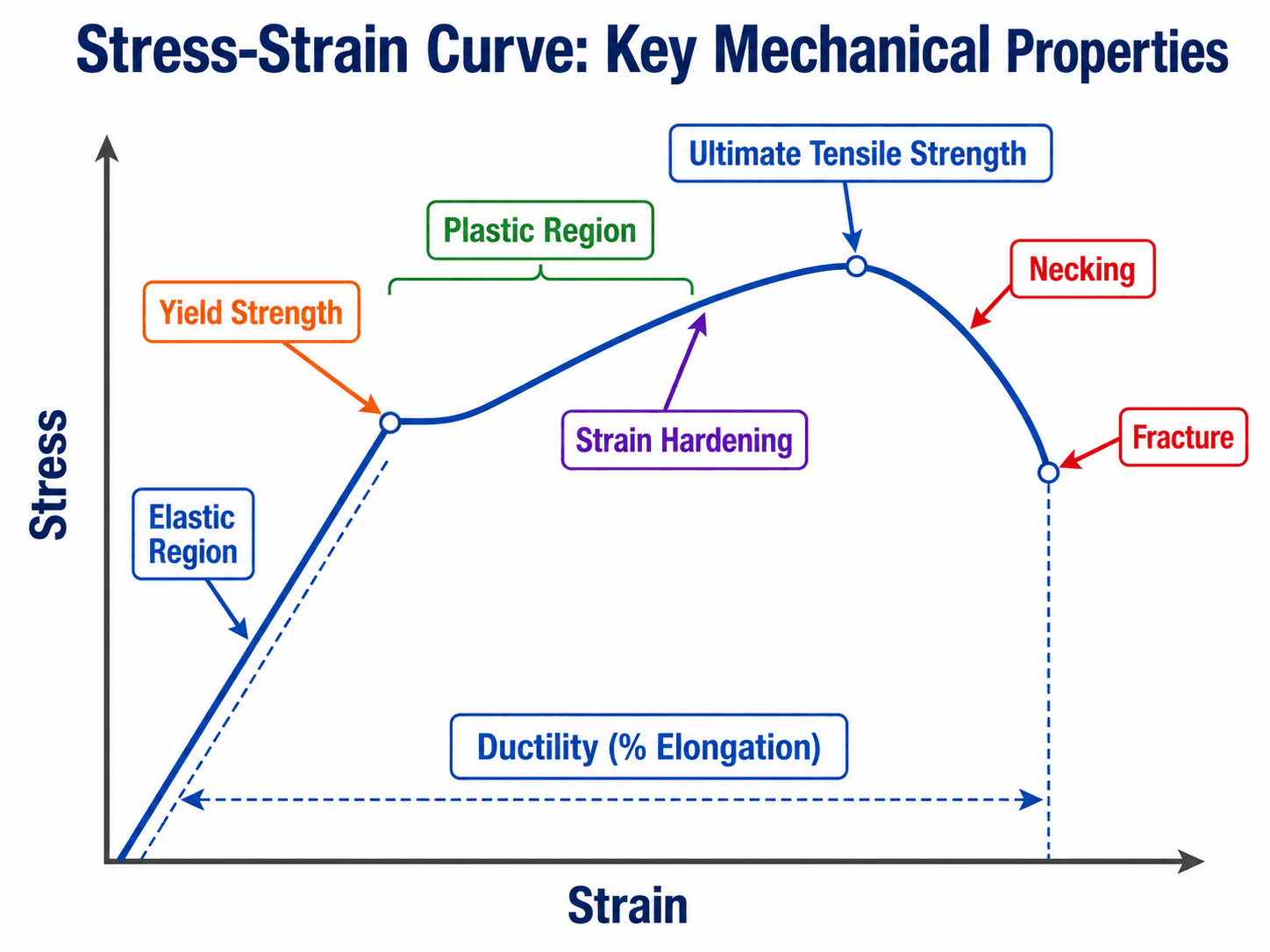
Stress is force per area, and strain is relative deformation. Plotting stress against strain shows where a material behaves elastically, yields, strain-hardens, necks, and fractures.
What Are Mechanical Properties?
Mechanical properties are the load-response characteristics of a material. They describe whether a material stretches, compresses, bends, returns to shape, permanently deforms, absorbs energy, resists indentation, survives repeated loading, or fractures suddenly.
In engineering design, mechanical properties are not just vocabulary terms. They are screening checks for real failure modes. A material may have enough strength but not enough stiffness, enough hardness but not enough toughness, or enough static capacity but poor fatigue performance.
| Mechanical property | Plain-language meaning | Engineering question it answers |
|---|---|---|
| Strength | Resistance to yielding, breaking, or permanent deformation. | Will the material fail under the applied stress? |
| Stiffness | Resistance to elastic deflection. | Will the part bend too much even if it does not break? |
| Hardness | Resistance to indentation, scratching, or local surface deformation. | Will the surface resist wear, denting, or contact damage? |
| Toughness | Ability to absorb energy before fracture. | Can the material survive impact, cracks, or sudden loading? |
| Ductility | Ability to plastically deform before breaking. | Will the material stretch or deform before fracture? |
| Fatigue resistance | Resistance to damage under repeated loading. | Will the part survive many stress cycles? |
| Creep resistance | Resistance to slow deformation under sustained load. | Will the part deform over time, especially at temperature? |
Stress and Strain: The Foundation of Mechanical Properties
Most mechanical property data starts with stress and strain. Stress describes internal force intensity, while strain describes relative deformation. Together, they let engineers compare materials independent of specimen size and connect laboratory test data to design behavior.
- \(\sigma\) Stress, commonly expressed in Pa, MPa, psi, or ksi.
- \(F\) Applied force or load.
- \(A\) Cross-sectional area resisting the load.
- \(\varepsilon\) Strain, the relative deformation of the material.
- \(\Delta L\) Change in length during loading.
- \(L_0\) Original gage length before loading.
The stress-strain curve is the bridge between raw test measurements and usable mechanical properties. The early slope relates to stiffness, the yield point relates to permanent deformation, the maximum stress relates to tensile strength, and the strain at fracture helps describe ductility.
The Most Important Mechanical Properties of Materials
The most important mechanical property depends on what the part must do. A rotating shaft, spring, bracket, bearing surface, pressure vessel, gear tooth, and impact guard can all be controlled by different properties.
| Property | What it means | Common units or measures | Where it matters most |
|---|---|---|---|
| Yield strength | Stress where permanent deformation begins. | MPa, ksi | Brackets, frames, shafts, pressure parts, fasteners. |
| Ultimate tensile strength | Maximum engineering tensile stress reached before fracture process dominates. | MPa, ksi | Material comparison, tensile members, qualification testing. |
| Modulus of elasticity | Elastic stiffness of the material. | GPa, Msi | Deflection, vibration, alignment, serviceability. |
| Hardness | Resistance to indentation or local surface deformation. | HRC, HRB, HV, HB | Wear surfaces, bearings, tooling, contact interfaces. |
| Toughness | Energy absorbed before fracture. | Energy or energy per volume, depending on method. | Impact-loaded parts, guards, low-temperature service, cracked components. |
| Ductility | Plastic deformation before fracture. | % elongation, % reduction in area | Forming, overload warning, seismic and crash-energy behavior. |
| Resilience | Elastic energy absorbed and released without permanent deformation. | Energy per volume | Springs, elastic components, shock-return applications. |
| Fracture toughness | Resistance to crack growth and brittle fracture. | MPa√m, ksi√in | Crack-sensitive parts, pressure equipment, aerospace, low-temperature service. |
| Fatigue strength | Resistance to failure under repeated stress cycles. | Stress at cycle count, MPa or ksi | Rotating shafts, springs, gears, aircraft parts, vibrating equipment. |
| Creep resistance | Resistance to slow deformation under sustained load. | Creep rate, rupture life, strain over time | High-temperature components, polymers under sustained load, turbines, piping. |
| Plasticity and malleability | Ability to permanently deform without cracking under forming operations. | Process-dependent forming limits | Sheet metal forming, rolling, forging, bending, manufacturing operations. |
| Poisson’s ratio | Ratio of lateral strain to axial strain in elastic deformation. | Dimensionless | Elastic models, FEA inputs, deformation compatibility, 3D stress-strain behavior. |
Elastic and Plastic Behavior
Elastic deformation is recoverable. Plastic deformation is permanent. For many ductile materials, design limits are based on avoiding unwanted plastic deformation, not just avoiding final fracture.
This linear relationship is Hooke’s law for the elastic region of many materials. It is useful only while the material behaves approximately linearly and has not yielded.
Strength vs Stiffness vs Toughness vs Hardness
Many material selection errors happen because these terms sound similar. In engineering, they are separate checks. A strong material can still deflect too much, a stiff material can still fracture suddenly, and a hard material can still be too brittle for impact loading.
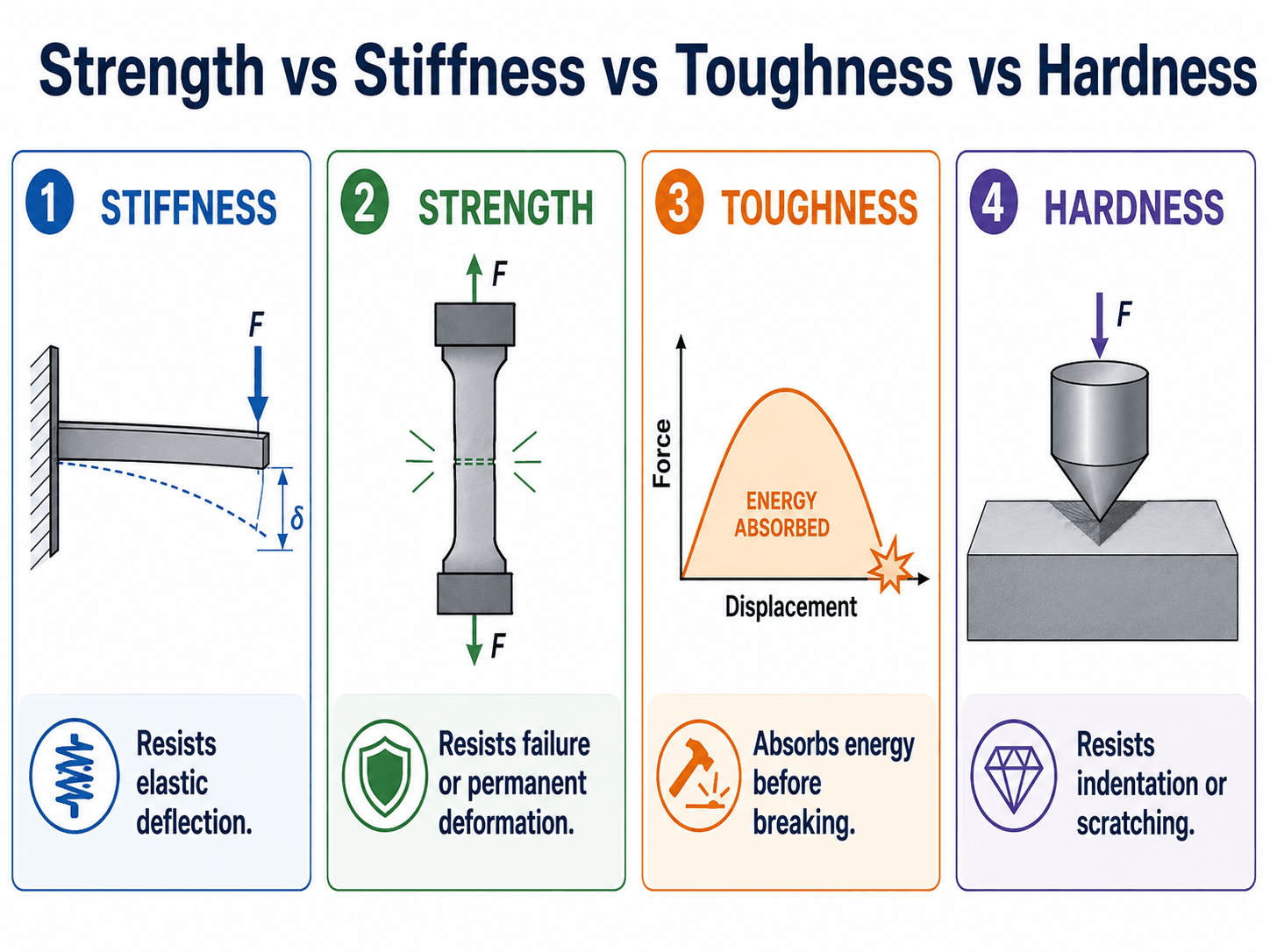
| Confused pair | Key difference | Practical design consequence |
|---|---|---|
| Strength vs stiffness | Strength is about failure or permanent deformation; stiffness is about elastic deflection. | A bracket may not yield but may still deflect enough to misalign a machine or damage connected parts. |
| Hardness vs toughness | Hardness is local surface resistance; toughness is energy absorption before fracture. | A hard material can resist indentation but crack under impact if its fracture toughness is poor. |
| Ductility vs toughness | Ductility is plastic deformation before fracture; toughness includes energy absorption. | A ductile material may form well, but toughness still depends on strength, defects, temperature, and crack sensitivity. |
| Elasticity vs plasticity | Elastic deformation is recoverable; plastic deformation is permanent. | Designs that must hold shape usually stay below yield unless controlled forming is intended. |
| Tensile strength vs yield strength | Yield strength marks permanent deformation; tensile strength marks maximum tensile stress in the test. | Many ductile designs are governed by yield, not by final tensile fracture. |
Mechanical Properties vs Physical, Thermal, and Electrical Properties
Mechanical properties are one subset of material properties. They focus on force, deformation, contact, damage, and failure. Other material properties may still matter in the same design, but they answer different questions.
| Property category | What it describes | Example engineering question |
|---|---|---|
| Mechanical properties | Response to load, deformation, impact, wear, fatigue, creep, and fracture. | Will this bracket yield, deflect, crack, wear, or fail in fatigue? |
| Physical properties | Basic measurable characteristics such as density, porosity, and melting point. | How heavy is the part, and what phase or state is expected? |
| Thermal properties | Response to heat, temperature gradients, and thermal expansion. | Will the material expand, soften, insulate, or transfer heat? |
| Electrical properties | Response to electric fields, current flow, insulation, and conductivity. | Should the material conduct electricity or act as an insulator? |
How Load Type Changes the Property That Matters
The same material can perform well in one loading condition and poorly in another. A material chosen for tensile strength may still be a poor choice for impact, fatigue, surface wear, creep, or bending stiffness.
| Load type | Property usually checked | Example component | Design concern |
|---|---|---|---|
| Tension | Yield strength, tensile strength, ductility | Tie rod, cable fitting, bolted member | Yielding, fracture, elongation, stress concentration. |
| Compression | Compressive strength, modulus, buckling interaction | Column, bearing block, spacer | Crushing, instability, local bearing damage. |
| Shear | Shear strength, shear modulus | Pin, bolt, rivet, adhesive joint | Sliding failure, shear yielding, joint slip. |
| Bending | Yield strength and stiffness | Beam, bracket, lever arm | Excess stress, deflection, local yielding. |
| Torsion | Shear modulus, shear strength, fatigue strength | Shaft, drive coupling, torsion bar | Twist, shear yielding, fatigue cracks. |
| Impact | Toughness, fracture toughness, notch sensitivity | Guard, housing, tool, crash component | Sudden fracture, brittle behavior, energy absorption. |
| Repeated cyclic loading | Fatigue strength and surface condition | Spring, gear tooth, rotating shaft | Crack initiation and growth below static strength. |
| Sustained long-term load | Creep resistance | High-temperature pipe, turbine part, loaded polymer clip | Time-dependent deformation or rupture. |
Mechanical Properties by Material Family
Mechanical behavior is strongly influenced by material family. Metals, polymers, ceramics, and composites respond differently because their bonding, microstructure, defects, processing, and internal reinforcement are different.
At the microstructure level, mechanical properties depend on bonding, grain structure, phase structure, dislocation motion, porosity, cracks, and reinforcement direction. Metals often deform plastically because dislocations can move. Many ceramics resist slip and fracture more suddenly. Polymers are strongly affected by temperature and time. Composites depend heavily on fiber direction, matrix behavior, layup, voids, and bonding.
| Material family | Typical mechanical behavior | Engineering implication |
|---|---|---|
| Metals and alloys | Often combine useful strength, ductility, toughness, and predictable yielding. | Common for frames, shafts, fasteners, pressure parts, vehicles, machinery, and structural components. |
| Polymers | Often lower stiffness than metals, with behavior sensitive to temperature, time, strain rate, and environment. | Useful for lightweight parts, housings, seals, wear components, and corrosion-resistant applications when load demands are appropriate. |
| Ceramics | Often hard, wear-resistant, and heat-resistant, but many are brittle and sensitive to flaws. | Useful where hardness, temperature capability, or chemical stability matters, but fracture risk must be controlled. |
| Composites | Often direction-dependent, with properties controlled by fiber direction, matrix behavior, layup, voids, and bonding. | Useful for high strength-to-weight or stiffness-to-weight designs, but require careful load-path and quality control. |
Published property values often apply to a specific material grade, processing route, heat treatment, specimen orientation, moisture condition, or test temperature. Do not assume every grade in a material family behaves the same way.
How Mechanical Properties Are Measured
Mechanical properties are measured with controlled tests that apply known loads, deformation rates, specimen geometries, and environmental conditions. The goal is not only to generate a number, but to determine which number applies to the actual design problem.
| Test method | Property commonly evaluated | What the result helps engineers decide |
|---|---|---|
| Tensile test | Yield strength, tensile strength, modulus, elongation, ductility | Whether a material can carry tension without yielding or breaking. |
| Compression test | Compressive strength, crushing behavior, elastic response | Whether a material can resist bearing, crushing, or column-like compression. |
| Hardness test | Indentation resistance and surface hardness | Whether a surface is likely to resist denting, wear, or contact deformation. |
| Impact test | Impact energy and notch sensitivity | Whether a material can absorb sudden energy without brittle fracture. |
| Fatigue test | Life under repeated cyclic loading | Whether a part can survive repeated stress cycles over its service life. |
| Creep test | Time-dependent deformation under sustained load | Whether a part will slowly deform during long-term service, especially at elevated temperature. |
| Fracture test | Crack growth resistance and fracture toughness | Whether cracks or flaws can grow into unstable fracture. |
A tested property is not automatically a design allowable. Design values may include safety factors, statistical reductions, code requirements, weld or joint reductions, temperature corrections, owner specifications, and quality control limits.
How to Read Mechanical Properties on a Material Datasheet
A material datasheet can be useful, but it must be read carefully. The most important question is whether the listed property matches the material condition, test method, temperature, orientation, and loading mode of the real part.
| Datasheet item | What to look for | Why it matters |
|---|---|---|
| Material grade and condition | Alloy, temper, heat treatment, processing route, print orientation, or composite layup. | The same base material can have very different mechanical properties in different conditions. |
| Minimum vs typical values | Whether the value is guaranteed, typical, nominal, or representative. | Typical values are not always appropriate for conservative design checks. |
| Test standard and specimen direction | Which test method was used and whether the specimen orientation matches the part. | Anisotropic materials can have different properties in different directions. |
| Temperature and environment | Room temperature, elevated temperature, moisture exposure, UV exposure, corrosion condition, or aging. | Mechanical properties can change dramatically outside the test environment. |
| Yield vs ultimate strength | Whether the design limit is permanent deformation or final fracture. | Many ductile designs are governed by yield strength rather than ultimate tensile strength. |
| Hardness scale | Rockwell, Brinell, Vickers, Shore, or another scale. | Hardness values are not interchangeable unless converted carefully and appropriately. |
| Fatigue or creep conditions | Cycle count, stress ratio, temperature, time, rupture criteria, and test environment. | Fatigue and creep values are highly condition-dependent. |
Mechanical Property Selection Workflow
The best way to use mechanical properties is to start with the load and failure concern, not with a material name. Engineers usually ask what the part must survive first, then identify which property controls the design.
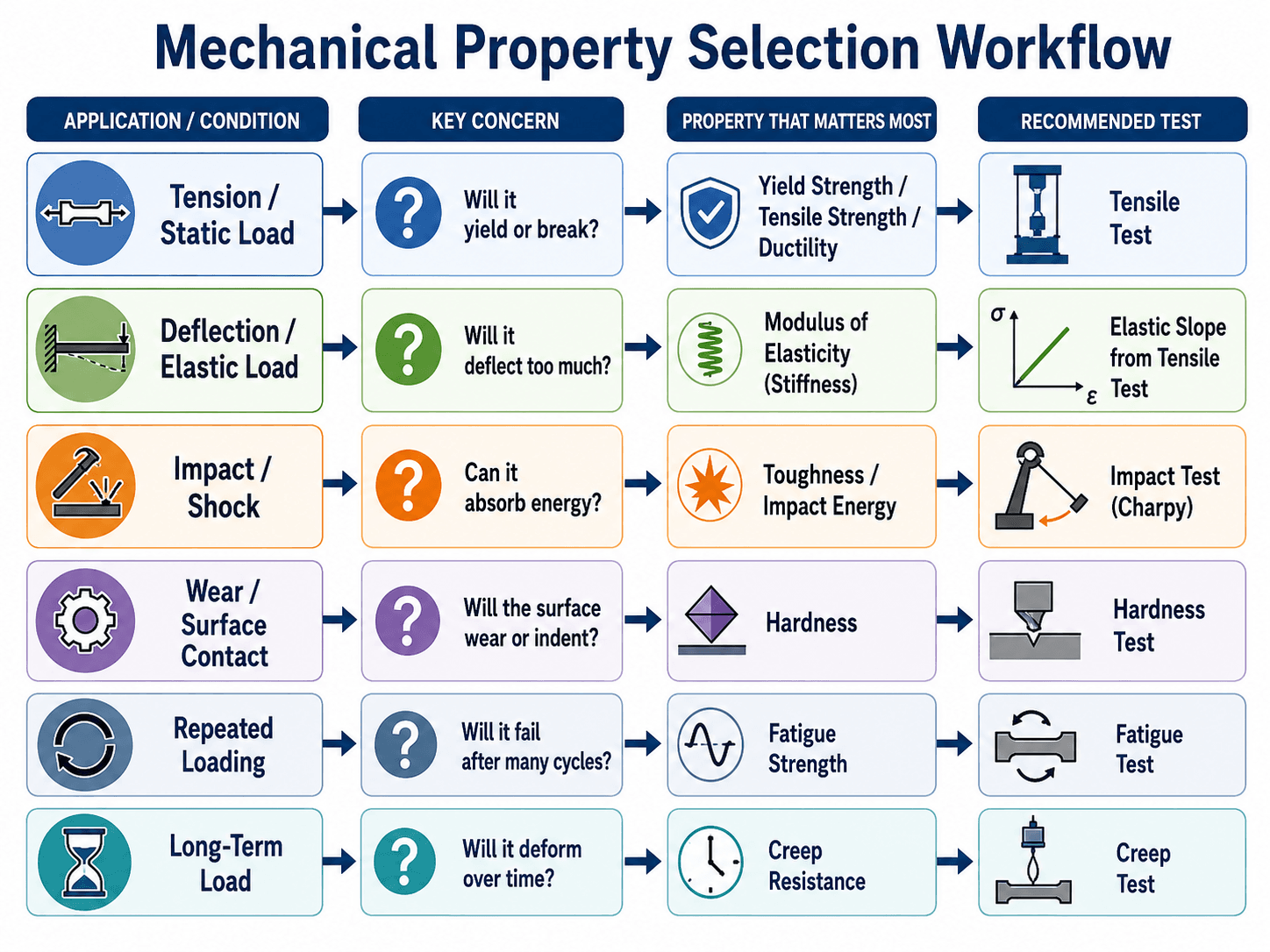
Identify the dominant load, define the failure concern, choose the controlling mechanical property, confirm the relevant test data, then check whether real conditions such as temperature, notches, surface finish, cyclic loading, or manufacturing defects change the answer.
| Design situation | Property to check first | Why it matters |
|---|---|---|
| Part must not permanently bend | Yield strength | Yielding marks the start of permanent deformation in many ductile materials. |
| Part must hold alignment under load | Modulus of elasticity and section stiffness | Deflection may control performance before material failure occurs. |
| Surface sees sliding or contact | Hardness and wear resistance | Surface damage may control life even when bulk strength is adequate. |
| Part sees impact or shock | Toughness and notch sensitivity | Sudden loading can trigger fracture, especially near sharp features or defects. |
| Part sees repeated cycles | Fatigue strength and stress concentration sensitivity | Fatigue cracks can grow under repeated stresses below static strength. |
| Part stays loaded for long periods | Creep resistance | Long-term deformation can control performance even without immediate yielding. |
Mechanical Properties Example: Selecting a Bracket Material
Consider a cantilever bracket supporting a repeated service load. A basic material comparison might only ask for tensile strength, but a real design review needs several property checks.
Step 1: Check Static Strength
The bracket should remain below the allowable stress based on yield strength or another project-specific design limit. If the material yields, the bracket may permanently sag, misalign connected parts, or create secondary stresses.
Step 2: Check Stiffness and Deflection
Even if the bracket does not yield, it may deflect too much. Stiffness depends on both the material modulus and bracket geometry. A higher-strength material does not automatically fix excessive deflection if the elastic modulus is similar.
Step 3: Check Fatigue, Notches, and Environment
If the bracket sees vibration or repeated loading, fatigue may control the design. Holes, welds, sharp corners, rough surfaces, corrosion, or poor fit-up can reduce fatigue performance more than a basic static calculation suggests.
Engineering Judgment and Field Reality
Mechanical property values are usually measured under controlled conditions. Real components see geometry effects, stress concentrations, residual stresses, manufacturing variation, surface damage, corrosion, temperature shifts, and loading histories that do not appear in a simple property table.
The weak point in a part is often not the base material itself. It may be a weld toe, thread root, drilled hole, notch, casting pore, delamination, heat-affected zone, scratched surface, or sharp internal corner where local stress is much higher than the nominal stress.
Good engineering judgment uses mechanical properties as inputs, not final answers. The final decision also depends on geometry, load path, safety factor, environment, manufacturing process, inspection requirements, cost, availability, and consequence of failure.
When This Breaks Down
Simple mechanical property comparisons become unreliable when the service condition does not match the test condition. This is especially important for polymers, composites, brittle materials, high-temperature applications, impact loading, fatigue-sensitive parts, and components with cracks or defects.
- Temperature changes: Elevated temperature can reduce strength, increase creep, soften polymers, or change ductility and toughness.
- High strain rate or impact: Fast loading can make some materials behave more brittle than they do in slow tests.
- Fatigue loading: Repeated stress cycles can initiate cracks below the material’s static yield or tensile strength.
- Stress concentrations: Holes, threads, keyways, welds, corners, and scratches can control failure before nominal stress reaches a published property value.
- Direction-dependent materials: Rolled metals, wood, additively manufactured parts, and composites may have different properties depending on orientation.
Common Mistakes and Practical Checks
The most common mistake is using a single mechanical property as if it proves a material is suitable. Mechanical design normally requires several checks because different failure modes can control under different conditions.
- Using tensile strength when yield strength controls: Ductile parts often become unacceptable once permanent deformation begins, long before final fracture.
- Assuming harder means better: Higher hardness may improve wear resistance but can reduce machinability, ductility, or impact tolerance in some materials.
- Ignoring stiffness: A part can be strong enough but still too flexible for alignment, vibration, sealing, or serviceability requirements.
- Ignoring fatigue: A static strength check does not prove a component will survive repeated loading.
- Comparing values from different test conditions: Strain rate, specimen geometry, temperature, heat treatment, and material condition can make property values non-equivalent.
Do not choose a material only because it has a high published strength value. Match the property to the actual failure mode: yielding, deflection, impact fracture, wear, fatigue, creep, or crack growth.
Testing Standards and Design Reference Context
Mechanical properties are most useful when the test method is clear. Tensile properties, for example, depend on specimen preparation, test speed, material condition, and data interpretation, so standardized testing is important when property values are used for engineering decisions.
- ASTM E8/E8M tensile testing: ASTM standard test methods for tension testing of metallic materials covers tension testing used to evaluate strength and ductility behavior in metallic materials.
- Project-specific criteria: Final material selection may also depend on owner requirements, safety factors, design codes, qualification testing, manufacturing specifications, and quality control requirements.
- Engineering use: Engineers use standardized test data to compare materials more consistently, but they still adjust decisions for geometry, environment, surface condition, defects, and service loading.
Frequently Asked Questions
Mechanical properties of materials describe how materials respond to force, deformation, impact, wear, repeated loading, and long-term service. They include strength, stiffness, hardness, toughness, ductility, elasticity, fatigue resistance, creep resistance, and fracture behavior.
The most important mechanical properties are usually yield strength, tensile strength, modulus of elasticity, hardness, toughness, ductility, fatigue strength, creep resistance, resilience, fracture toughness, and plasticity. The controlling property depends on the load type, environment, geometry, and failure mode.
Strength describes how much stress a material can resist before yielding, breaking, or permanently deforming. Stiffness describes how much it resists elastic deflection under load. A material can be strong but flexible, or stiff but brittle.
No. Hardness is resistance to indentation, scratching, or local surface deformation. Toughness is the ability to absorb energy before fracture. A hard material can still be brittle if it cracks easily under impact, stress concentration, or low-temperature service.
Mechanical properties are measured using tests such as tensile testing, compression testing, hardness testing, impact testing, fatigue testing, creep testing, and fracture testing. The right test depends on the property being evaluated and the loading condition the material will experience.
Summary and Next Steps
Mechanical properties of materials explain how materials behave under load, deformation, impact, wear, repeated cycling, and long-term service. The most common properties include strength, stiffness, hardness, toughness, ductility, elasticity, fatigue resistance, creep resistance, resilience, and fracture toughness.
The practical engineering step is to match the property to the failure mode. A design may be controlled by yielding, deflection, surface wear, impact fracture, fatigue cracks, creep deformation, or brittle fracture depending on load path, environment, geometry, and material condition.
Where to go next
Continue your learning path with related Turn2Engineering resources.
-
Material Properties
Review the broader property categories that describe how materials behave in engineering applications.
-
Material Selection
Learn how engineers balance mechanical properties with cost, manufacturability, environment, availability, and design requirements.
-
Hooke’s Law
Connect elastic behavior, stiffness, force, and deformation through a foundational engineering equation.