
Key Takeaways
- Core idea: Wetlands restoration repairs degraded wetland systems by restoring the water regime, soil saturation, native vegetation, and ecological functions that make the site behave like a wetland again.
- Engineering use: Water resources engineers evaluate drainage, grading, inflow, outflow, floodplain connection, soil conditions, erosion risk, monitoring criteria, and long-term maintenance before restoration work is built.
- What controls it: Hydroperiod, groundwater level, surface inflow, outlet control, microtopography, sediment load, plant community, and invasive species pressure usually control restoration success.
- Practical check: A wetland planting plan cannot compensate for incorrect hydrology; if water arrives too rarely, drains too quickly, or remains too deep, the target wetland functions may not develop.
Table of Contents
Introduction
Wetlands restoration is the process of repairing a degraded, drained, filled, or altered wetland so it can recover shallow water storage, saturated soils, native vegetation, habitat, flood attenuation, and water quality functions. In engineering practice, successful restoration depends on restoring the right hydrology before relying on grading or planting.
How Wetland Hydrology Controls Restoration Success
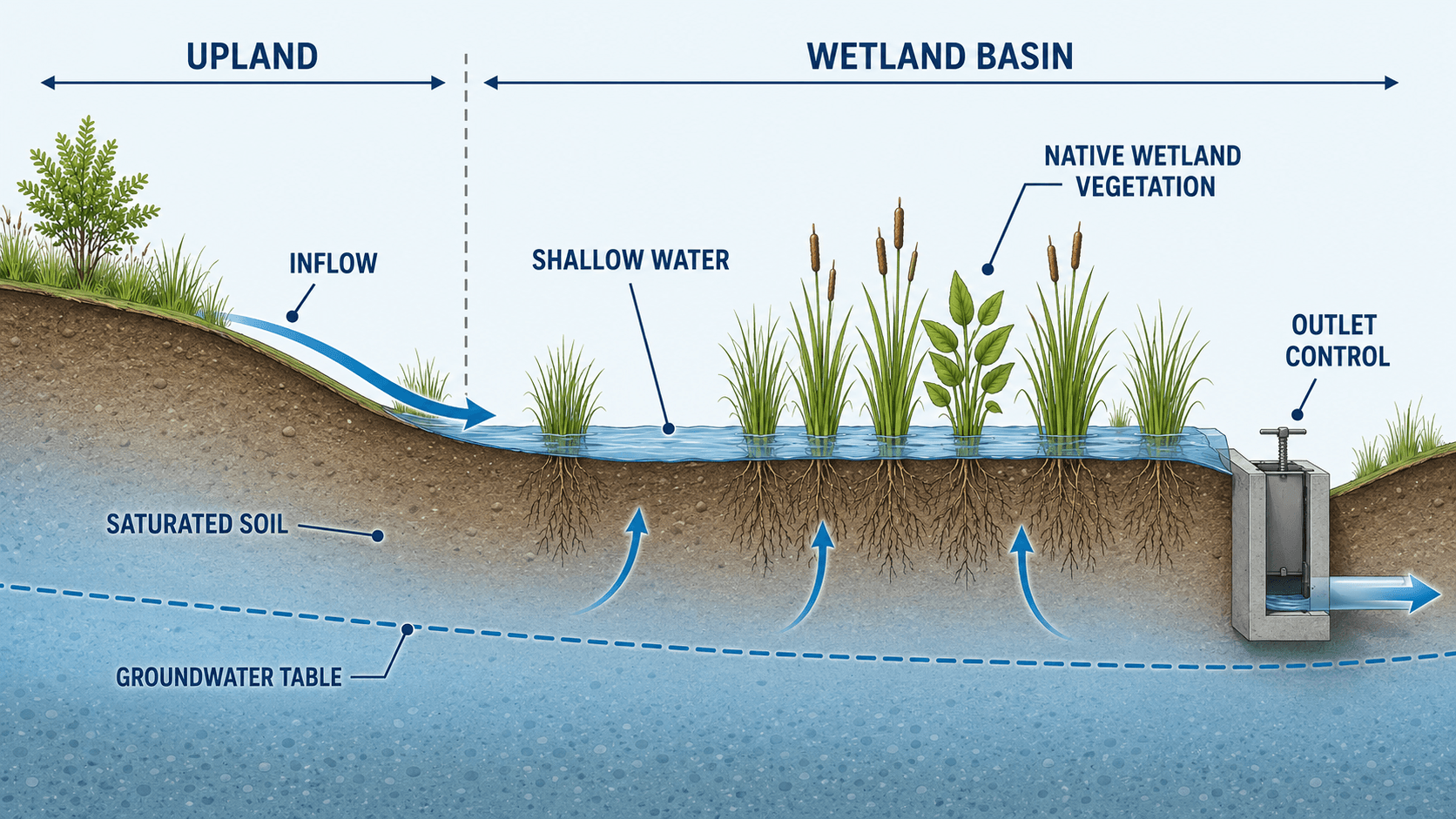
Notice that the wetland basin is controlled by both surface inflow and groundwater position. If either one is wrong, the restored vegetation and soil indicators may not match the project goal even if the basin shape looks correct.
What is Wetlands Restoration?
Core definition: Wetlands restoration repairs the water, soil, vegetation, and landscape connections that allow a degraded wetland to function again.
Wetlands restoration is the planned repair of a wetland system that has lost function because of drainage, filling, channelization, grading, invasive species, altered groundwater, sedimentation, nutrient loading, or surrounding land use change. The goal is not simply to make an area look green or wet. The goal is to restore the physical and biological processes that make the site function as a wetland.
In practice, wetlands restoration usually focuses on four linked conditions: hydrology, soils, vegetation, and landscape connection. Hydrology controls how often water enters and leaves the site. Soil conditions determine whether saturation, organic matter, and reduced conditions can develop. Vegetation responds to the water regime. Landscape connection determines how the wetland interacts with streams, floodplains, stormwater runoff, groundwater, and nearby habitat.
A useful restoration design starts by asking what function is missing. A drained wet meadow may need a higher water table. A disconnected floodplain wetland may need overbank flow restored. An urban wetland may need inflow stabilization and sediment management. The restoration method should match the stressor that caused the wetland to degrade.
Wetland Restoration vs Creation, Enhancement, and Mitigation
Important distinction: Restoration repairs a degraded wetland, while creation, enhancement, and mitigation serve different planning and regulatory purposes.
Many people use wetland restoration as a broad phrase, but engineering and environmental review often distinguish between restoration, creation, enhancement, and mitigation. The difference matters because each approach has different uncertainty, performance criteria, design effort, and monitoring requirements.
| Term | What it means | Why the distinction matters |
|---|---|---|
| Restoration | Repairing a degraded or former wetland so natural wetland functions can return. | Usually works best where historic wetland hydrology, hydric soils, or wetland landscape position are still recoverable. |
| Creation | Constructing a wetland where wetland conditions did not previously exist. | Often carries more uncertainty because the natural water regime and soil conditions may not already support wetland processes. |
| Enhancement | Improving one or more functions of an existing wetland, such as habitat diversity or water quality treatment. | May improve specific performance metrics without fully restoring historic wetland condition. |
| Mitigation | Restoration, creation, enhancement, or preservation used to compensate for wetland impacts elsewhere. | Often requires formal performance criteria, monitoring, documentation, and regulatory coordination. |
Restoration is often more technically feasible than creation when the site already has wetland clues such as hydric soils, remnant wetland vegetation, seasonal ponding, floodplain position, shallow groundwater, or old drainage infrastructure that can be disabled. These clues suggest that the site’s wetland processes may be recoverable rather than invented from scratch.
Wetland Types and Restoration Goals
Wetlands restoration is not one standard design. The target wetland type controls the water depth, saturation period, planting zones, flood connection, and monitoring criteria. A depressional wetland, floodplain wetland, riparian wetland, coastal marsh, and urban wetland may all require different restoration strategies.
| Wetland setting | Typical restoration goal | Key design concern |
|---|---|---|
| Depressional wetland | Restore seasonal ponding, saturated soils, and emergent or wet meadow vegetation. | Outlet elevation, drainage tile breaks, contributing watershed area, and drawdown timing. |
| Floodplain wetland | Reconnect overbank flow, flood storage, sediment exchange, and riparian habitat. | Flood elevations, channel stability, sediment deposition, downstream impacts, and erosion protection. |
| Riparian wetland | Improve streamside storage, filtration, bank protection, and habitat continuity. | Bank stability, buffer width, flow concentration, shade, invasive species, and maintenance access. |
| Coastal or tidal wetland | Restore tidal exchange, marsh platform function, vegetation zones, and shoreline resilience. | Tidal range, salinity, marsh elevation, sea level trend, and sediment supply. |
| Urban wetland | Improve runoff storage, water quality treatment, habitat pockets, and green infrastructure value. | Flashy inflow, trash, sediment load, nutrient load, public access, safety, and long-term maintenance. |
Wetlands Restoration Process
Workflow focus: The wetland restoration process moves from site assessment to measurable goals, hydrologic repair, grading, planting, monitoring, and adaptive management.
A strong restoration project moves from site understanding to measurable goals, then to hydrologic design, grading, vegetation establishment, and long-term monitoring. The sequence matters because later steps depend on earlier decisions. For example, a native planting plan should not be finalized until the expected water depths and saturation periods are understood.
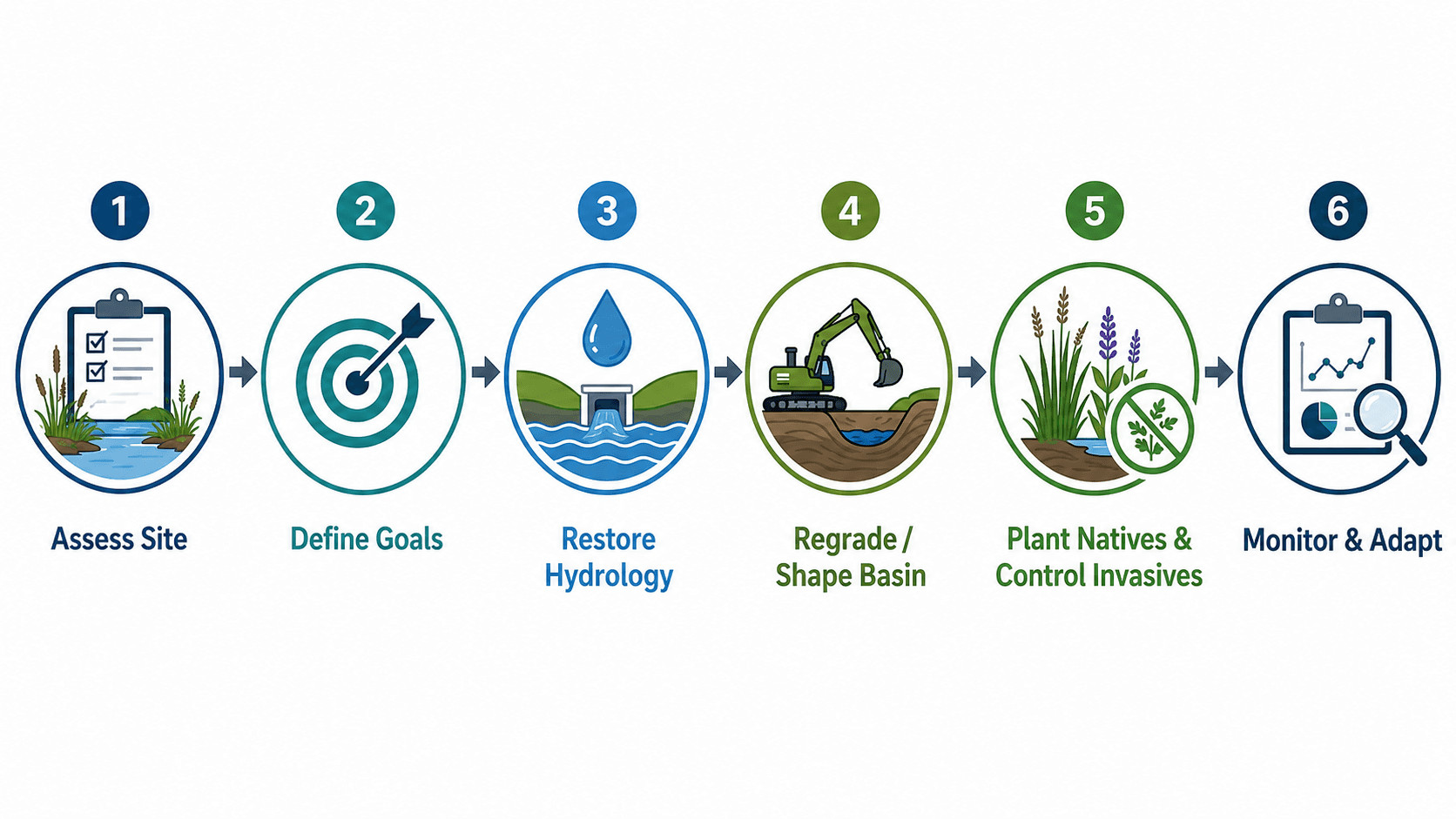
The diagram should be read left to right. Each step reduces uncertainty before the next design decision is made. Skipping the early assessment steps is one of the most common reasons wetland restoration methods are applied to the wrong problem.
1. Assess the Site
The site assessment identifies existing wetland indicators, historic drainage patterns, ditch locations, tile outlets, soil conditions, invasive species, floodplain connection, groundwater influence, and surrounding land uses. This step prevents the project from treating symptoms while leaving the original stressor in place.
2. Define Restoration Goals
Goals should be measurable. A project might target seasonal shallow water, emergent marsh vegetation, floodplain storage, amphibian habitat, stormwater polishing, riparian buffer function, or a mix of outcomes. The design should connect each goal to a field-observable success criterion.
3. Restore Hydrology Before Planting
Hydrologic restoration may include plugging ditches, breaking drainage tiles, reconnecting floodplain flow paths, adjusting outlet elevations, removing berms, or regrading compacted areas. This step controls whether the wetland will be too dry, too deep, too flashy, or stable enough for the target plant community.
4. Regrade and Establish Microtopography
Wetlands are rarely flat bowls. Small changes in elevation create shallow pools, saturated benches, seasonally wet edges, and drier transition zones. Microtopography helps support multiple vegetation zones and gives the site resilience during wet and dry periods.
5. Plant Native Species and Control Invasives
Native planting works best when species are matched to the expected water regime. Invasive species control must begin early because disturbed wetland soils and open water edges can be quickly colonized by aggressive plants before native communities establish.
6. Monitor and Adapt
Monitoring verifies whether the restored wetland is meeting its goals. Engineers and restoration teams may track water levels, vegetation cover, invasive species, soil saturation, erosion, sediment deposition, and outlet performance. If results drift from the design intent, adaptive management is used to correct the site.
Common Wetland Restoration Methods
Wetland restoration methods depend on why the wetland lost function. A drained agricultural wetland may need tile breaks and ditch plugs. A floodplain wetland may need reconnection to overbank flow. An urban wetland may need sediment management, inflow pretreatment, outlet control, and invasive species removal.
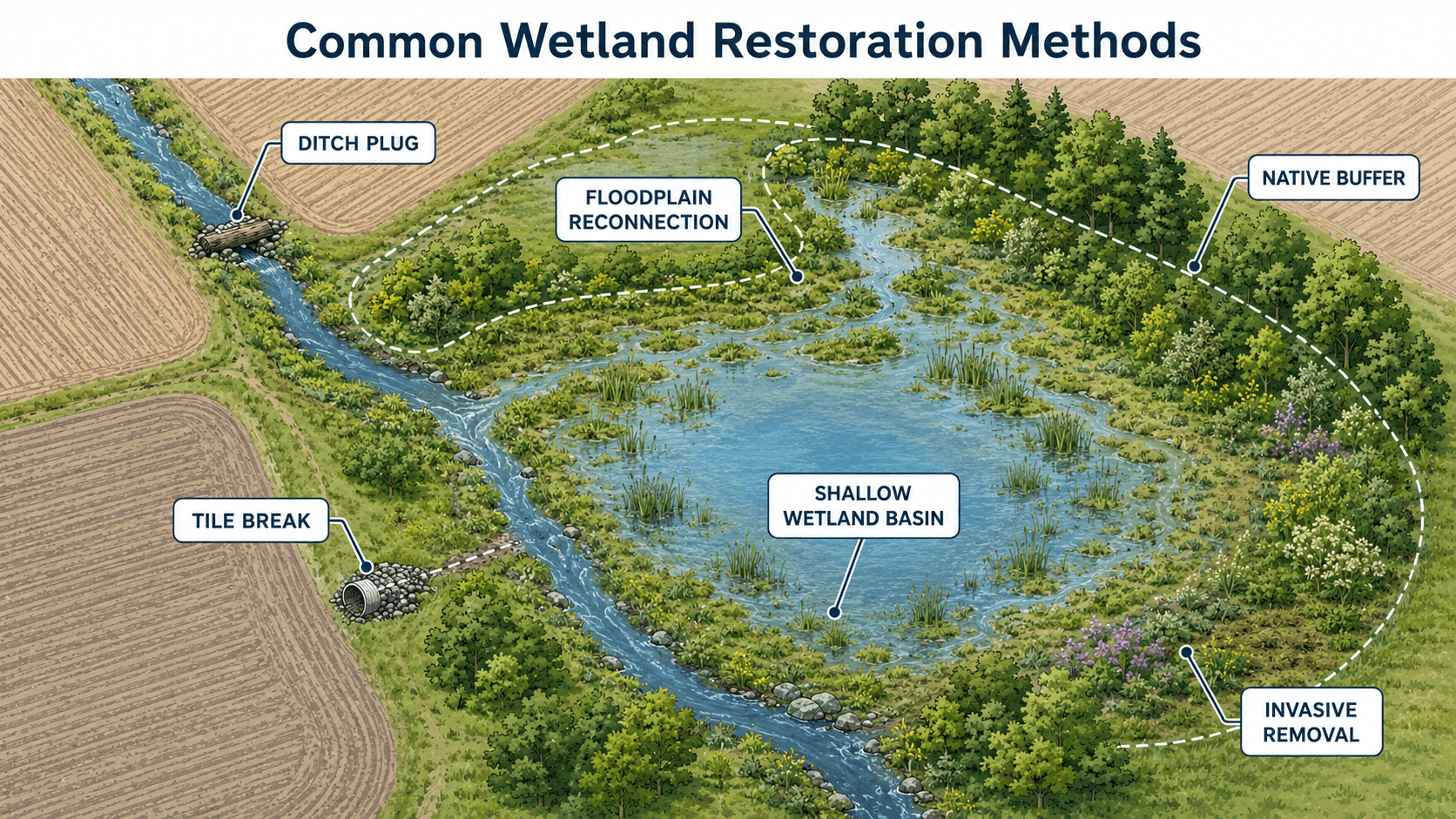
The plan-view diagram highlights that restoration methods are usually connected. A ditch plug may raise water levels, a tile break may reconnect shallow groundwater, a native buffer may reduce incoming sediment, and invasive removal may give the target plant community room to establish.
| Restoration method | What it does | Engineering implication |
|---|---|---|
| Ditch plugging | Blocks or slows artificial drainage so water can remain on the site longer. | Outlet elevations, overtopping routes, seepage, erosion protection, and upstream water levels must be checked. |
| Tile break or tile disablement | Interrupts subsurface drainage that previously lowered the water table. | The design must confirm where tile lines flow and where redirected groundwater or surface seepage will emerge. |
| Floodplain reconnection | Allows stream or river flows to access low-lying floodplain wetland areas again. | Hydraulic effects, flood elevations, sediment movement, and downstream impacts need review. |
| Microtopography grading | Creates shallow pools, wet benches, and transition zones instead of a uniform basin. | Small elevation differences can control plant zones, storage duration, and construction tolerance. |
| Native buffer establishment | Stabilizes wetland edges and filters runoff before it enters the restored wetland. | Buffer width, slope, flow concentration, mowing limits, and maintenance access affect long-term performance. |
| Invasive species removal | Reduces competition from aggressive plants that can dominate disturbed wetland soils. | Control must be repeated and coordinated with hydrology and native planting, not treated as a one-time cleanup. |
What Controls a Wetlands Restoration Design?
Design focus: A wetland restoration design should be reviewed as a water-controlled system, not as a planting or landscaping project.
The controlling design question is whether the restored wetland can maintain the right water regime for the target function. A project aimed at seasonal marsh habitat has different water depth, vegetation, and outlet needs than a riparian floodplain wetland or a stormwater treatment wetland. The design must match the site’s hydrologic setting instead of forcing one standard wetland layout onto every project.
Hydroperiod means the timing, depth, frequency, and duration of wetland saturation or ponding. It controls whether the site supports emergent marsh, wet meadow, forested wetland, open water, or transitional vegetation.
| Design control | Why it matters | Engineering implication |
|---|---|---|
| Hydroperiod | Controls how long soils stay saturated or ponded during the year. | Determines target plant zones, outlet elevation, basin depth, and whether the wetland is seasonal or persistent. |
| Water source | Water may come from runoff, groundwater, overbank flow, precipitation, or a combination of sources. | Design checks should separate flashy storm inflow from sustained base saturation because they support different wetland functions. |
| Topography and microrelief | Small elevation differences determine where water collects and where vegetation transitions occur. | Survey accuracy and grading tolerance matter because a few inches can change wetland plant survival. |
| Soil permeability and compaction | Soils influence infiltration, seepage, ponding, and root-zone saturation. | Compacted construction zones may need decompaction, amended soil handling, or revised grading to avoid poor establishment. |
| Outlet behavior | The outlet controls drawdown rate and maximum water level during wet periods. | Poor outlet design can make the site too dry, too deep, erosive, or vulnerable to unintended flooding. |
| Sediment and nutrient loading | Excess load can fill shallow areas, favor invasive species, and reduce water quality function. | Upstream erosion control, pretreatment, buffers, or forebays may be needed before water enters the restored wetland. |
Before finalizing a planting plan, check whether the proposed species match the expected depth and duration of saturation. If the grading and outlet design create a different hydroperiod than assumed, the vegetation plan may fail even if the plants are native.
Wetlands Restoration Design Review Checklist
A restoration design should be reviewed as a connected system, not as separate drawings for grading, planting, and erosion control. The checklist below focuses on the practical questions that help determine whether a restored wetland can actually meet its intended function after construction.
Start with the site stressor, confirm the water source, define the target hydroperiod, check grading and outlet behavior, match vegetation to the expected water regime, then set monitoring triggers for adaptive management.
| Review check | What to look for | Why it matters |
|---|---|---|
| Existing stressor is identified | Drainage tile, ditching, fill, channel incision, invasive species, altered inflow, sediment loading, or groundwater change. | Restoration may fail if the original cause of wetland degradation remains active. |
| Target hydroperiod is defined | Expected seasonal water depth, saturation duration, drawdown timing, and dry-period behavior. | Hydroperiod determines vegetation zones, soil development, habitat, and storage performance. |
| Water budget is credible | Runoff, precipitation, groundwater, seepage, evaporation, outlet flow, and overbank connection are considered. | A wetland cannot be restored by grading alone if the water supply or retention time is not realistic. |
| Outlet and overflow paths are safe | Drawdown route, emergency overflow, erosion protection, downstream conditions, and maintenance access. | Uncontrolled outlets can drain the wetland too quickly or cause erosion and unintended flooding. |
| Planting zones match elevations | Species are assigned to open water edge, saturated soil, seasonally wet bench, and upland buffer zones. | Native plants still fail when installed in water depths or saturation periods outside their tolerance. |
| Monitoring metrics are measurable | Water level targets, vegetation cover, invasive species thresholds, erosion observations, and photo points. | Monitoring must show whether the design is working and when corrective action is needed. |
Water Resources Benefits of Wetlands Restoration
Restored wetlands can provide several water resources benefits, but those benefits depend on site position and design. A floodplain wetland may reduce peak flow and store sediment during overbank events. A headwater wetland may slow runoff and support base saturation. A wetland receiving urban runoff may help remove sediment and nutrients when the inflow, residence time, and vegetation are appropriate.
| Wetland function | How restoration supports it | Design caution |
|---|---|---|
| Flood storage | Shallow basins and connected floodplains temporarily store runoff or overbank flow. | Storage benefits depend on available volume, outlet behavior, tailwater, and timing within the watershed hydrograph. |
| Water quality improvement | Vegetation, slow flow, sediment settling, soil processes, and biological uptake can reduce some pollutant loads. | Short-circuiting, high velocities, sediment overload, or insufficient residence time can reduce treatment performance. |
| Groundwater and soil moisture support | Restored saturation can reconnect shallow groundwater and maintain wetland soil conditions. | Sites dominated by deep drains or low-permeability fills may not recover without targeted hydrologic repair. |
| Habitat diversity | Varied depths, edges, native vegetation, and buffers create more ecological niches. | Uniform grading and one-size planting plans reduce habitat value and resilience. |
| Erosion and sediment control | Buffers and floodplain reconnection can reduce concentrated flow and slow erosive runoff. | Unstable inflow channels or undersized overflow paths can create erosion inside the restored wetland. |
Reference Wetlands and Performance Criteria
A reference wetland is a nearby or regionally appropriate wetland that helps define realistic restoration targets. It does not mean the restored site must become identical to the reference site. Instead, it helps the project team understand expected vegetation zones, water levels, soil indicators, seasonal variation, and ecological function.
Performance criteria translate restoration goals into measurable outcomes. Good criteria are specific enough to guide monitoring and adaptive management but flexible enough to account for wet years, dry years, establishment periods, and natural variability.
| Performance criterion | What it measures | Why it helps |
|---|---|---|
| Hydroperiod target | Seasonal water depth, saturation duration, and drawdown pattern. | Shows whether the restored water regime supports the intended wetland type. |
| Native vegetation cover | Percent cover, species composition, and establishment in the correct elevation zones. | Indicates whether the plant community is responding to the restored hydrology. |
| Invasive species threshold | Percent cover or presence of aggressive species requiring intervention. | Triggers maintenance before invasive species dominate disturbed wetland soils. |
| Physical stability | Erosion, sediment deposition, outlet condition, ditch plug stability, and overflow path performance. | Confirms that the restored wetland remains physically stable during storm events. |
| Photo point comparison | Repeat images from fixed locations over multiple seasons or years. | Provides an easy way to track vegetation zones, water levels, erosion, and maintenance needs. |
Example: Restoring a Drained Agricultural Wetland
A common wetland restoration scenario is a low agricultural field that still ponds seasonally but was historically drained by shallow ditches or subsurface tile. The site may still have hydric soil indicators and a landscape position that suggests a former wetland, but active drainage prevents the water table from remaining high enough to support wetland vegetation.
Existing Condition
The field has a shallow outlet ditch, a visible tile outlet, compacted soil near old equipment paths, and seasonal ponding after large storms. Vegetation is mostly upland weeds and invasive wet-tolerant plants along the ditch edge.
Restoration Actions
The design may include tile breaks, a ditch plug with a protected overflow route, shallow basin grading, microtopography, native emergent and wet meadow planting zones, and a buffer between the wetland and adjacent fields. The outlet elevation is set so the site holds seasonal water without causing unintended off-site flooding.
Monitoring Focus
The monitoring plan would track water levels, drawdown timing, vegetation establishment, invasive species cover, ditch plug stability, sediment deposition, and overflow performance after major storm events. The key engineering lesson is that drainage repair and overflow planning must be solved together.
Wetland Restoration Monitoring and Success Criteria
Monitoring focus: Wetland restoration success should be measured with hydrology, vegetation, stability, and maintenance indicators rather than appearance alone.
Monitoring is how restoration intent becomes measurable performance. A restored wetland may look successful after the first growing season but still have incorrect drawdown, unstable inflow, invasive species expansion, or sediment accumulation that becomes obvious only over time.
| Monitoring metric | What it shows | Example field method |
|---|---|---|
| Water level | Whether the restored hydroperiod matches the target wetland type. | Staff gauge, shallow well, pressure transducer, or repeated field observations. |
| Native vegetation cover | Whether target wetland plants are establishing in the correct zones. | Vegetation plots, transects, percent cover estimates, and photo points. |
| Invasive species cover | Whether aggressive plants are beginning to dominate disturbed areas. | Mapped patches, percent cover threshold, seasonal inspection, and maintenance records. |
| Soil saturation indicators | Whether wetland soil conditions are developing or recovering. | Soil observations, shallow groundwater checks, and repeated saturation observations. |
| Erosion and sedimentation | Whether inflow, outlet, and basin areas are physically stable. | Inspection after storms, sediment depth checks, bank observations, and fixed photo points. |
| Outlet condition | Whether water leaves the site at the intended rate and elevation. | Outlet inspection, debris checks, erosion checks, and drawdown observations. |
Hydrology Monitoring
Water level gauges, staff plates, shallow wells, field observations, and photo points can help verify whether the restored site reaches the intended depth and saturation period. Hydrology monitoring is especially important after major storms, drought periods, and the first full growing season.
Vegetation Monitoring
Vegetation monitoring tracks native cover, species diversity, wetland indicator species, bare soil, and invasive species pressure. The goal is not simply high plant density; the plant community should match the restored wetland’s water regime and target function.
Physical Stability Monitoring
Engineers should check inflow points, outlet structures, overflow paths, embankments, ditch plugs, tile breaks, and graded basins for erosion, settlement, blockage, or unintended drainage. Small physical defects can change the entire wetland hydroperiod.
When Wetlands Restoration May Require Permitting Review
Wetlands restoration can involve grading, fill removal, water control structures, stream reconnection, channel work, floodplain changes, and work in or near jurisdictional wetlands. Those activities may trigger local, state, or federal review depending on the location, wetland type, project purpose, and amount of disturbance.
Permitting review can affect the design schedule, construction limits, monitoring requirements, mitigation documentation, and allowable impacts. Early screening is important because a project intended to improve wetland function can still create regulatory concerns if it changes flood elevations, discharges fill, alters a stream, or affects adjacent wetlands.
Before construction, confirm whether the work affects jurisdictional wetlands, streams, floodplains, drainage systems, endangered species habitat, cultural resources, or locally regulated environmental areas.
Engineering Judgment and Field Reality
Wetlands restoration drawings often show clean water levels, smooth grading, and clear vegetation zones, but field conditions are rarely that tidy. Construction equipment can compact soils, unexpected tile lines can continue draining the site, upstream runoff can carry more sediment than expected, and drought or unusually wet years can distort early monitoring results.
A restored wetland should be designed with adjustability where possible. Small outlet modifications, supplemental invasive control, replanting of failed zones, and erosion repairs are often part of successful adaptive management rather than signs that the entire project failed.
Experienced reviewers look for a practical match between the site and the restoration goal. A small isolated depression may be appropriate for seasonal wetland habitat but not for major flood storage. A floodplain restoration may provide strong ecological and hydraulic value, but it also requires careful review of flood elevations, sediment dynamics, and downstream connectivity.
Restoration designs should also consider future hydrology. More intense rainfall, longer droughts, changing groundwater levels, sediment supply, or sea level influence can shift the target hydroperiod over time. A wetland that works under current average conditions may still need overflow capacity, drought resilience, or adaptive outlet management.
When This Breaks Down
Simplified wetlands restoration logic breaks down when the site is treated as a static basin instead of a dynamic hydrologic system. A design can meet a grading plan and still miss the target function if the water source, outlet, soil, or watershed context is wrong.
- The wetland is too dry: Remaining drains, lowered groundwater, insufficient watershed input, or an outlet set too low can prevent wetland vegetation and hydric soil conditions from developing.
- The wetland is too deep: Excessive ponding can drown emergent vegetation, reduce plant diversity, and turn a target marsh or wet meadow into open water.
- The wetland is too flashy: Rapid storm inflow and drawdown can erode channels, transport sediment, and create unstable conditions for plants and habitat.
- The watershed stressor remains: Sediment, nutrients, invasive propagules, or altered runoff from upstream land use can overwhelm the restored area.
- Monitoring is too vague: If success criteria are not measurable, the project team may not know when adaptive management is needed.
Common Mistakes and Practical Checks
Many wetlands restoration problems trace back to treating the project as a planting effort instead of a hydrologic and geomorphic repair. The most useful checks are the ones that connect field observations to the physical processes controlling wetland function.
| Do not do this | Why it causes problems | Better approach |
|---|---|---|
| Plant before fixing water levels | Native wetland plants fail if the hydroperiod is too dry, too deep, or too flashy. | Confirm water source, outlet behavior, and target saturation period before final planting zones. |
| Use one flat basin elevation | Uniform grading reduces habitat diversity and can create large areas with the wrong depth. | Use microtopography to create shallow pools, wet benches, and transition zones. |
| Ignore upstream sediment | Sediment can fill shallow wetland areas, bury plants, and shift the vegetation community. | Stabilize inflow paths, use buffers, and consider pretreatment where sediment loads are high. |
| Leave tile drains active | Subsurface drainage can keep the restored wetland too dry after construction. | Locate, map, and disable drainage features where they conflict with the restoration goal. |
| Monitor only once | A single visit can miss seasonal water-level patterns, drought effects, invasive species expansion, or outlet problems. | Monitor across wet and dry periods using water levels, vegetation, photo points, and physical inspections. |
Do not assume that water visible after construction means the wetland is restored. The important question is whether the site reaches the right water levels at the right time of year for the intended soil, vegetation, habitat, and storage functions.
Useful References and Design Context
Wetlands restoration projects often involve ecology, hydrology, geomorphology, construction, monitoring, and regulatory coordination. A good technical reference helps keep the project focused on measurable goals, watershed context, feasibility, monitoring, and long-term self-sustaining function.
- U.S. Environmental Protection Agency: EPA wetland restoration principles explain practical restoration principles such as setting clear goals, considering watershed context, evaluating feasibility, using reference systems, anticipating future changes, and monitoring results.
- Project-specific criteria: Local floodplain rules, wetland jurisdiction, state environmental requirements, owner goals, conservation program requirements, and permitting conditions can control how restoration is planned and documented.
- Engineering use: Engineers use restoration references to connect site goals to hydrologic design, grading plans, erosion control, water quality function, vegetation zones, monitoring criteria, and adaptive management triggers.
Frequently Asked Questions
Wetlands restoration is the process of repairing a degraded, drained, filled, or altered wetland so it can recover key wetland functions such as shallow water storage, saturated soils, native vegetation, wildlife habitat, flood attenuation, and water quality improvement.
Restoring the right hydrology is usually the most important part of wetlands restoration because wetland plants, hydric soils, storage volume, and habitat value all depend on how often water enters the site, how deep it becomes, how long it stays, and how it leaves.
Wetland restoration repairs a former or degraded wetland where wetland conditions previously existed or still remain in altered form. Wetland creation attempts to establish a new wetland where one did not historically function, which is usually more uncertain because the natural hydrology and soils may not already support wetland processes.
Wetland restoration projects commonly fail when the hydrology is wrong, drainage features remain active, invasive species dominate, sediment or nutrient loads overwhelm the site, the target vegetation does not match the water regime, or monitoring is not used to correct problems after construction.
Many wetlands restoration projects require engineering input when the work changes grading, drainage, floodplain connection, channels, culverts, water control structures, erosion risk, or stormwater routing. Smaller habitat projects may be simpler, but the hydrology, soil conditions, and regulatory setting still need to be checked.
Summary and Next Steps
Wetlands restoration repairs degraded wetland systems by restoring the physical and biological conditions that support wetland function. The most important starting point is usually hydrology: where the water comes from, how deep it gets, how long it stays, and how it leaves the site.
A successful restoration plan connects site assessment, measurable goals, hydrologic repair, grading, native vegetation, invasive control, monitoring, and adaptive management. The strongest designs avoid the common mistake of treating wetlands restoration as landscaping and instead review the wetland as a water-controlled system.
Where to go next
Continue your learning path with related Turn2Engineering resources.
-
Hydrology
Learn how rainfall, runoff, infiltration, groundwater, streamflow, and storage control wetland water regimes.
-
Water Resources Modeling
Explore how engineers simulate watersheds, floodplains, aquifers, and water systems before making design decisions.
-
Water Resources Management
See how wetland restoration fits into broader water planning, ecosystem protection, flood reduction, and water quality strategy.