
Key Takeaways
- Definition: The Pythagorean Theorem relates the two perpendicular legs of a right triangle to the hypotenuse.
- Main use: Engineers use it to find diagonals, offsets, brace lengths, slope distances, vector magnitudes, and coordinate distances.
- Watch for: The theorem only applies directly when the included angle is exactly \(90^\circ\), and all side lengths must use consistent units.
- Outcome: After reading, you should be able to solve for any missing side and quickly check whether a result is physically reasonable.
Table of Contents
Right triangle diagram for the Pythagorean Theorem
The Pythagorean Theorem relates two perpendicular side lengths to the diagonal hypotenuse in a right triangle.
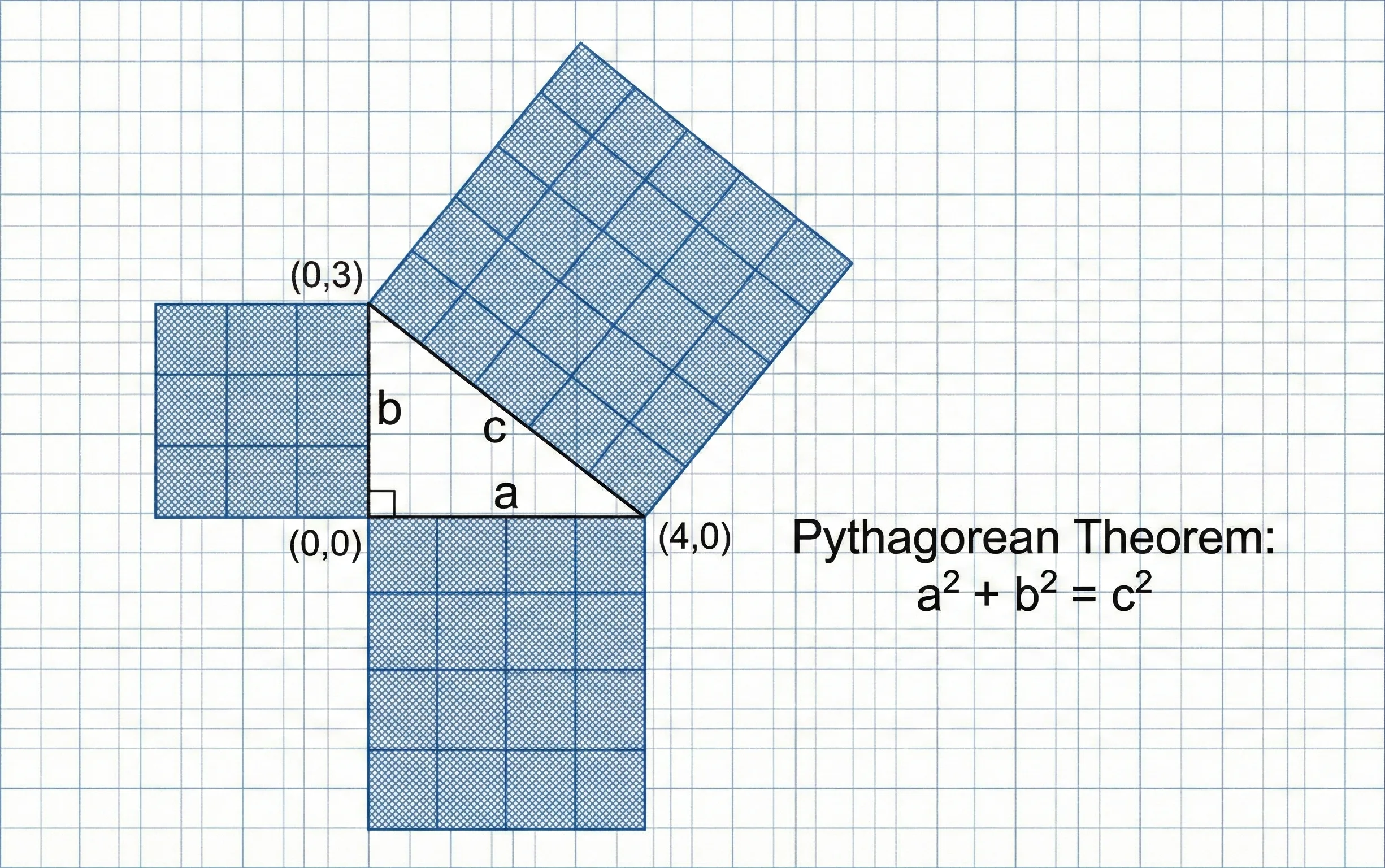
The first thing to identify is the right angle. The two sides touching that angle are the legs, and the side across from it is the hypotenuse. If the triangle is not a right triangle, the standard Pythagorean Theorem is not the correct tool.
What is the Pythagorean Theorem?
The Pythagorean Theorem is a geometry equation that describes the relationship between the three side lengths of a right triangle. In engineering terms, it connects two perpendicular measurements to the true diagonal distance between their endpoints.
That makes the theorem useful far beyond textbook triangle problems. It appears in structural layout, surveying offsets, roof and ramp geometry, equipment clearances, force resultants, vector magnitudes, coordinate geometry, CAD checks, and field squaring methods.
The theorem is really a perpendicular-component rule. When two measured components are at \(90^\circ\), their combined straight-line distance is found by squaring the components, adding them, and taking the square root.
The Pythagorean Theorem formula
The standard form of the Pythagorean Theorem is used when the triangle has a confirmed right angle and all side lengths are measured in the same unit system.
In this equation, \(a\) and \(b\) are the two legs that form the right angle, and \(c\) is the hypotenuse. Because \(c\) is the side opposite the \(90^\circ\) angle, it must be the longest side in a valid right triangle.
The diagonal form is the version most often used in engineering layout because the two perpendicular distances are commonly known first. For example, a technician may know a horizontal offset and vertical rise and need the true diagonal length of a brace, cable, ladder, ramp, or pipe run.
Variables and units in the Pythagorean Theorem
The theorem works with any length unit as long as every side length uses the same unit before squaring. The output length will be in the same base unit used for the inputs.
- \(a\) First leg of the right triangle. This may represent horizontal run, width, offset, or one perpendicular component.
- \(b\) Second leg of the right triangle. This may represent vertical rise, height, depth, or another perpendicular component.
- \(c\) Hypotenuse of the right triangle. This is the side opposite the right angle and the true diagonal distance.
Convert before squaring. Do not place \(12\ \text{ft}\) and \(36\ \text{in}\) into the same equation unless one value has first been converted.
The hypotenuse must be larger than either leg but smaller than the sum of the two legs. If your answer violates that range, the setup is wrong.
| Variable | Meaning | SI units | US customary units | Typical engineering use | Check |
|---|---|---|---|---|---|
| \(a\) | First perpendicular leg | mm, m | in, ft | Run, width, horizontal offset, x-component | Must meet \(b\) at \(90^\circ\) |
| \(b\) | Second perpendicular leg | mm, m | in, ft | Rise, height, vertical offset, y-component | Must meet \(a\) at \(90^\circ\) |
| \(c\) | Hypotenuse | mm, m | in, ft | Diagonal, brace length, slope length, resultant distance | Must be the longest side |
How to rearrange the Pythagorean Theorem
The form you use depends on which side is unknown. Engineers usually solve either for the hypotenuse from two known legs or for a missing leg when the hypotenuse and one leg are known.
When solving for a leg, the value under the square root must be positive. If \(c^2 – b^2\) or \(c^2 – a^2\) is negative, the hypotenuse was mislabeled, the measurements are inconsistent, or the triangle is not right.
Where engineers use the Pythagorean Theorem
In engineering, the Pythagorean Theorem is often used as a geometry check rather than a standalone design method. It helps convert between component dimensions and true distances.
- Structural layout: checking diagonal brace lengths, frame squareness, and rectangular bay dimensions.
- Surveying and site work: converting offsets into straight-line distances and checking right-angle layouts.
- Mechanical design: finding center-to-center distances, link lengths, clearances, and diagonal fit-up dimensions.
- Electrical engineering: interpreting right-triangle relationships in power triangles and perpendicular vector components.
- Transportation and civil design: understanding slope length, horizontal run, vertical rise, and geometric design relationships.
Use the Pythagorean Theorem when the two known directions are perpendicular. Use a trigonometric relationship when an angle is known. Use the Law of Cosines when the triangle is not a right triangle.
Worked example using the Pythagorean Theorem
Example problem: diagonal brace length
A rectangular equipment frame has a horizontal bay width of \(8\ \text{ft}\) and a vertical height of \(6\ \text{ft}\). Find the diagonal brace length needed from one corner to the opposite corner.
Substitute the known perpendicular dimensions into the formula. The horizontal bay width is one leg, and the vertical frame height is the other leg.
The required diagonal brace length is \(10\ \text{ft}\). This result is reasonable because the brace is longer than either perpendicular side but shorter than \(8\ \text{ft} + 6\ \text{ft}\).
The \(6\)-\(8\)-\(10\) result is a scaled \(3\)-\(4\)-\(5\) right triangle. That makes it useful for quick field layout and squareness checks.
Pythagorean Theorem vs. related equations
The Pythagorean Theorem is one member of a broader set of geometry and vector relationships. Choosing the right equation depends on whether the known sides or components form a right angle.
| Equation / method | Best used for | Key assumption | Main limitation |
|---|---|---|---|
| Pythagorean Theorem | Missing side in a right triangle | Included angle is \(90^\circ\) | Does not directly apply to oblique triangles |
| Distance formula | Straight-line distance between coordinate points | Coordinate differences form perpendicular components | Requires accurate coordinate data |
| Right-triangle trigonometry | Solving sides or angles with sine, cosine, or tangent | Triangle is right and an angle ratio is known | Angle measurements must be reliable |
| Law of Cosines | Non-right triangles or known included angle | Side-angle-side or three-side triangle data is available | More setup required than the right-triangle form |
The 2D distance formula is the Pythagorean Theorem applied to coordinate differences. The horizontal difference acts like one leg, and the vertical difference acts like the other leg.
Assumptions behind the Pythagorean Theorem
The equation is exact only when its geometric assumptions are satisfied. In practical engineering work, the most important assumption is that the two legs are truly perpendicular.
- 1 The triangle is a right triangle with one angle equal to \(90^\circ\).
- 2 The side labeled \(c\) is the hypotenuse, not one of the legs.
- 3 All side lengths are measured in the same unit system before calculation.
- 4 The geometry is planar unless a 3D extension is intentionally being used.
Neglected factors
The theorem is a geometric model, so it does not account for material behavior, construction tolerance, measurement uncertainty, curvature, deformation, or out-of-plane misalignment.
- Measurement error: small tape, laser, or survey errors can create diagonal mismatches in field layout.
- Out-of-square construction: if the angle is not exactly \(90^\circ\), the theorem becomes an approximation.
- 3D geometry: if the offset includes depth as well as height and width, use the 3D form instead of the 2D formula.
Engineering judgment and field reality
In the field, the Pythagorean Theorem is often used to check whether a layout is square. For example, if a rectangular slab or frame has known length and width, the diagonal can be calculated and compared against the measured diagonal.
A diagonal mismatch does not automatically tell you which side is wrong. It only tells you that the measured geometry is not consistent with the assumed right triangle. Recheck the side lengths, corner angle, and measurement reference points before changing the layout.
For quick layout checks, use scaled Pythagorean triples such as \(3\)-\(4\)-\(5\), \(6\)-\(8\)-\(10\), \(5\)-\(12\)-\(13\), and \(8\)-\(15\)-\(17\). These make it easy to verify a right angle without a calculator.
When the Pythagorean Theorem breaks down
The theorem breaks down when the right-angle condition is not met, when the wrong side is treated as the hypotenuse, or when the problem is not a flat two-dimensional right-triangle problem.
Do not use \(a^2 + b^2 = c^2\) as a general triangle equation. For triangles without a \(90^\circ\) angle, use a more general relationship such as the Law of Cosines.
The theorem can also be misleading in precision work if the geometry is flexible or distorted. A brace, cable, frame, slab, or pipe run may have a calculated diagonal length, but field fit-up can still be affected by tolerances, connection details, sag, deflection, and installation access.
Common mistakes and engineering checks
- Using it on a non-right triangle: the theorem only applies directly to \(90^\circ\) geometry.
- Mislabeling the hypotenuse: \(c\) must be opposite the right angle and must be the longest side.
- Mixing units: convert feet, inches, meters, or millimeters before squaring values.
- Forgetting the square root: \(a^2 + b^2\) gives \(c^2\), not \(c\).
- Ignoring reasonableness: the final hypotenuse should be longer than either leg but shorter than the sum of the legs.
After calculating \(c\), compare it to \(a\), \(b\), and \(a+b\). A valid hypotenuse should satisfy \(c>a\), \(c>b\), and \(c
| Check item | What to verify | Why it matters |
|---|---|---|
| Right angle | The two legs meet at \(90^\circ\) | The theorem depends on perpendicular geometry |
| Hypotenuse | \(c\) is the longest side and opposite the right angle | Wrong labeling creates impossible results |
| Units | All sides use the same unit before squaring | Mixed units can produce large errors |
| Magnitude | The answer is larger than either leg and less than their sum | This catches most setup mistakes quickly |
Frequently asked questions
The formula is \(a^2 + b^2 = c^2\), where \(a\) and \(b\) are the perpendicular legs of a right triangle and \(c\) is the hypotenuse.
Use it when the triangle is a right triangle or when two perpendicular components form a right-triangle relationship. It is not a general formula for every triangle.
Subtract the square of the known leg from the square of the hypotenuse, then take the square root. For example, \(a = \sqrt{c^2 – b^2}\).
No. The Pythagorean Theorem works directly only for right triangles. For non-right triangles, use a method such as the Law of Cosines.
Summary and next steps
The Pythagorean Theorem is one of the most useful geometry equations in engineering because it converts perpendicular components into true diagonal distance. The core relationship is \(a^2 + b^2 = c^2\), with \(c\) reserved for the hypotenuse.
Use the theorem confidently when the geometry is a right triangle, the side labels are correct, and the units are consistent. If the angle is not \(90^\circ\), move to a different triangle relationship instead of forcing the equation.
Where to go next
Continue your learning path with these curated next steps.
-
Prerequisite: Engineering Equations
Browse foundational equations and connect the Pythagorean Theorem to other engineering formulas.
-
Application: Square Footage Calculator
Review area and shape calculations that often use related geometry and layout thinking.
-
Advanced application: Roof Pitch Calculator
Extend right-triangle thinking into rise, run, slope, pitch, and angle-based roof geometry.