
Direct Answer
Civil engineering is the branch of engineering that plans, analyzes, designs, constructs, operates, maintains, and rehabilitates the infrastructure people depend on every day. It includes roads, bridges, buildings, foundations, water and wastewater systems, storm drainage, airports, railways, ports, utilities, dams, levees, and land development.
Civil engineering differs from a purely theoretical discipline because every design must work under real physical constraints. Engineers have to account for loads, soil, water, materials, traffic, environmental conditions, construction methods, regulations, cost, public use, and long-term maintenance.
How Does a Civil Engineering Project Work?
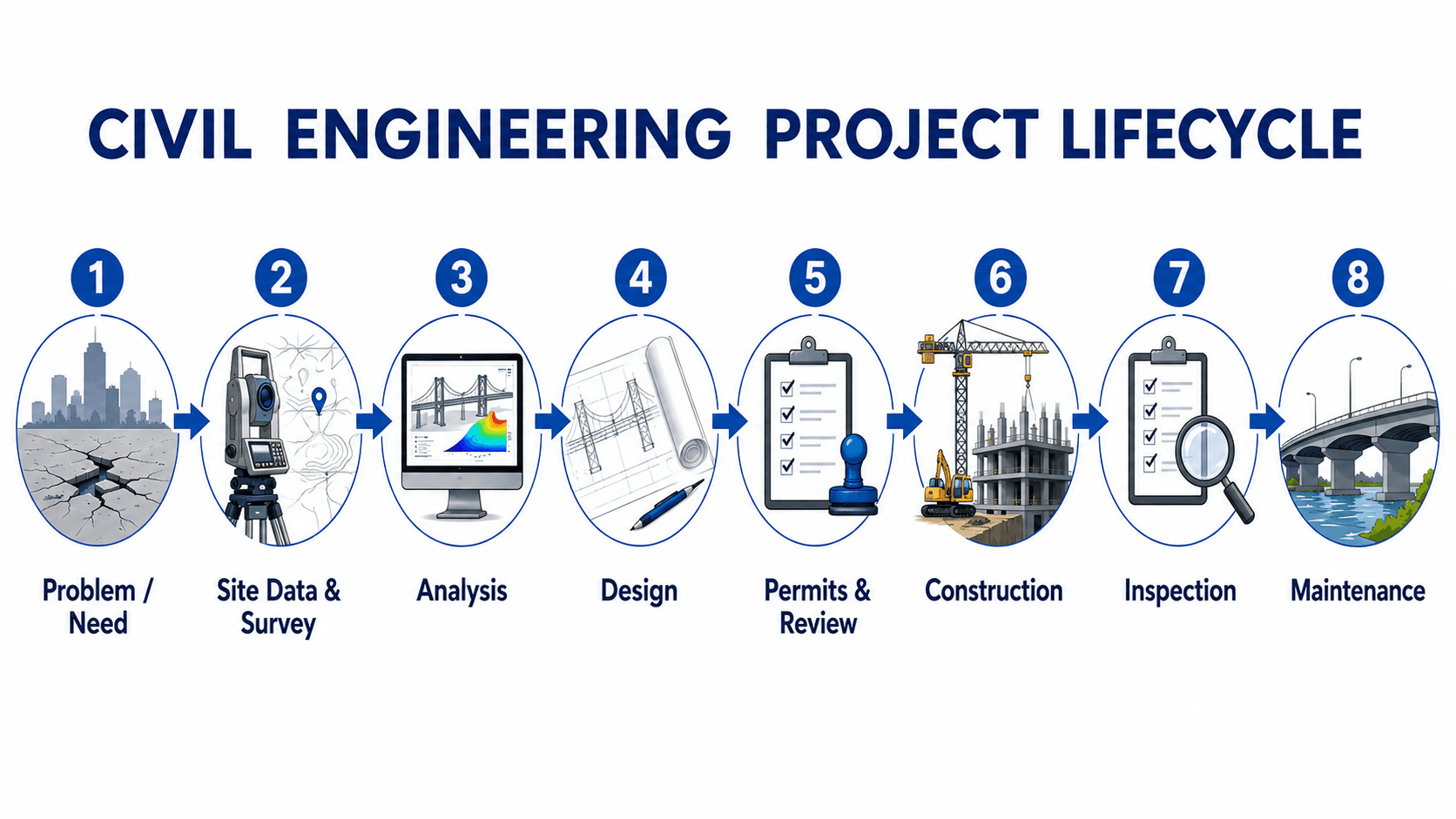
Civil engineering projects move from a defined need through investigation, analysis, design, review, construction, and long-term operation. Each stage reduces uncertainty and converts project information into increasingly specific decisions.
-
Define the problem
Determine what the infrastructure must accomplish, such as improving safety, adding capacity, controlling flooding, supporting a structure, serving new development, or replacing deteriorated assets.
-
Understand existing conditions
Gather survey information, soil data, groundwater conditions, traffic information, drainage patterns, utility records, existing plans, environmental constraints, and field observations.
-
Establish design criteria
Identify required loads, performance criteria, permits, owner requirements, applicable standards, property limits, cost constraints, construction limits, and maintenance needs.
-
Compare alternatives
Evaluate practical solutions against technical performance, risk, cost, environmental effects, public impacts, construction feasibility, and long-term operation.
-
Develop the design
Convert the selected approach into coordinated calculations, models, drawings, specifications, quantities, reports, and construction requirements.
-
Review and coordinate
Resolve comments and conflicts among disciplines, owners, utilities, regulators, permitting authorities, and other project stakeholders.
-
Construct and verify
Address field questions, evaluate actual conditions, review proposed changes, and confirm that construction remains consistent with the engineering intent.
-
Operate and maintain
Inspect condition and performance, repair deficiencies, rehabilitate aging infrastructure, and eventually plan replacement when needed.
Civil engineering is rarely a perfectly straight sequence. A soil investigation can change the foundation concept, a utility conflict can alter grading, permit review can change drainage, and construction can expose conditions that were impossible to see during design.
What Does Civil Engineering Actually Cover?
Civil engineering covers the physical systems that allow communities, buildings, transportation networks, utilities, and developed land to function safely and reliably.
The field includes both visible infrastructure and systems most people rarely notice. Roads, bridges, buildings, dams, and airports are obvious examples. Foundations, buried utilities, storm sewers, soil improvements, retaining systems, water mains, culverts, and subgrade support are equally important.
Civil engineering is broad because these systems interact. A building depends on the soil beneath it, drainage around it, roads serving it, utilities connected to it, and structural systems carrying its loads.
Above-ground systems
Buildings, bridges, roads, retaining walls, pavements, railways, airports, ports, channels, dams, and other visible infrastructure.
Below-ground systems
Foundations, soil, rock, groundwater, buried utilities, storm drains, water mains, sewers, culverts, and subsurface structures.
Natural-system interface
Rainfall, runoff, rivers, flooding, erosion, groundwater, slopes, soil movement, coastlines, and long-term environmental exposure.
What is the purpose of civil engineering?
The purpose is not simply to create infrastructure. Civil engineers develop infrastructure that must perform under expected conditions, be practical to construct, be possible to inspect and maintain, and avoid creating unacceptable problems elsewhere.
For example, a stormwater system that moves runoff off one property but increases flooding downstream is not a complete solution. A bridge that meets structural strength requirements but cannot be inspected efficiently creates a lifecycle problem.
Civil engineering requires systems-level thinking because structures, soil, water, transportation, utilities, construction, and maintenance affect one another. Strong designs account for those interfaces instead of optimizing one component in isolation.
If your main question is about the occupation rather than the discipline, see what civil engineers do .
Professional scope: American Society of Civil Engineers — About Civil Engineering .
What Are the Major Branches of Civil Engineering?
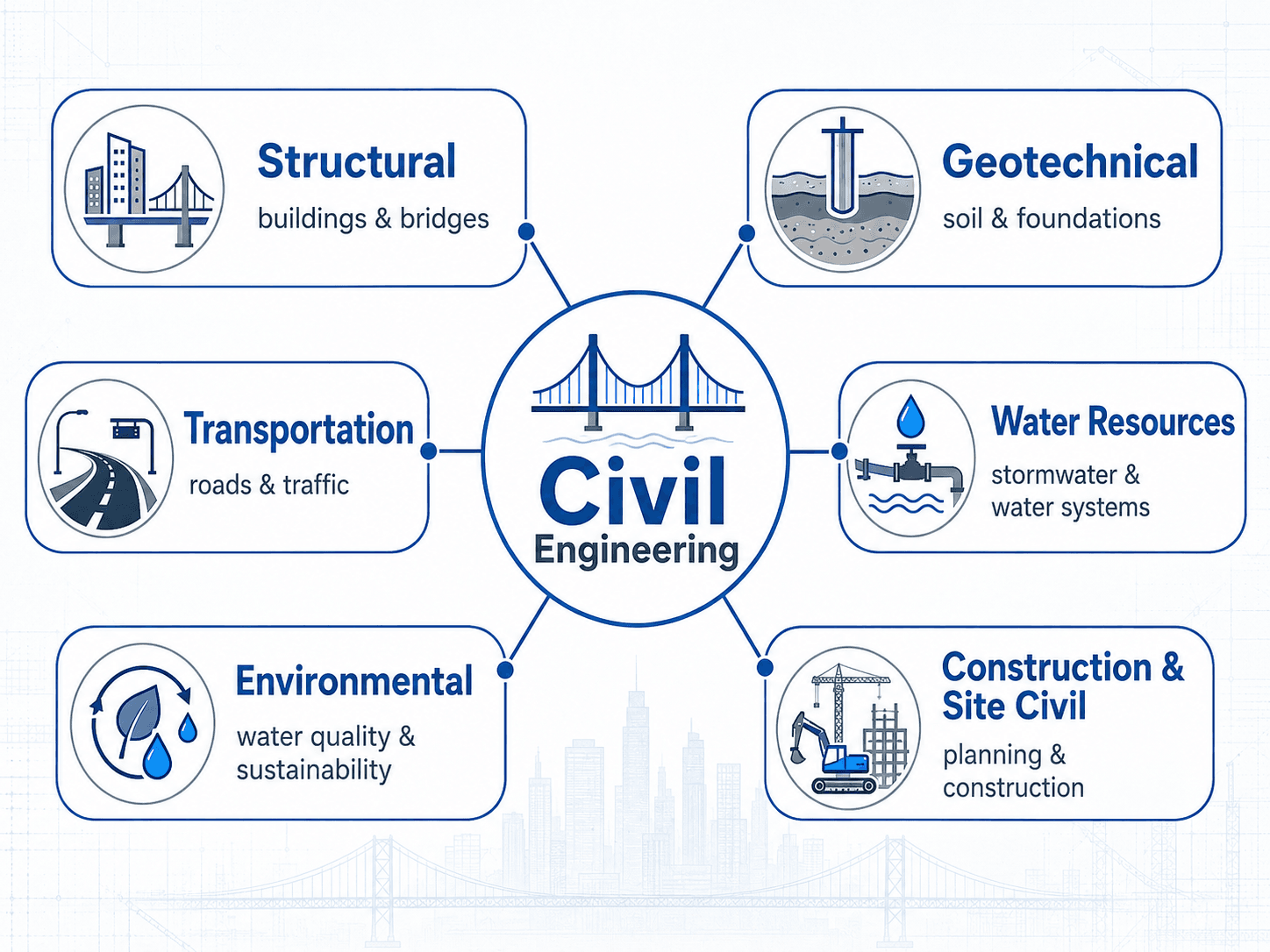
Civil engineering is divided into specialties because infrastructure projects involve different physical problems. The clearest way to understand each branch is by the engineering question it is responsible for answering.
| Branch | Primary question | Typical work | Example projects |
|---|---|---|---|
| Structural engineering | Can the structure safely resist the forces placed on it? | Loads, load paths, member sizing, connections, stability, deflection, durability | Buildings, bridges, towers, retaining walls, industrial structures |
| Geotechnical engineering | How will soil, rock, and groundwater affect the project? | Site investigation, foundations, settlement, slopes, retaining systems, earthwork | Building foundations, bridge foundations, embankments, excavations, slopes |
| Transportation engineering | How can people and goods move safely and efficiently? | Traffic operations, roadway geometry, safety, transit, access, pavement systems | Roads, highways, intersections, transit, rail, airports, ports |
| Water resources engineering | Where will water come from, flow, collect, and discharge? | Hydrology, hydraulics, drainage, flood analysis, channels, water systems | Storm drains, culverts, detention basins, rivers, reservoirs, flood-control systems |
| Environmental engineering | How can water quality, waste, contaminants, and environmental impacts be managed? | Water treatment, wastewater, remediation, permitting, pollution control | Treatment plants, remediation sites, waste systems, environmental infrastructure |
| Construction engineering | How can the design be built safely and practically? | Construction methods, sequencing, temporary works, field engineering, constructability | Heavy civil construction, bridges, roads, utilities, earthwork, major structures |
| Site development engineering | How do grading, access, drainage, utilities, and development fit together on a site? | Site layout, grading, utilities, stormwater, erosion control, permitting | Commercial sites, subdivisions, campuses, industrial sites |
| Municipal engineering | How should public infrastructure be planned, improved, operated, and maintained? | Streets, utilities, public works, drainage, capital improvements, asset management | City infrastructure, water systems, sewer systems, local roads, public facilities |
Swipe horizontally to view all table columns.
Environmental engineering is closely related to civil engineering and is often housed within civil engineering departments or practice groups, but it can also exist as a separate engineering discipline. The other branch boundaries are similarly flexible across universities, firms, agencies, and project types.
The specialties also depend on one another. Structural engineers rely on geotechnical information for foundation behavior. Transportation projects need drainage and soil design. Site engineers coordinate grading, utilities, access, and stormwater. Construction engineers encounter decisions made by every design discipline.
Start with the physical problem. Loads point toward structural engineering, soil toward geotechnical engineering, water toward water resources, movement toward transportation, environmental quality toward environmental engineering, and buildability toward construction engineering.
ASCE identifies numerous civil engineering specialties, while ABET separately accredits civil and environmental engineering programs and requires broad technical preparation within civil engineering.
What Does a Civil Engineer Evaluate Before a Design Works?
A civil engineering design succeeds only when individual calculations, components, and systems work together under the actual site, environmental, construction, and operating conditions of the project.
This is where civil engineering becomes more than a list of formulas. Passing one calculation does not prove that an entire project works. Engineers also have to determine whether assumptions are appropriate, whether systems conflict, whether the design can be built, and whether it will remain serviceable.
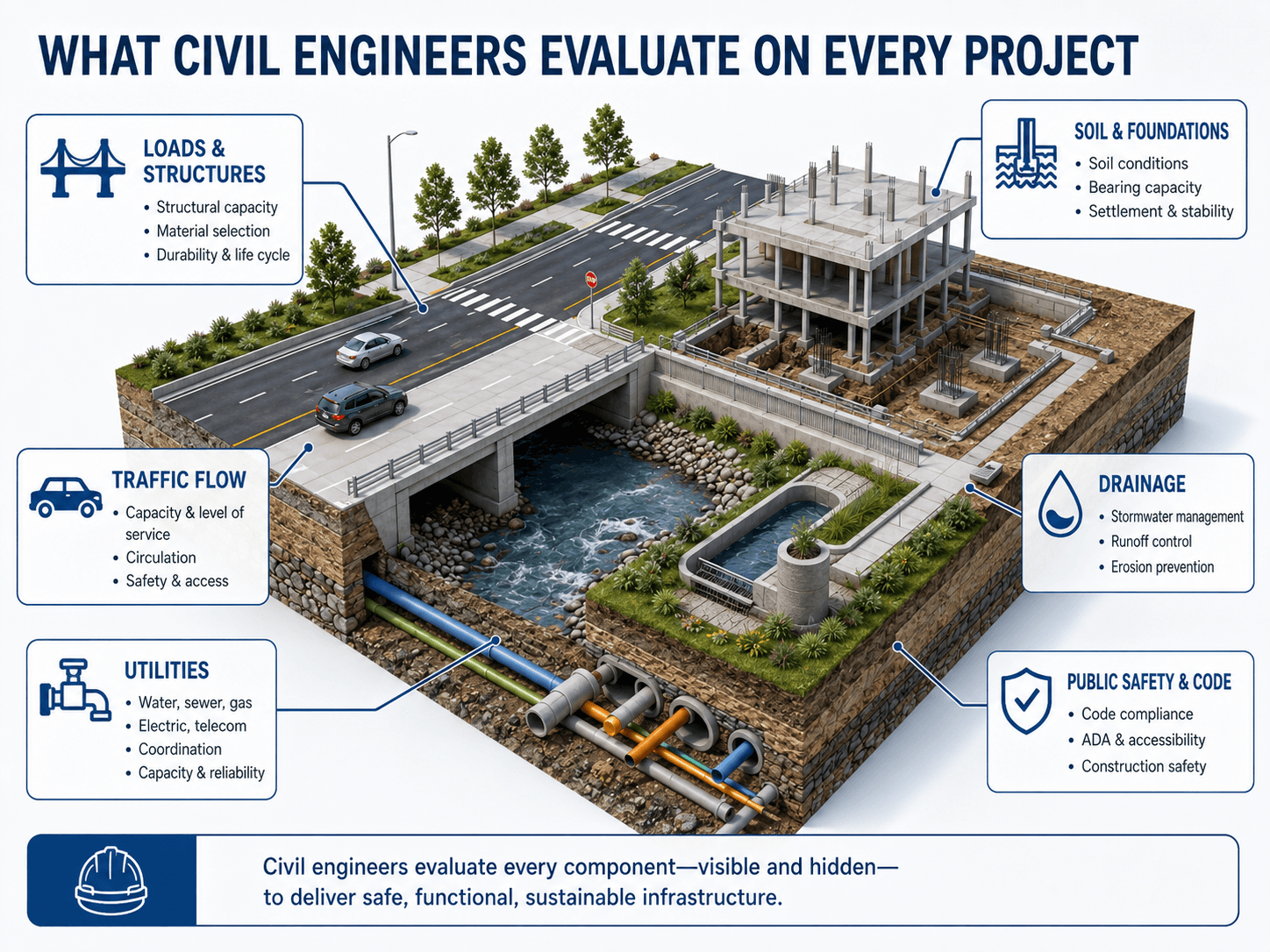
What soil, rock, groundwater, settlement, slope, or earthwork conditions affect the project?
What gravity, traffic, wind, seismic, earth, water, impact, or other loads must the system resist?
Where will rainfall, runoff, groundwater, river flow, wastewater, or supplied water move under normal and extreme conditions?
How will vehicles, pedestrians, freight, transit, emergency access, equipment, and maintenance personnel use the infrastructure?
Where do structures, roads, grading, utilities, foundations, drainage, architecture, and existing infrastructure conflict or depend on one another?
Can the project be excavated, assembled, staged, accessed, tested, inspected, and built using practical methods?
Which codes, permits, agency criteria, owner standards, environmental requirements, and jurisdiction-specific rules apply?
Can the infrastructure be inspected, cleaned, repaired, replaced, and maintained without creating unreasonable future cost or risk?
Why interfaces create so many problems
Expensive construction changes frequently occur where one system meets another. A roadway elevation affects drainage. Drainage elevations compete with buried utilities. A foundation depends on soil assumptions. Retaining walls affect grading and property limits. Building entrances depend on accessible site grades.
Civil engineers therefore spend significant effort coordinating boundaries between systems instead of treating every component as an isolated problem.
For every major design decision, ask: What assumption controls the result? What other system does this decision affect? What changes when the design reaches the field?
Examples of Civil Engineering in Everyday Life
Civil engineering is present anywhere people rely on constructed infrastructure, including systems that are easy to see and systems buried underground or hidden inside larger projects.
Road or intersection
Engineers may evaluate traffic, sight distance, pavement, grading, drainage, utilities, pedestrian access, signals, construction staging, and future maintenance.
Bridge
Structural capacity has to work with foundations, soil, roadway geometry, drainage, river hydraulics, scour, durability, inspection access, and construction sequencing.
Building site
The civil team may coordinate grading, access, stormwater, utilities, geotechnical conditions, retaining walls, sidewalks, parking, erosion control, and permitting around the building.
Stormwater system
Engineers trace runoff from where rain falls through grading, inlets, pipes, channels, detention facilities, overflow routes, erosion protection, and the final discharge point.
Water or wastewater system
Engineers consider treatment, capacity, pressure, storage, pumping, collection, conveyance, reliability, access, maintenance, and future demand.
Land development
A site plan has to reconcile boundaries, terrain, access, drainage, utilities, earthwork, environmental constraints, permits, emergency access, and construction economics.
The civil engineering you usually do not see
Some of the most important infrastructure disappears after construction. Foundations are below buildings, storm sewers are buried, subgrade supports pavement, and water or sewer networks may operate beneath streets for decades.
This hidden infrastructure is one reason the field is often underestimated. The finished road or building is visible; the soil assumptions, drainage calculations, utility coordination, construction details, and maintenance planning behind it are not.
What Do You Study in Civil Engineering, and Where Can It Lead?
Civil engineering education is broad because engineers need to recognize interactions among several technical systems before specializing.
Mathematics, calculus-based physics, chemistry, mechanics, materials, statistics, computing or data science, and numerical methods.
Structures, geotechnical engineering, transportation, water resources, environmental systems, construction, materials, surveying, and related areas.
Design, sustainability, risk, resilience, ethics, experiments, project management, engineering economics, safety, communication, and licensure.
Current ABET criteria for civil engineering programs require broad preparation in mathematics and science, engineering mechanics and materials, numerical methods, sustainability, risk, resilience, design, ethics, experimentation, project management, engineering economics, and complex engineering problems across multiple civil engineering specialty areas.
What does that education lead to?
Civil engineering graduates can work in consulting, construction, local or state government, federal agencies, transportation agencies, utilities, infrastructure ownership, water systems, development, industrial facilities, and specialized technical practices.
The U.S. Bureau of Labor Statistics describes civil engineers as planning, designing, and supervising construction and maintenance of infrastructure and identifies a bachelor’s degree as the typical entry-level education. Licensure requirements depend on jurisdiction and the type of engineering services being provided.
If you are evaluating civil engineering as a career, continue into the career-focused resources rather than trying to turn this definition page into a complete jobs guide.
Continue with What Do Civil Engineers Do? for responsibilities and daily work, Civil Engineering Salary for compensation context, or Top Civil Engineering Schools if you are comparing degree programs.
Educational context: ABET — Criteria for Accrediting Engineering Programs . Occupational context: U.S. Bureau of Labor Statistics — Civil Engineers .
Common Misconceptions About Civil Engineering
- “Civil engineering is mostly bridges.” Bridges are an important example, but the field also includes roads, foundations, soil, stormwater, flood control, utilities, water systems, wastewater, site development, airports, railways, ports, dams, levees, and construction engineering.
- “Civil engineering and construction are the same thing.” Construction executes the work. Civil engineering establishes and evaluates the technical design, criteria, performance, and many decisions that guide what is built.
- “Civil engineering is just CAD and calculations.” Drawings and calculations are tools. The work also includes site investigation, judgment, coordination, permitting, constructability, inspection, communication, and lifecycle planning.
- “Codes tell engineers exactly what to design.” Codes and standards establish requirements and accepted methods, but engineers still have to interpret project conditions, loads, risk, interfaces, constructability, and owner objectives.
- “The design is finished when drawings are issued.” Projects continue through review, permitting, bidding, submittals, RFIs, field changes, inspection, closeout, maintenance, rehabilitation, and eventual replacement.
- “All civil engineering is public infrastructure.” Civil engineers also work on commercial development, residential communities, industrial sites, campuses, energy facilities, private utilities, and privately owned infrastructure.
Civil engineering is not defined by one object such as a bridge or road. It is defined by the engineering of infrastructure systems and their interaction with people, loads, soil, water, materials, construction, regulation, and the physical environment.
Civil Engineering References
These primary sources support the professional scope, educational breadth, and career context described on this page. Real projects still require the applicable codes, standards, site data, agency criteria, owner requirements, and jurisdiction-specific rules.
- American Society of Civil Engineers — About Civil Engineering Supports the scope of civil engineering, infrastructure examples, and breadth of technical specialties.
- ABET — Criteria for Accrediting Engineering Programs Supports current civil engineering educational breadth, engineering design, sustainability, risk, resilience, ethics, project management, economics, professional responsibility, and safety.
- U.S. Bureau of Labor Statistics — Civil Engineers, Occupational Outlook Handbook Supports current U.S. occupational duties, typical entry-level education, work environment, and licensure context.
Civil Engineering in One Sentence
Civil engineering is the engineering of infrastructure as an interconnected physical system—from soil and water below ground to structures, roads, utilities, construction, public use, and long-term maintenance.
The field is broad because infrastructure problems are interconnected. Understanding those relationships is the foundation for learning any civil engineering specialty.