
Key Takeaways
- Core idea: A microgrid is a localized power system that can operate connected to the utility grid or separated from it in island mode.
- Engineering use: Microgrids support critical-load continuity, resilience, renewable integration, local energy control, and improved operation of distributed energy resources.
- What controls it: The practical design depends on the electrical boundary, critical load size, DER mix, storage autonomy, protection scheme, controller logic, and utility interconnection requirements.
- Practical check: A solar-plus-battery system is not automatically a microgrid unless it has coordinated controls, protection, switching, and a defined operating boundary.
Table of Contents
Introduction
A microgrid is a localized electric power network with defined loads, generation, storage, controls, and switching equipment that can operate with the main utility grid or disconnect and operate independently. In power systems engineering, microgrids matter because they turn distributed energy resources into a coordinated system that can support resilience, critical facilities, renewable integration, and controlled islanded operation.
Microgrid Architecture Diagram
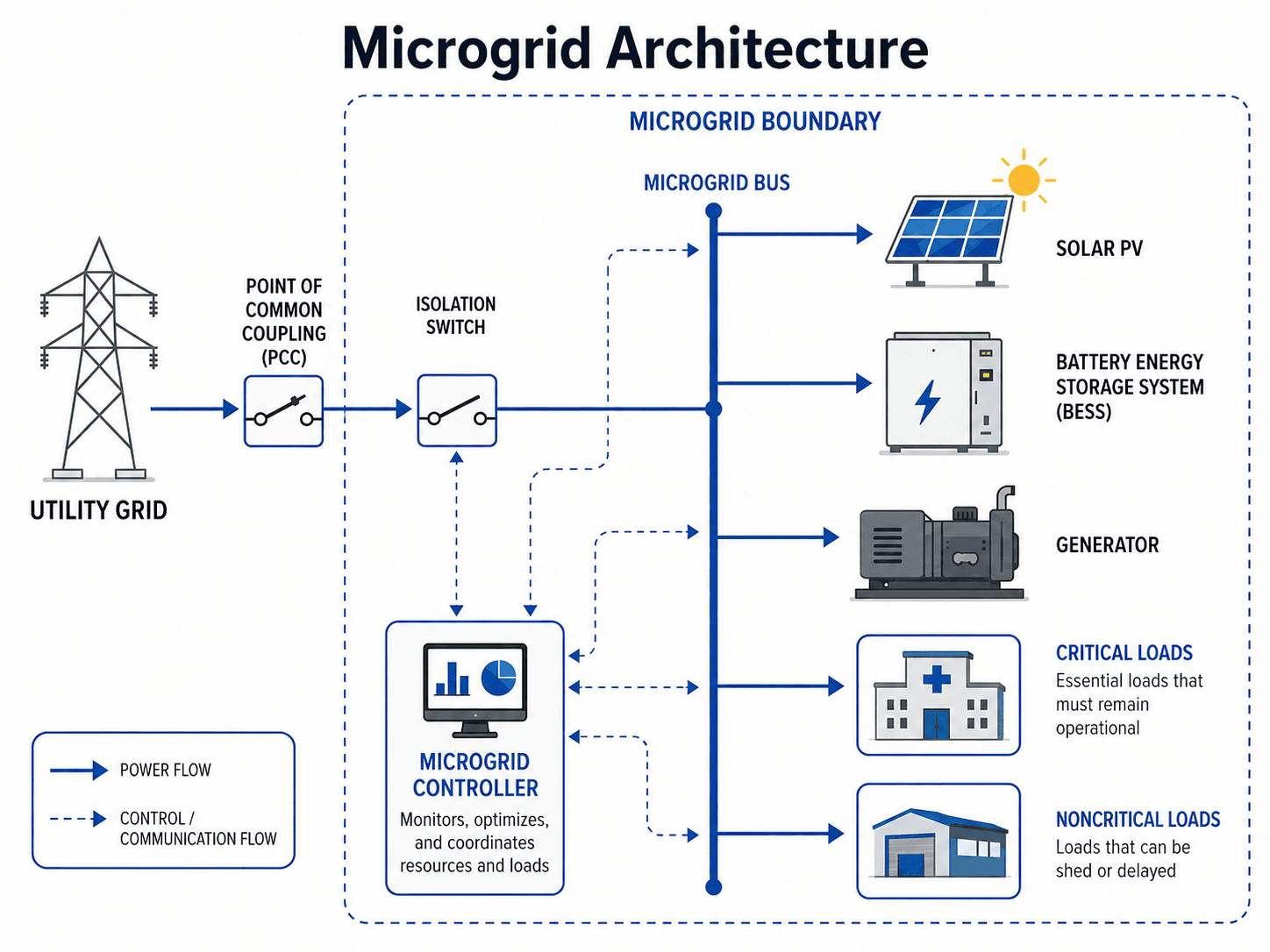
Notice that the utility grid is outside the microgrid boundary, while the controller, local resources, and loads are coordinated inside it. That boundary is what separates a microgrid from a loose collection of generators and loads.
What Is a Microgrid?
A microgrid is a controllable local power system. It usually includes electrical loads, distributed generation, energy storage, switchgear, protective devices, meters, communications, and a microgrid controller. The system may normally operate in parallel with the utility grid, but it is designed so it can separate from the grid and continue serving selected loads when needed.
Although wording varies by organization, most engineering definitions describe a microgrid as a group of interconnected loads and distributed energy resources within a defined electrical boundary that can act as one controllable entity. The most important idea is not simply “local power.” A facility may have rooftop solar, a standby generator, or a battery system without being a complete microgrid.
When reviewing a proposed microgrid, first identify the boundary, the point of common coupling, the isolation device, the critical loads, and the resource that will establish voltage and frequency during islanded operation.
How Does a Microgrid Work?
A microgrid works by continuously balancing local generation, storage, and load demand within a defined electrical area. When the utility grid is available, the microgrid may import power, export power, charge batteries, reduce demand peaks, or support local loads with renewable generation. When the grid becomes unavailable or the system is intentionally islanded, the microgrid disconnects and uses local resources to keep priority loads energized.
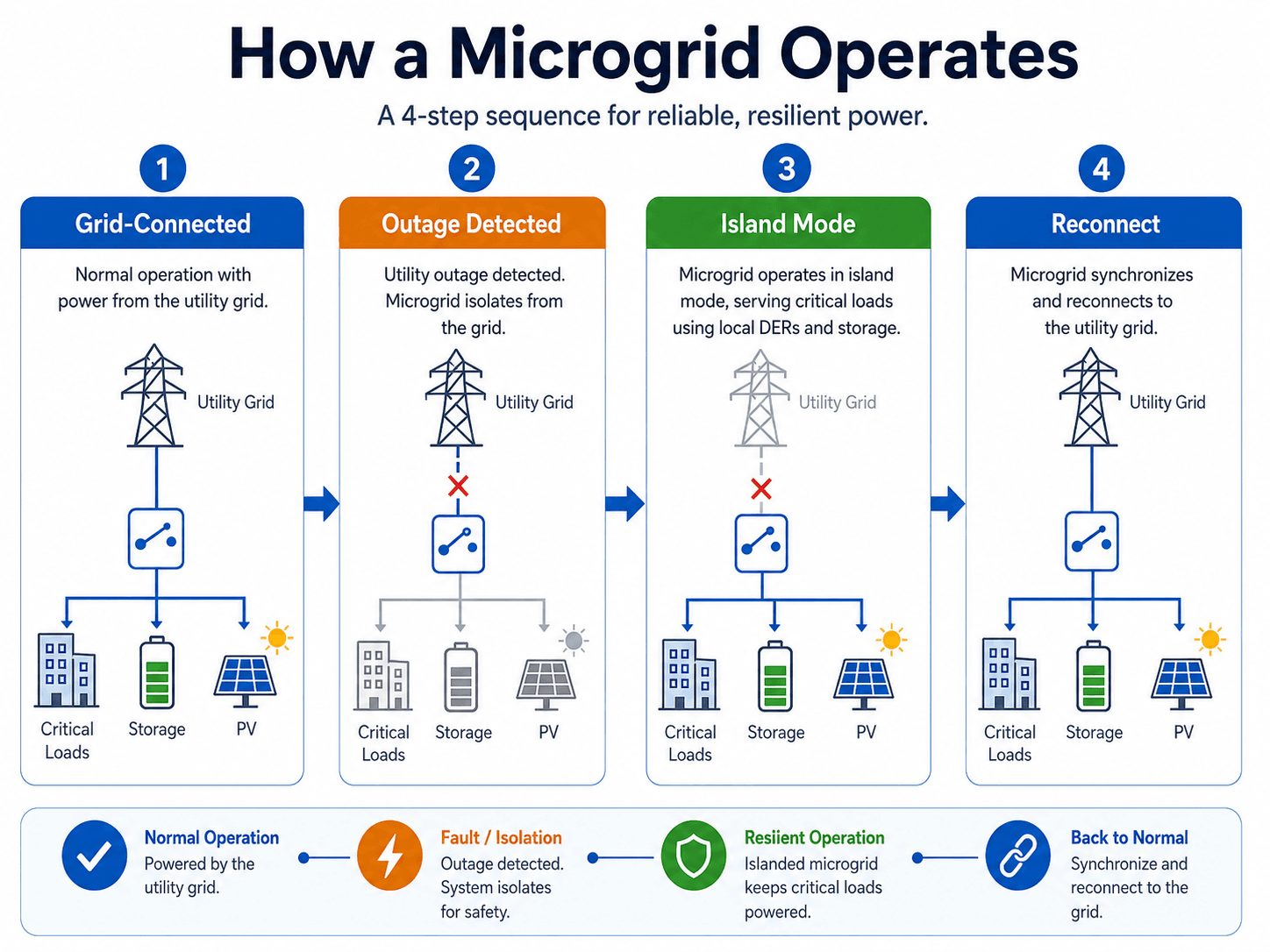
Grid-connected mode
In grid-connected mode, the utility grid often acts as the voltage and frequency reference. The microgrid can serve local loads, charge batteries, offset utility purchases, or export power if the interconnection agreement allows it. Protection and metering at the point of common coupling are especially important because the microgrid is operating in parallel with the larger electric system.
Microgrid islanding
Islanding is the process of separating the microgrid from the utility grid and operating it as a local electrical island. This can happen during an outage, a planned resilience test, or an intentional operating event. During islanded operation, the microgrid must maintain voltage, frequency, load balance, and protection without relying on the utility system.
Reconnection and synchronization
Reconnection is not just closing a breaker. The microgrid must be synchronized with the utility grid so voltage magnitude, frequency, phase angle, and protection conditions are acceptable. Poor reconnection logic can create damaging transients or unsafe operating conditions.
Black start capability
Black start capability means the microgrid can restart selected loads without first relying on the utility grid. This may require a generator, grid-forming inverter, battery system, or staged start sequence that energizes controls, auxiliaries, switchgear, and priority loads in a deliberate order.
This simplified power balance is the operating logic behind a microgrid. During islanded operation, \(P_{\text{grid import}}\) becomes zero, so local generation, battery discharge, and load shedding must keep the system balanced in real time. The expression shows real power balance; actual microgrids also require reactive power support, voltage regulation, harmonic control, ramp-rate management, and stable transient response.
Microgrid Components
Microgrids are built from familiar power system equipment, but the equipment must be coordinated as a local operating system. The controller, protection scheme, communications, and switching logic are what allow the microgrid to behave as more than a collection of independent devices.
| Microgrid component | Role in the system | Engineering implication |
|---|---|---|
| Point of common coupling | Defines where the microgrid connects to the utility system. | Controls interconnection, metering, protection, islanding, and reconnection requirements. |
| Isolation switch or breaker | Separates the microgrid from the utility grid during islanded operation. | Must coordinate with protection logic and prevent unsafe backfeed. |
| Solar PV, generators, fuel cells, or other DERs | Provide local electrical generation inside the microgrid boundary. | Resource mix affects dispatch, emissions, fuel supply, reliability, and islanding duration. |
| Battery energy storage system | Absorbs excess energy, supports fast response, and helps ride through transitions. | State of charge, inverter capability, and autonomy strongly affect resilience. |
| Critical and noncritical loads | Define what must remain energized and what can be shed or delayed. | Load priority is often the difference between a useful microgrid and an oversized backup system. |
| Microgrid controller | Coordinates dispatch, monitoring, islanding, load shedding, and reconnection. | Controller logic must be tested under normal, outage, islanded, and recovery conditions. |
| Protection and switchgear | Detect faults, isolate equipment, and maintain safe operation. | Settings may need different behavior for grid-connected and islanded modes. |
Many of these components are also used in conventional distribution systems. The difference is that a microgrid design must coordinate them around islanding, critical-load service, energy management, and reconnection instead of treating each device as a standalone asset.
Microgrid Control and Protection
The microgrid controller is the operational brain of the system. It monitors loads, DER output, battery state of charge, utility conditions, switchgear status, meters, and protective devices. It then issues commands for dispatch, load shedding, voltage control, frequency control, islanding, and reconnection.
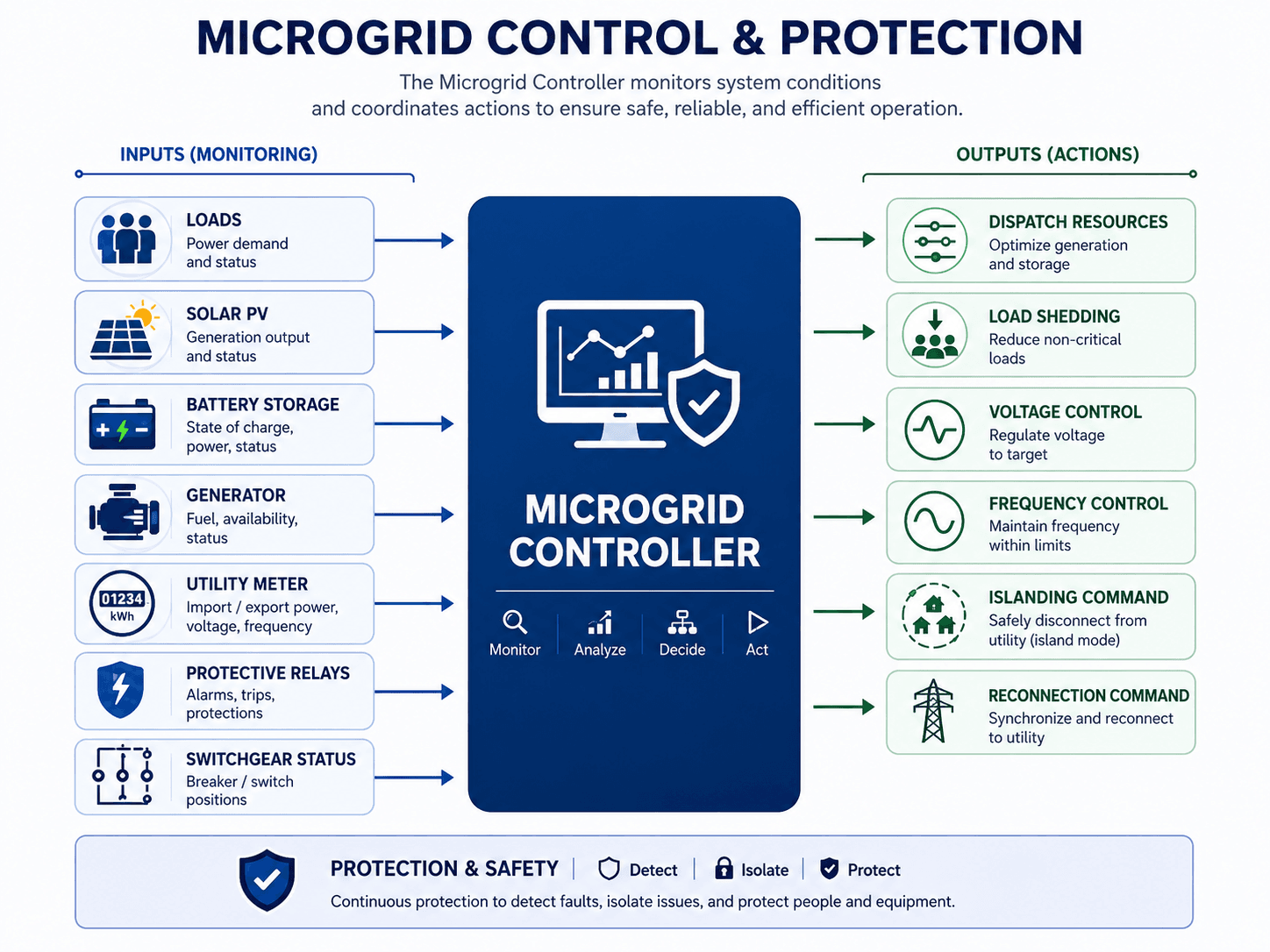
Grid-forming vs grid-following resources
Modern microgrids often depend on inverter-based resources, so the difference between grid-forming and grid-following behavior matters. A grid-following inverter typically needs an existing voltage and frequency reference. A grid-forming inverter can help establish that reference during islanded operation. If a microgrid is expected to run on solar and batteries after separation from the utility, the design must identify what source forms the islanded grid.
Protection in grid-connected vs islanded mode
Protection can become more difficult after islanding because the available fault current may drop, especially when inverter-based resources dominate the microgrid. A relay setting that works while connected to the utility may not detect or coordinate properly during islanded operation unless the protection study considers both modes.
Utility coordination
Utility coordination is not a paperwork detail. The microgrid’s point-of-common-coupling protection, export behavior, reclosing logic, anti-islanding requirements, and reconnection sequence must align with the serving utility’s interconnection requirements.
The controller is only as useful as the data, communications, sensors, meters, protective relays, and switchgear it depends on. A microgrid should be reviewed as a complete operating sequence, not just a one-line diagram.
Types of Microgrids
Microgrids can be grouped by ownership, operating mode, location, and electrical architecture. The label matters because a remote community microgrid, hospital microgrid, campus microgrid, and industrial microgrid may all use similar components but have very different design priorities.
| Microgrid type | Typical setting | Main design priority |
|---|---|---|
| Campus microgrid | Universities, research campuses, corporate campuses, and military bases. | Coordinating multiple buildings, feeders, CHP, solar, storage, and central controls. |
| Community microgrid | Neighborhoods, emergency service areas, shelters, and resilience hubs. | Keeping selected public-safety or community loads energized during outages. |
| Remote microgrid | Islands, rural communities, mining sites, telecom sites, and off-grid facilities. | Balancing renewables, fuel logistics, storage duration, maintenance, and reliability. |
| Facility microgrid | Hospitals, data centers, wastewater plants, industrial sites, and airports. | Serving mission-critical loads with high reliability and controlled transition behavior. |
| Utility-owned microgrid | Distribution systems with critical feeders, constrained areas, or outage-prone regions. | Coordinating local resources with utility protection, operations, and restoration plans. |
AC, DC, and Hybrid Microgrids
Most utility-connected microgrids are AC systems because buildings, switchgear, utility feeders, and many loads are AC. DC and hybrid architectures are increasingly important where solar PV, batteries, electric vehicle charging, data centers, or power electronics dominate the load and resource mix.
| Architecture type | Typical use | Practical tradeoff |
|---|---|---|
| AC microgrid | Campuses, commercial facilities, hospitals, industrial sites, and most utility-connected projects. | Works well with existing distribution equipment, but inverter coordination and reactive power control still matter. |
| DC microgrid | Battery-heavy systems, PV-rich systems, telecom facilities, laboratories, and some data center applications. | Can reduce conversion stages, but protection, standards, and equipment availability can be more specialized. |
| Hybrid AC/DC microgrid | Systems with both conventional AC loads and major DC resources or loads. | Offers flexibility, but controls and interface converters become central design elements. |
Microgrid Benefits and Engineering Tradeoffs
Microgrids are often discussed as resilience tools, but their value depends on what the owner needs the system to do. A microgrid may be justified by outage resilience, renewable integration, energy cost management, power quality, fuel security, or operational control. Each benefit comes with a design tradeoff.
| Microgrid benefit | Engineering value | Tradeoff to review |
|---|---|---|
| Resilience | Keeps priority loads energized during a grid outage. | Requires tested islanding, protection, fuel or storage planning, and maintenance. |
| Renewable integration | Uses solar, storage, or other DERs closer to the load. | Needs controls for intermittency, ramping, state of charge, and power quality. |
| Peak demand control | Can reduce high demand periods through storage dispatch or local generation. | Depends on tariff structure, load predictability, controls, and battery cycling limits. |
| Power quality support | Can help regulate local voltage, frequency, and disturbance response. | Requires careful inverter, controller, grounding, and protection design. |
| Remote electrification | Can serve loads where long utility feeders are expensive or unreliable. | Maintenance access, spare parts, operator training, and fuel logistics become critical. |
What affects microgrid cost?
Microgrid cost is controlled by the resource mix, storage duration, critical-load size, switchgear, protection upgrades, controls, communications, interconnection studies, civil and electrical construction, commissioning tests, cybersecurity requirements, and long-term operations and maintenance. Cost estimates should be based on the required operating mode and resilience target, not only on total kilowatts installed.
Microgrid vs Backup Generator, Distributed Generation, and Smart Grid
Microgrids are often confused with related power system concepts. The distinction usually comes down to whether the system has a defined electrical boundary, coordinated controls, islanding capability, and a plan for serving specific loads as a local grid.
| Related system | What it is | Key difference from a microgrid |
|---|---|---|
| Backup generator | An emergency source that supplies selected loads when normal power is unavailable. | Usually does not coordinate multiple DERs, storage, export/import behavior, and islanded grid operation as a complete local system. |
| Distributed generation | Generation located near loads, such as solar PV, CHP, fuel cells, or small generators. | May not include islanding, critical-load control, microgrid protection, or centralized dispatch. |
| Stand-alone power system | An off-grid system that serves loads without a normal utility connection. | May operate independently full-time rather than switching between grid-connected and islanded modes. |
| Smart grid | A broader digitally monitored and controlled electric grid concept. | Describes grid modernization more broadly; it is not necessarily a local islandable power network. |
| Virtual power plant | An aggregated group of DERs controlled as a portfolio. | Often coordinates resources across many locations rather than serving a single defined electrical boundary. |
What Controls Microgrid Sizing?
Microgrid sizing starts with the loads that must remain energized, then works backward to the resources needed to serve them for the required duration. Oversizing every source is rarely the best answer; a strong design separates critical loads, uses storage strategically, and defines what the system is allowed to shed during islanded operation.
| Sizing driver | What engineers review | Why it matters |
|---|---|---|
| Peak critical load | Maximum coincident demand for loads that must remain online. | Sets the minimum power capacity for islanded operation. |
| Starting and inrush loads | Motors, pumps, HVAC equipment, transformers, and staged restoration sequences. | Momentary demand can exceed steady load and affect inverter or generator sizing. |
| Required islanding duration | Hours or days the system must support priority loads without normal utility service. | Controls storage energy, fuel planning, renewable contribution, and load-shedding strategy. |
| Solar and renewable variability | Time of day, season, weather, forecasting, curtailment, and charging windows. | Renewable output rarely aligns perfectly with outage timing or critical-load demand. |
| Redundancy target | N+1 expectations, spare capacity, equipment outage scenarios, and maintenance windows. | Resilience depends on what still works when one major asset is unavailable. |
| Power quality requirement | Voltage regulation, frequency limits, harmonics, flicker, and sensitive loads. | Some loads need tighter control than simple kW and kWh sizing can show. |
Microgrid Design Review Checklist
A useful microgrid review starts by asking whether the system can safely and intentionally operate as a coordinated local grid. The checklist below focuses on the practical issues that determine whether a design is resilient in the real world or only resilient on a one-line diagram.
Define the boundary, classify the loads, confirm the DER and storage capacity, review islanding and reconnection logic, check protection in both operating modes, then test the control sequence under realistic outage and recovery scenarios.
| Microgrid review check | What to look for | Why it matters |
|---|---|---|
| Electrical boundary | A clear boundary around loads, DERs, storage, switchgear, and controller scope. | Without a boundary, the system cannot be evaluated as a controllable microgrid. |
| Critical-load list | Loads separated into critical, priority, and shed-able groups. | Islanded operation often depends more on load discipline than installed generation size. |
| Grid-forming source | A generator, inverter, or control strategy that can establish voltage and frequency. | The utility grid cannot provide the reference during islanded operation. |
| Storage autonomy | Battery energy, power rating, state-of-charge limits, recharge strategy, and degradation assumptions. | Storage duration is usually much shorter than nontechnical stakeholders expect. |
| Protection in both modes | Fault current, relay settings, breaker coordination, grounding, and inverter fault behavior. | A safe grid-connected protection scheme may not automatically work after islanding. |
| Reconnection logic | Voltage, frequency, phase angle, synchronizing, and utility permission requirements. | Unsafe reconnection can damage equipment or create unacceptable disturbances. |
| Commissioning tests | Planned tests for islanding, load shedding, black start, controller failure, and restoration. | A microgrid that has not been tested may not perform when the outage actually occurs. |
Example: Facility Microgrid During a Utility Outage
Consider a hospital campus with utility service, rooftop solar, a battery energy storage system, emergency generators, critical medical loads, life-safety systems, HVAC loads, and administrative loads. The microgrid value comes from how those pieces are sequenced during an outage.
Normal operation
During normal operation, the hospital imports utility power while solar offsets daytime load and the battery maintains a reserve state of charge. The controller monitors the utility meter, battery state of charge, generator status, and critical-load demand.
Outage and islanded operation
When the utility outage is detected, the point-of-common-coupling breaker opens and the microgrid isolates. The battery or another grid-forming source stabilizes the transition, critical loads remain energized, emergency generators start, and noncritical loads are shed or delayed if the islanded resource margin is limited.
Restoration
When utility service returns, the controller verifies acceptable voltage, frequency, and phase conditions before reconnection. Loads can then be restored in stages, the battery reserve can be rebuilt, and the system returns to normal grid-connected operation.
Engineering Judgment and Field Reality
Microgrid diagrams often make the system look simple: utility grid, switch, solar, battery, generator, and loads. Real projects are harder because controls, protection, utility requirements, equipment ratings, maintenance access, communications, cybersecurity, and operating procedures all affect whether the system performs during an outage.
The most expensive microgrid equipment is not always the most important reliability risk. A poorly defined critical-load list, untested controller sequence, weak communications link, or incorrect relay assumption can defeat an otherwise well-funded microgrid project.
Engineers also need to consider how the system will be maintained. Batteries age, generators require fuel and exercising, protective settings change when equipment is modified, and operators need clear procedures. A microgrid is an operating asset, not just a construction package.
When This Breaks Down
The simplified microgrid concept breaks down when the system cannot maintain power balance, cannot protect itself under islanded conditions, or cannot transition between operating modes without unacceptable voltage, frequency, or safety issues.
- Insufficient local capacity: The DER and storage mix cannot support the selected islanded loads for the required duration.
- Weak protection assumptions: Fault current is lower or different in island mode, causing protective devices to miscoordinate or fail to trip as expected.
- Unclear load priority: Too many noncritical loads remain connected, draining storage or overloading generation during islanded operation.
- Poor transition control: The system experiences voltage or frequency excursions during islanding, black start, or reconnection.
- Untested operating logic: The controller sequence looks correct in design documents but has not been validated under realistic conditions.
- Unplanned O&M burden: Batteries, generators, relays, communications, sensors, and control systems require periodic testing and maintenance.
Common Microgrid Mistakes and Practical Checks
Many microgrid mistakes come from treating the concept as an equipment purchase rather than a coordinated operating system. A battery container, solar array, or standby generator can be valuable, but the microgrid performance depends on how those assets are controlled and protected together.
| Common mistake | Why it matters | Practical check |
|---|---|---|
| Calling any solar-plus-battery project a microgrid | The system may not have islanding, protection, or control capability. | Verify boundary, islanding switch, controller, and operating modes. |
| Oversizing generation while ignoring load priority | Noncritical loads can consume limited islanded resources. | Create a critical-load schedule before sizing storage and backup generation. |
| Assuming grid-connected protection works in island mode | Fault behavior may change after the utility source is removed. | Review coordination and device operation under both operating modes. |
| Ignoring communications and controls reliability | The controller needs dependable data and command paths. | Evaluate sensor, meter, relay, switchgear, and controller communication failure modes. |
| Skipping realistic commissioning tests | Mode transitions are where many problems appear. | Test islanding, load shedding, black start, synchronization, and restoration procedures. |
Do not judge a microgrid only by installed generation capacity. In practice, controllability, critical-load discipline, protection coordination, and tested islanding behavior often matter more than the total nameplate rating.
Engineering References and Design Guidance
Microgrid design is influenced by utility interconnection requirements, equipment standards, controller requirements, protection studies, commissioning tests, and owner resilience objectives. A resource article can explain the concept, but actual projects require project-specific engineering review.
- U.S. Department of Energy: DOE microgrids technical guide provides a useful public overview of microgrid definition, components, benefits, and planning considerations.
- Common standards context: Engineers may encounter IEEE 1547 for distributed energy resource interconnection and IEEE 2030.7 for microgrid controller requirements, depending on project scope and jurisdiction.
- Project-specific criteria: Utility interconnection rules, protective relay settings, equipment listing requirements, local electrical codes, owner resilience targets, and commissioning procedures can all affect the final design.
Frequently Asked Questions
A microgrid is a local electric power system that serves a defined group of loads using nearby generation, storage, controls, and switching equipment. It can operate connected to the utility grid or separate from it and continue serving selected loads in island mode.
Yes. A microgrid can operate without the utility grid if it has enough local generation, storage, controls, and protection to support the connected loads. Some microgrids normally operate grid-connected and island only during outages, while remote microgrids may operate off-grid all the time.
Not automatically. Solar panels and batteries can be part of a microgrid, but a true microgrid also needs a defined electrical boundary, controls, protection, switching, and an operating strategy that allows the system to act as one coordinated power network.
A backup generator usually supplies emergency power to selected loads during an outage. A microgrid is broader because it coordinates multiple resources such as solar PV, batteries, generators, switchgear, meters, and controls so the local system can manage power flow, islanding, load priority, and reconnection.
Microgrid protection is difficult because fault current and system behavior can change between grid-connected and islanded operation. Inverter-based resources may not provide the same fault current as traditional machines, so relay settings, breaker coordination, grounding, and islanding logic must be reviewed together.
Summary and Next Steps
A microgrid is a localized power system that coordinates loads, distributed generation, energy storage, controls, switchgear, and protection inside a defined electrical boundary. Its defining feature is the ability to operate as a controllable local grid, either connected to the utility system or separated in island mode.
The strongest microgrid designs start with critical-load definition, then work through the DER mix, storage autonomy, grid-forming capability, protection in both modes, controller logic, and commissioning tests. The practical challenge is not only producing local power; it is keeping the system safe, stable, and useful during transitions.
Where to go next
Continue your learning path with related Turn2Engineering resources.
-
Protective Relays
Learn how relays detect faults, trip breakers, and support selective protection across power systems.
-
Overcurrent Protection
Review how overload and short-circuit protection applies to feeders, equipment, and coordinated electrical systems.
-
Voltage Regulation
Study how voltage is controlled across distribution feeders, transformers, loads, and local power systems.