
Direct Answer
A disconnector is a mechanical switching device used to isolate electrical equipment by creating an open contact gap after current has been interrupted by the appropriate switching or protective device. In substations, disconnectors are used around lines, transformers, circuit breakers, busbars, reactors, capacitor banks, and other equipment to establish a controlled isolation boundary for maintenance and inspection.
A plain disconnector is generally not intended to interrupt load or fault current. Its engineering role is isolation, not fault clearing. Correct application depends on voltage class, continuous current, short-time withstand current, insulation level, assigned switching duties, mechanical endurance, interlocking, position indication, earthing-switch coordination, and the actual operating procedure.
Disconnector at a Glance
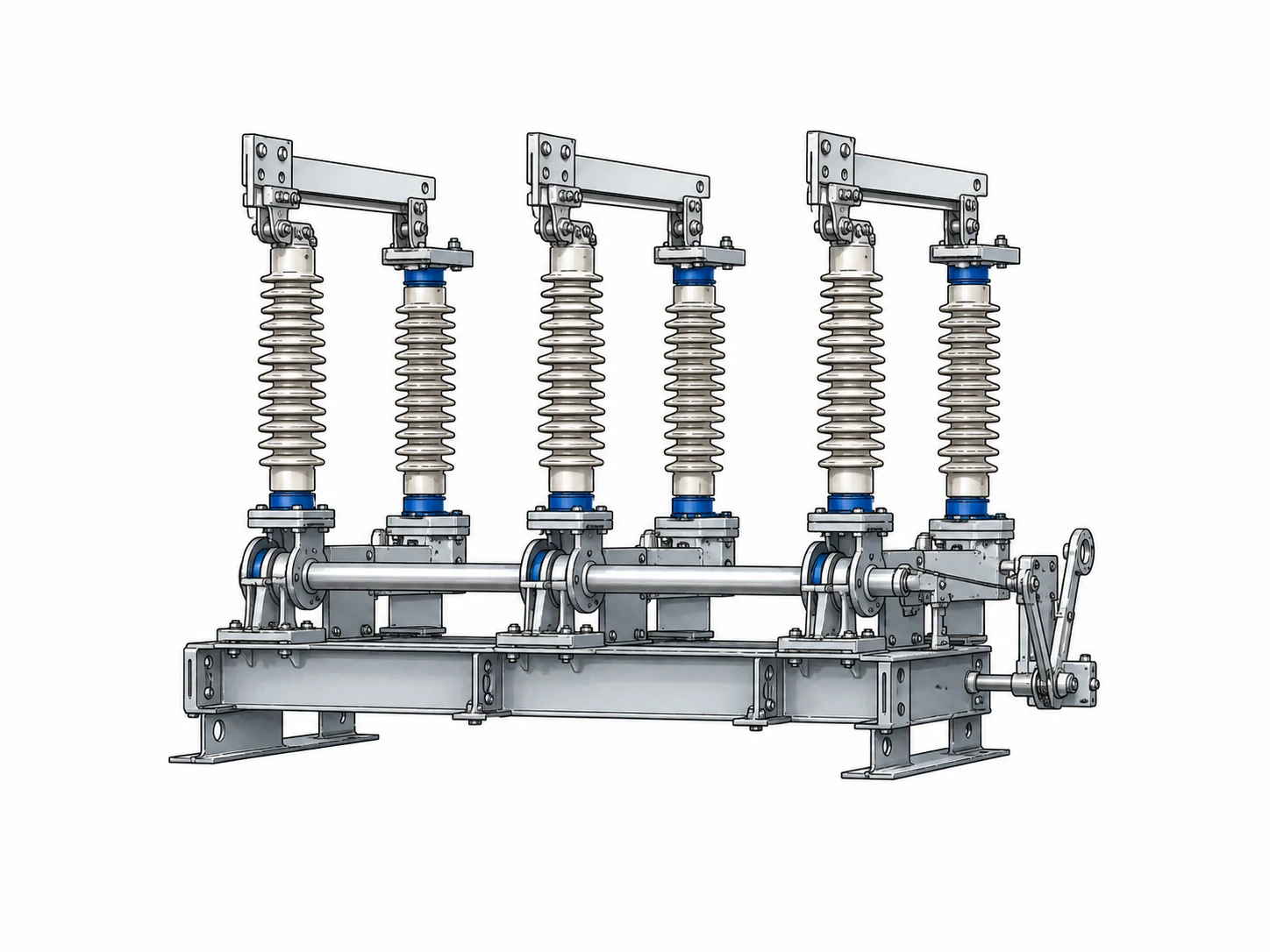
What Is a Disconnector in a Power System?
A disconnector—often called an isolator or disconnect switch in common engineering usage—is a switching device whose primary job is to create electrical isolation. It physically separates contacts so a line, breaker, transformer, bus section, reactor, capacitor bank, or other asset can be isolated from an energized source.
The defining point is that a disconnector normally operates after the circuit current has already been interrupted. The disconnector establishes the isolation boundary; the circuit breaker, fuse, load-break switch, or other rated interrupting device performs the current-interruption function.
Circuit breaker: interrupts load and fault current within its rating. Disconnector: establishes isolation. Those two functions often appear next to each other on a one-line diagram, but they are not interchangeable.
| Function | What it provides | Why it matters |
|---|---|---|
| Isolation | Physical separation of conductive contacts | Defines the isolated equipment boundary |
| Visible open point | Direct visual confirmation in many AIS designs | Supports maintenance switching and field verification |
| Network configuration | Connects or separates bus sections and bays when unloaded or within assigned duty | Enables maintenance and alternate operating configurations |
| Grounding coordination | Works with earthing switches after isolation | Helps establish a controlled grounded work zone |
Swipe horizontally to view all table columns.
Disconnector vs. Circuit Breaker vs. Load Switch
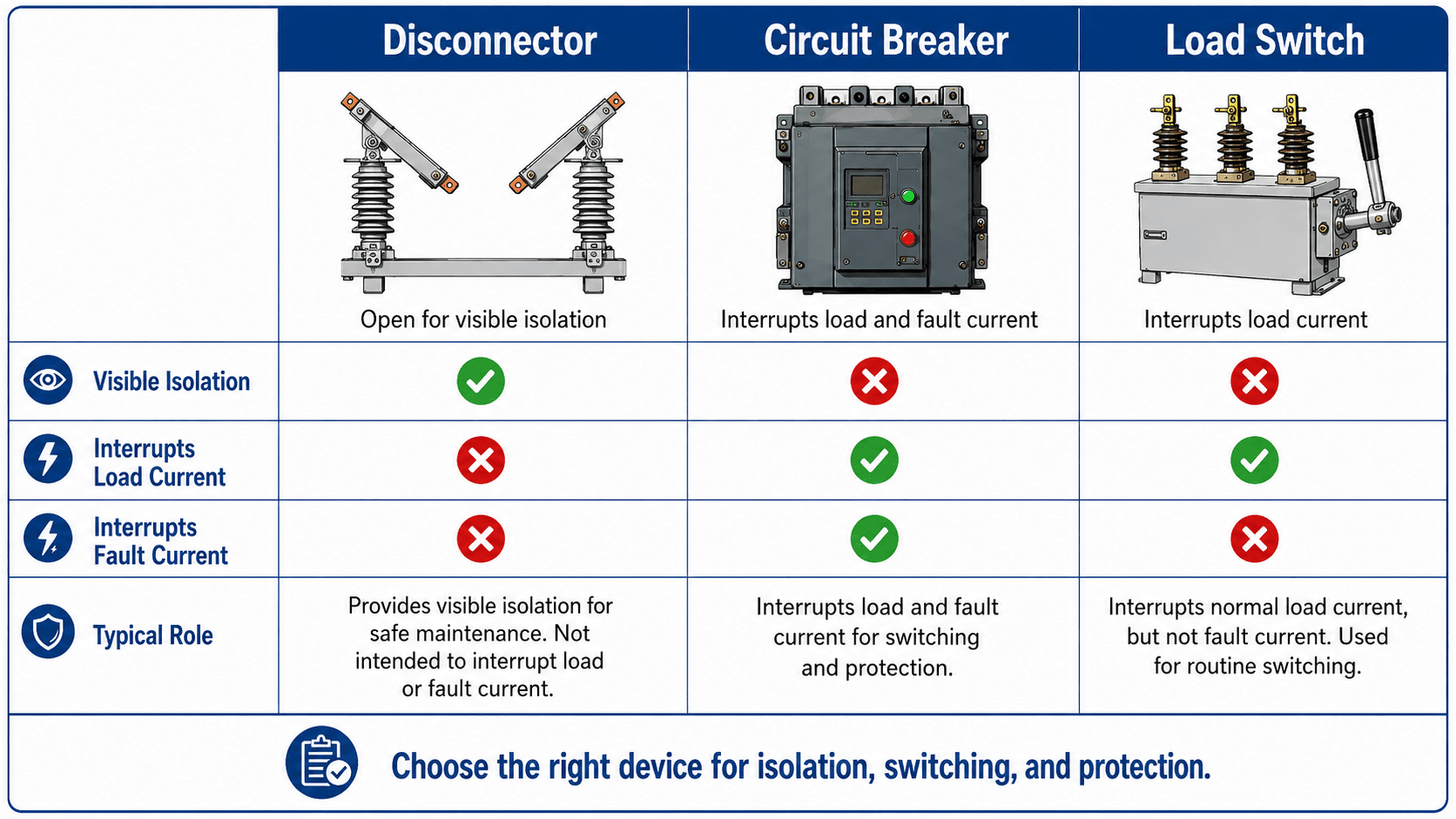
Users searching for disconnectors often need the difference between several switch types more than they need a long definition. The most important difference is the current each device is designed to interrupt.
| Device | Primary purpose | Typical interrupting duty | Typical use |
|---|---|---|---|
| Disconnector | Isolation | Normally off-load; only assigned switching duties when specifically rated | Lines, breakers, transformers, bus sections, maintenance zones |
| Circuit breaker | Switching and protection | Load and fault current within its ratings | Fault clearing and controlled switching |
| Load switch | Normal-load switching | Rated load current; not necessarily high short-circuit interruption | Feeders, ring-main units, distribution switching |
| Switch-disconnector | Switching plus isolation | Specified load/current duties plus isolating function | Where one device is assigned both functions |
| Earthing switch | Grounding an isolated section | Not a normal load-interrupting device; may have assigned making/switching duties | Maintenance grounding and controlled earthing |
Swipe horizontally to view all table columns.
For deeper breaker coverage, see Circuit Breakers.
Types of Disconnectors
Disconnector geometry is chosen to fit the substation layout, voltage class, available clearances, mechanical requirements, conductor arrangement, and operating method.
| Type | How it opens | Where it fits well | Main layout consideration |
|---|---|---|---|
| Center-break | Two rotating arms separate at the center | Common outdoor AIS applications | Requires horizontal blade-swing and phase-to-phase space |
| Double-break | Moving section creates two breaks | High-current and high-voltage layouts | More contacts and linkages to align and maintain |
| Vertical-break | Blade rotates vertically to create the gap | Layouts where horizontal space is constrained | Requires adequate vertical clearance and wind/ice review |
| Pantograph | Mechanism extends vertically to contact an overhead bus | Compact high-voltage bus arrangements | Precise vertical alignment and travel are critical |
| Knee / horizontal-break | Articulated or rotating blade creates a side gap | Specific bus and line-bay geometries | Mechanical geometry and bay footprint |
| GIS disconnector | Contacts move inside sealed gas-insulated equipment | Compact indoor, urban, offshore, or harsh environments | Position indication and interlocking replace direct open-air visual observation |
Swipe horizontally to view all table columns.
How Disconnectors Operate
Disconnectors use a manual or motor-operated mechanism to move conductive contacts between fully closed and fully open positions. In outdoor air-insulated substations, the blade position is often clearly visible. In GIS and enclosed equipment, auxiliary contacts and mechanical position indicators become especially important.
Closed Position
When closed, the disconnector must carry continuous current with acceptable contact temperature rise and must withstand specified short-time fault current until the circuit breaker clears the fault. It is therefore not enough for the blades to “touch”; contact pressure, overlap, alignment, surface condition, and terminal integrity all matter.
Open Position
When open, the device must establish the required isolation distance and dielectric withstand. In AIS, this is often a visibly obvious gap. In GIS, position indication and tested internal construction establish the disconnecting function.
Manual vs. Motor Operation
Manual mechanisms are common in simpler or lower-frequency switching applications. Motor-operated disconnectors support local and remote switching, SCADA integration, interlocks, and automated substation sequences. Motor operation adds control power, limit switches, auxiliary contacts, gearing, and failure modes that must be maintained.
A disconnector can be electrically adequate on paper and still fail in service if the blade does not fully seat, the contact jaw is damaged, the mechanism stalls, or position indication does not match the actual contact state.
Disconnectors and Earthing Switches
An earthing switch is often installed in the same bay as a disconnector but serves a different purpose. After a circuit has been isolated and the switching procedure permits grounding, the earthing switch intentionally connects the isolated conductor or equipment section to ground.
Why Ground an Isolated Section?
- Control induced voltage from nearby energized circuits
- Discharge trapped capacitive charge where applicable
- Provide a defined grounding point during maintenance
- Reduce risk if accidental energization occurs
- Support utility or facility safe-work procedures
Disconnector / Earthing-Switch Interlocking
Interlocks are intended to prevent unsafe combinations—for example, closing an earthing switch onto an energized circuit or closing a disconnector into an improperly grounded configuration. Interlocks may be mechanical, electrical, key-based, or implemented through station-control logic.
An open disconnector does not automatically mean the work zone is grounded. Isolation, absence-of-voltage verification, earthing, tagging, and operating authority are separate parts of the safe switching process.
Disconnector Ratings and Switching Duties
A disconnector is still rated switchgear equipment even though it is not usually the fault-interrupting device. Its closed contacts may carry continuous current and fault current, while its open gap must withstand system and transient voltage.
| Rating / characteristic | What it means | Why it matters |
|---|---|---|
| Rated voltage | Voltage class for which the device is designed | Drives clearances, insulation and open-gap requirements |
| Continuous current | Current the closed contacts can carry continuously | Poor contacts can overheat even when the switch is not operating |
| Short-time withstand current | Fault current the closed device can survive for a defined duration | The breaker clears the fault, but the disconnector still carries the fault until clearing |
| Peak withstand current | Electrodynamic withstand during the fault peak | Contacts, terminals, insulators and structures see high mechanical forces |
| Insulation / impulse withstand | Dielectric withstand of the insulation and open gap | Must coordinate with system insulation level |
| Mechanical endurance | Number / class of operating cycles and mechanism duty | Important for frequently operated selector or sectionalizing applications |
| Assigned switching currents | Specific make/break duties defined by the applicable standard or manufacturer | Some disconnectors can handle bus-transfer, induced or charging currents within stated ratings |
Swipe horizontally to view all table columns.
Can a Disconnector Be Opened Under Load?
A plain disconnector should generally be treated as an off-load device. Some disconnectors have defined current-switching capabilities, and switch-disconnectors are specifically assigned load-switching duty, but the correct answer always comes from the exact equipment rating—not from the generic device name.
“Low current” does not automatically mean “safe to interrupt.” Line charging current, bus-transfer current, transformer magnetizing current, induced current, and other duties can still create significant arcing or overvoltage.
AIS vs. GIS Disconnectors
Air-insulated and gas-insulated disconnectors perform the same isolation function, but the operator sees and maintains them very differently.
| Feature | AIS disconnector | GIS disconnector |
|---|---|---|
| Isolation medium | Air | Gas-insulated sealed compartment |
| Open position | Often directly visible | Verified through tested construction and position indication |
| Space | Requires larger physical clearances | Much more compact |
| Environment | Exposed to weather, contamination, wildlife, ice and corrosion | Internal contacts are protected from the external environment |
| Maintenance focus | Contacts, blades, insulators, linkages and weather exposure | Mechanism, indicators, gas system, seals and internal diagnostics |
Swipe horizontally to view all table columns.
For the surrounding station context, see Substations.
Typical Disconnector Operating Sequence
The exact sequence is defined by the utility or facility switching order, but the educational logic is consistent: interrupt current before operating an off-load disconnector, establish the isolation boundary, verify the condition, and apply grounding where required.
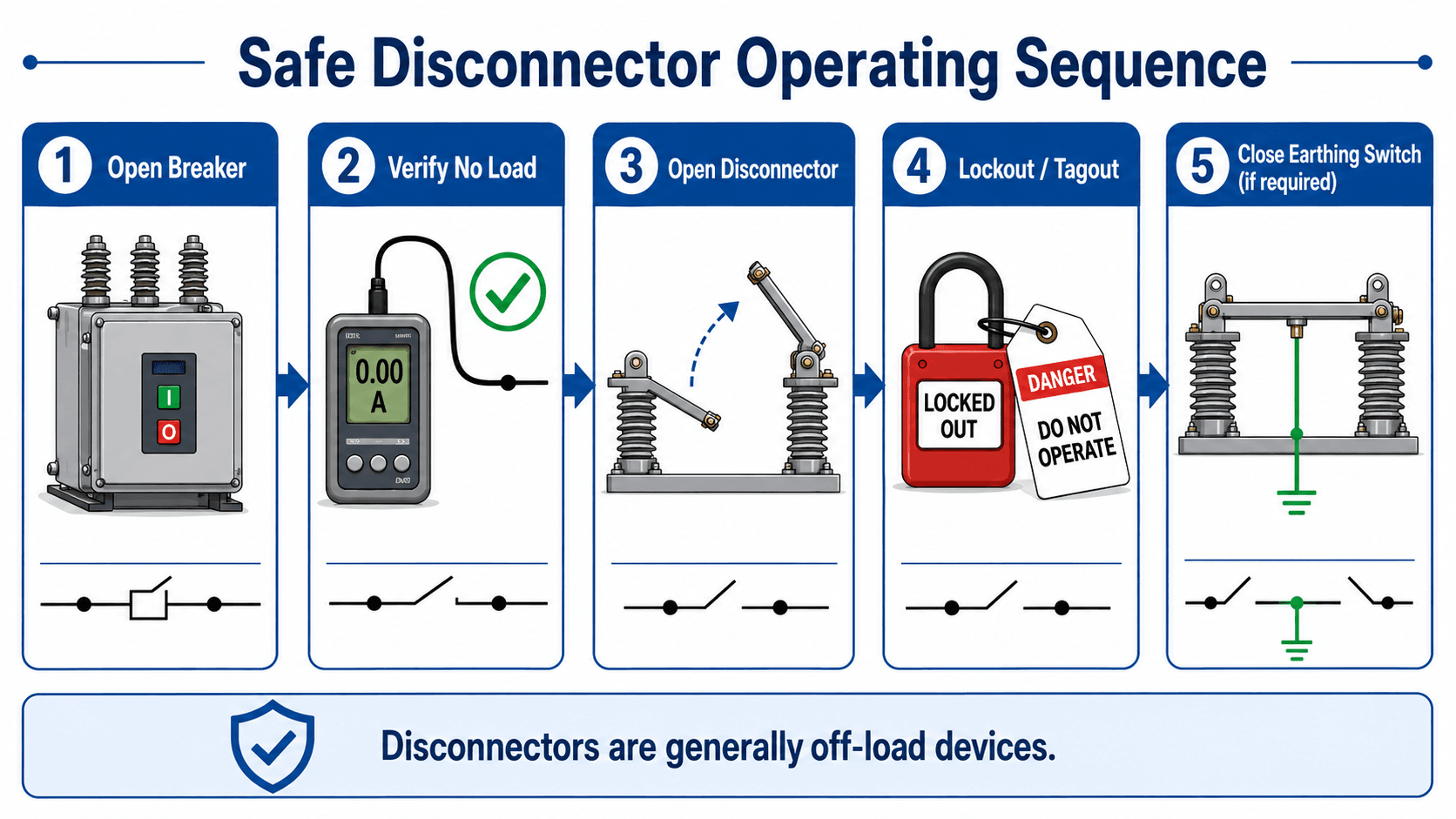
- Identify the correct circuit and work zone. Confirm one-line, equipment identification, and switching authority.
- Interrupt current with the appropriate device. Open the circuit breaker or other rated load-interrupting device.
- Open the required disconnectors. Establish the defined isolation points.
- Verify position and absence-of-voltage as required. Follow the approved procedure and indication requirements.
- Apply lockout/tagout and grounding as required. Earthing switches or portable grounds may be part of the work protection scheme.
This sequence explains the engineering logic, not a universal switching instruction. Actual substation switching should follow the site’s approved switching order, operating rules, interlocks, and qualified-person procedures.
Disconnector Failure Modes and Maintenance Checks
Disconnectors are mechanically simple compared with circuit breakers, but they can develop serious reliability problems because their contacts, insulators, linkages, bearings, and operating mechanisms live outdoors or operate infrequently for many years.
| Failure mode | Field symptom | Why it matters |
|---|---|---|
| Poor contact pressure | Thermal hot spot, discoloration, pitting | High resistance can damage contacts and cause overheating |
| Incomplete closing | Blade not fully seated in jaw | Reduced current-carrying capability and severe local heating |
| Incomplete opening | Insufficient visible gap / uncertain position | Can compromise the intended isolation boundary |
| Corrosion / contamination | Stiff operation, polluted insulators, rusted linkage | Mechanical and dielectric performance can deteriorate |
| Mechanism failure | Stalling, slow movement, failed motor operation | Switching sequence may stop in an indeterminate state |
| Auxiliary-contact mismatch | SCADA indication disagrees with physical position | Remote operators may have incorrect state information |
| Interlock failure | Unsafe operation becomes mechanically/electrically possible | Can permit incorrect breaker/disconnector/earthing-switch combinations |
Swipe horizontally to view all table columns.
High-Value Inspection Checks
- Blade alignment and full travel
- Contact jaw condition, wipe, pressure, and pitting
- Infrared temperature comparison between phases
- Insulator contamination, cracking, tracking, or damage
- Linkages, bearings, lubrication, fasteners, and operating rods
- Motor operator, limit switches, auxiliary contacts, and local/remote controls
- Interlock operation and position indication
- Corrosion, grounding/bonding, structure condition, and environmental exposure
Disconnector Engineering Review Checklist
A complete review checks the electrical ratings, mechanical layout, operating sequence, interlocking, maintenance condition, and actual isolation boundary together.
| Review item | Verify | Risk if missed |
|---|---|---|
| Voltage / insulation | Rated voltage, impulse withstand, open-gap insulation | Flashover or inadequate isolation withstand |
| Continuous current | Load duty and contact temperature rise | Overheated contacts and terminals |
| Short-time / peak withstand | System fault current and breaker clearing time | Mechanical or thermal damage while switch is closed |
| Switching duty | Any assigned load, charging, transfer, induced-current or making duty | Unsafe arcing if the device is operated outside rating |
| Isolation boundary | Correct devices open around the intended work zone | Equipment remains energized from an alternate source |
| Earthing switch | Correct location, interlocking and making-current capability where applicable | Unsafe grounding sequence |
| Mechanical travel | Full open and closed positions, stops, alignment, operating torque | High-resistance joint or incomplete isolation |
| Position indication | Local indication, auxiliary contacts and SCADA state agree | Operators act on incorrect equipment status |
| Environment | Pollution, ice, wind, salt, corrosion, wildlife, temperature | Degraded insulation or mechanism performance |
| Procedure / labeling | Equipment IDs, one-line, interlocks, switching orders and training | Human-factor switching error |
Swipe horizontally to view all table columns.
Disconnector Engineering References
- IEEE C37.30.1-2022 — AC High-Voltage Air Switches Rated Above 1000 V Active IEEE standard covering required ratings, construction, design tests, applications, and suggested practices for high-voltage air switches including disconnecting and grounding switches.
- IEC 62271-102:2018+AMD1:2022 — AC Disconnectors and Earthing Switches Current consolidated IEC standard applying to AC disconnectors and earthing switches above 1 kV, including position indication, mechanical interlocking, operating requirements, and switching capabilities.
- GE Vernova — High-Voltage Disconnectors Industry reference showing center-break, double-side-break, vertical-break, knee-type, pantograph, semi-pantograph, HVDC, and related disconnector configurations used in substations.
Frequently Asked Questions
What is a disconnector in a power system?
A disconnector is a mechanical switching device used to isolate electrical equipment by creating an open contact gap after current has been interrupted by the appropriate switching device.
Is a disconnector the same as an isolator?
In many power-system contexts, isolator is used as a synonym for disconnector. The exact terminology can vary by standard, utility, country, and voltage class, so device ratings and duty should always be checked.
What is the difference between a disconnector and a circuit breaker?
A circuit breaker is designed to interrupt load and fault current within its rating. A disconnector is primarily used to establish isolation after current has already been interrupted.
Can a disconnector open under load?
A plain disconnector should generally not be opened under load unless it has a specific assigned switching duty. A switch-disconnector or load switch may be rated to interrupt specified current.
Why is an earthing switch used with a disconnector?
After a circuit has been isolated, an earthing switch can connect the isolated section to ground when required by the operating procedure, helping control induced voltage, trapped charge, and accidental energization risk.
What are the main types of disconnectors?
Common types include center-break, double-break, vertical-break, pantograph, semi-pantograph, knee or horizontal-break, and enclosed GIS disconnectors.
Why are disconnectors installed on both sides of a circuit breaker?
Disconnectors on each side of a breaker can isolate the breaker from both adjacent energized sections so it can be inspected or maintained within a clearly defined work zone.
What ratings matter on a disconnector?
Important ratings include voltage, continuous current, short-time withstand current, peak withstand current, insulation/impulse withstand, mechanical endurance, and any assigned current-switching or grounding-switch duties.
What causes a disconnector to overheat?
Common causes include poor contact pressure, incomplete closing, corrosion, contamination, loose terminals, surface damage, excessive current, or misalignment that reduces the effective contact area.
Summary and Next Step
Disconnectors are isolation devices, not ordinary fault interrupters. Their job is to establish a controlled open point around lines, transformers, breakers, busbars, and other power-system equipment after current has been interrupted appropriately.
The most important concepts are device duty, open-gap isolation, disconnector vs. breaker terminology, earthing-switch coordination, interlocks, current and withstand ratings, mechanical travel, contact condition, position indication, and approved switching procedure.