
Direct Answer
An inductor is a passive electrical component—usually a coil of conductive wire—that stores energy in a magnetic field and resists rapid changes in current. Its defining relationship is \(v=L\,di/dt\): the faster current tries to change, the more voltage an ideal inductor develops in opposition to that change.
Inductors are used in power supplies, converters, EMI filters, chokes, line reactors, current-limiting reactors, and tuned filters. Real inductors must be checked for saturation current, RMS current, winding resistance, core loss, temperature rise, self-resonance, insulation, and the actual frequency spectrum of the current they carry.
What Does an Inductor Look Like?
Most inductors are built around a coil of conductive wire. The winding may surround air, ferrite, powdered iron, laminated steel, or another magnetic core. Small inductors may be molded or shielded so the winding is hidden, while larger chokes and reactors often expose the winding and magnetic structure.
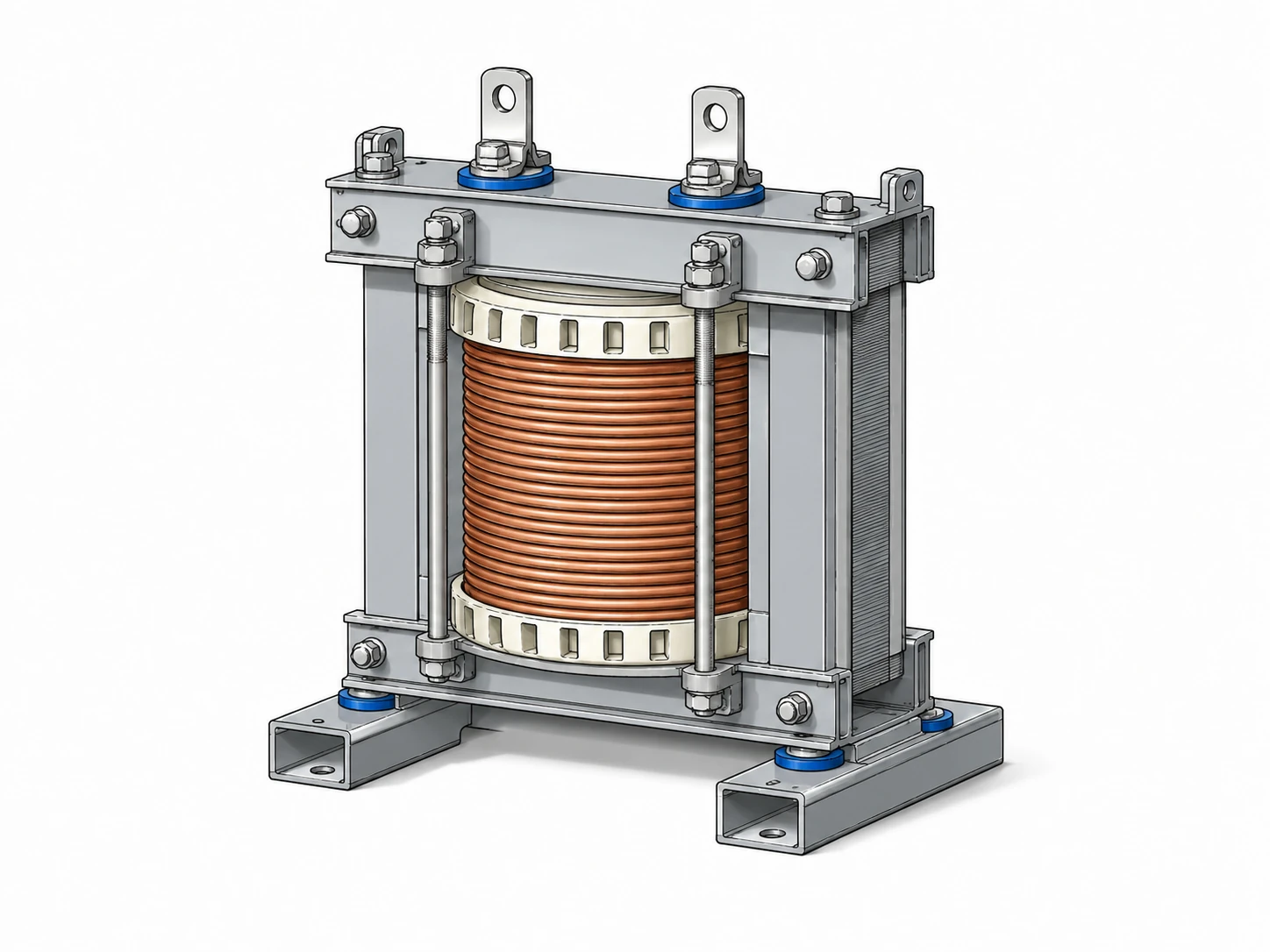
Inductor Symbol and Unit
Inductance is represented by L and measured in henries (H). Practical inductors are commonly specified in millihenries (mH), microhenries (µH), or nanohenries (nH). Circuit diagrams usually represent an inductor with a coil-shaped symbol even when the physical component is molded or shielded.
| Part | Function | Engineering consequence |
|---|---|---|
| Winding | Carries current and creates magnetomotive force | Turns count, conductor size, DCR, skin/proximity effect, and insulation affect performance |
| Magnetic core | Guides and concentrates magnetic flux | Permeability, saturation, core loss, gap, and temperature limit inductance and current |
| Air gap | Stores magnetic energy and linearizes some core designs | Can increase usable DC bias / saturation margin at the cost of lower permeability |
| Terminals / leads | Connect the winding to the circuit | Current rating, creepage, mechanical stress, and high-frequency parasitics matter |
| Shield / enclosure | Controls stray magnetic field or protects the component | Important near sensitive electronics and in high-power equipment |
Swipe horizontally to view all table columns.
A circuit schematic usually reduces all of this to a simple coil symbol. That symbol represents the intended inductance \(L\), not the full physical behavior of the component.
How Inductors Work
Current through a conductor produces a magnetic field. Winding the conductor into a coil causes the magnetic fields from individual turns to reinforce one another. When current changes, magnetic flux changes, and Faraday’s law produces an induced voltage that opposes that current change.
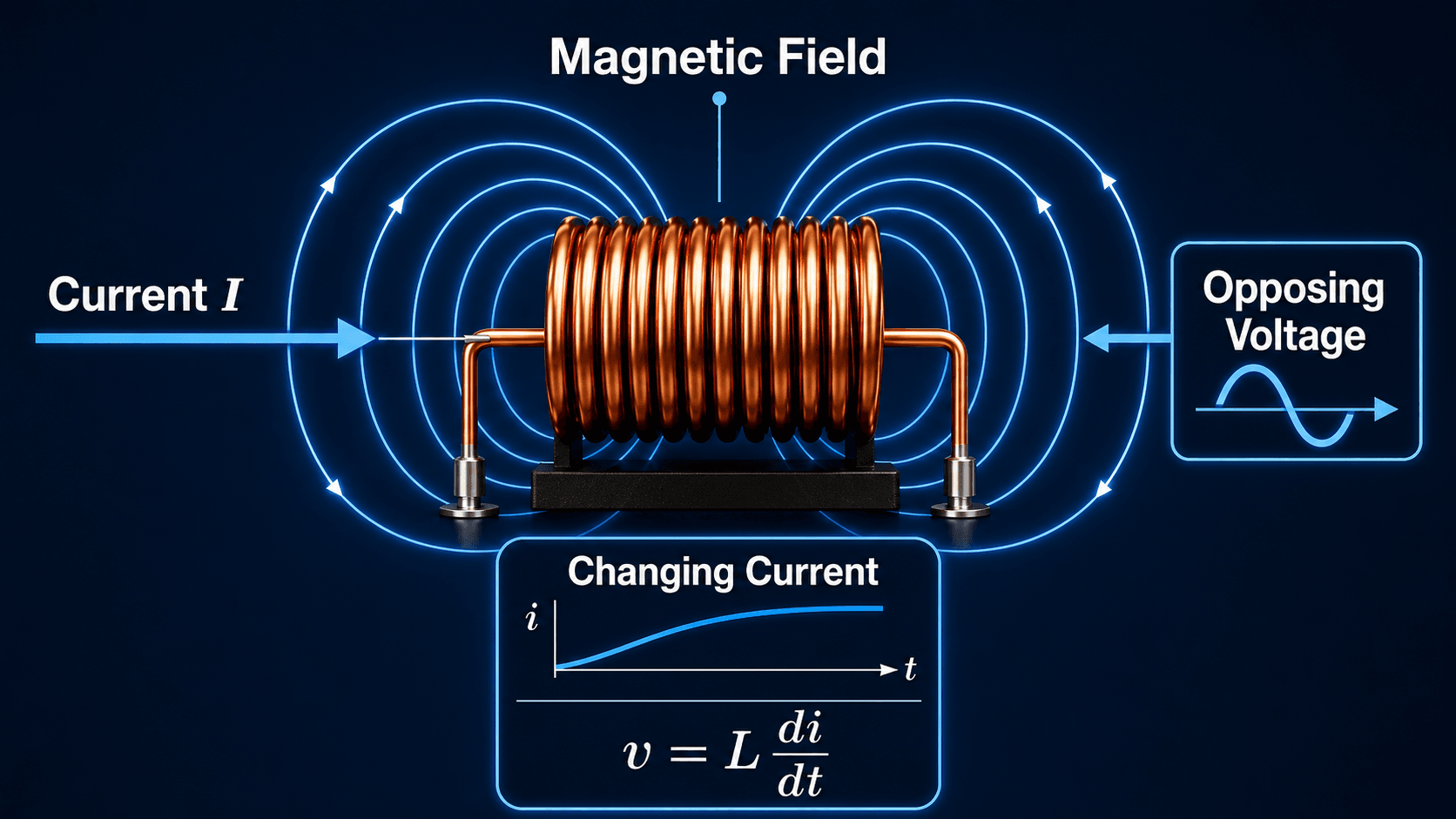
Why the Induced Voltage Opposes the Change
Lenz’s law establishes the direction of the induced effect: the inductor’s voltage opposes the change in current that created it. If current is increasing, the inductor develops voltage that resists the increase. If current is decreasing, stored magnetic energy drives current in the direction that resists the decrease.
Where the Energy Is Stored
Energy is stored in the magnetic field, not “inside the wire” as current. When the field collapses, that energy must go somewhere. If the circuit suddenly removes the normal current path, voltage can rise sharply until another path—such as a snubber, diode, MOV, arc, or parasitic capacitance—accepts the energy.
Interrupting inductive current can create large voltage spikes. Relays, solenoids, motors, reactors, and converter inductors therefore often need deliberate transient-suppression or insulation coordination.
Key Inductor Equations
Voltage-Current Relationship
Stored Magnetic Energy
Inductive Reactance
RL Time Constant
In a simple first-order RL circuit, \(\tau\) describes how quickly current approaches its new steady-state value. After one time constant, current has completed about 63.2% of the transition toward its final value.
- \(L\)Inductance in henries (H).
- \(I\)Current in amperes.
- \(f\)Frequency in hertz.
- \(X_L\)Inductive reactance in ohms.
- \(\tau\)RL time constant in seconds.
Inductors in Series and Parallel
For uncoupled ideal inductors, series inductances add directly:
For uncoupled ideal inductors in parallel:
These equations assume the inductors are magnetically uncoupled. If their magnetic fields link, mutual inductance changes the equivalent inductance and the winding polarity/dot convention matters.
Inductor Behavior in DC, AC, and Switching Circuits
An inductor responds to changes in current, so its behavior is strongly dependent on frequency and time scale.
Steady DC: ideal inductor ≈ short circuit. Sinusoidal AC: current lags voltage by 90° in the ideal model. Higher frequency: inductive reactance increases. Fast switching: the inductor develops whatever voltage is needed—within real insulation and circuit limits—to oppose rapid current change.
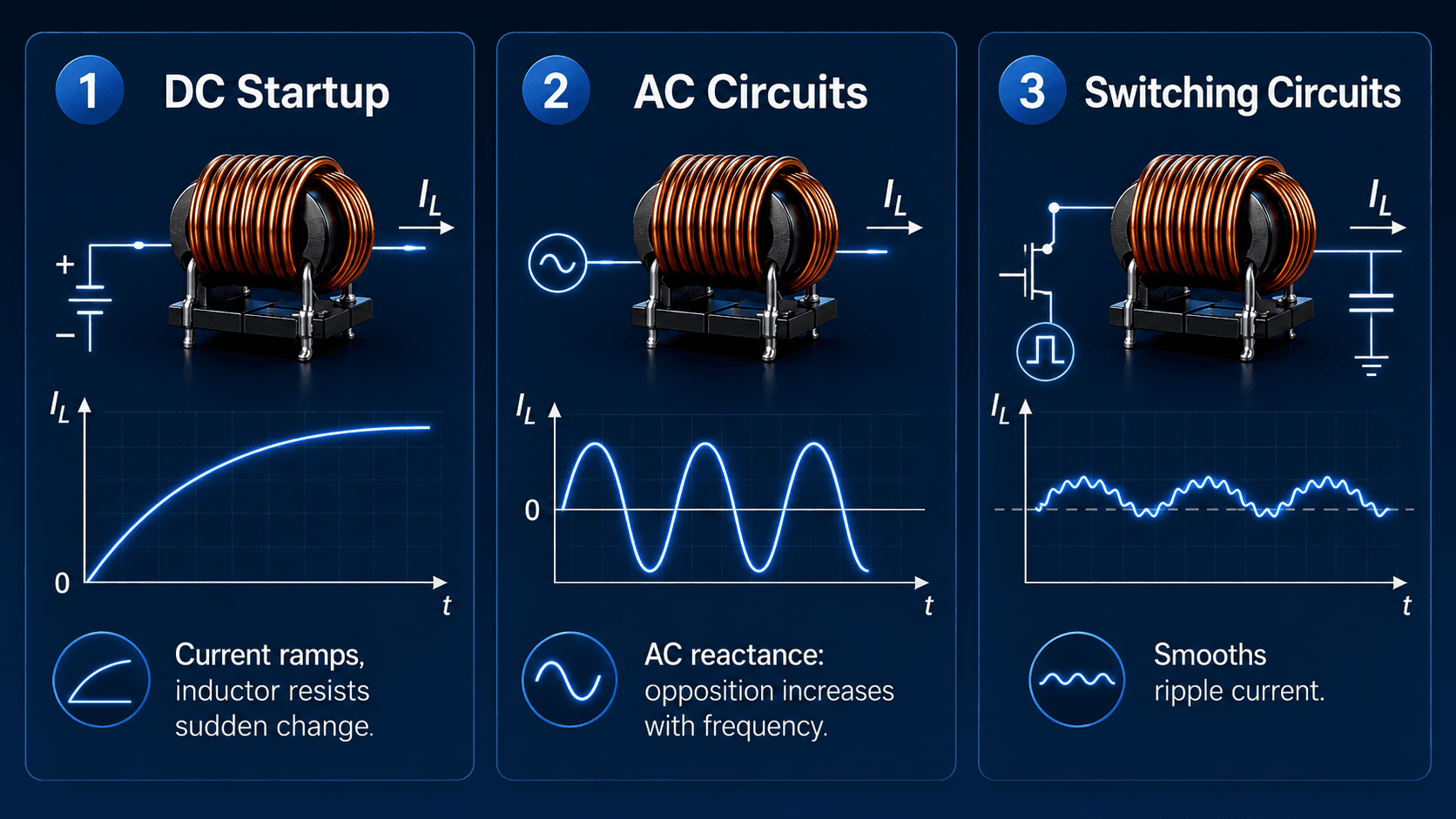
Steady DC
After the transient has settled, an ideal inductor acts like a short circuit at DC. A real inductor still has winding resistance, so it dissipates \(I^2R\) heat and develops some voltage drop.
Sinusoidal AC
For an ideal sinusoidal inductor, current lags voltage by 90°. Because \(X_L=2\pi fL\), higher-frequency components see higher reactance. That frequency dependence makes inductors useful for filtering and harmonic control.
Switching Waveforms
In a buck, boost, inverter, or other converter, the inductor is repeatedly charged and discharged each switching cycle. Designers select \(L\) to control ripple, peak current, stored energy, transient response, and current stress while staying within core and thermal limits.
Types of Inductors
Inductor construction is chosen to balance inductance, current capability, frequency, losses, size, leakage field, insulation, and cost.
| Type | Strength | Typical use | Main limitation |
|---|---|---|---|
| Air-core | No ferromagnetic saturation | RF, high-frequency, special filters | Lower inductance density / larger size |
| Ferrite-core | High permeability with low high-frequency core loss | Switching converters, EMI filters | Saturation and material-specific loss limits |
| Powdered-iron | Distributed gap and useful DC-bias behavior | Power inductors, filters | Core loss can be higher than ferrite in some frequency ranges |
| Laminated iron/steel | Suitable for line-frequency and high-power magnetic equipment | Reactors, filters, industrial power equipment | Large size, audible noise, eddy/hysteresis losses |
| Toroidal | Closed magnetic path and reduced stray field | Filters, power supplies, audio/power electronics | Winding/manufacturing and cooling constraints |
| Shielded power inductor | Reduced external magnetic field | Dense DC/DC converter layouts | Thermal and saturation limits still apply |
| Common-mode choke | High impedance to common-mode noise | EMI filtering on power/data conductors | Differential-mode and common-mode behavior must not be confused |
| Line / current-limiting reactor | Adds intentional system impedance | Drives, feeders, substations, fault-current control | Voltage drop, losses, thermal duty, insulation, and fault forces |
Swipe horizontally to view all table columns.
Inductor vs. Choke vs. Reactor
All three are inductive components. “Inductor” is the broad component term. A choke is normally an inductor used to impede unwanted AC, ripple, or noise. A reactor usually refers to a higher-power inductor intentionally added to a power circuit for current limiting, voltage/reactive control, filtering, or drive/system protection.
Real Inductors: Saturation, DCR, Core Loss, and Self-Resonance
The difference between a working design and an overheated or unstable design often comes from non-ideal behavior rather than the nominal inductance value.
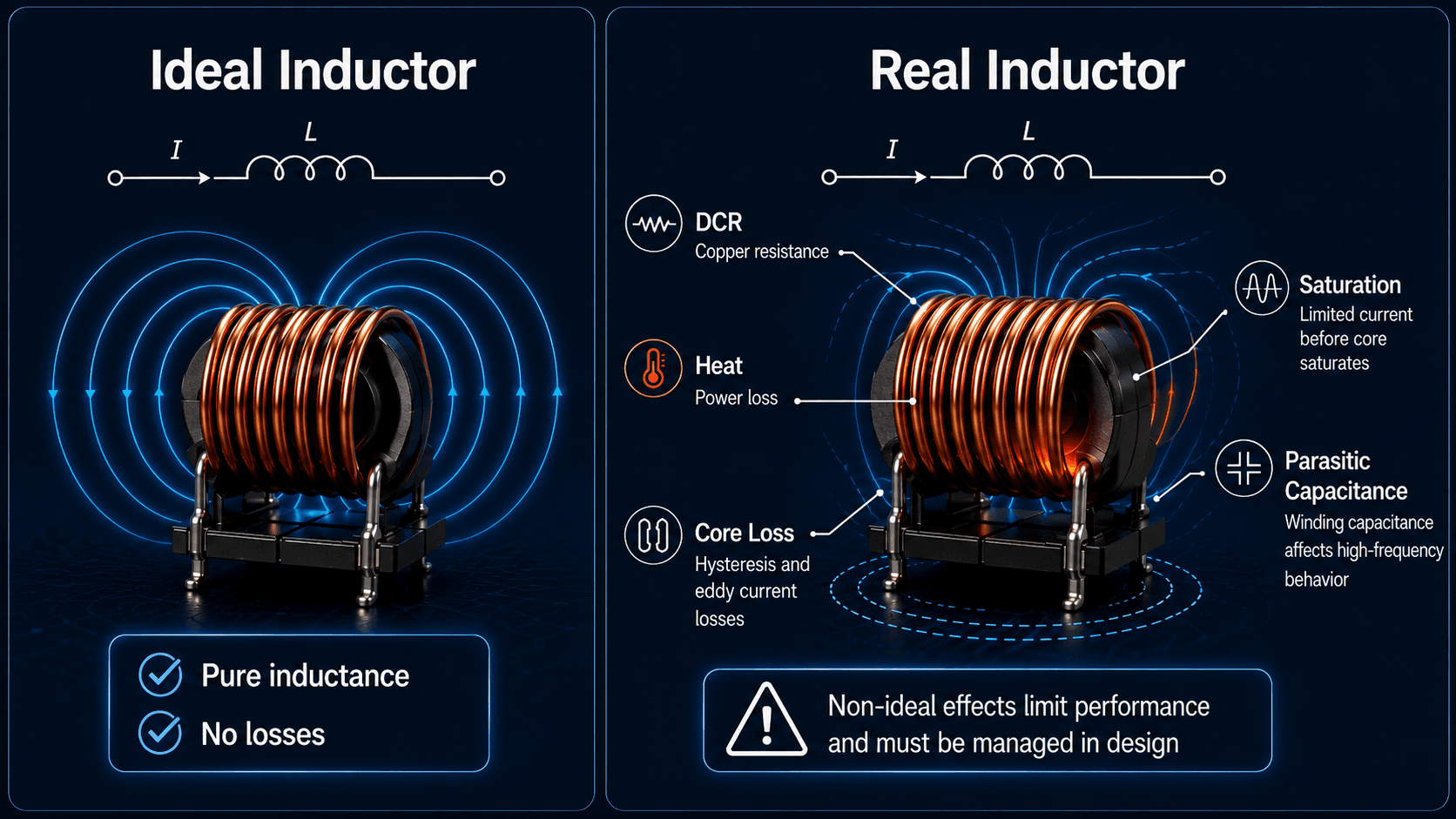
Inductor Saturation
As magnetic flux density approaches the core material’s saturation region, incremental permeability falls and effective inductance can drop sharply. The same applied voltage then produces a faster rise in current, which can create runaway current stress in a converter or reduce the intended impedance of a reactor.
DC Resistance and Copper Loss
The winding has finite resistance. Copper loss is approximately \(I_{\mathrm{RMS}}^2R\), and resistance increases as the conductor heats. At high frequency, skin and proximity effects can make effective AC winding resistance larger than the DC-resistance value.
Core Loss
Changing flux produces hysteresis and eddy-current-related losses in magnetic materials. Core loss depends on material, frequency, flux swing, waveform, temperature, and geometry. A design that is cool at 60 Hz can behave very differently at tens or hundreds of kilohertz.
Real Q varies with frequency because winding resistance, skin effect, proximity effect, core loss, inductance, and parasitic capacitance all change with frequency.
Inductor quality factor compares useful inductive reactance with loss at a given frequency. A common low-frequency approximation is:
Q Factor
Self-Resonant Frequency
Parasitic capacitance exists between winding turns. Together with inductance, it creates a self-resonant frequency (SRF). Below SRF the component is generally inductive; near resonance its impedance peaks; above SRF it can become increasingly capacitive.
Do not assume “rated current” and “saturation current” mean the same thing. One may be based on temperature rise while the other is based on a specified drop in inductance.
Where Inductors Are Used
Inductors are used whenever a circuit needs controlled current change, magnetic energy storage, filtering, impedance, or noise suppression.
| Application | Role of the inductor | Key sizing variable |
|---|---|---|
| Buck / boost converter | Stores energy and controls current ripple | L, peak current, RMS current, saturation, core loss |
| LC filter | Works with capacitance to attenuate selected frequencies | Inductance, capacitance, damping, resonance |
| EMI choke | Impedes unwanted high-frequency current | Impedance vs. frequency, current, parasitics |
| Motor-drive line reactor | Adds series impedance and limits current change | Percent impedance, current, voltage, thermal duty |
| Current-limiting reactor | Reduces prospective fault current | Reactance, short-time current, voltage drop, insulation |
| Passive harmonic filter | Tunes with capacitors to control harmonic current | Tuning frequency, MVAR, harmonic current, losses |
Swipe horizontally to view all table columns.
Inductors and Reactors in Power Systems
At power-system scale, deliberately applied inductance is usually described as a reactor. Reactors are used to control current, reactive power, harmonic response, and transient behavior.
| Reactor application | Connection | Primary purpose |
|---|---|---|
| Line reactor | Series | Add impedance, limit current change, reduce drive/input stress |
| Current-limiting reactor | Series | Reduce available short-circuit current |
| Shunt reactor | Shunt | Absorb reactive power and control overvoltage on lightly loaded long lines/cables |
| Filter reactor | Usually series with capacitor branch | Create tuned/detuned harmonic response |
| Neutral grounding reactor | Neutral-to-ground | Limit ground-fault current in selected grounding schemes |
Swipe horizontally to view all table columns.
For deeper utility-scale coverage, see Reactors. Keeping reactor-specific protection and application depth on that page prevents this broad “Inductors” page from becoming redundant.
Inductors and Capacitors Together
Because \(X_L\) rises with frequency while \(X_C\) falls with frequency, inductors and capacitors can be combined to create resonant or filtering networks. That interaction is useful in harmonic filters but can also create unintended resonance if system impedance is not studied.
See Capacitors and Power Quality for the complementary capacitor and harmonic context.
How to Select an Inductor
Start with the current waveform and circuit function. The nominal inductance value should be treated as one requirement among several magnetic and thermal constraints.
| Check | What to verify | What can go wrong |
|---|---|---|
| Inductance | Value and tolerance at relevant bias/current | Wrong ripple, filter, or transient response |
| Peak current | Startup, ripple peak, overload, transient | Core saturation and rapid current rise |
| RMS current | Actual waveform RMS | Excess copper heating |
| DCR / AC resistance | Resistance at operating temperature/frequency | Loss, voltage drop, poor efficiency |
| Core material | Frequency and flux-density suitability | High core loss or saturation |
| SRF / impedance curve | Operation below relevant resonance where inductive behavior is required | Component becomes ineffective or capacitive at high frequency |
| Insulation | Working voltage and transient stress | Turn-to-turn or winding-to-core breakdown |
| Thermal environment | Ambient, airflow, enclosure, nearby heat | Unexpected temperature rise and shortened life |
Swipe horizontally to view all table columns.
Worked Example: 2 mH Inductor at 8 A
For an ideal 2 mH inductor carrying 8 A:
At 60 Hz, the same inductor has:
At 10 kHz, the ideal reactance would be about 125.7 Ω, illustrating why frequency changes the role of a fixed inductance so dramatically. Real high-frequency behavior must still be checked against core loss and self-resonance.
Frequency increased from 60 Hz to 10 kHz by a factor of about 166.7, so ideal inductive reactance should increase by the same factor. \(0.754\times166.7\approx125.7\ \Omega\), which matches the calculation.
Inductor Engineering References and Selection Context
- MIT — Inductance and Magnetic Energy Educational treatment of inductance, mutual inductance, magnetic energy, and the underlying electromagnetic relationships.
- OpenStax University Physics — Self-Inductance and Inductors Accessible university-level reference for self-inductance, induced EMF, and magnetic energy.
- U.S. Department of Energy — Power Electronics Research and Development Power-electronics context in which magnetic components such as inductors are important to conversion, filtering, and grid-interface technologies.
Frequently Asked Questions
What is an inductor?
An inductor is a passive component, usually a coil of wire, that stores energy in a magnetic field and opposes rapid changes in current.
What does an inductor look like?
Most inductors visibly contain a coil or winding around an air or magnetic core. Small power inductors may be molded or shielded so the winding is hidden, while larger chokes and reactors often have clearly visible windings and magnetic cores.
Why do inductors oppose changes in current?
A changing current changes the magnetic field. That changing field induces a voltage whose polarity opposes the current change, as described by Faraday’s and Lenz’s laws.
Does an inductor block DC?
An ideal inductor does not block steady DC; after the transient, it behaves like a short circuit. A real inductor still has winding resistance and therefore voltage drop and heating.
What is inductor saturation?
Saturation occurs when a magnetic core reaches a region where additional magnetizing force produces relatively little additional flux. Effective inductance can then fall sharply and current may rise much faster than intended.
What is the difference between an inductor, choke, and reactor?
Inductor is the general component term. A choke is typically an inductor used to impede ripple or noise, while reactor usually refers to a higher-power inductor used in power systems or industrial power equipment.
What is the difference between an inductor and a capacitor?
An inductor stores energy in a magnetic field and resists changes in current. A capacitor stores energy in an electric field and resists changes in voltage.
What happens when you suddenly disconnect an inductor?
The magnetic field attempts to keep current flowing. If the normal current path is removed abruptly, voltage can rise sharply until another path accepts the stored energy, which is why inductive switching often uses suppression or insulation protection.
How do inductors combine in series and parallel?
For ideal uncoupled inductors, series inductances add directly. Parallel inductors combine using the reciprocal formula. If the coils are magnetically coupled, mutual inductance and winding polarity change the result.
Summary and Next Step
Inductors store energy in magnetic fields and resist rapid changes in current. The ideal equations explain current ramping, magnetic energy, AC reactance, and RL time constants, while real performance depends on saturation, winding resistance, core loss, parasitic capacitance, self-resonance, and thermal conditions.
The most useful selection habit is to start with the actual current waveform and frequency content rather than the nominal inductance alone. Then verify peak current, RMS current, saturation, DCR, core loss, insulation, and temperature against the real operating environment.