
Key Takeaways
- Core idea: A thermodynamic cycle is a repeating path of processes that returns a system to its starting state after exchanging heat and work.
- Engineering use: Cycles are the foundation for engines, power plants, refrigeration systems, heat pumps, gas turbines, and many HVAC systems.
- What controls it: Temperature limits, pressure ratios, working fluid properties, component efficiencies, heat-transfer limits, and irreversibilities control real cycle performance.
- Practical check: Ideal cycle diagrams are useful for learning, but real equipment loses performance through friction, pressure drop, heat leakage, non-ideal compression, and finite heat-transfer rates.
Table of Contents
Introduction
Thermodynamic cycles are repeated sequences of heat and work interactions that return a system to its initial state. They explain how engines produce power, how refrigerators move heat from cold spaces to warm surroundings, and how engineers compare the efficiency, losses, and operating limits of real energy systems.
Thermodynamic Cycles Diagram
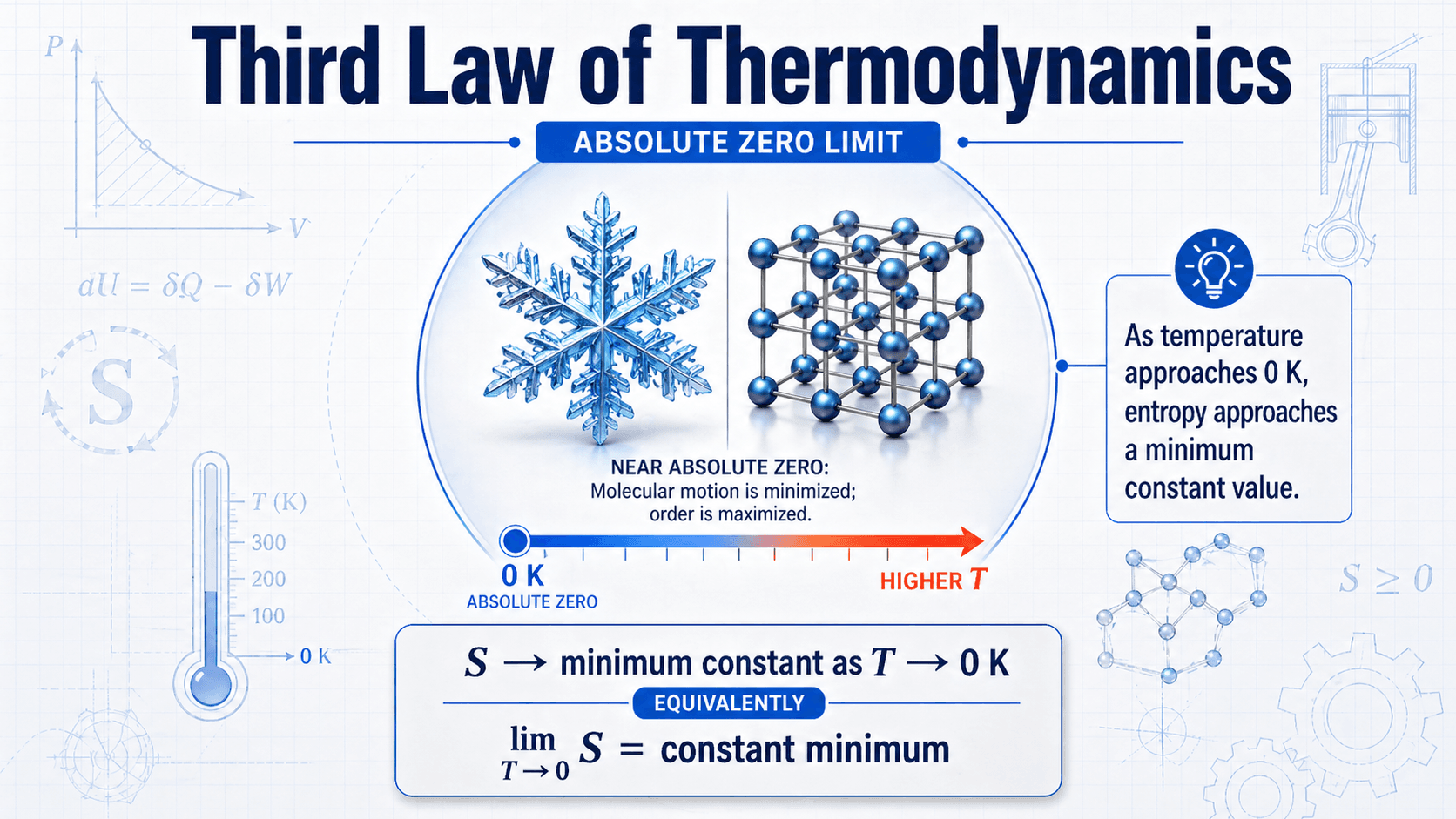
Notice the loop concept first. The important idea is not that every part of the system is physically moving in a circle, but that the thermodynamic state repeats after one full operating sequence.
What Are Thermodynamic Cycles?
A thermodynamic cycle is a series of processes that brings a system back to its original thermodynamic state. During the cycle, the system may absorb heat, reject heat, produce work, or require work input. Because the initial and final states are the same, state properties such as pressure, temperature, specific volume, internal energy, enthalpy, and entropy return to their starting values after one complete cycle.
The cycle itself can still produce a useful result. A power cycle converts part of the heat input into net work output. A refrigeration or heat pump cycle uses work input to move heat against its natural direction. This is why cycles are central to engines, turbines, steam plants, air conditioners, refrigerators, and industrial heat-recovery systems.
Over a complete cycle, the system returns to the same state, but the surroundings do not. The useful engineering result comes from the net heat and work exchanged with the surroundings during that loop.
How Thermodynamic Cycles Work
A cycle is built from individual processes. Each process changes the state of the working fluid in a controlled way, such as compression, expansion, heating, cooling, evaporation, condensation, throttling, or heat rejection. Engineers connect those processes into a loop and then evaluate the heat and work transfer across the system boundary.
State Points Define the Cycle
A state point describes the condition of the working fluid at a specific location or stage in the cycle. In a vapor-compression refrigeration cycle, for example, engineers commonly track the refrigerant state at the compressor inlet, compressor outlet, condenser outlet, expansion device outlet, and evaporator outlet. In a gas turbine cycle, the major state points occur around the compressor, combustor, turbine, and exhaust.
Processes Connect the State Points
The process between two state points determines how energy moves. Compression usually requires work input. Expansion through a turbine can produce work output. Heat addition raises the energy of the working fluid. Heat rejection removes energy so the cycle can return to its initial condition.
Cycle Diagrams Make Energy Behavior Visible
Thermodynamic cycles are often shown on pressure-volume, temperature-entropy, or pressure-enthalpy diagrams. These plots help engineers see work areas, heat transfer trends, compression behavior, phase changes, and departures from ideal performance.
Engineering Applications of Thermodynamic Cycles
Engineers use thermodynamic cycles to predict how much useful output can be obtained from heat, how much work is required to move heat, and where real equipment wastes energy. The same cycle logic applies across mechanical systems, energy systems, HVAC equipment, vehicles, and industrial processes.
- Power generation: Rankine cycles model steam power plants, while Brayton cycles model gas turbines and jet engines.
- Internal combustion: Otto and Diesel cycle models help explain spark-ignition and compression-ignition engine behavior.
- Cooling and heat pumping: Vapor-compression cycles explain refrigerators, air conditioners, chillers, and heat pumps.
- Performance benchmarking: The Carnot cycle gives an ideal upper limit for heat-engine efficiency between two temperature reservoirs.
- Waste-heat recovery: Engineers use cycle analysis to evaluate whether rejected heat can be recovered for power, heating, or process use.
Before comparing two cycles, confirm that they use the same objective. A power cycle is judged by net work and thermal efficiency, while a refrigeration cycle is judged by cooling effect, compressor work, and coefficient of performance.
Key Factors That Control Cycle Performance
Real thermodynamic cycle performance is controlled by more than the ideal diagram. Temperature limits, pressure levels, working fluid behavior, component losses, heat-exchanger performance, and operating constraints all affect efficiency and reliability.
| Factor | Why it matters | Engineering implication |
|---|---|---|
| Temperature limits | Hot and cold reservoir temperatures strongly influence the maximum possible efficiency or COP. | Higher source temperatures can improve power-cycle efficiency, while smaller temperature lifts improve refrigeration and heat pump performance. |
| Pressure ratio | Pressure ratio affects compressor work, turbine work, temperature rise, and component stress. | An aggressive pressure ratio may improve ideal output but increase real losses, material demands, leakage, and operating risk. |
| Working fluid | The fluid controls phase-change behavior, property tables, safety, environmental impact, and equipment compatibility. | Steam, air, refrigerants, combustion gases, and organic working fluids each lead to different cycle layouts and constraints. |
| Component efficiency | Compressors, pumps, turbines, nozzles, and heat exchangers do not behave ideally. | Small drops in component efficiency can noticeably reduce net work output, cooling capacity, or overall system COP. |
| Irreversibilities | Friction, turbulence, heat transfer across finite temperature differences, throttling, and mixing generate entropy. | Irreversibilities reduce the useful work available from the cycle and move real performance away from ideal predictions. |
Cycle Analysis Equations Engineers Use
The main equations for thermodynamic cycles come from the first and second laws of thermodynamics. The exact property calculations depend on the working fluid and equipment, but the cycle-level energy balance is usually built around net heat transfer and net work transfer.
For a heat engine operating in a cycle, the net work output equals the heat added to the cycle minus the heat rejected from the cycle. This relationship is useful because the internal energy returns to its starting value after one complete cycle.
Thermal efficiency compares the useful net work output to the heat input. It is commonly used for power-producing cycles such as steam power cycles, gas turbine cycles, and idealized internal combustion cycles.
For a refrigerator, coefficient of performance compares the desired cooling effect \(Q_L\) to the required work input. A heat pump uses a similar idea, but the desired output is the heat delivered to the warm space.
- \(W_{net}\) Net work over one cycle, usually in kJ, Btu, kW, or hp depending on whether energy or power rate is being evaluated.
- \(Q_{in}\) Heat added to the cycle from a high-temperature source, such as combustion, a boiler, solar heat, or an external heat exchanger.
- \(Q_{out}\) Heat rejected from the cycle to a lower-temperature sink, such as ambient air, cooling water, a condenser, or exhaust stream.
- \(COP_R\) Refrigeration coefficient of performance, a ratio of cooling effect to work input.
Thermodynamic Cycle Selection Checklist
Choosing the right cycle starts with the engineering objective. A system designed to produce shaft work, cool a space, pump heat, or recover waste heat will use different performance metrics and different practical constraints.
Start with the desired output → identify the heat source and heat sink → choose a working fluid → map the major state points → estimate ideal performance → add component losses → check temperatures, pressures, materials, safety, and controllability.
| Check or decision | What to look for | Why it matters |
|---|---|---|
| Define the objective | Power output, cooling capacity, heating capacity, waste-heat recovery, or efficiency improvement. | The objective determines whether efficiency, COP, net work, heat rate, or capacity is the main performance metric. |
| Identify temperature reservoirs | Available source temperature, required sink temperature, ambient conditions, and process temperature limits. | Temperature limits set the theoretical ceiling for performance and strongly influence equipment size. |
| Choose the working fluid | Steam, air, refrigerant, combustion gas, organic fluid, or another process-specific fluid. | Fluid properties control phase change, pressure levels, safety, materials compatibility, and property-data needs. |
| Estimate real component losses | Compressor efficiency, pump work, turbine efficiency, pressure drop, heat exchanger approach temperature, and leakage. | Real equipment performance can differ significantly from ideal cycle diagrams. |
| Check operating range | Startup, part-load operation, seasonal conditions, fouling, cycling, and control stability. | A cycle that looks good at one design point may perform poorly or become unreliable across the real operating envelope. |
Worked Example: Reading a Simple Heat Engine Cycle
Suppose a heat engine receives 500 kJ of heat from a high-temperature source during one cycle and rejects 320 kJ to a low-temperature sink. The cycle returns to its original state, so the net work output is the difference between heat input and heat rejection.
Energy Balance
The engine produces 180 kJ of net work per cycle. If the cycle repeats many times per second, this energy per cycle can be converted into power by multiplying by the cycle rate.
Thermal Efficiency
A 36% thermal efficiency means 36% of the heat input becomes useful net work, while the remaining energy is rejected as heat. The rejected heat is not automatically a design failure; it is required by the second law for a heat engine operating between finite temperature reservoirs.
Engineering Judgment and Field Reality
Ideal thermodynamic cycles are learning tools and starting points for engineering estimates. Real systems operate with non-ideal equipment, imperfect controls, changing ambient conditions, fouled heat exchangers, pressure losses, and material limitations. A cycle that performs well on a clean diagram may need major adjustment once equipment constraints are included.
Experienced engineers also separate cycle efficiency from system usefulness. A slightly less efficient cycle may be the better design if it is safer, cheaper, easier to control, more reliable at part load, compatible with available fluids, or easier to maintain.
Heat exchangers rarely operate with zero temperature difference, compressors rarely follow ideal compression, and turbines rarely convert all available expansion energy into useful shaft work. Always move from ideal cycle results to real component assumptions before making design decisions.
When This Breaks Down
Simplified thermodynamic cycle analysis becomes less reliable when the assumptions behind the cycle no longer match the real system. This is especially important when a textbook cycle is used to estimate performance for actual equipment.
- Large pressure drops: Piping, valves, heat exchangers, filters, and fittings can shift state points away from the ideal cycle.
- Non-constant properties: Real gases, refrigerants, steam, and mixtures may require property tables or software instead of simple ideal-gas assumptions.
- Transient operation: Startup, shutdown, cycling, and part-load behavior may not match steady-state cycle assumptions.
- Heat leakage: Unwanted heat gain or heat loss changes the balance between \(Q_{in}\), \(Q_{out}\), and useful work.
- Control limitations: Expansion valves, compressors, burners, pumps, and turbines must operate within stable and safe control ranges.
Common Mistakes and Practical Checks
Most mistakes in thermodynamic cycle work come from mixing ideal theory with real equipment assumptions without clearly stating where each applies. The safest approach is to define the boundary, label every heat and work interaction, and keep sign conventions consistent.
- Confusing energy and power: Heat and work per cycle are energy values, while power depends on the rate at which the cycle repeats or mass flows through the system.
- Using the wrong performance metric: Heat engines use thermal efficiency, while refrigerators and heat pumps use coefficient of performance.
- Ignoring pressure drop: Pressure losses in heat exchangers and piping can materially change compressor work, turbine work, and capacity.
- Assuming reversible behavior: Real compression, expansion, heat transfer, and throttling processes generate entropy and reduce useful performance.
- Forgetting the working fluid: A cycle diagram is incomplete without fluid properties, phase behavior, and safe operating limits.
Do not compare a real system to an ideal cycle and call the difference a single “efficiency loss.” Break the gap into component efficiency, pressure drop, heat-transfer limitations, leakage, control behavior, and operating conditions.
Useful References and Design Context
Thermodynamic cycle analysis is usually supported by textbooks, property databases, equipment standards, and manufacturer data. These references help engineers move from ideal cycle models to real component selection and performance checks.
- Engineering thermodynamics textbooks: Used for first-law and second-law cycle analysis, state-property evaluation, T-s diagrams, P-v diagrams, and idealized power and refrigeration cycles.
- Steam tables and refrigerant property data: Used to calculate enthalpy, entropy, pressure, temperature, quality, and phase behavior for Rankine, refrigeration, and heat pump cycles.
- ASHRAE references: Commonly used for HVAC, refrigeration, refrigerants, cooling loads, equipment performance, and practical system design context.
- Manufacturer performance data: Used to check compressor maps, pump curves, turbine performance, heat exchanger ratings, pressure drops, and real operating limits.
Frequently Asked Questions
A thermodynamic cycle is a repeating sequence of processes that returns a working fluid or system to its initial state after exchanging heat and work. Because the final state matches the starting state, the net change in properties such as internal energy is zero over one complete cycle.
Thermodynamic cycles are important because they describe how engines, turbines, refrigerators, heat pumps, and power plants convert energy. Engineers use cycle analysis to estimate efficiency, work output, cooling capacity, heat rejection, equipment size, fuel use, and where real losses occur.
Common thermodynamic cycles include the Carnot cycle, Rankine cycle, Brayton cycle, Otto cycle, Diesel cycle, refrigeration cycle, and vapor-compression cycle. Each cycle represents a different engineering purpose, such as power generation, aircraft propulsion, internal combustion, cooling, or heat pumping.
Engineers evaluate a thermodynamic cycle by defining the system boundary, identifying heat and work interactions, calculating state properties at each point, applying the first and second laws of thermodynamics, and checking practical losses such as pressure drop, friction, heat leakage, non-ideal compression, and component inefficiency.
Summary and Next Steps
Thermodynamic cycles explain how energy systems repeatedly exchange heat and work while returning to an initial state. They are the conceptual foundation for power cycles, refrigeration cycles, heat pumps, turbines, engines, and many mechanical energy systems.
The most important practical checks are the system boundary, state points, heat and work directions, working fluid properties, component efficiencies, pressure losses, and whether the selected performance metric matches the purpose of the cycle.
Where to go next
Continue your learning path with related Turn2Engineering resources.
-
Heat Engines
Learn how heat engines use thermodynamic cycles to convert heat input into mechanical work.
-
Carnot Cycle
Review the ideal benchmark cycle used to understand maximum possible heat-engine efficiency.
-
Refrigeration Cycles
Explore how work input is used to move heat from a colder region to a warmer region.