
Key Takeaways
- Main use: estimate distributed friction head loss in full, pressurized water pipes.
- Core inputs: flow \(Q\), inside diameter \(d\), pipe length \(L\), and Hazen-Williams coefficient \(C\).
- Diameter sensitivity: head loss varies approximately with \(1/d^{4.87}\), so modest diameter changes have a large effect.
- Watch for: Hazen-Williams is empirical and water-specific; use Darcy-Weisbach when viscosity, Reynolds number, non-water fluids, or broader applicability matters.
Table of Contents
Hazen-Williams head loss in a full pressurized water pipe
The Hazen-Williams equation relates pipe length, inside diameter, water flow, and empirical pipe roughness to distributed friction head loss.
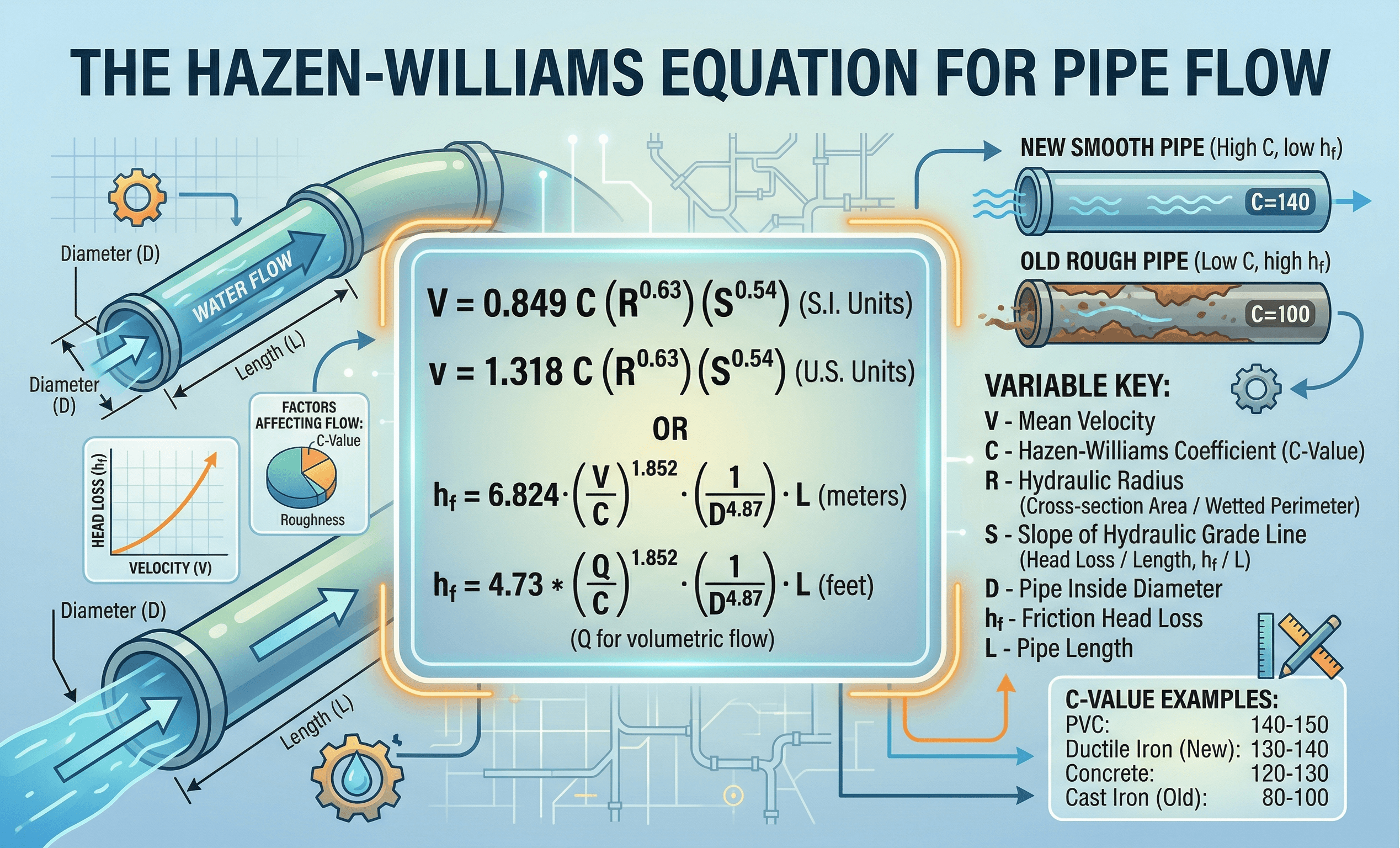
The strongest geometric effect is pipe diameter. Because diameter appears to the 4.87 power, a relatively small increase in inside diameter can sharply reduce predicted friction loss.
What is the Hazen-Williams equation?
The Hazen-Williams equation is an empirical pipe-flow relationship used to estimate friction head loss for water flowing through a full, pressurized pipe. It is widely used because it is fast and does not require explicit viscosity, Reynolds-number, or friction-factor iteration.
The tradeoff is that it is not a universal fluid-friction equation. Its best use is conventional water-system work where the selected Hazen-Williams coefficient reasonably represents the pipe material and condition.
Hazen-Williams equation formula
A common SI form expresses friction slope \(S_f=h_f/L\) using flow in m³/s and inside diameter in m:
Total distributed head loss is:
The numerical constant belongs to a specific unit convention. Never carry the 10.67 constant into a calculation that uses gallons per minute and inches.
US customary Hazen-Williams forms
When flow is expressed in ft³/s and diameter in ft, a commonly used friction-slope form is:
Another widely used US customary form uses flow in gpm, diameter in inches, length in ft, and returns head loss in ft:
Use one complete unit convention from start to finish. The exponents are similar across published forms, but the constants and input units are not interchangeable.
Variables and units
- \(h_f\) Distributed friction head loss over the evaluated pipe length.
- \(S_f\) Friction slope or head-loss gradient, equal to \(h_f/L\).
- \(Q\) Volumetric water flow rate.
- \(d\) Actual inside flow diameter of the pipe.
- \(L\) Hydraulic pipe length over which distributed friction is evaluated.
- \(C\) Empirical Hazen-Williams coefficient representing pipe hydraulic smoothness/condition.
| Variable | Meaning | SI example | US customary example | Engineering note |
|---|---|---|---|---|
| \(h_f\) | Friction head loss | m | ft | Distributed pipe loss only |
| \(S_f\) | Friction slope | m/m | ft/ft | Equals \(h_f/L\) |
| \(Q\) | Flow rate | m³/s | ft³/s or gpm | Must match the selected equation form |
| \(d\) | Inside diameter | m | ft or in | Use actual internal flow diameter |
| \(L\) | Pipe length | m | ft | Distributed-friction length |
| \(C\) | Hazen-Williams coefficient | dimensionless | dimensionless | Selection strongly affects predicted loss |
Nominal pipe size is not necessarily the hydraulic diameter used in the equation. Use the actual inside diameter associated with the pipe material, schedule, SDR, or product being evaluated.
How the Hazen-Williams coefficient \(C\) affects head loss
The coefficient \(C\) is empirical. Larger values represent hydraulically smoother pipe behavior and therefore produce lower predicted head loss for the same flow and diameter.
A \(C\) value should therefore be chosen intentionally from the applicable design basis, pipe-manufacturer information, utility criteria, fire-protection criteria, or project standard rather than copied from an unrelated material table.
Existing pipe can perform differently from new pipe because corrosion, scale, tuberculation, deposits, lining condition, and other aging effects can change hydraulic resistance.
Why pipe diameter matters so much
Hazen-Williams head loss is extremely sensitive to inside diameter:
| Input change | Approximate effect | Relationship |
|---|---|---|
| Increase pipe length | Head loss increases linearly | \(h_f\propto L\) |
| Increase flow | Head loss rises rapidly | \(h_f\propto Q^{1.852}\) |
| Increase \(C\) | Head loss decreases | \(h_f\propto1/C^{1.852}\) |
| Increase diameter | Head loss drops very rapidly | \(h_f\propto1/d^{4.87}\) |
How to rearrange the Hazen-Williams equation
Solve for flow from the SI friction-slope form:
Solve for required diameter:
Solve for friction slope from a known allowable head loss:
After solving for theoretical diameter, select an actual available pipe size and recalculate head loss and velocity using its true inside diameter.
Hazen-Williams and minor losses
The basic Hazen-Williams equation estimates distributed wall-friction loss along straight pipe. Real systems also lose head through fittings, valves, tees, meters, strainers, entrances, exits, and other disturbances.
Total system loss may therefore include both distributed Hazen-Williams loss and separately calculated minor losses.
On short or fitting-heavy piping runs, minor losses can be a meaningful fraction of total loss and should not be ignored simply because straight-pipe friction has been calculated.
Worked examples
Example 1: head loss in a PVC water main
Water flows at \(Q=0.020\ \text{m}^3/\text{s}\) through a \(0.150\ \text{m}\) inside-diameter pipe over \(250\ \text{m}\). Assume \(C=145\).
The estimated distributed friction head loss is about \(1.95\ \text{m}\). Minor losses, static elevation, and required downstream pressure should be checked separately.
Example 2: allowable flow for a head-loss limit
A \(0.20\ \text{m}\) inside-diameter water pipe is \(300\ \text{m}\) long with \(C=130\). Maximum allowable distributed head loss is \(4.5\ \text{m}\).
The ideal Hazen-Williams flow estimate is about \(0.054\ \text{m}^3/\text{s}\), or \(54\ \text{L/s}\). The resulting pipe velocity and other system criteria should then be checked.
Example 3: effect of changing \(C\)
Compare two otherwise identical water lines, one with \(C=150\) and the other with \(C=100\).
Under the same flow, diameter, and length, the \(C=100\) case predicts about 2.12 times the distributed head loss of the \(C=150\) case.
Hazen-Williams vs. Darcy-Weisbach
| Method | Best used for | Main inputs | Key limitation |
|---|---|---|---|
| Hazen-Williams | Fast water-pipe estimates | \(Q,d,L,C\) | Empirical and water-specific |
| Darcy-Weisbach | General pipe-friction analysis | Velocity, diameter, length, friction factor | Requires friction-factor / flow-regime treatment |
Darcy-Weisbach is the more general physics-based method because it can explicitly incorporate fluid properties, Reynolds number, and relative roughness. Hazen-Williams remains useful where its empirical water-system assumptions are accepted.
Assumptions and limitations
- 1The pipe is full and pressurized.
- 2The fluid is water or a water-like application for which Hazen-Williams is accepted.
- 3The selected \(C\) value reasonably represents pipe material, age, and condition.
- 4The chosen unit form and numerical constant are used consistently.
- 5Minor losses and other system-energy terms are checked separately.
Use a more general method for non-water fluids, laminar flow, strongly temperature-dependent viscosity, partially full pipes, open channels, or analyses where Reynolds number and fluid properties need to be represented explicitly.
Common mistakes and engineering checks
- Mixing the SI constant with US customary input units.
- Using nominal pipe size instead of actual inside diameter.
- Selecting an unrealistically high \(C\) value for an aging or rough pipe.
- Forgetting minor losses from fittings and valves.
- Using Hazen-Williams for a fluid or flow regime outside its intended scope.
- Accepting a calculated pipe size without checking velocity, pressure, available commercial sizes, and project criteria.
| Check item | What to verify | Why it matters |
|---|---|---|
| Units | Constant matches the chosen flow and diameter units | A wrong form can produce a large numerical error |
| Inside diameter | Use actual hydraulic ID | Head loss is extremely sensitive to diameter |
| \(C\) value | Basis reflects pipe material and condition | Head loss varies strongly with \(C\) |
| Minor losses | Fittings and valves are handled separately | Basic Hazen-Williams covers distributed loss only |
| Applicability | Full pressurized water-pipe assumption is reasonable | Prevents use outside the method’s intended scope |
Frequently asked questions
It is used to estimate distributed friction head loss, flow capacity, or required pipe diameter in full, pressurized water-pipe systems.
\(C\) is an empirical coefficient representing hydraulic pipe smoothness and condition. Higher \(C\) values produce lower predicted friction loss for the same flow and diameter.
Darcy-Weisbach is generally the better choice when fluid properties, viscosity, Reynolds number, non-water fluids, or broader flow-regime applicability need to be modeled explicitly.
No. The basic equation estimates distributed straight-pipe friction loss. Minor losses from fittings, valves, meters, entrances, exits, and other components are added separately.
Diameter appears to approximately the 4.87 power in the denominator, so small changes in actual inside diameter can produce large changes in predicted friction head loss.
Summary and next steps
The Hazen-Williams equation is a fast empirical method for estimating distributed friction loss in full, pressurized water pipes. Its usefulness depends on using the correct unit form, actual inside diameter, and a defensible \(C\) value.
The most important judgment is knowing when the method is appropriate. For broader pipe-friction analysis, non-water fluids, or cases where viscosity and Reynolds number matter directly, Darcy-Weisbach is generally the stronger general-purpose method.
Where to go next
Continue with calculation tools and equations that connect pipe friction to system flow and energy.
-
Hazen-Williams Calculator
Solve directly for head loss, flow, or pipe diameter.
-
Bernoulli Equation Calculator
Combine friction loss with pressure, elevation, and velocity changes.
-
Continuity Equation
Relate flow rate, velocity, and pipe area before applying friction calculations.