
Key Takeaways
- Core idea: An unsteady flow process has mass, energy, or properties inside the control volume changing with time.
- Engineering use: It is used for filling tanks, emptying vessels, pressure blowdown, charging systems, and startup or shutdown analysis.
- What controls it: The result depends on inlet and outlet mass, enthalpy, heat transfer, work transfer, initial state, final state, and simplifying assumptions.
- Practical check: Do not cancel the storage terms unless the problem is truly steady; accumulation is the main point of unsteady-flow analysis.
Table of Contents
Introduction
An unsteady flow process is a transient open-system thermodynamic process where mass, energy, or properties inside a control volume change with time. It is used to analyze filling tanks, emptying pressure vessels, charging systems, blowdown, and equipment startup or shutdown when steady-flow assumptions no longer apply.
Unsteady Flow Process Control Volume Diagram
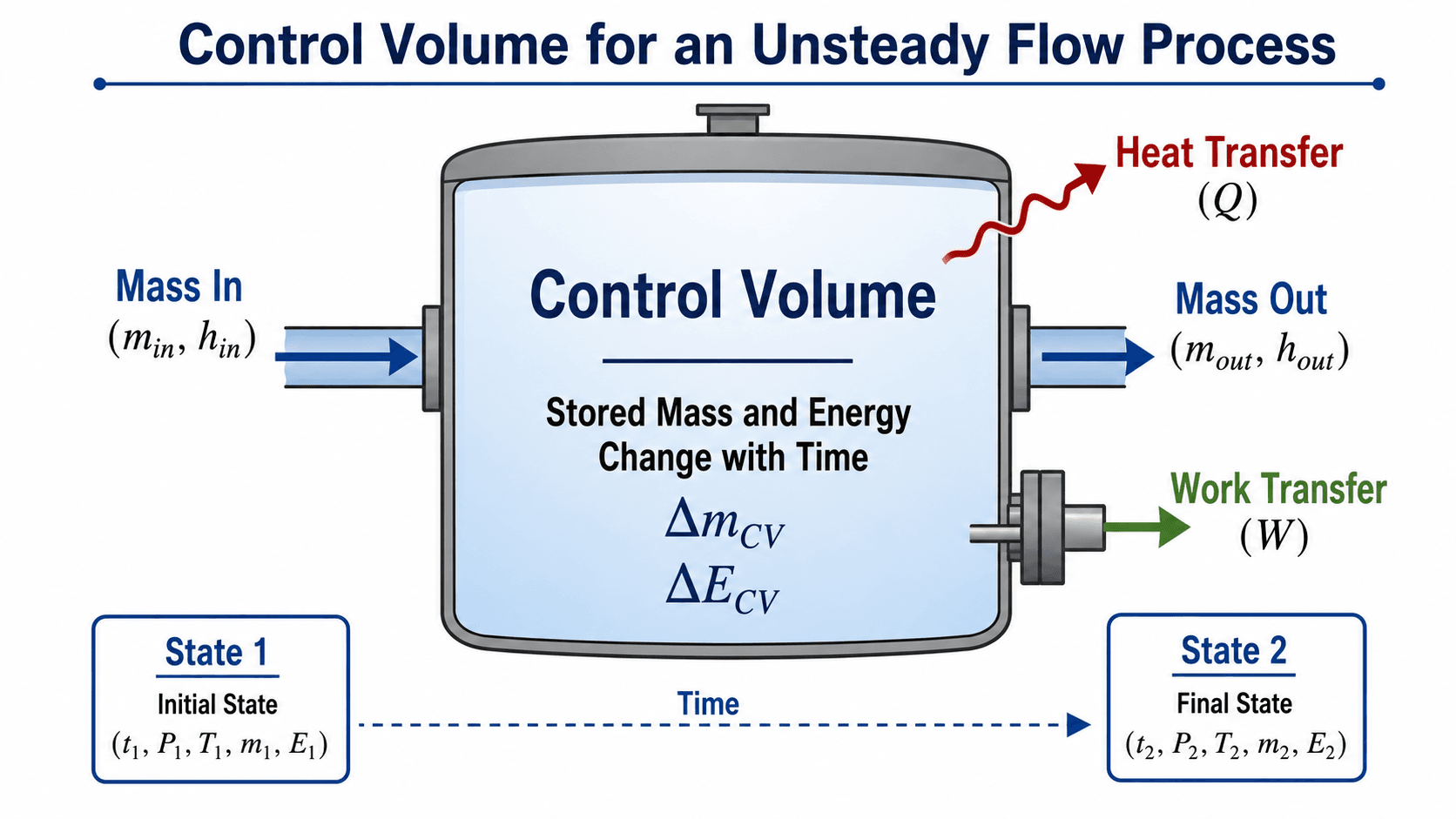
Notice the storage terms first: \(\Delta m_{CV}\) and \(\Delta E_{CV}\). Those terms are what separate an unsteady flow process from a steady-flow problem.
What Is an Unsteady Flow Process?
An unsteady flow process is a control-volume process where the amount of mass or energy stored inside the control volume changes during the process. The system is open because mass crosses the boundary, but it is not steady because the stored conditions do not remain constant with time.
In thermodynamics, the word “unsteady” is not just a casual way of saying that a flow rate fluctuates. It means the analysis must account for accumulation or depletion inside the control volume. A tank that is filling, for example, has mass entering with enthalpy while the tank mass, pressure, temperature, and internal energy may all change.
If the problem gives an initial state and a final state for a tank, vessel, or control volume, it is often signaling an unsteady-flow process rather than a steady-flow device problem.
How to Identify an Unsteady Flow Problem
Many thermodynamics mistakes happen before any math is written. The key is recognizing whether the control volume stores or loses mass and energy during the process.
| Signal in the problem statement | What it usually means | Why it matters |
|---|---|---|
| Initial and final tank states are given | The control volume changes over a finite time interval. | Use an unsteady-flow balance instead of a steady-flow rate balance alone. |
| A tank, vessel, cylinder, or reservoir is filling or emptying | The mass inside the control volume changes. | The accumulation term \(\Delta m_{CV}\) is usually not zero. |
| Pressure or temperature changes inside the vessel | The stored energy state is changing. | The energy balance must include \(\Delta E_{CV}\). |
| The device is starting up or shutting down | Normal steady-flow assumptions may not apply yet. | Transient behavior may control the result. |
| The problem asks for final mass, final temperature, or final pressure | The final stored state is part of the unknown. | You need both mass and energy balances to close the problem. |
Steady Flow vs Unsteady Flow Process
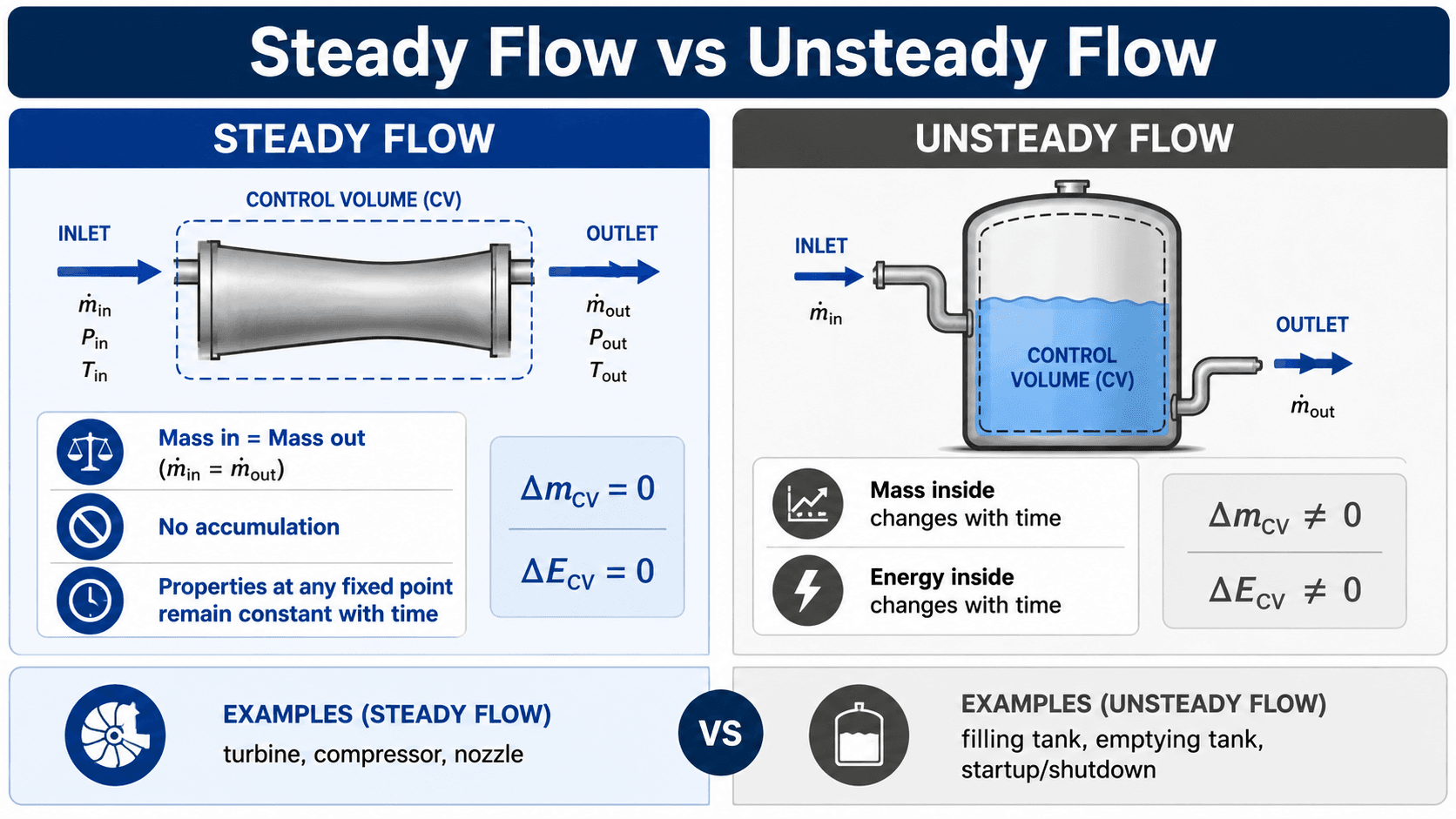
The easiest way to identify unsteady flow is to ask whether the control volume is storing or losing mass and energy over the time interval of interest. A turbine operating at normal conditions is commonly modeled as steady flow. A tank being charged from a compressed-air line is not steady because the tank contents are changing.
| Feature | Steady flow process | Unsteady flow process |
|---|---|---|
| Mass inside control volume | Constant with time | Changes with time |
| Energy inside control volume | Constant with time | Changes with time |
| Mass balance behavior | Usually \(\dot{m}_{in} = \dot{m}_{out}\) for one inlet and one outlet | \(m_{in} – m_{out} = m_2 – m_1\) |
| Typical analysis form | Rate balance during continuous operation | Finite process balance between initial and final states |
| Common examples | Turbines, compressors, nozzles, pumps, and heat exchangers during normal operation | Filling tanks, emptying tanks, blowdown, vessel charging, startup, and shutdown |
Turbines, compressors, nozzles, pumps, and heat exchangers are commonly modeled as steady-flow devices during normal operation. During startup, shutdown, surge, blowdown, or rapidly changing boundary conditions, those same devices may require unsteady-flow analysis.
Thermodynamics Meaning vs Fluid Mechanics Meaning
The phrase “unsteady flow” can appear in both thermodynamics and fluid mechanics, but the emphasis is different. In this thermodynamics page, the focus is on control-volume mass and energy accumulation, not on solving a full time-dependent velocity field.
| Context | What “unsteady” means | Main analysis focus |
|---|---|---|
| Thermodynamics | Stored mass, stored energy, or thermodynamic properties inside a control volume change with time. | Mass balance, energy balance, initial state, final state, heat, work, and flow energy. |
| Fluid mechanics | Velocity, pressure, density, or other flow properties at a point may change with time. | Flow field behavior, momentum, pressure distribution, velocity profile, and time-dependent boundary conditions. |
| Shared idea | The system is time dependent. | The correct model depends on whether the goal is a control-volume energy balance or a flow-field description. |
How an Unsteady Flow Process Works
Unsteady-flow analysis is built around a control volume and a time interval. Instead of only asking what flows through the boundary at one instant, the engineer compares what entered, what left, and what changed inside the control volume between the initial and final states.
Choose the control volume boundary
The control surface should cut through the inlets and outlets where mass crosses the boundary. For a tank, the control volume usually includes the tank interior and cuts across the inlet or outlet pipe at a convenient location where the flowing-fluid state can be described.
Keep the storage terms
The defining feature is that \(\Delta m_{CV}\) and \(\Delta E_{CV}\) are not assumed to be zero. The tank may gain mass, lose mass, heat up, cool down, pressurize, depressurize, or experience a changing phase condition.
Separate flowing energy from stored energy
Fluid crossing the boundary is usually handled with enthalpy, while fluid stored inside a tank is often handled with internal energy. That distinction is one of the most important details in tank-filling and tank-emptying problems.
Unsteady Flow Process Equations
The two most important equations are the mass balance and the energy balance. The rate form is useful when the flow changes continuously with time. The finite-process form is useful for many tank problems where the initial and final states are known.
Rate form of the mass balance
The rate form says that the time rate of change of mass inside the control volume equals the total mass flow rate entering minus the total mass flow rate leaving.
Finite-process mass balance
When the process is evaluated from State 1 to State 2, the integrated mass balance is:
Finite-process energy balance
The energy balance applies the First Law of Thermodynamics to an open system. Energy can cross the boundary as heat, work, and flowing mass, while the stored energy inside the control volume changes.
In this sign convention, \(Q\) is positive when heat enters the control volume, and \(W\) is positive when work is done by the control volume. If a course, textbook, or software package uses a different convention, the signs must be adjusted consistently.
For many introductory tank problems, kinetic and potential energy changes are small compared with internal energy and enthalpy. When that assumption is valid, the energy balance becomes much easier to use.
- \(m_{in}\) Total mass entering the control volume during the process, commonly in kg or lbm.
- \(m_{out}\) Total mass leaving the control volume during the process.
- \(h\) Specific enthalpy of the flowing stream, commonly in kJ/kg or Btu/lbm.
- \(u\) Specific internal energy of the mass stored inside the control volume.
- \(Q, W\) Heat transfer and work transfer across the control-volume boundary.
Why Inlet and Outlet Streams Use Enthalpy
One of the most common student mistakes is using internal energy everywhere. Stored fluid inside a rigid tank is usually described by internal energy, but fluid that crosses a control-volume boundary also carries flow work. That is why inlet and outlet stream terms commonly use enthalpy.
The \(u\) term represents microscopic stored energy per unit mass. The \(Pv\) term represents flow work per unit mass needed to push fluid across the control surface. Together, they form enthalpy, which is the convenient property for mass entering or leaving an open system.
Use \(h\) for mass crossing the control-volume boundary and \(u\) for mass stored inside a tank, unless the problem statement or derivation clearly requires a different form.
Unsteady Flow Process Assumptions
Most textbook unsteady-flow problems become manageable because the problem statement gives simplifying assumptions. These assumptions are not just mathematical shortcuts; they define which energy terms can be removed without changing the engineering meaning of the result.
| Assumption | What it removes or simplifies | When it is reasonable |
|---|---|---|
| Rigid tank | Boundary work is usually zero because tank volume does not change. | Pressure vessels, storage tanks, and fixed-volume containers. |
| Adiabatic process | Sets \(Q = 0\). | Fast processes or insulated vessels where heat transfer is small during the time interval. |
| Negligible kinetic and potential energy | Removes \(V^2/2\) and \(gz\) terms from the energy balance. | Large tanks with modest inlet or exit velocities and small elevation changes. |
| Uniform tank state | Allows the tank contents to be represented by one pressure, temperature, and property state at a given instant. | Well-mixed tanks or simplified introductory thermodynamics problems. |
| Single inlet or single outlet | Simplifies the summations in the mass and energy balances. | Basic filling, emptying, charging, and blowdown examples. |
Only remove a term after tying it to a physical assumption. For example, do not set \(Q = 0\) because it is convenient; set it to zero only if the process is adiabatic or heat transfer is negligible over the process duration.
Uniform Flow Process in Thermodynamics
A uniform flow process is a common idealization used inside many unsteady-flow problems. The control-volume state may change with time, but at any instant the properties inside the control volume are treated as uniform. The inlet and outlet streams are also treated as uniform across each opening.
This assumption is what makes many tank-filling and tank-emptying problems solvable without tracking spatial variations inside the vessel. It does not mean the process is steady. It means the tank is modeled as having one representative pressure, temperature, and property state at each instant.
| Idea | What it means | Common limitation |
|---|---|---|
| Uniform inside the control volume | The tank contents are represented by one property state at a given instant. | Real tanks can have stratification, inlet jet effects, or phase separation. |
| State changes with time | The tank pressure, temperature, mass, and internal energy may change from State 1 to State 2. | The process is still unsteady because storage changes over time. |
| Uniform inlet or outlet stream | Properties at the boundary opening are treated as a single stream state. | Valves, nozzles, throttling, and pressure losses can complicate the actual stream state. |
Unsteady Flow Process Examples: Filling and Emptying Tanks
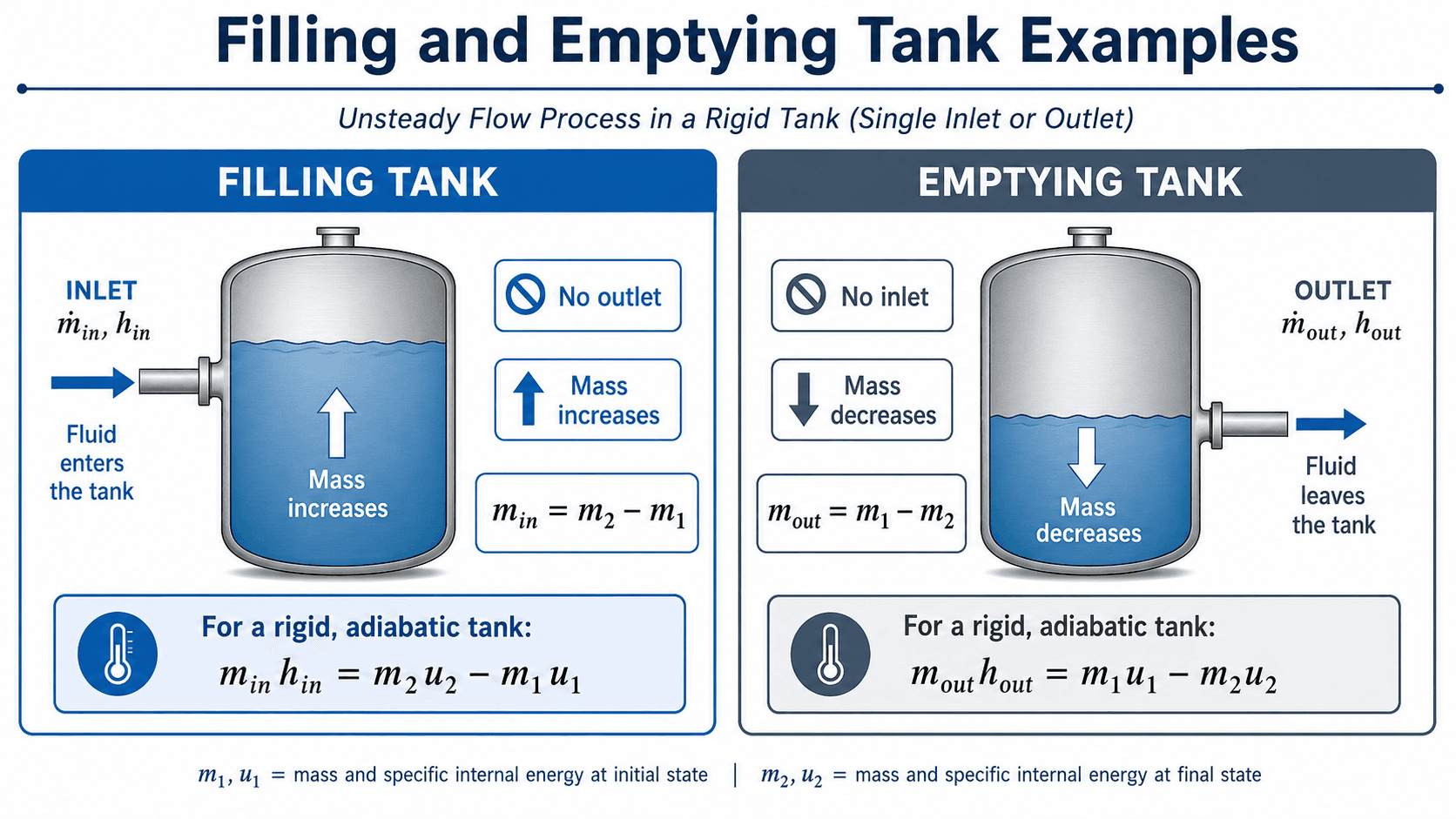
Filling and emptying tanks are the standard examples because they make accumulation easy to see. In a filling tank, mass enters and the amount of stored mass increases. In an emptying tank, mass leaves and the amount of stored mass decreases.
Filling tank simplification
For a rigid, adiabatic tank with one inlet and no outlet, the mass balance becomes \(m_{in} = m_2 – m_1\). If kinetic and potential energy are neglected and there is no shaft work, a common simplified energy balance is:
Emptying tank simplification
For a rigid, adiabatic tank with one outlet and no inlet, the mass balance becomes \(m_{out} = m_1 – m_2\). A simplified energy balance for the same idealized assumptions is:
In a real blowdown or discharge problem, the outlet enthalpy may change with time as the tank state changes. The compact emptying-tank equation is most useful when the problem allows a simplified, averaged, or uniform outlet-state treatment.
Worked Example: Filling an Initially Empty Rigid Tank
A simple filling example shows why inlet enthalpy and final tank internal energy are connected. Consider a rigid, adiabatic tank that is initially empty. One inlet supplies fluid to the tank, there is no outlet, and kinetic and potential energy changes are neglected.
Step 1: State the assumptions
- The tank is rigid, so boundary work is zero.
- The tank is adiabatic, so \(Q = 0\).
- The tank is initially empty, so \(m_1 = 0\).
- There is one inlet and no outlet.
- Kinetic and potential energy changes are neglected.
Step 2: Apply the mass balance
Since the tank is initially empty and has no outlet, all entering mass becomes the final mass stored in the tank.
Step 3: Apply the energy balance
With heat, work, kinetic energy, and potential energy removed by assumption, the inlet flow energy becomes the final stored internal energy of the tank contents.
Since \(m_{in} = m_2\), the expression simplifies to:
Engineering meaning
This result does not mean enthalpy and internal energy are always equal. It means that for this very specific idealized filling process, the final specific internal energy of the stored tank fluid equals the specific enthalpy of the entering stream. The result comes from the assumptions, not from a general property identity.
Common Unsteady Flow Problem Types
Different unsteady-flow problems use the same conservation principles, but the knowns, unknowns, and simplifying assumptions change. This table helps connect common problem statements to the balance terms that matter most.
| Problem type | Typical knowns | Typical unknowns | Main simplification |
|---|---|---|---|
| Filling an empty tank | Inlet state, tank volume, final pressure or final condition | Final temperature, final mass, final internal energy | \(m_{in}=m_2\) when \(m_1=0\) |
| Filling a partially full tank | Initial tank state, inlet state, final state or final mass | Mass added, final temperature, final pressure | \(m_{in}=m_2-m_1\) |
| Emptying a tank | Initial tank state and final tank state or final pressure | Mass discharged, final temperature, remaining mass | \(m_{out}=m_1-m_2\) |
| Blowdown | Initial vessel state, exit condition, valve or nozzle behavior | Time-dependent pressure, temperature, and remaining mass | Outlet state often changes with time |
| Startup or shutdown | Initial device state, boundary conditions, operating target | Transient energy storage, warm-up or cool-down behavior | Steady-flow model may apply only after stabilization |
Unsteady Flow Problem-Solving Workflow
A strong unsteady-flow solution starts by identifying the control volume and then deciding which balance terms actually apply. Use this workflow before writing equations so you do not accidentally solve a transient problem as a steady-flow problem.
Start with the physical process: is the tank filling, emptying, charging, discharging, heating, cooling, or changing pressure? Then define the control volume, list the inlet and outlet streams, identify initial and final states, apply the mass balance, apply the energy balance, and only then simplify using the stated assumptions.
| Check or decision | What to look for | Why it matters |
|---|---|---|
| Identify the process direction | Filling, emptying, charging, blowdown, startup, or shutdown. | Determines the sign and location of the mass terms. |
| Define State 1 and State 2 | Initial and final pressure, temperature, mass, volume, or quality. | Unsteady-flow problems are usually solved over a finite interval. |
| List boundary interactions | Heat transfer, shaft work, boundary work, inlet flow, and outlet flow. | Prevents missing an energy path across the control surface. |
| Decide which properties describe each region | Use \(h\) for streams crossing the boundary and \(u\) for stored tank contents. | This avoids one of the most common energy-balance mistakes. |
| Remove terms only after checking assumptions | Rigid, adiabatic, no outlet, no inlet, negligible KE/PE, or uniform state. | Keeps the math consistent with the physical problem. |
Where Engineers Use Unsteady Flow Analysis
Unsteady-flow analysis matters whenever the equipment behavior changes during the process. It is especially useful for pressure vessels, storage tanks, pneumatic systems, steam systems, compressed-air charging, gas-cylinder blowdown, and startup or shutdown of open-system devices.
- Compressed-air tank charging: Estimate final pressure, temperature, and stored mass after a tank is filled from a supply line.
- Pressure-vessel blowdown: Estimate how mass and internal energy decrease as fluid leaves a vessel.
- Thermal system startup: Understand why equipment may not match steady-flow assumptions until temperatures, pressures, and flows stabilize.
- Steam or gas storage: Track how inlet enthalpy changes the final stored energy inside a vessel.
If a device normally operates at steady state but is being started, stopped, charged, vented, or depressurized, use unsteady-flow thinking first. The steady-flow model may only apply after the transient period has passed.
Engineering Judgment and Field Reality
Real unsteady-flow systems are rarely as clean as a single, well-mixed tank. In practice, inlet jets can create stratification, heat transfer can matter during slower processes, valves can throttle the flow, and the outlet state may change continuously as pressure and temperature inside the vessel change.
The “uniform tank state” assumption is often the biggest simplification. It is useful for learning and quick estimates, but real tanks may have temperature gradients, phase separation, pressure losses, and time-dependent flow rates that require more detailed modeling.
This is why unsteady-flow analysis should be treated as an energy bookkeeping framework, not just a plug-in equation. The engineer still has to decide whether the idealized assumptions match the equipment, time scale, and accuracy needed.
When This Breaks Down
The simplified unsteady-flow equations become less reliable when the real system violates the assumptions used to remove terms. The method still applies, but the model may need more detailed property data, time stepping, valve-flow relationships, heat-transfer estimates, or spatially varying conditions.
- Strong mixing problems: A single uniform tank state may not represent the actual fluid if inlet jets, stratification, or phase separation are important.
- Long-duration transients: Heat transfer may no longer be negligible if the process lasts long enough for the vessel to exchange meaningful energy with its surroundings.
- High-speed discharge: Kinetic energy, choking, pressure losses, and nozzle behavior may control the result.
- Multiphase behavior: Vapor-liquid mixtures can require quality, saturation properties, and phase-change tracking.
- Changing boundary conditions: Inlet pressure, outlet pressure, valve position, and flow rate may change throughout the process.
Common Mistakes and Practical Checks
Most mistakes in unsteady-flow problems come from using steady-flow habits on a transient problem. Before solving, check that every term matches the process direction, the boundary interactions, and the stored energy change.
| Mistake | Why it is wrong | Practical check |
|---|---|---|
| Setting \(m_{in} = m_{out}\) automatically | That removes accumulation, which may be the entire point of the problem. | Ask whether the control-volume mass changes from State 1 to State 2. |
| Using \(u\) for inlet or outlet streams | Flowing mass carries flow work, so stream energy is commonly represented by enthalpy. | Use \(h\) for mass crossing the boundary and \(u\) for stored tank contents. |
| Forgetting the final state | Unsteady-flow analysis depends on the change between the initial and final states. | Write \(m_1, u_1\) and \(m_2, u_2\) before simplifying. |
| Assuming adiabatic behavior without justification | Slow filling or emptying can allow significant heat transfer. | Check process duration, insulation, vessel surface area, and surroundings. |
| Applying a compact tank equation to a complex blowdown | Exit enthalpy, flow rate, and tank state may change continuously. | Use time stepping or a more detailed model when boundary conditions are changing. |
Relevant Reference for Control-Volume Analysis
Unsteady-flow process problems are usually taught as part of open-system mass and energy analysis. A useful reference should help connect conservation of mass, energy of flowing fluids, and control-volume energy balances.
- Purdue ME 200 thermodynamics notes: Purdue open-system mass and energy balance notes cover open-system mass balances, energy of a flowing fluid, and conservation of energy for control volumes.
- Engineering use: Use references like this to verify sign conventions, property definitions, and the difference between stored energy inside the control volume and energy carried by flowing streams.
Unsteady Flow Process FAQ
An unsteady flow process is a transient open-system thermodynamic process where mass, energy, or properties inside a control volume change with time. Common examples include filling a tank, emptying a pressure vessel, vessel charging, blowdown, and equipment startup or shutdown.
In steady flow, the mass and energy stored inside the control volume remain constant with time, so accumulation terms are zero. In unsteady flow, storage changes during the process, so the mass and energy balances must include the change between the initial and final states.
The uniform flow process assumption treats the control-volume contents as uniform at any instant, even though the state may change with time. It also assumes inlet and outlet stream properties are uniform across each opening. This simplification is commonly used for tank filling and emptying problems.
Enthalpy appears because mass crossing a control-volume boundary carries both internal energy and flow work. The fluid stored inside a tank is usually described with internal energy, while fluid entering or leaving through a port is commonly described with enthalpy.
Common assumptions include a rigid tank, adiabatic behavior, negligible kinetic and potential energy changes, a single inlet or outlet, and a uniform state inside the tank at each instant. These assumptions simplify the mass and energy balances but must match the actual problem statement.
Summary and Next Steps
An unsteady flow process is a transient open-system process where the stored mass or energy inside a control volume changes with time. The key difference from steady flow is that accumulation cannot be ignored.
The best way to solve these problems is to define the control volume, identify inlet and outlet streams, write the mass balance, write the energy balance, and simplify only after checking the assumptions. Filling tanks and emptying tanks are the clearest examples because the storage change is visible.
Where to go next
Continue your learning path with related Turn2Engineering resources.
-
Steady Flow Process
Compare unsteady-flow storage terms with the no-accumulation assumption used in steady-flow analysis.
-
Open Systems
Build the control-volume foundation needed for unsteady-flow analysis.
-
Enthalpy
Understand why flowing streams use enthalpy in open-system energy balances.