
Key Takeaways
- Core idea: A water treatment plant is an engineered facility that converts untreated source water into finished drinking water through a connected treatment train.
- Main process: The most important conventional steps are coagulation, flocculation, sedimentation, filtration, and disinfection.
- Engineering use: Engineers use treatment plants to control turbidity, suspended solids, microorganisms, taste, odor, pH, chemical stability, and finished water reliability.
- Practical check: A treatment plant is only as strong as its weakest step; poor mixing, settling, filtration, disinfection, or storage can affect the entire system.
Table of Contents
Introduction
Water treatment plants are engineered facilities that remove debris, suspended particles, microorganisms, and water quality problems from source water before it is delivered as drinking water. A typical drinking water plant moves water through screening, coagulation, flocculation, sedimentation, filtration, disinfection, finished water storage, and distribution, with each step protecting the next.
Water Treatment Plant Process Diagram
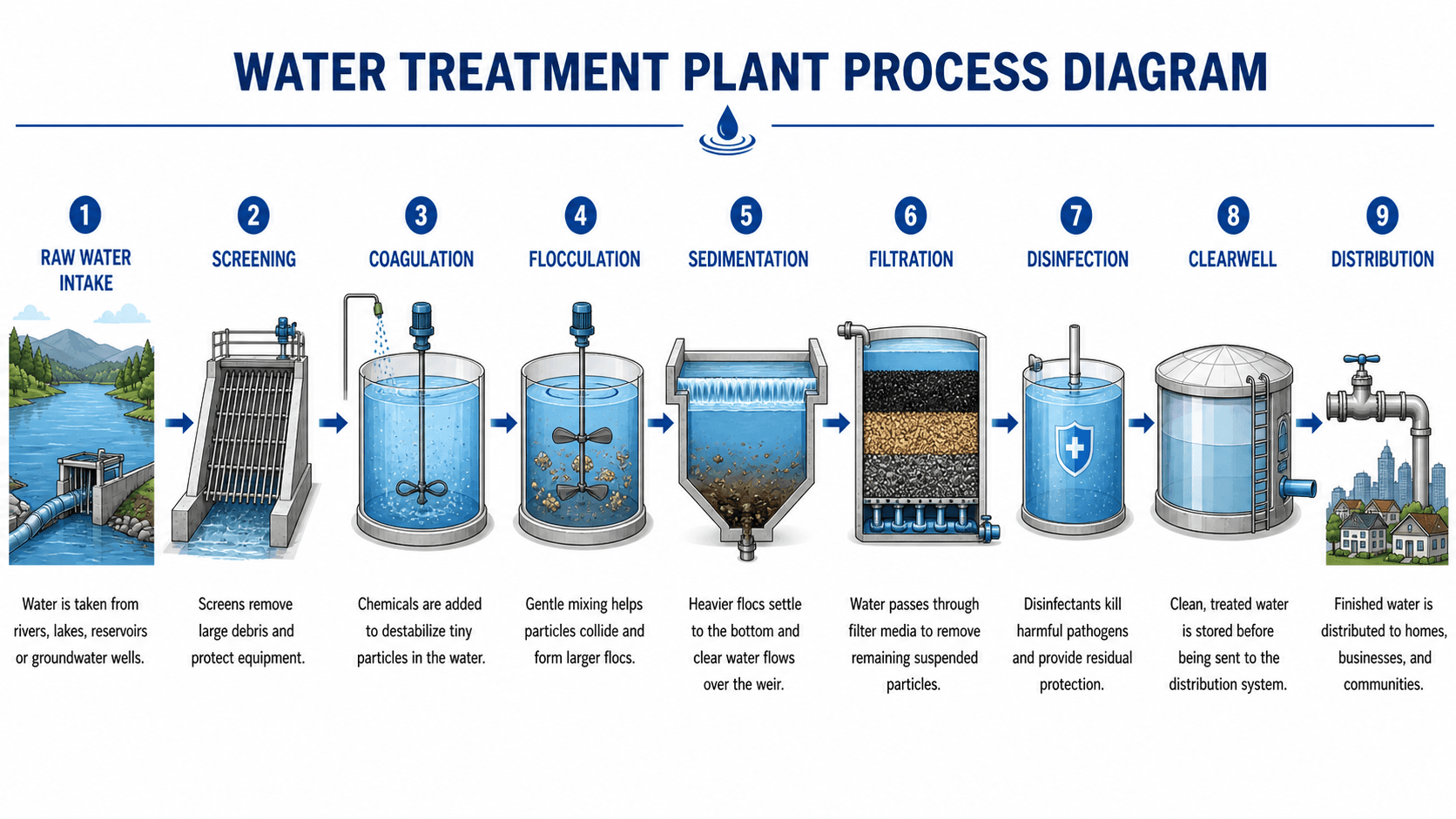
Read the diagram from left to right. The early steps protect equipment and prepare particles for removal, the middle steps improve clarity, and the final steps protect public health before water leaves the plant.
What Is a Water Treatment Plant?
A water treatment plant is a facility that takes source water from a river, lake, reservoir, groundwater well, or blended supply and treats it until it meets the intended drinking water quality goals. The plant uses a sequence of physical, chemical, and disinfection processes rather than relying on one single step.
In water resources engineering, treatment plants sit between the natural water source and the public water supply system. Hydrology and source water planning help explain where the water comes from, while treatment processes determine how the water is cleaned before it becomes finished water.
This guide focuses on drinking water treatment plants. Wastewater treatment plants use a different process train because they treat used water before discharge or reuse, not source water before potable distribution.
How Water Treatment Plants Work
Water treatment plants work by arranging individual treatment steps in a logical sequence. Large debris is removed early so pumps and downstream equipment are protected. Fine particles are then destabilized, gathered into larger floc, settled, filtered, and disinfected. Finished water is stored before pumps or gravity move it into the distribution system.
Why the process happens in stages
Each stage prepares the water for the next stage. Screening protects mechanical equipment, coagulation and flocculation make fine particles removable, sedimentation reduces the solids load on filters, filtration polishes the water, and disinfection provides the final public health barrier.
Why the exact layout varies by plant
Not every plant looks identical. Surface water plants often need more particle removal because rivers and reservoirs can carry algae, sediment, turbidity, and organic matter. Groundwater plants may need more attention to iron, manganese, hardness, dissolved gases, pH adjustment, or targeted contaminant removal depending on aquifer chemistry.
A simplified process diagram shows a clean sequence, but operators adjust chemical dose, filter operation, disinfection strategy, and storage decisions as source water quality changes throughout the year.
Main Steps in the Water Treatment Plant Process
The main treatment steps below form the backbone of many drinking water plants. They are shown separately for learning, but in a real plant the steps are connected by channels, pipes, valves, pumps, chemical feed systems, control systems, sensors, and operator decisions.
Screening and preliminary protection
Source water enters the plant from a lake, river, reservoir, well field, or blended supply. Screens remove leaves, sticks, trash, aquatic vegetation, and other large material before it can damage pumps or clog downstream equipment. This topic is important inside the plant explanation, but it does not need to be treated as a separate standalone page unless search data shows demand.
Coagulation
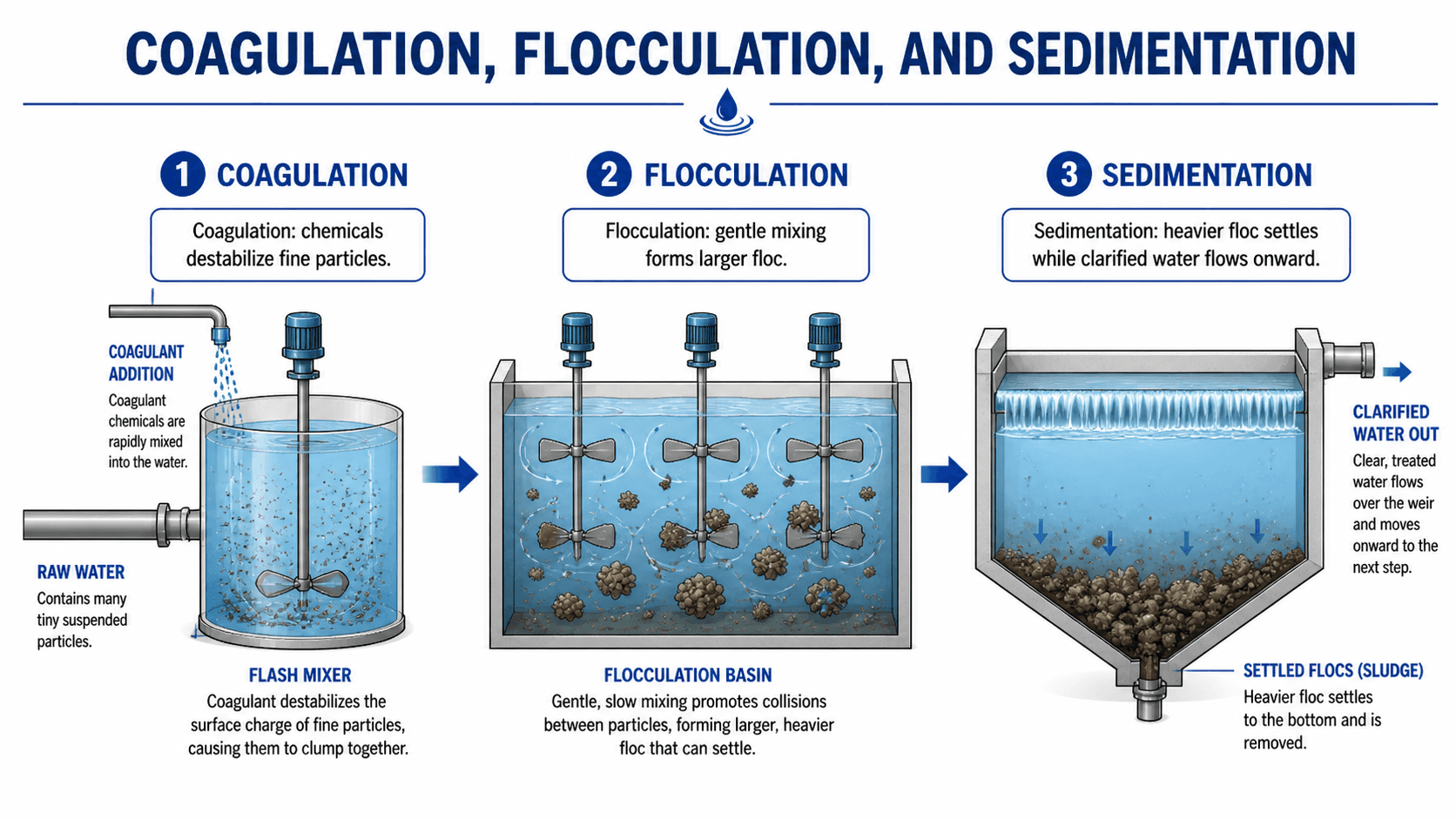
Coagulation is the chemical mixing step where a coagulant is added to help destabilize very small suspended particles. These particles often carry surface charges that keep them dispersed in the water. The goal is not to remove particles instantly, but to prepare them so they can collide and form larger groups during flocculation.
Flocculation
Flocculation uses slower, gentler mixing to bring destabilized particles into contact with each other. As particles collide, they form larger, heavier clusters called floc. Good flocculation requires enough mixing to promote collisions, but not so much energy that the floc breaks apart before reaching the sedimentation basin.
Sedimentation
Sedimentation allows heavier floc particles to settle to the bottom of a basin while clearer water flows over weirs or toward the next treatment step. This step reduces turbidity and protects filters from receiving too much solids loading. Settled solids collected at the bottom must be removed so material does not re-enter the flow.
Filtration
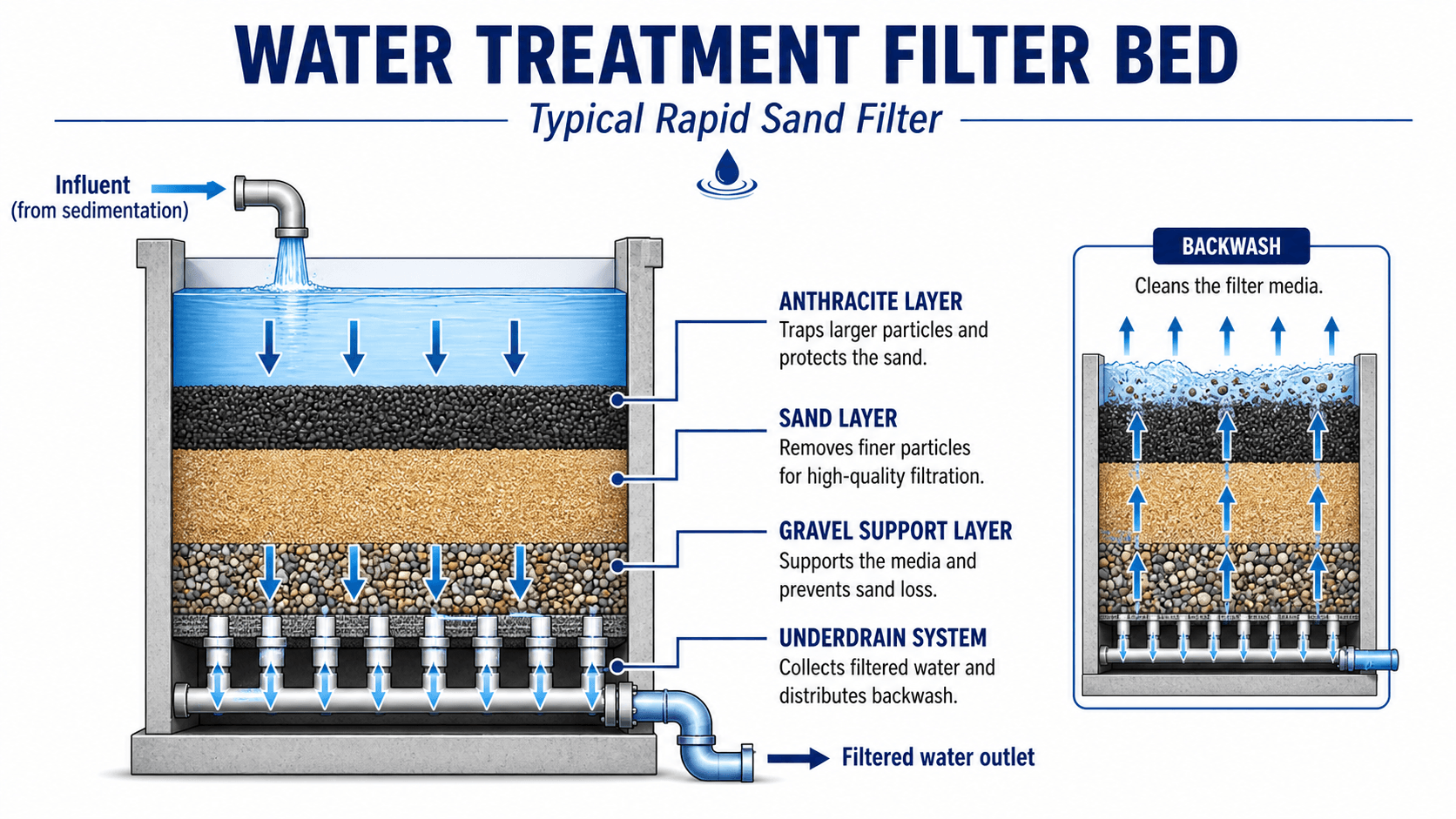
Filtration removes remaining fine particles by passing water through layers of filter media. A rapid sand filter may include anthracite, sand, gravel support media, and an underdrain system. Filters improve clarity and provide another barrier before disinfection, but they eventually require backwashing to remove trapped solids.
Disinfection
Disinfection inactivates harmful microorganisms before treated water leaves the plant. Chlorine, chloramines, ozone, and ultraviolet light may be used depending on plant design and treatment goals. Chlorine-based systems may also maintain a residual that helps protect water quality as it travels through the distribution system.
Finished water storage and distribution
Finished water storage provides flow balance and may support disinfectant contact time before the water is pumped or sent into the distribution system. Storage helps balance plant production with changing demand during the day.
Water Treatment Plant Components
A water treatment plant is not only a process sequence. It is a physical facility made of intake structures, pump stations, chemical feed systems, basins, filters, tanks, control equipment, and finished water infrastructure. The layout below shows how the major components fit together from the water source to the distribution system.
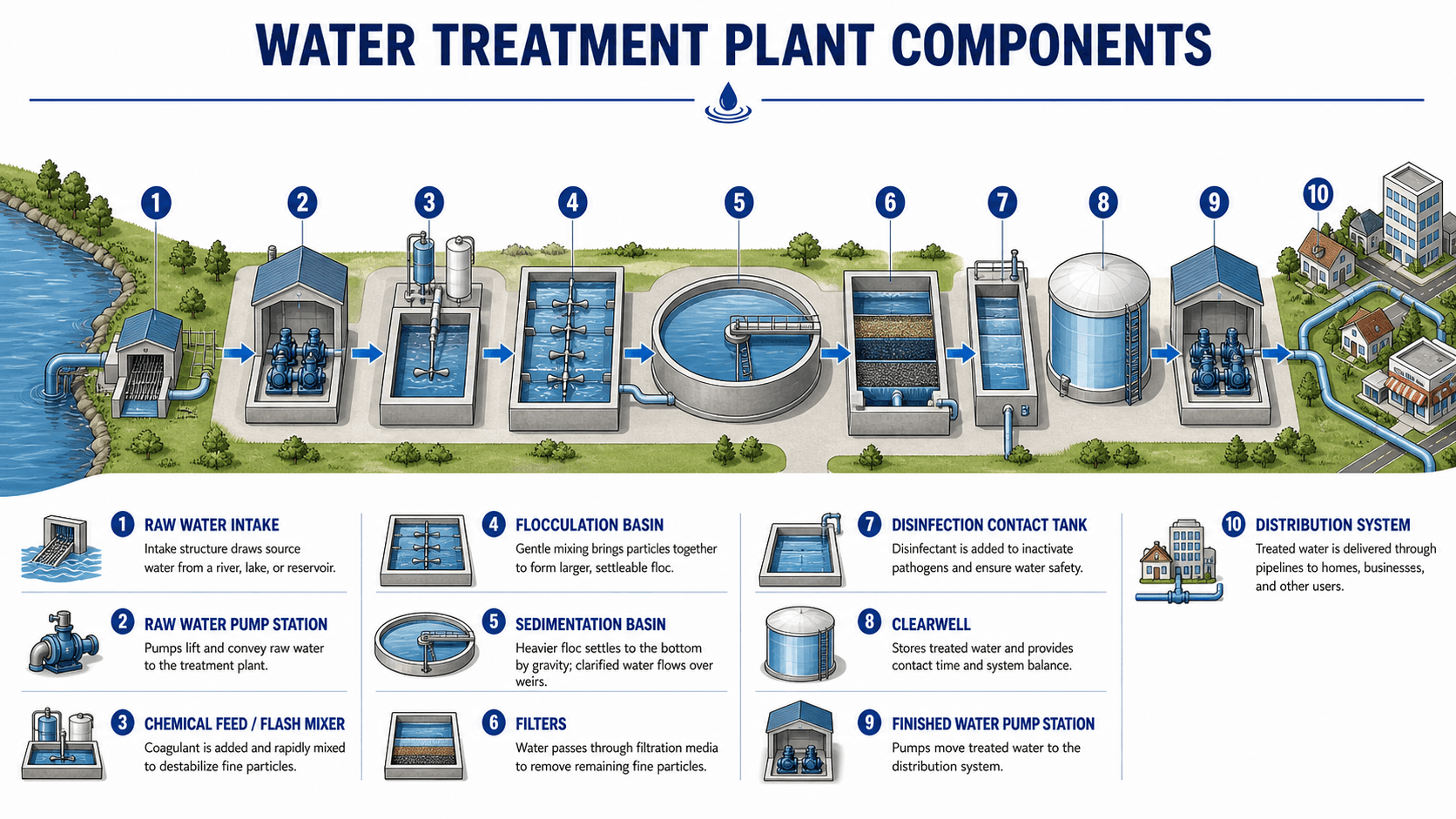
| Component | What it does | Why it matters |
|---|---|---|
| Source water entry and screening | Brings water into the plant and removes large debris. | Protects pumps, valves, basins, and downstream treatment equipment. |
| Raw water pump station | Lifts or conveys water when gravity flow is not enough. | Maintains required plant flow under changing source and demand conditions. |
| Chemical feed and rapid mixing | Adds and rapidly mixes treatment chemicals into the water. | Improves particle removal and helps stabilize treatment performance. |
| Flocculation basin | Gently mixes water so destabilized particles form larger floc. | Creates settleable particles without breaking them apart. |
| Sedimentation basin | Allows heavier floc to settle while clarified water moves forward. | Reduces solids loading on the filters. |
| Filters | Remove remaining suspended particles through media layers. | Polish the water before disinfection. |
| Disinfection system | Provides chemical, UV, ozone, or other disinfection before distribution. | Supports microorganism inactivation and finished water protection. |
| Finished water storage | Stores finished water before distribution. | Balances production, contact time, and system demand. |
Critical Water Treatment Plant Topics to Study Next
Instead of linking every small piece of equipment as a separate article, this learning path focuses on the strongest existing resources and the highest-intent pages worth building next. This keeps the pillar page useful for readers while avoiding thin, low-demand pages.
Existing high-intent pages
Start with these working Turn2Engineering resources. These are the strongest internal links because they match real search intent and explain major treatment concepts rather than isolated low-demand components.
| Topic | Why it belongs in the cluster | Search intent |
|---|---|---|
| How Water Treatment Plants Work | Explains the full sequence in plain language and supports beginner search intent. | Users want a step-by-step overview. |
| Water Treatment Processes | Supports the broader process-train query and connects conventional, chemical, biological, membrane, and advanced treatment. | Users want to compare treatment methods and process order. |
| Water Treatment Plant Components | Best page for equipment and facility-layout intent without making every small component a thin article. | Users want labeled parts, equipment, basins, tanks, and systems. |
| Drinking Water Treatment | Targets the broader potable-water treatment intent beyond the plant facility itself. | Users want to know how drinking water is treated and made safe. |
| Coagulation in Water Treatment | Core conventional treatment step with strong educational and engineering value. | Users want the purpose, chemicals, mechanism, and examples. |
| Flocculation in Water Treatment | Core conventional treatment step that pairs directly with coagulation and sedimentation. | Users want to understand floc formation and gentle mixing. |
| Sedimentation Basin | High-value component/process page because users search basins and settling behavior. | Users want to understand how settling tanks remove floc and solids. |
| Water Filtration | Broad filtration topic with strong search demand and direct connection to treatment plants. | Users want filter types, media, and what filtration removes. |
| Filtration Systems | Supports equipment-oriented filtration searches and helps connect filter media, operation, and design. | Users want to compare filtration system types and applications. |
| Disinfection Methods | Better existing URL than creating a duplicate disinfection page before needed. | Users want chlorine, UV, ozone, chloramine, and disinfection comparisons. |
| Chemical Treatment | Good existing page for coagulants, pH control, oxidation, disinfection, and chemical treatment context. | Users want chemical methods used in water treatment. |
| Activated Carbon Treatment | Important advanced/support process for taste, odor, organics, and trace contaminant discussions. | Users want to know what activated carbon removes and how it works. |
| Water Softening | Strong related treatment page for hardness control, ion exchange, and source-specific treatment. | Users want to understand hard water removal and softening methods. |
| Reverse Osmosis | High-interest membrane treatment topic that supports advanced treatment and desalination intent. | Users want to know how RO works and what it removes. |
High-intent pages to build next
These should be created before small equipment pages such as raw water intake, flash mixers, chemical feed systems, or finished water pump stations. They have broader search intent and will strengthen the cluster more effectively.
| Page to create | Recommended URL slug | Why it is worth building |
|---|---|---|
| Conventional Water Treatment | /conventional-water-treatment | Directly targets the classic coagulation, flocculation, sedimentation, filtration, and disinfection treatment train. |
| Water Treatment Plant Design | /water-treatment-plant-design | High engineering value. This is the closest water-treatment equivalent to successful design-intent pages like pavement design. |
| Jar Test in Water Treatment | /jar-test-in-water-treatment | Strong practical topic connected to coagulation dose, turbidity control, and operator decision-making. |
| Turbidity in Water Treatment | /turbidity-in-water-treatment | Important search-intent bridge between source water quality, coagulation, sedimentation, filtration, and finished water quality. |
| Water Treatment Chemicals | /water-treatment-chemicals | Better keyword than a narrow chemical-feed-system page because users search chemicals, coagulants, disinfectants, pH adjustment, and dosing. |
| Chlorination in Water Treatment | /chlorination-in-water-treatment | More specific and likely stronger than a generic contact-tank page. Useful for residual, dose, contact time, and disinfection byproducts. |
| UV Disinfection in Water Treatment | /uv-disinfection-in-water-treatment | Good advanced disinfection page with clear comparison intent against chlorine and ozone. |
| Surface Water Treatment Plant | /surface-water-treatment-plant | Better than a raw-water-intake page because it captures source-water and conventional-treatment intent together. |
| Groundwater Treatment | /groundwater-treatment | Useful because groundwater treatment often focuses on iron, manganese, hardness, gases, pH, and dissolved constituents instead of conventional surface-water clarification. |
Do not build standalone pages for raw water intake, screening, flash mixers, flocculation basins, filter beds, disinfection contact tanks, finished water storage, or finished water pump stations until stronger process and design-intent pages are complete. Keep those as sections inside broader pages unless your keyword data shows meaningful demand.
Why Each Treatment Step Matters
The order of treatment matters because each step reduces the burden on the next one. A plant can still produce water when conditions vary, but poor performance in one stage can quickly affect downstream stages.
| Treatment step | Main purpose | What can happen if it performs poorly |
|---|---|---|
| Screening and preliminary protection | Bring in source water and remove large debris. | Debris can clog screens, damage pumps, or reduce flow capacity. |
| Coagulation | Make tiny particles easier to remove. | Particles may remain dispersed and pass through settling and filters. |
| Flocculation | Form larger floc through gentle mixing. | Weak floc may settle poorly or break apart before removal. |
| Sedimentation | Remove heavier solids by gravity. | Excess solids may reach filters and shorten filter runs. |
| Filtration | Remove remaining fine particles. | Turbidity can increase and filtered water quality can decline. |
| Disinfection | Inactivate microorganisms. | Pathogen control may be inadequate if dose or contact time is not sufficient. |
| Finished water storage | Store treated water and support operational flexibility. | Operational flexibility and disinfection contact time may be reduced. |
Surface Water vs Groundwater Treatment Plants
The source water strongly affects how the treatment plant is designed and operated. Surface water from rivers, lakes, and reservoirs is more exposed to runoff, algae, sediment, temperature swings, and changing organic matter. Groundwater is often clearer, but it may contain dissolved minerals or naturally occurring constituents that require targeted treatment.
| Source type | Common concerns | Typical treatment emphasis |
|---|---|---|
| Surface water | Turbidity, algae, organic matter, microorganisms, taste and odor, seasonal changes. | Coagulation, flocculation, sedimentation, filtration, and disinfection. |
| Groundwater | Iron, manganese, hardness, gases, pH, dissolved minerals, and source-specific contaminants. | Aeration, oxidation, filtration, softening, pH adjustment, and disinfection when needed. |
| Blended supplies | Changing water chemistry when multiple sources are mixed. | Operational monitoring, chemical adjustment, corrosion control, and stable finished water quality. |
For background on source water movement and availability, start with Hydrology. For broader supply planning context, see Water Supply Chain.
Common Chemicals and Treatment Media
Chemical and media selection depends on source water quality and plant goals. The same plant may adjust coagulant dose, disinfectant strategy, pH control, or carbon use as source water quality changes.
- Coagulants: added to destabilize fine suspended particles before flocculation and settling.
- Disinfectants: used to inactivate microorganisms and, in some systems, maintain a protective residual.
- pH and alkalinity chemicals: used to support treatment performance, corrosion control, or water stability.
- Activated carbon: used as a treatment media for certain taste, odor, and organic compound concerns.
- Softening chemicals or processes: used when hardness control is a treatment objective.
- Membranes: used for particle removal, dissolved solids reduction, desalination, reuse, or advanced treatment goals.
For existing related resources, see Chemical Treatment, Activated Carbon Treatment, Water Softening, and Reverse Osmosis.
Engineering Concepts Used in Water Treatment Plants
Water treatment plants are usually introduced as a process, but engineers also think about hydraulics, detention time, loading rates, chemical dose, head loss, contact time, operations, and reliability. These concepts help convert a simple diagram into a working facility.
| Concept | What it means | Why it matters in a plant |
|---|---|---|
| Flow rate | The amount of water moving through the plant over time. | Affects basin size, mixing intensity, filter loading, contact time, and pump operation. |
| Detention time | The approximate time water spends in a basin or tank. | Important for mixing, settling, and disinfection contact. |
| Surface overflow rate | A settling basin loading concept based on flow divided by surface area. | Helps evaluate whether floc has enough opportunity to settle. |
| Filter loading rate | The flow applied per unit filter area. | Affects head loss, filter run time, turbidity removal, and backwash frequency. |
| Contact time | The time disinfectant remains in contact with water before use or distribution. | Supports microorganism inactivation and finished water protection. |
| Head loss | Energy loss through pipes, filters, valves, and basins. | Controls pumping needs, hydraulic grade, and available operating range. |
When reviewing a treatment process, do not only ask whether each step exists. Ask whether each step has enough time, energy, area, chemical control, monitoring, and redundancy to perform during changing water quality and demand.
Water Treatment Plant Review Checklist
Use this checklist as a practical way to review a treatment plant process diagram, student assignment, facility overview, or early conceptual layout. It focuses on whether the treatment train makes engineering sense from source water to finished water.
Start with the source water, identify the main water quality concerns, trace each process step in order, check whether each step prepares the water for the next step, then confirm that disinfection, storage, and distribution are not treated as afterthoughts.
| Check or decision | What to look for | Why it matters |
|---|---|---|
| Source water identified | River, lake, reservoir, groundwater well, or blended supply. | The source controls the likely contaminants, turbidity swings, and treatment priorities. |
| Particle removal sequence is logical | Coagulation before flocculation, flocculation before sedimentation, sedimentation before filtration. | Reordering these steps can make the plant explanation technically wrong. |
| Clarification is understood | Sedimentation basins or clarifiers are shown as settling processes, not filters. | Clarification removes settleable floc and reduces the load on downstream filters. |
| Filtration has a clear purpose | Filter media, flow direction, solids removal, and backwash need are understood. | Filters are not just screens; they are a polishing step that requires operation and maintenance. |
| Disinfection includes contact time | Disinfectant type, contact basin, clearwell, or distribution residual is considered. | Adding disinfectant is not the same as proving adequate contact and protection. |
| Finished water storage is included | Clearwell or storage tank is shown before distribution. | Storage helps balance treatment production, contact time, and demand variation. |
| Operations are considered | Backwash, settled solids removal, chemical feed adjustment, monitoring, and alarms are recognized. | Plants must be operated continuously, not just drawn as ideal process diagrams. |
Engineering Judgment and Field Reality
Water treatment plants are designed around expected water quality, but real source water changes. Storm events can increase turbidity. Warm weather can increase algae and taste-and-odor problems. Cold water can change reaction behavior. Filter performance, chemical feed systems, settled solids removal, and disinfection contact time all need operational flexibility.
The most polished treatment diagram can still be misleading if it ignores operations. Operators must monitor turbidity, pH, disinfectant residual, filter head loss, chemical feed rates, basin performance, and equipment status to keep the process stable.
This is where the topic connects to broader Water Resources Engineering. A plant is not isolated from the watershed, aquifer, utility system, or community demand it serves.
When This Breaks Down
A simplified water treatment plant explanation breaks down when it treats the process as fixed, uniform, or independent of source water quality. Real plants must respond to changing source conditions, equipment limitations, treatment goals, and regulatory requirements.
- High turbidity events: storms, runoff, erosion, or reservoir turnover can increase solids loading and stress coagulation, sedimentation, and filters.
- Algae and organic matter: seasonal blooms can affect taste, odor, disinfectant demand, filter performance, and disinfection byproduct potential.
- Filter breakthrough: if filters are overloaded or not backwashed properly, particles can pass into filtered water.
- Inadequate mixing: poor chemical mixing can cause inconsistent coagulation and uneven treatment performance.
- Short-circuiting: water may pass through a basin faster than intended if flow patterns are poor, reducing effective detention or contact time.
Common Mistakes and Practical Checks
Many beginner explanations make water treatment seem like a single filter or one chemical step. A stronger engineering view treats the plant as a connected system where process order, hydraulic behavior, operations, and monitoring all matter.
- Calling filtration the entire treatment process: filtration is important, but it is usually only one part of the full plant.
- Skipping coagulation and flocculation: fine particles often need chemical destabilization and gentle mixing before they can settle or filter well.
- Building too many thin component pages: small parts such as screens, flash mixers, feed pumps, filter beds, and contact tanks usually work better inside broader treatment-process pages.
- Using wastewater terminology too broadly: terms like primary clarifier are usually associated with wastewater treatment, while drinking water pages should emphasize sedimentation basins and clarification in water treatment.
- Ignoring disinfection contact time: dose alone does not explain disinfection performance; contact time and water quality also matter.
- Assuming all plants are the same: surface water, groundwater, and blended sources can require different treatment strategies.
- Forgetting residuals: settled solids, filter backwash water, and other residual streams are part of real plant operation.
Do not describe a water treatment plant as “water goes through a filter and becomes safe.” Filters remove particles, but public health protection usually depends on the entire treatment train, especially disinfection and finished water control.
Useful References and Design Context
Water treatment design and operation are shaped by public health goals, source water quality, local utility requirements, and regulatory criteria. A broad educational page can explain the process, but actual plant decisions require project-specific engineering review and applicable drinking water requirements.
- CDC drinking water treatment overview: CDC guide to how water treatment works explains common treatment stages such as coagulation, flocculation, sedimentation, filtration, and disinfection in a public health context.
- Project-specific criteria: State drinking water rules, utility standards, design manuals, source water studies, and owner requirements may control final treatment selection and plant design.
- Engineering use: Engineers combine source water data, flow demand, treatment objectives, hydraulics, chemical feed systems, operational constraints, and monitoring requirements to develop a reliable treatment train.
Frequently Asked Questions
A water treatment plant removes debris, suspended particles, microorganisms, taste and odor compounds, and other water quality concerns from source water so it can be delivered as finished drinking water. The exact treatment process depends on source water quality and finished water goals.
A conventional drinking water treatment plant commonly includes screening, coagulation, flocculation, sedimentation, filtration, disinfection, finished water storage, and distribution. Some plants add or remove steps depending on groundwater quality, surface water conditions, or specific contaminants.
Coagulation and flocculation help remove tiny suspended particles that are difficult to settle or filter on their own. Coagulation destabilizes fine particles, while flocculation gently mixes the water so those particles collide and form larger floc that can settle more easily.
Sedimentation removes heavier floc particles by allowing them to settle by gravity, while filtration removes smaller remaining particles as water passes through filter media. Sedimentation reduces the solids load on filters, and filtration polishes the water before disinfection.
Usually, no. Raw water intake is technically important, but it is often better handled as a section inside a broader water treatment plant, source water, or surface water treatment page unless keyword data shows meaningful demand. Broader topics such as conventional water treatment, water treatment plant design, jar testing, turbidity, treatment chemicals, and groundwater treatment are usually better next-page opportunities.
Summary and Next Steps
Water treatment plants convert source water into finished drinking water using a connected treatment train. Screening protects the system, coagulation and flocculation prepare particles for removal, sedimentation settles floc, filtration polishes the water, disinfection provides a public health barrier, and finished water storage supports contact time and distribution.
The key engineering idea is that every step affects the next one. A strong treatment plant explanation should connect source water quality, process order, basin performance, filter behavior, disinfection contact, finished water storage, and operations instead of describing treatment as a single filter or single chemical process.
Where to go next
Continue your learning path with the most important existing Turn2Engineering resources.
-
Water Treatment Processes
Review the full treatment train and compare major physical, chemical, biological, membrane, and advanced treatment methods.
-
Coagulation in Water Treatment
Learn how chemicals help destabilize fine particles before flocculation and settling.
-
Sedimentation Basin
See how floc settles by gravity before water moves to the filter stage.