
Key Takeaways
- Core idea: Rainwater harvesting captures rainfall, usually from a roof, and stores it for later use instead of sending all runoff directly to a drain or storm sewer.
- Engineering use: Engineers use rainwater harvesting to reduce potable water demand, manage roof runoff volume, support green infrastructure, and provide non-potable water for irrigation or building reuse.
- What controls it: Useful storage depends on rainfall depth, roof area, runoff coefficient, demand, dry periods, treatment level, tank volume, overflow routing, and maintenance.
- Practical check: The biggest mistake is sizing a tank from one storm only; reliable systems balance long-term rainfall supply, real water demand, losses, and dry-weather performance.
Table of Contents
Introduction
Rainwater harvesting is the collection, storage, and reuse of rainfall, most often from rooftops, for irrigation, toilet flushing, washing, or other non-potable uses. In water resources engineering, it is also a stormwater strategy because it reduces roof runoff volume, delays discharge, conserves potable water, and can support site-level water balance goals.
How Rainwater Harvesting Works
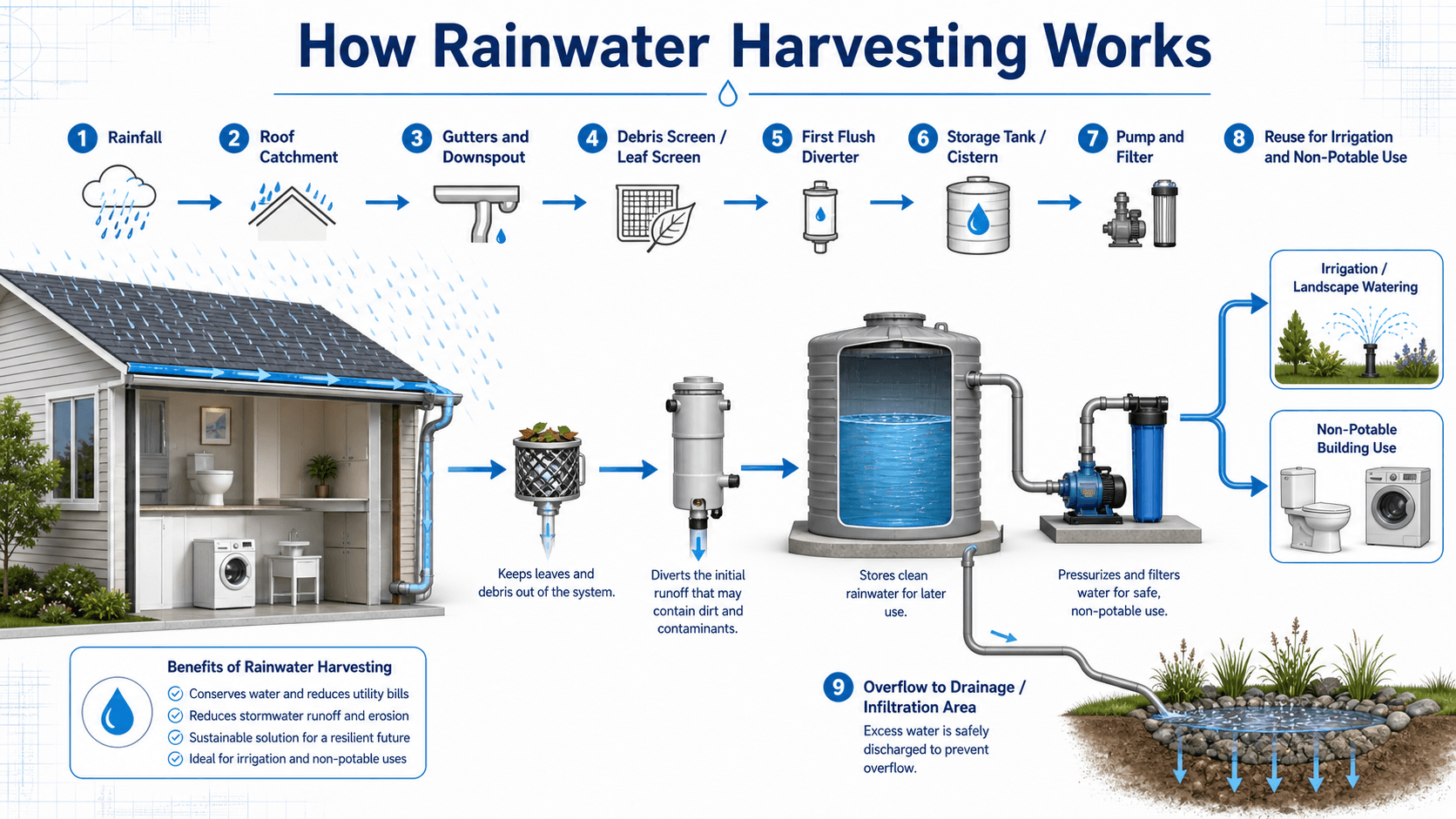
Notice that the system is not just a tank. The performance depends on the full treatment train: roof surface, gutters, screening, first flush diversion, storage, pumping, filtration, reuse piping, and overflow management.
What Is Rainwater Harvesting?
Rainwater harvesting is a water collection practice that captures rainfall before it becomes uncontrolled runoff. The most common setup collects roof runoff with gutters and downspouts, removes leaves and sediment, diverts the dirtiest first portion of runoff, stores the remaining water in a barrel or cistern, and then reuses it where a potable water source is not required.
In a water resources engineering context, rainwater harvesting sits between water conservation and stormwater management. It reduces demand on treated municipal water, but it also changes the runoff hydrograph from a site by temporarily storing water that would otherwise leave the roof quickly. That makes it especially relevant to hydrology, urban stormwater management, and urban water management.
Rainwater harvesting is narrower than broader rainwater management because it focuses on capturing and reusing rainfall as a water supply. Broader rainwater management may also include detention, infiltration, conveyance, erosion control, and flood reduction practices that do not necessarily reuse the water.
Rainwater harvesting is not the same as simply draining a roof. A drainage system removes water from a building; a harvesting system intentionally captures, stores, protects, and reuses part of that water.
Main Components of a Rainwater Harvesting System
A reliable system is a sequence of components, not one isolated device. Each component either collects water, moves water, protects water quality, stores water, pressurizes water, or safely handles overflow. The more the system connects to building plumbing or larger site reuse, the more important separation, treatment, controls, and maintenance access become.
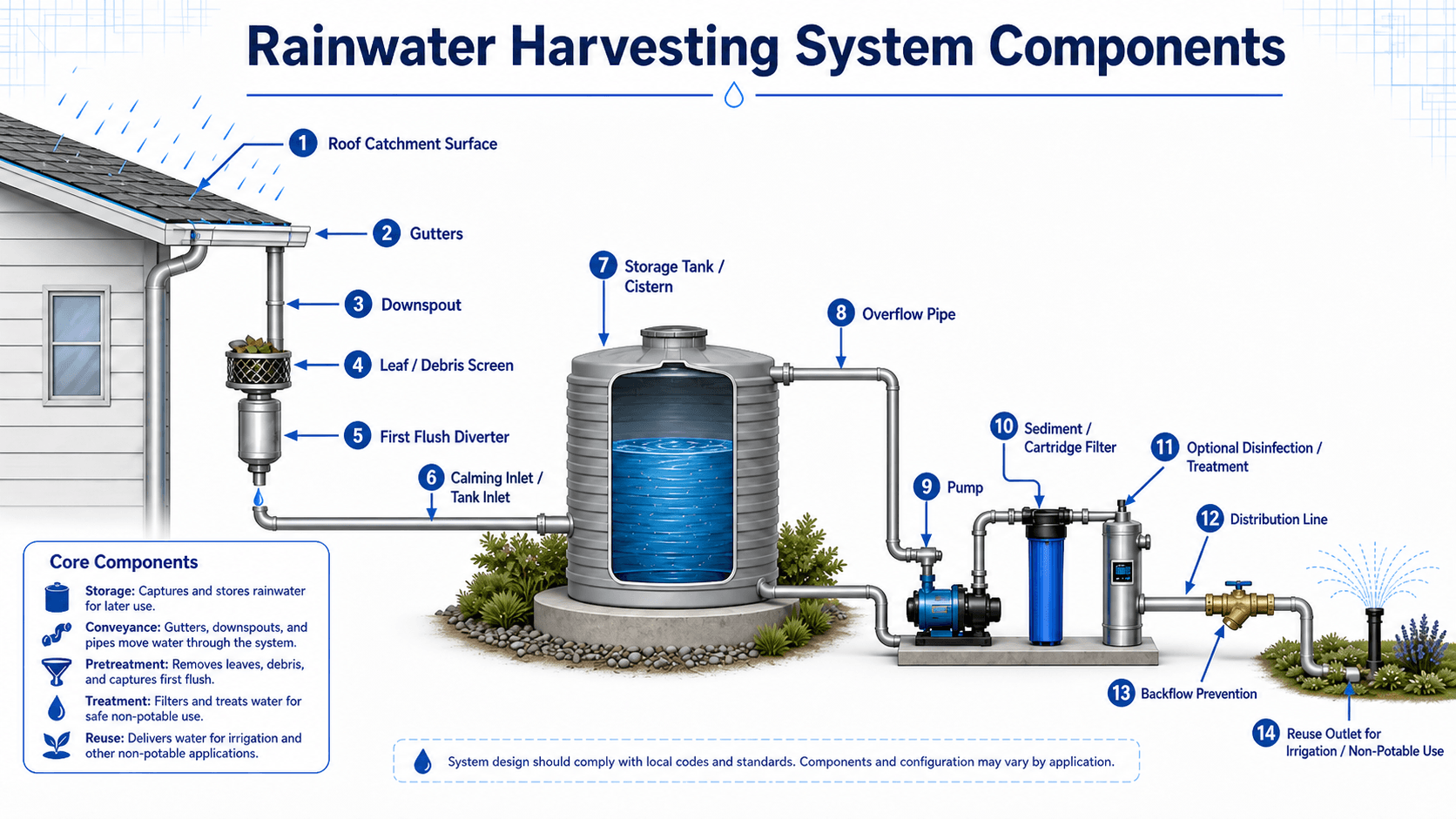
| Component | Purpose | Engineering implication |
|---|---|---|
| Roof catchment | Collects rainfall and creates the available supply. | Roof area, slope, material, and cleanliness affect both collection volume and water quality. |
| Gutters and downspouts | Convey roof runoff to the storage system. | Undersized, clogged, or poorly sloped gutters can bypass water before it reaches the tank. |
| Leaf screen and first flush diverter | Remove debris and divert the dirtiest initial runoff. | Pretreatment reduces sediment, organic loading, odor, clogging, and maintenance problems inside the tank. |
| Storage tank or cistern | Stores captured water for later use. | Tank sizing must balance expected rainfall, demand, dry periods, cost, available space, and overflow frequency. |
| Pump, filter, and distribution piping | Move stored water to irrigation or non-potable demand points. | Pressure, filtration level, backflow prevention, and separation from potable water become critical for building-connected systems. |
| Overflow route | Discharges excess water when the tank is full. | Overflow must be routed to a safe drainage, infiltration, or stormwater location so the tank does not create erosion or building flooding. |
How the System Works as a Water Balance
A rainwater harvesting system works by shifting water through four linked stages: supply, storage, demand, and loss. Rainfall provides supply, the roof determines catchment area, the tank provides temporary storage, and reuse demand draws water down between storms. Losses occur through first flush diversion, imperfect collection, filter waste, leaks, evaporation, overflow, and periods when demand does not match rainfall.
Supply is intermittent
Rainfall does not arrive evenly through the year. A location may receive a large annual rainfall depth but still experience long dry periods. For that reason, the average annual total is not enough by itself. Engineers care about storm timing, seasonal patterns, dry spell duration, roof area, and whether the system is meant to serve occasional irrigation or a more reliable non-potable demand.
Storage is a buffer, not an unlimited source
The tank temporarily stores water, but it cannot create water during dry weather. A very small tank may overflow during most storms and run empty quickly. A very large tank may cost more than the value it provides if the roof area or demand is too small. Good design finds the useful storage range, not simply the largest possible tank.
Demand controls how often storage becomes useful
A rain barrel connected to a small garden hose has very different performance from a cistern serving irrigation zones, toilet flushing, or a commercial landscape. If demand is low, the tank may stay full and overflow often. If demand is too high, the tank may run dry and need backup supply.
How Engineers Use Rainwater Harvesting
Engineers use rainwater harvesting when the project has a water conservation goal, a stormwater volume reduction goal, a sustainability requirement, or a practical need for non-potable water. The system may be simple on a residential site, but larger building or campus systems require design coordination between site civil, plumbing, landscape, controls, and operations teams.
- Stormwater volume control: Capturing roof runoff can reduce the volume discharged during small and moderate storms.
- Landscape irrigation: Stored rainwater can offset potable water used for lawns, planting beds, courtyards, and green infrastructure maintenance.
- Indoor non-potable reuse: More advanced systems can support toilet flushing, laundry, or washdown where allowed and properly separated from potable systems.
- Water resilience: Storage can help bridge short dry periods, especially when irrigation demand is seasonal and predictable.
Before sizing the tank, define the actual objective: reducing stormwater runoff, lowering potable water use, supporting irrigation reliability, meeting a sustainability target, or providing backup non-potable supply. Each objective can lead to a different “best” tank size.
Key Factors That Control System Performance
Rainwater harvesting performance is controlled by the relationship between rainfall, catchment area, storage, use, and losses. A good-looking system can still perform poorly if it is installed on the wrong roof area, paired with the wrong demand, or allowed to overflow at a location that creates a drainage problem.
| Factor | Why it matters | Engineering implication |
|---|---|---|
| Rainfall depth and timing | Determines how much water is available and how often the tank refills. | Seasonal rainfall and dry periods often matter more than annual rainfall alone. |
| Catchment area | The roof area controls the supply entering the system. | Small roofs limit collection even if the region is rainy; large roofs may need larger gutters and overflow capacity. |
| Runoff coefficient | Accounts for wetting, splash, minor losses, and roof surface behavior. | Smooth impervious roofs usually collect more efficiently than rough, dirty, or highly obstructed surfaces. |
| Storage volume | Controls how much water can be held between storms. | Undersized tanks overflow frequently; oversized tanks may not be cost-effective or may create water quality issues if turnover is low. |
| Water demand | Draws the tank down and creates room for the next storm. | Demand that aligns with rainy seasons and irrigation need can improve useful capture. |
| Treatment level | Determines what the water can safely be used for. | Irrigation may need basic screening, while indoor or potable applications require much more careful treatment and controls. |
| Overflow route | Handles excess water when the tank is full. | Overflow should not discharge against foundations, erode slopes, overwhelm small drains, or bypass required stormwater controls. |
Rainwater Harvesting Calculation and Tank Sizing
The simplest useful estimate converts rainfall on a roof into a volume of water. This does not replace detailed sizing, but it gives a strong first check for whether a rainwater harvesting system is realistic for a site.
In U.S. customary units, a common quick estimate is:
- \(V\) Collected water volume, typically expressed in gallons or liters.
- \(P\) Rainfall depth over the catchment, commonly inches for U.S. customary calculations or millimeters for SI calculations.
- \(A\) Roof or catchment area contributing to the system.
- \(C\) Runoff coefficient that accounts for roof surface behavior and collection losses.
- \(E\) Collection efficiency, including first flush, screens, filters, conveyance losses, and maintenance condition.
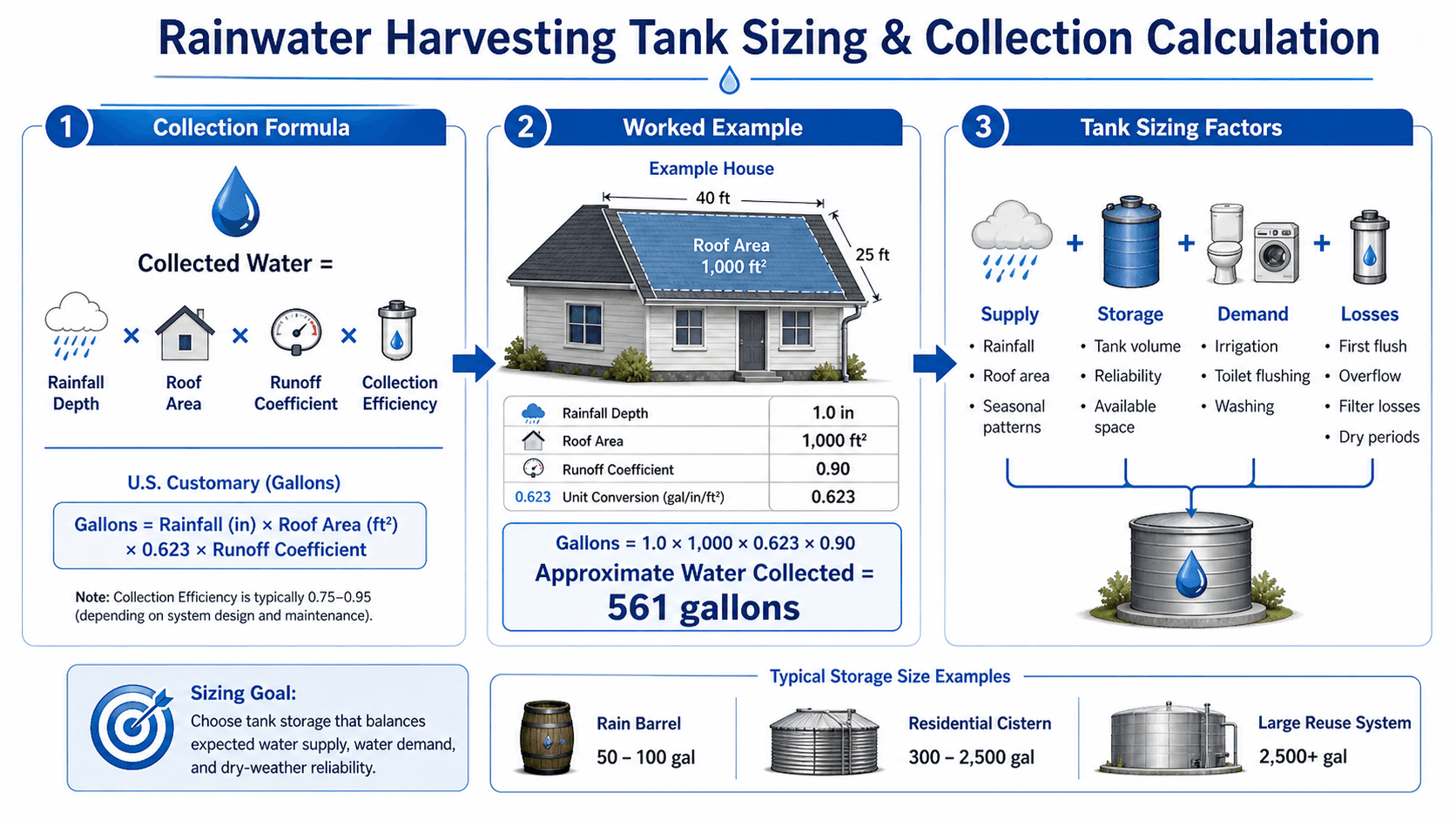
Worked example
Suppose a roof area of 1,000 ft² receives 1.0 inch of rain, and the runoff coefficient is 0.90. The estimated volume is \(1.0 \times 1{,}000 \times 0.623 \times 0.90 = 561\) gallons. That does not mean the tank should automatically be 561 gallons. It means that one inch of rainfall on that roof can produce roughly that much collectable water before other project-specific losses.
Tank sizing is more than one storm
A one-storm calculation is useful for intuition, but tank sizing should consider the full pattern of rainfall and demand. A rain barrel may be appropriate for occasional garden watering, while a cistern serving irrigation zones or building reuse needs a water balance that checks how often the system fills, empties, overflows, or requires backup supply.
Benefits and Limitations of Rainwater Harvesting
Rainwater harvesting can reduce potable water demand, lower irrigation water use, reduce small-storm runoff volume, and support green infrastructure goals. Its limitations are storage cost, seasonal rainfall variability, maintenance needs, water quality concerns, and the fact that tanks still overflow when full.
| Benefit or limitation | What it means | Design implication |
|---|---|---|
| Water conservation | Harvested water can offset potable water for non-potable uses. | Most valuable where irrigation or non-potable demand is frequent enough to draw down the tank. |
| Runoff reduction | Storage can reduce roof runoff during smaller storms. | Effectiveness depends on available empty tank volume before a storm begins. |
| Seasonal reliability | Rainfall may not align with outdoor water demand. | Dry-period checks are needed for realistic performance expectations. |
| Water quality management | Roof runoff can carry debris, sediment, microbes, and roof-related contaminants. | Treatment and allowable uses should match the intended reuse application. |
| Maintenance burden | Screens, filters, diverters, pumps, and tanks require service. | Design should prioritize accessible, maintainable components instead of hidden or hard-to-clean details. |
Rain Barrel vs. Cistern Decision Table
One of the first practical decisions is whether the project needs a small rain barrel or a larger cistern system. The best choice depends on the desired use, reliability, budget, available space, and whether pumps or treatment are required.
Use a rain barrel when the goal is simple, low-cost outdoor watering. Use a cistern when the goal is meaningful irrigation volume, building-connected non-potable reuse, stormwater credit, or a controlled system that needs pumps, filters, overflow routing, and maintenance access.
| Check or decision | Rain barrel | Cistern system |
|---|---|---|
| Typical purpose | Small garden or landscape watering. | Irrigation, larger storage, non-potable reuse, or stormwater management. |
| Storage range | Often about 50 to 100 gallons. | Often hundreds to thousands of gallons, depending on demand and site constraints. |
| System complexity | Low; usually gravity-fed or simple hose use. | Moderate to high; may include pumps, filters, controls, overflow structures, and plumbing separation. |
| Best fit | Homeowner-level water conservation and small irrigation tasks. | Projects where useful volume, reliability, pressure, or stormwater credit matters. |
| Main risk | Overflow, mosquitoes, freezing, and limited useful volume. | Undersized treatment, poor turnover, pump issues, poor overflow routing, and higher maintenance burden. |
Water Quality, Treatment, and Safe Reuse
Harvested rainwater is not automatically clean enough for every use. Rain may be relatively low in dissolved minerals, but roof runoff can pick up pollen, leaves, sediment, bird droppings, roofing particles, metals, bacteria, and organic material before it reaches storage. Treatment needs should be based on the intended use, not on the assumption that “rainwater is clean.”
| Reuse application | Typical treatment concern | Practical design note |
|---|---|---|
| Landscape irrigation | Leaves, sediment, clogging, odor, and mosquito control. | Screening, first flush diversion, covered storage, and filter maintenance are usually the main concerns. |
| Toilet flushing | Sediment, color, odor, cross-connection, and plumbing separation. | Requires more careful filtration, labeling, controls, and backflow protection than outdoor watering. |
| Laundry or washdown | Particles, microbes, color, and equipment compatibility. | May require finer filtration, disinfection, and project-specific water quality review. |
| Potable use | Pathogens, chemical contaminants, roof materials, and testing reliability. | Requires a much more robust treatment train, routine testing, and compliance with applicable health requirements. |
Water quality is easier to protect before storage than after a tank becomes dirty. Good systems keep debris out, divert the dirtiest first runoff, screen inlets and vents, seal the tank from insects and animals, and maintain filters before performance declines.
Engineering Judgment and Field Reality
Real rainwater harvesting systems are affected by small details that simplified diagrams often hide. Gutters clog. Roof valleys concentrate flow. Screens become blocked after leaf fall. First flush diverters are not maintained. Tanks overflow during storms when demand is low. Pumps lose prime, filters plug, and irrigation controllers may draw water at times that do not match tank recovery.
Engineers also have to think about where excess water goes. A full tank does not eliminate runoff; it simply redirects additional runoff to an overflow. If that overflow discharges onto a slope, near a foundation, or into an undersized drain, the harvesting system can create a new drainage problem while solving a water conservation problem.
The most successful systems are usually simple enough to maintain. A theoretically high-performing system with inaccessible screens, hidden filters, poor overflow access, or no maintenance routine often performs worse than a simpler system that operators actually understand and service.
When This Breaks Down
Rainwater harvesting is most reliable when supply, demand, storage, treatment, and maintenance are aligned. It becomes less reliable when the system is expected to provide continuous water without enough rainfall, roof area, storage, or backup supply.
- Long dry periods: A tank can run empty even in areas with high annual rainfall if storms are seasonal or widely spaced.
- Low demand during wet periods: The tank may stay full and overflow frequently, reducing the useful capture volume.
- Poor pretreatment: Leaves, sediment, and organic debris can reduce water quality, clog filters, and create odor.
- Improper overflow routing: Excess water can erode soil, wet foundations, overload drains, or bypass required stormwater controls.
- Unclear water quality goals: A system designed for irrigation should not be casually repurposed for indoor or potable use without additional treatment and controls.
Common Mistakes and Practical Checks
Most rainwater harvesting problems come from treating the system as a storage tank rather than a managed water system. The tank is important, but performance depends on all the upstream and downstream details.
- Sizing from roof area only: Roof area estimates supply, but demand and dry-period reliability determine whether the water is useful.
- Ignoring first flush and screens: Poor pretreatment increases sediment, clogging, odor, and filter maintenance.
- Forgetting overflow: Every tank needs a safe overflow route for storms larger than the available storage.
- Assuming rainwater is potable: Roof runoff can contain contaminants and should be treated according to the intended use.
- No maintenance access: Screens, valves, filters, pumps, and tank openings must be accessible enough to inspect and service.
- No winter or freeze planning: Exposed piping, pumps, and barrels may need seasonal protection in cold climates.
The most important mistake is assuming a full tank means the system is working well. If demand is low, a full tank may simply mean most new rainfall is bypassing to overflow.
Relevant Manuals, Data Sources, and Design References
Rainwater harvesting design often depends on local plumbing rules, stormwater credit requirements, health guidance, rainfall data, and owner maintenance capability. A general engineering resource can explain the concept, but project design should be checked against the criteria that apply to the site and intended use.
- U.S. Environmental Protection Agency: EPA Types of Green Infrastructure identifies rainwater harvesting as a green infrastructure practice that collects roof runoff for later irrigation or non-potable use, making it a useful reference for connecting water reuse with stormwater volume reduction.
- Project-specific criteria: Local stormwater manuals, plumbing codes, health requirements, owner standards, irrigation needs, and authority having jurisdiction requirements may control final system layout and allowable uses.
- Engineering use: Engineers combine rainfall data, roof area, demand estimates, water quality targets, storage sizing, overflow routing, and maintenance planning to determine whether rainwater harvesting is practical for a site.
Frequently Asked Questions
Rainwater harvesting is the collection, storage, and reuse of rainfall, usually from rooftops, so the water can be used later for irrigation, toilet flushing, washing, or other non-potable needs. In water resources engineering, it is also used to reduce runoff volume and support sustainable stormwater management.
A practical estimate is gallons collected equals rainfall in inches times roof area in square feet times 0.623 times the runoff coefficient. For example, 1 inch of rain on a 1,000 square foot roof with a 0.90 runoff coefficient produces about 561 gallons before additional losses such as first flush diversion or overflow.
Harvested rainwater should not be assumed potable just because it came from rainfall. Roof runoff can contain sediment, organic debris, bird droppings, metals, microbes, and other contaminants, so drinking water use requires appropriate filtration, disinfection, testing, and compliance with local health and plumbing requirements.
A rain barrel is usually a small, low-cost storage container used for simple outdoor watering, while a cistern is a larger storage system that may include pumps, filters, controls, overflow routing, and more formal plumbing connections. Cisterns are more common when the goal is reliable irrigation, commercial reuse, or indoor non-potable demand.
Summary and Next Steps
Rainwater harvesting captures rainfall, stores it, and reuses it where potable water is not required. For water resources engineering, the value is broader than water savings because the system can also reduce roof runoff volume, support green infrastructure, and improve site-level water management.
The most important design ideas are simple: estimate supply from rainfall and catchment area, match storage to real demand, protect water quality with pretreatment and maintenance, and route overflow safely. A useful system is not just the largest tank; it is the system that balances performance, cost, reliability, and maintainability.
Where to go next
Continue your learning path with related Turn2Engineering resources.
-
Hydrology
Build the foundation for understanding rainfall, runoff, infiltration, storage, and watershed response.
-
Urban Stormwater Management
See how runoff control, detention, infiltration, water quality, and urban drainage fit into broader stormwater design.
-
Urban Water Management
Explore how water supply, wastewater, stormwater, and reuse strategies work together in urban water systems.