
Key Takeaways
- Core idea: Fiber reinforced plastics are composite materials made from reinforcing fibers embedded in a polymer resin matrix.
- Engineering use: FRP is used for concrete strengthening, bridge decks, rebar, grating, column wraps, cladding, and pultruded structural shapes.
- What controls it: Fiber type, fiber direction, resin system, bond, stiffness, environmental exposure, and connection detailing control performance.
- Practical check: FRP should not be treated like steel because it is directional, often brittle, and highly sensitive to detailing and installation quality.
Table of Contents
Introduction
Fiber reinforced plastics, often called FRP or fiber reinforced polymers, are composite materials made from strong fibers embedded in a polymer resin. In structural engineering, FRP is used for corrosion-resistant reinforcement, concrete strengthening, bridge components, retrofit systems, and lightweight structural products where durability, low weight, and high tensile capacity are valuable.
How Fiber Reinforced Plastics Work
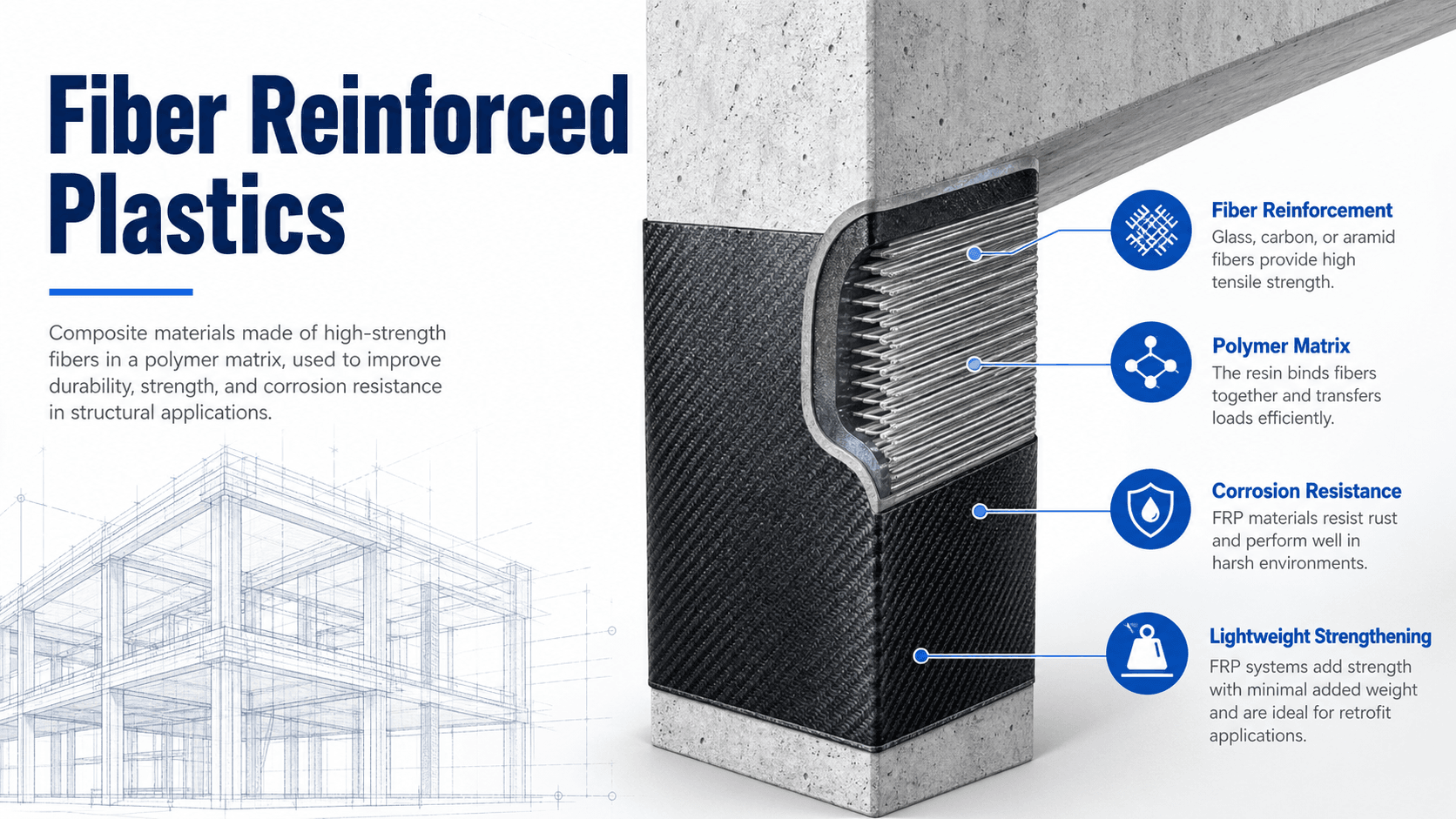
Notice that FRP behavior is controlled by both the fibers and the resin. The fibers provide most of the tensile capacity, while the resin protects the fibers, transfers stress, and helps the composite act as a single material.
What are Fiber Reinforced Plastics?
Fiber reinforced plastics are composite materials made by placing reinforcing fibers inside a polymer matrix. The fibers are commonly glass, carbon, aramid, or basalt. The resin is commonly polyester, vinyl ester, or epoxy. Together, these materials create a composite that can be much lighter than steel while still providing high tensile strength and excellent corrosion resistance.
From a structural engineering perspective, FRP is not just a “strong plastic.” It is a directional composite material. Its strength and stiffness depend on where the fibers are placed, how they are oriented, how well the resin bonds to the fibers, and how the product is manufactured or installed. That is why FRP rebar, CFRP strengthening strips, pultruded FRP beams, and FRP grating can behave very differently even though they all fall under the same broad material family.
The word “plastic” can make FRP sound nonstructural, but the reinforcing fibers are what make the material useful for engineering applications. In many structural products, the polymer matrix mainly supports, protects, and distributes load to the fibers; the fibers provide the primary tensile resistance.
How FRP Carries Load
FRP works by combining two materials that perform different jobs. The fibers carry most of the tensile load. The resin matrix holds the fibers in position, transfers stress between fibers, protects them from environmental exposure, and gives the composite its final shape. This is why fiber reinforced plastics can be engineered into rebar, laminates, sheets, plates, wraps, tubes, gratings, bridge decks, and pultruded structural shapes.
Fiber direction controls strength
FRP is usually much stronger in the direction of the fibers than across the fibers. A unidirectional CFRP strip bonded to the bottom of a concrete beam may provide strong flexural strengthening along the beam span, but that does not mean it has the same capacity in every direction. This directional behavior is called anisotropy, and it is one of the most important differences between FRP and traditional isotropic materials such as steel.
The resin matrix is not just filler
The resin system affects durability, bond, temperature resistance, chemical resistance, moisture behavior, and installation tolerance. In externally bonded systems, the adhesive and resin also influence how well forces transfer from the existing structure into the FRP. A high-strength fiber system can still perform poorly if surface preparation, resin selection, curing, anchorage, or environmental exposure are not handled correctly.
FRP often behaves linearly until rupture
Many FRP products do not yield like reinforcing steel. Instead, they may remain nearly linear-elastic until rupture. That creates a very different design mindset. Engineers must pay close attention to serviceability, deformation, bond behavior, redundancy, strain limits, and failure mode control rather than assuming ductile yielding will provide warning before failure.
Types of Fiber Reinforced Plastics
The most common FRP categories are named after the fiber type. The right choice depends on the design objective, exposure environment, stiffness needs, installation method, and budget.
| FRP type | Common fiber | Typical structural use | Engineering note |
|---|---|---|---|
| GFRP | Glass fiber | Rebar, bridge decks, grating, platforms, panels, utility structures | Often cost-effective and corrosion resistant, but stiffness is usually lower than steel. |
| CFRP | Carbon fiber | Beam strengthening, slab strengthening, column wraps, seismic retrofit, specialty strengthening | High strength and stiffness make it useful where added capacity is needed with minimal weight. |
| AFRP | Aramid fiber | Impact-resistant systems, specialty retrofits, lightweight applications | Tough and lightweight, but less common in everyday building and bridge design. |
| BFRP | Basalt fiber | Emerging rebar, reinforcement, and corrosion-resistant products | Can be attractive for durability, but availability and design familiarity vary by market. |
A useful way to think about FRP selection is this: GFRP is often the economical corrosion-resistant option, CFRP is often the high-performance strengthening option, and specialty fibers are used when a project has unusual performance requirements.
Structural Engineering Applications of FRP
FRP is most valuable when traditional materials struggle with corrosion, weight, installation access, electrical conductivity, or retrofit constraints. In building and infrastructure work, FRP is commonly used as reinforcement, strengthening, decking, grating, panels, and lightweight structural shapes.
- FRP rebar: Used in corrosion-prone concrete such as bridge decks, marine structures, parking garages, and chemical exposure environments.
- Externally bonded FRP: CFRP or GFRP sheets, strips, and plates are bonded to existing concrete, masonry, timber, or steel elements to improve flexural, shear, or confinement performance.
- FRP column wraps: Used to confine concrete columns, improve ductility, and support seismic retrofit objectives.
- Pultruded FRP shapes: Used for beams, channels, angles, plates, tubes, ladders, railings, and platforms, especially in corrosive industrial environments.
- FRP bridge decks and panels: Used where low dead load, prefabrication, and corrosion resistance can simplify replacement or rehabilitation.
- FRP grating: Used in wastewater plants, chemical facilities, rooftops, platforms, and access walkways where steel corrosion is a long-term maintenance issue.
Before choosing FRP, ask what problem the material is solving. If the project does not benefit from corrosion resistance, low weight, nonconductivity, or retrofit constructability, a conventional steel, concrete, masonry, or timber solution may be simpler and more economical.
Key Factors That Control FRP Performance
FRP performance depends on more than tensile strength. Engineers must evaluate stiffness, fiber orientation, bond, temperature, fire exposure, creep rupture, moisture, ultraviolet exposure, installation quality, and how the FRP connects to the rest of the structure.
| Factor | Why it matters | Engineering implication |
|---|---|---|
| Fiber type | Glass, carbon, aramid, and basalt fibers have different strength, stiffness, durability, and cost profiles. | Material selection should match the design objective rather than assuming all FRP products behave the same. |
| Fiber orientation | FRP is strongest and stiffest in the fiber direction. | Load paths, strengthening direction, wrap orientation, and laminate layout must align with the forces being resisted. |
| Modulus of elasticity | High tensile strength does not always mean high stiffness. | Deflection, crack width, vibration, and serviceability can control even when strength appears adequate. |
| Bond and anchorage | FRP must transfer forces into the existing structure or connected members. | Debonding, peel stresses, lap length, anchors, surface preparation, and adhesive behavior can govern capacity. |
| Environmental exposure | Moisture, alkalinity, chemicals, temperature, UV exposure, and freeze-thaw cycles can affect long-term performance. | Resin selection, protective coatings, durability reduction factors, and maintenance planning matter. |
| Fire and temperature | Polymer matrices can lose strength or stiffness at elevated temperatures. | Fire rating, thermal protection, allowable exposure, and service temperature limits should be checked early. |
| Connection detailing | Pultruded shapes and panels often fail or become inefficient at connections. | Bolt bearing, local crushing, edge distances, hole quality, and joint stiffness may control the design. |
FRP vs Steel, Concrete, and Traditional Materials
Fiber reinforced plastics are not a universal replacement for steel, reinforced concrete, or timber. They are a specialized material family that performs very well in certain conditions and less well in others. The best design choice depends on the governing problem.
| Comparison | Where FRP can be better | Where traditional materials may be better |
|---|---|---|
| FRP vs steel | Corrosion resistance, low weight, nonconductivity, retrofit strengthening, reduced maintenance in harsh environments. | Ductility, fire performance, high stiffness, connection familiarity, availability, and broad code familiarity. |
| FRP vs reinforced concrete | Lightweight panels, externally bonded strengthening, corrosion-resistant reinforcement, fast retrofit work. | Compression-dominated mass structures, fire robustness, conventional building systems, and low material cost. |
| FRP vs timber | Moisture resistance, chemical resistance, dimensional stability in certain products, industrial access structures. | Cost, sustainability goals, fire-charring behavior, connection familiarity, and architectural warmth. |
| FRP vs aluminum | Electrical nonconductivity, corrosion resistance in selected environments, low maintenance, molded shapes. | Ductility, thermal performance, recyclability, standard connection methods, and predictable metal behavior. |
The practical question is not “Is FRP stronger?” The better question is “Which material provides the required strength, stiffness, durability, constructability, fire performance, inspection access, and lifecycle cost for this specific project?”
FRP Selection Decision Table
A strong FRP decision starts by identifying the problem the material is supposed to solve. Use this practical selection table to compare common structural scenarios before committing to an FRP system.
Define the exposure problem, identify the load path, choose the FRP form, check stiffness and failure mode, review fire and durability requirements, then verify installation quality control and inspection access.
| Project condition | FRP option to consider | Engineering check before using it |
|---|---|---|
| Concrete deck exposed to deicing salts | GFRP rebar or corrosion-resistant FRP reinforcement | Check serviceability, crack control, development length, bar handling, and project-specific design guidance. |
| Existing concrete beam needs added flexural capacity | CFRP strips or plates bonded to the tension face | Check existing concrete strength, surface preparation, bond, debonding limits, fire protection, and strain compatibility. |
| Concrete column needs seismic confinement | FRP wrap around the column perimeter | Check confinement objective, lap details, column geometry, discontinuities, end conditions, and jacket protection. |
| Industrial walkway in a corrosive plant | FRP grating, pultruded beams, railings, or platforms | Check deflection, connection details, slip resistance, fire exposure, impact loads, and chemical compatibility. |
| Bridge rehabilitation where dead load must be reduced | FRP deck panels or lightweight composite elements | Check connections, wearing surface, fatigue, thermal movement, inspection access, and owner acceptance criteria. |
| Electrical or utility environment | Nonconductive GFRP components | Check electrical requirements, ultraviolet exposure, ladder/platform stiffness, and long-term outdoor durability. |
Design Review Checklist for FRP Systems
FRP design review should focus on the complete system, not just the product datasheet. A datasheet may report impressive tensile strength, but the installed system can be controlled by bond, stiffness, temperature, anchorage, or field workmanship.
Before design
Confirm the structural objective. Is the FRP being used for corrosion resistance, added strength, confinement, weight reduction, nonconductivity, or accelerated construction? The design checks change depending on the objective.
During design
Check strength, stiffness, serviceability, strain limits, bond, anchorage, environmental reduction factors, fire exposure, and constructability. For pultruded shapes, pay special attention to connection behavior and local effects. For bonded systems, review surface preparation, adhesive requirements, curing conditions, and inspection methods.
Before construction
Verify that the installer understands storage, handling, preparation, temperature limits, cure time, and quality control requirements. FRP strengthening work can be sensitive to moisture, dust, surface roughness, substrate damage, and improper resin mixing.
If the design only compares ultimate tensile strength, it is incomplete. A credible FRP review also checks stiffness, strain compatibility, bond transfer, failure mode, durability, fire exposure, and how the FRP force actually reaches the supporting structure.
Engineering Judgment and Field Reality
FRP often performs best when the engineer treats it as a system rather than a material substitution. A CFRP strip does not strengthen a beam unless force can transfer from concrete into adhesive, from adhesive into fiber, and from fiber back into the structural system without premature debonding. A GFRP bar does not behave like epoxy-coated steel just because it is placed in concrete. A pultruded FRP beam does not automatically solve a corrosion problem if its connections, supports, or fire exposure are not addressed.
Field conditions also matter. Bonded FRP systems depend on surface preparation and curing. Outdoor FRP systems depend on UV protection, temperature range, and moisture exposure. Industrial FRP components depend on chemical compatibility and connection detailing. Bridge and transportation applications depend on fatigue, impact, inspection, wearing surfaces, and owner-specific requirements.
Many FRP failures are not caused by the fibers being too weak. They are caused by bond problems, poor surface preparation, unsuitable resin, connection distress, unanticipated exposure, inadequate fire protection, or treating directional FRP behavior like isotropic steel behavior.
When This Breaks Down
Simplified FRP explanations break down when they imply that FRP is just a stronger, lighter version of steel. Structural use of FRP requires different assumptions about material direction, deformation, long-term behavior, and failure mode.
- When ductility is required: Many FRP systems do not yield before rupture, so ductile load redistribution cannot be assumed the same way it may be for steel.
- When stiffness controls: GFRP can have high strength but lower stiffness, so deflection and crack width may control before strength.
- When fire exposure governs: Polymer matrices and adhesives may lose properties at elevated temperatures, requiring protection or a different material strategy.
- When connections are overlooked: Bolted pultruded FRP connections, bearing zones, edge distances, and local crushing can govern structural behavior.
- When installation quality is poor: Bonded FRP systems are highly dependent on substrate preparation, resin mixing, curing, alignment, and inspection.
- When exposure is misunderstood: UV, moisture, alkalinity, chemicals, freeze-thaw cycles, and temperature swings can affect long-term performance.
Common Mistakes and Practical Checks
The most common FRP mistakes come from using traditional material intuition without adjusting for composite behavior. FRP can be an excellent structural material, but it must be detailed, installed, and checked as FRP.
- Comparing only ultimate strength: Strength may look excellent while stiffness, bond, or fire performance controls the design.
- Ignoring fiber direction: FRP capacity depends heavily on fiber orientation relative to the load path.
- Treating GFRP rebar like steel rebar: GFRP has different stiffness, bond, development, bend, and rupture behavior.
- Skipping serviceability checks: Deflection, crack width, vibration, and deformation compatibility may govern the design.
- Overlooking installation conditions: Dust, moisture, temperature, surface roughness, and cure time can change bonded FRP performance.
- Forgetting inspection and maintenance: FRP systems still need inspection planning, especially where damage, impact, UV exposure, or fire exposure is possible.
Do not select FRP from a product table alone. Always check the installed system, including load path, bond, anchorage, stiffness, environmental exposure, fire requirements, construction tolerances, and inspection access.
Relevant FRP Design References
FRP design guidance is usually application-specific. Engineers should use the reference that matches the actual FRP system, such as concrete reinforcement, externally bonded strengthening, bridge components, pultruded shapes, or transportation applications.
- ACI 440 guidance: Commonly used for FRP reinforcement and externally bonded FRP systems in concrete strengthening and concrete construction applications.
- AASHTO FRP bridge guidance: Relevant for bridge deck, railing, repair, strengthening, and transportation applications where owner specifications and bridge performance requirements control.
- Manufacturer evaluation reports and product data: Useful for material properties, resin systems, allowable exposure, installation requirements, and quality control, but they should not replace project-specific engineering review.
- Owner and agency requirements: Transportation departments, public agencies, facility owners, and industrial clients may have additional acceptance criteria for durability, fire, inspection, and long-term maintenance.
Frequently Asked Questions
Fiber reinforced plastics are composite materials made by combining reinforcing fibers with a polymer resin. In structural engineering, they are used for corrosion-resistant reinforcement, concrete strengthening, bridge components, industrial grating, pultruded shapes, and retrofit systems where low weight and durability are important.
FRP can have very high tensile strength, but it is not automatically better than steel. Steel is generally more ductile, familiar, and stiff, while FRP is usually selected for corrosion resistance, low weight, nonconductive behavior, or strengthening applications where steel is difficult to install.
GFRP uses glass fibers and is commonly chosen for cost-effective corrosion resistance, such as rebar, grating, and bridge deck components. CFRP uses carbon fibers and is usually selected when higher stiffness and strength are needed, especially for externally bonded strengthening of beams, slabs, and columns.
The main disadvantages of fiber reinforced plastics are anisotropic behavior, brittle rupture, stiffness limitations in some products, fire and UV exposure concerns, creep rupture, connection sensitivity, installation quality control, and design guidance that is more application-specific than traditional steel or reinforced concrete design.
Summary and Next Steps
Fiber reinforced plastics are composite materials made from reinforcing fibers and polymer resin. In structural engineering, they are used when corrosion resistance, low weight, strengthening efficiency, nonconductivity, or retrofit constructability makes FRP more attractive than a conventional material.
The most important FRP concepts are fiber direction, resin behavior, stiffness, bond, anchorage, environmental exposure, fire performance, and field installation quality. FRP can be very effective, but it should be designed as a directional composite system rather than treated as a direct substitute for steel.
Where to go next
Continue your learning path with related Turn2Engineering resources.
-
Composite Materials
Learn the broader material family behind FRP, including how composites combine different materials to create structural behavior.
-
Concrete Reinforcement
Review how reinforcement works in concrete and why FRP rebar requires different thinking than steel reinforcement.
-
Bridges and Overpasses
See how structural materials, durability, dead load, fatigue, and maintenance influence bridge design and rehabilitation decisions.