
Key Takeaways
- Core idea: Thermal properties describe how a material transfers, stores, resists, and responds to heat.
- Engineering use: Engineers use them to select heat sinks, insulation, high-temperature parts, electronics packaging, building materials, and dimensionally stable components.
- What controls it: Important controls include thermal conductivity, specific heat, density, thermal expansion, temperature range, geometry, and boundary conditions.
- Practical check: Do not treat handbook values as universal; many thermal properties change with temperature, moisture, porosity, grade, and test method.
Table of Contents
Introduction
Thermal properties are material characteristics that describe how a substance behaves when heat is added, removed, or transferred through it. They include thermal conductivity, specific heat capacity, thermal expansion, thermal diffusivity, thermal resistance, and thermal stress behavior. In engineering, these properties help determine whether a material should conduct heat, insulate against heat, store heat, stay dimensionally stable, or survive repeated temperature changes.
How Heat Flow Changes with Thermal Conductivity
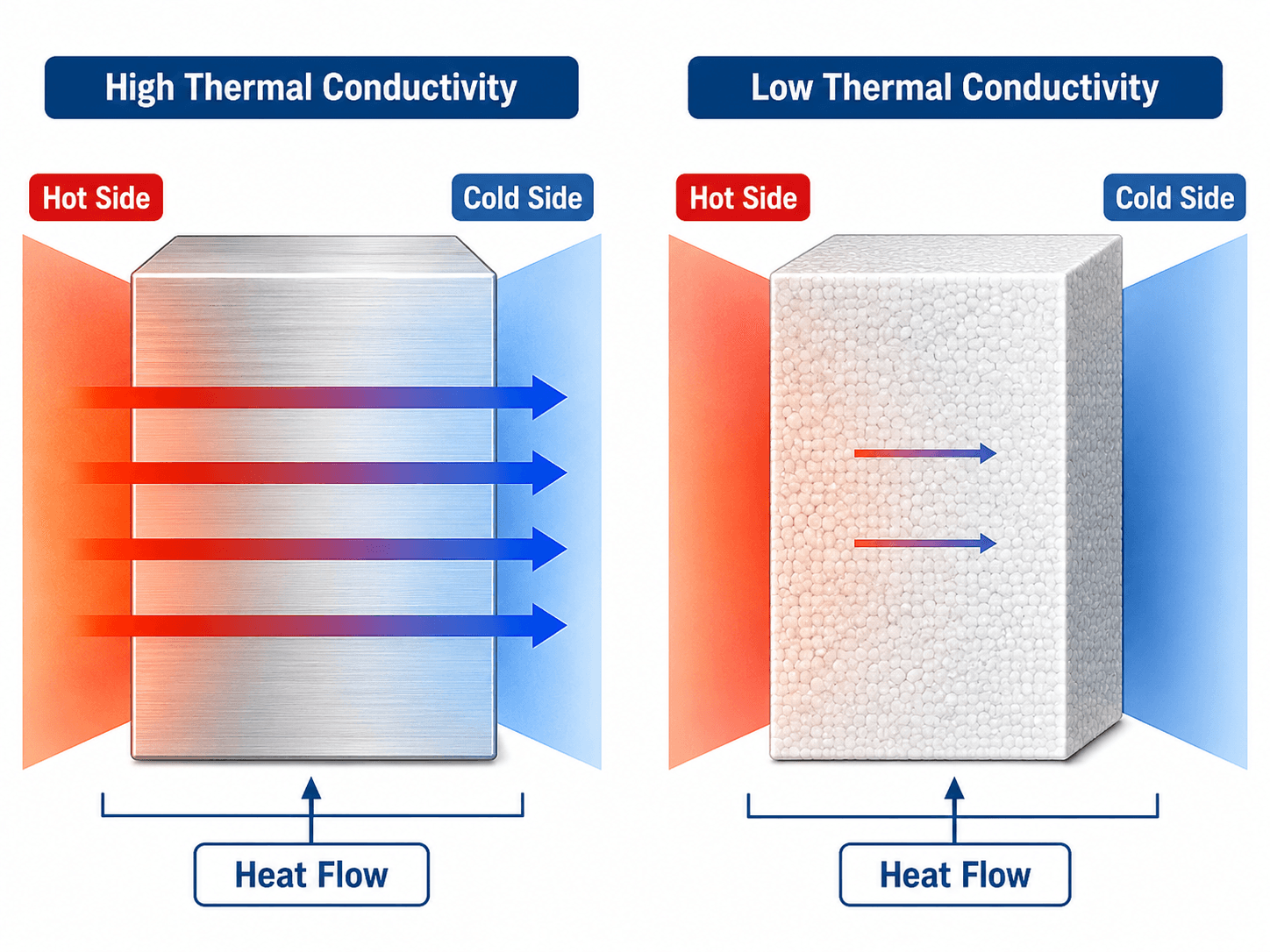
The key idea is not that one material is always better. A heat sink needs high conductivity, while an insulation layer needs low conductivity. The right thermal property depends on the design goal.
What Are Thermal Properties?
Thermal properties are measurable behaviors that describe how a material interacts with heat. They tell engineers how easily heat passes through a material, how much heat the material can store, how much it expands or contracts with temperature, and whether temperature change can create stress, distortion, or failure.
In materials science, thermal properties connect atomic structure, bonding, microstructure, porosity, and composition to real performance. A metal, ceramic, polymer, foam, and composite can all be exposed to the same temperature difference but respond very differently because their heat-transfer paths and expansion behavior are different.
Thermal performance is rarely controlled by one property alone. A part that conducts heat well may still overheat if it has poor geometry, weak convection, high contact resistance, or too little surface area to reject heat.
Types of Thermal Properties of Materials
The most useful way to study thermal properties is to separate heat movement, heat storage, dimensional change, and thermal failure behavior. Each property answers a different engineering question.
| Thermal property | Common symbol | Typical units | What it tells you | Engineering use |
|---|---|---|---|---|
| Thermal conductivity | \(k\) | W/m·K, Btu/hr·ft·°F | How easily heat conducts through a material. | Selecting heat sinks, conductive plates, insulation, and wall assemblies. |
| Specific heat capacity | \(c\), \(c_p\) | J/kg·K, Btu/lb·°F | How much energy is needed to raise temperature. | Estimating thermal mass, cooldown time, temperature rise, and heat storage. |
| Volumetric heat capacity | \(\rho c_p\) | J/m³·K | How much heat a material stores per unit volume. | Comparing dense thermal mass materials, transient heating, and thermal diffusivity. |
| Thermal expansion | \(\alpha\) | 1/K, µm/m·K, in/in·°F | How much a material changes size as temperature changes. | Designing clearances, expansion joints, bonded layers, fasteners, and precision parts. |
| Thermal diffusivity | \(a\), sometimes \(\alpha_t\) | m²/s, ft²/hr | How quickly a temperature disturbance spreads through a material by conduction. | Evaluating transient heating, quenching, thermal shock, and short-duration heat exposure. |
| Thermal resistance | \(R\) | m²·K/W, ft²·°F·hr/Btu | How strongly a layer or assembly resists heat flow. | Comparing insulation layers, building envelopes, equipment jackets, and thermal barriers. |
| Thermal stress behavior | Varies | Pa, MPa, psi | How a material reacts when expansion or contraction is restrained. | Preventing cracking, warping, fatigue, delamination, and joint failure. |
These properties build on the broader idea of material properties, where mechanical, thermal, electrical, chemical, and physical behavior are considered together before choosing a material.
Thermal Conductivity, Heat Capacity, and Diffusivity Are Not the Same
Thermal conductivity, specific heat, and thermal diffusivity are often confused because all three involve heat. In design, they answer different questions: how easily heat moves, how much heat is stored, and how fast a temperature change spreads through the material.
Thermal Conductivity: How Easily Heat Moves
Thermal conductivity measures the ability of a material to conduct heat through its structure. Metals such as copper and aluminum typically have high conductivity, which makes them useful for heat spreaders and cooling fins. Foams, wood, many polymers, and air-filled materials usually have low conductivity, which makes them useful for insulation.
Specific Heat Capacity: How Much Heat Is Stored
Specific heat capacity measures how much energy is needed to raise the temperature of a unit mass by one degree. A material with high specific heat can absorb more energy before its temperature rises significantly. This is why water and masonry can act as thermal mass, while thin metal parts may heat quickly even if they also conduct heat efficiently.
Thermal Diffusivity: How Fast Temperature Changes Spread
Thermal diffusivity describes how quickly a temperature disturbance spreads through a material by conduction, relative to how much heat the material stores per unit volume. A material with high diffusivity tends to spread temperature changes quickly; a material with low diffusivity may keep the surface hot or cold while the interior changes more slowly.
Many references use \(\alpha\) for thermal diffusivity and also use \(\alpha\) for coefficient of thermal expansion. This page uses \(a\) for thermal diffusivity and \(\alpha\) for thermal expansion to avoid confusion.
| Question | Property that answers it | Design interpretation |
|---|---|---|
| Will heat pass through this material easily? | Thermal conductivity | High values support heat spreading; low values support insulation. |
| Will the material temperature rise quickly? | Specific heat capacity and mass | Higher heat capacity and more mass reduce temperature rise for the same heat input. |
| Will a temperature change penetrate quickly? | Thermal diffusivity | Higher diffusivity spreads temperature changes faster during transient events. |
| Will a compact volume store a lot of heat? | Volumetric heat capacity | Higher \(\rho c_p\) means more heat storage per unit volume. |
Thermal Conductivity vs Thermal Resistance and R-Value
Thermal conductivity is a material property, while thermal resistance depends on the material and the thickness of the layer. This distinction matters because insulation performance is usually about the full assembly, not just a single material value.
For one-dimensional conduction through a flat layer, thermal resistance \(R\) increases as thickness \(L\) increases and decreases as thermal conductivity \(k\) increases. A thin low-conductivity material may not insulate as well as expected, while a thicker layer of the same material can have much higher resistance to heat flow.
| Term | What it means | Practical use |
|---|---|---|
| Thermal conductivity, \(k\) | Material ability to conduct heat. | Compare raw materials such as aluminum, ceramic, foam, and polymer. |
| Thermal resistance, \(R\) | Resistance to heat flow through a specific layer or path. | Compare insulation thicknesses, wall layers, jackets, and barriers. |
| U-value | Overall heat transfer coefficient for an assembly. | Compare building envelopes, panels, and layered systems where multiple resistances combine. |
When evaluating insulation, ask whether you are comparing a material property, a layer thickness, or a full assembly. Those are related, but they are not the same engineering question.
Thermal Expansion, Mismatch, and Thermal Stress
Thermal expansion describes how a material changes length, area, or volume as temperature changes. If a part is free to expand, the main design concern may be clearance. If expansion is restrained, the same temperature change can create thermal stress.
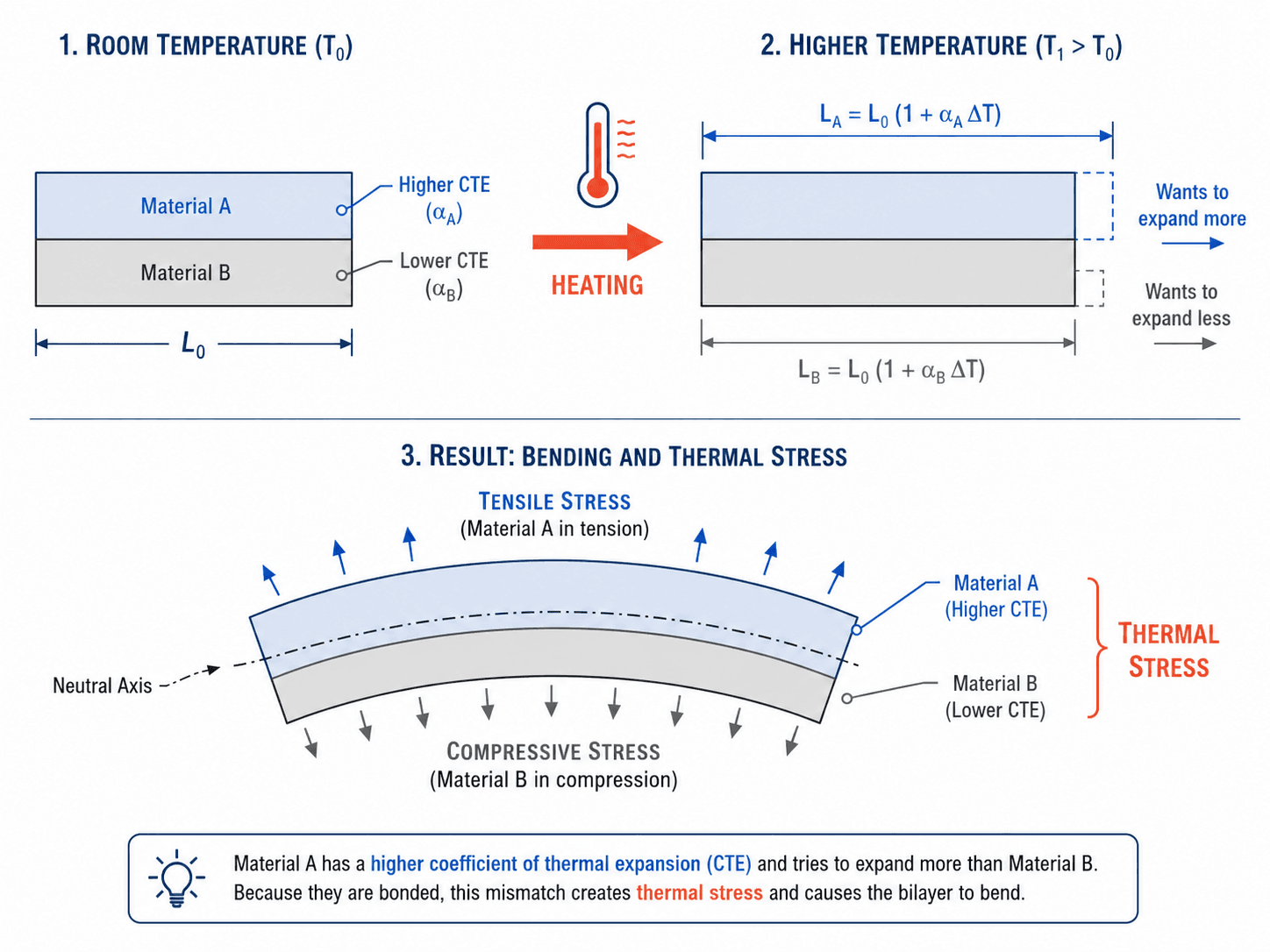
Expansion mismatch is especially important in coatings, adhesives, composite laminates, electronics packages, glass-to-metal seals, bolted joints, welded assemblies, and any design where two materials are forced to move together through a temperature cycle.
A material can be strong at room temperature and still fail in service if thermal expansion is restrained or if it is bonded to a material with a very different coefficient of thermal expansion.
Key Equations for Thermal Properties
Thermal property equations are useful for early estimates, comparison, and sanity checks. They do not replace detailed heat-transfer modeling, but they help engineers understand which variables control temperature rise, conduction, expansion, and transient response.
Heat Stored by a Material
This equation estimates the heat energy \(Q\) required to raise a material of mass \(m\) by a temperature change \(\Delta T\), where \(c\) is the specific heat capacity. It is useful for thermal mass, heating time, cooling time, and temperature-rise estimates.
Linear Thermal Expansion
This equation estimates the change in length \(\Delta L\) for an original length \(L_0\), coefficient of linear thermal expansion \(\alpha\), and temperature change \(\Delta T\). It is commonly used when checking clearances, gaps, rails, pipes, shafts, panels, and precision assemblies.
Thermal Diffusivity
Thermal diffusivity \(a\) depends on thermal conductivity \(k\), density \(\rho\), and specific heat \(c_p\). This relationship shows why two materials with similar conductivity can behave differently during transient heating if their density or heat capacity is different.
- \(k\) Thermal conductivity, usually reported in W/m·K or Btu/hr·ft·°F.
- \(c_p\) Specific heat capacity at constant pressure, commonly reported in J/kg·K or Btu/lb·°F.
- \(\rho c_p\) Volumetric heat capacity, useful for comparing heat storage per unit volume.
- \(\alpha\) Coefficient of linear thermal expansion, commonly reported in 1/K or µm/m·K.
Mini Example: Estimating Thermal Expansion
Thermal expansion calculations are often used early in design to decide whether a part needs clearance, slotted holes, expansion joints, or a different material. Consider a 2.0 m aluminum rail that experiences a 40°C temperature increase. Using a representative linear expansion coefficient of \(23 \times 10^{-6} /K\):
The rail expands about 0.00184 m, or 1.84 mm. That may seem small, but it can matter in tight assemblies, long rails, precision equipment, solar racking, pipe supports, panels, machine frames, and bolted connections.
The result is an early estimate, not a final design value. The exact coefficient should be checked for the specific alloy, temper, temperature range, connection restraint, and acceptable movement.
Using Thermal Properties in Material Selection
Thermal properties become most useful when they are tied to a design objective. A material that is excellent for a heat sink may be poor for insulation. A material with high thermal mass may be helpful for temperature smoothing but undesirable in a lightweight assembly.
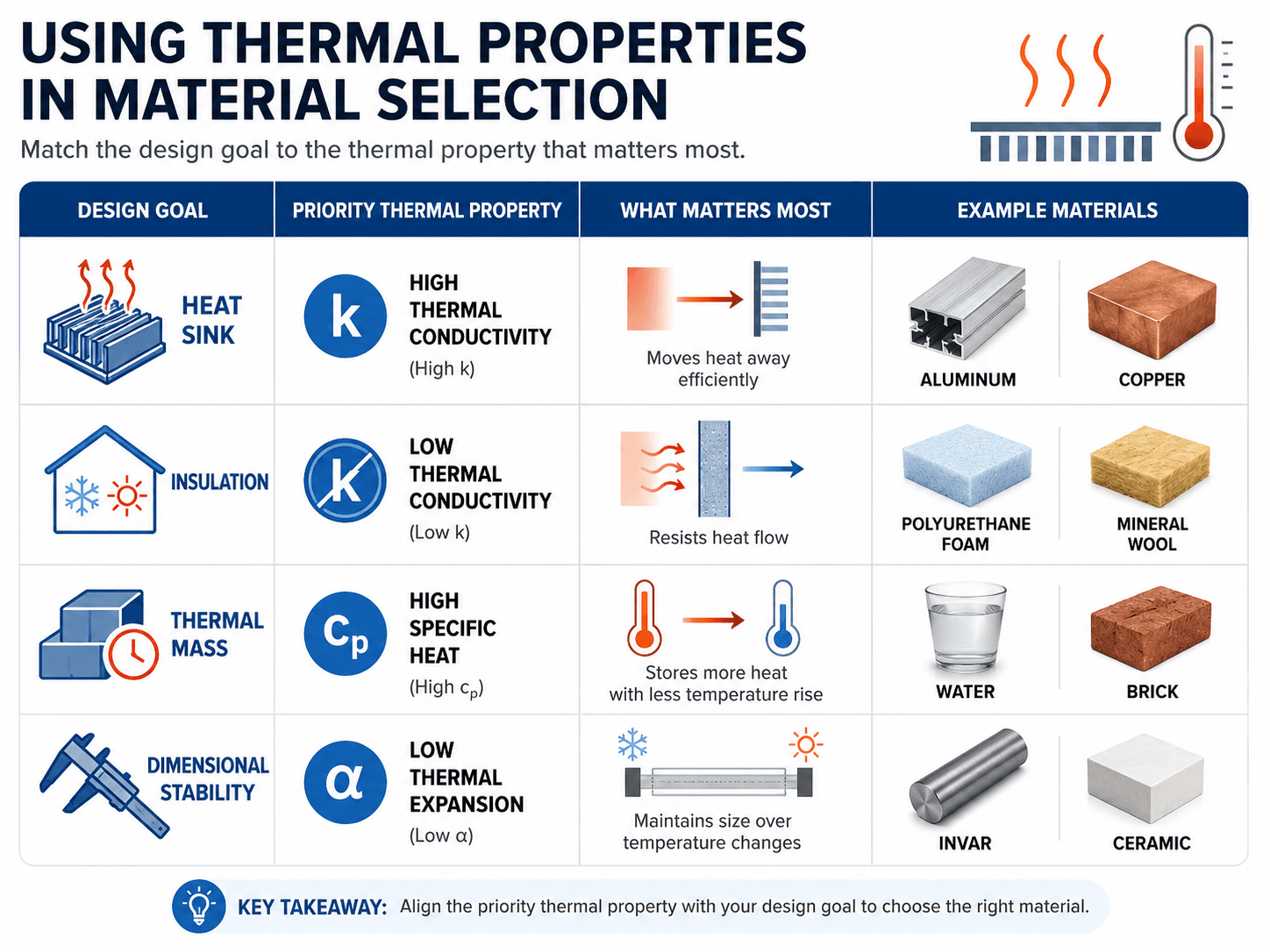
| Design goal | Property to prioritize | Typical engineering logic |
|---|---|---|
| Move heat away from a component | High thermal conductivity | Use conductive materials and geometry that increases heat-spreading area. |
| Reduce heat loss or heat gain | Low thermal conductivity and high thermal resistance | Use insulation layers, trapped air, low-density materials, or thermal breaks. |
| Reduce temperature swings | High heat capacity and sufficient mass | Use thermal mass to absorb energy without a large temperature change. |
| Maintain tight dimensions | Low thermal expansion | Use low-CTE materials or provide clearances and expansion allowances. |
| Survive rapid temperature change | Thermal shock resistance and suitable diffusivity | Check temperature gradients, brittleness, fracture toughness, and expansion restraint. |
Thermal properties should also be reviewed alongside mechanical properties of materials. A material may conduct heat well but lack strength, toughness, corrosion resistance, manufacturability, or fatigue life for the actual design.
Thermal Property Selection Checklist
Use this checklist before choosing a material for a heat-exposed component. It helps separate the thermal goal from the surrounding design constraints.
Start with the design goal: move heat, block heat, store heat, or maintain dimensions. Then check the operating temperature range, temperature cycling, material interfaces, geometry, environment, and likely failure mode before finalizing the material.
| Thermal design check | What to look for | Why it matters |
|---|---|---|
| Heat-flow objective | Decide whether the material should conduct heat, resist heat flow, or store heat. | This determines whether high conductivity, low conductivity, or high heat capacity is desirable. |
| Operating temperature range | Check minimum, maximum, and sustained service temperatures. | Thermal properties, strength, stiffness, oxidation, and creep behavior can change with temperature. |
| Thermal cycling | Look for repeated heating and cooling, rapid startup, cooldown, or outdoor exposure. | Cycling can loosen joints, fatigue materials, crack coatings, and damage bonded layers. |
| Expansion restraint | Identify bolts, welds, adhesives, supports, seals, and fixed boundaries. | Restrained expansion turns a temperature change into stress. |
| Dissimilar materials | Check whether two connected materials have different thermal expansion coefficients. | Expansion mismatch can cause bending, delamination, cracking, or loss of seal integrity. |
| Geometry and contact | Review thickness, area, surface finish, contact pressure, and thermal interface layers. | Real heat flow depends on geometry and contact resistance, not just material conductivity. |
Thermal Properties of Metals, Polymers, Ceramics, and Composites
Material classes follow useful trends, but actual values depend on grade, composition, processing, porosity, orientation, moisture, and temperature. Use these patterns for early screening, then verify data for the exact material condition.
| Material class | Thermal conductivity trend | Expansion trend | Heat storage trend | Watch-out |
|---|---|---|---|---|
| Copper and aluminum | Typically high | Moderate to high | Moderate | Excellent heat spreading, but expansion and galvanic compatibility may matter. |
| Carbon steel and stainless steel | Usually lower than copper and aluminum | Moderate | Moderate | Strength and temperature capability may matter more than conductivity. |
| Ceramics | Varies widely | Often low to moderate | Moderate | Some ceramics handle heat well but may be brittle or thermal-shock sensitive. |
| Polymers | Typically low | Often high compared with metals | Varies | Heat buildup, softening temperature, creep, and expansion can control design. |
| Foams and fibrous insulation | Typically very low | Varies by product | Low to moderate | Moisture, compression, aging, and installation quality can change performance. |
| Composites | Often directional | Often directional | Varies by fiber, matrix, and layup | Fiber direction, resin properties, and laminate schedule can dominate behavior. |
Thermal Failure Modes from Temperature Change
Thermal properties affect more than temperature. They can determine whether a part keeps its shape, holds a bond, maintains a seal, or survives repeated heating and cooling.
| Thermal issue | Common cause | Where it appears | Practical check |
|---|---|---|---|
| Thermal stress | Expansion or contraction is restrained. | Bolted parts, welded frames, pipe supports, bonded assemblies. | Check restraint, coefficient of thermal expansion, and temperature range. |
| Thermal shock | Rapid temperature gradients create high local stress. | Glass, ceramics, castings, hot tools, quenching operations. | Check heating/cooling rate, brittleness, geometry, and thermal diffusivity. |
| Warping | Uneven heating, asymmetric geometry, or residual stress. | Panels, plastic housings, composite laminates, thin plates. | Check temperature gradients, part thickness, supports, and manufacturing history. |
| Delamination | Expansion mismatch or thermal cycling at an interface. | Coatings, adhesives, laminates, electronics packages. | Check bonded material CTE, adhesive temperature rating, and cycle count. |
| Thermal fatigue | Repeated expansion and contraction over many cycles. | Engine parts, solder joints, pipework, heat exchangers, outdoor assemblies. | Check stress range, cycle count, restraint, and material fatigue behavior. |
What People Often Get Wrong About Thermal Properties
Many design mistakes come from assuming one thermal property explains the whole system. In reality, heat transfer, material response, geometry, and constraints work together.
| Misconception | Better engineering interpretation |
|---|---|
| High conductivity means the material will not overheat. | High conductivity only helps move heat; the system still needs a path to reject heat. |
| Low conductivity alone makes good insulation. | Insulation depends on conductivity, thickness, air gaps, moisture, installation, and assembly details. |
| Thermal expansion only matters for long parts. | Small expansion can still damage tight tolerances, seals, bonded joints, and precision assemblies. |
| A published room-temperature value is enough. | Thermal properties should be checked over the actual service temperature range. |
| Material property equals system performance. | Real performance also depends on geometry, surface contact, coatings, fasteners, airflow, and boundary conditions. |
How to Use Thermal Property Data Correctly
Thermal property data is only useful when the value matches the actual material, temperature range, and design condition. A table value can be excellent for screening and still be wrong for final design if the test condition does not match the application.
| Data quality check | What to verify | Why it matters |
|---|---|---|
| Temperature range | Confirm the property value is valid at the service temperature. | Conductivity, heat capacity, expansion, and strength may change with temperature. |
| Material grade or composition | Check alloy, polymer type, ceramic composition, foam density, or composite layup. | Small composition differences can create meaningful property differences. |
| Moisture and porosity | Confirm whether the data is for dry, wet, dense, porous, aged, or installed material. | Porous and insulating materials can change significantly with moisture and compression. |
| Directionality | Check whether properties differ by direction. | Composites, wood, laminates, and some engineered materials can be anisotropic. |
| Material vs assembly | Separate raw material properties from installed system performance. | Interfaces, air gaps, coatings, and geometry can dominate thermal behavior. |
| Test method and source | Use reputable datasheets, technical references, or validated property databases. | Different test methods or assumptions can produce values that are not directly interchangeable. |
Before final selection, ask whether the property value represents the actual material, actual temperature, actual direction, actual moisture condition, and actual assembly behavior.
Engineering Judgment and Field Reality
Thermal property values are often measured under controlled conditions. Real components operate with coatings, fasteners, imperfect contact, surface oxidation, moisture, manufacturing tolerances, and changing boundary conditions. Those details can matter as much as the published material value.
A high-conductivity material can still perform poorly if it has poor contact with the heat source, an insulating coating, trapped air gaps, limited surface area, or weak convection on the cooling side.
This is why thermal design often connects material selection to heat transfer, geometry, interfaces, and failure prevention. For deeper heat-flow concepts, see the Turn2Engineering guide to heat transfer.
When This Breaks Down
Simplified thermal property comparisons break down when the material value is treated as a constant or when the part geometry, environment, and boundary conditions are ignored.
- Large temperature ranges: Conductivity, heat capacity, expansion, stiffness, strength, and oxidation resistance may change across the service range.
- Layered assemblies: Adhesives, coatings, air gaps, and contact resistance can dominate the heat path.
- Porous or wet materials: Moisture can change thermal conductivity and heat storage significantly, especially in insulation and building materials.
- Directional materials: Composites, laminates, wood, and some crystals may conduct or expand differently depending on direction.
- Rapid thermal events: Short-duration heating, quenching, and thermal shock depend on gradients, fracture behavior, and transient response, not just steady-state conductivity.
Common Mistakes and Practical Checks
Most thermal property mistakes come from using the right property in the wrong context or ignoring the rest of the heat-transfer path.
- Confusing conductivity with heat capacity: Conductivity describes heat movement; heat capacity describes energy storage and temperature rise.
- Ignoring thickness: A low-conductivity material may not insulate well if the layer is too thin.
- Ignoring expansion restraint: A free part may only change size, while a restrained part may build stress.
- Using room-temperature values for hot service: High-temperature components need property data at the actual operating range.
- Forgetting interfaces: Thermal grease, surface finish, clamping force, air gaps, and coatings can control heat flow between parts.
Do not choose a material only because it has a high or low thermal conductivity value. The final thermal performance also depends on thickness, area, contact resistance, cooling conditions, expansion allowance, and service temperature.
Thermophysical Data Sources and Design References
Thermal property tables are useful only when the material grade, temperature range, test condition, and units are understood. Engineering teams often use handbooks, material datasheets, and validated property databases to confirm values before design release.
- NIST thermophysical property reference: NIST thermophysical properties reference data provides technical context for properties such as thermal conductivity, specific heat, density, and coefficient of thermal expansion.
- Project-specific criteria: Final material selection should match the actual operating temperature range, environment, geometry, interface details, manufacturing process, and reliability requirements.
- Engineering use: Use published values for screening, then verify the exact material condition when thermal stress, safety, dimensional control, or long-term reliability is important.
Frequently Asked Questions
The main thermal properties of materials are thermal conductivity, specific heat capacity, thermal expansion, thermal diffusivity, thermal resistance, and thermal stress behavior. Together, they describe how a material transfers heat, stores heat, changes size with temperature, and responds when expansion is restrained.
Thermal properties are important because heat changes how materials perform. Engineers use them to choose heat sink materials, insulation, high-temperature components, electronics enclosures, building materials, engine parts, and bonded assemblies that must survive temperature changes without overheating, cracking, warping, or losing dimensional control.
Thermal conductivity describes how easily heat moves through a material, while specific heat describes how much energy is required to raise the material temperature. A material can conduct heat quickly without storing much energy, or it can store a lot of heat while conducting it slowly.
Thermal expansion causes stress when a material wants to expand or contract but is restrained by supports, bolts, welds, adhesives, coatings, or another bonded material. If two connected materials expand at different rates, the mismatch can create bending, cracking, fatigue, or joint failure.
Yes. Many thermal properties change with temperature, phase, moisture, porosity, microstructure, material grade, and test method. A single handbook value is useful for early comparison, but final engineering decisions should check the property value over the actual service temperature range.
Summary and Next Steps
Thermal properties describe how materials transfer heat, store heat, expand with temperature, resist heat flow, and respond when thermal movement is restrained. They are essential for choosing materials in heat sinks, insulation, engines, electronics, buildings, bonded assemblies, and high-temperature components.
The most useful engineering approach is to match the property to the design goal. Use thermal conductivity for heat flow, specific heat for heat storage, diffusivity for transient response, thermal expansion for dimensional change, and thermal stress checks when expansion is constrained.
Where to go next
Continue your learning path with related Turn2Engineering resources.
-
Material Properties
Review the broader property categories engineers use to compare and select materials.
-
Mechanical Properties of Materials
Compare thermal behavior with strength, stiffness, ductility, toughness, hardness, and fatigue resistance.
-
Material Selection
Learn how engineers combine material properties, cost, manufacturability, reliability, and design requirements.