
Key Takeaways
- Core idea: Water treatment plant components are the intake, hydraulic, chemical, clarification, filtration, disinfection, storage, pumping, residuals, and control systems that convert raw water into finished drinking water.
- Engineering use: Engineers arrange components as a treatment train so each unit prepares the water for the next stage and protects finished-water quality.
- What controls it: Source water quality, turbidity, organic matter, microorganisms, flow demand, chemical dose, contact time, residuals handling, and monitoring requirements determine the component layout.
- Practical check: A complete equipment list is not enough; the components must work together hydraulically, chemically, operationally, and reliably during normal and peak conditions.
Table of Contents
Introduction
Water treatment plant components are the physical systems that bring raw water into a plant, remove debris and contaminants, disinfect the water, store finished water, and pump it into the distribution system. The main components typically include the intake, screens, pumps, chemical feed systems, rapid mix, flocculation, sedimentation, filtration, disinfection, clearwell storage, high-service pumping, residuals handling, and monitoring controls.
What Are the Main Components of a Water Treatment Plant?
Most conventional drinking water treatment plants include a sequence of components that move water from the source to finished storage and distribution. The exact layout varies by water source and treatment goals, but the table below shows the major components readers usually expect to understand first.
| Component | Main purpose | Typical location in the plant |
|---|---|---|
| Raw water intake | Collects source water and directs it toward the plant. | Beginning of the treatment train |
| Screening system | Removes large debris and protects downstream equipment. | At or near the intake |
| Low-lift pumps | Move raw or screened water into the treatment units. | After intake or screening |
| Chemical feed system | Stores, meters, and injects treatment chemicals. | At rapid mix, pH control, disinfection, and corrosion-control points |
| Rapid mix basin | Disperses coagulant quickly and destabilizes fine particles. | Before flocculation |
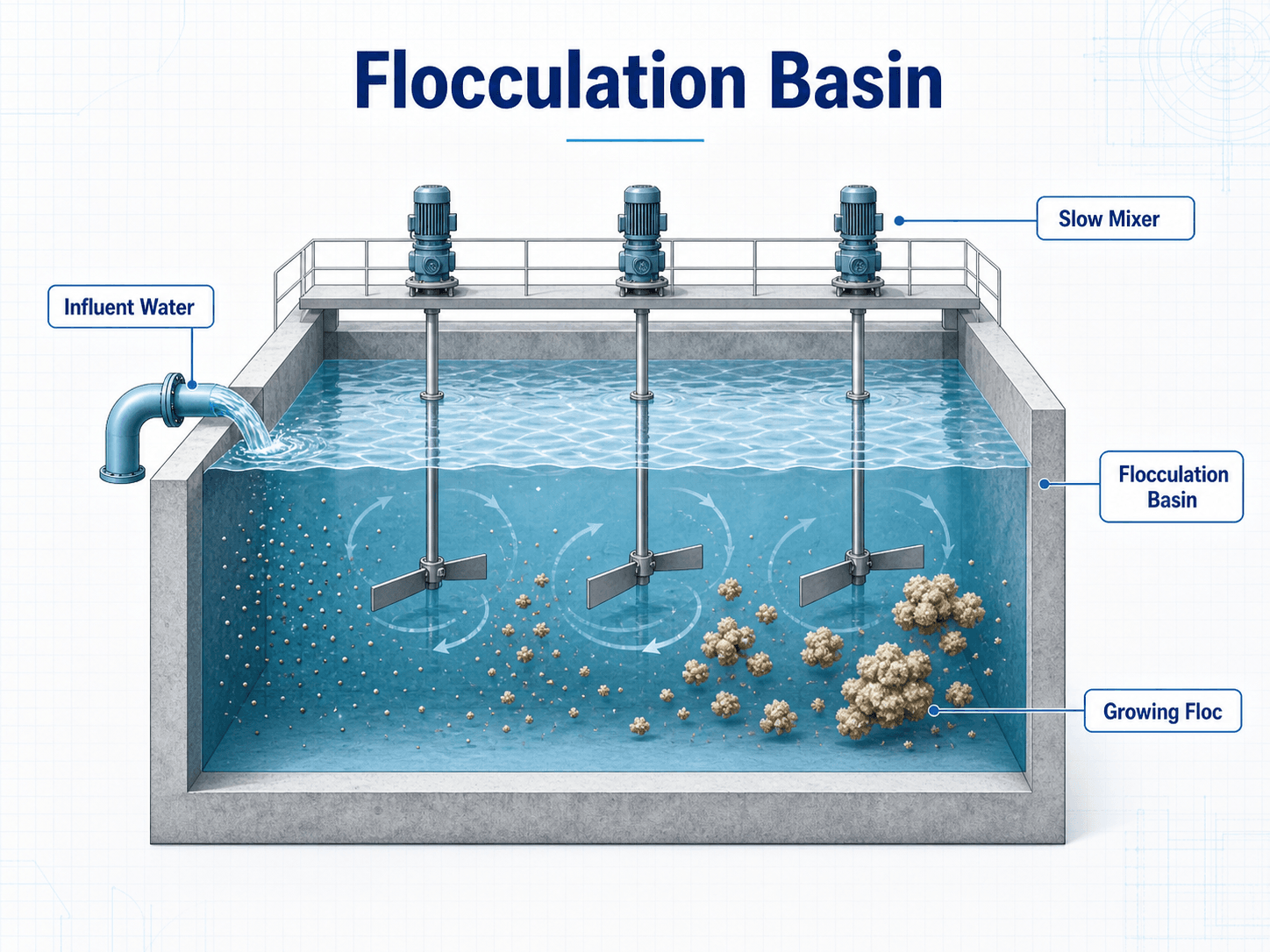
| Flocculation basin | Gently mixes water so larger floc particles form. | Before sedimentation |
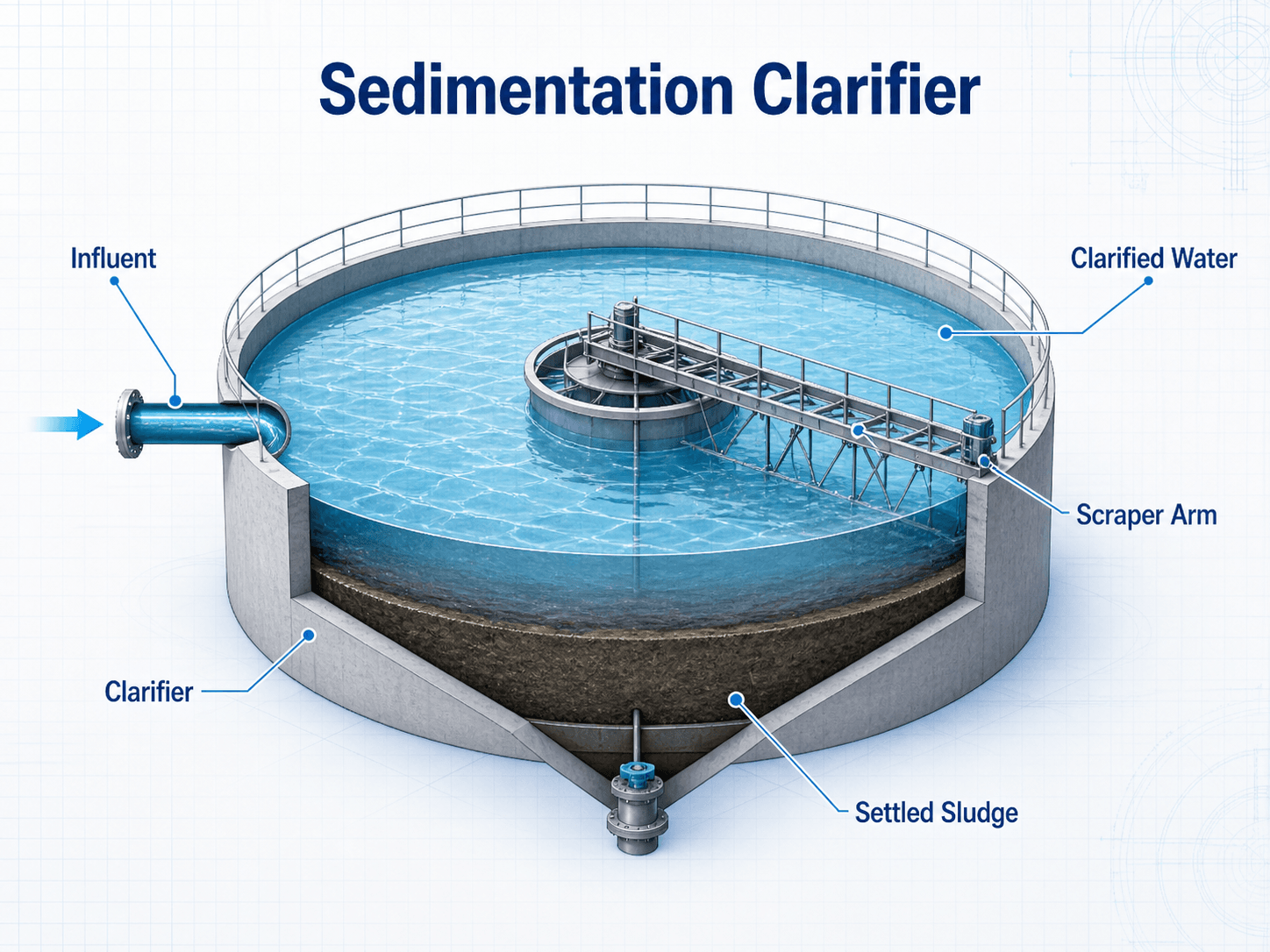
| Sedimentation clarifier | Settles floc and removes accumulated sludge. | Before filtration |
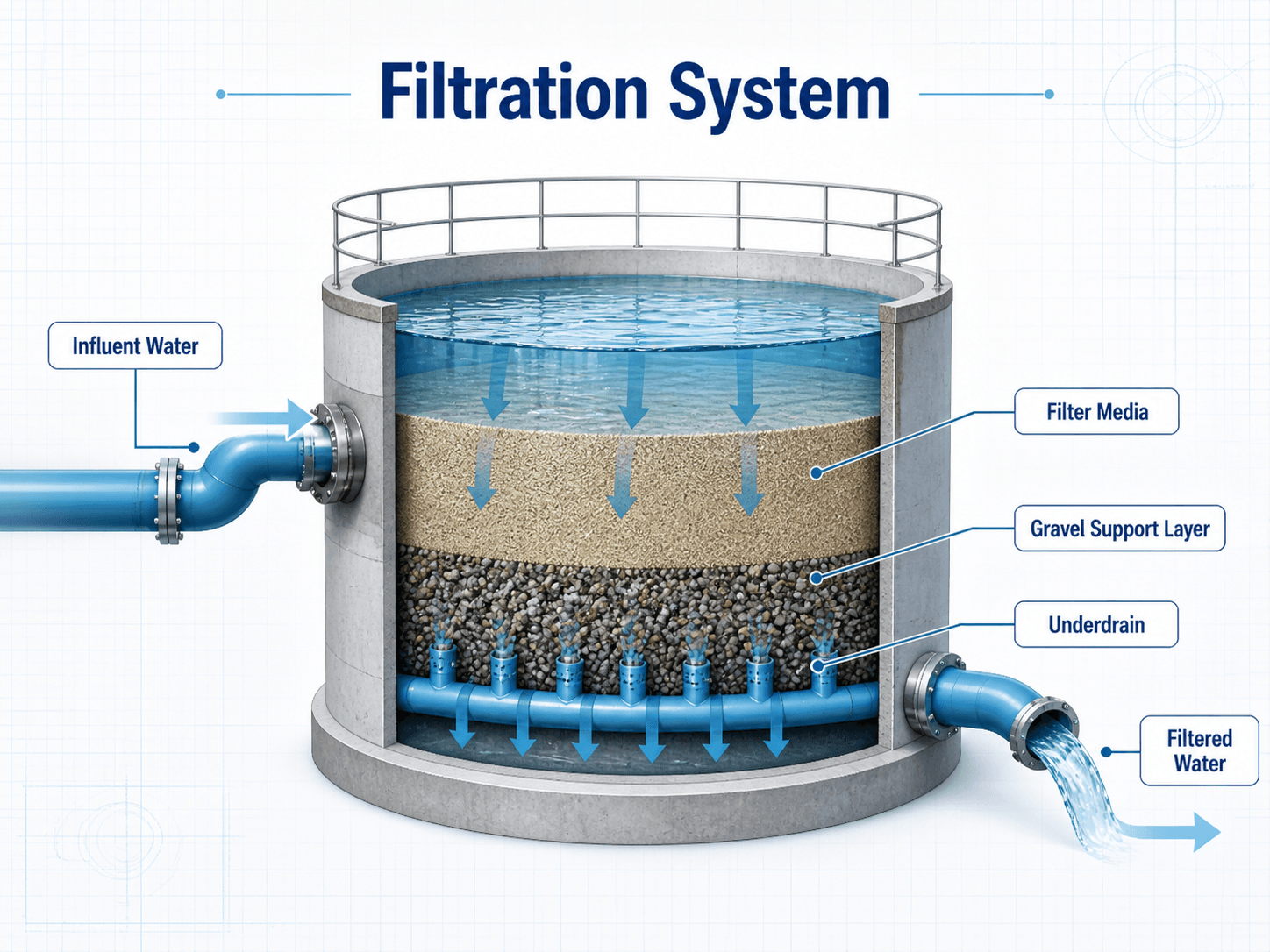
| Filtration system | Removes remaining fine particles after clarification. | Before final disinfection or storage |
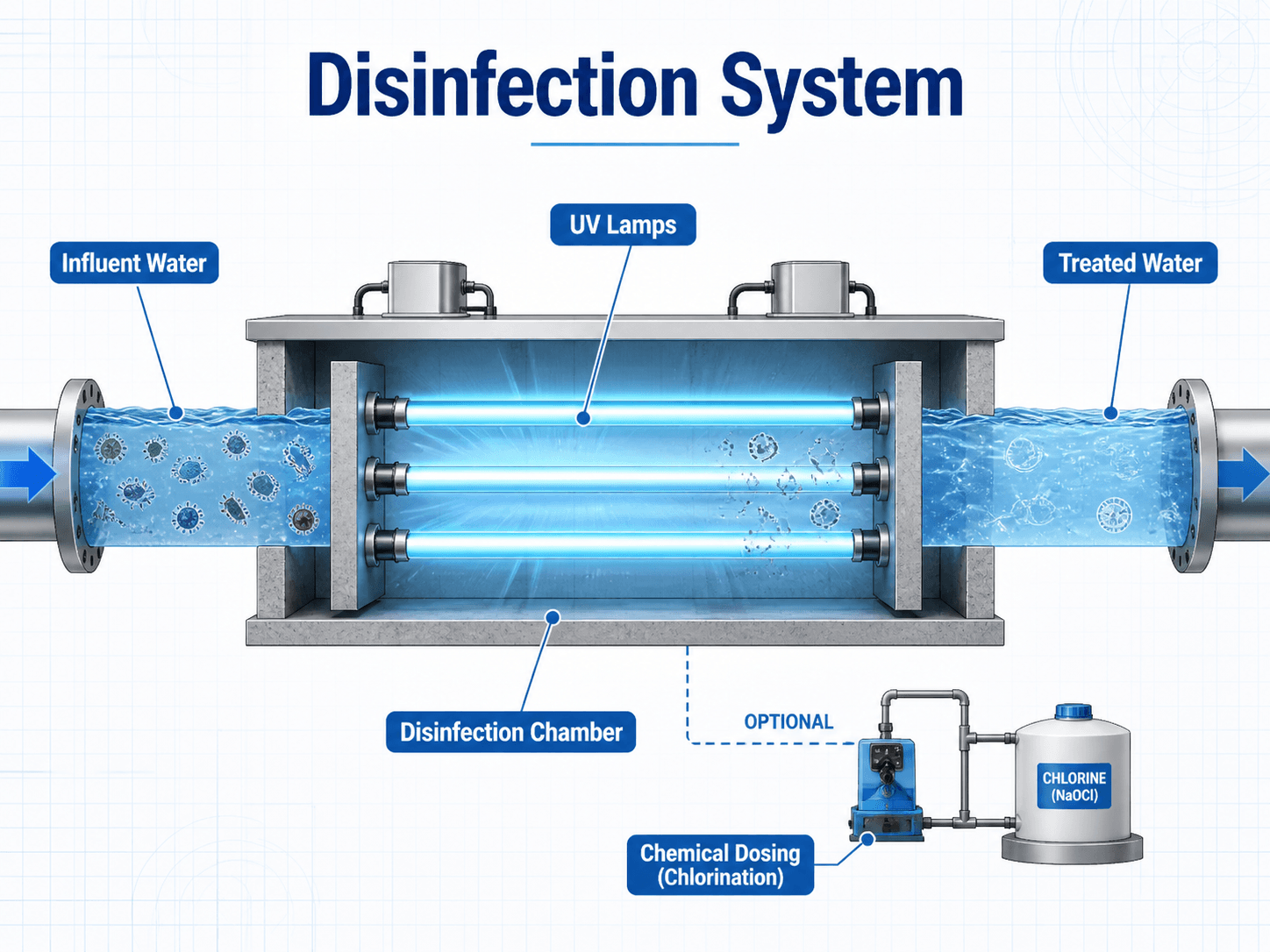
| Disinfection system | Inactivates microorganisms and may provide residual protection. | After filtration or at multiple treatment points |
| Clearwell storage | Stores finished water and may provide disinfectant contact time. | Before high-service pumping |
| High-service pumps | Deliver finished water to distribution, storage, or pressure zones. | End of the plant |
| Monitoring and controls | Track water quality, flow, chemical feed, alarms, and operating status. | Throughout the plant |
Raw Water Intake Component Diagram
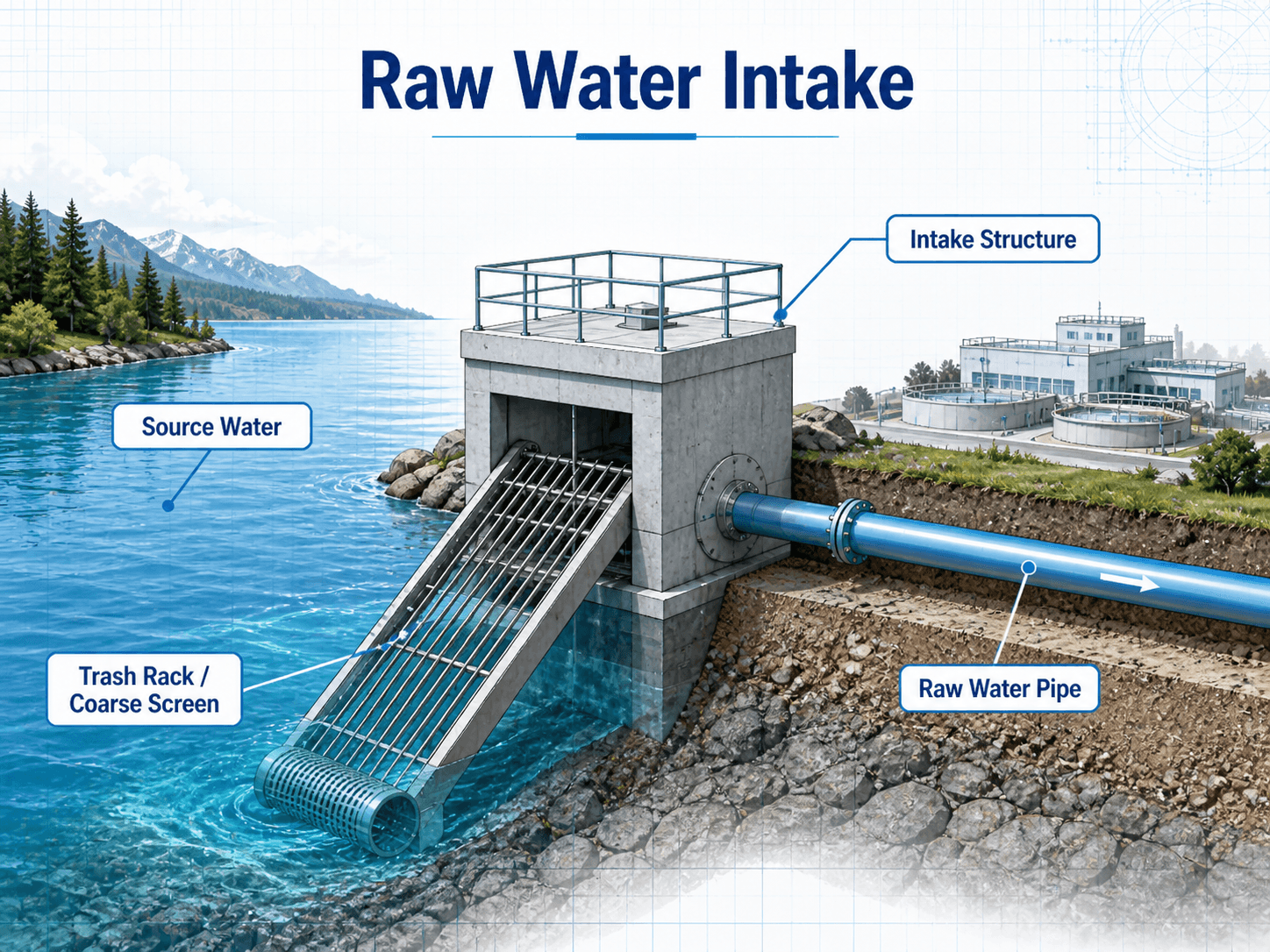
Read a water treatment plant from source to distribution: intake and screening protect the system, pumps move water, chemical and clarification components remove particles, filters polish the water, disinfection controls microorganisms, and storage and high-service pumps deliver finished water.
What Counts as a Component?
A water treatment component is a physical structure, piece of equipment, control point, or support system that performs part of the treatment function. A component may be a large basin, a pump station, a filter, a chemical feed skid, an online analyzer, a storage tank, or a residuals-handling unit.
A common mistake is confusing processes with components. Coagulation is a process, but the coagulant tank, metering pump, injection point, mixer, and rapid mix basin are components. Filtration is a process, but the filter box, media bed, underdrain, backwash valves, flow meters, and control system are the physical components that make filtration work.
| Process or function | Physical components | Engineering purpose |
|---|---|---|
| Source collection | Intake structure, gates, intake pipe, trash rack | Collect source water and protect the plant from large debris. |
| Flow movement | Low-lift pumps, high-service pumps, valves, pipe galleries | Move water through the plant and into the distribution system. |
| Chemical treatment | Storage tanks, feed pumps, mixers, injection points, containment | Add coagulant, disinfectant, pH adjustment, corrosion control, or other treatment chemicals. |
| Particle removal | Flocculation basins, clarifiers, filters, underdrains, backwash systems | Remove suspended solids, turbidity, and fine particles. |
| Disinfection | Chlorine feed, UV reactor, ozone system, contact basin, residual analyzer | Inactivate microorganisms and support finished-water safety. |
| Operations and control | SCADA, sensors, flow meters, turbidity meters, pH probes, chlorine residual analyzers | Help operators monitor performance and respond to changes. |
Typical Component Sequence in a Drinking Water Plant
A conventional drinking water plant is usually arranged as a connected treatment train. Each component prepares water for the next step. If an upstream component performs poorly, the burden shifts downstream and can shorten filter runs, increase chemical use, reduce disinfection reliability, or destabilize finished water quality.
Source water → raw water intake → screens → low-lift pumps → chemical feed and rapid mix → flocculation basin → sedimentation clarifier → filtration system → disinfection system → clearwell → high-service pumps → distribution system.
Not every plant uses this exact layout. Groundwater plants may not need full coagulation, flocculation, and sedimentation if the source water has low turbidity. Advanced plants may add granular activated carbon, membranes, ion exchange, ozone, biological filtration, or advanced oxidation when conventional treatment alone does not meet the treatment objective.
Intake, Screening, and Low-Lift Pumping Components
The first group of components controls how raw water enters the plant. These systems do not remove dissolved contaminants, but they protect the treatment train from debris, unstable hydraulics, and mechanical damage.
Raw water intake
The raw water intake collects water from a lake, river, reservoir, or other source and directs it into the plant. Surface water intakes often include an intake structure, gates, pipe, trash rack, and coarse screen. Groundwater systems may use wells and well pumps instead of a surface intake.
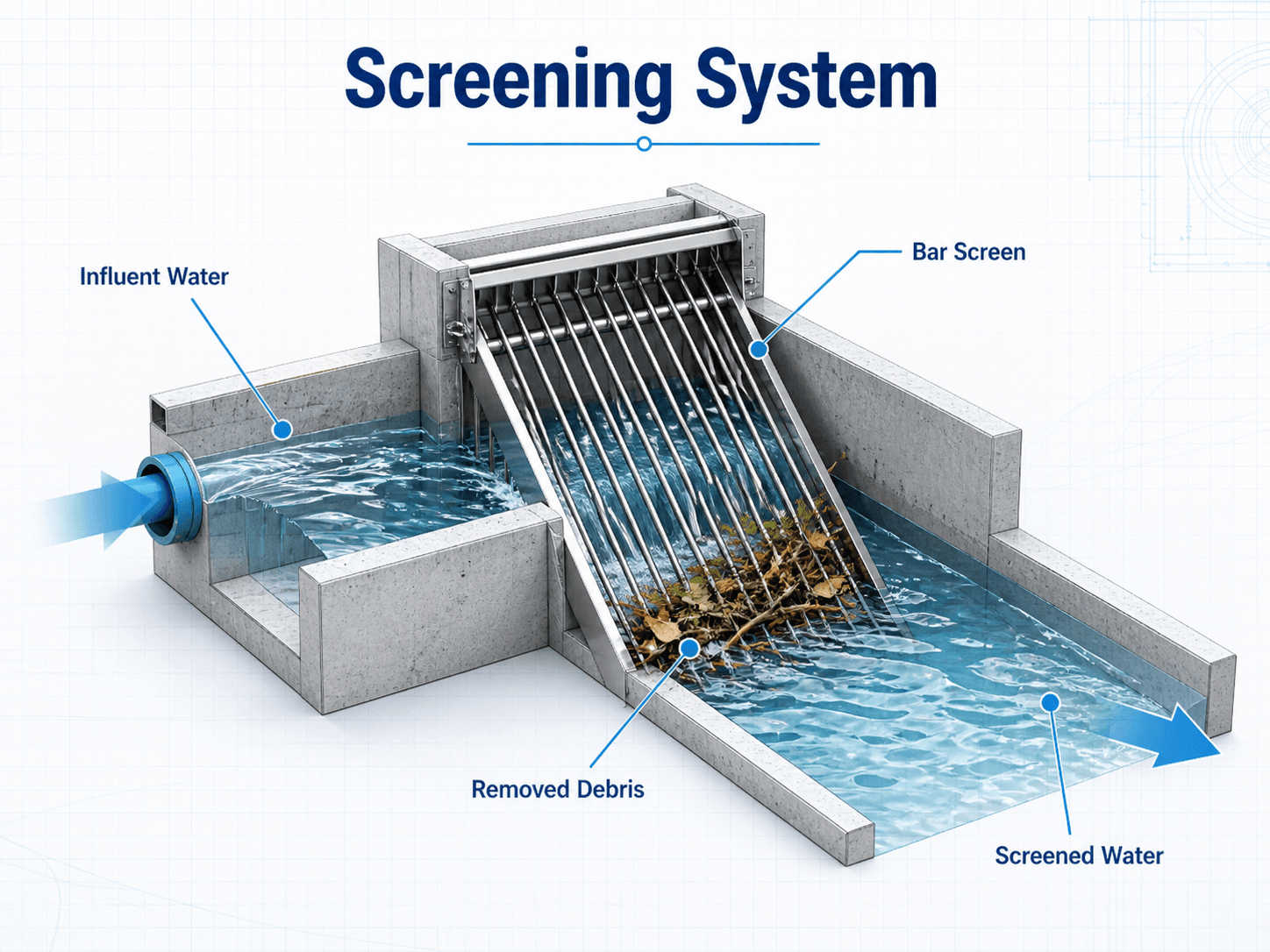
Screening system
Screening removes large debris before it reaches pumps and basins. Screens help protect pumps, valves, mixers, channels, and downstream treatment units from leaves, sticks, trash, algae mats, aquatic debris, and other large material.
Low-lift pumps
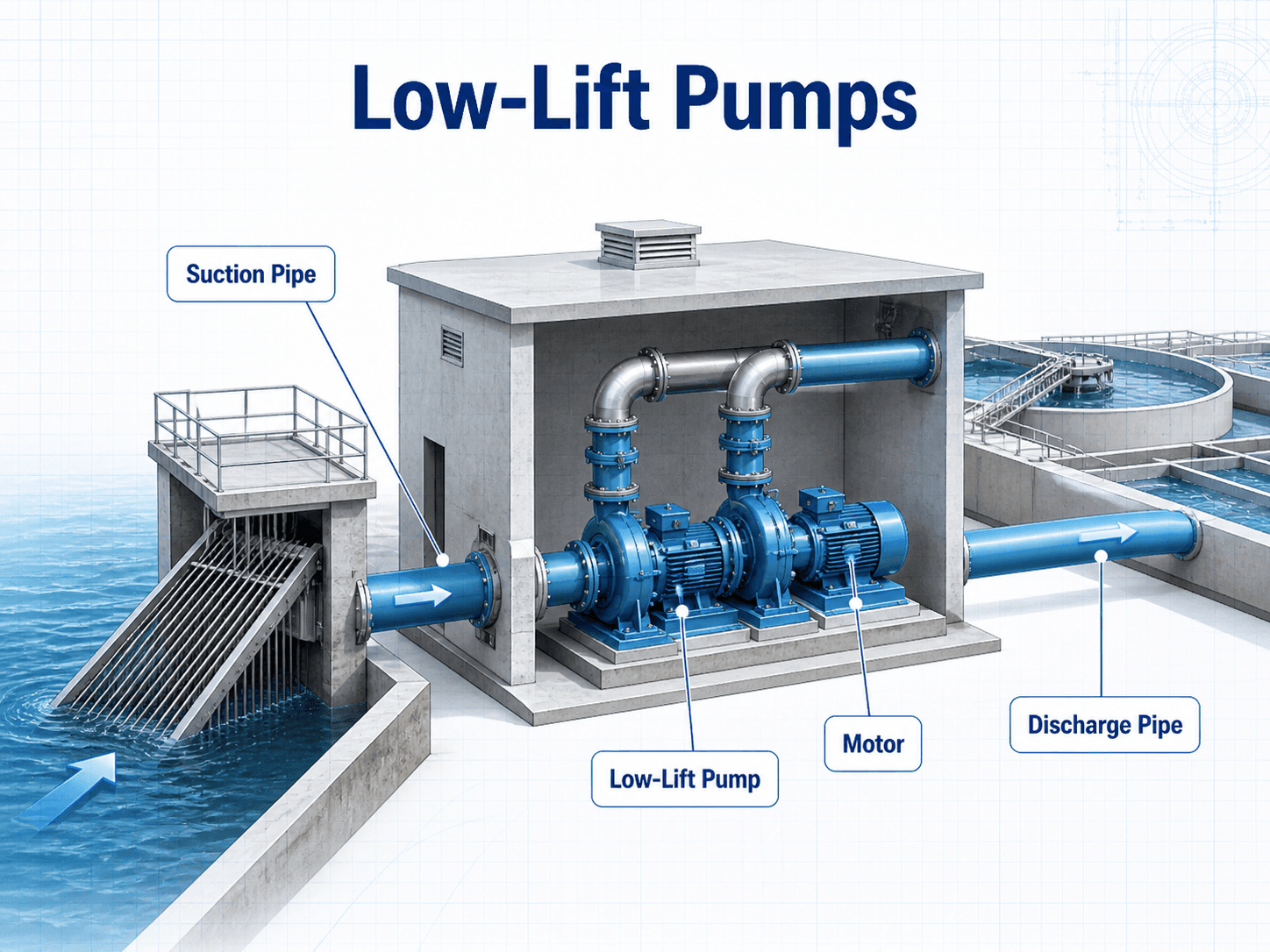
Low-lift pumps move raw or screened water from the intake area into the treatment plant. Engineers review pump capacity, suction conditions, redundancy, cavitation risk, peak flow, energy use, standby capacity, and how pump operation affects downstream hydraulic grade.
Chemical Feed and Rapid Mix Components
Chemical feed systems are core water treatment plant components, not accessories. They store, meter, and inject chemicals that control coagulation, pH, alkalinity, disinfection, corrosion control, taste and odor treatment, and other water quality objectives.
Chemical storage and dosing
Chemical systems may include bulk storage tanks, day tanks, containment areas, feed pumps, calibration columns, flow-paced controls, static mixers, injection quills, safety showers, chemical piping, and alarms. Common chemicals may include coagulants, polymers, lime, caustic, acid, chlorine, sodium hypochlorite, ammonia, fluoride, phosphate, or activated carbon depending on the plant.
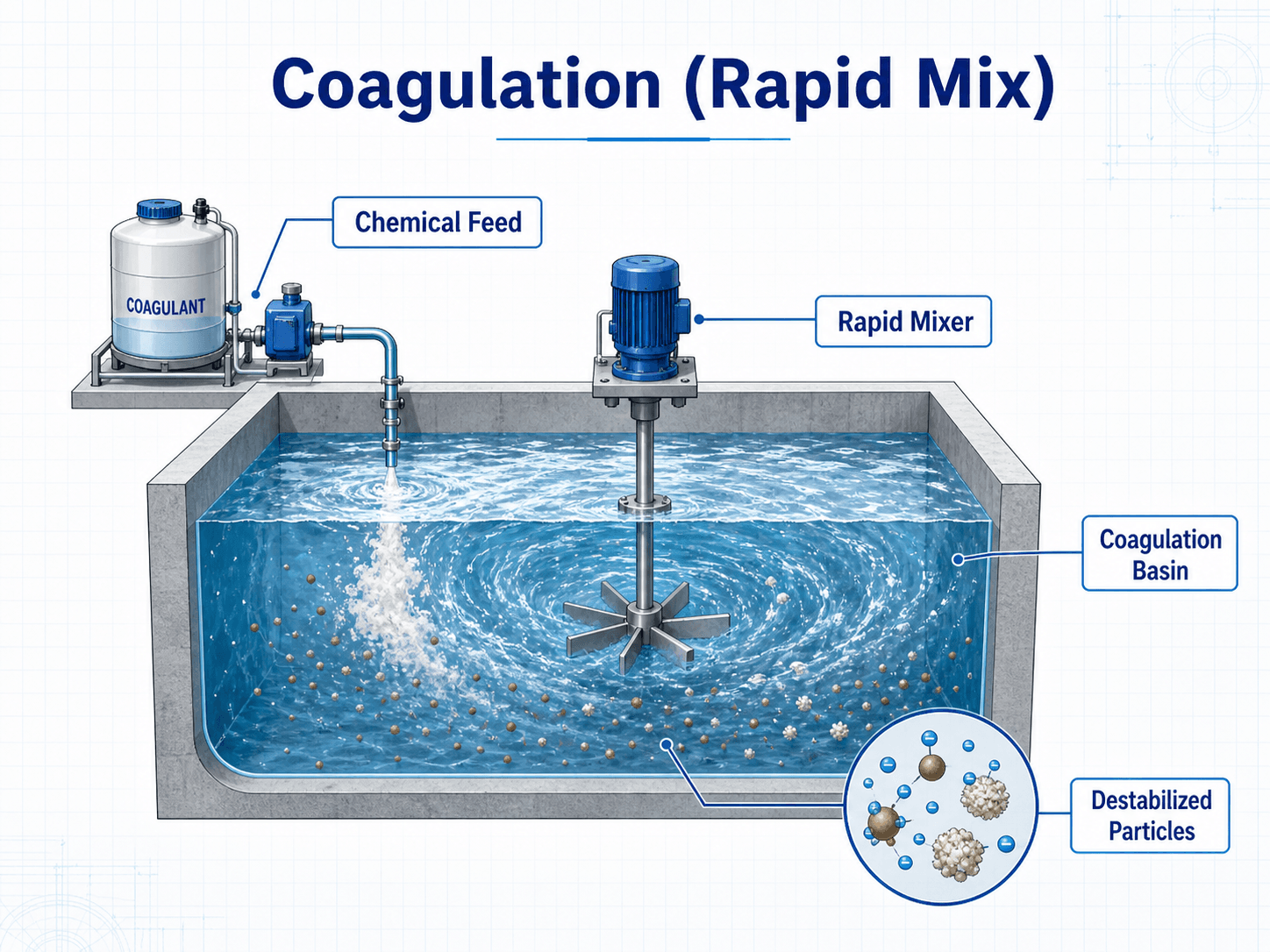
Rapid mix basin
The rapid mix basin disperses coagulant quickly so suspended particles and colloids begin losing their stable surface charge. Mixing must be strong enough to distribute chemical rapidly, but the rapid mix stage is only the first part of particle removal.
Flocculation and Sedimentation Components
Flocculation and sedimentation are particle-removal components used after coagulation in many surface water plants. Their job is to grow destabilized particles into settleable floc and then remove those solids before filtration.
Flocculation basin
The flocculation basin provides slow, controlled mixing so destabilized particles collide and form larger floc. Too little mixing produces small floc that settles poorly. Too much mixing can shear floc apart before clarification.
Sedimentation clarifier
The sedimentation clarifier slows the water so larger floc particles can settle by gravity. A clarifier may include an inlet zone, settling zone, outlet weirs, sludge hopper, sludge scraper, and sludge withdrawal equipment. Good clarification reduces the solids load on filters and supports longer filter runs.
Filtration and Disinfection Components
Filtration and disinfection are the polishing and public-health protection components of the treatment train. Filtration removes fine particles that remain after clarification. Disinfection inactivates microorganisms and may provide residual protection in the distribution system.
Filtration system
A conventional filtration system may include filter boxes, sand, anthracite, granular activated carbon, gravel support layers, underdrains, valves, surface wash equipment, backwash pumps, air scour, turbidity meters, and headloss monitoring. Some plants use membranes when finer separation is required.
Disinfection system
Disinfection may use free chlorine, chloramines, ozone, ultraviolet light, or a combination of methods. UV and ozone can serve as strong primary disinfectants, while chlorine or chloramines are commonly used when a distribution system residual is needed.
Clearwell Storage and High-Service Pump Components
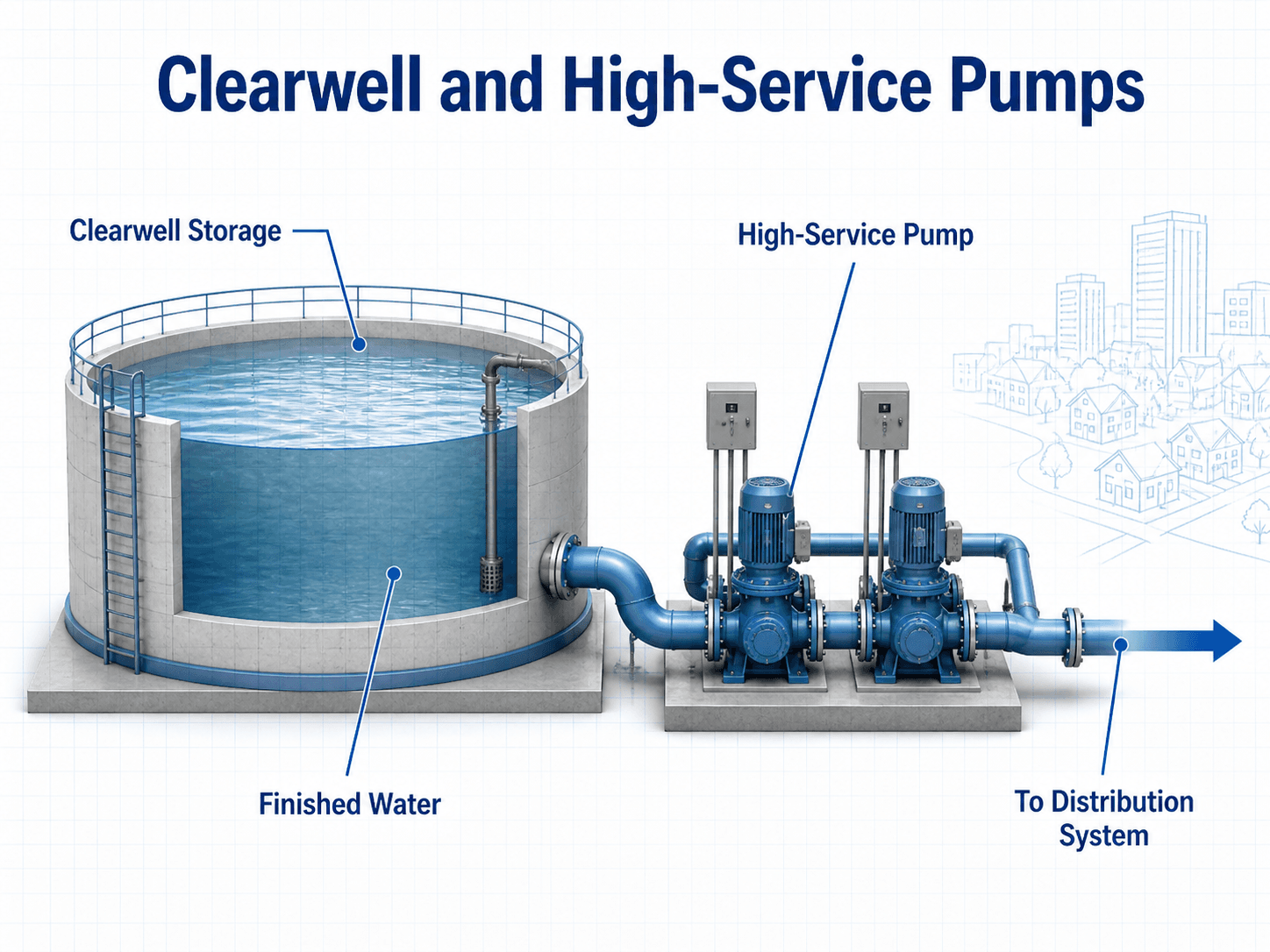
After treatment and disinfection, finished water usually enters a clearwell or storage tank before being pumped into the distribution system. This part of the plant provides storage, flow equalization, operational buffering, and in many designs, additional disinfectant contact time.
Clearwell storage
A clearwell is not just a tank. It can provide finished-water storage, disinfectant contact time, stable suction conditions for pumps, and operational flexibility. Baffling, inlet location, outlet location, water age, and short-circuiting all affect performance.
High-service pumps
High-service pumps deliver treated water from the plant to distribution mains, storage tanks, or pressure zones. Engineers review pump curves, system head, pressure targets, redundancy, standby power, surge control, and how pump cycling affects storage and distribution operations.
Instrumentation, Monitoring, and Control Components
Monitoring and control systems are essential water treatment plant components because operators need reliable data to confirm that each treatment barrier is working. These systems do not remove contaminants directly, but they help detect failure, adjust chemical dose, maintain flow, and protect finished-water quality.
| Control or monitoring component | What it measures or controls | Why it matters |
|---|---|---|
| SCADA system | Pumps, valves, alarms, basins, chemical feed, and process status. | Gives operators centralized visibility and control over the plant. |
| Flow meters | Raw water, process flow, chemical pacing, filter loading, and finished water flow. | Controls hydraulic loading and supports accurate chemical dosing. |
| Turbidity meters | Clarified water, filtered water, and sometimes raw water. | Provides a key indicator of particle removal performance. |
| pH and alkalinity monitoring | Coagulation conditions, corrosion control, softening, and chemical adjustment. | Water chemistry strongly affects treatment efficiency and finished-water stability. |
| Chlorine residual analyzers | Disinfectant residual after contact time, storage, or distribution entry. | Helps confirm disinfectant performance and residual maintenance. |
| Filter headloss monitoring | Resistance through filter media during operation. | Helps determine filter run length, backwash timing, and possible clogging. |
A treatment plant should have monitoring points that match the treatment barriers. If the plant depends on coagulation, clarification, filtration, and disinfection, operators need measurements that show whether each barrier is actually performing.
What Determines Which Components a Plant Needs?
The right component layout depends on the water source and treatment objective. A low-turbidity groundwater plant may need aeration, oxidation, filtration, softening, or disinfection. A river water plant may need full conventional treatment with clarification and filtration. Advanced components are added when specific contaminants, taste and odor, dissolved solids, or finished-water goals require them.
| Factor | Why it matters | Engineering implication |
|---|---|---|
| Source water type | Surface water, groundwater, and brackish water have different contaminant profiles. | Controls whether the plant needs intake screens, clarification, membranes, aeration, softening, or specialized treatment. |
| Turbidity and suspended solids | High turbidity increases particle loading throughout the plant. | May require stronger coagulation control, adequate flocculation time, larger clarifiers, and robust filter backwash capacity. |
| Natural organic matter | Organic matter affects coagulant demand, taste and odor, disinfection byproducts, and activated carbon needs. | Can drive enhanced coagulation, GAC, ozone, biological filtration, or alternate disinfectant strategies. |
| Microbial risk | Pathogen control is a primary public health goal for drinking water plants. | Influences filtration barriers, disinfectant selection, contact time, residual maintenance, and redundancy. |
| Groundwater chemistry | Groundwater may contain iron, manganese, hardness, hydrogen sulfide, arsenic, nitrate, radionuclides, or corrosive chemistry. | May require aeration, oxidation, filtration, softening, ion exchange, adsorption, membranes, pH adjustment, or corrosion control. |
| Peak flow and redundancy | Plants must keep producing finished water during demand changes, maintenance, and equipment outages. | Affects number of pumps, parallel basins, filter count, standby units, storage volume, and backup power. |
| Residuals handling | Sedimentation sludge and filter backwash create waste streams that must be managed. | Requires sludge collection, thickening, drying, recycle controls, disposal planning, or concentrate handling. |
Which Components Remove Which Contaminants?
Most plants use multiple treatment barriers rather than relying on one component. Large debris is removed early, fine particles are chemically conditioned and physically separated, pathogens are controlled by filtration and disinfection, and dissolved constituents may require advanced treatment.
| Water quality problem | Main components that help | Important limitation |
|---|---|---|
| Leaves, sticks, trash, and large debris | Raw water intake, trash rack, bar screen | Screens protect equipment but do not remove dissolved or fine particulate contaminants. |
| Turbidity and suspended solids | Coagulation, flocculation, sedimentation, filtration | Performance depends on chemical dose, pH, mixing, settling, filter condition, and raw water variability. |
| Fine particles after clarification | Granular media filters or membrane filters | Filters can clog or break through if upstream clarification performs poorly. |
| Microorganisms | Filtration, UV, chlorine, ozone, contact basins | Disinfection depends on water quality, dose, contact time, pH, temperature, and disinfectant demand. |
| Taste and odor compounds | Powdered activated carbon, granular activated carbon, ozone, advanced oxidation | These components are source-water dependent and may be seasonal or event-driven. |
| Dissolved minerals or salts | Ion exchange, reverse osmosis, nanofiltration, softening | Advanced treatment may create concentrate, brine, or residuals that need separate handling. |
| Corrosion tendency | pH adjustment, alkalinity control, phosphate feed, chemical dosing | Finished-water stability depends on distribution system materials and local water chemistry. |
When reviewing a treatment plant layout, ask whether each contaminant has a clear removal or control mechanism. If a contaminant is dissolved, a settling basin or standard sand filter alone may not be the controlling component.
Component Review Checklist for a Water Treatment Plant
A practical component review should follow the water through the plant and check whether each unit protects the next one. The goal is not only to list equipment, but to confirm that hydraulic capacity, treatment performance, monitoring, maintenance access, and residuals handling all work together.
Trace the flow path → identify each treatment barrier → check expected removal function → review hydraulic capacity → check chemical and control dependencies → review bypass and redundancy → confirm residuals handling → verify monitoring points.
| Check or decision | What to look for | Why it matters |
|---|---|---|
| Start at the source | Source water type, seasonal variability, debris load, algae, turbidity spikes, and intake constraints. | The required component train starts with the raw water problem, not with a generic plant layout. |
| Confirm hydraulic continuity | Pump capacity, gravity flow paths, basin water levels, headloss, overflow routes, and bottlenecks. | A treatment component cannot perform if water cannot move through it at the required operating range. |
| Review chemical dependencies | Coagulant dose, pH, alkalinity, polymer use, disinfectant demand, and chemical storage capacity. | Chemical systems often control whether clarification, filtration, and disinfection perform as expected. |
| Check solids and backwash pathways | Clarifier sludge removal, filter backwash flow, recycle lines, residuals storage, and disposal constraints. | A plant that treats water also creates residuals. Poor residuals handling can limit plant capacity. |
| Verify monitoring locations | Turbidity, pH, flow, chlorine residual, UV intensity, filter headloss, and basin levels. | Operators need measurements at the right points to detect component problems before finished water quality is affected. |
| Check redundancy | Parallel pumps, multiple filters, standby chemical feed pumps, backup power, and bypass limitations. | Drinking water plants must keep operating during maintenance, equipment failure, and demand changes. |
Conventional vs Advanced Treatment Components
Conventional treatment components are usually aimed at debris, turbidity, suspended solids, and pathogen control. Advanced components are added when the plant must address dissolved contaminants, taste and odor compounds, salts, trace organics, or more stringent finished-water goals.
| Plant type | Common components | When this layout is used |
|---|---|---|
| Conventional surface water plant | Intake, screens, pumps, coagulation, flocculation, sedimentation, filtration, disinfection, clearwell, high-service pumps. | Common for rivers, lakes, and reservoirs with turbidity and particle removal needs. |
| Groundwater treatment plant | Wells, aeration, oxidation, filtration, softening, chemical feed, disinfection, storage, pumping. | Used where the main issues may be iron, manganese, hardness, gases, microbial protection, or source-specific dissolved contaminants. |
| Advanced treatment plant | GAC, ion exchange, membranes, ozone, UV, advanced oxidation, biological filtration, enhanced chemical systems. | Used when conventional treatment does not address specific dissolved contaminants, organics, taste and odor, or stricter goals. |
| Desalination or brackish water plant | Pretreatment filters, cartridge filters, reverse osmosis membranes, concentrate handling, remineralization, disinfection. | Used when dissolved salts or brackish source water control the treatment approach. |
Drinking Water vs Wastewater Treatment Plant Components
This page focuses on drinking water treatment plant components, which are used to convert raw source water into potable water. Wastewater treatment plants use a different component layout because they treat sewage or used water before discharge, reuse, or additional treatment.
| Drinking water treatment plant | Wastewater treatment plant |
|---|---|
| Common components include intake structures, screens, pumps, chemical feed systems, coagulation, flocculation, sedimentation, filters, disinfection, clearwells, and high-service pumps. | Common components include headworks, grit removal, primary clarifiers, aeration basins, secondary clarifiers, disinfection, digesters, sludge handling, and dewatering systems. |
| The goal is to produce safe drinking water for public use. | The goal is to remove pollutants from used water before discharge, reuse, or further treatment. |
| Finished water storage and distribution pressure are major end-of-plant concerns. | Biological treatment and sludge processing are major middle- and end-of-plant concerns. |
Engineering Judgment and Field Reality
Textbook treatment trains look clean and sequential, but real plants are affected by seasonal storms, algae blooms, temperature changes, chemical delivery limits, filter aging, mechanical downtime, residuals constraints, and operator response time. A component that works well under average conditions may become the bottleneck during high turbidity, high demand, cold water, or maintenance outages.
Experienced engineers look at the plant as an integrated system. A clarifier problem may appear as a filter problem because the filter clogs quickly. A disinfection issue may start with high organic matter or poor filtration. A pumping issue may be caused by intake clogging, air entrainment, valve position, or high system head rather than the pump alone.
The most important components are often the easiest to overlook: chemical feed reliability, backwash capacity, sludge removal, online monitoring, backup power, and maintenance access can control whether the visible treatment units actually perform.
When This Breaks Down
A simplified component diagram breaks down when the plant is treated as a fixed checklist instead of a site-specific treatment system. Component needs change when raw water quality changes, regulatory goals change, flow demand increases, or advanced contaminants become part of the treatment objective.
- Source water changes: Storm runoff, algae, drought, reservoir turnover, or upstream land use can change turbidity, organic matter, taste and odor, and chemical demand.
- One component overloads another: Poor coagulation can overload clarifiers and filters, while poor backwash can shorten filter runs and increase headloss.
- Hydraulics are ignored: Short-circuiting, inadequate detention time, uneven filter loading, or pump cycling can reduce treatment performance even when the equipment list looks complete.
- Residuals are underestimated: Sludge, backwash water, brine, or concentrate can become operational constraints if handling systems are undersized.
- Monitoring is too sparse: Operators need data at the right points to detect problems before finished water quality is affected.
Common Mistakes and Practical Checks
The most common mistake is thinking of water treatment plant components as independent pieces of equipment. In reality, each component changes the loading, chemistry, hydraulic conditions, or reliability requirements of the next component.
- Confusing drinking water and wastewater components: Drinking water plants commonly focus on intake, clarification, filtration, disinfection, storage, and distribution pumping, while wastewater plants include biological treatment and sludge-processing systems.
- Calling every process a component: Coagulation is a process; chemical tanks, metering pumps, injection points, mixers, and rapid mix basins are the physical components.
- Ignoring chemical feed systems: Chemical storage, containment, dosing, calibration, and controls are critical plant components, not minor accessories.
- Leaving out residuals handling: Sedimentation sludge and filter backwash are part of the plant’s operating reality and should be included in any serious component review.
- Assuming advanced treatment is always better: Membranes, ozone, GAC, and ion exchange can solve specific problems, but they also add cost, controls, residuals, and maintenance demands.
Do not evaluate treatment components based only on average raw water quality. Peak turbidity, cold water, algae events, high demand, maintenance outages, and chemical feed interruptions often reveal the true controlling condition.
Useful References and Design Context
Component selection for a real water treatment plant depends on regulatory requirements, source water studies, pilot testing, design standards, operator input, and local permitting expectations. Public technical references are useful for understanding available treatment technologies, but final design decisions are normally project-specific.
- EPA drinking water treatment technologies: EPA overview of drinking water treatment technologies summarizes common and advanced treatment technologies such as filtration, granular activated carbon, aeration, ion exchange, membranes, UV, advanced oxidation, caustic feed, and corrosion-control approaches.
- Project-specific criteria: Local regulations, state drinking water rules, utility standards, source water quality, pilot testing, and owner requirements can control the final component layout.
- Engineering use: Engineers use references like this to compare possible treatment barriers, then refine the design using water quality data, flow demand, operations constraints, residuals handling, redundancy, and monitoring requirements.
Frequently Asked Questions
The main components of a drinking water treatment plant are the raw water intake, screening system, low-lift pumps, chemical feed systems, rapid mix basin, flocculation basin, sedimentation clarifier, filtration system, disinfection system, clearwell storage, high-service pumps, residuals handling equipment, and monitoring controls.
No. The component layout depends on source water quality, flow rate, treatment goals, local requirements, available land, residuals handling, and whether the plant treats surface water, groundwater, brackish water, or another specialized source.
Particle removal usually depends on a treatment train rather than one component. Coagulation and flocculation prepare particles for removal, sedimentation removes larger floc by settling, and filtration removes remaining fine particles before disinfection.
A clarifier removes suspended solids by slowing the water so floc can settle by gravity. A filter removes smaller remaining particles by passing water through media such as sand, anthracite, granular activated carbon, or membranes.
Summary and Next Steps
Water treatment plant components are the physical systems that turn raw source water into finished drinking water. The most common components include intake structures, screens, pumps, chemical feed systems, rapid mix basins, flocculation basins, sedimentation clarifiers, filters, disinfectant systems, clearwells, high-service pumps, residuals handling systems, and monitoring controls.
The best way to understand these components is to follow the flow path through the plant and ask what each unit does for the next one. Intake and screening protect equipment, chemical and clarification components reduce solids loading, filters polish the water, disinfection protects public health, and storage and pumping components deliver finished water reliably.
Where to go next
Continue your learning path with related Turn2Engineering resources.
-
Water Treatment Plants
Learn how complete treatment plants are organized from source water intake to finished water distribution.
-
How Water Treatment Plants Work
Review the full process sequence that connects components into a working treatment train.
-
Coagulation in Water Treatment
Go deeper into the chemical destabilization step that prepares fine particles for flocculation and clarification.