
Key Takeaways
- Definition: Poisson’s Ratio compares lateral strain to axial strain when a material is stretched or compressed.
- Main use: Engineers use it to estimate transverse deformation and connect elastic properties such as Young’s modulus, shear modulus, and bulk modulus.
- Watch for: The value is dimensionless, but the strain directions, sign convention, and elastic-range assumption matter.
- Outcome: You will be able to calculate Poisson’s Ratio, interpret realistic values, and avoid common material-modeling mistakes.
Table of Contents
Material stretching with lateral contraction
Poisson’s Ratio relates transverse strain to axial strain, showing how much a material narrows sideways when stretched or expands sideways when compressed.
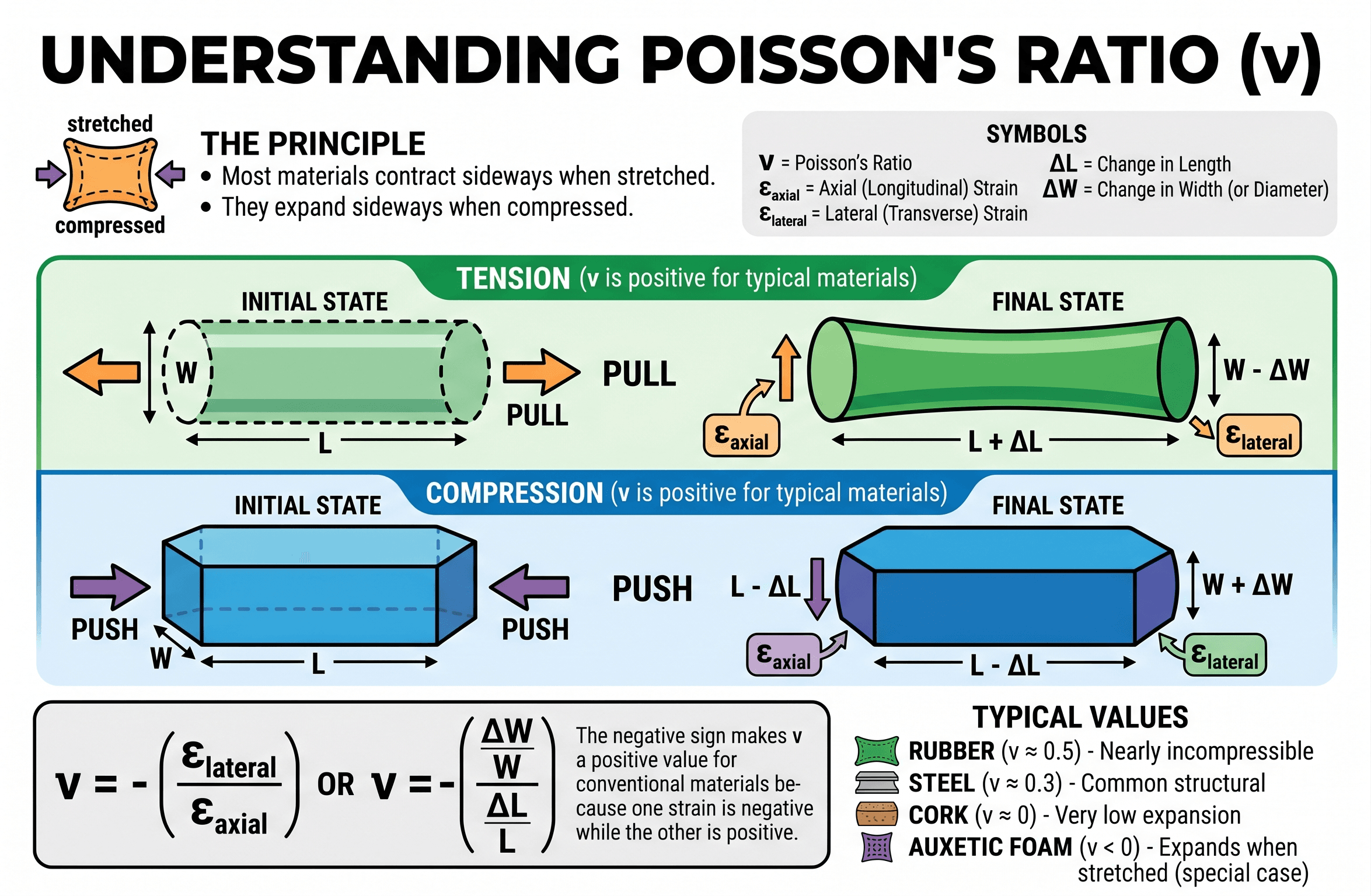
Notice the two strain directions first: the specimen gets longer in the loading direction and smaller across its width. Poisson’s Ratio is the ratio that connects those two deformation responses.
What is Poisson’s Ratio?
Poisson’s Ratio, usually written as \( \nu \), is a material property that describes how a material deforms sideways when it is stretched or compressed in another direction. In a simple tension test, most materials elongate in the loading direction and contract laterally. Poisson’s Ratio measures how strong that lateral response is compared with the axial strain.
This matters because real engineering members do not deform in only one direction. A steel rod in tension becomes slightly thinner. A concrete cylinder under compression bulges laterally. A rubber pad under load can spread sideways significantly. Poisson’s Ratio helps engineers model those coupled deformations instead of treating strain as a one-dimensional effect.
In practice, Poisson’s Ratio is used in mechanics of materials, structural analysis, finite element modeling, geotechnical engineering, pressure vessel analysis, vibration studies, and elastic material-property conversions.
The Poisson’s Ratio formula
The most common definition uses axial strain in the loading direction and lateral strain perpendicular to that loading direction.
The negative sign is included because ordinary tensile loading produces positive axial strain and negative lateral strain. With that sign convention, most common engineering materials have a positive Poisson’s Ratio.
This alternate form is often more useful in design checks. If you know the axial strain and the material’s Poisson’s Ratio, you can estimate the lateral strain directly.
Axial strain and lateral strain
Poisson’s Ratio compares two normal strains measured in perpendicular directions. For small engineering strain:
In a tensile test on an ordinary material, \(\Delta L>0\) while \(\Delta d<0\), so the negative sign in the Poisson's Ratio definition makes \(\nu\) positive.
Use strains taken from the same load state and from directions that are truly axial and transverse to the loading direction.
Variables and units
Poisson’s Ratio is dimensionless because it divides one strain by another strain. Strain may be written as in/in, mm/mm, microstrain, or percent strain, but the numerator and denominator must use the same strain basis before taking the ratio.
- \( \nu \) Poisson’s Ratio; dimensionless material property that compares lateral strain to axial strain.
- \( \varepsilon_{\text{lateral}} \) Strain perpendicular to the loading direction; dimensionless, often written as mm/mm, in/in, or microstrain.
- \( \varepsilon_{\text{axial}} \) Strain in the loading direction; dimensionless and measured using the same strain convention as lateral strain.
Do not mix microstrain with decimal strain unless you convert both strains first. A strain of \(500 \, \mu\varepsilon\) is \(500 \times 10^{-6}\), not 500.
For many metals, a Poisson’s Ratio around 0.25 to 0.35 is a reasonable first-pass expectation. Values near 0.50 suggest nearly incompressible behavior, such as rubber-like materials.
| Quantity | Meaning | SI units | US customary units | Typical range | Notes |
|---|---|---|---|---|---|
| \( \nu \) | Poisson’s Ratio | Dimensionless | Dimensionless | About 0.0 to 0.5 for many isotropic elastic materials | Negative values are possible for auxetic materials but are uncommon in ordinary design materials. |
| \( \varepsilon_{\text{lateral}} \) | Sideways strain | mm/mm, m/m, or \( \mu\varepsilon \) | in/in or \( \mu\varepsilon \) | Depends on material and load level | Usually opposite in sign to axial strain for ordinary materials. |
| \( \varepsilon_{\text{axial}} \) | Strain in loading direction | mm/mm, m/m, or \( \mu\varepsilon \) | in/in or \( \mu\varepsilon \) | Small in elastic design checks | Should be taken from the same test state as the lateral strain. |
Typical Poisson’s Ratio values
Poisson’s Ratio varies with material, temperature, direction, porosity, moisture, and loading condition. The ranges below are useful as broad engineering checks, not substitutes for project-specific material data.
| Material class | Typical approximate range | Engineering interpretation |
|---|---|---|
| Steel and many metals | About 0.25–0.35 | Moderate lateral contraction under elastic tension |
| Aluminum alloys | About 0.30–0.35 | Similar order to many structural metals |
| Concrete | Often about 0.15–0.25 in elastic modeling | Varies with mix, cracking, confinement, and load state |
| Glass / ceramics | Often about 0.15–0.30 | Generally lower transverse strain than rubber-like materials |
| Rubber-like elastomers | Often near 0.45–0.50 | Nearly incompressible behavior |
| Auxetic materials | Negative | Expand laterally when stretched |
Do not select a design value only from a generic table when deformation is important. Use the applicable material specification, manufacturer data, laboratory testing, or calibrated constitutive model.
How to rearrange Poisson’s Ratio
Most rearrangements are used to solve for lateral strain, axial strain, or the material property itself. The key is to keep the sign convention clear before substituting numbers.
Use this when you know the material’s Poisson’s Ratio and want to estimate the sideways strain from a known axial strain.
Use this form when measured lateral strain is available and you need to back-calculate the corresponding axial strain for a linear elastic interpretation.
If a tensile test gives positive axial strain and the calculated lateral strain is also positive for an ordinary material, check the sign convention before trusting the result.
Poisson’s Ratio and elastic constants
For a homogeneous, isotropic, linear elastic material, Poisson’s Ratio connects Young’s modulus \(E\), shear modulus \(G\), and bulk modulus \(K\).
These conversion formulas assume isotropic linear elasticity. They should not be used blindly for orthotropic composites, wood, layered rock, cracked materials, or nonlinear constitutive models.
Worked example
Example problem
A steel specimen is loaded in tension. The measured axial strain is \(900 \, \mu\varepsilon\), and the measured lateral strain is \(-270 \, \mu\varepsilon\). Estimate the Poisson’s Ratio.
The microstrain units cancel because both strains are measured using the same unit basis. The negative sign in the formula turns the expected lateral contraction into a positive material property.
A value of 0.30 is reasonable for many steels and other metals. The result says the lateral contraction is about 30% of the axial extension in magnitude for this elastic loading condition.
Example problem — lateral contraction of a tensile bar
A bar has an original diameter of \(20.0\ \text{mm}\), axial strain of \(1200\,\mu\varepsilon\), and Poisson’s Ratio \(\nu=0.30\). Estimate the lateral strain and diameter change.
The diameter decreases by about \(0.0072\ \text{mm}\). The small value is typical of elastic deformation in metals, but it can still matter in strain measurement, press fits, precision components, and finite element validation.
The answer is not a stress, stiffness, or strength value. It is a dimensionless deformation ratio that helps describe the shape change of the material.
Poisson’s Ratio, volume change, and incompressibility
For small uniaxial strain in an isotropic material, the approximate volumetric strain is:
As \(\nu\) approaches \(0.5\), the factor \(1-2\nu\) approaches zero, indicating very little volume change. This is why rubber-like materials are often described as nearly incompressible.
Nearly incompressible materials can require appropriate finite element formulations. Setting \(\nu\) extremely close to 0.5 in a basic displacement formulation may cause numerical locking or poor conditioning.
Where engineers use Poisson’s Ratio
Poisson’s Ratio becomes important whenever deformation in one direction affects behavior in another direction. It is not just a lab-test number; it is a core input in elastic material models.
- Mechanics of materials: estimating lateral contraction, volumetric strain, and elastic response in loaded members.
- Finite element analysis: defining isotropic linear elastic materials along with Young’s modulus.
- Structural engineering: modeling plates, shells, concrete, steel, and other materials under multiaxial stress states.
- Geotechnical engineering: approximating elastic soil or rock response in settlement, wave propagation, and deformation checks.
- Mechanical design: evaluating contact, pressure, sealing, vibration, and deformation-sensitive components.
In many projects, Poisson’s Ratio is assumed from material tables rather than measured directly. That is acceptable for preliminary elastic checks, but test data or project-specific values matter when deformation predictions control the design.
Negative Poisson’s Ratio and auxetic materials
Some engineered materials have a negative Poisson’s Ratio. These materials are called auxetic: they become wider laterally when stretched and narrower laterally when compressed.
Auxetic behavior can arise from microstructure, cellular geometry, re-entrant patterns, or specially designed composites. A negative value is therefore not automatically an error, but it should be physically supported by the material and test setup.
Assumptions behind Poisson’s Ratio
The simple Poisson’s Ratio equation assumes the measured strains represent a consistent material response under the same loading condition. For ordinary handbook use, the material is usually treated as homogeneous, isotropic, and linearly elastic.
- 1 The material response is approximately elastic over the strain range being analyzed.
- 2 The lateral and axial strains are measured at the same load state and with compatible sign conventions.
- 3 The material can be reasonably represented as isotropic if a single Poisson’s Ratio is being used.
- 4 The strain field is small enough that simple engineering strain remains appropriate.
Neglected factors
A single Poisson’s Ratio can hide important behavior. Real materials may show direction-dependent properties, cracking, plastic deformation, creep, temperature dependence, moisture effects, or nonlinear stress-strain behavior.
- Anisotropy: wood, composites, laminated materials, and layered rock may need direction-specific elastic constants.
- Plasticity: after yielding, the apparent lateral-to-axial strain ratio can change substantially.
- Cracking and damage: concrete, masonry, rock, and brittle materials may not maintain a clean elastic strain relationship.
- Large deformation: rubber-like materials and highly deformable systems may need nonlinear material models.
When a single Poisson’s Ratio is not enough
Poisson’s Ratio is most reliable as a small-strain elastic material property. It becomes less reliable when the material no longer behaves like a simple linear elastic solid.
Do not treat one tabulated Poisson’s Ratio as a universal value for cracked concrete, yielded metal, anisotropic composites, saturated soils, or rubber-like materials undergoing large deformation.
In those cases, engineers usually move to a more complete constitutive model, laboratory test data, nonlinear finite element analysis, or project-specific calibration.
Common mistakes and engineering checks
The algebra is simple, but Poisson’s Ratio is easy to misuse because it sits inside larger material models. Most mistakes come from sign convention, unrealistic values, or applying a linear elastic property outside its valid range.
- Forgetting the negative sign and reporting a negative value for an ordinary material.
- Mixing microstrain, percent strain, and decimal strain without converting consistently.
- Using a value from a material table without checking whether the material direction, temperature, or condition matches the problem.
- Assuming Poisson’s Ratio describes strength; it describes deformation coupling, not failure resistance.
- Using one isotropic value for materials that are strongly directional, layered, cracked, or nonlinear.
For ordinary isotropic elastic materials, a calculated Poisson’s Ratio far below 0 or above 0.5 should trigger a review of measurement direction, strain units, signs, and material assumptions.
| Check item | What to verify | Why it matters |
|---|---|---|
| Signs | Axial tension and lateral contraction should have opposite signs for ordinary materials. | Prevents reporting the wrong sign for \( \nu \). |
| Units | Both strains must be expressed on the same basis. | Prevents large scaling errors when using microstrain or percent strain. |
| Range | Compare the result with expected material ranges. | Flags bad strain readings, wrong directions, or non-elastic behavior. |
| Material model | Confirm whether isotropic linear elasticity is appropriate. | Prevents using a simple value where a directional or nonlinear model is needed. |
Frequently asked questions
Poisson’s Ratio measures how much a material strains sideways compared with how much it strains in the loading direction.
Poisson’s Ratio is dimensionless because it is a ratio of lateral strain to axial strain. Both strains use the same unit basis.
Many common engineering materials fall between about 0.20 and 0.45. Metals are often near 0.25 to 0.35, while rubber-like materials can approach 0.50.
The negative sign makes Poisson’s Ratio positive for ordinary materials because tensile axial strain usually produces lateral contraction.
A single Poisson’s Ratio becomes less reliable when the material is nonlinear, anisotropic, cracked, permanently deformed, or tested outside the small-strain elastic range.
Summary and next steps
Poisson’s Ratio is the dimensionless relationship between lateral strain and axial strain. It explains why a material changes shape sideways when it is stretched or compressed, and it is one of the core properties used in linear elastic material models.
The most important engineering judgment is knowing whether one clean value of \( \nu \) actually represents the material and loading condition. For small-strain isotropic elastic behavior, Poisson’s Ratio is fast and powerful. For nonlinear, cracked, anisotropic, or large-deformation behavior, a more specific material model may be needed.
Where to go next
Continue your learning path with these curated next steps.
-
Prerequisite: Hooke’s Law
Build the linear elastic stress-strain foundation used with Poisson’s Ratio.
-
Related: Mohr’s Circle
Move from one-dimensional strain relationships into transformed multiaxial stress states.
-
Engineering Equations Hub
Continue with related mechanics, materials, strain, and elasticity equations.