
Key Takeaways
- Definition: Kinetic energy is the energy an object has because it is moving.
- Main formula: For classical translational motion, \( KE = \frac{1}{2}mv^2 \).
- Biggest sensitivity: Speed is squared, so a small increase in velocity can create a much larger increase in kinetic energy.
- Watch for: Keep units consistent and remember that \(KE=\frac{1}{2}mv^2\) describes translational kinetic energy; rotating bodies, impacts, and relativistic motion may require additional models.
Table of Contents
Kinetic Energy Diagram Showing Mass, Velocity, and Energy
The kinetic energy equation relates an object’s mass and speed to the energy it carries because of motion.
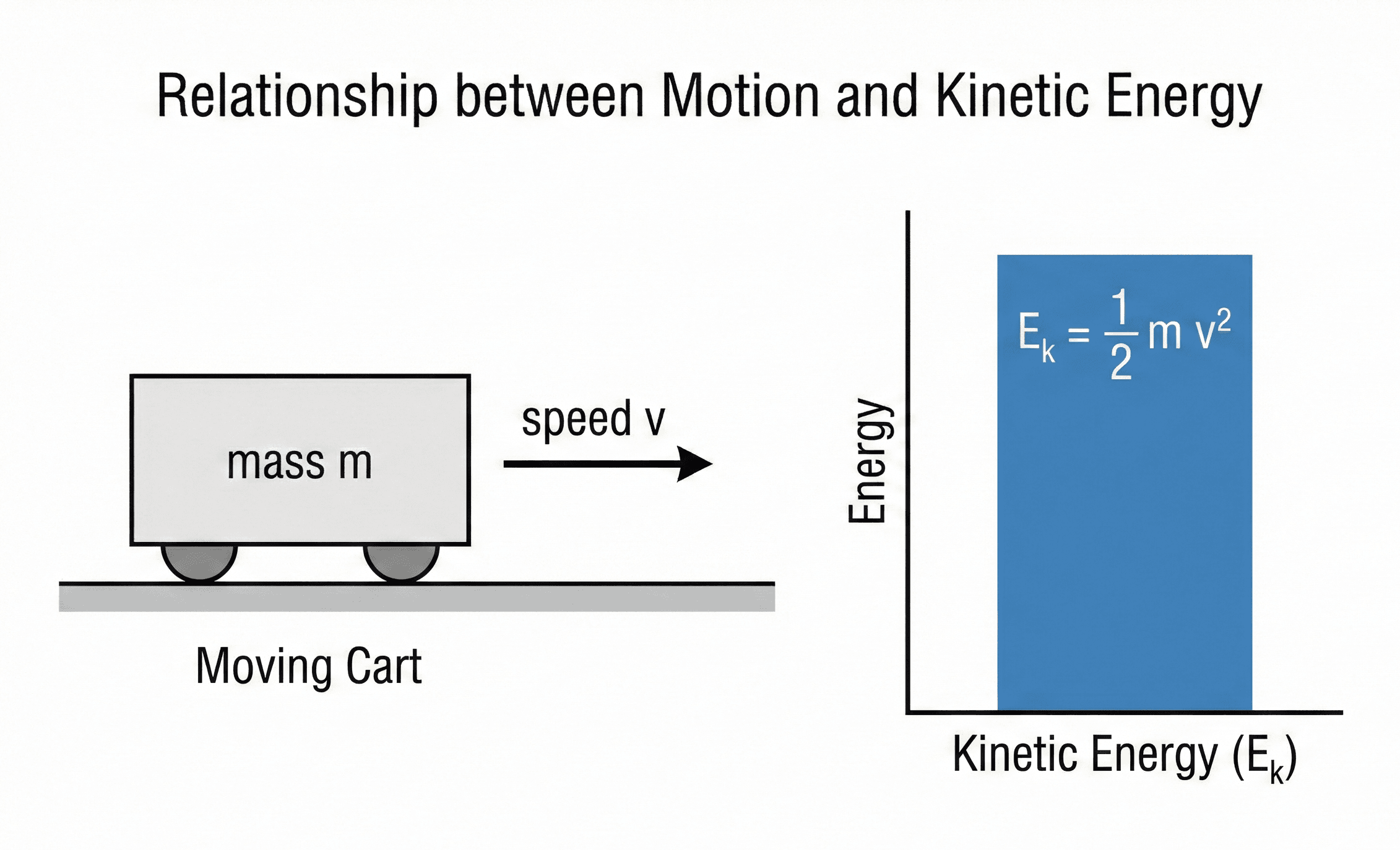
Notice that velocity is squared. That is the most important feature of the equation: if mass stays the same, doubling speed increases kinetic energy by a factor of four.
What is the kinetic energy equation?
The kinetic energy equation calculates the energy associated with the motion of an object. In engineering, it is used to estimate how much energy must be added to accelerate a mass, how much energy must be removed to stop it, or how much energy may be involved in a moving-object impact.
The equation is most commonly used for translational motion, where an object’s center of mass is moving with speed \(v\). It appears in mechanics, dynamics, machine design, vehicle braking, impact analysis, hydraulics, aerospace, and many introductory engineering physics problems.
Physically, kinetic energy connects motion to work. If an object starts from rest and reaches a speed \(v\), the work done on the object becomes kinetic energy, ignoring losses such as friction, drag, heat, deformation, or sound.
The kinetic energy equation formula
The standard classical kinetic energy equation for a moving mass is:
This form is the best starting point for most engineering calculations because it directly relates mass, speed, and stored motion energy. The result is always nonnegative because speed is squared.
The momentum form is useful when momentum \(p\) is already known. Since \(p = mv\), this alternate form connects kinetic energy to linear momentum, which is especially helpful in impact, impulse, and collision problems.
Before using the result, ask whether the object is mainly translating, rotating, deforming, or moving fast enough that classical mechanics may not be appropriate.
Which kinetic energy formula should you use?
The standard formula covers translational motion. Use the form that matches the data and the type of motion you are analyzing.
| If you know | Use | Best for | Main caution |
|---|---|---|---|
| Mass and speed | \(KE=\dfrac12mv^2\) | Translational motion | Use mass, not weight |
| Momentum and mass | \(KE=\dfrac{p^2}{2m}\) | Momentum-based problems | Classical mechanics only |
| Moment of inertia and angular speed | \(KE_{rot}=\dfrac12I\omega^2\) | Spinning rotors, wheels, shafts | Describes rotational energy, not translation |
| Translation + rotation | \(KE_{total}=\dfrac12mv^2+\dfrac12I\omega^2\) | Rolling or moving-and-spinning bodies | Include both terms when both modes matter |
Do not treat a rolling wheel, flywheel, rotor, or other spinning body as purely translational if its rotational energy is significant.
Variables and units in the kinetic energy equation
The kinetic energy equation is simple, but unit consistency matters. In SI calculations, use kilograms for mass, meters per second for speed, and joules for energy.
- \(KE\) Kinetic energy, usually measured in joules \(J\), kilojoules \(kJ\), foot-pounds \(ft\cdot lb_f\), or BTU depending on the engineering context.
- \(m\) Mass of the moving object. In SI, use kilograms \(kg\). Avoid confusing mass with weight.
- \(v\) Speed of the object. In SI, use meters per second \(m/s\). Use speed magnitude, not signed velocity, for scalar kinetic energy.
- \(p\) Linear momentum, defined as \(p = mv\). In SI, momentum is measured in \(kg\cdot m/s\).
If you use \(m\) in kilograms and \(v\) in meters per second, the result is automatically in joules because \(1J = 1kg\cdot m^2/s^2\).
| Variable | Meaning | SI units | US customary notes | Engineering check |
|---|---|---|---|---|
| \(KE\) | Energy due to motion | \(J\), \(kJ\), \(MJ\) | Often expressed as \(ft\cdot lb_f\) | Should never be negative |
| \(m\) | Mass | \(kg\) | Use slugs if working directly in \(ft\), \(s\), and \(lb_f\) | Do not enter weight in pounds-force as mass |
| \(v\) | Speed | \(m/s\) | Convert \(ft/s\), \(mph\), or other speed units before substitution | Energy scales with \(v^2\) |
If speed doubles and mass stays fixed, kinetic energy becomes four times larger. If mass doubles and speed stays fixed, kinetic energy doubles.
Speed conversions before calculating kinetic energy
Because speed is squared, a conversion error has an amplified effect on kinetic energy. Convert speed before substituting it into the equation.
| Conversion | Relationship |
|---|---|
| mph to m/s | \(v_{\text{m/s}}=0.44704\,v_{\text{mph}}\) |
| km/h to m/s | \(v_{\text{m/s}}=\dfrac{v_{\text{km/h}}}{3.6}\) |
| ft/s to m/s | \(v_{\text{m/s}}=0.3048\,v_{\text{ft/s}}\) |
A 10% increase in speed raises kinetic energy by about 21% when mass stays constant because \(1.1^2=1.21\).
How to rearrange the kinetic energy equation
Engineers often rearrange the kinetic energy equation to solve for the required speed, allowable mass, or stored energy. The two most common rearrangements solve for speed and mass.
Use this form when the available energy and mass are known and you need the speed that energy could produce.
Use this form when a target energy and speed are known and you need the corresponding mass.
When solving for velocity, the square root means the result is a speed magnitude. Direction must come from the physical setup, not from the scalar kinetic energy equation.
Kinetic energy and the work-energy theorem
The work-energy theorem connects force and distance directly to changes in kinetic energy:
If a nearly constant opposing force \(F\) brings an object from kinetic energy \(KE\) to rest over stopping distance \(d\), the idealized energy balance is:
Real vehicle or machine stopping distance may also depend on reaction time, changing braking force, tire or rail adhesion, grade, aerodynamic drag, control response, temperature, and other losses. The energy relation is a mechanics model, not a complete stopping-system design.
Where the kinetic energy equation comes from
The kinetic energy equation comes from the work-energy relationship. For an object accelerated by a net force over a distance, the work done on the object changes its kinetic energy.
For constant mass translational motion, applying Newton’s second law and the motion relationship between acceleration, distance, and velocity leads to:
This is why kinetic energy is measured in units of work. An object with kinetic energy can do work as it slows down, such as compressing a spring, deforming a barrier, heating brakes, or lifting another object.
Rotational kinetic energy
A rotating rigid body stores kinetic energy because its mass is distributed around an axis of rotation. The rotational form is:
Here, \(I\) is the mass moment of inertia about the rotation axis and \(\omega\) is angular speed in radians per second.
For an object that both translates and rotates, such as a rolling wheel, the total classical kinetic energy can be written:
Flywheels, wheels, rollers, rotors, pulleys, and shafts can store substantial rotational energy even when the center of mass is stationary.
Worked example using the kinetic energy equation
Example problem
A small cart has a mass of \(40\,kg\) and moves at \(6\,m/s\). Estimate its translational kinetic energy.
Square the speed first, then multiply by the mass and the factor of one-half:
The cart has \(720\,J\) of kinetic energy. That is the amount of ideal work required to accelerate it from rest to \(6\,m/s\), or the amount of energy that must be removed to bring it back to rest, ignoring losses.
Example problem — vehicle energy at two speeds
A \(1500\ \text{kg}\) vehicle is compared at \(15\ \text{m/s}\) and \(30\ \text{m/s}\). Find the translational kinetic energy at each speed.
Doubling speed from \(15\) to \(30\ \text{m/s}\) increases the kinetic energy from about \(169\) to \(675\ \text{kJ}\), a factor of four. This is why speed has such a strong effect on braking and impact energy.
The answer is not just a number. It tells you the energy scale of the moving object, which matters for braking, stopping distance, collision effects, guards, bumpers, and energy absorption.
Assumptions behind the kinetic energy equation
The standard \(KE = \frac{1}{2}mv^2\) equation is a classical mechanics equation. It is powerful, but it is not a complete model of every moving system.
- 1 The object is moving at non-relativistic speed, far below the speed of light.
- 2 The mass is constant during the motion being analyzed.
- 3 The calculation is focused on translational kinetic energy of the center of mass.
- 4 Losses such as friction, drag, heat, sound, and deformation are not included unless modeled separately.
Neglected factors
In real engineering problems, the kinetic energy equation may be only one part of the analysis. It does not automatically include:
- Rotational energy: A rolling wheel or spinning rotor may also have \(KE_{rot} = \frac{1}{2}I\omega^2\).
- Energy losses: Braking, sliding, fluid drag, and internal friction convert mechanical energy into heat and other forms.
- Impact deformation: Collision problems may require stiffness, crush distance, impulse, momentum, or material failure models.
- Reference frame effects: Kinetic energy depends on the observer’s frame of reference because speed depends on the frame of reference.
Engineering judgment and field reality
In design work, kinetic energy is often used as a first-pass energy scale. It helps engineers understand whether a moving mass is minor, dangerous, or large enough to drive the design of stops, restraints, barriers, brakes, guards, or energy absorbers.
Real stopping and impact behavior depends on how energy is dissipated. Two objects can have the same kinetic energy but produce very different outcomes depending on stopping distance, contact area, stiffness, material ductility, and load path.
If a result seems surprisingly high, check velocity first. A speed conversion error, such as using mph as if it were m/s, can produce a major kinetic energy error because velocity is squared.
When the basic kinetic energy model is not enough
The classical translational equation works extremely well for ordinary engineering speeds, but it describes only one part of the energy when rotation, deformation, losses, or relativistic effects become important.
Do not use \(KE = \frac{1}{2}mv^2\) alone for high-speed relativistic particles, rotating machinery with significant angular energy, deformable impact systems, explosive events, or fluid systems where losses dominate the energy balance.
| Situation | Why the basic equation is incomplete | What to consider next |
|---|---|---|
| Rolling or rotating bodies | Energy is split between translation and rotation | Rotational kinetic energy and moment of inertia |
| Vehicle braking | Tires, brakes, road friction, grade, and drag affect stopping | Work-energy balance and braking force models |
| Impact or crash analysis | Energy is dissipated through deformation, heat, sound, and fracture | Impulse, momentum, crush distance, material behavior |
| Very high-speed particles | Classical mechanics becomes inaccurate | Relativistic kinetic energy |
Common mistakes and engineering checks
- Using weight instead of mass: In SI, use kilograms for mass. In US customary calculations, be careful with pounds-force versus slugs.
- Forgetting to square velocity: The speed term dominates the result because it is squared.
- Mixing unit systems: Convert speed and mass before substitution.
- Ignoring rotation: Rolling or spinning objects may have both translational and rotational kinetic energy.
- Treating kinetic energy as direction-based: Kinetic energy is scalar. Use momentum or vector dynamics when direction matters.
After calculating kinetic energy, double the speed mentally. If the energy does not increase by a factor of four, something is wrong in the setup, units, or arithmetic.
| Check item | What to verify | Why it matters |
|---|---|---|
| Mass | Use mass, not force or weight, unless using a consistent US customary setup | Wrong mass input directly scales the answer |
| Speed | Convert to \(m/s\) or another consistent speed unit | Velocity errors are squared |
| Energy units | Confirm joules, kilojoules, foot-pounds, or another desired unit | Misread units can make a result look too large or too small |
| Physics scope | Check whether rotation, deformation, or losses matter | The basic equation may only describe part of the system |
Frequently asked questions
The kinetic energy equation is \(KE = \frac{1}{2}mv^2\). It calculates the energy an object has because it is moving, based on its mass and speed.
In SI units, use mass in kilograms and speed in meters per second. The answer will be in joules. If using US customary units, make sure the mass, force, distance, and energy units are consistent.
Rearrange \(KE = \frac{1}{2}mv^2\) to get \(v = \sqrt{\frac{2KE}{m}}\). This gives the speed magnitude for a known kinetic energy and mass.
Speed is squared in the kinetic energy equation. If \(v\) doubles, \(v^2\) becomes four times larger, so kinetic energy also becomes four times larger when mass stays constant.
No. Kinetic energy is scalar energy due to motion, while momentum is a vector quantity related to mass and velocity. They are connected, but they are not interchangeable.
Summary and next steps
The kinetic energy equation \(KE = \frac{1}{2}mv^2\) is one of the most important formulas in engineering mechanics because it connects motion, mass, and energy. It is especially useful for estimating the energy that must be added, removed, absorbed, or dissipated when an object speeds up, slows down, or impacts another system.
The main engineering judgment is knowing when the simplified equation is enough. For many ordinary mechanics problems it works well, but rotating bodies, deformable impacts, high-speed motion, and systems with major losses need additional modeling.
Where to go next
Continue your learning path with these curated next steps.
-
Related: Potential Energy Equation
Compare kinetic energy with stored gravitational energy and mechanical-energy changes.
-
Related: Newton’s Second Law
Connect changes in kinetic energy to the forces and acceleration acting on a mass.
-
Engineering Equations Hub
Continue with related mechanics, energy, power, and motion equations.