
Key Takeaways
- Core idea: Concrete reinforcement adds tensile resistance to a material that is naturally strong in compression but weak in tension.
- Engineering use: Reinforcement helps beams, slabs, columns, walls, footings, and pavements control cracking and carry loads safely.
- What controls it: Performance depends on reinforcement type, amount, spacing, cover, bond, lap length, exposure, and correct placement.
- Practical check: Reinforcement that is the wrong type, too shallow, poorly supported, or outside the tension zone may add little structural value.
Table of Contents
Introduction
Concrete reinforcement is material placed in concrete to resist tension, control cracking, improve ductility, and help concrete members perform safely under load. The most common reinforcement is steel rebar, but welded wire mesh, fibers, prestressing tendons, and fiber-reinforced polymer bars are also used depending on structure type, exposure, and performance requirements.
How Concrete Reinforcement Works
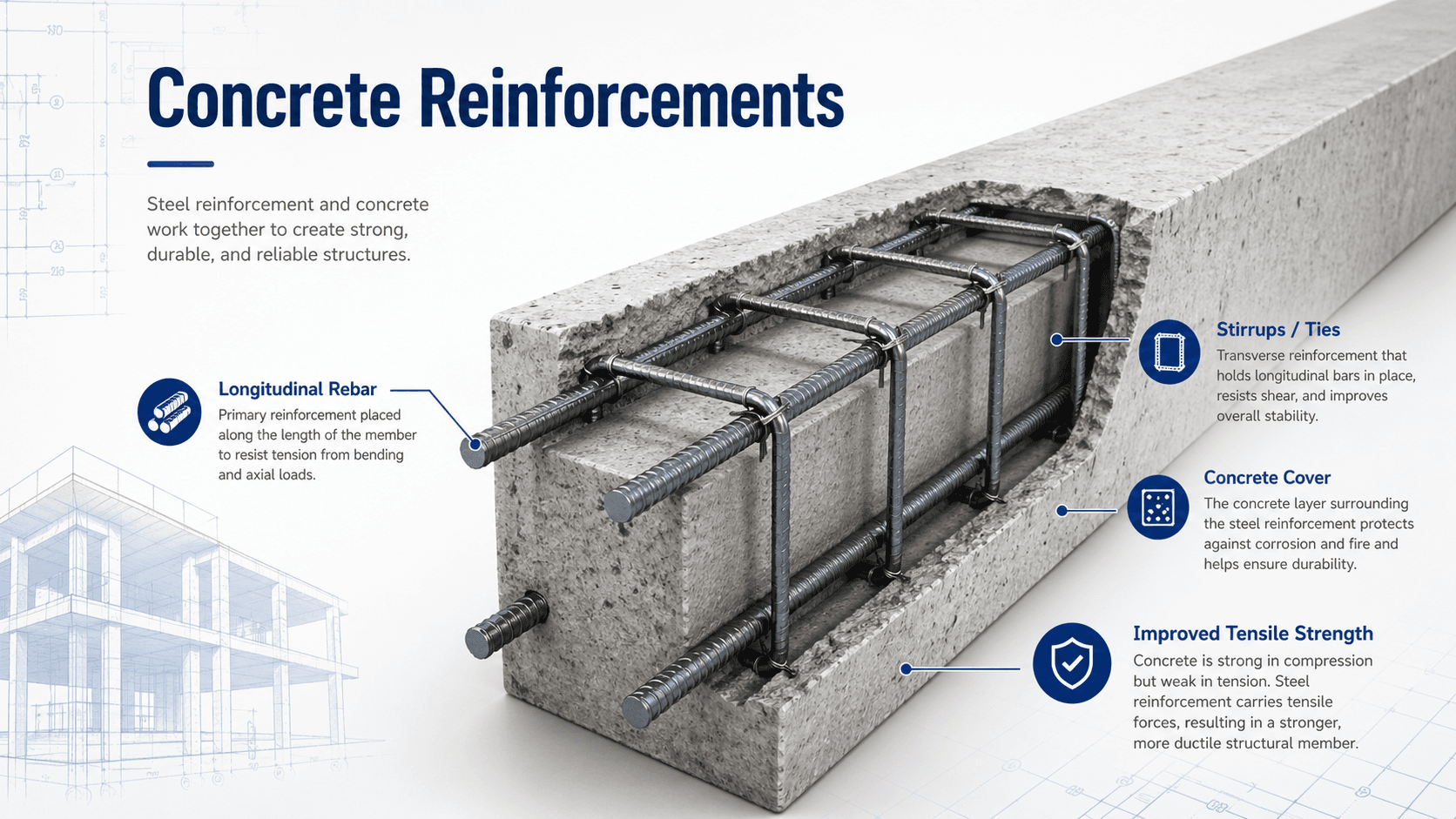
Notice that reinforcement is not randomly added to concrete. Its location matters. In structural members, the most important bars are usually placed where tensile stress develops, while concrete cover protects the reinforcement and helps the two materials act together.
What is Concrete Reinforcement?
Concrete reinforcement is a system of bars, wires, fibers, strands, or polymer reinforcement used to improve concrete behavior after the concrete begins to experience tension. Plain concrete can carry large compressive forces, but it cracks at relatively low tensile stress. Reinforcement gives the concrete member a way to keep carrying load after cracking begins.
In structural engineering, reinforcement is not just “extra strength.” It is part of the load path. A reinforced concrete beam, slab, wall, footing, or column depends on the concrete and reinforcement working together through bond, embedment, cover, and detailing. The right reinforcement in the wrong location can still perform poorly.
Why Concrete Needs Reinforcement
Concrete is strong in compression because aggregate and cement paste can resist crushing forces well. It is much weaker in tension, so bending, shrinkage, temperature movement, settlement, restraint, and overload can cause cracks. Reinforcement helps carry tensile forces across those cracks and limits how wide they become.
Compression and tension zones
A simply supported beam loaded downward develops compression near the top and tension near the bottom. That is why bottom bars are common in simple reinforced concrete beams. A cantilever or continuous beam can reverse this pattern near supports, making top reinforcement critical.
Crack control and serviceability
Reinforcement does not always prevent concrete from cracking. Instead, it often changes a few wide cracks into many smaller cracks. That matters because crack width affects appearance, water intrusion, corrosion risk, stiffness, and long-term serviceability.
Ductility before failure
Steel reinforcement can yield and deform before collapse, giving a reinforced concrete member warning and energy absorption. This ductile behavior is one reason reinforced concrete is widely used in buildings, bridges, foundations, retaining walls, and seismic-force-resisting systems.
Main Types of Concrete Reinforcement
Different reinforcement systems solve different engineering problems. Some are intended to resist primary structural tension. Others are mainly used for crack control, shrinkage control, toughness, corrosion resistance, or construction efficiency.
- Steel rebar: Deformed reinforcing bars used in beams, slabs, walls, columns, footings, foundations, bridges, and other structural members.
- Welded wire mesh: A grid of welded steel wires often used in slabs-on-grade, pavements, sidewalks, and light-duty flatwork.
- Fiber reinforcement: Synthetic, glass, or steel fibers mixed into concrete to improve crack distribution, toughness, impact resistance, or shrinkage behavior.
- Prestressing tendons: High-strength steel strands or tendons used to compress concrete before or after loads create significant tension.
- FRP reinforcement: Fiber-reinforced polymer bars or grids used where corrosion resistance or electromagnetic neutrality is important.
Do not choose reinforcement by material name alone. Ask what force or crack mechanism it must resist, where the tension zone is, how the member will be exposed, and whether the reinforcement is structural, secondary, or durability-driven.
What Controls Reinforcement Performance?
Reinforcement performance depends on more than bar size. A good design considers force demand, spacing, location, development, lap splices, concrete cover, corrosion exposure, constructability, and whether the reinforcement can remain in position during concrete placement.
| Factor | Why it matters | Engineering implication |
|---|---|---|
| Reinforcement location | Bars, mesh, or tendons must be placed near the expected tension zone. | Misplaced reinforcement may not resist bending or crack width effectively. |
| Concrete cover | Cover protects reinforcement from corrosion, fire, and surface damage. | Too little cover can lead to rust, spalling, loss of bond, and reduced durability. |
| Spacing and distribution | Spacing affects crack width, load distribution, consolidation, and constructability. | Bars too far apart can allow wide cracks; bars too close can block concrete flow. |
| Bond and embedment | Force must transfer between concrete and reinforcement. | Short bars, poor development length, or weak anchorage can cause pullout or splitting. |
| Exposure conditions | Moisture, chlorides, chemicals, carbonation, and freeze-thaw cycles affect durability. | Harsh exposure may require more cover, coated reinforcement, stainless steel, or FRP. |
Important Detailing Concepts
Reinforced concrete design uses detailed code provisions, but the basic force concept is straightforward: bending creates tension, and reinforcement must be developed and positioned so it can carry that tensile force. A simplified flexural relationship is often useful for understanding why bar location matters.
In this simplified expression, the tensile force in reinforcement increases as bending moment increases and decreases as the internal lever arm becomes larger. This is not a replacement for reinforced concrete design, but it shows why effective depth, bar location, and force transfer matter.
- T Approximate tensile force carried by reinforcement.
- Mu Factored bending moment demand used in strength design.
- d Effective depth from the compression face to the centroid of tension reinforcement.
- j d Approximate internal lever arm between compression and tension resultants.
Development length
Development length is the embedment distance needed for reinforcement to develop its intended force. A bar that stops too soon may slip, split the concrete, or fail to reach its design strength.
Lap splices
Lap splices transfer force from one bar to another through the surrounding concrete. The required overlap depends on bar size, stress, coating, concrete strength, spacing, cover, and confinement.
Concrete cover
Cover is not just a construction tolerance. It affects corrosion protection, fire resistance, bond behavior, durability, and whether reinforcement remains effective over the life of the structure.
Concrete Reinforcement Selection Guide
The best reinforcement choice depends on the member type, load path, crack-control needs, exposure, and whether the reinforcement must resist primary structural tension. Use the guide below as a practical starting point before moving into project-specific design.
Identify the concrete member, determine whether it must resist structural bending or only control shrinkage cracks, locate the expected tension zone, select the reinforcement type, check cover and spacing, then verify that the layout can actually be built and inspected before concrete is placed.
| Project condition | Typical reinforcement direction | Why it matters |
|---|---|---|
| Structural beam, elevated slab, wall, column, or footing | Designed steel rebar or engineered reinforcement layout | These members need reinforcement sized and placed for load path, bending, shear, anchorage, and code requirements. |
| Light slab-on-grade, patio, sidewalk, or pavement | Welded wire mesh, rebar grid, fibers, or a combination | The main goal may be crack control and load distribution, but support and elevation during placement are still critical. |
| Industrial floor or impact-prone surface | Steel fibers, rebar, mesh, or combined systems | Toughness, joint performance, surface durability, and wheel loads may control the reinforcement strategy. |
| Long-span slab, parking structure, or bridge element | Prestressing tendons with conventional reinforcement as needed | Prestressing can reduce tensile cracking and improve structural efficiency for longer spans. |
| Marine, bridge deck, deicing salt, or corrosive exposure | Epoxy-coated, galvanized, stainless, or FRP reinforcement where appropriate | Durability may control the reinforcement choice as much as strength. |
Rebar vs Mesh vs Fiber Reinforcement
Many concrete reinforcement decisions come down to whether the project needs primary structural reinforcement, crack control, surface durability, or a combination. Rebar, mesh, and fibers are often discussed together, but they do not perform the same job.
Use rebar when structural tension matters
Rebar is usually the correct starting point for beams, suspended slabs, walls, columns, footings, retaining walls, and heavily loaded concrete. It can be placed in specific tension zones and detailed for development, lap splices, hooks, confinement, and load transfer.
Use welded wire mesh for distributed slab reinforcement
Welded wire mesh can help distribute cracks and reinforce many slabs-on-grade, but it must be supported at the intended elevation. Mesh left on the subgrade or pushed to the bottom of a slab may not provide the crack-control performance the designer expected.
Use fibers for shrinkage control and toughness
Fibers are mixed throughout the concrete and can help reduce plastic shrinkage cracking, improve toughness, and increase impact or abrasion resistance. However, fiber reinforcement is not automatically a structural replacement for properly designed rebar.
Engineering Judgment and Field Reality
Reinforcement drawings may look precise, but field performance depends on placement, support, tolerances, congestion, concrete consolidation, and inspection. A well-designed bar layout can lose value if bars are stepped on, chairs are missing, cover is too shallow, laps are shortened, or openings are cut without added reinforcement.
The most common reinforcement problem is not that the material is weak. It is that the reinforcement is not where the design assumes it is. Chairs, ties, clear cover, bar supports, and pre-pour inspection are part of structural performance.
When This Breaks Down
Simplified explanations of concrete reinforcement break down when a member has complex loading, severe exposure, unusual geometry, high seismic demand, heavy fatigue loading, poor constructability, or reinforcement that cannot be properly developed.
- Corrosion exposure is underestimated: Chlorides, moisture, carbonation, and cracked cover can lead to rust expansion, spalling, and section loss.
- Crack control is confused with crack prevention: Reinforcement often controls crack width and spacing rather than eliminating all cracks.
- Slab reinforcement is treated as structural by default: A slab-on-grade may be controlled by subgrade support, joints, shrinkage, wheel loads, and curling rather than flexure alone.
- Anchorage is ignored: Bars must extend far enough and be detailed correctly to transfer force into the surrounding concrete.
Common Mistakes and Practical Checks
Concrete reinforcement mistakes are often hidden after placement, so the most important checks happen before the pour. Engineers, inspectors, and contractors should focus on location, cover, spacing, support, congestion, lap length, and whether the reinforcement layout matches the intended load path.
- Letting rebar or mesh sit on the ground: Reinforcement must be held at the intended elevation, not simply dropped into the form.
- Using fibers as a blanket replacement for rebar: Fibers can improve crack behavior, but structural substitution requires explicit design and specification.
- Ignoring openings and penetrations: Openings interrupt reinforcement and create stress concentrations that may require added bars.
- Allowing inadequate cover: Shallow reinforcement is more vulnerable to corrosion, surface cracking, and fire exposure.
- Overcrowding reinforcement: Congested bars can prevent proper concrete flow and consolidation, creating honeycombing or voids.
Do not assume reinforcement is effective just because it is present. Its value depends on correct type, location, support, spacing, cover, anchorage, and inspection before the concrete hardens.
Useful References and Design Context
Concrete reinforcement is governed by project-specific design requirements, local code adoption, exposure conditions, and the type of reinforced concrete system being used. The references below are commonly used for design context, material requirements, and reinforcement detailing.
- ACI 318: Provides widely used requirements for structural concrete design, including strength, serviceability, development length, cover, detailing, and reinforced concrete member behavior.
- CRSI Manual of Standard Practice: Commonly used for reinforcing steel detailing, fabrication, placing drawings, bar supports, bends, hooks, and practical construction coordination.
- ASTM A615 and ASTM A706: Material specifications often associated with deformed carbon-steel reinforcing bars and low-alloy reinforcing bars used in concrete construction.
- ACI 440 guidance: Used for fiber-reinforced polymer reinforcement where noncorrosive reinforcement is considered instead of conventional steel.
- ACI 544 guidance: Provides background for fiber-reinforced concrete behavior, including toughness, crack control, and fiber applications.
Frequently Asked Questions
The main purpose of concrete reinforcement is to resist tensile forces that plain concrete cannot carry well. It also helps control crack width, improve ductility, transfer forces across cracks, and keep slabs, beams, walls, columns, and foundations serviceable under load.
Rebar is usually better for structural members and heavily loaded concrete because it can be placed and detailed to resist specific tensile forces. Wire mesh is useful for many slabs-on-grade and crack-control applications, but it must be supported at the correct elevation to be effective.
Fiber reinforcement can reduce plastic shrinkage cracking, improve toughness, and help distribute small cracks, but it should not be assumed to replace structural rebar unless the concrete system is specifically designed and specified that way. Many projects use fibers with rebar or mesh rather than as a direct substitute.
Reinforcement should be placed where tensile stress is expected, while maintaining the required concrete cover. In a simply supported beam, primary tension reinforcement is commonly near the bottom; in cantilevers or continuous members, top reinforcement may be critical near supports.
Summary and Next Steps
Concrete reinforcement allows concrete to perform as a practical structural material by adding tensile resistance, crack control, ductility, and durability when the reinforcement is properly selected and detailed.
The main engineering decisions are reinforcement type, location, spacing, cover, anchorage, exposure resistance, and constructability. Rebar, wire mesh, fibers, prestressing tendons, and FRP each have a place, but they are not interchangeable without understanding the load path and performance objective.
Where to go next
Continue your learning path with related Turn2Engineering resources.
-
Concrete Design
Learn how reinforced concrete members are proportioned, checked, and detailed for strength and serviceability.
-
Reinforced Concrete Structures
See how reinforced concrete systems are used in beams, slabs, columns, walls, foundations, and larger structural frames.
-
Structural Failure
Understand how poor detailing, durability loss, overload, and construction errors can contribute to structural problems.